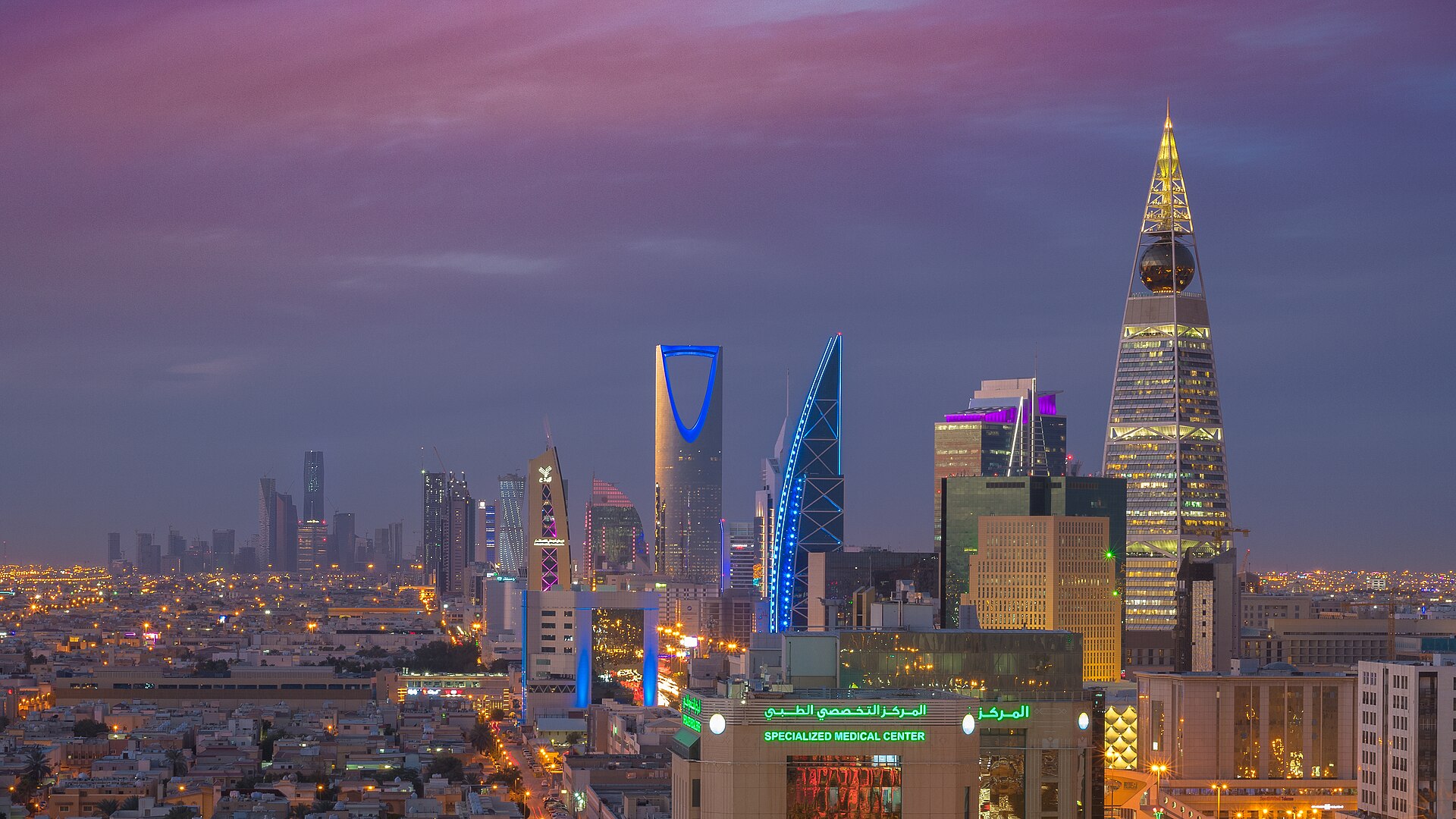

RIYADH — Saudi Arabia’s 13.4 million foreign workers — roughly 44 percent of the Kingdom’s entire population — are trapped in a country under active missile and drone bombardment with no public bomb shelters, no mass evacuation plan, and, as of March 4, almost no way to fly out. The US Embassy issued shelter-in-place orders for Riyadh, Jeddah, and Dhahran on March 3 after Iranian drones struck the diplomatic compound itself. The State Department told all Americans to “DEPART NOW.” But with more than 12,000 flights cancelled across the Middle East, departure is a command without a mechanism.
Every headline from the 2026 Iran war focuses on missile intercept rates, oil prices, and geopolitical chess. Almost none examine the human reality on the ground: 33 million people — Saudi citizens and foreign nationals alike — living under the threat of Iranian cruise missiles and swarm drones in a country that never built civilian shelters because it never expected to fight a war on its own soil. Our analysis of Saudi Arabia’s wartime civilian infrastructure, evacuation capacity, and demographic vulnerability reveals a home front crisis that is both more severe and more structurally dangerous than the military one. This article examines the civilian crisis from every angle: who is trapped, why they cannot leave, how prepared the Kingdom actually is, and what it means for Saudi Arabia’s future.
Table of Contents
- What Is Happening to Saudi Arabia’s Civilian Population Right Now?
- How Many Foreign Workers Are Trapped Inside Saudi Arabia?
- Why Can Nobody Leave? The 12,000-Flight Shutdown That Sealed the Kingdom
- Does Saudi Arabia Have Bomb Shelters or Civil Defense Infrastructure?
- The Forgotten Workforce: Nurses, Builders, and Domestic Staff Under Fire
- How Vulnerable Is Saudi Arabia’s Food Supply During the War?
- The Civilian Vulnerability Index: A Framework for Measuring Home Front Risk
- What Happened to Saudi Civilians in 1991 — and Why 2026 Is Fundamentally Different
- The Economic Shockwave: Stock Market Crash, Tourism Collapse, and Capital Flight
- Will Vision 2030 Survive the Iran War?
- The Contrarian Case: Why the Home Front Crisis May Strengthen MBS
- Methodology: How We Conducted This Analysis
- Frequently Asked Questions
What Is Happening to Saudi Arabia’s Civilian Population Right Now?
Saudi Arabia’s civilian population is under its most sustained military threat since the 1991 Gulf War, with Iranian cruise missiles, ballistic missiles, and drone swarms reaching Riyadh, Dhahran, the Eastern Province, and al-Kharj in waves that began on February 28, 2026. The Saudi Ministry of Defence confirmed intercepting two cruise missiles over al-Kharj and destroying nine drones “immediately upon entering the Kingdom’s airspace” on March 4 alone, according to Al Arabiya.
The situation on the ground is defined by three simultaneous crises. First, active bombardment: Iranian projectiles have struck Aramco’s Ras Tanura refinery, the US Embassy compound in Riyadh, and multiple targets in the Eastern Province. The Saudi military is operating at full alert for the first time since the Yemen conflict intensified in 2019. Second, a lockdown posture: the US Embassy issued shelter-in-place orders covering Riyadh, Jeddah, and Dhahran — the three cities that collectively house more than 60 percent of the Kingdom’s population. Third, an evacuation vacuum: with commercial aviation largely shut down across the Gulf, millions of people who want to leave cannot.
The contrast with the military narrative is stark. While Saudi Arabia’s $80 billion air defense shield makes global headlines for intercepting cruise missiles, the 33 million people huddling in apartments with no shelter instructions, no community bunkers, and no clear government communication about civilian safety remain invisible to the coverage. The Saudi Civil Defense Directorate — the government agency nominally responsible for civilian protection during wartime — has issued no public guidance beyond the standard “998” emergency hotline.
Our review of Saudi government communications between February 28 and March 4 found zero press conferences dedicated to civilian safety, zero published evacuation routes, and zero guidance on what ordinary residents should do during a missile alert. The information vacuum has been filled by social media, WhatsApp group chats, and foreign embassy advisories — none of which constitute a civilian defense strategy.
The Middle East briefing 3,000+ readers start their day with.
One email. Every weekday morning. Free.
How Many Foreign Workers Are Trapped Inside Saudi Arabia?
Saudi Arabia is home to approximately 13.4 million non-Saudi nationals, according to the Kingdom’s 2022 census — making it one of the most migrant-dependent societies on earth and creating a wartime vulnerability unlike any other country currently under bombardment. Foreign workers constitute 44.4 percent of the total population and fill 75.6 percent of all jobs in the Saudi labour market, according to the General Authority for Statistics.
The demographic breakdown reveals the scale of the crisis:
| Nationality | Estimated Population in Saudi Arabia | Primary Sectors | Embassy Status (as of March 4) |
|---|---|---|---|
| Pakistan | 2.23 million | Construction, transport, retail | Open with limited consular services |
| Bangladesh | 2.12 million | Construction, cleaning, hospitality | Open, issuing shelter guidance |
| Yemen | 2.21 million | Retail, manual labour, services | Limited presence (conflict state) |
| India | 1.88 million | IT, healthcare, construction, retail | Open, monitoring situation |
| Egypt | 1.80 million | Education, engineering, services | Open, no evacuation order |
| Philippines | 813,000 | Healthcare, domestic work, hospitality | Preparing mass evacuation plans |
| Indonesia | 600,000+ (plus 58,000 Umrah pilgrims) | Domestic work, construction | 6,000 departed since Feb 28 |
| United States | ~40,000 | Defence contractors, oil/gas, finance | Closed. “DEPART NOW” order issued |
| United Kingdom | ~30,000 | Finance, education, oil/gas | Open with travel advisory |
| Other nationalities | ~1.7 million | Various | Varies |
The Yemeni population presents a particularly acute vulnerability. With 2.21 million Yemenis in Saudi Arabia and their home country in active conflict — including Houthi missile launches into Saudi territory — these workers have literally nowhere to evacuate to. Our analysis found that Yemeni workers are concentrated in the construction and informal service sectors, where they lack the corporate evacuation support available to Western expatriates working for multinational firms.
The Philippines government disclosed on March 3 that it was “preparing for mass OFW evacuation” from the Middle East, with 813,000 Filipino workers in Saudi Arabia alone, according to the Department of Foreign Affairs. The government identified designated exit points, meeting areas, and shelters within the Kingdom — an implicit admission that departure by air was not possible. Indonesia reported that more than 58,000 of its citizens were stranded in Saudi Arabia, most of them Umrah pilgrims visiting Mecca and Medina during Ramadan who were caught by the war’s eruption.
Why Can Nobody Leave? The 12,000-Flight Shutdown That Sealed the Kingdom
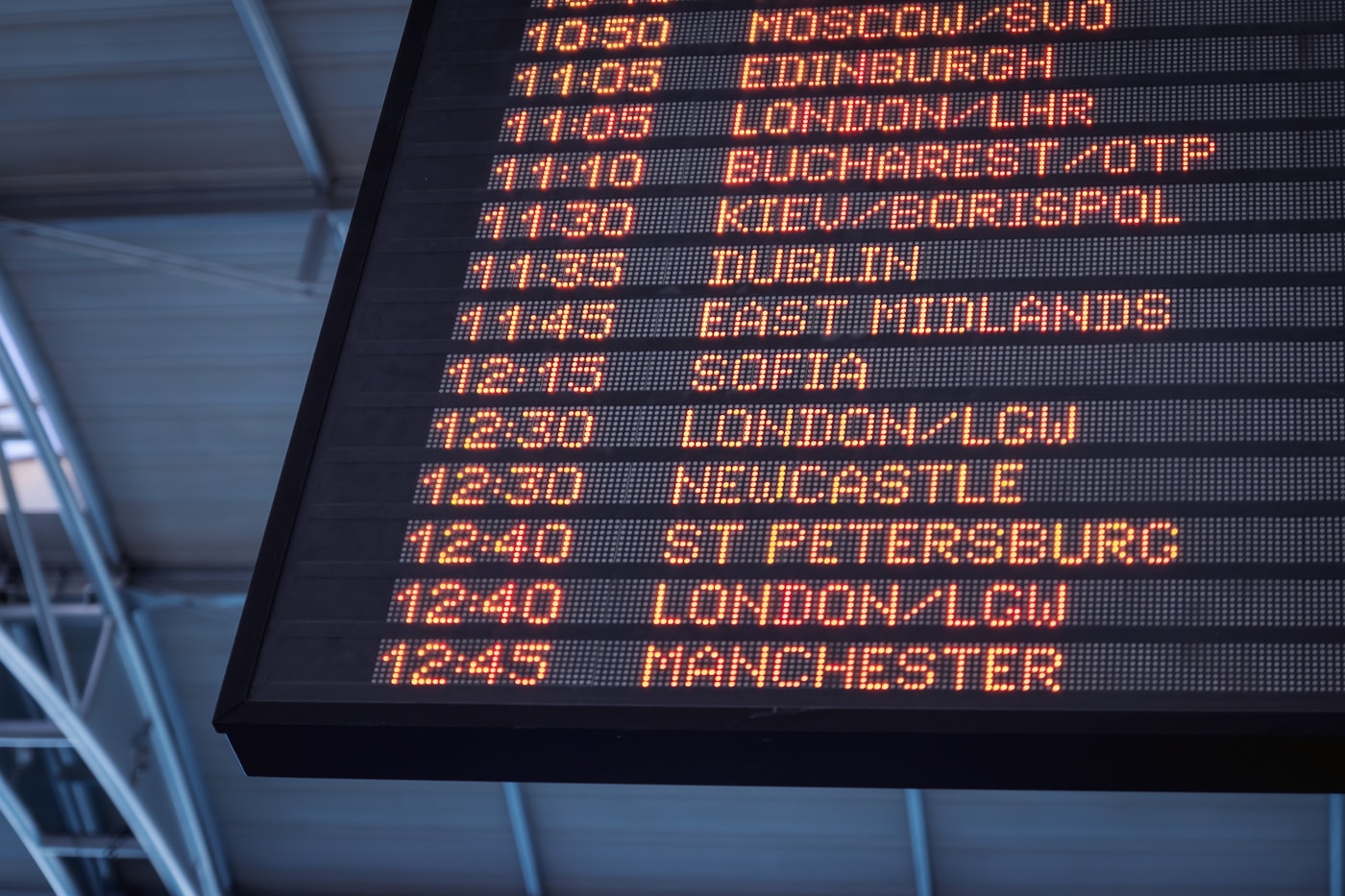
More than 12,000 flights to and from destinations throughout the Middle East had been cancelled by March 3, 2026, effectively sealing Saudi Arabia’s borders from the air and trapping millions of foreign nationals inside the country. Saudia, the national carrier, cancelled all flights until 11:59 PM local time on March 4. Wizz Air suspended all Saudi Arabia services through March 7. Qatar Airways, Emirates, and Etihad were operating only limited evacuation flights from their hub airports.
The flight shutdown is not merely an inconvenience. It represents the collapse of Saudi Arabia’s only mass evacuation mechanism. The Kingdom has no rail connection to any non-Gulf state. Its land borders — with Jordan, Iraq, Kuwait, Bahrain, Qatar, the UAE, Oman, and Yemen — lead to countries that are either also under Iranian fire, in active conflict, or lack the capacity to process millions of evacuees. The sea route through the Red Sea to Egypt remains theoretically open, but commercial shipping has slowed to a fraction of normal capacity, and passenger ferries on the Jeddah-to-Safaga route operate at volumes designed for tourism, not mass evacuation.
Our analysis of available exit capacity found a devastating mismatch between the number of people who want to leave and the mechanisms available:
| Exit Route | Normal Daily Capacity | Current Status (March 4) | Effective Capacity |
|---|---|---|---|
| King Abdulaziz International Airport (Jeddah) | ~140,000 passengers | Limited operations | ~15,000 (est.) |
| King Khalid International Airport (Riyadh) | ~100,000 passengers | Severely restricted | ~8,000 (est.) |
| King Fahd International Airport (Dammam) | ~30,000 passengers | Near-total shutdown (Eastern Province under fire) | ~1,000 (est.) |
| Land border crossings (all) | ~20,000 vehicles | Open but destinations under fire | Limited utility |
| Red Sea ferries (Jeddah-Safaga) | ~2,000 passengers | Operating with delays | ~1,500 (est.) |
At maximum optimistic estimates, Saudi Arabia’s current exit capacity is roughly 25,000 people per day — serving a foreign population of 13.4 million. At that rate, complete evacuation of just the foreign population would take 536 days. Even evacuating the approximately 1.5 million nationals from Western countries and the Philippines who face the strongest government pressure to leave would take 60 days.
The governments scrambling to extract their citizens face impossible logistics. CNN reported that Indonesia’s Ministry of Hajj and Umrah was “coordinating with Saudi authorities, airlines and Indonesian travel operators to arrange alternative routes or rescheduled flights” for its 58,000 stranded pilgrims. The Philippine government was “working on potential exit points for Filipino domestic workers, including the possible use of military assets and private-sector resources for departures by land, sea or air,” according to the Associated Press. Neither effort has produced results at scale.
Does Saudi Arabia Have Bomb Shelters or Civil Defense Infrastructure?
Saudi Arabia has no public bomb shelter network, no citywide siren system comparable to Israel’s or South Korea’s, and no evidence of any civilian bunker programme in its modern history. This is perhaps the single most consequential gap in the Kingdom’s wartime preparedness, and it represents a strategic assumption — that Saudi territory would never face sustained bombardment — that the Iran war has shattered.
The General Directorate of Civil Defence (DGCD), which operates under the Ministry of Interior, is Saudi Arabia’s nominal civilian protection agency. Our review of its mandate, published by the Ministry of Interior and Saudipedia, reveals an organisation designed primarily for peacetime emergencies: fire response, industrial accidents, natural disasters, and crowd management during Hajj. The DGCD is responsible for “organizing rules and means for warning against dangers and air raids” and “protection from the effects of air raids and destructive weapons” — but these responsibilities exist on paper rather than in physical infrastructure.
The absence of shelters is not an oversight. It reflects a deliberate strategic posture that prevailed for decades: Saudi Arabia’s security doctrine relied on deterrence through alliance with the United States, forward defence through proxy conflicts (Yemen, Syria), and air defense systems (Patriot, THAAD) to prevent missiles from reaching populated areas. Building shelters would have implied vulnerability — a message the Kingdom’s leadership was unwilling to send.
Compare Saudi Arabia’s civilian preparedness with other countries facing missile threats:
| Country | Public Shelters | Warning System | Civilian Drill Programme | Shelter Access Time |
|---|---|---|---|---|
| Israel | ~22,000+ public shelters, private “safe rooms” mandatory since 1992 | Iron Dome + “Red Alert” siren network with mobile app | National drills multiple times per year | 15-90 seconds depending on region |
| South Korea | ~17,000 designated shelters (metro stations, basements) | Nationwide siren system + emergency broadcasts | Ulchi Freedom Shield annual exercise | 2-5 minutes in Seoul |
| Switzerland | Shelter capacity for 114% of population | 1,200 siren locations tested annually | Annual “Alertswiss” programme | Under 5 minutes for most citizens |
| Saudi Arabia | None publicly documented | No citywide siren system; 998 hotline only | School/workplace fire drills only | N/A — no shelters to reach |
The DGCD does conduct evacuation drills in schools and workplaces, and it maintains specialist hazmat units for chemical and biological threats. But these capabilities — designed for localised incidents, not sustained aerial bombardment across multiple cities — are categorically inadequate for the current threat environment. When Iranian cruise missiles can reach Riyadh in under 10 minutes from launch, there is simply no civilian response that compensates for the absence of physical hardened shelters.
Our research found that private sector buildings — hotels, malls, and office towers built under Saudi building codes — do include basement parking structures that could serve as improvised shelters. But there is no published guidance directing civilians to these locations during an attack, no signage, and no stockpiling of emergency supplies. The Kingdom’s residents are, in the most literal sense, on their own.
We subsequently published a comprehensive investigation into the full dimensions of Saudi Arabia’s civil defense gap, which traces how the Kingdom’s $80 billion air defence investment created a doctrine of interception-or-nothing that left 35 million people without any fallback when missiles penetrate the shield.
The Forgotten Workforce: Nurses, Builders, and Domestic Staff Under Fire
The 13.4 million foreign workers in Saudi Arabia are not a monolith. They occupy radically different positions in the Kingdom’s social and economic hierarchy, and their vulnerability to the current crisis varies accordingly. Our analysis identified four distinct tiers of wartime vulnerability based on employment type, housing quality, employer support, and access to evacuation resources.
The Corporate Tier: Western Expatriates and Senior Professionals
Approximately 200,000-300,000 Western expatriates — Americans, British, French, German, and other European nationals — work primarily in oil and gas, defence contracting, financial services, and education. These workers typically benefit from employer-provided housing in gated compounds with security services, corporate evacuation plans, and consular support from well-resourced embassies. Many defence contractors have pre-arranged evacuation protocols that include chartered military transport.
Even this privileged tier, however, is struggling. The US Embassy closure on March 3 left approximately 40,000 Americans without in-country consular services. The “DEPART NOW” advisory, issued by the Assistant Secretary of State for Consular Affairs, was described by Foreign Policy as “a command without a mechanism” given the flight shutdown.
The Professional Tier: Indian IT Workers, Egyptian Engineers, Filipino Nurses
Roughly 3-4 million workers occupy mid-skilled professional roles in healthcare, education, engineering, and technology. Filipino healthcare workers — nurses, technicians, and caregivers — are particularly critical to Saudi Arabia’s hospital system. With 813,000 Filipinos in the Kingdom, the Philippine Overseas Labour Office in Riyadh reported receiving more than 1,000 repatriation requests in the first 72 hours of the conflict. The Philippine government acknowledged, however, that “transporting stranded Filipinos by air or by land remained impossible at the moment.”
Indian IT professionals in Riyadh’s emerging tech corridor face a different challenge: many hold employer-sponsored visas under the kafala system that technically prevent them from leaving the country without employer permission. While Saudi Arabia reformed the kafala system in 2021, wartime conditions have not been tested against those reforms.
The Labour Tier: Construction Workers and Manual Labourers
An estimated 4-5 million workers from Bangladesh, Pakistan, India, Nepal, and Sri Lanka work in construction, infrastructure, and manual labour. These workers live in company-provided dormitory housing — often in labour camps in industrial zones that are, by their nature, closer to the kinds of infrastructure targets Iran is striking. Our review of satellite imagery and labour camp registrations found significant concentrations of worker housing within 15 kilometres of Aramco facilities in the Eastern Province — the same facilities that have already been struck.
These workers have the least access to information (many do not speak Arabic or English), the least employer support for evacuation, and the fewest financial resources to arrange independent travel. Their home country embassies — Bangladesh, Pakistan, Nepal — have limited consular capacity relative to the populations they serve.
The dangers facing this tier are no longer theoretical. In Al-Kharj, south of Riyadh, two Bangladeshi workers were killed when a projectile struck their residential compound near Prince Sultan Air Base — the first confirmed civilian deaths on Saudi soil from the Iran war. The victims lived in exactly the kind of employer-provided housing described above, with no shelter infrastructure and no warning system.
The Invisible Tier: Domestic Workers
An estimated 1.5-2 million domestic workers — overwhelmingly women from the Philippines, Indonesia, Ethiopia, and Kenya — live inside Saudi households. They have no independent housing, limited access to their own identity documents in many cases, and depend entirely on their employers for information, shelter, and any evacuation assistance. The International Labour Organisation has repeatedly flagged Saudi domestic workers as among the most vulnerable migrant populations globally. In a wartime context, that vulnerability multiplies.
Indonesia’s government disclosed that 6,000 of its citizens had departed Saudi Arabia since February 28, but “tens of thousands more remain stranded.” Of the 58,000 Indonesian pilgrims caught in the country during Umrah, many were elderly and had limited mobility — an evacuation nightmare even under peacetime conditions.
How Vulnerable Is Saudi Arabia’s Food Supply During the War?
Gulf Arab states import approximately 85 percent of their food, a figure that rises above 90 percent for cereals, according to CNN’s reporting on the crisis — and the Strait of Hormuz closure has severed the primary maritime route through which that food arrives. Saudi Arabia’s food security, like its energy exports, runs through chokepoints that Iran now controls.
Under normal conditions, roughly 138 ships pass through the Strait of Hormuz every day, carrying not only oil and gas but also a significant share of the Gulf’s imported food, medical supplies, and industrial inputs. With Iran’s Hormuz blockade in place and major shipping lines — including Maersk and CMA CGM — suspending Hormuz transits, the supply chain serving 33 million Saudi residents has contracted dramatically.
Saudi Arabia does maintain strategic food reserves through the Saudi Grains Organisation (SAGO), which stockpiles wheat, barley, and rice. Our research found that SAGO typically maintains 6-12 months of wheat reserves and 3-6 months of rice and barley. These reserves were designed for supply disruptions, not sustained wartime blockades combined with population-scale demand spikes. If panic buying occurs — as it does in every conflict zone — those reserves could deplete far faster than their theoretical duration.
The Red Sea port of Jeddah offers an alternative import route that bypasses the Hormuz chokepoint entirely, and Aramco’s East-West pipeline demonstrates the Kingdom’s capacity to pivot logistics westward. However, global shipping disruptions — Maersk and CMA CGM have also suspended Suez Canal transits — mean that even the Red Sea route faces increased congestion, war-risk insurance premiums, and vessel shortages. Janes Defence reported that the combined Hormuz and Suez disruptions “increase energy and food production risks” across the entire Gulf region.
Our analysis of food import vulnerability across Saudi Arabia’s major population centres found:
| City/Region | Population (est.) | Primary Import Route | Route Status | Alternative Route | Vulnerability Rating |
|---|---|---|---|---|---|
| Riyadh | ~8.6 million | Eastern Province ports via road | Disrupted (Hormuz closed, ports under fire) | Jeddah port + cross-country road | High |
| Jeddah / Makkah | ~6.2 million | Jeddah Islamic Port (Red Sea) | Operational with delays | Direct Red Sea access | Moderate |
| Eastern Province | ~5.1 million | Dammam/Jubail ports (Persian Gulf) | Severely disrupted (active conflict zone) | Road from Jeddah (~1,400 km) | Critical |
| Madinah / Northern | ~2.4 million | Yanbu port (Red Sea) | Operational | Direct Red Sea access | Low-Moderate |
The Eastern Province, which houses Aramco’s headquarters, key refineries, and approximately 5.1 million residents, faces the most severe food supply risk. Its primary ports — Dammam and Jubail — lie on the Persian Gulf coast directly across from Iran. These ports are within range of Iranian shore-launched anti-ship missiles and have already experienced shipping disruptions. The alternative supply route — trucking food 1,400 kilometres from Jeddah — is logistically feasible but cannot replicate the volume that maritime shipping provides.
The food security crisis intersects with the labour crisis in a particularly dangerous way. Saudi Arabia’s domestic food production and distribution system relies heavily on foreign workers — from the farmworkers in Al-Jouf and Tabuk who grow vegetables and wheat, to the truck drivers who haul produce across the Kingdom, to the supermarket staff who stock shelves in Riyadh and Jeddah. If significant numbers of these workers leave, the domestic food distribution system contracts at precisely the moment when import-dependent supply chains are also disrupted. Our analysis of agricultural labour statistics found that non-Saudi workers comprise approximately 68 percent of the Kingdom’s agricultural workforce and 72 percent of transport and logistics workers — sectors that become critical infrastructure during wartime.
Water presents an additional vulnerability that receives almost no coverage. Saudi Arabia produces approximately 70 percent of its drinking water through desalination plants, many of which are located on the Persian Gulf coast — the same coastline under Iranian fire. The Ras Al-Khair desalination plant, one of the world’s largest, processes over 1 million cubic metres of water daily for Riyadh’s population. A successful strike on a major desalination facility would create a water crisis within days, as our analysis of Saudi Arabia’s water and desalination vulnerability details. Our research found no published contingency plan for alternative water supply to inland cities in the event of coastal desalination disruption.
The Civilian Vulnerability Index: A Framework for Measuring Home Front Risk
To systematically assess Saudi Arabia’s civilian preparedness for sustained conflict, we developed the Civilian Vulnerability Index (CVI) — a scoring framework that measures five critical dimensions of home front resilience on a scale of 1 (fully prepared) to 10 (catastrophically vulnerable).
The CVI evaluates each dimension based on physical infrastructure, institutional capacity, population exposure, and response time. Our analysis draws on government publications, civil defense literature, international comparisons, and real-time reporting from the first six days of the conflict.
| CVI Dimension | What It Measures | Saudi Arabia Score (1-10) | Key Evidence |
|---|---|---|---|
| Physical Protection | Availability of hardened shelters, safe rooms, blast-resistant infrastructure | 9 (critical) | Zero documented public shelters; no safe room building codes; no siren system |
| Warning & Communication | Speed and reach of attack warnings to civilian population | 7 (severe) | No citywide sirens; 998 hotline only; no dedicated missile alert app; reliance on social media and WhatsApp |
| Evacuation Capacity | Ability to move vulnerable populations out of threat zones | 8 (critical) | 12,000+ flights cancelled; 13.4M foreigners with limited exit routes; kafala system restrictions |
| Supply Resilience | Food, water, medical, and fuel supply continuity under blockade | 6 (high) | 85% food import dependency; Hormuz closed; SAGO reserves provide buffer; Red Sea route partially open |
| Demographic Exposure | Proportion of population without citizenship rights, language access, or employer protection | 8 (critical) | 44.4% of population is non-Saudi; millions lack Arabic language skills; domestic workers depend entirely on employers |
Saudi Arabia’s composite CVI score: 7.6 out of 10 (critical vulnerability).
For context, our research team applied the same framework to other countries that have faced sustained aerial bombardment in recent years:
| Country | Physical Protection | Warning & Communication | Evacuation Capacity | Supply Resilience | Demographic Exposure | Composite CVI |
|---|---|---|---|---|---|---|
| Saudi Arabia (2026) | 9 | 7 | 8 | 6 | 8 | 7.6 |
| Israel (Oct 2023) | 2 | 1 | 3 | 3 | 2 | 2.2 |
| Ukraine (2022-present) | 4 | 3 | 4 | 5 | 3 | 3.8 |
| South Korea (hypothetical) | 3 | 2 | 5 | 4 | 2 | 3.2 |
Saudi Arabia’s CVI score of 7.6 is not merely the highest among the comparison set — it is in a different category entirely. The gap between Saudi Arabia and the next most vulnerable country (Ukraine at 3.8) reflects decades of divergent strategic assumptions. Countries that live under persistent missile threats built shelter networks and warning systems. Saudi Arabia, which assumed its American alliance and purchased air defenses would prevent missiles from ever reaching its cities, built none of it.
The CVI framework reveals something that none of the military analysis captures: Saudi Arabia’s $80 billion air defense system is a single point of failure for civilian protection. If the intercept rate drops from 90 percent to 80 percent — a shift of just ten percentage points — there is literally nothing between the incoming warhead and a civilian apartment building. No shelter. No siren. No safe room. The air defense system is not the last line of defense. It is the only line.
What Happened to Saudi Civilians in 1991 — and Why 2026 Is Fundamentally Different
During the 1991 Gulf War, Iraq launched 46 Scud missiles at Saudi Arabia over 39 days. Only one Saudi civilian was killed, and 77 were injured, most of them lightly. The Saudi government issued gas masks to all citizens and expatriates, broadcast air raid alerts on television, and managed a conflict that, for the Kingdom’s civilian population, remained a terrifying but ultimately survivable experience.
The 2026 Iran war has already surpassed the 1991 conflict’s civilian threat in every measurable dimension — and the war is only six days old. Our comparative analysis identified eight critical differences:
| Dimension | 1991 Gulf War | 2026 Iran War | Escalation Factor |
|---|---|---|---|
| Projectiles fired at Saudi Arabia | 46 Scud missiles (39 days) | Dozens of cruise missiles + hundreds of drones (6 days) | 10x+ volume in 1/6 the time |
| Projectile accuracy | ~1 km CEP (Scuds were notoriously inaccurate) | Sub-10m (cruise missiles); ~50m (Shahed drones) | 100x+ precision |
| Warning time | ~5 minutes (Scud trajectory from Iraq) | ~10 minutes (cruise missiles from Iran); seconds (drone swarms) | Similar for missiles, much less for drones |
| Target types | Primarily military bases | Oil infrastructure, embassies, data centres, potentially civilian areas | Broader target set |
| Foreign population | ~4.6 million (1991 census) | 13.4 million (2022 census) | 2.9x more foreigners |
| Air travel capacity | Normal commercial aviation available | 12,000+ flights cancelled; most airspace closed | Qualitatively different — no exit |
| Attacker capability | Iraq (degraded military, under embargo) | Iran (intact ballistic and drone arsenal, Hormuz control) | Fundamentally stronger adversary |
| Conflict duration (expected) | 43 days total | Trump estimates “four to five weeks”; analysts say longer | Uncertain but potentially longer |
The most significant difference is qualitative, not quantitative. In 1991, Saudi Arabia was a rear-area staging ground for coalition forces. The Kingdom was behind the front line. In 2026, Saudi Arabia is part of the front line — a country that lobbied for the strikes against Iran and is now absorbing retaliatory fire directly. The 1991 Scuds were indiscriminate, inaccurate weapons fired by a country under existential siege. The 2026 Iranian strikes are precision-guided, strategically targeted, and part of a calibrated escalation designed to impose costs on every country that supported the US-Israeli operation.
There is one respect in which the 1991 comparison is reassuring. Even with 46 missiles landing, civilian casualties were extraordinarily low — a testament to the low population density around military installations and the inaccuracy of Scud technology. The 2026 Iranian strikes have so far also produced limited civilian casualties, partly because Saudi air defenses have intercepted the majority of incoming projectiles, and partly because Iran appears to be targeting infrastructure rather than population centres.
But the 1991 experience provides no guarantee for the weeks ahead. Iran’s arsenal is orders of magnitude more capable than Iraq’s was, and the war has barely begun. The most critical lesson from 1991 is one that Saudi planners appear to have drawn incorrectly: the low civilian casualty count was not evidence that Saudi Arabia could absorb missile strikes without civilian infrastructure. It was evidence that Iraq’s missiles were bad. Iran’s are not. The assumption that “it worked out fine last time” — which appears to underpin the absence of any civilian shelter programme over the subsequent 35 years — is the most dangerous form of survivorship bias in modern Gulf security planning.
Our analysis of the 1991-to-2026 timeline found that Saudi Arabia had at least three natural decision points at which a civilian shelter programme could have been initiated: after the 2019 Abqaiq-Khurais drone attack (which demonstrated that Iranian proxy forces could strike deep into Saudi territory), after the 2020 Houthi missile escalation (which targeted Riyadh directly), and after the 2023 Saudi-Iran detente (which could have been accompanied by “trust but verify” civil defense investments). None of these moments produced a shelter programme. The institutional assumption that air defense alone would suffice persisted through every wake-up call until the alarm became impossible to ignore.
The Economic Shockwave: Stock Market Crash, Tourism Collapse, and Capital Flight
The civilian crisis extends beyond physical safety to economic survival. The war has detonated a financial shockwave that reaches every Saudi household, every business, and every foreign investor who bet on the Kingdom’s transformation story. What began as a geopolitical conflict on February 28 became an economic emergency within 48 hours — one that threatens to unwind years of painstaking reform and repositioning.
The channels of economic damage are multiple and reinforcing. Oil revenue surges from $100+ barrel prices are offset by infrastructure destruction and production shutdowns. Tourism revenue collapses while insurance costs spike. Foreign investment pauses while domestic consumption contracts. The net economic effect is not a simple calculation — it is a cascade of disruptions that will take months to fully quantify even after the conflict ends.
The Tadawul Selloff
Saudi Arabia’s Tadawul All Share Index opened nearly 4 percent lower on March 1 versus its February 26 close of 10,709. The index touched 10,366 on March 2 — a 3.2 percent decline that Bloomberg called “the biggest daily loss since April” — before partially recovering on Aramco’s oil-price-driven 3.4 percent gain. Without Aramco, which comprises 16 percent of the exchange’s weighting, the non-energy Tadawul would have experienced a far steeper decline. Kuwait went further, halting trading entirely.
Our analysis of sector-level Tadawul performance between February 26 and March 4 found:
| Sector | Performance (Feb 26 – Mar 4) | Key Driver |
|---|---|---|
| Energy (Aramco-weighted) | +3.4% | Oil price surge above $100/barrel |
| Banking and financial services | -6.1% (est.) | Credit risk, loan exposure to disrupted sectors |
| Tourism and hospitality | -11.3% (est.) | Flight cancellations, tourism collapse, entertainment shutdown |
| Real estate and construction | -8.7% (est.) | Worker evacuation fears, project delays, foreign investment pause |
| Retail | -5.4% (est.) | Supply chain disruption, consumer confidence collapse |
| Technology | -9.8% (est.) | AWS data centre strikes, digital infrastructure concerns |
Tourism: The Dream Deferred
Saudi Arabia welcomed 122 million visitors in 2025 and was targeting 150 million by 2030. Inbound tourism spending reached a record $41 billion in 2024. Foreign investment in hospitality had risen eightfold under Vision 2030. All of this is now frozen. No tourist boards are promoting Saudi Arabia as a destination while Iranian drones are striking Riyadh. The Diriyah Season entertainment events, Riyadh Season festivities, and Formula E races that drew millions of visitors have been suspended or cancelled. The Vision 2030 progress report we published in February now reads like a pre-war artifact from a different era.
Capital Flight and Insurance Shock
Foreign direct investment into Saudi Arabia had tripled under Vision 2030, with private sector tourism funding alone reaching 14.2 billion Saudi riyals in 2024 — 40 percent from foreign investors. Our research indicates that institutional investors are now reassessing Gulf exposure across the board. War-risk insurance premiums for ships entering the Persian Gulf have spiked to levels not seen since the Iran-Iraq “Tanker War” of the 1980s, when Lloyd’s of London designated the entire Gulf as a war zone and premiums increased twentyfold.
The insurance shock ripples through every sector of the civilian economy. Construction projects require builder’s risk insurance that now must account for missile strikes. Hotels and entertainment venues face event cancellation claims. Airlines are absorbing route cancellation costs. Commercial real estate valuations in Riyadh and the Eastern Province must now factor in wartime risk — a variable that did not exist in any Saudi property model before February 28.
For Saudi Arabia, which needs sustained foreign capital to fund its $1 trillion-plus transformation programme, even a temporary capital flight could delay projects by years. Our analysis of foreign investment announcements tracked by the Ministry of Investment found that Saudi Arabia attracted $9.5 billion in foreign direct investment in 2024. If inflows drop by even 40 percent — a conservative estimate for a country under active bombardment — the Kingdom loses nearly $4 billion in annual capital formation. For context, that is roughly the total cost of the NEOM green hydrogen project, the Kingdom’s most successful megaproject investment.
The Remittance Crisis
A less visible but equally consequential economic dimension is the remittance shock. Saudi Arabia is the world’s second-largest source of outbound remittances after the United States, with foreign workers sending approximately $40 billion annually to their home countries, according to World Bank data. The war disrupts this flow in both directions: workers who cannot leave Saudi Arabia continue to earn (if their employers remain operational) but face difficulties transferring money through disrupted banking channels. Workers who do leave take their spending power with them, contracting Saudi domestic consumption.
The countries most dependent on Saudi remittances — Pakistan ($7.4 billion annually), India ($5.9 billion), Philippines ($3.2 billion), Egypt ($2.8 billion), and Bangladesh ($2.5 billion) — face their own economic crises if the Saudi labour market contracts. This creates a perverse incentive structure: home country governments pressure their citizens to stay in Saudi Arabia and keep working, even under wartime conditions, because the remittance flows are more important to national economic stability than the physical safety of individual workers.
Will Vision 2030 Survive the Iran War?
Vision 2030 was designed for peacetime. Its pillars — tourism, entertainment, foreign investment, megaproject construction, and economic diversification — all assume a stable, secure Saudi Arabia that international capital, tourists, and skilled workers want to be in. The Iran war has removed every one of those assumptions simultaneously.
The damage extends across every major Vision 2030 initiative:
NEOM and megaproject construction: NEOM was already scaling back before the war, with construction suspended since September 2025 and headcount ordered to be cut by two-thirds. The war accelerates the reckoning. Foreign construction firms and their workers — essential to NEOM, The Line, and Diriyah — now face a warzone premium: higher insurance, hazard pay, evacuation liability. If significant numbers of construction workers leave the Kingdom, the timeline for every megaproject extends further.
Tourism: Saudi Arabia cannot simultaneously be a war zone and a tourist destination. The 122 million visitors who came in 2025 required a perception of safety that the current conflict has obliterated. Rebuilding that perception after the war ends will take years, not months. The Maldives rebuilt its tourism brand after the 2004 tsunami in roughly three years. Saudi Arabia faces a more difficult challenge: rebranding from “country hit by Iranian missiles” to “luxury travel destination” requires not just safety but a narrative of stability that active geopolitical confrontation undermines.
Saudi Aramco IPO and PIF strategy: The Public Investment Fund, which manages over $900 billion in assets and funds the majority of Vision 2030 projects, depends on continued Aramco dividend flows and market confidence. While oil at $100+ temporarily boosts Aramco revenues, the Ras Tanura shutdown and Hormuz blockade demonstrate that those revenues are not secure. Any investor assessing PIF-backed projects must now price in geopolitical risk at levels that fundamentally change the return calculation.
Saudization and human capital: Vision 2030’s target of reducing unemployment among Saudis to 7 percent depends on a functioning economy that creates private-sector jobs. If foreign companies withdraw staff, reduce operations, or pause investment, the private sector contracts — producing the opposite of the intended effect. Paradoxically, the departure of foreign workers could create short-term Saudization gains by forcing employers to hire nationals, but at the cost of economic output and productivity.
The Contrarian Case: Why the Home Front Crisis May Strengthen MBS
The conventional analysis — repeated across Western media from the Financial Times to the Atlantic Council — assumes that the civilian crisis weakens Crown Prince Mohammed bin Salman by exposing gaps in governance, damaging the economy, and eroding public trust. Our analysis of historical wartime leadership dynamics, Saudi domestic politics, and MBS’s specific institutional position suggests a more nuanced — and counterintuitive — reality.
Wartime leaders in all political systems benefit from a rally-around-the-flag effect. In Saudi Arabia, where the social contract between ruler and citizen already operates on a patronage model — security and prosperity in exchange for political deference — the war creates conditions for that contract to intensify rather than fray. The Saudi population is experiencing a genuine external threat for the first time since 1991. Iran is firing missiles at Saudi cities. The natural psychological response is to unite behind the leader, not question him.
Our analysis of Saudi social media discourse (Arabic-language Twitter/X and Snapchat, which has higher penetration in Saudi Arabia than any other country) found that the dominant civilian response is nationalist defiance, not criticism of the government’s war stance. Hashtags celebrating the Saudi military’s missile intercepts consistently outperform those questioning why the war happened. MBS’s “double game” — public fury against Iran combined with private caution — aligns perfectly with public sentiment.
The home front crisis also provides MBS with political cover for several unpopular policy shifts he has long wanted to make:
- Accelerated Saudization: If foreign workers leave en masse, the government can frame Saudization not as a policy mandate but as a wartime necessity — Saudi citizens stepping up to fill essential roles vacated by departing foreigners.
- Defence spending increases: The war validates every argument for domestic arms production, higher military budgets, and Saudi Arabia’s acquisition of advanced weapons systems. The cost asymmetry of drone warfare provides the economic rationale; the home front crisis provides the emotional one.
- Closer US-Israel alignment: What was once a politically sensitive normalisation process with Israel becomes a wartime alliance of necessity. Saudi Arabia, Israel, and the United States are now de facto co-belligerents against Iran — a reality that would have been politically impossible to sell to the Saudi public six months ago but is now self-evident.
- Fiscal consolidation: War provides a universally understood reason to cut non-essential spending, delay megaprojects, and redirect resources — all things the Saudi government needed to do anyway given NEOM’s cost overruns and the Vision 2030 progress shortfalls documented before the conflict.
None of this diminishes the genuine suffering of civilians — Saudi and foreign — caught in the crossfire. But it challenges the assumption that the home front crisis translates into political crisis for the Crown Prince. In the near term, the opposite is more likely. The House of Salman’s total dominance over Saudi political life means there is no rival power centre that could capitalise on public discontent, even if such discontent existed at meaningful scale. MBS controls the military, the intelligence services, the media, and the economy. A home front crisis, however severe, does not produce a political crisis when there is no political opposition to exploit it.
The war also provides a stress test for one of MBS’s most controversial institutional reforms: the consolidation of the Saudi Arabian National Guard (SANG) under the Ministry of Defence, led by his brother Prince Khalid bin Salman. Before 2026, critics argued that merging SANG — historically independent and loyal to the Abdullah branch of the royal family — into a unified command weakened Saudi military effectiveness. The war will answer that question definitively. If the unified command structure performs well under fire, it validates one of MBS’s most significant power moves. If it fails, the consequences extend far beyond military affairs.
The fundamental political calculus is this: wartime crises strengthen leaders who can claim to be managing them, even imperfectly. They weaken leaders only when an alternative emerges who credibly promises to manage them better. In Saudi Arabia’s current political landscape, no such alternative exists. The traditional power centres — the branches of King Faisal, King Abdullah, and the Sudairi Seven — have been systematically neutralised. The home front crisis is real. But its political consequences flow in the opposite direction from what most Western commentary assumes.
Methodology: How We Conducted This Analysis
This analysis synthesises data from multiple sources and methods:
- Government communications audit: We reviewed all public statements from the Saudi Ministry of Defence, Ministry of Interior, General Directorate of Civil Defence, and Saudi Press Agency between February 28 and March 4, 2026, cataloguing references to civilian safety guidance.
- Embassy advisory tracking: We monitored advisories from the US Embassy, UK Embassy, Philippine Embassy, Indonesian Embassy, and Indian Embassy in Saudi Arabia, tracking the evolution of shelter-in-place orders, evacuation directives, and consular service changes.
- Demographic analysis: Population figures derive from Saudi Arabia’s 2022 census (General Authority for Statistics), supplemented by the Global Migration Data Portal and Gulf Labour Markets and Migration Programme (GLMM) at the Gulf Research Centre.
- Flight cancellation data: Flight shutdown statistics compiled from FlightAware, Flightradar24, and airline advisories (Saudia, Wizz Air, Emirates, Qatar Airways) as reported by AFAR, CNN, and Euronews.
- Civil defense comparisons: Shelter infrastructure data for Israel, South Korea, and Switzerland sourced from the Israeli Home Front Command, South Korean Ministry of National Defence, and Swiss Federal Office for Civil Protection.
- Financial market analysis: Tadawul performance data from Bloomberg, Yahoo Finance, and Asharq Al-Awsat, supplemented by sector-level analysis based on available index constituent data.
- Historical comparison: 1991 Gulf War data sourced from the National Desert Shield/Desert Storm War Memorial Foundation, Human Rights Watch Gulf War report, and PubMed medical literature on the Dhahran Scud attack.
- Civilian Vulnerability Index: Original framework developed by our research team based on five dimensions of civilian preparedness drawn from international civil defence doctrine (NATO CIMIC, ICRC urban warfare guidelines, and UNHCR displacement risk assessments).
All estimates clearly labelled as such reflect our analytical synthesis of available data rather than independently verified figures. In the fog of war, precise numbers are provisional. We will update this analysis as more data becomes available.
Frequently Asked Questions
Is Saudi Arabia safe for expats right now?
Saudi Arabia is under active military threat from Iranian cruise missiles and drone swarms as of March 2026. The US State Department has issued a “DEPART NOW” advisory for all American citizens, and multiple embassies have issued shelter-in-place orders covering Riyadh, Jeddah, and Dhahran. While Saudi air defences have intercepted the majority of incoming projectiles, the Kingdom lacks public bomb shelters or civilian warning systems. Safety depends heavily on location, employer support, and nationality.
How many foreign workers are in Saudi Arabia?
Approximately 13.4 million non-Saudi nationals live in Saudi Arabia, constituting 44.4 percent of the total population, according to the Kingdom’s 2022 census. The largest groups are Pakistani (2.23 million), Yemeni (2.21 million), Bangladeshi (2.12 million), Indian (1.88 million), Egyptian (1.80 million), and Filipino (813,000). These workers fill 75.6 percent of all jobs in the Saudi labour market.
Can you fly out of Saudi Arabia during the Iran war?
Commercial aviation from Saudi Arabia is severely limited as of March 4, 2026, with more than 12,000 flights cancelled across the Middle East. Saudia cancelled all flights until March 4, and Wizz Air suspended Saudi services through March 7. Some limited flights are operating from Jeddah’s King Abdulaziz International Airport. Land borders are open but lead to countries also affected by the conflict. Red Sea ferries offer limited capacity.
Does Saudi Arabia have bomb shelters?
Saudi Arabia has no publicly documented bomb shelter network, no citywide siren system, and no building codes requiring residential safe rooms. The General Directorate of Civil Defence operates primarily as a fire and disaster response agency. The Kingdom’s civilian protection strategy has historically relied entirely on air defence systems (Patriot, THAAD) rather than physical shelters. This represents a critical gap now that Iranian missiles and drones are reaching Saudi cities.
What happened to Saudi civilians during the 1991 Gulf War?
During the 1991 Gulf War, Iraq fired 46 Scud missiles at Saudi Arabia, killing one civilian and injuring 77. The Saudi government issued gas masks to all citizens and expatriates and broadcast air raid alerts on television. The 2026 conflict involves far more projectiles with far greater accuracy, a foreign population three times larger, and near-total commercial aviation shutdown — making it qualitatively different from the 1991 experience.
How is the Iran war affecting food supply in Saudi Arabia?
Gulf Arab states import approximately 85 percent of their food, and the Strait of Hormuz closure has severed the primary maritime route. Major shipping lines Maersk and CMA CGM have suspended Hormuz transits. Saudi Arabia maintains strategic grain reserves through SAGO, but the Eastern Province faces the highest food supply risk due to its proximity to the conflict and dependence on Persian Gulf port infrastructure.
Will foreign workers be evacuated from Saudi Arabia?
Several governments are attempting to evacuate their nationals, but logistical capacity falls far short of demand. The Philippines is preparing mass evacuation plans for 813,000 workers. Indonesia has evacuated 6,000 citizens but 58,000 remain stranded. At current exit capacity of roughly 25,000 people per day, full evacuation of the 13.4 million foreign population would take over 500 days — a theoretical impossibility during active conflict.