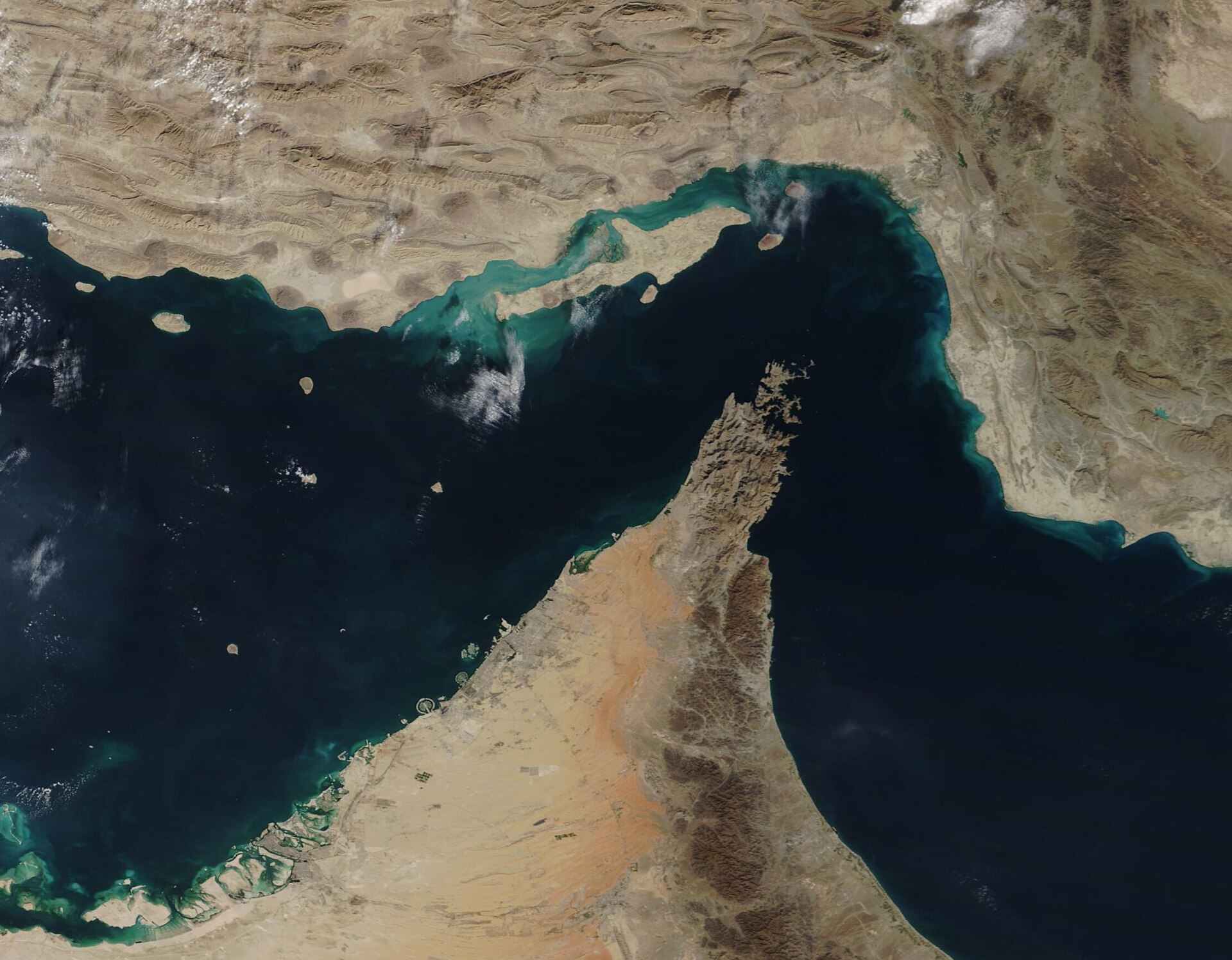

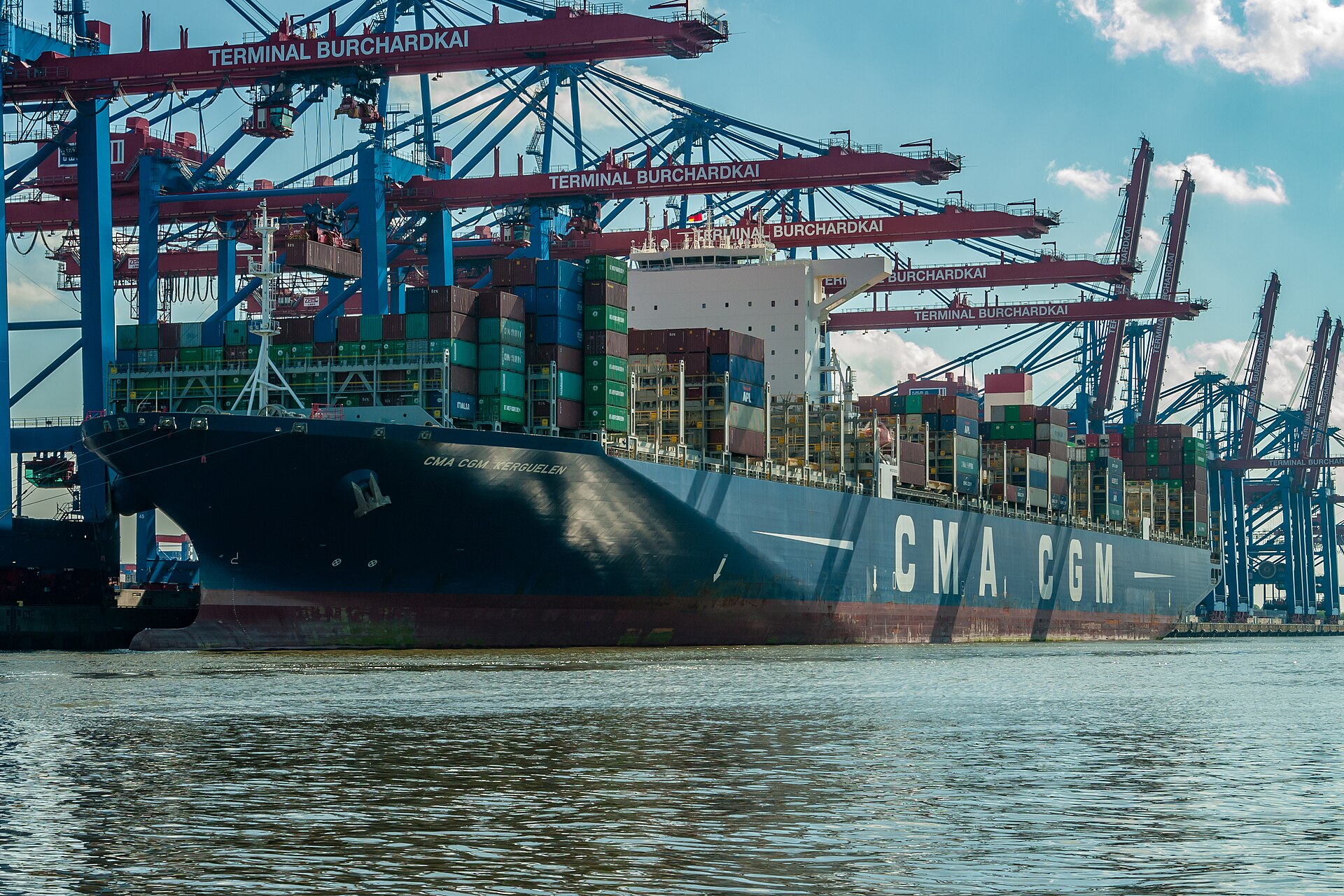
DUBAI — A cruise missile struck the CMA CGM San Antonio, a 2,824-TEU Maltese-flagged containership en route to Mundra, India, during its transit of the Strait of Hormuz on May 5, 2026, injuring eight crew members and effectively killing the US Navy’s Project Freedom escort program less than 48 hours after its launch. The attack was the second on a vessel operated by CMA CGM — the world’s third-largest container shipping line, headquartered in Marseille — in 18 days, following the IRGC strike on the French-flagged Everglade on April 17.
The strike fell one day before US and Iranian negotiators were reported to be within 48 hours of signing a memorandum of understanding to end the war, according to Axios. France — which co-chairs the 51-country Hormuz reopening coalition and has now moved the Charles de Gaulle nuclear carrier strike group south of Suez — responded with a statement that framed the diplomatic problem precisely: “France was in no way the target.” The San Antonio flies a Maltese flag and carries Filipino crew.
Table of Contents
The San Antonio Strike
UKMTO initially reported the San Antonio had been hit by an “unknown projectile” while transiting Hormuz on May 5. US officials subsequently identified the weapon as a cruise missile, according to Maritime Executive. The IMO recorded eight crew members injured. CMA CGM confirmed its crew had been evacuated and were receiving medical care, per Al Jazeera.
A US military official told Maritime Executive that the vessel’s operator had failed to follow Project Freedom check-in procedures and that the crew had called Oman for assistance rather than US forces. The blame fell on the commercial operator — not on the escort program’s design or the IRGC’s willingness to fire on escorted traffic. The suspension lasted less than 72 hours: on May 7-8, Saudi Arabia and Kuwait restored US basing and overflight access following a second Trump-MBS call, clearing the Pentagon to resume escort operations.
Hormuz transit volume had fallen to 5-6 vessels per day as of May 3-4, roughly 3-4 percent of the pre-war baseline of 138 daily transits, according to the Albany Antree War-Risk Insurance Update published May 6. War risk insurance premiums have reached 3-8 percent of vessel value per transit — $3-8 million for a large tanker — compared with 0.1-0.15 percent before the conflict, per S&P Global and Lloyd’s List.
Maud Bregeon, French government spokesperson and Energy Minister, said on May 6 that “France was in no way the target” and that “the strikes clearly show that the situation remains dangerous,” according to Xinhua English.
The Middle East briefing 3,000+ readers start their day with.
One email. Every weekday morning. Free.
Was CMA CGM the Target or France?
The Everglade is French-flagged, home port Marseille, 366 meters at the waterline, roughly 154,000 deadweight tons. The San Antonio is Maltese-flagged, Filipino crew. Under traditional maritime targeting — the logic employed by Iran in the 1980s tanker war — the flag determines the political message. By that standard, Bregeon is right. The San Antonio strike targeted Malta.
Two strikes on the same company in 18 days is not explained by flag registries. CMA CGM operates more than 600 vessels under dozens of flags. The IRGC’s five-tier flag-state classification system, disclosed by Bloomberg in April, places Western-flagged vessels in the highest-risk category and requires operators to submit crew lists, cargo manifests, and AIS data via an IRGC-linked intermediary. Transit fees are denominated in Chinese yuan.
If the IRGC is targeting the operating company rather than the flag state, it marks a departure from tanker war precedent. During the Iran-Iraq War, Kuwait reflagged 11 tankers under the US flag in 1987 specifically because the attack calculus followed the registry. Targeting by corporate ownership would mean reflagging offers no protection — a conclusion that renders the entire flag-of-convenience architecture irrelevant as a diplomatic shield.
The Everglade attack on April 17 offers evidence. It was one of four CMA CGM vessels attempting Hormuz exit that day. All four aborted transit after the strike, according to Linerlytica. The IRGC had demonstrated that any CMA CGM vessel — regardless of registry — would face fire.
CMA CGM’s headquarters sit in the country that, on the same day as the Everglade strike, co-hosted the 51-country coalition summit demanding Hormuz reopening without tolls. The France-UK joint statement from April 17 explicitly opposed “any restriction or agreement regime that would amount to a de-facto attempt to privatize the strait, and obviously any toll system,” according to GOV.UK. The IRGC’s response arrived by cruise missile.
Project Freedom: Suspended in 48 Hours
The US Navy launched Project Freedom on May 4 as an escort program for commercial vessels transiting Hormuz. The San Antonio was struck the following day. The program was suspended before it completed 48 hours of operation.
The IRGC offered its own framing. In a statement carried by PressTV on May 6, the IRGC said it would allow “safe, stable” transit through Hormuz only “with aggressor threats neutralized” — conditioning the strait’s reopening on the US ending its naval presence. A day earlier, PressTV described the IRGC as “activating a new Strait of Hormuz transit system” and tightening security in response to US escalation. On May 4, PressTV reported that the IRGC had vowed to “forcefully stop” ships violating its Hormuz regulations.
The sequence established a functional pattern: the US announced an escort program, the IRGC struck a vessel that had not followed its procedures, and the program was suspended. The IRGC’s stated conditions for safe transit — removal of US naval forces — are the inverse of the escort program’s premise. Iran’s parliament had already been advancing a 12-article Hormuz sovereignty law that would codify IRGC transit authority into domestic statute, making any future concession on Hormuz a matter of legislative repeal rather than executive reversal.
What Does the Timing Mean for the MOU?
Axios reported on May 6 that US and Iranian negotiators had been within 48 hours of signing a memorandum of understanding when the San Antonio was struck. The MOU was the product of weeks of indirect talks brokered through Oman and Pakistan, building on the framework established during the Vance-Ghalibaf encounter in Islamabad in April.
The Institute for the Study of War (ISW) identified this dynamic after the Everglade strike. “The IRGC appears to be controlling Iranian decision-making instead of Iranian political officials who are engaging with the United States in negotiations, particularly Foreign Affairs Minister Abbas Araghchi,” ISW assessed, in analysis cited by Euronews on April 19. “The IRGC’s decision to interfere with international shipping and act in contradiction to Araghchi’s statement reflects broader divisions within the Iranian regime.”
Fortune’s analysis on April 18 described IRGC commanders as “steering Iran toward a more hard-line, combative stance, favoring continued fighting instead of a ceasefire deal that would erode its main source of leverage over the U.S. — the Strait of Hormuz.” The San Antonio strike extended the pattern: each time diplomatic talks approached a deliverable, the IRGC demonstrated that Hormuz remained under its operational control regardless of what Araghchi negotiated.
“We must durably return to the regime of full freedom of navigation that prevailed before the conflict.”
— Emmanuel Macron, French President, after call with Pezeshkian, May 6, 2026
President Macron, speaking after a call with Iranian President Pezeshkian on May 6, added that “a return to calm in the Strait will help advance negotiations on nuclear issues, ballistic matters, and the regional situation,” per Tribune India. He called strikes on UAE civilian infrastructure and ships “unjustified,” according to The Hill and Al Arabiya English. The linkage was explicit: Hormuz and the nuclear file were now a single negotiation in French diplomacy.
The MOU’s fate after May 5 remained uncertain as of May 7. The framework had already excluded Saudi Arabia from its terms despite Riyadh absorbing the war’s heaviest fiscal damage. The oil price drop triggered by MOU reports — Brent fell toward $96-101 on May 6 — created the feedback loop that HOS previously analyzed: deal hopes crash prices, which erode Iran’s incentive to finalize, which delays the deal, which lifts prices back toward levels that restore Iran’s bargaining position.
France Moves the Charles de Gaulle
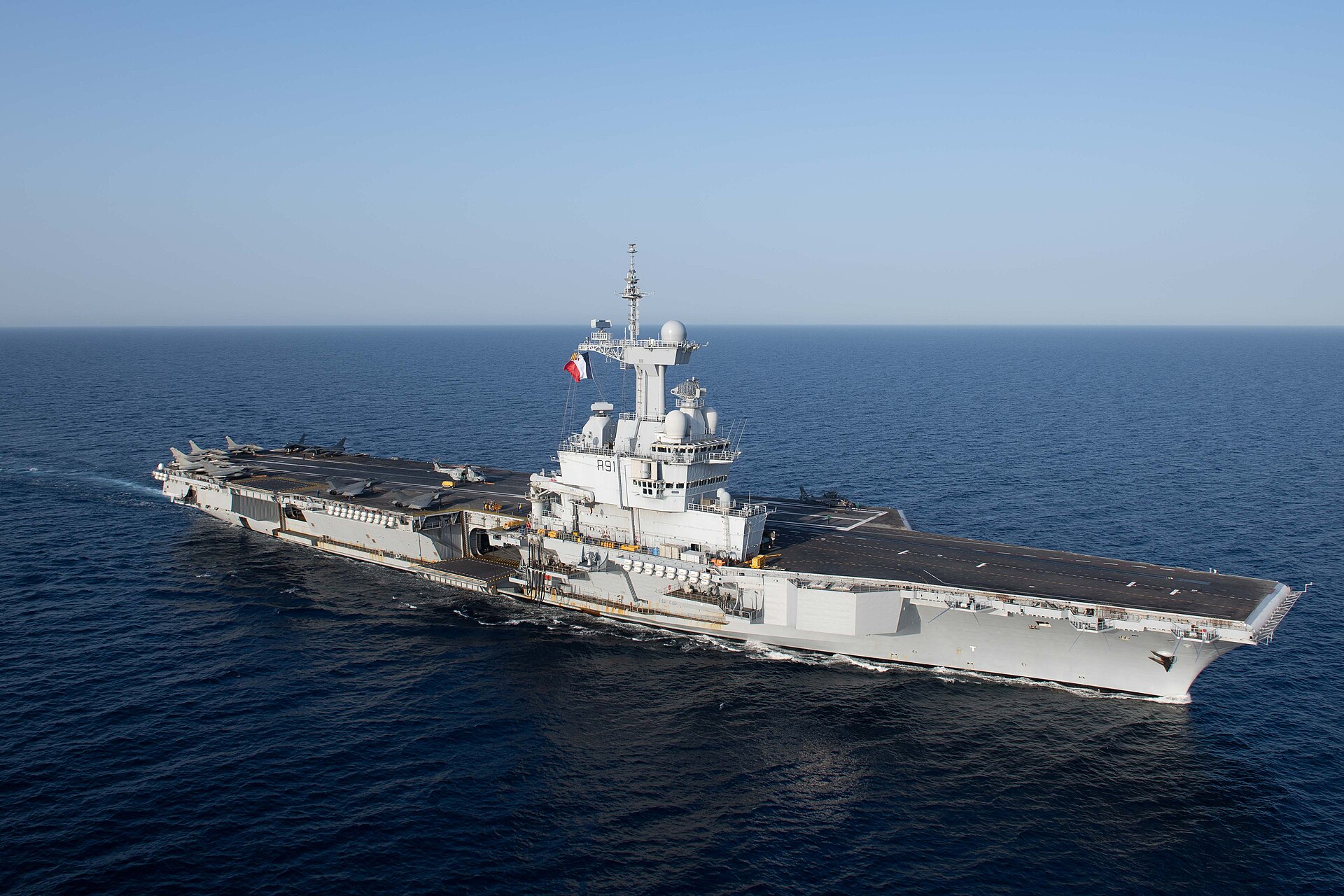
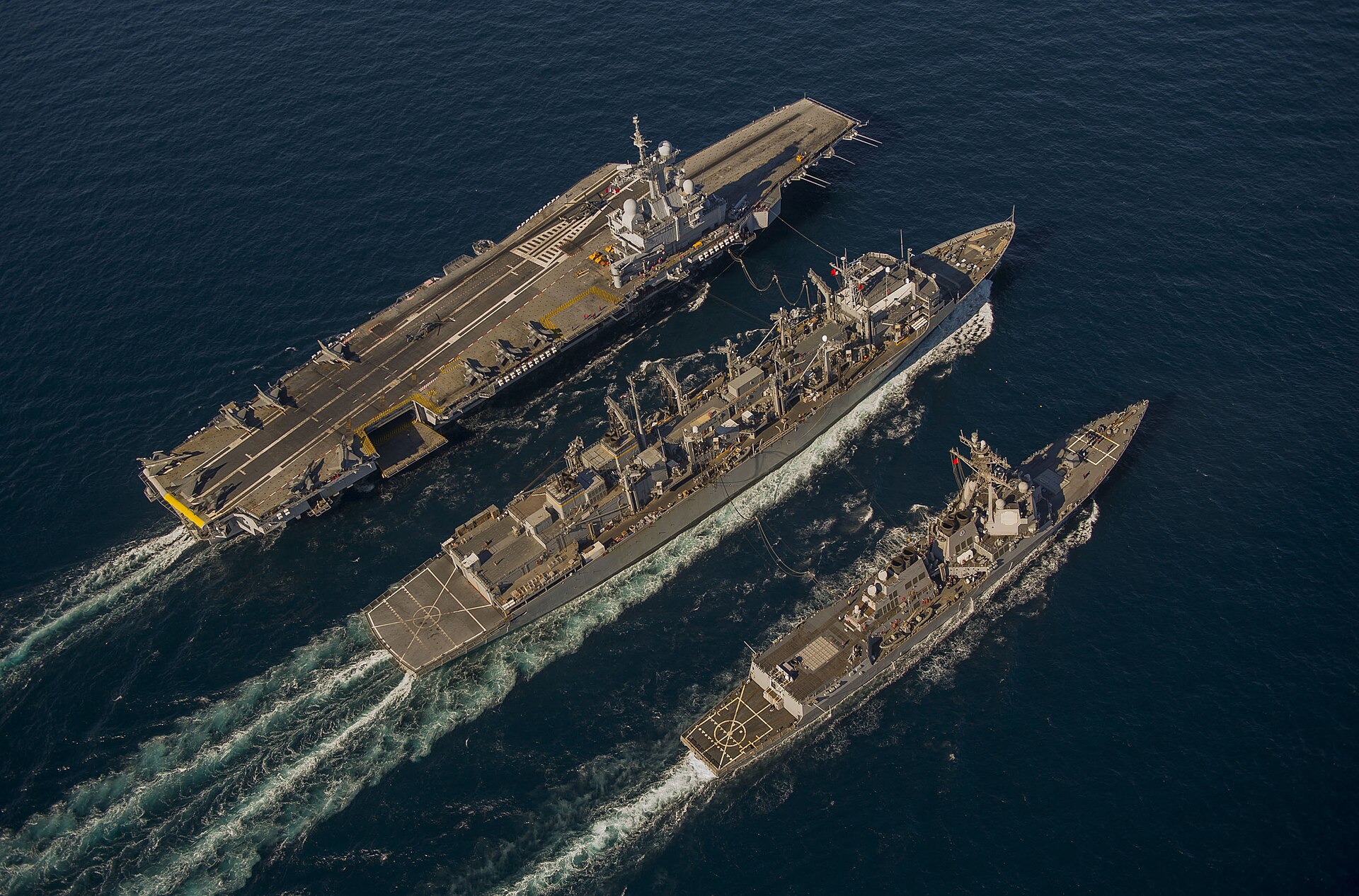
On May 6 — the same news cycle in which the San Antonio strike became public — France moved the Charles de Gaulle nuclear carrier strike group south of Suez into the Red Sea, according to Washington Times, NavalNews, and The National. The deployment positioned France’s primary naval asset for a potential France-UK escort mission through Hormuz.
An unnamed French official told Bloomberg on May 6 that the France-UK maritime coalition was “ready to escort tankers in Hormuz” if Iran agreed to the US proposal to end the war. The conditionality mattered: France was not threatening to force the strait open but offering escort as a service contingent on diplomatic progress — the opposite of Project Freedom’s unilateral approach.
Chatham House, in a May 2026 analysis of naval coalition design, recommended “compartmentalizing task groups allowing for escalation management with Iran” and suggested that limits on the use of force “would signal limited intent to a potentially hostile country like Iran.” The European model assumed a different theory of Hormuz — that the strait would be reopened through agreement, not forced — and designed its military posture accordingly.
The approach carried a visible complication. The IRGC had already struck two vessels operated by the coalition co-chair’s largest shipping company. The Charles de Gaulle’s deployment raised the question of what happens when the country offering escorts is also the country whose commercial fleet is being targeted. France-flagged warships would escort France-operated commercial vessels through a strait where France-operated commercial vessels had been fired on twice in 18 days.
The Everglade Precedent
The CMA CGM Everglade was struck on April 17 north of Kumzar, Oman, approximately 25 nautical miles from the standard Traffic Separation Scheme corridor. Wire services described the attack as “warning shots.” Container damage was limited, no crew were injured, and the vessel remained operational, according to Anadolu Agency and Seatrade Maritime.
The Everglade is French-flagged, IMO number 9894985, home port Marseille — no ambiguity about the national signal. The attack occurred on the same day as the France-UK 51-country Hormuz coalition summit and within 24 hours of the IRGC reversing Foreign Minister Araghchi’s declaration that the strait was “completely open.”
All four CMA CGM vessels attempting Hormuz exit that day aborted after the Everglade was hit. The message — delivered through a single strike with limited damage — was efficient: CMA CGM would not transit Hormuz without IRGC clearance.
The escalation from Everglade to San Antonio followed a clear gradient. Warning shots became a cruise missile. Zero casualties became eight injuries. A French-flagged vessel became a Maltese-flagged one — broadening the target set from French registry to French corporate ownership. The 18-day interval coincided with two diplomatic milestones: the launch of Project Freedom and the approach of the MOU.
| Attribute | CMA CGM Everglade (April 17) | CMA CGM San Antonio (May 5) |
|---|---|---|
| Flag state | France | Malta |
| Capacity | ~154,000 DWT / 366m LOA | 2,824 TEU |
| Weapon used | Warning shots | Cruise missile |
| Casualties | None | 8 crew injured |
| Vessel status post-strike | Operational; aborted transit | Crew evacuated |
| Diplomatic context | France-UK 51-country summit (same day) | MOU reportedly 48 hours away; Project Freedom Day 2 |
| Other CMA CGM vessels affected | 3 additional ships aborted transit | Project Freedom suspended for all traffic |
FAQ
Why would the IRGC target CMA CGM specifically rather than other shipping lines?
CMA CGM is the third-largest container shipping line globally and the largest headquartered in a country actively leading the Hormuz reopening coalition. France co-chairs the 51-country effort with the UK and has deployed the Charles de Gaulle carrier group. Targeting CMA CGM sends a coercive signal to Paris through its commercial fleet without directly striking a French military vessel — which under NATO Article 5 could trigger collective defense consultations. The IRGC has also seized vessels from MSC (Swiss-Italian, world’s largest by capacity) — the MSC Francesca, an 11,660-TEU ship, was taken on April 22. But no other single operator has been struck twice in 18 days.
How does the San Antonio strike differ from the HMM Namu attack on May 4?
The HMM Namu, a South Korean-connected vessel, was struck approximately 36 nautical miles north of Dubai on May 4 — one day before the San Antonio. South Korea does not co-chair any Hormuz coalition and has maintained a lower diplomatic profile on the crisis. The HMM Namu attack fits the IRGC’s pattern of generalized maritime interdiction across the Persian Gulf, which it declared a targeting zone in April. The San Antonio strike is the second hit on the same corporate operator in three weeks — the operator that belongs to the country leading the European push to reopen the strait. One is disruption. The other is coercion.
What is Project Freedom’s current status?
Project Freedom was launched May 4, 2026, as a US Navy escort program for commercial vessels transiting Hormuz. It was suspended after the San Antonio strike on May 5 — less than 48 hours of operation. A US military official attributed the failure partly to the vessel operator’s non-compliance with check-in procedures. As of May 7, no announcement of resumption has been made. The IRGC has conditioned Hormuz transit on US naval withdrawal, creating a structural impasse: the escort program designed to protect commercial shipping became the IRGC’s stated justification for targeting it.
Can a Hormuz MOU hold if the IRGC is not a signatory?
The MOU under negotiation is a government-to-government framework between Washington and Tehran. The IRGC is not a party to it — and ISW and Fortune have both documented the IRGC acting against the diplomatic interests of the Iranian government when Hormuz leverage is at stake. Iran’s 12-article Hormuz sovereignty law, advancing in parliament, would give the IRGC’s transit authority a statutory basis that cannot be waived by executive agreement. Any MOU that does not explicitly address IRGC operational control — not just Iranian government commitment — faces the same authorization ceiling that has derailed every ceasefire framework since March.
Has Iran claimed responsibility for the San Antonio strike?
Iran issued no specific public claim of responsibility for the San Antonio attack. PressTV, the IRGC-aligned English-language outlet, framed the Hormuz situation on May 5-6 as the IRGC “activating a new Strait of Hormuz transit system” — casting strikes as enforcement of a sovereign regulatory regime rather than military aggression. Iran separately denied striking the UAE on May 5 despite UAE Defense Ministry confirmation of cruise missile and drone intercepts, per Al Jazeera and CBS News. The pattern — operational action without formal attribution — has been consistent throughout the crisis and serves a specific legal purpose: deniability preserves the argument that Hormuz is being “managed,” not blockaded.
The deliberate targeting pattern behind both CMA CGM strikes, and what France’s decision to deploy the Charles de Gaulle carrier group to the Suez means for the coercive escalation ladder Iran is running, is examined in depth in Iran Has Struck Two French Ships in 17 Days. The Charles de Gaulle Just Entered the Suez.