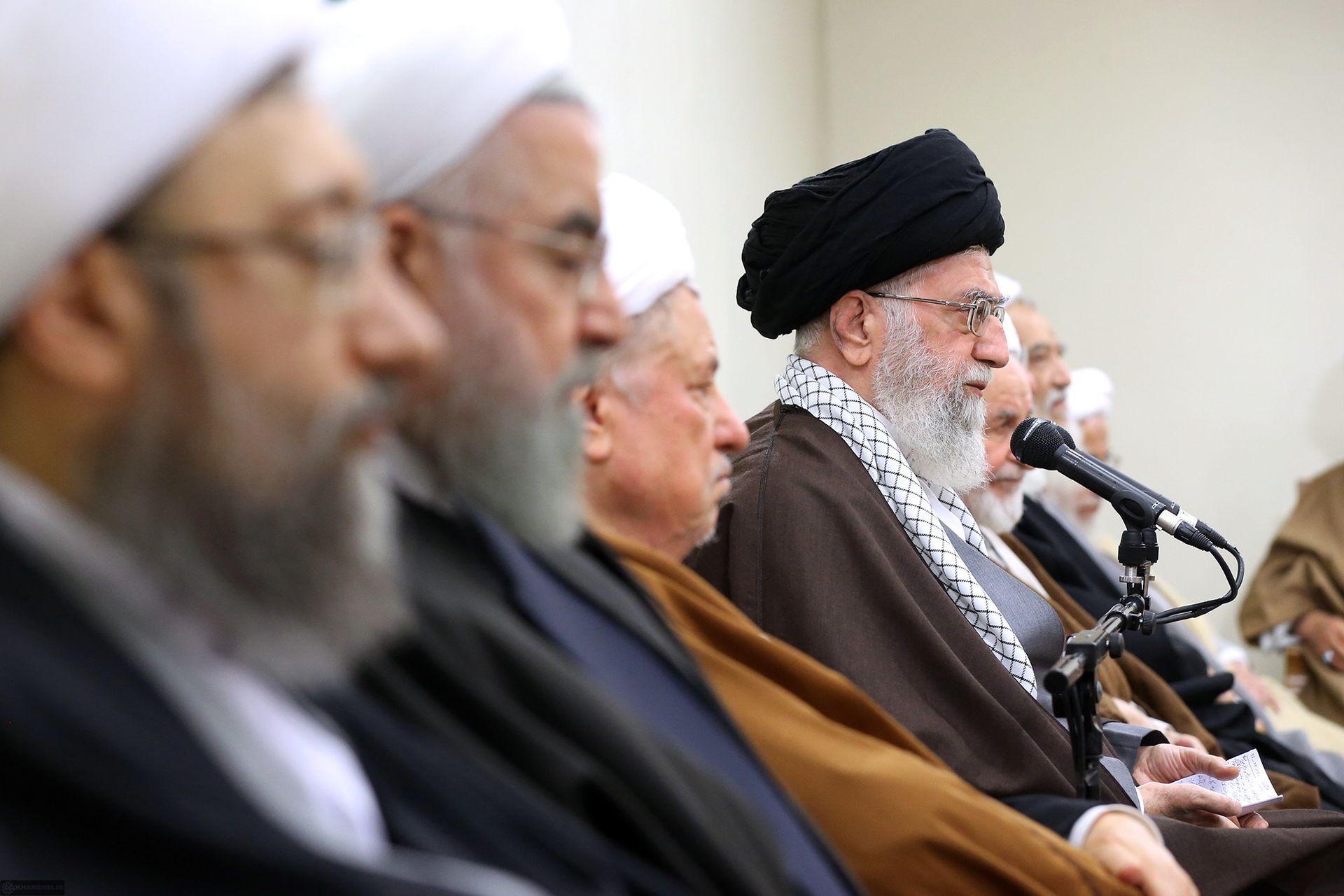

TEHRAN — Iran’s Assembly of Experts on Saturday named Mojtaba Khamenei, the 56-year-old son of assassinated Supreme Leader Ali Khamenei, as the Islamic Republic’s third supreme leader since its founding in 1979. The wartime succession, confirmed by the 88-member clerical body in what state media described as a “decisive vote,” installs a hardline figure with deep ties to the Islamic Revolutionary Guard Corps at the helm of a nation fighting a two-front war against the United States and Israel — and threatening Gulf states, including Saudi Arabia, with an expanding campaign of missile and drone attacks.
The appointment carries immediate implications for Riyadh. Saudi Arabia has intercepted dozens of Iranian missiles and drones over the past 10 days, sustained its first civilian casualties of the war in Al-Kharj, and deployed its diplomatic backchannel to Tehran with growing urgency. A new supreme leader who owes his position to the IRGC and is described by analysts as more hardline than his father signals that Iran’s retaliatory campaign against Gulf nations hosting American forces is unlikely to abate — and may intensify.
Table of Contents
- Who Is Mojtaba Khamenei?
- How Did the Assembly of Experts Select a New Supreme Leader?
- The IRGC’s Role in the Succession
- Trump Calls Appointment “Unacceptable”
- What Does Mojtaba Khamenei Mean for Saudi Arabia?
- Will Iran Pursue Nuclear Weapons Under New Leadership?
- How Does the Succession Change the War’s Trajectory?
- Regional and International Reaction
- Frequently Asked Questions
Who Is Mojtaba Khamenei?
Mojtaba Hosseini Khamenei, born on 8 September 1969 in Mashad, spent his formative years in the shadow of revolution and war. His father rose from the presidency to the supreme leadership in 1989, and Mojtaba followed a path through the institutions that his father would come to dominate — first the military, then the seminary, and finally the innermost circle of regime power.
He joined the Islamic Revolutionary Guard Corps in 1987 and served in the Habib ibn Mazaher Battalion of the 27th Mohammad Rasulullah Division during the Iran-Iraq War, according to research by the United Against Nuclear Iran (UANI) project. The battlefield forged connections with men who would become senior figures in the Iranian security apparatus, including Hossein Taeb, the former head of IRGC intelligence.
After the war, Mojtaba pursued religious studies at the Qom Seminary, studying under Ayatollah Mohammad Taghi Mesbah Yazdi — a cleric described by Iranian opposition media as having called for the killing of Iranian youths who promoted “Western immorality,” according to Britannica. Mesbah Yazdi’s influence shaped what analysts describe as Mojtaba’s exceptionally hardline worldview, placing him among the most conservative members of the principlist faction.
He has never held elected office or been subjected to a public vote. Instead, Mojtaba cultivated influence from the shadows. Axios reported that he allegedly engineered the 2005 election that installed Mahmoud Ahmadinejad as president. During the 2009 Green Movement protests, Mojtaba reportedly supervised the IRGC’s crackdown on demonstrators, according to Euronews. By 2009 he had taken control of the Basij paramilitary volunteer militia, cementing his authority over the regime’s internal enforcement apparatus.
The Middle East briefing 3,000+ readers start their day with.
One email. Every weekday morning. Free.
How Did the Assembly of Experts Select a New Supreme Leader?
The Assembly of Experts, the 88-member clerical body constitutionally responsible for selecting, supervising, and — in theory — dismissing the supreme leader, convened under extraordinary wartime conditions following the US-Israeli strikes that killed Ali Khamenei on 28 February 2026.
The body announced on 8 March that it had elected Mojtaba Khamenei in what it described as “the decisive vote of the representatives of the Assembly of Experts on Leadership,” according to state media reports carried by Al Jazeera. Iran’s President Masoud Pezeshkian hailed the selection, saying it reflected “Iran’s resilience and unity in the face of attacks by the United States and Israel,” NPR reported.
The process, however, was far from the deliberative, consensus-driven procedure that the Assembly’s constitution envisions. According to Iran International, the first electoral session was held online on 3 March — just three days after Ali Khamenei’s death — with IRGC commanders already exerting pressure on Assembly members. The speed of the process and the pre-ordained outcome prompted immediate questions about the legitimacy of what the Assembly framed as a free election. The succession has triggered a broader crisis of Islamic authority that extends across the Sunni-Shia divide and into the corridors of every Muslim-majority government weighing its response to the war.
Father-to-son succession carries particular sensitivity in the Islamic Republic. The 1979 revolution toppled the US-backed Pahlavi dynasty, making hereditary power transfer a symbol of the monarchical system the revolutionaries sought to destroy. The Washington Post reported that Mojtaba’s appointment has been met with unease even among regime loyalists who view the father-to-son handoff as contradicting the republic’s foundational principles.
The IRGC’s Role in the Succession
The Revolutionary Guard’s influence over the succession was not subtle. Iran International reported that starting in the early hours of 3 March, IRGC commanders engaged in “repeated contacts and psychological and political pressure” on Assembly of Experts members to vote for Mojtaba Khamenei. The pressure campaign targeted individual members over several days before the formal announcement on 8 March.
Mojtaba’s deep institutional ties to the IRGC made him the military establishment’s preferred candidate. His wartime service, his close relationships with senior guard commanders including IRGC chief Ahmad Vahidi and Parliament Speaker Mohammad Bagher Ghalibaf, and his control of the Basij gave him a power base that no other candidate could match, according to UANI research.
The IRGC’s calculations were both ideological and practical. With Iran under active military assault, the Guards needed a supreme leader who would maintain their institutional prerogatives, authorize continued retaliatory strikes against US bases in Gulf states, and resist any ceasefire that Washington or Riyadh might attempt to negotiate. Mojtaba, analysts say, meets all three criteria.
US News reported that Iran’s clerical leadership “chose confrontation over compromise” in appointing Mojtaba — a move regional officials described as a direct rebuke to President Donald Trump, who had publicly demanded involvement in selecting Iran’s next leader.
Trump Calls Appointment “Unacceptable”
President Trump’s response was characteristically blunt. In an exclusive interview with Axios published on 5 March — before the formal announcement but after Mojtaba’s selection appeared certain — Trump declared: “Khamenei’s son is unacceptable to me. We want someone that will bring harmony and peace to Iran.”
Trump went further, claiming personal authority over the selection process. “I have to be involved in the appointment, like with Delcy [Rodriguez] in Venezuela,” he told Axios, drawing a parallel to his administration’s intervention in Venezuela, where US strikes led to the ousting and capture of then-President Nicolás Maduro. Bloomberg reported that the White House viewed the Khamenei family maintaining power as incompatible with the war’s stated objective of ending Iran’s “destabilizing behavior.”
The demand was dismissed in Tehran. By proceeding with Mojtaba’s appointment three days later, the Assembly of Experts signaled that Iran’s wartime leadership would not be subject to American approval. The Soufan Center, a security research organization, noted in its 8 March intelligence brief that the US “struggles with exit strategy as Iran selects new supreme leader,” observing that Washington had no practical mechanism to influence the clerical body’s decision.
The disconnect between Trump’s demands and Iran’s actions raises questions about the broader US strategy in the Gulf. If the war’s implicit aim included regime change or at minimum regime transformation, Mojtaba’s installation represents a failure of that objective — the regime has reconstituted itself, potentially in a more hardline form, within 10 days of its supreme leader’s assassination.
What Does Mojtaba Khamenei Mean for Saudi Arabia?
For Saudi Arabia, the appointment represents a significant complication to its already urgent diplomatic efforts to de-escalate the conflict. Bloomberg reported on 6 March that Saudi officials had intensified their direct backchannel to Iran with growing urgency. The question now confronting Riyadh is whether Mojtaba Khamenei — who owes his position to the IRGC and whose political identity is defined by confrontation — will prove receptive to Saudi overtures.
The early evidence is not encouraging. Since the war began on 28 February, Saudi Arabia has intercepted cruise missiles near Al Jouf, ballistic missiles targeting Prince Sultan Air Base, and at least 15 drones over Riyadh, according to the Saudi Defence Ministry. On 8 March — the same day Mojtaba’s appointment was announced — a military projectile struck a residential area in Al-Kharj, killing two foreign nationals and wounding 12, marking Saudi Arabia’s first civilian casualties of the war.
| Date | Target | Weapon Type | Outcome |
|---|---|---|---|
| Mar 1 | US positions in Saudi Arabia | Missiles/drones | 1 US service member wounded (later died Mar 8) |
| Mar 3 | US Embassy, Riyadh | Drones | Embassy struck, operations suspended |
| Mar 5 | Near Al Jouf | 2 cruise missiles | Intercepted and destroyed |
| Mar 6 | Prince Sultan Air Base | 3 ballistic missiles | Intercepted and destroyed |
| Mar 7 | Shaybah oil field | Drone | Intercepted |
| Mar 7 | Ras Tanura refinery | Drones | Partial shutdown of 550,000 bpd facility |
| Mar 8 | Al-Kharj residential area | Military projectile | 2 killed, 12 wounded (first civilian deaths) |
| Mar 9 | Riyadh Diplomatic Quarter | 15 drones | Intercepted by Saudi Defence Ministry |
Crown Prince Mohammed bin Salman has received solidarity calls from the Crown Prince of Kuwait and Ukrainian President Volodymyr Zelenskyy in recent days. Zelenskyy offered Saudi Arabia Ukrainian expertise in countering Iranian Shahed drones, telling reporters that “Ukrainians have been fighting against Shahed drones for years now, and everyone recognises that no other country in the world has this kind of experience,” Al Jazeera reported. Saudi Arabia’s acceptance of such assistance would itself represent a dramatic shift in its traditionally cautious approach to the Russia-Ukraine conflict.
The Saudi Defence Ministry’s response has been measured in its public messaging, focusing on operational intercept reports rather than political commentary on Iran’s leadership transition. But the kingdom’s military has raised its readiness levels, according to France 24, and Saudi Arabia has warned of a possible military response if its oil infrastructure continues to be targeted.
Will Iran Pursue Nuclear Weapons Under New Leadership?
Perhaps the most consequential question surrounding Mojtaba Khamenei’s appointment concerns Iran’s nuclear programme. His father, Ali Khamenei, maintained a religious fatwa prohibiting nuclear weapons — though the sincerity and binding nature of that edict was contested by Western intelligence agencies and think tanks, including the Atlantic Council, which published research arguing that the fatwa amounted to “a false narrative” that “Iran sold the world.”
Analysts at the Washington Institute for Near East Policy have assessed that Mojtaba “may decide that Iran must move quickly to obtain nuclear weapons in order to forestall future U.S. and Israeli attacks.” The logic is straightforward: the US-Israeli strikes that killed his father demonstrated that Iran’s conventional deterrent and its network of proxy forces were insufficient to prevent a direct assault on the country’s leadership. A nuclear weapon would fundamentally alter that calculus.
For Saudi Arabia, an Iranian nuclear breakout under Mojtaba’s leadership would trigger the kingdom’s own nuclear hedging strategy. Crown Prince Mohammed bin Salman stated publicly in 2023 that Saudi Arabia would pursue nuclear weapons if Iran acquired them. The November 2025 defense pact with Washington, which granted Saudi Arabia major non-NATO ally status and offered F-35 fighter jets, included provisions for civilian nuclear cooperation — but the line between civilian and military nuclear capability remains a matter of intense concern for proliferation experts, according to CSIS analysis.
How Does the Succession Change the War’s Trajectory?
The Daily Telegraph predicted that Mojtaba would view the United States as an “implacable enemy” and would be “likely to escalate the conflict and unlikely to make any compromises.” Whether that assessment proves correct depends in large part on the institutional constraints Mojtaba faces — and the condition of the military apparatus he now commands.
Iran’s war machine, while degraded by 10 days of US-Israeli strikes, retains significant capacity. The country has fired ballistic missiles, cruise missiles, and hundreds of drones at targets across the Gulf, including Kuwait, Iraq, Saudi Arabia, the UAE, and Bahrain, according to Al Jazeera. Iran has also struck civilian infrastructure, including a Bahraini desalination plant, in what PBS described as a dangerous widening of the conflict’s targeting parameters.
The war’s toll has been severe. At least 1,230 people have been killed in Iran, 397 in Lebanon, and 11 in Israel, according to Al Jazeera’s live tracker. Seven American service members have died, including the seventh — an Army soldier wounded in the 1 March attack in Saudi Arabia — who succumbed to injuries on 8 March, CNN reported.
Mojtaba inherits a country under sustained aerial bombardment. Israeli strikes destroyed oil depots in Tehran on the night of 7-8 March. The IRGC’s conventional military infrastructure has been significantly damaged. But Iran’s missile production capacity — dispersed across hardened underground facilities — remains partially intact, and the country’s drone arsenal is far from exhausted.
The succession also carries implications for Iran’s naval posture in the Strait of Hormuz, where mines and anti-ship missiles have disrupted global shipping. A new supreme leader seeking to demonstrate strength in his opening days may authorise further escalation — particularly against the oil infrastructure of Gulf states that host American forces.
Regional and International Reaction
The Arab League’s secretary-general condemned Iran’s “reckless policy” of attacking neighbouring countries, though the statement stopped short of addressing the succession directly. The US State Department ordered the departure of non-emergency personnel from embassies in Saudi Arabia, Qatar, Kuwait, Jordan, and Bahrain — a measure that predated Mojtaba’s appointment but underscores the continued deterioration of the regional security environment.
The embassy drawdown proved prescient: within days, Washington ordered its embassy staff to leave Saudi Arabia entirely as oil prices broke past $110 per barrel, a milestone that underscored how the new supreme leader’s appointment had failed to calm either markets or military planners.
Israel has maintained its bombing campaign regardless of the leadership transition. The Times of Israel reported that Israeli intelligence believes Mojtaba Khamenei survived an assassination attempt in the opening strikes that killed his father, and was wounded but remains functional. Whether Israel views the new supreme leader as a viable negotiating partner or an enhanced target remains unclear.
For the Gulf Cooperation Council, Mojtaba’s appointment reinforces the urgency of collective defence coordination. MBS and the Crown Prince of Kuwait jointly condemned Iran’s attacks as “a violation of sovereignty and security” and reaffirmed their commitment to “strengthening joint coordination among GCC countries,” Al Arabiya reported. But the Gulf states’ varying degrees of exposure to Iranian strikes — from Bahrain’s near-daily bombardment to Oman’s studied neutrality — make unified policy responses difficult.
| Actor | Response | Source |
|---|---|---|
| Donald Trump (US) | “Khamenei’s son is unacceptable to me. I have to be involved in the appointment.” | Axios, 5 March |
| Masoud Pezeshkian (Iran) | Hailed selection as reflecting “Iran’s resilience and unity” | NPR, 8 March |
| Arab League | Condemned Iran’s “reckless policy” of attacking neighbours | Al Jazeera, 8 March |
| Saudi Arabia / Kuwait | Joint condemnation of Iranian attacks as “violation of sovereignty” | Al Arabiya, 6 March |
| Volodymyr Zelenskyy (Ukraine) | Offered MBS help countering Iranian drones | Al Jazeera, 7 March |
| Israel | Continued strikes; believes Mojtaba survived assassination attempt | Times of Israel, 8 March |
The Soufan Center’s 8 March intelligence brief observed that the succession “creates an even more uncertain strategic environment” because Mojtaba’s instincts and decision-making processes under pressure are largely unknown outside Iran’s inner circle. Unlike his father, who spent 35 years as supreme leader and whose red lines and negotiating patterns were well-mapped by foreign intelligence services, Mojtaba is an untested quantity at the helm of a state at war.
The appointment also raises questions about internal cohesion. Euronews reported that Mojtaba is “not particularly popular in Iran,” and that the father-to-son succession has drawn comparisons to the Pahlavi monarchy — an analogy that strikes at the Islamic Republic’s founding myth. Whether Mojtaba can consolidate authority while fighting a war and managing a population that has staged repeated uprisings in recent years — including the 2022 Mahsa Amini protests — remains an open question. His reliance on IRGC coercion to secure the appointment suggests that legitimacy, rather than military strategy, may prove his most pressing vulnerability. The tension between the IRGC-backed new Supreme Leader and the elected president who has attempted to apologize to Gulf states for Iranian missile strikes reveals a governance crisis that may shape the war’s outcome as much as any military operation.
Frequently Asked Questions
Who is Mojtaba Khamenei and why was he chosen?
Mojtaba Khamenei, born in 1969, is the second son of the late Ali Khamenei and a cleric with deep ties to the IRGC. The Assembly of Experts elected him on 8 March 2026 following his father’s assassination on 28 February. The IRGC reportedly pressured Assembly members to select him through what Iran International described as “repeated contacts and psychological and political pressure.”
How does Mojtaba’s appointment affect the Iran war?
Analysts predict escalation. The Daily Telegraph assessed that Mojtaba views the United States as an “implacable enemy” and is unlikely to compromise. His appointment signals that Iran’s retaliatory campaign against Gulf states hosting US forces — including the missile and drone attacks that have hit Saudi Arabia — will continue and may intensify under the new supreme leader.
What are the implications for Saudi Arabia?
Saudi Arabia faces a more hardline interlocutor in Tehran at a time when the kingdom is sustaining direct attacks on its military bases, oil infrastructure, and residential areas. The Saudi diplomatic backchannel to Iran, which Bloomberg reported had been deployed with growing urgency, faces an uncertain reception under a leader whose power base is the very military organisation conducting the attacks on Saudi soil.
Will Iran pursue nuclear weapons under Mojtaba Khamenei?
The Washington Institute for Near East Policy has assessed that Mojtaba “may decide that Iran must move quickly to obtain nuclear weapons” to prevent future US-Israeli attacks. His father maintained a contested fatwa against nuclear weapons. Mojtaba is not bound by that edict, and the war has demonstrated the limits of conventional deterrence against the combined US-Israeli military.
Why did Trump say the appointment was “unacceptable”?
President Trump told Axios on 5 March that he wanted personal involvement in selecting Iran’s next leader, drawing a parallel to US intervention in Venezuela. He called Mojtaba “a lightweight” and said the choice was “unacceptable.” Iran proceeded with the appointment three days later, in what US News described as a direct rebuke to Trump’s demands.
For a comprehensive analysis of Mojtaba Khamenei’s biography, IRGC connections, financial empire, and what his leadership means for Saudi Arabia, see our in-depth profile of Iran’s new Supreme Leader. Since his appointment, Mojtaba has been confirmed wounded and has not appeared publicly — raising urgent questions about who actually controls Iran’s war machine. The theological legitimacy crisis his appointment triggered has become a defining vulnerability of the Islamic Republic.