
RIYADH — Saudi Arabia is building fifteen stadiums, training one hundred and thirty-four facilities, and preparing to welcome more than a million visitors for the 2034 FIFA World Cup — the most ambitious sporting project in the Kingdom’s history. Iranian drones are now reaching every city on the venue list. Two weeks into a war that has sent missiles over Riyadh’s Diplomatic Quarter, shut down the Strait of Hormuz, and forced the evacuation of foreign workers from the Eastern Province, the single most expensive bet in Saudi Arabia’s Vision 2030 portfolio faces a threat that no bid book anticipated: a live shooting war with the regional power whose missiles can strike every proposed stadium within ninety minutes of launch.
The security threat has already claimed its first major sporting casualty. Formula 1 cancelled both the Saudi Arabian and Bahrain Grands Prix on March 13, citing logistics constraints, insurance failures, and the ongoing drone and missile threat — the first time in the sport’s history that Middle Eastern races have been pulled due to an active military conflict.
The 2034 tournament, awarded to Saudi Arabia by FIFA in December 2024, was designed to be Mohammed bin Salman’s crowning achievement — the moment the Kingdom proved to the world that it had completed its transformation from oil state to entertainment superpower. An estimated $26 billion in stadium and infrastructure investment, spread across five cities from Riyadh to NEOM, was supposed to showcase the post-oil Saudi Arabia that MBS has been selling to investors since 2016. Instead, the project now sits at the intersection of the Kingdom’s greatest ambition and its greatest vulnerability. The war with Iran threatens not just the construction timeline but the very premise that Saudi Arabia can guarantee the safety of sixty-four matches, thirty-two national teams, and potentially three million visiting fans in a country where air raid sirens have become a nightly occurrence.
Table of Contents
- What Is Saudi Arabia’s 2034 World Cup Plan?
- Which 2034 World Cup Stadiums Are in the Iranian Strike Zone?
- Can Saudi Arabia Build Eleven Stadiums While Fighting a War?
- The Venue Viability Matrix — Scoring Every World Cup City
- What Would It Take to Defend a World Cup Stadium From Drones?
- What Qatar 2022 Reveals About Wartime Tournament Risk
- Why FIFA Has Said Nothing About the War and the 2034 World Cup
- The $51 Billion Sports Empire at Stake
- What Happens to World Cup Sponsors and Insurers During a War?
- How Is the War Affecting the World Cup Workforce?
- The Contrarian Case — Why the War Makes the World Cup More Likely
- Has FIFA Ever Moved a World Cup?
- Three Scenarios for 2034
- Frequently Asked Questions
What Is Saudi Arabia’s 2034 World Cup Plan?
Saudi Arabia’s bid for the 2034 FIFA World Cup commits to fifteen stadiums across five host cities: Riyadh, Jeddah, Al Khobar, Abha, and NEOM. The plan requires building eleven new venues from scratch while upgrading four existing facilities — the largest stadium construction programme undertaken by any World Cup host since Qatar’s eight-venue build for 2022. Total infrastructure spending is projected at $26 billion, according to FIFA’s evaluation report, though independent analysts at Consultancy ME estimate the true cost could exceed $40 billion once transportation, hospitality, and urban development are included.
The centrepiece is the King Salman International Stadium in Riyadh, a 92,760-seat colossus designed to host the opening match and the final. Construction was scheduled to begin in 2025, with completion targeted for 2029 — five years before kickoff. As of March 2026, groundwork has commenced but structural steel has not risen. The project sits in the early stages of a build that, under peacetime conditions, would have been comfortably on schedule.
The most technically audacious venue is the NEOM Stadium, a 46,000-capacity arena planned for integration into the roof of The Line — the 170-kilometre linear city that forms NEOM’s core urban concept. Perched 350 metres above the desert floor, the stadium would be the first venue in World Cup history built into the facade of a skyscraper. Construction is not scheduled to begin until 2027, with a 2032 completion target. Even before the war, sceptics questioned whether the engineering timeline was realistic. ESPN reported in October 2025 that the stadium’s integration into The Line’s structure made it dependent on construction progress at The Line itself — a project that has already been scaled back from its original specifications.
The Middle East briefing 3,000+ readers start their day with.
One email. Every weekday morning. Free.
| Stadium | City | Capacity | Status (March 2026) | Distance from Iran (km) |
|---|---|---|---|---|
| King Salman International Stadium | Riyadh | 92,760 | Early groundwork | 1,150 |
| Prince Mohammed bin Salman Stadium | Riyadh (Qiddiya) | 45,000 | Under construction | 1,180 |
| King Fahd International Stadium | Riyadh | 68,752 | Operational (renovation planned) | 1,150 |
| Prince Faisal bin Fahd Stadium | Riyadh | 22,500 | Renovation by 2027 | 1,150 |
| King Abdullah Sports City | Jeddah | 62,345 | Operational (renovation planned) | 1,680 |
| New Jeddah Stadium | Jeddah | 45,000 | Planning stage | 1,680 |
| Aramco Stadium | Al Khobar | 45,000 | Under construction | 380 |
| Al Khobar Waterfront Stadium | Al Khobar | 45,000 | Planning stage | 380 |
| NEOM Stadium (The Line) | NEOM | 46,000 | Pre-construction | 1,520 |
| NEOM Bay Stadium | NEOM | 40,000 | Planning stage | 1,520 |
| Abha Stadium | Abha | 45,000 | Planning stage | 1,800 |
Three stadiums are currently under active construction: the Aramco Stadium in Al Khobar (scheduled for completion in 2026 to host the 2027 Asian Cup), the Prince Mohammed bin Salman Stadium at Qiddiya, and one Riyadh venue undergoing early-phase work. The remaining eight exist as architectural renderings, planning documents, and cleared land. This means Saudi Arabia needs to break ground on and complete eight major stadiums between now and 2033 — a seven-year window that the war is already compressing.
Which 2034 World Cup Stadiums Are in the Iranian Strike Zone?
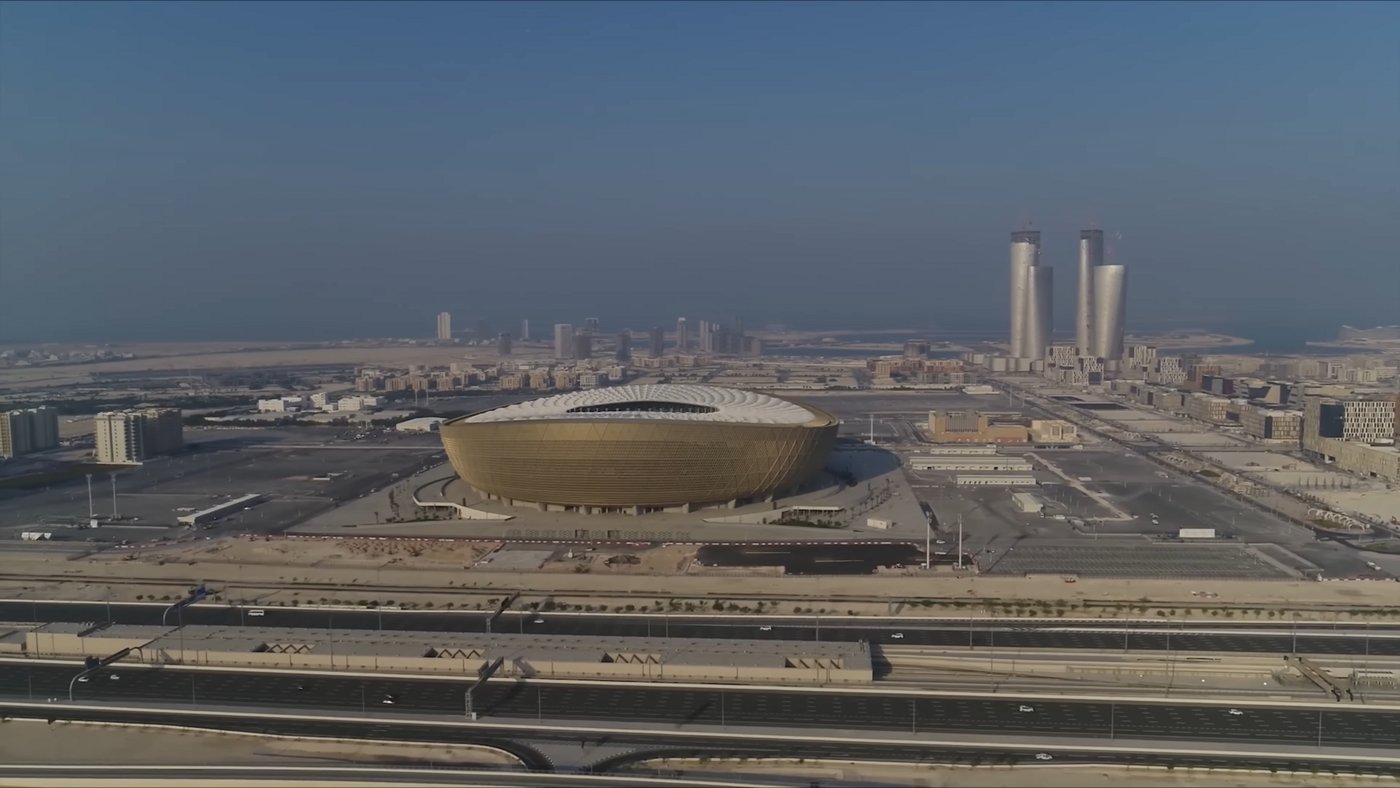
Every single one. Iran’s ballistic missile inventory includes the Shahab-3 (range: 1,300 kilometres), the Ghadr-1 (range: 1,950 kilometres), and the Emad (range: 1,700 kilometres), according to the International Institute for Strategic Studies’ 2026 Military Balance assessment. The farthest proposed World Cup venue — Abha, in the Asir mountains of southwestern Saudi Arabia — sits approximately 1,800 kilometres from Iran’s western launch sites. The closest — the Aramco Stadium in Al Khobar — is just 380 kilometres from the Iranian coast, within range of not just ballistic missiles but also the short-range cruise missiles and kamikaze drones that have formed the backbone of Iran’s current offensive.
The war has already demonstrated that Iran can deliver ordnance to every host city. On March 13, 2026, Saudi air defences intercepted and destroyed 31 drones and three ballistic missiles targeting multiple sites across the Kingdom, according to the Saudi Ministry of Defence. Riyadh’s Diplomatic Quarter — less than fifteen kilometres from the King Fahd International Stadium — was specifically targeted. Drones have reached Shaybah in the Empty Quarter, some 600 kilometres from any Iranian launch point, proving that distance alone provides no sanctuary.
Al Khobar presents the most acute vulnerability. The Aramco Stadium sits in the Eastern Province, where Saudi Arabia’s oil infrastructure is concentrated and where the Kingdom’s military resources are already stretched thin defending Ras Tanura, Abqaiq, and Dhahran. Staging World Cup matches in Al Khobar would require defending a stadium packed with 45,000 spectators while simultaneously protecting critical oil facilities within a fifty-kilometre radius — a dual-defence challenge that no air defence network has ever been asked to execute simultaneously.
Can Saudi Arabia Build Eleven Stadiums While Fighting a War?
The construction challenge was formidable before the war. Saudi Arabia’s giga-project pipeline — NEOM, Qiddiya, the Red Sea Global resort, King Salman Park, and the Diriyah Gate project — was already absorbing the Kingdom’s construction capacity. Project awards nearly halved in the first nine months of 2025, according to MEED Projects data, and the Kingdom’s construction sector was experiencing a rationalisation that saw salary premiums for foreign workers decline as the Public Investment Fund reordered its spending priorities.
The war has compounded every pre-existing constraint. Saudi Arabia cannot build and fight at the same time, and the numbers explain why. Construction materials that arrive through the Persian Gulf — steel, cement additives, electrical components, heavy machinery — now face either the Hormuz blockade or the longer and more expensive routing through the Red Sea via the Suez Canal or around the Cape of Good Hope. Shipping costs for Very Large Crude Carriers hit an all-time high of $423,736 per day in March 2026, according to LSEG data. Construction materials follow the same shipping lanes and face the same wartime premiums.
The workforce dimension is equally critical. Saudi Arabia hosts 13.4 million migrant workers, with Indian, Bangladeshi, and Pakistani nationals forming the core of the construction labour force. Human Rights Watch’s December 2024 report documented how these workers already faced dangerous conditions on giga-projects with “tight and unrealistic deadlines.” The war has introduced a new variable: personal safety. The US Embassy in Riyadh issued a security alert on March 12, 2026, and foreign governments have begun advising their citizens to leave. Construction workers, who are paid a fraction of what white-collar expatriates earn, have the least incentive to stay and the most to fear from drone attacks on industrial zones.
A timeline analysis suggests that the war needs to end within eighteen months for the construction programme to remain viable. The Aramco Stadium — the venue closest to completion — was scheduled for 2026 delivery but is now subject to the same Eastern Province security disruptions affecting Aramco’s own operations. The King Salman International Stadium needs a minimum of four years of uninterrupted construction. The NEOM Stadium, with its dependency on The Line’s own troubled timeline, likely needs six. Every month of war is a month of delay, and the 2034 deadline does not move.
The Venue Viability Matrix — Scoring Every World Cup City
Not all five host cities face equal risk. A systematic assessment of each venue’s viability under wartime conditions reveals a stark hierarchy. Four factors determine whether a World Cup city can function as planned: proximity to the Iranian threat axis, existing air defence coverage, construction progress, and the availability of alternative venues if the primary stadium cannot be completed.
| City | Threat Proximity (1-5) | Air Defence Coverage (1-5) | Construction Progress (1-5) | Alternative Venues (1-5) | Viability Score (/20) |
|---|---|---|---|---|---|
| Riyadh | 3 | 5 | 4 | 5 | 17 |
| Jeddah | 4 | 4 | 3 | 4 | 15 |
| Abha | 5 | 2 | 1 | 1 | 9 |
| NEOM | 4 | 2 | 1 | 1 | 8 |
| Al Khobar | 1 | 3 | 3 | 2 | 9 |
Riyadh scores highest. The capital has Saudi Arabia’s densest concentration of air defence assets — Patriot batteries, THAAD systems, and the Kingdom’s most sophisticated radar coverage. It already has two operational stadiums (King Fahd International Stadium and Prince Faisal bin Fahd Stadium) and active construction at two more. Even if the war delays the King Salman International Stadium, Riyadh could host matches in upgraded existing venues. The city also offers the deepest hotel inventory, the most developed airport infrastructure, and proximity to the political apparatus that would oversee tournament security.
Jeddah performs reasonably well. Its Red Sea location places it 1,680 kilometres from Iran’s western border — the farthest major city from the threat axis after Abha. King Abdullah Sports City is already operational at 62,345 capacity. The city’s air defence coverage is adequate if not as dense as Riyadh’s, and Jeddah’s experience hosting Formula 1 and major boxing events has built institutional competence in large-scale event security.
Al Khobar, NEOM, and Abha all face serious viability questions. Al Khobar’s Eastern Province location places it within drone range of Iranian bases across the Persian Gulf — a distance of roughly 380 kilometres that even the cheapest Iranian drones can traverse. NEOM’s stadium depends on a construction timeline that was already unrealistic before the war, and the remote northwestern location lacks the air defence infrastructure that Riyadh and Dhahran benefit from. Abha, while geographically distant from Iran, has minimal existing infrastructure and no operational stadiums.
What Would It Take to Defend a World Cup Stadium From Drones?
Protecting a World Cup stadium is fundamentally different from protecting a military base or an oil refinery. A Patriot battery defending Ras Tanura can fail to intercept one drone in twenty and the damage is industrial — a pipeline damaged, a tank farm hit, production temporarily disrupted. A single drone penetrating the airspace above a stadium packed with 45,000 spectators would be a mass-casualty event broadcast live to billions of viewers. The standard of protection required is not military-grade. It is total.
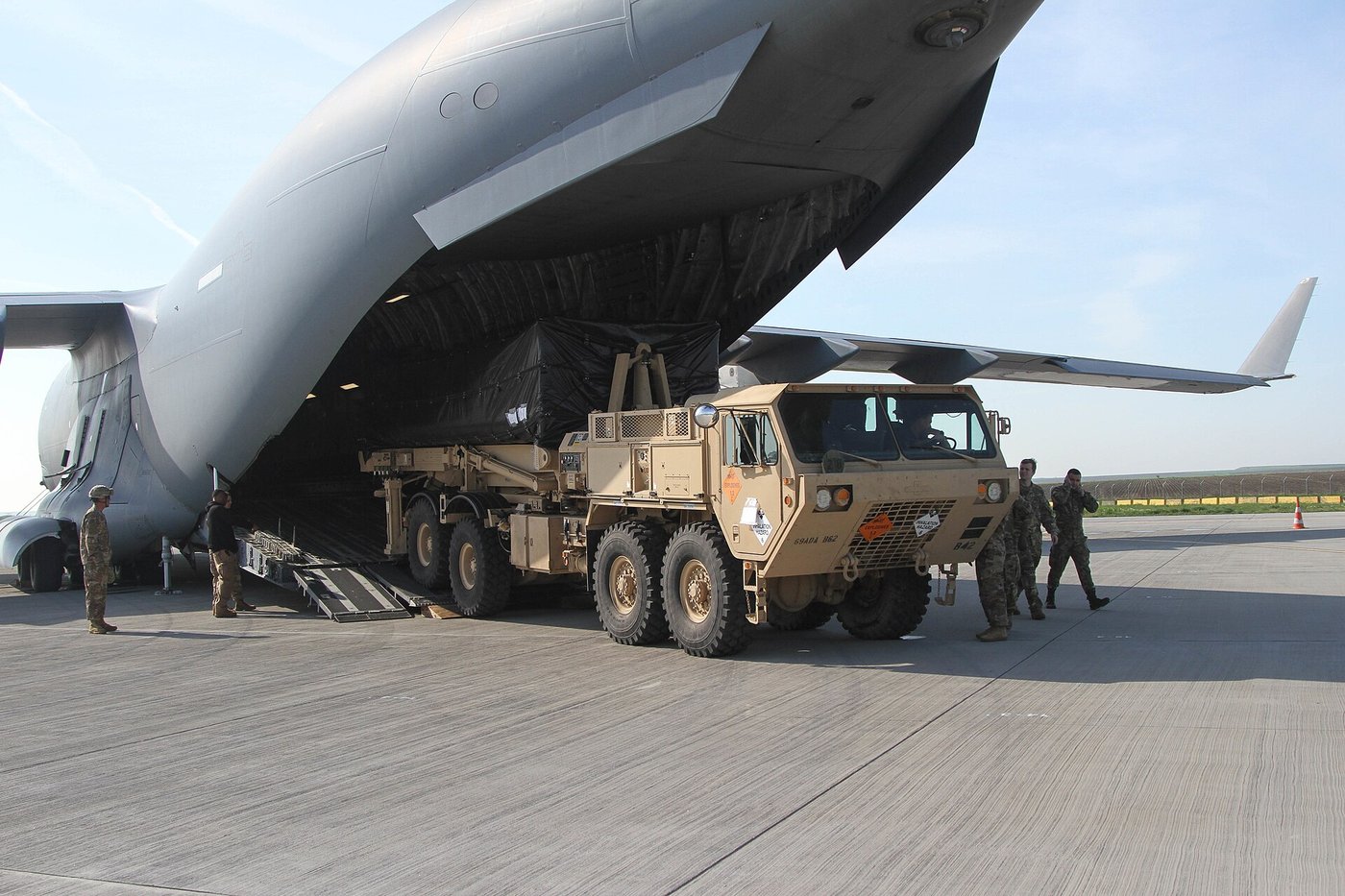
The current air defence architecture in Saudi Arabia was never designed for this mission. The Kingdom’s Patriot and THAAD systems are optimised for point defence of high-value military and industrial targets — airbases, oil refineries, command centres, and royal palaces. Protecting fifteen stadiums simultaneously during a sixty-four-match tournament would require establishing dedicated air defence perimeters around each venue, with overlapping coverage zones and counter-drone systems capable of detecting and neutralising low-altitude threats that fly beneath conventional radar coverage.
The cost would be staggering. A single Patriot battery costs approximately $1.1 billion, and each interceptor missile costs between $3 million and $4 million, according to Raytheon’s publicly disclosed pricing. Deploying dedicated air defence at fifteen venues, with redundancy, would require at minimum thirty additional batteries — a $33 billion investment in air defence hardware alone, exceeding the entire stadium construction budget. This does not include the electronic warfare systems, counter-drone lasers, and sensor networks that a comprehensive stadium defence architecture would demand.
The alternative — and likely the approach Saudi Arabia would pursue — is to establish temporary no-fly zones around venues during match days, with mobile air defence assets repositioned according to the tournament schedule. South Korea and Japan employed a version of this approach during the 2002 World Cup, following the September 11 attacks, deploying Patriot batteries near stadiums and enforcing temporary flight restrictions. The scale in Saudi Arabia would need to be considerably larger, and the threat considerably more sophisticated than anything faced by a previous World Cup host.
What Qatar 2022 Reveals About Wartime Tournament Risk
Qatar hosted the 2022 FIFA World Cup against a backdrop of regional tension, but nothing approaching active warfare. The tournament took place in a compact city-state where all eight venues were within a fifty-kilometre radius of Doha, making centralised security feasible. Saudi Arabia’s 2034 plan distributes venues across five cities spanning roughly 1,500 kilometres of territory — a security perimeter that is orders of magnitude more complex.
Qatar spent an estimated $220 billion preparing for its tournament, according to a widely cited analysis by Bloomberg — a figure that included the construction of an entirely new city (Lusail), a metro system, a new airport terminal, and substantial upgrades to national infrastructure. Saudi Arabia’s planned $26 billion spend is modest by comparison, though the Kingdom argues that much of the supporting infrastructure — airports, metro systems, hotels — is already being built under the Vision 2030 programme regardless of the World Cup.
The critical lesson from Qatar is that FIFA has an extremely high tolerance for controversy but a very low tolerance for anything that threatens broadcast revenue. The 2022 tournament proceeded despite sustained criticism of Qatar’s labour practices, LGBTQ+ rights record, and the legitimacy of its bidding process. FIFA’s institutional response to criticism has historically been to deflect, delay, and proceed — a pattern that suggests the organisation will not voluntarily move the 2034 tournament unless the security situation makes it physically impossible to guarantee match-day safety.
Russia hosted the 2018 World Cup four years after annexing Crimea and amid active conflict in eastern Ukraine. The United States is co-hosting the 2026 World Cup while conducting military operations against Iran — the very war that threatens the 2034 Saudi tournament. FIFA has never stripped a host nation of a World Cup on security grounds. The only precedent for a host withdrawal is Colombia in 1986, which pulled out voluntarily due to economic constraints, and the tournament was reassigned to Mexico.
Why FIFA Has Said Nothing About the War and the 2034 World Cup
FIFA president Gianni Infantino has made no public statement addressing the impact of the Iran war on the 2034 tournament. This silence is strategic, not accidental. FIFA’s relationship with Saudi Arabia is the most commercially significant partnership in the organisation’s history. The Kingdom is not merely a host nation — it is a financial patron whose sovereign wealth fund owns Newcastle United, whose Aramco subsidiary is FIFA’s top-tier sponsor, and whose government has committed to deploying the Public Investment Fund’s resources to make the 2034 tournament a commercial success.
The bid evaluation, completed in late 2024, awarded Saudi Arabia a near-perfect score. FIFA’s own feasibility report declared that the Kingdom met all technical requirements and offered “tremendous growth” potential for the sport. Reopening the bid evaluation now — or even publicly acknowledging that the war creates uncertainty — would undermine a decision that FIFA’s leadership invested considerable political capital in defending against human rights organisations, European football associations, and media critics.
FIFA’s institutional incentives all point toward treating the war as a temporary disruption rather than a structural threat. The tournament is eight years away. Wars end. Construction timelines can be compressed. The 2034 World Cup represents an estimated $11 billion in broadcast and sponsorship revenue for FIFA, according to the organisation’s own financial projections — revenue that depends entirely on the tournament proceeding as planned in Saudi Arabia. No alternative host could be identified, vetted, and prepared on shorter notice without significant financial loss.
The organisation has also demonstrated its willingness to relocate matches rather than tournaments. In February 2026, FIFA considered moving 2026 World Cup matches from Mexico to Canada amid security concerns related to cartel violence. This incremental approach — adjusting venues rather than scrapping the host — is likely the template FIFA would follow if specific Saudi cities prove untenable by 2034.
The $51 Billion Sports Empire at Stake
The World Cup is the crown jewel of a sports investment strategy that has cost Saudi Arabia more than $51 billion since 2016, according to an analysis by Sporting Intelligence. The Kingdom has acquired Newcastle United (£305 million), launched and funded LIV Golf (£2.5 billion and counting), signed a ten-year WWE hosting contract ($1 billion), secured Formula 1 and Formula E races, hosted marquee boxing events worth an estimated £3.5 billion, and built the Saudi Pro League into a global brand through $3 billion in player transfers that brought Cristiano Ronaldo, Neymar, and Karim Benzema to Riyadh.
This spending serves a dual purpose that the war complicates but does not eliminate. Domestically, sports and entertainment are central to Vision 2030’s social reform agenda — giving Saudi Arabia’s overwhelmingly young population a reason to stay in the Kingdom rather than seeking lifestyle opportunities abroad. The General Entertainment Authority has targeted 130 million entertainment visits per year by 2030, up from virtually zero before 2016. Internationally, sports acquisitions function as what scholars at Chatham House have described as “reputational infrastructure” — a systematic effort to associate Saudi Arabia with global entertainment rather than with its human rights record or oil dependency.
The gaming and esports push, valued at $38 billion, is already under direct threat from the war. The Formula 1 Saudi Arabian Grand Prix, held on the Jeddah Corniche Circuit, faces questions about whether it can proceed safely in 2027 given the precedent of a Houthi missile attack near the circuit during the 2022 race — before the current, far more dangerous conflict. The World Cup sits at the apex of this pyramid of investments. If Saudi Arabia cannot host the tournament, the entire sports diplomacy strategy loses its most powerful symbol.
What Happens to World Cup Sponsors and Insurers During a War?
The commercial architecture of a modern FIFA World Cup depends on two pillars that the Iran war is simultaneously undermining: corporate sponsorship and event insurance. FIFA’s top-tier sponsors for 2034 include Aramco, Visa, Coca-Cola, Adidas, and Qatar Airways — companies whose risk-assessment teams are watching the conflict with acute interest. Aramco’s sponsorship is particularly significant: the Saudi oil giant signed a multi-year deal with FIFA in 2023 reported to be worth approximately $100 million per year, making it the organisation’s most valuable commercial partner.
The insurance dimension may prove more immediately consequential than sponsorship loyalty. Major international events require comprehensive liability and cancellation insurance, with policies covering everything from terrorism to natural disasters to political instability. The war has already caused leading maritime insurers — including Norway’s Gard and Skuld, Britain’s NorthStandard, and the London P&I Club — to cancel war risk cover for vessels operating in the Middle East, according to CNBC. If the same insurers refuse to underwrite a World Cup in Saudi Arabia, or demand premiums that make coverage prohibitively expensive, FIFA would face a structural barrier to staging the event regardless of Saudi Arabia’s willingness to host.
Lloyd’s of London underwrote the cancellation insurance for the Qatar 2022 World Cup. Industry sources suggest the policy exceeded $1 billion in coverage. A similar policy for Saudi Arabia 2034, written during or shortly after a regional war, could command premiums five to ten times higher than Qatar’s — if underwriters agree to write the policy at all. The precedent is the 2020 Tokyo Olympics, where COVID-19 cancellation insurance became unavailable at any price, forcing the International Olympic Committee to self-insure through a combination of reserves and Japanese government guarantees.
How Is the War Affecting the World Cup Workforce?
Stadium construction depends on a foreign labour force that is increasingly reluctant to stay. Saudi Arabia’s 13.4 million migrant workers underpin every sector of the economy, but construction — the most physically demanding and least well-compensated sector — is the most vulnerable to workforce attrition during wartime. Indian, Bangladeshi, Nepali, and Pakistani workers constitute the majority of the construction labour pool, and their home governments are facing growing domestic pressure to repatriate citizens from a conflict zone.
India has the most at stake. An estimated 2.4 million Indian nationals work in Saudi Arabia, many in construction and hospitality — the two sectors most critical to World Cup preparation. New Delhi’s response to the Iran war has been complicated by its simultaneous dependence on Gulf oil and its obligation to protect citizens abroad. If India issues a formal advisory urging evacuation from the Eastern Province or Riyadh, the construction workforce for at least three stadiums could evaporate within weeks.
Pakistan’s position is even more complex. Islamabad has deployed air defence units and troops to Saudi Arabia under the Strategic Mutual Defence Agreement signed in September 2025, according to Pakistani and Saudi officials. Pakistan’s military commitment to Saudi Arabia’s security may create an expectation that Pakistani construction workers remain in the Kingdom. But Pakistan’s own economy is fragile, and the families of construction workers in Lahore and Karachi are not reassured by the presence of army units in Riyadh.
The salary picture amplifies the retention challenge. Saudi firms had already begun scaling back the generous premiums that once attracted top foreign talent, according to reporting by Allwork Space in November 2025. Construction workers on giga-projects were facing stagnant wages even before the war added a physical danger premium that their employers are not offering to pay. A construction worker earning $800 per month has a different risk calculus from an executive earning $30,000 — and it is the $800 workers who pour the concrete and raise the steel.
The Contrarian Case — Why the War Makes the World Cup More Likely
The conventional wisdom holds that war makes the World Cup harder. An evidence-backed counterargument suggests the opposite: the war gives MBS a more powerful reason to ensure the tournament proceeds, and it gives Saudi Arabia’s allies a stronger incentive to help.
Consider the political economy. The 2034 World Cup is not merely a sporting event — it is the single most visible proof point for Vision 2030. If Saudi Arabia hosts a successful tournament eight years from now, it demonstrates to global investors, rating agencies, and strategic partners that the Kingdom can execute mega-projects, manage security threats, and deliver on its promises. Cancellation or relocation, by contrast, would be read globally as evidence that Saudi Arabia’s transformation project has failed — a narrative that would undermine the $950 billion in planned non-oil investment that the Kingdom’s entire economic future depends upon.
MBS understands this calculus. The Crown Prince’s personal brand is inextricable from the megaproject portfolio — the House of Saud’s legitimacy in the post-oil era rests on delivering the future that Vision 2030 promised. Abandoning the World Cup would be an admission of strategic defeat more damaging than any military setback. It is precisely because the war threatens the tournament that MBS will deploy disproportionate resources to ensure it proceeds.
The international dimension reinforces this logic. The United States, which has stationed THAAD batteries and Patriot systems in Saudi Arabia as part of its wartime support, has a direct interest in demonstrating that its security umbrella works. If American air defence systems protect Saudi Arabia well enough to host a World Cup, it is the most powerful advertisement for US defence exports imaginable. The UK, which dispatched additional fighter jets and a destroyer to the Gulf in March 2026, has similar incentives. The World Cup becomes a joint venture in which Western military commitments and Saudi civilian ambition converge.
Historical precedent supports this reading. South Korea did not cancel the 2002 World Cup after the September 11 attacks. Brazil did not abandon the 2014 tournament despite nationwide protests. Russia hosted the 2018 World Cup while under international sanctions. The pattern is consistent: host nations invest so much political and financial capital in World Cups that cancellation is more threatening than the risks that provoke it.
Has FIFA Ever Moved a World Cup?
Only once in the tournament’s ninety-four-year history has a host nation failed to stage the event. Colombia was awarded the 1986 World Cup but withdrew in 1982, citing economic difficulties that made the required investment impossible. FIFA reassigned the tournament to Mexico, which had hosted in 1970 and already possessed the infrastructure. No host nation has ever been stripped of the tournament against its will.
The legal framework for relocation is murky. FIFA’s hosting agreement with Saudi Arabia contains force majeure provisions, but these are designed to cover natural disasters and pandemics rather than regional wars that may or may not be ongoing eight years in the future. FIFA has stated publicly — in the context of the 2026 World Cup — that match relocation would only be considered “as a very last resort” after consultation with security officials and commercial partners. This language establishes an extremely high threshold for action.
If specific Saudi venues prove untenable, the more likely outcome is venue redistribution rather than tournament relocation. FIFA could reduce the number of host cities from five to three — concentrating matches in Riyadh, Jeddah, and a third city while dropping Al Khobar, Abha, or NEOM from the venue list. This approach would preserve Saudi Arabia’s hosting rights while acknowledging that not every proposed venue can be defended or built in time. It mirrors the approach FIFA took with Qatar, which reduced its venue count from twelve to eight during the planning process.
An alternative host at this stage would face its own obstacles. No country has expressed interest in a backup bid. Australia, which bid against Saudi Arabia and lost, has indicated it would not reactivate its candidacy. The only previous instance of a reassignment — Mexico in 1986 — benefited from the fact that Mexico had hosted recently and already possessed World Cup-grade stadiums. Finding a replacement host willing and able to build the infrastructure for a forty-eight-team tournament in fewer than eight years would be an extraordinary challenge.
Three Scenarios for 2034 — and What Each Means for Saudi Arabia
The war’s impact on the World Cup depends on how long the conflict lasts and what regional security architecture emerges from it. Three scenarios capture the range of outcomes.
In the first scenario — a ceasefire within six months followed by a durable peace settlement — the World Cup proceeds essentially as planned. Construction timelines would face twelve to eighteen months of delay, but the eight-year runway to 2034 provides sufficient buffer. This is the scenario FIFA is quietly banking on, and it aligns with the historical pattern of Middle Eastern conflicts ending through negotiated settlements rather than total military victory.
In the second scenario — an extended low-intensity conflict lasting two to three years, with periodic escalation and no formal peace — the World Cup proceeds but with significant modifications. Al Khobar would almost certainly be dropped as a host city due to its proximity to the Iranian threat axis. NEOM’s stadium would be replaced by a more conventional venue in a less exposed location. The tournament would likely concentrate in Riyadh and Jeddah, with a possible third city chosen based on security conditions closer to the event. This scenario is the most probable based on the trajectory of previous Gulf conflicts and the current diplomatic landscape.
In the third scenario — a prolonged regional war that transforms the security environment permanently — the World Cup either relocates or is restructured as a multi-country event with Saudi Arabia as the primary host supported by a Gulf co-host such as the UAE or Qatar. This scenario is the least probable but cannot be dismissed. FIFA’s own precedent for multi-country hosting — the 2026 US-Canada-Mexico and 2002 South Korea-Japan tournaments — provides a template. A Saudi-Gulf co-hosting arrangement would preserve the Kingdom’s prestige while distributing the security burden across multiple nations with complementary infrastructure.
Frequently Asked Questions
Will the 2034 World Cup still be held in Saudi Arabia?
Almost certainly yes. FIFA has never stripped a host nation of a World Cup, and the organisation’s financial dependence on Saudi Arabia’s sponsorship and commercial commitments makes relocation extremely unlikely. The more probable adjustment, if security conditions require it, is a reduction in the number of host cities from five to three, concentrating matches in Riyadh and Jeddah while dropping venues in more exposed locations like Al Khobar or NEOM.
Can Iran’s missiles reach Saudi World Cup stadiums?
Every proposed 2034 World Cup venue falls within the range of Iran’s ballistic missile arsenal. The Shahab-3 and Ghadr-1 missiles have ranges exceeding 1,300 and 1,950 kilometres respectively, according to the International Institute for Strategic Studies. The Al Khobar venues are just 380 kilometres from the Iranian coast — within range of short-range cruise missiles and kamikaze drones. Riyadh’s venues sit approximately 1,150 kilometres from western Iran, reachable by all medium-range ballistic missiles in Tehran’s inventory.
How much is Saudi Arabia spending on the 2034 World Cup?
FIFA’s evaluation estimates $26 billion in direct stadium and infrastructure spending. Independent analysts project the true cost at $40 billion or more when transportation, hospitality, and urban development are included. Qatar spent an estimated $220 billion on the 2022 World Cup, though that figure included an entirely new city and metro system. Saudi Arabia argues that much of its supporting infrastructure is being built under Vision 2030 regardless of the World Cup.
What happened to Iran’s participation in the 2026 World Cup?
Iran’s participation in the 2026 World Cup, co-hosted by the United States, Canada, and Mexico, is in serious doubt. Iranian football federation president Mehdi Taj stated in March 2026 that the country “cannot be expected to look forward to the World Cup with hope” following US military strikes. FIFA has identified Iraq as the next eligible replacement. Iran would forfeit at least $10.5 million in FIFA prize money if it withdraws or is expelled.
Has FIFA ever moved a World Cup to another country?
The only relocation in World Cup history occurred when Colombia withdrew as host of the 1986 tournament due to economic constraints. FIFA reassigned it to Mexico. No host has ever been stripped of the tournament involuntarily. FIFA has stated that match relocation — moving individual games between venues or co-hosts — would be considered only as “a very last resort” following security and commercial consultations.