NEOM — On April 15, Yasir Al-Rumayyan stood before investors and said the thing that nobody inside the Public Investment Fund had been willing to say for two years. “Is having The Line by 2030 important? I don’t think so,” the PIF governor told an audience that had watched $6.85 billion in NEOM contracts get cancelled in a single month. “What we must have is Oxagon.”
The remark was framed as strategic clarity. It was received as concession. And the timing — Brent crude below $100, Hormuz commercial throughput at 3.6% of its pre-war baseline, Saudi Arabia running a $33.5 billion quarterly deficit — turned what might have been a routine portfolio rebalancing into something closer to triage.
PIF’s 2026–2030 strategy, published May 7, confirms the pivot in bureaucratic language: NEOM is now classified as a standalone “independent ecosystem” within PIF’s Vision Portfolio, separated from the five sector-based categories that organize PIF’s other domestic holdings. The classification gives NEOM its own reporting line and, more to the point, its own failure perimeter. If Oxagon delivers and The Line does not, PIF can claim the ecosystem succeeded on its industrial merits. If Oxagon stalls, the ecosystem designation means the losses stay contained rather than dragging down PIF’s urban-development or manufacturing verticals.
What Al-Rumayyan did not say — and what the 2026–2030 strategy document carefully omits — is that Oxagon’s viability as a Red Sea industrial and logistics node depends on the same Hormuz reopening that the Saudi state cannot currently secure. The port infrastructure is real. The green hydrogen plant is 80% built. The DataVolt data-center campus has a signed $5 billion agreement. But the state capital required to fund all of it flows from oil revenue that transits, or used to transit, the Strait of Hormuz.
Table of Contents
- What Did PIF Actually Announce in Its 2026–2030 Strategy?
- 2.4 Kilometres of 170: The Line’s Quiet Burial
- Why Is Oxagon Now the Real NEOM Deliverable?
- Does Oxagon Solve Saudi Arabia’s Hormuz Problem?
- The DataVolt Hedge: AI Compute as Hormuz-Independent Revenue
- Green Hydrogen and the Shipping Lane It Needs
- The Fiscal Trap Al-Rumayyan Did Not Mention
- King Abdullah Economic City and the Megaproject Pattern
- Can Saudi Arabia’s Red Sea Pivot Survive the Houthis?
- FAQ
What Did PIF Actually Announce in Its 2026–2030 Strategy?
PIF’s new five-year strategy reorganizes the fund’s $912 billion in assets under management — SAR 3.4 trillion at end-2024, reflecting a 7.2% annualized return since inception in 2017 — into three portfolios. The Vision Portfolio funds six domestic ecosystems: Tourism, Urban Development, Advanced Manufacturing, Industrials & Logistics, Clean Energy, and NEOM. The Strategic Portfolio holds existing key assets managed for financial returns. The Financial Portfolio handles global diversified investments.
The domestic allocation has shifted hard. PIF now targets 80% domestic and 20% international deployment, down from a 30% international peak. The shift predates the war — it tracks MBS’s push to force PIF capital into Saudi job creation — but the war has accelerated it. International deal flow slowed as counterparties priced in Gulf instability. Domestic spending accelerated as the state leaned on PIF to absorb costs that should sit on the Ministry of Finance’s books.
The Middle East briefing 3,000+ readers start their day with.
One email. Every weekday morning. Free.
NEOM’s designation as a standalone ecosystem, separate from the five sector categories, is the structural tell. PIF’s other domestic bets — ROSHN (housing), the Tourism Development Fund, ACWA Power — sit inside sectoral buckets. NEOM sits alone. The official language from NEOM’s X account frames this as commitment: “Classifying NEOM as an independent ecosystem within the PIF upcoming five-year strategy embodies the depth of commitment in supporting the success of this project.” Read differently, the classification embodies containment. A project with an internally audited completion cost of $8.8 trillion and a projected timeline stretching to 2080 — per a Wall Street Journal report citing McKinsey-assisted internal documents — needs its own blast radius.
No replacement KPIs for The Line’s 1.5 million population target appear in published PIF language. The strategy frames NEOM under “commercially driven, phased execution” — a phrase that does real work by replacing population benchmarks with commercial ones, which are easier to redefine and harder to independently verify.
2.4 Kilometres of 170: The Line’s Quiet Burial
The Line’s construction was suspended on September 16, 2025. At that point, 2.4 km of foundation work had been completed — 1.4% of the planned 170 km linear structure. The population target had already been revised from 1.5 million residents by 2030 to under 300,000 in internal documents circulated in late 2024. A 35% workforce cut in April 2025 and the relocation of over 1,000 employees from the NEOM site to Riyadh in July 2025 preceded the formal suspension by months.
March 2026 brought the contract terminations that made the scaling-back irreversible. Webuild’s $4.7 billion dam-and-lake contract for Trojena — the mountain resort intended to host the 2029 Asian Winter Games — was cancelled effective March 29, with the project approximately 30% complete. Hyundai’s $1 billion tunnel contract for The Line was terminated the same month. Eversendai’s structural steel work for Trojena’s ski village ended effective March 26. Combined, $6.85 billion in active contracts dissolved in four weeks.
The Trojena cancellations carry a specific downstream consequence: without the dam, the lake, or the steel superstructure, Trojena cannot host the 2029 Asian Winter Games. The Olympic Council of Asia awarded the games to NEOM in 2022. No public statement has addressed the hosting question since the cancellations.
Al-Rumayyan, asked directly about cancellations, offered a careful non-denial: no NEOM projects have been cancelled, he told Al-Arabiya English on April 15. Spending priorities have been reassessed. The distinction between cancelling a project and cancelling the contracts that build it is the kind of semantic work that keeps lawyers employed and investors uneasy.
Why Is Oxagon Now the Real NEOM Deliverable?
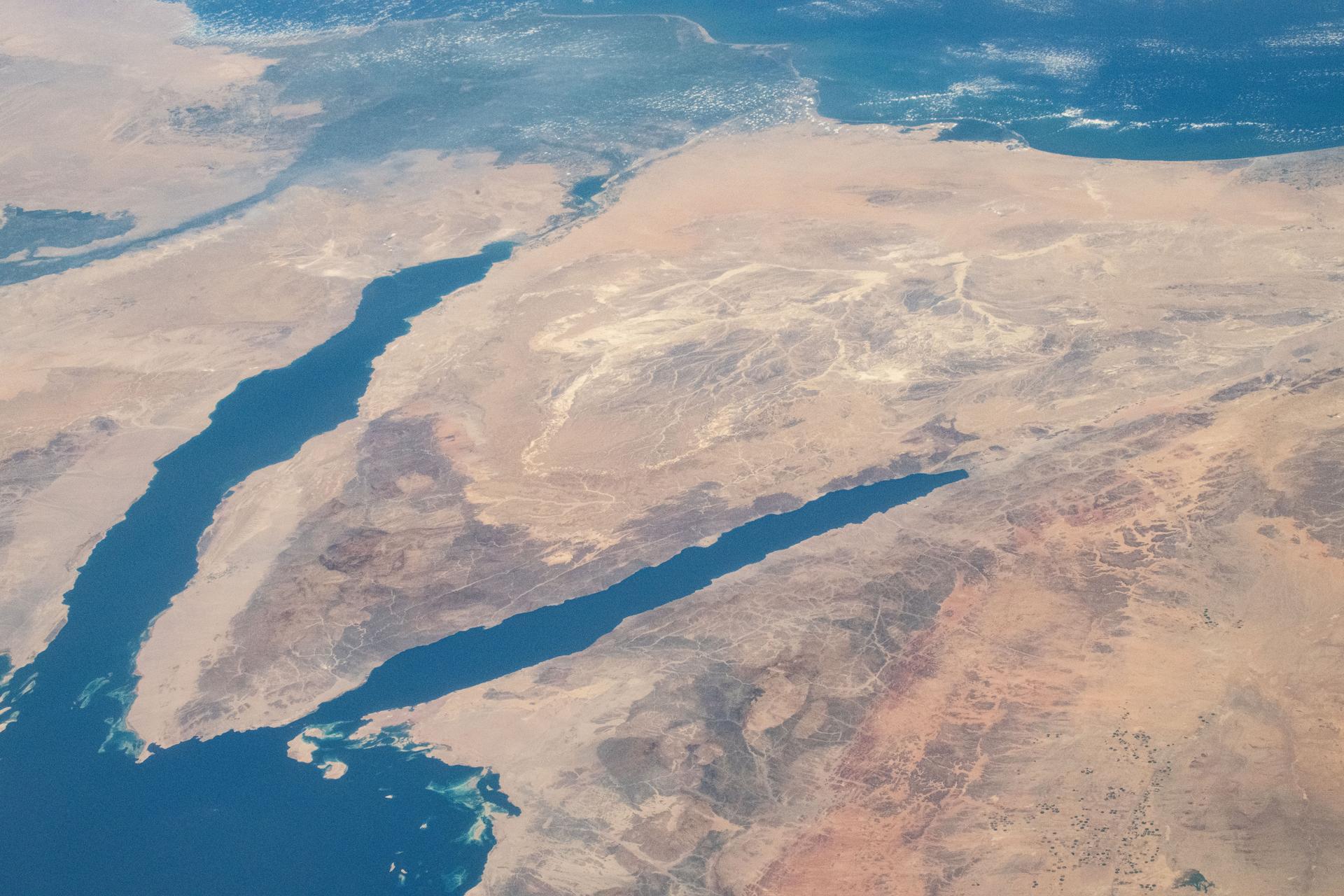
Oxagon was announced in 2022 as an octagonal floating industrial city on the Red Sea coast at the southern edge of the NEOM zone. The concept included a speculative outer ring of floating structures and a grounded industrial core anchored by port infrastructure, manufacturing zones, and energy facilities. The floating city concept has quietly receded. The port and industrial core have not.
The port construction is the most tangible piece of physical infrastructure in the entire NEOM project. Boskalis completed the container terminal expansion in March 2026. BESIX delivered 4.6 km of quay wall and seven berths at depths ranging from 10.5 to 18.5 metres. The port is already open for cargo shipments, with full container terminal operations targeted for 2026 and a capacity goal of 1.5 million TEU by 2030. SR7.5 billion ($2 billion) has been invested in sustainable all-electric port operations.
A multimodal trade corridor is already active: Trieste to Damietta to Safaga to NEOM, used by importers in Italy, the United Kingdom, Germany, and Poland. This route — Mediterranean to Red Sea to NEOM — bypasses the Suez Canal’s southern approaches and positions Oxagon as a transshipment node between European and Gulf markets.
The port’s positioning has been explicitly framed by Saudi officials as a Hormuz bypass. “The Port of Neom is intended to bypass the Strait of Hormuz to access global export markets,” The National reported on April 17, citing Saudi logistics planners. The framing is accurate for containerized cargo and certain petrochemical products. It is not accurate for crude oil, which moves east through Hormuz to Asia in volumes that no Red Sea port can absorb.
Three industrial anchors give Oxagon commercial substance beyond port throughput. The NEOM Green Hydrogen Company (NGHC), an $8.4 billion joint venture split equally among ACWA Power, Air Products, and NEOM, has its 4GW solar and wind power infrastructure 80% complete. First green ammonia production has slipped from 2026 to 2027, with a target output of 600 tonnes per day. DataVolt’s $5 billion, 1.5GW net-zero AI data-center campus has Phase 1 (300MW) targeted for 2028, powered entirely by renewable energy and developed in partnership with LG Electronics.
The pattern is legible: PIF is concentrating NEOM capital on assets that generate revenue (port fees, hydrogen exports, data-center hosting) rather than assets that require residents (The Line, Trojena, Sindalah). Al-Rumayyan’s “what we must have” is a balance-sheet judgment, not an urbanist’s vision.
Does Oxagon Solve Saudi Arabia’s Hormuz Problem?
Oxagon addresses a category of trade that was never primarily Hormuz-dependent. For crude oil — the product that actually drives Saudi state revenue — the Red Sea pivot solves nothing.
Saudi crude exports flow east. Before the war, 7 to 7.5 million barrels per day transited the Strait of Hormuz bound for refineries in China, India, Japan, and South Korea. The East-West Pipeline — the Petroline — carries crude from Eastern Province fields to the Yanbu terminal on the Red Sea, but its effective loading capacity is 4 to 5.9 million bpd against a 7 million bpd nameplate, creating a structural gap of 1.1 to 1.6 million bpd that cannot be rerouted west even under optimal conditions. The IRGC strike on an East-West Pipeline pumping station on April 8 — the day after ceasefire — demonstrated that the bypass itself is targetable.
Oxagon’s port handles containers, not crude tankers. Its 1.5 million TEU target capacity serves manufactured goods, petrochemical products, and transshipment cargo on the Europe-Gulf axis. The green hydrogen and ammonia produced by NGHC would also move west through the Red Sea, not east through Hormuz. In this narrow sense, Oxagon does bypass Hormuz — for a category of trade that was never primarily Hormuz-dependent.
The deeper dependency runs in the other direction. Saudi state revenue — the capital that funds PIF, which funds NEOM, which funds Oxagon — comes overwhelmingly from crude oil sales to Asian buyers who receive their barrels through Hormuz. With Hormuz commercial throughput at 45 transits since the April 8 ceasefire (3.6% of the pre-war baseline of roughly 1,250 transits per month), the revenue stream that capitalizes PIF’s domestic investment program is severely impaired.
Chatham House captured the structural logic in its May 2026 assessment: “Riyadh is now prioritizing an effort to become the central node for mitigating Hormuz risks, creating infrastructure that can bypass the strait and link the Gulf with the Red Sea. Significant long-term investment will be needed in infrastructure that allows goods — especially oil — to move between the Red Sea and major urban centres across the Gulf, with longer timelines and higher costs being unavoidable.”
The phrase “significant long-term investment” is doing considerable work. The investment required to make the Red Sea a genuine alternative to Hormuz for energy exports — expanded pipeline capacity, new crude terminals, LNG liquefaction facilities — runs into hundreds of billions of dollars over a decade or more. PIF’s $912 billion AUM is large but substantially committed. The capital available for transforming Oxagon from a container port into a full-spectrum energy export hub is constrained by the same revenue crisis that makes such a transformation attractive.
| Trade Route | Primary Product | Pre-War Volume | Current Status | Oxagon Relevance |
|---|---|---|---|---|
| Hormuz → Asia | Crude oil | 7–7.5M bpd | 3.6% of baseline | None — crude moves east |
| East-West Pipeline → Yanbu | Crude oil | 4–5.9M bpd effective | Pumping station struck April 8 | Indirect — shares Red Sea corridor |
| Red Sea → Europe (via Suez) | Containers, petrochemicals | Varies | Active, Houthi risk residual | Direct — Oxagon port’s primary market |
| Oxagon → Global | Green hydrogen/ammonia | N/A (2027 start) | Under construction | Core — but needs functioning sea lanes |
The DataVolt Hedge: AI Compute as Hormuz-Independent Revenue
Of the three industrial anchors at Oxagon, DataVolt’s AI data-center campus is the most structurally independent of maritime trade routes. Data centres consume electricity, not shipping lanes. Their output — compute cycles, model training capacity, inference hosting — travels over fibre-optic cables, not through contested straits.
The renewable energy powering the facility is generated on-site from NEOM’s solar and wind resources, eliminating the hydrocarbon fuel dependency that makes most Gulf data centres indirect Hormuz bets. LG Electronics’ involvement as a technology partner adds manufacturing credibility. PIF’s Humain AI vehicle has committed $23 billion in strategic partnerships with Nvidia, AMD, AWS, and Qualcomm, plus a $10 billion AI venture fund — capital deployed to AI compute infrastructure at the same time NEOM construction is frozen. The implicit judgment is that AI compute generates faster, more defensible returns than linear cities. That judgment hardened in May 2026: HUMAIN signed McKinsey and Accenture as enterprise partners within twenty days of PIF confirming the end of LIV Golf funding, closing the soft-power portfolio and opening a phase built on consulting-grade AI deployment contracts.
The hedge has limits. Data-center revenue in the Gulf is still nascent. Saudi Arabia is competing with the UAE (which has a head start via G42 and existing hyperscaler campuses), Qatar (which has cheap gas for power generation), and Oman (which offers cooler coastal climates). Oxagon’s advantages — renewable energy at scale, Red Sea fibre connectivity to Europe, PIF’s willingness to subsidize construction — are real but unproven at commercial scale. Phase 1 does not open until 2028.
The more immediate question is whether DataVolt’s 300MW Phase 1 can generate enough revenue to matter on PIF’s balance sheet while The Line sits dormant and the port ramps up. A 300MW data centre at Gulf hosting rates generates roughly $300 to $500 million in annual revenue — meaningful for a standalone business, marginal for a fund managing $912 billion. The 1.5GW full build-out changes the arithmetic, but that is a 2030-and-beyond story.
Green Hydrogen and the Shipping Lane It Needs
NGHC is the oldest and largest industrial commitment at Oxagon. The $8.4 billion joint venture, structured as equal thirds among ACWA Power, Air Products, and NEOM, reached financial close with project-finance backing from international lenders. The 4GW solar and wind infrastructure is 80% complete. First green ammonia production — hydrogen converted to ammonia for maritime transport — has slipped from 2026 to 2027, targeting 600 tonnes per day.
Green ammonia is a bulk commodity. It moves on ships. Those ships need functioning sea lanes. NGHC’s primary export market is Europe and East Asia, served via Red Sea routes that transit either the Suez Canal (northbound to Europe) or the Bab el-Mandeb strait (southbound toward Asia via the Cape of Good Hope or eastward through the Indian Ocean).
Both routes face distinct security threats. The Houthis disrupted Red Sea shipping throughout 2024 and into 2025, driving major container lines to reroute around the Cape of Good Hope. Chatham House’s May 2026 assessment is direct: “Attacks on Red Sea shipping by the Iran-aligned Houthis show that maritime insecurity will become a central constraint on Saudi Arabia’s westward reorientation, not a secondary concern.” Oxagon sits on the Red Sea coast. Its export routes run through waters the Houthis have demonstrated the ability to threaten.
The eastbound route — ammonia shipped from the Red Sea south through Bab el-Mandeb and east across the Indian Ocean to Asian buyers — encounters Hormuz at the destination, not the origin. Asian buyers who might purchase Saudi green ammonia are the same buyers whose crude oil imports are blocked by the Hormuz closure. The economic environment that makes Hormuz-dependent crude shipments impossible also weakens Asian industrial demand for green ammonia, since the manufacturing activity that consumes ammonia (fertilizer production, chemical feedstocks, shipping fuel) is itself stressed by the energy supply disruption.
NGHC’s hydrogen is a long-term bet on the energy transition. The war has not invalidated that bet. But it has exposed the assumption embedded in the project’s financial models: that maritime trade routes in the Red Sea and the western Indian Ocean would function at commercial scale during the project’s ramp-up years. That assumption was already strained by the Houthis in 2024. It is now compounded by the Hormuz crisis.
The Fiscal Trap Al-Rumayyan Did Not Mention
Saudi Arabia’s Q1 2026 budget deficit was SAR 125.7 billion ($33.5 billion) — the largest quarterly shortfall since 2018. Total revenues came in at SAR 261 billion, with oil revenues at SAR 144.7 billion, down 3% year-on-year. Total spending hit SAR 386.7 billion, up 20% year-on-year. Government reserves stood at SAR 400.9 billion.
The Q1 deficit already consumed most of the officially projected full-year shortfall. The 2026 budget assumed a SAR 101 billion deficit for the entire year. Three months in, the deficit was 24% larger than the annual target. The fiscal break-even oil price — the Brent level at which Saudi Arabia balances its budget including PIF-linked off-balance-sheet spending — sits at $108 to $111 per barrel, according to Bloomberg estimates that incorporate PIF’s capital calls. Brent closed the week at approximately $99.80.
This gap — roughly $10 per barrel below break-even — is the fiscal context in which Al-Rumayyan announced PIF’s new strategy. With Saudi production already crashed to 7.25 million bpd in March (IEA data), down from 10.4 million bpd in February — a 30% drop driven by the Hormuz closure and IRGC strikes on production infrastructure — the revenue shortfall compounds on both price and volume.
PIF’s capital comes from three sources: direct government transfers, retained earnings from portfolio companies, and debt issuance (PIF’s first green bond in 2023 raised $3 billion). All three are under pressure. Government transfers depend on oil revenue. Retained earnings from PIF’s Saudi portfolio companies — many of which are domestic consumption plays like ROSHN, STC, and Lucid’s Saudi operations — depend on a domestic economy that is contracting under war conditions. Debt issuance remains viable but priced at a premium: Saudi sovereign CDS spreads have widened since February, and PIF’s own credit rating reflects the sovereign’s risk profile.
MBS is paying for a war he says he wants to end. The cost is denominated partly in cancelled contracts ($6.85 billion at NEOM alone), partly in deferred revenue (Hormuz closure), and partly in the opportunity cost of capital redirected from Vision 2030 projects to war-economy stabilization. PIF’s 2026–2030 strategy does not mention the war. It does not mention Hormuz. It mentions “commercially driven, phased execution” — language that accommodates both a strategic pivot and a funding crisis without distinguishing between them.
| Metric | Pre-War | Current (Q1 2026) | Gap |
|---|---|---|---|
| Saudi crude production | 10.4M bpd (Feb) | 7.25M bpd (Mar) | -3.15M bpd (-30%) |
| Brent crude | ~$109/bbl (Feb peak) | ~$99.80/bbl | -$8–11 below fiscal break-even |
| Quarterly budget deficit | SAR 25B (Q1 2025 est.) | SAR 125.7B ($33.5B) | Largest since 2018 |
| Government reserves | SAR 430B+ (end-2025) | SAR 400.9B | -SAR 30B in one quarter |
| NEOM active contracts | $20B+ committed | $6.85B cancelled (March) | Trojena, Line tunnels terminated |
King Abdullah Economic City and the Megaproject Pattern
Saudi Arabia has built this before. King Abdullah Economic City (KAEC), launched in 2006 on the Red Sea coast between Jeddah and Rabigh, was designed to house 4.5 million residents by 2020 in a purpose-built urban zone with an industrial port, a financial district, and residential communities. Today, KAEC has approximately 4,000 inhabitants.
The Washington Institute’s Frederic Schneider places Oxagon in this lineage directly: “Saudi Arabia’s Vision 2030 repeats old mistakes of relying heavily on new megaprojects and ignoring regional advantages in research and education. While offering a spectacular façade, they tend to deliver few tangible economic results.” The comparison is uncomfortable for NEOM’s planners because KAEC had the same structural ingredients — Red Sea location, port infrastructure, government backing, an industrial zone — and failed not because the port didn’t work but because the city around it never attracted residents or tenants at scale.
The differences are real but may not be decisive. Oxagon has PIF’s balance sheet behind it rather than a publicly listed developer (Emaar, The Economic City). The green hydrogen anchor provides an export commodity that KAEC lacked. The data-centre component connects to a global demand curve (AI compute) that didn’t exist in 2006. And NEOM’s geographic position in Tabuk province, closer to Egypt and the Suez Canal than KAEC’s location, offers marginally better logistics connectivity to European markets.
But the KAEC precedent exposes the persistent Saudi failure mode: infrastructure precedes demand. The port gets built. The industrial zone gets zoned. The masterplan gets published. And then the private-sector tenants and residents who are supposed to make the economics work don’t arrive in sufficient numbers, because the location is remote, the alternatives (Jeddah, Dammam, Riyadh) are established, and the incentive packages that lure first-movers expire before critical mass is reached.
Al-Rumayyan’s pivot to Oxagon is, among other things, a bet that an industrial port with hydrogen and data-centre anchors can avoid the KAEC pattern by not depending on residential population. If Oxagon succeeds as an export logistics and compute node with a workforce of thousands rather than a city of millions, the KAEC comparison loses its force. If Oxagon needs the broader NEOM residential and tourism ecosystem — The Line, Sindalah, Trojena — to generate the foot traffic, labour pool, and consumer economy that makes the industrial zone viable, then KAEC’s ghost is harder to dismiss.
Can Saudi Arabia’s Red Sea Pivot Survive the Houthis?
The strategic logic of moving Saudi economic infrastructure from the Gulf coast to the Red Sea assumes the Red Sea is safer than the Persian Gulf. The Houthis tested that assumption extensively in 2024 and 2025 — and the results were not reassuring.
Houthi attacks on commercial shipping in the Red Sea and the Bab el-Mandeb strait forced major container lines — Maersk, MSC, CMA CGM — to reroute around the Cape of Good Hope, adding 10 to 14 days to Europe-Asia transits and raising freight rates by 200 to 300%. The attacks targeted vessels with perceived Israeli, American, or British connections, but the operational effect was indiscriminate: insurers raised war-risk premiums for all Red Sea transits, and the commercial incentive to avoid the route applied regardless of flag state.
Oxagon’s port sits on the Red Sea coast north of the Houthi threat zone — closer to the Suez Canal than to the Bab el-Mandeb — but its export routes must cross waters the Houthis have demonstrated they can reach. Green ammonia bound for Europe transits northward through relatively secure waters to Suez. Ammonia or containerized goods bound for East Asian markets must pass through the Bab el-Mandeb or route around Africa.
Chatham House’s warning is precise: maritime insecurity from Iran-aligned groups is “a central constraint on Saudi Arabia’s westward reorientation, not a secondary concern.” The Oxagon pivot does not move Saudi economic exposure from one secure space to another. It moves exposure from a strait Iran controls (Hormuz) to a sea the Houthis — an Iranian partner — can threaten. The geographic diversification is real. The security diversification is less clear.
The Iranian parliament’s advancing 12-article Hormuz sovereignty law — drafted by lawmakers Ahmadi and Rezayi Kouchi — would formalize IRGC control over Hormuz transit as a matter of domestic legislation rather than military improvisation. If passed, the legal framework for Hormuz closure becomes permanent rather than contingent on the current war. Saudi Arabia’s interest in Red Sea alternatives becomes correspondingly more urgent — and more expensive.
Saudi Arabia’s economy is recovering in ways that expose the problem rather than solve it. A recovery built on redirected oil flows through Yanbu and military spending does not generate the kind of commercial diversification that Oxagon requires. The port needs civilian trade volumes, not emergency crude rerouting.
What the Three-Portfolio Structure Reveals About NEOM’s Future
PIF’s three-portfolio architecture — Vision, Strategic, Financial — creates an implicit hierarchy of expectations. The Financial Portfolio (global diversified investments) is expected to generate returns. The Strategic Portfolio (existing key assets like STC, SABIC holdings, Lucid) is expected to generate returns while serving national economic goals. The Vision Portfolio is expected to serve national economic goals while eventually generating returns.
NEOM sits in the Vision Portfolio. So does Tourism (including the Red Sea Global resort project), Urban Development (ROSHN), Advanced Manufacturing, Industrials & Logistics, and Clean Energy (ACWA Power, the Green Hydrogen complex). The Vision Portfolio is where PIF parks projects whose commercial returns are subordinate to their role in economic transformation. The designation is honest about what NEOM is: a state-directed development project, not a commercial investment.
The 225 portfolio companies across PIF’s holdings generated a 7.2% annualized return since 2017. That headline number blends profitable positions (STC, Saudi National Bank stakes, international equities) with capital-consuming Vision Portfolio projects. NEOM’s contribution to that return is almost certainly negative — the project has absorbed tens of billions in capital with no revenue to date. The three-portfolio structure ensures this drag is visible but contained.
For Oxagon specifically, the question is whether it migrates from the Vision Portfolio to the Strategic Portfolio over the 2026–2030 period — whether, in other words, it begins generating commercial returns that justify its capital consumption. The port’s 1.5 million TEU target, NGHC’s ammonia exports, and DataVolt’s hosting revenue provide plausible pathways. But “plausible pathway” and “commercial return” are different things, and PIF’s own language — “commercially driven, phased execution” — hedges toward the former.
The Gamble Behind “What We Must Have”
Al-Rumayyan’s April 15 statement is best understood as three things simultaneously. It is an admission that The Line — the project most closely identified with MBS’s personal vision — will not deliver on its original promise by 2030 or anything close to it. It is a reframing of NEOM around its most commercially viable component. And it is a bet that the international investment community will accept the pivot rather than treat the original NEOM vision as a credibility loss.
The bet is not unreasonable. Ports generate revenue. Data centres generate revenue. Green hydrogen, if the shipping lanes open, will generate revenue. These are assets with identifiable cash flows, unlike a 170 km mirrored-glass residential structure in the desert. By concentrating on Oxagon, Al-Rumayyan is converting NEOM from a visionary urbanism project — which was failing — into an industrial logistics project — which has a chance.
The credibility risk is that the pivot confirms the critics’ narrative. The Middle East Monitor’s framing — Saudi Arabia “drastically scaling back NEOM megaproject amid mounting costs and failures” — is the version that sticks if Oxagon is seen as retreat rather than refinement. Al-Estiklal, the Arab opposition-linked outlet, was blunter: “NEOM’s failure is a blow to Saudi ambitions and the Crown Prince’s vision.” The Clingendael Institute frames the pivot as externally forced, not strategically chosen — a distinction that matters for Saudi Arabia’s narrative of sovereign decision-making.
Al-Rumayyan chose not to address the Hormuz dependency, the fiscal context, or the war. The 2026–2030 strategy reads as though the Gulf were at peace and oil revenue were stable. It is a peacetime document published during a war. Whether that reflects strategic optimism about a near-term Hormuz resolution, institutional inability to acknowledge the war’s fiscal impact in a public-facing strategy, or a deliberate choice to separate PIF’s long-term planning from short-term crisis management is not clear from the published text.
What is clear is the arithmetic. Oxagon’s three industrial anchors — port, hydrogen, data centre — require roughly $15 to $20 billion in remaining capital deployment through 2030. PIF’s domestic allocation across all six ecosystems will total hundreds of billions over the same period. The capital exists on paper. Whether it exists as deployable cash when Hormuz is closed, oil revenue is impaired, the deficit is running at four times the annual target, and reserves are declining at SAR 30 billion per quarter — that is the question Al-Rumayyan’s statement did not answer, and the 2026–2030 strategy did not ask.
FAQ
What happens to NEOM’s broader workforce and supply chain if Oxagon becomes the only active buildout?
The 2025 workforce restructuring already relocated over 1,000 NEOM employees from the site to Riyadh and cut headcount by 35%. If The Line, Trojena, and Sindalah remain suspended, the specialist engineering, construction, and hospitality supply chains assembled for those projects have no natural home at Oxagon, which is an industrial and logistics node requiring port operators, hydrogen technicians, and data-centre engineers rather than urban planners and luxury hospitality designers.
What will Oxagon actually produce and export?
Three primary outputs are in development. The NEOM Green Hydrogen Company will produce 600 tonnes per day of green ammonia starting in 2027, using 4GW of solar and wind power (80% complete) to electrolyse water. The Port of Oxagon, with 7 berths and a 1.5 million TEU capacity target by 2030, will handle containerized cargo on a Trieste–Damietta–Safaga–NEOM multimodal corridor serving European importers. DataVolt’s 1.5GW AI data-center campus will sell compute capacity to hyperscalers and enterprise clients, with Phase 1 (300MW) from 2028.
How does the Hormuz closure affect Oxagon if Oxagon is on the Red Sea?
Oxagon’s port operations do not depend on Hormuz transit — containerized cargo and ammonia exports move through the Red Sea toward Europe without crossing the Strait. The dependency is indirect but structural: Saudi state oil revenue, which funds PIF, which funds Oxagon, flows primarily from crude exports to Asia through Hormuz. With Saudi production down 30% to 7.25 million bpd and Hormuz at 3.6% of pre-war throughput, the capital pipeline that finances Oxagon’s construction is impaired even though the port itself faces the opposite direction.
The broader strategic context for PIF’s wartime capital reallocation — the 80/20 domestic split that now governs the 2026–2030 plan and redirects $92 billion away from international markets — is covered in The $92 Billion Turn Inward.
How the war has concretely remade Saudi Arabia’s economic geography — with Yanbu’s terminal surge, Oxagon’s Red Sea port position, and MBS’s $600 billion in US investment commitments forming the post-Hormuz economy — is examined in War Made the Red Sea Saudi Arabia’s Front Door.
What do international investors and analysts actually think about the Oxagon pivot?
Reactions divide along lines of emphasis. The Clingendael Institute frames the pivot as externally forced by the war and fiscal constraints rather than strategically chosen — a distinction that weakens PIF’s narrative of disciplined portfolio management. The Washington Institute’s Frederic Schneider draws a direct parallel to King Abdullah Economic City, arguing Saudi megaproject pivots typically deliver port infrastructure while failing to generate the private-sector activity that justifies the investment. DataVolt and Humain’s participation is read by some analysts as PIF substituting digital capital for construction capital rather than generating genuinely new external investment.
How does PIF’s $912 billion compare to what NEOM needs?
PIF’s $912 billion AUM at end-2024 is a gross figure that includes illiquid positions in 225 portfolio companies, sovereign stakes in Saudi Aramco and Saudi National Bank, and international holdings that cannot be easily liquidated. An internal audit cited by the Wall Street Journal projected NEOM’s full completion cost at $8.8 trillion with a timeline to 2080 — a figure that exceeds PIF’s total assets by nearly ten times. The 2026–2030 strategy’s shift to “phased execution” is in part an acknowledgement that NEOM’s original scope was never financeable, even by the world’s largest sovereign wealth fund.