
RIYADH — PIF’s board of directors, chaired by Crown Prince Mohammed bin Salman, approved a 2026–2030 strategy on April 15 that shifts the fund’s target allocation to 80% domestic and 20% international — down from a peak of 30% abroad. At the fund’s reported $912–925 billion in assets under management, that 10-percentage-point reduction redirects approximately $91–92 billion in capital inward. The press release framed it as strategic evolution. The fiscal data suggest something closer to wartime preparation.
The strategy was formalized on Day 46 of the Iran conflict, amid the largest quarterly deficit since 2018 and an oil production collapse that cut Saudi output by nearly a third. PIF’s decision to bring capital home at this scale carries a weight the strategy document does not acknowledge: Riyadh has concluded the disruption will persist long enough to require the Gulf’s largest sovereign fund as a domestic fiscal instrument rather than a global investment vehicle.
Table of Contents
- The Arithmetic of Repatriation
- What Does PIF’s 80/20 Split Actually Mean?
- The Liquidation Before the Announcement
- How Deep Is Saudi Arabia’s Wartime Fiscal Hole?
- What Survives the International Portfolio?
- Is PIF Repeating Kuwait’s 1990 Playbook?
- Where the Money Goes Now
- Twenty Days Between Resilience and Retreat
- Frequently Asked Questions
The Arithmetic of Repatriation
The numbers are straightforward, even if PIF’s press release declines to state them. AUM stands at $925 billion per the strategy document, or $912 billion per the fund’s annual report filed May 7 — the gap is mark-to-market timing on illiquid holdings, reported by Caproasia and The Saudi Times respectively. At the lower figure, shifting from 30% to 20% international allocation moves approximately $91.2 billion. At the higher, $92.5 billion. Either number represents the largest single reallocation in PIF’s history.
The new strategy introduces a three-portfolio architecture. The Vision Portfolio targets domestic ecosystem development — the giga-projects, the industrial buildouts, the sectoral platforms that constitute Vision 2030’s remaining physical and digital infrastructure. The Strategic Portfolio holds key national assets, principally PIF’s stake in Saudi Aramco. The Financial Portfolio manages global investments for return. Under the 2026–2030 plan, it is the Financial Portfolio that contracts.
PIF does not disclose the dollar breakdown by portfolio. What it does disclose is direction: capital that would have flowed to New York, London, and Tokyo will instead be deployed in Riyadh, Jeddah, and what remains of NEOM as an active construction program. The fund committed to maintaining its stated 7% annualized total shareholder return since 2017. How that target survives a smaller global allocation and an expanded domestic footprint during a wartime fiscal contraction is a question the strategy document avoids entirely.
The 2026–2030 strategy is the first time PIF has published a formal domestic/international allocation split as a binding commitment. Previous strategies referenced diversification in aspirational terms, without quantified geographic constraints. The shift from aspiration to codification occurred 46 days into a war that has cut Saudi oil exports to Asia by 38.6%, per Kpler data.
The Middle East briefing 3,000+ readers start their day with.
One email. Every weekday morning. Free.
| Metric | Pre-2026 Peak | 2026–2030 Target | Implied Shift |
|---|---|---|---|
| Domestic allocation | ~70% | 80% | +10 pp |
| International allocation | ~30% | 20% | −10 pp |
| AUM (strategy document) | — | $925B | — |
| AUM (annual report, May 7) | — | $912B | — |
| Capital redirected inward | — | — | ~$91–92B |
| Annualized return target | 7% | 7% | Unchanged |
What Does PIF’s 80/20 Split Actually Mean?
PIF’s shift from 30% to 20% international allocation redirects approximately $91–92 billion toward domestic deployment at current AUM. Approved on April 15 — Day 46 of the Iran war — the move converts what was the Gulf’s most ambitious outbound investment vehicle into a domestic fiscal instrument, prioritizing Saudi economic resilience over global diversification at the moment the kingdom’s oil export infrastructure is most constrained.
The timing frames the decision more precisely than the strategy language does. Twenty days before the board vote, PIF Governor Yasir Al-Rumayyan addressed the Future Investment Initiative Priority summit in Miami. “The Saudi macroeconomic and fiscal position remains strong, stable and resilient,” he told Bloomberg on March 26, “and the PIF’s portfolio is well-diversified and structurally resilient.” He said he expected to unveil the five-year strategy “in coming weeks.” The message in Miami was continuity. The message on April 15 was retrenchment.
Between those two dates, Saudi oil production dropped by 3.15 million barrels per day. The Strait of Hormuz — through which the kingdom had exported the majority of its crude before the war — remained under effective IRGC control. The Yanbu bypass pipeline, Saudi Arabia’s Red Sea export alternative, operated at a ceiling of 4–5.9 million bpd against a pre-war Hormuz throughput of 7–7.5 million. The Saudi Gazette confirmed that March oil revenues fell due to “export disruptions” from “the effective closure of the Strait of Hormuz.”
Al-Rumayyan’s Miami appearance and the April 15 board decision are not contradictory. They are sequential. One was the posture of a fund governor managing institutional investor sentiment during active hostilities. The other was the private conclusion of a board chaired by a head of state whose primary export corridor had been shut for six weeks.
The Liquidation Before the Announcement
The 80/20 split formalized a retreat already underway. PIF’s US equity portfolio, as disclosed in SEC 13F filings, fell from $19.4 billion at end-Q3 2025 to $12.9 billion at end-Q4 2025 — a $6.5 billion reduction in a single quarter, months before the war began and before the strategy was published. Five US-listed equity positions remain: Lucid Group, Electronic Arts, Uber Technologies, Allurion Technologies, and Claritev Corp. Arab News and AGBI reported the drawdown in February 2026.
The pullback preceded not just the strategy but the conflict itself. In December 2024, PIF’s board approved a minimum 20% spending reduction across its 100-plus portfolio companies, including more than 50 giga-project development entities. Some project budgets were cut by as much as 60%, per AGBI’s March 2025 reporting. NEOM construction was suspended on September 16, 2025. The Line — the 170-kilometer linear city that had been PIF’s most visible megaproject — was formally suspended under the 2026–2030 strategy. These were pre-war decisions driven by a pre-war fiscal squeeze that the war has since compounded.
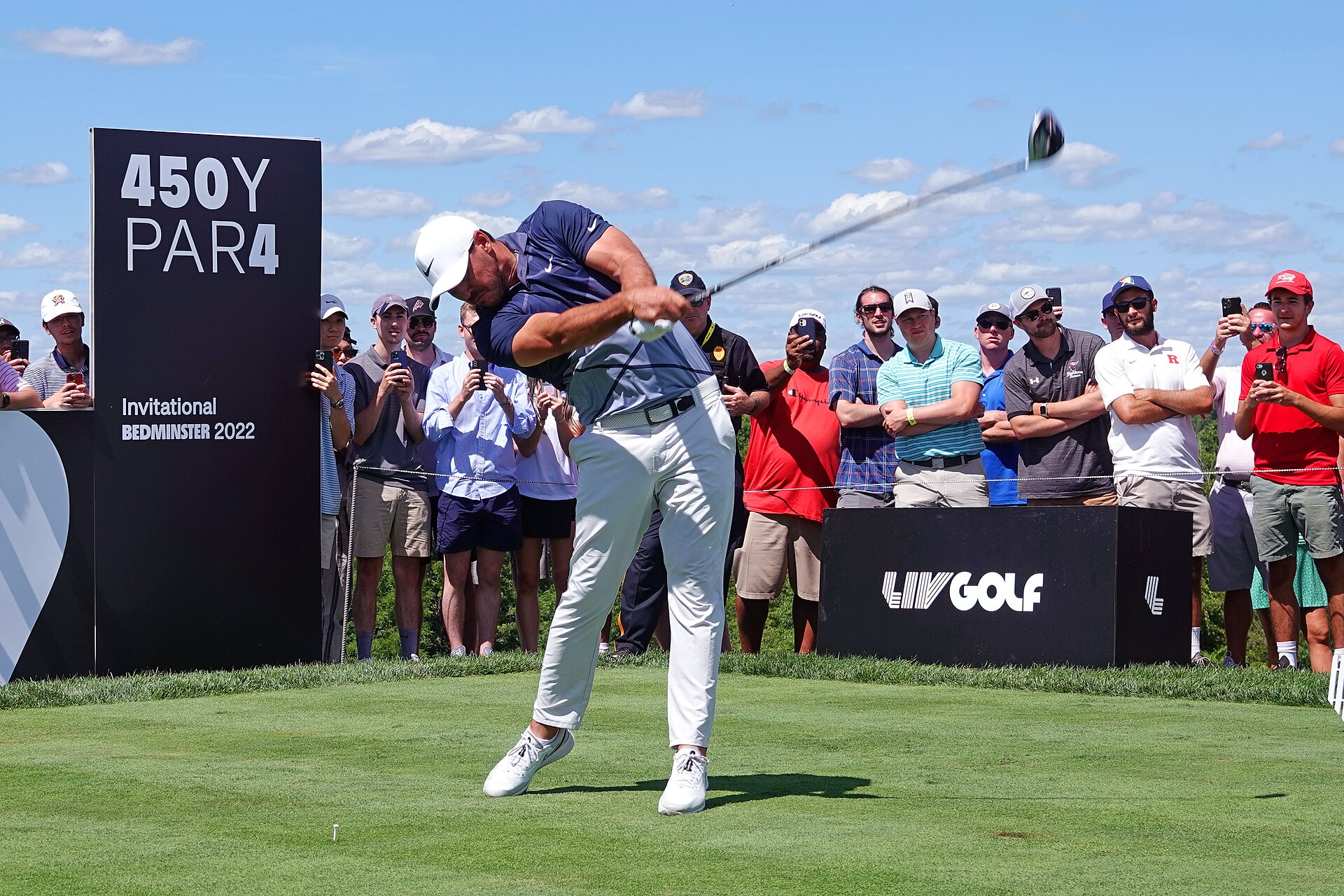
Then came the exits that spending discipline alone cannot explain. On April 29, two weeks after the strategy’s approval, PIF announced it would end funding for LIV Golf effective after the 2026 season. Total capital deployed over four years: $5–6 billion. Financial return: zero. PIF’s statement called the investment “no longer consistent with the current phase of PIF’s investment strategy” and attributed the decision to “PIF’s investment priorities and current macro dynamics.”
“Current macro dynamics.” Four words. The closest any official PIF text has come to naming the war.
The Warner Bros Discovery consortium bid — $24 billion, structured with the Qatar Investment Authority and Abu Dhabi’s L’Imad — had already collapsed in December 2025 when WBD’s board rejected it unanimously, as the Hollywood Reporter confirmed. Affinity Partners, the Jared Kushner-led firm that received $2 billion in PIF funding in 2021, withdrew from the consortium. Across LIV Golf, WBD, and the US equity drawdown, international positions were being unwound before the 2026–2030 strategy gave the process a formal framework.
| Position | Capital | Status | Domestic Linkage |
|---|---|---|---|
| SoftBank Vision Fund | $45B (2016) | Underperforming | Limited |
| LIV Golf | $5–6B (2022–26) | Exited April 29, 2026 | None |
| WBD Consortium | $24B bid | Collapsed Dec 2025 | Entertainment |
| EA Acquisition | ~$36B PIF equity | Pending / Senate scrutiny | Gaming / V2030 |
| US Equities (13F) | $12.9B | Reduced −$6.5B in Q4 2025 | Mixed |
| Newcastle United | 2021 acquisition | Retained | Sport / Tourism |
| Shanghai Office | New (2025–26) | Expanding | China bilateral |
How Deep Is Saudi Arabia’s Wartime Fiscal Hole?
Saudi Arabia’s Q1 2026 deficit reached SAR 125.7 billion ($33.5 billion), consuming 58% of the kingdom’s full-year SAR 217 billion borrowing plan in three months. Oil revenues fell to SAR 144.7 billion, down 3% year-on-year, while total spending surged to SAR 386.7 billion — up 20% — driven by military expenditure and economic stabilization measures the Ministry of Finance has not itemized. These figures were published by the Saudi Gazette and Gulf News on May 5.
The May 6 GDP release added a dimension the budget report withheld: military spending rose 26% year-on-year in Q1, the GDP data showed, confirming that the unitemized expenditure surge was concentrated in defense rather than Vision 2030 capital deployment.
Public debt rose from SAR 1.52 trillion at end-2025 to SAR 1.67 trillion by end-Q1 2026, a SAR 150 billion increase in a single quarter. The composition: SAR 1.04 trillion domestic, SAR 624.4 billion external, per Argaam and NDMC data. Government reserves were held steady at SAR 400.9 billion — untouched, for now.
That reserve figure is the fiscal clock. At Q1’s implied monthly deficit of roughly SAR 42 billion, SAR 400.9 billion covers nine to ten months without additional borrowing. But the borrowing plan is not holding. The SAR 217 billion annual authorization was set before the war began on February 28 and has not been revised. If Q2 tracks Q1, Saudi Arabia will have exhausted its entire annual borrowing capacity by midsummer.
| Indicator | Figure | Context |
|---|---|---|
| Q1 deficit | SAR 125.7B ($33.5B) | Largest since 2018 |
| Oil revenue | SAR 144.7B | −3% YoY |
| Total spending | SAR 386.7B | +20% YoY |
| Public debt (end-Q1) | SAR 1.67T | +SAR 150B in one quarter |
| Government reserves | SAR 400.9B | ~9–10 months at current burn |
| Borrowing plan consumed | 58% | In first three months |
| Brent (May 7) | $101.96/bbl | $6–9 below break-even |
| March production | 7.25M bpd | −30% from Feb (10.4M bpd) |
The revenue gap is structural, not cyclical. Brent at $101.96 sits six to nine dollars below the kingdom’s fiscal break-even of $108–111 per barrel, calculated by Bloomberg using PIF-inclusive methodology. Goldman Sachs estimates the war-adjusted deficit at 6.6% of GDP — double the government’s official 3.3% projection. The IMF revised Saudi 2026 GDP growth down 1.4 percentage points to 3.1%.
The supply picture compounds the revenue shortfall. The IEA recorded Saudi March output at 7.25 million bpd, down from 10.4 million in February — a 30% decline driven by the effective closure of the Strait of Hormuz. OPEC+ set Saudi Arabia’s April quota at 10.2 million bpd, a figure that now exceeds actual production by 3 million barrels per day. The Yanbu bypass pipeline restored partial Red Sea export capacity but operates well below the volume Hormuz had carried. The gap between quota and output is not a policy choice. It is an infrastructure constraint imposed by the strait’s closure.
What Survives the International Portfolio?
PIF’s 20% international allocation — approximately $182–185 billion at current AUM — still constitutes one of the largest outbound sovereign investment programs globally. What survives the cut is as informative as what does not. AGBI’s analysis identifies the filter: international investments that serve domestic Saudi sectors are maintained or expanded; those without a domestic revenue pathway are wound down. PIF will continue to fund US positions, per AGBI, “where it sees potential to support domestic priorities” — specifically AI, digital infrastructure, and media.
The Electronic Arts acquisition fits the surviving category. The $55 billion deal — a consortium with Silver Lake and Affinity Partners, with PIF contributing approximately $36 billion in equity — remains pending as of the strategy announcement. US Senate scrutiny over Saudi ownership of a major American gaming company represents a genuine regulatory overhang, as reported by MergerSight and AGBI. But the strategic logic aligns with Vision 2030’s entertainment sector: EA’s intellectual property has a domestic application in a way that LIV Golf’s tour negotiations never did.
The Shanghai office is the most revealing data point in the surviving portfolio. PIF registered a China presence in 2025 and became operational in early 2026, per Bloomberg’s May 6 reporting. At a moment when every other international allocation was contracting, China expanded. Beijing occupies a unique position in the wartime economy: simultaneously the largest buyer of Saudi crude, the broker of the limited Hormuz transits that still occur under IRGC-brokered permissions, and the counterparty to PIF’s surviving outbound investment appetite. The investment geography tracks the diplomatic one.
Al-Rumayyan told Bloomberg in Miami that PIF had deployed $170 billion in the United States since 2017. Sources close to the fund stress it “remains totally committed” to Newcastle United. These are cumulative stock figures — descriptions of what was built over nine years. The flow of new capital has reversed direction. The 80/20 framework makes the reversal policy.
Is PIF Repeating Kuwait’s 1990 Playbook?
Not yet — but the structural parallel clarifies why PIF is acting now rather than waiting. The Kuwait Investment Authority held approximately $100 billion in overseas assets when Iraq invaded in August 1990. Those holdings became the sole funding source for Kuwait’s government-in-exile, liquidated under extreme duress to finance the country’s liberation and post-war reconstruction. KIA’s experience is the sovereign wealth fund world’s cautionary tale: international diversification protects against domestic risk until the domestic risk turns existential, at which point every dollar held abroad is a dollar that cannot be deployed at home.
PIF’s 80/20 pivot is the proactive version of KIA’s forced repatriation. Capital is being redirected while the fund still controls the timing, the terms, and the public framing. The distinction is consequential. KIA sold into markets that understood Kuwait had no choice — distressed pricing was inevitable. PIF is rebalancing from a position where it can still characterize the shift as strategic maturation rather than fiscal emergency. Whether that framing holds depends on how long the war continues and how quickly the fiscal position deteriorates further.
The difference in scale is worth noting precisely. KIA’s $100 billion was the entire Kuwaiti state’s financial reserve — there was nothing else. PIF’s $912–925 billion dwarfs KIA’s wartime holdings, but Saudi Arabia’s fiscal obligations also dwarf Kuwait’s 1990 expenditures. At a quarterly deficit burn rate of SAR 125.7 billion, PIF’s capital base — however large — exists alongside a fiscal appetite that can consume tens of billions per quarter. KIA’s lesson was not about the size of the fund. It was about the speed at which a wartime government can exhaust even a very large one.
The Norwegian Government Pension Fund Global stands at the opposite end of the institutional spectrum. At $2.2 trillion, the GPFG is constitutionally required to invest entirely outside Norway. In crisis, Oslo draws on investment returns, not principal — a model that presumes the homeland will never face a threat severe enough to demand capital repatriation. PIF’s board, on April 15, chose to operate under a different assumption about the durability of Saudi Arabia’s security environment. The Norwegian model extracts returns from abroad to absorb domestic shocks. PIF’s new model redirects principal home to build the shock absorber itself.
Where the Money Goes Now
The strategy document names PIF’s new flagship: HUMAIN, an artificial intelligence subsidiary launched with a $10 billion investment commitment and data center capacity that PIF describes as already sold out. If NEOM represented Vision 2030’s physical ambition — build a new city from scratch in the Tabuk desert — HUMAIN represents its wartime successor: digital infrastructure that does not depend on equipment imports transiting a contested strait. The full pivot — LIV Golf closed, HUMAIN opened with McKinsey and Accenture as its first enterprise partners — is documented in detail in PIF Exits LIV Golf at $5.3 Billion as HUMAIN Signs McKinsey and Accenture the Same Day.
The Line’s formal suspension under the 2026–2030 strategy removes what had been PIF’s most capital-intensive domestic program. NEOM’s broader construction halt, in place since September 16, 2025, preceded the war by more than five months and reflected fiscal constraints that were already binding. The strategy formalizes what the December 2024 spending cuts had already communicated: the giga-project era, at its original scale and timeline, is over. What replaces it is a commitment to “delivering competitive domestic ecosystems to connect sectors, unlock the full potential of strategic assets, maximize long-term returns” — the strategy document’s own phrasing, unaccompanied by specific capital allocation figures for individual programs.
The identifiable domestic pipeline: HUMAIN and broader AI infrastructure investment, Aramco value-chain extensions, and the entertainment and tourism corridor anchored by Qiddiya, the Red Sea project, and Diriyah Gate. What the strategy does not disclose: how the redirected capital will be divided among these programs, what proportion may function as an indirect fiscal buffer for the Saudi government rather than productive investment, and how much will simply remain undeployed while the war persists and domestic absorption capacity stays suppressed.
PIF manages more than 100 portfolio companies and over 50 giga-project entities. A 20% minimum spending reduction was already imposed across this portfolio in December 2024, with some budgets cut by 60%. The 2026–2030 strategy layers a formal allocation framework on top of austerity measures already in force. The domestic portfolio is simultaneously expanding in mandate and contracting in per-project spending — a tension the three-portfolio structure organizes but does not resolve.
The strategy’s stated goal — “delivering competitive domestic ecosystems to connect sectors” — implies a shift in how PIF measures success. During the international expansion phase, the metric was financial return: the 7% annualized figure that Al-Rumayyan cited on stages from Davos to Miami. Under the 2026–2030 framework, the domestic portfolio’s value to the Saudi state may be measured less in returns and more in jobs sustained, fiscal multiplier effects generated, and non-oil GDP maintained during a period when oil revenue has contracted by a third. The strategy document does not acknowledge this shift in measurement criteria. The three-portfolio structure implies it.
Twenty Days Between Resilience and Retreat
March 26, 2026. Al-Rumayyan at FII Priority, Miami. “The Saudi macroeconomic and fiscal position remains strong, stable and resilient.” Day 26 of the war. Brent above $100. The performance was calibrated for an audience of institutional investors and sovereign fund counterparts who needed to hear that PIF’s commitments would hold.
April 15, 2026. PIF’s board approves the 80/20 split. Day 46. In the intervening 20 days, Saudi Arabia absorbed the most severe production disruption in its history. Output had been functionally halved relative to pre-war capacity. The Yanbu bypass was operational but structurally insufficient. March fiscal data — not yet public on April 15 but visible to the board — would later reveal the worst quarterly deficit performance in eight years.
The strategy document does not mention the Iran war. The words do not appear. Neither does “Hormuz,” “conflict,” “blockade,” or “disruption.” The document references “current conditions” and “evolving priorities” — language that can survive a Bloomberg terminal search without triggering a market reassessment of Saudi sovereign risk. PIF’s only concession to the operating environment came not in the strategy itself but in the LIV Golf exit statement issued 14 days later: “current macro dynamics.” Four words — the most direct acknowledgment of wartime pressure the fund has published in any capacity.
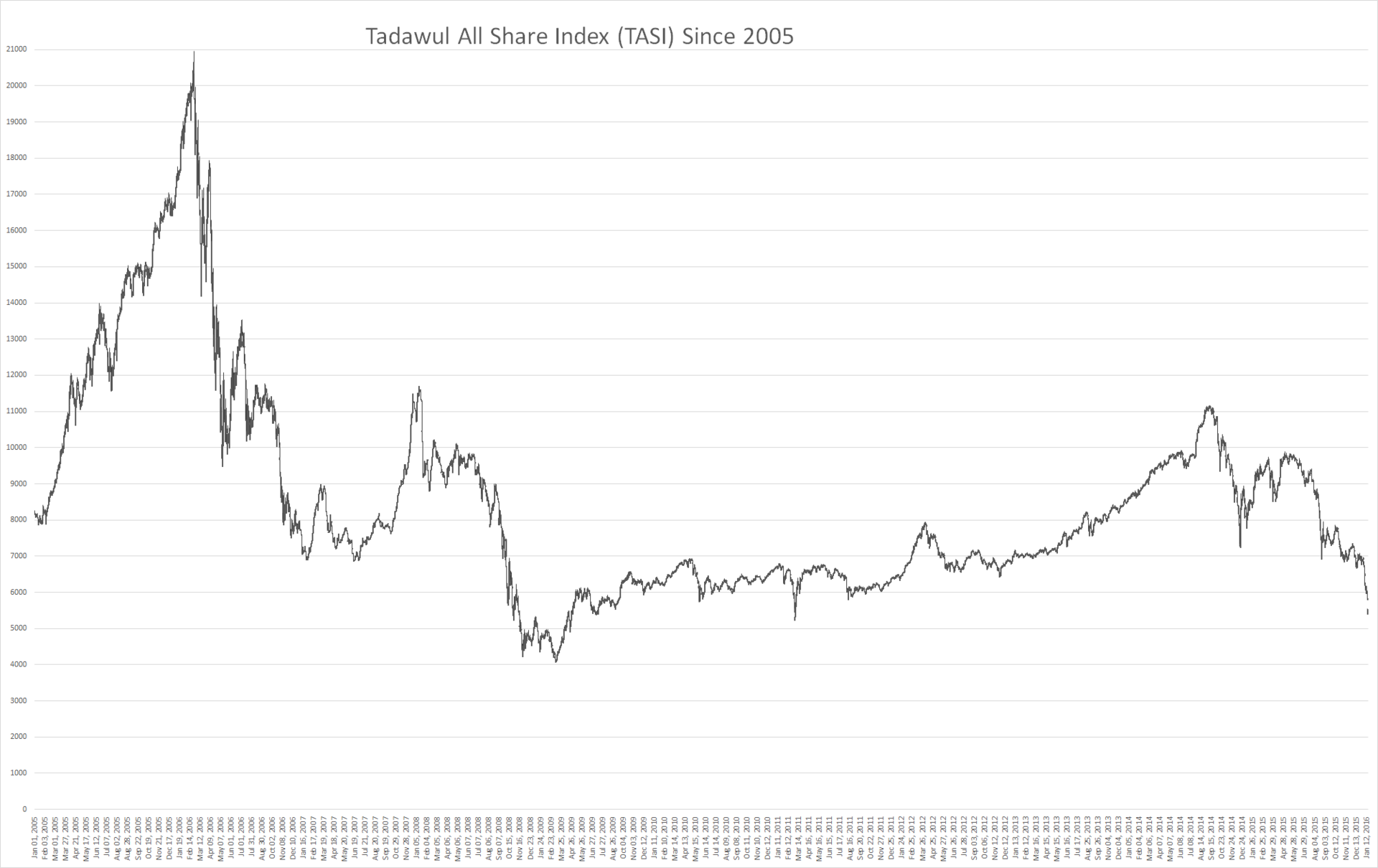
The Tadawul All Share Index closed at 11,020 on May 5, down 3.62% year-on-year. The strategy document was silent on the war. The market was not.
Frequently Asked Questions
Did PIF’s decade of international investing deliver competitive returns?
PIF’s defining international bet was a $45 billion anchor commitment to SoftBank’s Vision Fund in 2016 — the largest single sovereign fund allocation of its kind at the time. SoftBank subsequently recorded substantial portfolio losses, and the Vision Fund era is widely regarded as underperforming. LIV Golf absorbed a further $5–6 billion with zero financial return over four years. PIF’s stated 7% annualized total shareholder return since 2017 is a blended figure across all three portfolios; the fund has never separately disclosed the Financial Portfolio’s standalone international performance. The blended return is heavily influenced by appreciation of PIF’s Saudi Aramco stake — a domestic holding, not an international one. The question of whether the international portfolio alone justified its allocation has never been publicly answered.
How does Tehran read PIF’s domestic pivot?
From Iran’s strategic perspective, a sovereign wealth fund repatriating capital at scale has priced in a long war. The 20-day interval between Al-Rumayyan’s “strong, stable and resilient” declaration in Miami on March 26 and the board’s formal domestic reorientation on April 15 is the type of behavioral sequence adversary intelligence analysts isolate: public confidence language followed within weeks by private crisis preparation. The structural read from Tehran — that Riyadh does not expect the Hormuz disruption, the production shortfall, or the fiscal pressure to resolve on a timeline that justifies maintaining 30% outbound allocation — is a conclusion the strategy document’s silence on the war does nothing to contradict.
What is HUMAIN and why has it replaced NEOM as PIF’s flagship?
HUMAIN is PIF’s artificial intelligence subsidiary, launched with a $10 billion investment commitment and data center infrastructure described by PIF as already at capacity. Its elevation to flagship status reflects a wartime calculation beyond fiscal austerity: digital infrastructure does not depend on physical import corridors through the Strait of Hormuz. AI data centers require power, fiber optic connectivity, and cooling — resources Saudi Arabia can supply domestically or source via Red Sea ports that bypass the contested strait entirely. NEOM’s construction demanded steel, specialized glass, and heavy fabrication equipment imported through supply chains now subject to wartime disruption and marine insurance repricing.
The strategic architecture MBS is building on this Red Sea foundation — how the Yanbu terminal surge, Oxagon port, and $600 billion in US investment commitments form a coherent post-Hormuz economic geography — is examined in War Made the Red Sea Saudi Arabia’s Front Door.
Was the SAR 217 billion borrowing plan designed for wartime spending?
No. The National Debt Management Center set the SAR 217 billion annual figure before hostilities began on February 28. It assumed a Brent crude environment of $108–111 per barrel and pre-war production volumes near 10.4 million bpd — neither of which holds. Q1 spending consumed 58% of the plan in three months. NDMC has not announced a revised borrowing authorization. If Q2’s deficit trajectory matches Q1, Saudi Arabia will exhaust its full-year borrowing capacity by approximately end-June, forcing either a formal mid-year upward revision, a drawdown from the SAR 400.9 billion government reserve, or a combination of both — territory the kingdom has not entered since the 2015–2016 oil price collapse.