
RIYADH — Seventeen days into Iran’s retaliatory drone and missile campaign against Gulf states, the conflict’s civilian toll has fallen disproportionately on the region’s most vulnerable population: the estimated 35 million migrant workers from South Asia, Southeast Asia, and Africa who drive the Gulf’s construction sites, hospitals, delivery routes, and domestic households. At least eight of the fourteen civilians killed across the Gulf Cooperation Council states since February 28 have been identified as foreign nationals from Pakistan, Bangladesh, Nepal, and India, according to reports compiled by Al-Monitor and the Coalition on Labor Justice for Migrants in the Gulf. Roughly 70 workers from at least 15 countries have been injured. The dead were not soldiers, diplomats, or executives. They were a water delivery driver, a car washer, a shipbuilder, and a nurse — people whose daily routines placed them outside, exposed, and unable to shelter when Iranian drones and debris fell from the sky.
While wealthy expatriates and dual-passport holders have booked flights out of the region — airports in Riyadh, Jeddah, and Dammam remain open with frequent disruptions — millions of low-wage workers remain trapped by the very system that brought them to the Gulf. The kafala sponsorship framework, which ties a worker’s residency and employment to a single employer, limits their freedom of movement even in peacetime. In wartime, it has become a cage. Workers who borrowed thousands of dollars to pay recruitment agents cannot abandon their positions without forfeiting wages, visas, and the means to repay debts their families in Dhaka, Lahore, or Manila depend on.
The vulnerability of the Gulf’s migrant workforce is set to intensify during the upcoming Eid al-Fitr holiday, when millions of workers traditionally send remittances home and gather for communal celebrations. With Gulf states cancelling Eid events and restricting public gatherings, many migrant workers face the most isolated holiday of their lives abroad.
Table of Contents
- Who Are the Gulf’s 35 Million Migrant Workers?
- How Have Iran’s Attacks Killed and Injured Migrant Workers?
- The Kafala Trap Keeps Workers in a War Zone
- What Happens to $130 Billion in Annual Gulf Remittances?
- Saudi Arabia’s 13 Million Foreign Workers Face the Greatest Exposure
- Can Gulf Construction Projects Survive the Conflict?
- The Economic Shockwave Reaching Asia’s Poorest Families
- International Organizations Demand Kafala Abolition and Emergency Protections
- Frequently Asked Questions
Who Are the Gulf’s 35 Million Migrant Workers?
The Gulf Cooperation Council states — Saudi Arabia, the United Arab Emirates, Kuwait, Qatar, Bahrain, and Oman — depend on one of the largest concentrations of foreign labor anywhere on Earth. According to the Gulf Labor Markets and Migration programme at the Gulf Research Center, migrant workers account for nearly half of all workers across the GCC. In several member states, they constitute the outright majority of residents: foreigners make up approximately 88 percent of the UAE’s population, 73 percent of Qatar’s, and 70 percent of Kuwait’s.
Saudi Arabia, the largest Gulf economy, hosts an estimated 13.4 million non-Saudi residents, representing 44.4 percent of the Kingdom’s 34.9 million people, according to data compiled by the General Authority for Statistics. The private sector alone employs approximately 7.7 million foreign workers. Bangladeshi nationals lead with 2.12 million, followed by Indians at 1.88 million, Pakistanis at 1.21 million, Yemenis at 841,000, and Egyptians at 837,000, according to Saudi labor force data from 2022.
| Country | Estimated Migrant Workers (millions) | % of Total Population | Largest Source Countries |
|---|---|---|---|
| Saudi Arabia | 13.4 | 44% | Bangladesh, India, Pakistan, Yemen, Egypt |
| UAE | 8.7 | 88% | India, Bangladesh, Pakistan, Philippines |
| Kuwait | 3.1 | 70% | India, Egypt, Bangladesh, Philippines |
| Qatar | 2.4 | 73% | India, Nepal, Bangladesh, Philippines |
| Oman | 2.0 | 43% | India, Bangladesh, Pakistan |
| Bahrain | 0.8 | 55% | India, Bangladesh, Pakistan, Philippines |
These workers fill the roles that Gulf economies cannot function without: construction laborers on megaproject sites from NEOM to the Red Sea Global resorts, hospital nurses, food delivery drivers, domestic helpers, oil refinery technicians, and warehouse operatives. The workforce skews overwhelmingly male and of prime working age, with labor participation rates for non-Saudi workers running between 95 and 97 percent, according to Saudi General Authority for Statistics quarterly labor force surveys.
The Middle East briefing 3,000+ readers start their day with.
One email. Every weekday morning. Free.
How Have Iran’s Attacks Killed and Injured Migrant Workers?
Since Iran began firing missiles and launching drones at Gulf targets on February 28, 2026, at least 14 civilians have been killed across GCC states, according to casualty reports compiled by wire services and regional media. Eight of the dead have been identified as foreign nationals. The circumstances of their deaths underscore how wartime risk falls heaviest on workers whose jobs require them to be outdoors, on roads, or at exposed industrial sites.
Ahmad Ali, a 55-year-old Bangladeshi national, was delivering drinking water in the United Arab Emirates on February 28 when debris from a missile strike tore through his delivery van, killing him instantly. Ali had spent 30 years in the Emirates and was building a house for his family in the Barlekha subdistrict of eastern Bangladesh, according to Al-Monitor. His son, Abdul Hoque, confirmed his father’s death.
On the same day, Murib Zaman Nizar, a 44-year-old Pakistani driver and father of five children aged four to twelve, was killed in Abu Dhabi when debris from an intercepted drone fell on his car as he was washing his vehicle in his residential compound. His brother, Muhammad Khan, a construction worker from Bannu in Khyber Pakhtunkhwa province, told reporters that the family had no means to repatriate the body, according to Al-Monitor.
In Bahrain, SM Tareq, a 48-year-old Bangladeshi shipbuilder, was killed by missile debris at the Arab Shipbuilding and Repair Yard. In Kuwait, workers from Bangladesh and the Philippines, alongside employees from ten other nationalities, were injured during an attack on Kuwait International Airport. In Oman, at least one migrant worker was injured when Iranian drones struck the port of Salalah, damaging worker accommodations.
| Name | Nationality | Age | Location | Occupation | Cause |
|---|---|---|---|---|---|
| Ahmad Ali | Bangladeshi | 55 | UAE | Water delivery driver | Missile debris struck van |
| Murib Zaman Nizar | Pakistani | 44 | Abu Dhabi, UAE | Driver | Intercepted drone debris fell on car |
| SM Tareq | Bangladeshi | 48 | Bahrain | Shipbuilder | Missile debris at repair yard |
| Mary Anne V. de Vera | Filipino | 32 | Israel | Care worker | Residential building attack |
The dead represent only the documented cases. Al-Monitor reported that almost all of those killed in the UAE from debris have been migrant workers — people whose jobs placed them outside at the moment of attack, in delivery vans, parking compounds, and industrial yards rather than in reinforced residential buildings.
The Kafala Trap Keeps Workers in a War Zone
The kafala sponsorship system, which governs foreign labor across most GCC states, has drawn decades of international criticism from human rights organizations including Human Rights Watch, Amnesty International, and the International Labour Organization. Under kafala, a migrant worker’s legal right to reside and work in a Gulf state is tied to a specific employer, or sponsor. The employer controls the worker’s visa status and, in many cases, holds the worker’s passport. Changing employers, leaving the country, or even moving between cities typically requires the sponsor’s explicit permission.
In peacetime, the system restricts labor mobility and has been linked to wage theft, abusive working conditions, and a power imbalance that the Council on Foreign Relations describes as “modern-day slavery.” In wartime, these restrictions become life-threatening. Workers who wish to leave the Gulf face multiple barriers: they cannot travel without their employer’s consent, they have no independent visa status, and many owe substantial debts to the recruitment agents who arranged their placement.
The Coalition on Labor Justice for Migrants in the Gulf, whose signatories include Anti-Slavery International, the International Domestic Workers Federation, and Building and Wood Workers’ International, published an urgent statement in March 2026 demanding the immediate abolition of the kafala system. The coalition warned that employers are using the conflict as a pretext to withhold earned wages, deny leave, or dismiss workers without compensation. “Many migrant workers do not hold their own passports and are legally tied to their employers,” the statement noted. “This systemic lack of mobility further traps migrant workers in conflict zones, limiting their movement.”
Saudi Arabia formally ended elements of the kafala system in 2021, introducing a contract-based employment model that allows workers to change employers under certain conditions. However, implementation has been uneven, and the practical barriers to worker mobility remain significant, according to a March 2025 assessment by the Migration Policy Institute. Exit permit requirements have been relaxed in some states, but workers still face bureaucratic hurdles, financial penalties, and the risk of employer retaliation if they attempt to leave.
What Happens to $130 Billion in Annual Gulf Remittances?
The economic stakes extend far beyond the Gulf’s borders. Migrant workers in GCC countries send an estimated $130 billion in annual remittances to their home countries, according to World Bank data. Each disruption to Gulf employment ripples through economies from Bangladesh to the Philippines, where remittance income constitutes a critical share of household budgets and national current account balances.
India faces the largest exposure. Approximately 9.1 million Indian citizens work in GCC countries and send an estimated $50 billion home annually, according to Al Jazeera, citing Indian government data. Each worker supports an average of four to five people in India, meaning 40 to 50 million Indians directly depend on Gulf employment income. Former Indian ambassador Talmiz Ahmad told Al Jazeera that there is “no way any country, including India, can evacuate nine or 10 million people” in a war situation, though he noted that India successfully airlifted nearly 200,000 nationals from Kuwait during the 1990 Iraqi invasion.

Bangladesh received $30.32 billion in total remittances in fiscal year 2024-25, the highest in the country’s history, with a substantial share originating from Gulf states, according to Bangladesh Bank data cited by the Daily Star. An estimated 2.12 million Bangladeshi workers are employed in Saudi Arabia alone. The Philippines received $6.13 billion from the Middle East in 2024, accounting for 17.77 percent of the country’s total $34.49 billion in remittance income, according to the Bangko Sentral ng Pilipinas.
| Country | Workers in GCC (millions) | Annual Remittances From Gulf (est.) | Key Vulnerability |
|---|---|---|---|
| India | 9.1 | $50 billion | 40-50 million dependents; 80% of gas imports via Hormuz |
| Bangladesh | 3.5 | $15-18 billion | Remittances are largest foreign exchange source |
| Pakistan | 4.9 | $12-15 billion | Current account already in deficit |
| Philippines | 2.2 | $6.1 billion | 17.8% of total remittance income from Middle East |
| Nepal | 1.5 | $4-5 billion | Remittances equal ~25% of GDP |
| Sri Lanka | 0.6 | $2-3 billion | Already in debt restructuring |
Capital Economics warned in a March 2026 analysis that if GCC economies remain under sustained attack and the Hormuz blockade persists, the remittance channel will transmit the Gulf’s pain directly into South and Southeast Asian economies. “When Gulf employers freeze hiring, when construction contracts stall, when workers are stranded at closed airports, the remittance flow does not stop immediately,” the firm’s researchers wrote. “It slows first, and then, for many families, it stops.”
Saudi Arabia’s 13 Million Foreign Workers Face the Greatest Exposure
Saudi Arabia presents the most acute intersection of war risk and migrant worker vulnerability in the Gulf. The Kingdom hosts the largest absolute number of foreign workers, and its territory has been struck by Iranian drones and missiles every day since the conflict began. The Saudi Ministry of Defense reported on March 16 that the Kingdom’s air defense systems intercepted approximately 60 unmanned aerial vehicles launched from Iran toward eastern Saudi Arabia overnight alone.
Two people were killed in the Al-Kharj governorate when Iranian missiles struck residential areas on March 9, in one of the deadliest incidents on Saudi soil since the war started. While the nationalities of those victims have not been publicly confirmed, Al-Kharj’s population includes a significant proportion of migrant workers employed at nearby military facilities and agricultural operations.
Saudi Arabia’s Vision 2030 transformation programme has expanded the Kingdom’s dependence on foreign labor in construction, hospitality, and entertainment sectors. The NEOM megaproject alone employed tens of thousands of foreign workers before the conflict, and projects across Riyadh, Jeddah, and the Red Sea coast require a continuous supply of laborers from South and Southeast Asia. The war has frozen new recruitment pipelines, according to recruitment industry sources cited by Bloomberg, even as existing workers remain on site.
The U.S. Embassy in Riyadh has issued daily security alerts since March 3, directing American citizens to shelter in place and advising departure via commercial flights from Riyadh, Jeddah, and Dammam. The Department of State ordered non-emergency U.S. government employees to depart on March 8. But these advisories are directed at citizens of countries with the diplomatic resources and financial means to evacuate. For a Bangladeshi water delivery driver or a Pakistani construction worker earning $400 per month, the concept of booking a flight out is disconnected from economic reality.
Can Gulf Construction Projects Survive the Conflict?
The Gulf’s construction sector, which accounts for the single largest share of migrant employment, faces cascading disruptions from the conflict. Iranian strikes have forced temporary shutdowns at multiple industrial and construction sites across Saudi Arabia, the UAE, Bahrain, and Kuwait. The attack on Abu Dhabi’s Shah gas field on March 16, which set ablaze a sour gas development jointly operated by ADNOC and Occidental Petroleum, demonstrated that even facilities deep in the Empty Quarter desert, 180 kilometres from Abu Dhabi, are within range of Iranian drones. The IRGC has since expanded its threat, explicitly ordering workers to evacuate areas near any American-linked industrial facility ahead of planned strikes.
The Strait of Hormuz blockade has disrupted supply chains for construction materials including steel, aluminium, and copper, according to industry sources. Shipping insurance premiums for Gulf-bound cargo have increased by orders of magnitude, with several major insurers withdrawing war-risk coverage entirely, CNBC reported. Cement, aggregate, and finishing materials that arrive by sea face delays measured in weeks rather than days.
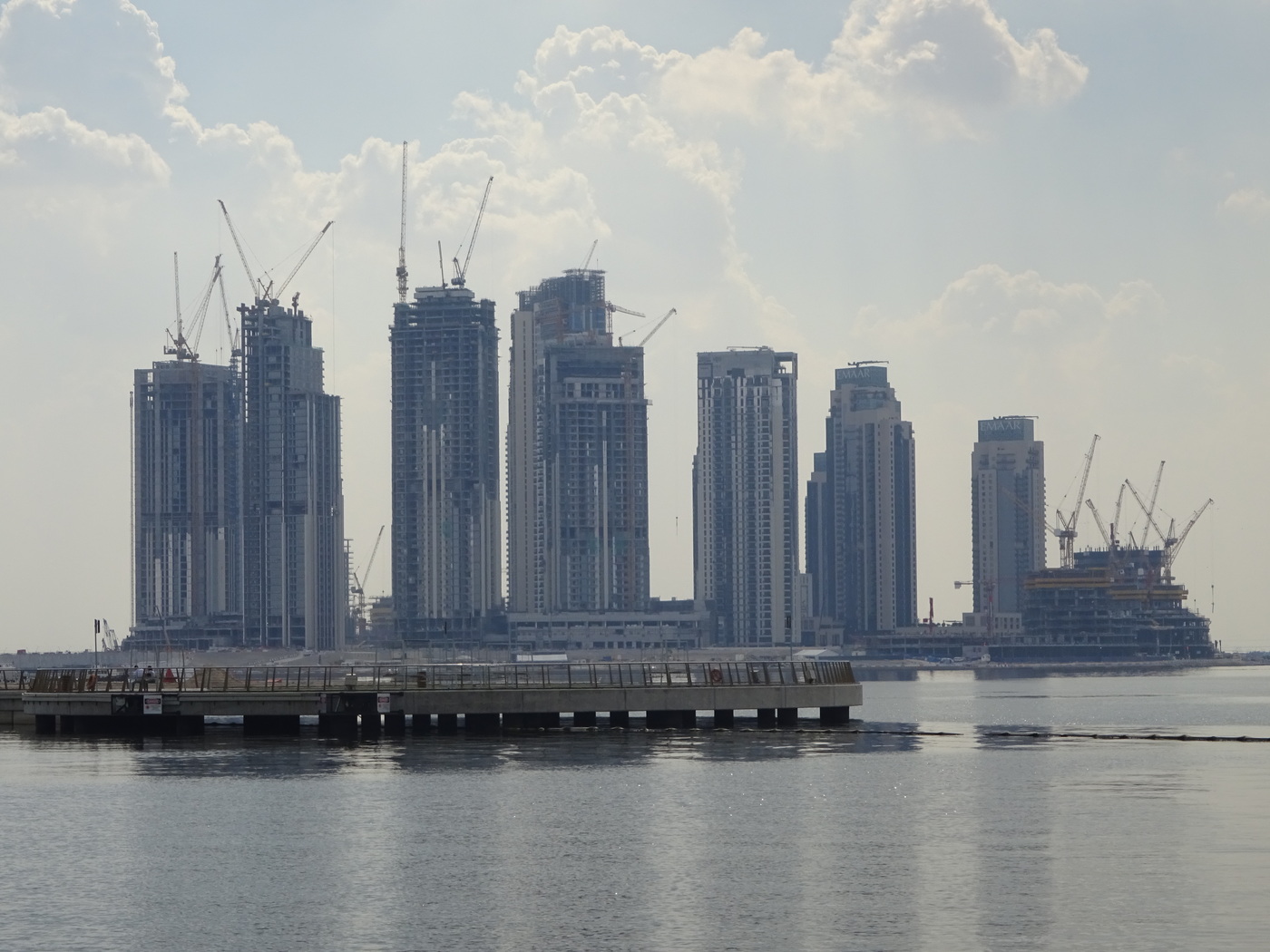
Workers on megaproject sites report a strange duality: the sirens sound, debris falls, and the next morning the cranes resume. An Indian engineer named Binoy, working on a project in the UAE, told Al-Monitor: “We know they are interceptions, but it is still worrying.” A Filipino nurse identified as Jane said she continues working while trying to manage the emotional toll, despite her children’s fears.
The International Revolutionary Guard Corps issued a warning on March 16, reported by the Middle East Monitor and PressTV, ordering the evacuation of all US-linked industrial facilities across the region and stating that “in the coming hours, these industries will be targeted and hit.” That threat extends the danger zone beyond military and energy targets to any commercial operation with American corporate involvement — a category that encompasses a substantial portion of Gulf construction, oil services, and technology projects employing migrant workers.
The Economic Shockwave Reaching Asia’s Poorest Families
The war’s disruption of Gulf employment is already sending tremors through Asian economies that depend on remittance income and Gulf energy imports. According to Time magazine, reporting on March 16, multiple Asian governments have implemented emergency economic measures in response to the oil price surge and supply disruptions caused by the Hormuz blockade.
Bangladesh has imposed fuel caps, closed universities, and deployed troops at oil depots. Thailand has ordered government agencies to adopt work-from-home policies and imposed temporary diesel price caps. The Philippines has mandated four-day work weeks for government employees and imposed air-conditioning limits. South Korea implemented its first fuel price cap in nearly 30 years. Nepal began rationing cooking gas. India redirected liquefied petroleum gas from industrial users to households.
The economic pain operates through two channels simultaneously. The first is the direct energy shock: approximately 80 percent of Asia’s oil imports transit the Strait of Hormuz, according to the International Energy Agency. Vietnam holds fewer than 20 days of reserves, Pakistan and Indonesia roughly 20 days each, and India, Thailand, and the Philippines approximately two months, according to Time’s analysis of government data.
The second channel is remittance disruption. When construction contracts stall, delivery companies reduce routes, and hospitality venues close, the workers who depend on those wages lose their ability to send money home. The World Bank projects that even a 10 percent decline in Gulf remittances would push an additional 3 to 5 million people in South Asia below the poverty line, according to the institution’s pre-conflict baseline estimates. Yale Insights noted that smaller economies — the Philippines, Pakistan, Sri Lanka — face the strongest macroeconomic effects through widening current account deficits and exchange rate pressures.
Qatar’s halt of LNG and helium production after suspected Iranian strikes has created additional supply chain risks. Qatar is the world’s second-largest helium producer, supplying roughly one-third of global demand, and helium is critical to semiconductor manufacturing in Taiwan, South Korea, and Japan, according to industry analysis.
International Organizations Demand Kafala Abolition and Emergency Protections
The Coalition on Labor Justice for Migrants in the Gulf, supported by eight international organizations including Anti-Slavery International, the International Trade Union Confederation, and Global Labor Justice, published a set of demands directed at GCC governments, origin countries, and the international community.
The coalition’s primary demands include an immediate ceasefire with full compliance with international humanitarian law; equal access to emergency shelters, early warning systems, and multilingual assistance regardless of citizenship status; coordinated safe repatriation with guarantees that employers cannot withhold documents or wages; and the permanent abolition of the kafala system, including tied visas and exit permit requirements.
The coalition specifically warned about domestic workers, who constitute one of the most hidden segments of the migrant workforce. Domestic workers, predominantly women employed in private households, often have even less mobility than construction laborers. They typically live in their employer’s home, may not have independent access to their passport, and are excluded from labor law protections in several GCC states. During a missile or drone attack, their ability to reach shelters depends entirely on the decisions of their employer household.
Harsh V. Pant, vice president of the Observer Research Foundation, told Al Jazeera that “energy markets are already volatile and costs are rising, which could eventually translate into broader economic and inflationary pressures” across Asia. The diplomatic implications for India, which has sought to maintain balanced relations with both Iran and the GCC states, are particularly acute given the 9.1 million Indian nationals whose safety and employment are at stake.
Gulf governments have so far responded with shelter-in-place directives and airport evacuation assistance for their own citizens and those of allied nations. Saudi Arabia’s civil defense authorities have expanded public shelter availability in Riyadh, the Eastern Province, and Al-Kharj. But no GCC government has announced a dedicated evacuation programme for migrant workers, or temporary protections that would allow workers to leave without their employer’s consent.
Frequently Asked Questions
How many migrant workers are in the Gulf?
Approximately 35 million migrant workers live and work across the six Gulf Cooperation Council states, according to the Gulf Labor Markets and Migration programme. Saudi Arabia alone hosts an estimated 13.4 million foreign nationals, representing 44.4 percent of the population. The largest source countries are India, Bangladesh, Pakistan, the Philippines, and Nepal, with workers employed primarily in construction, domestic work, hospitality, healthcare, and oil services.
Why can’t migrant workers leave the Gulf during the war?
Multiple barriers prevent departure. The kafala sponsorship system ties workers’ legal residency to their employer, limiting independent movement. Many workers have debts to recruitment agents that can only be repaid through continued employment. Commercial flights, while still operating from major Gulf airports, are expensive and subject to cancellations. No GCC government has announced a dedicated evacuation programme for foreign workers, and origin countries lack the diplomatic or logistical capacity to evacuate millions of citizens simultaneously.
How much money do Gulf migrant workers send home each year?
Gulf migrant workers send an estimated $130 billion in annual remittances to their home countries, according to World Bank data. India’s 9.1 million Gulf workers alone send approximately $50 billion per year. Bangladesh, Pakistan, the Philippines, Nepal, and Sri Lanka also depend heavily on Gulf remittance income, which in some cases represents 15 to 25 percent of national GDP. Any sustained disruption to Gulf employment threatens the financial stability of tens of millions of families across Asia and Africa.
Have any migrant workers been killed in the Iran-Gulf conflict?
At least eight of the fourteen civilians killed across GCC states since February 28, 2026, have been identified as foreign nationals. Documented victims include Ahmad Ali, a 55-year-old Bangladeshi water delivery driver killed in the UAE; Murib Zaman Nizar, a 44-year-old Pakistani driver killed in Abu Dhabi; SM Tareq, a 48-year-old Bangladeshi shipbuilder killed in Bahrain; and Mary Anne Velasquez de Vera, a 32-year-old Filipino care worker killed in Israel. Approximately 70 workers from 15 countries have been injured.
What has Saudi Arabia done to protect foreign workers?
Saudi Arabia’s civil defense authorities have expanded public shelter availability and issued guidance for residents to shelter in place. The Kingdom’s air defense systems have intercepted thousands of Iranian drones and missiles since the conflict began. However, Saudi Arabia has not announced a dedicated evacuation programme for foreign workers, temporary visa amnesty provisions, or emergency kafala suspension measures. The 2021 labor reforms that nominally ended the kafala system have not been tested under wartime conditions.
The stakes for Gulf workers are compounded by a rapidly deteriorating economic environment. Goldman Sachs warned on March 17 that Gulf economies face their worst recession in a generation, with GDP contractions that could trigger mass layoffs in sectors employing millions of expatriate workers.
That preparedness gap was underscored on March 18 when Saudi Civil Defense activated Riyadh’s first-ever phone-based air raid alert during an Iranian ballistic missile barrage, ordering residents to shelter in place without designating any public shelters.