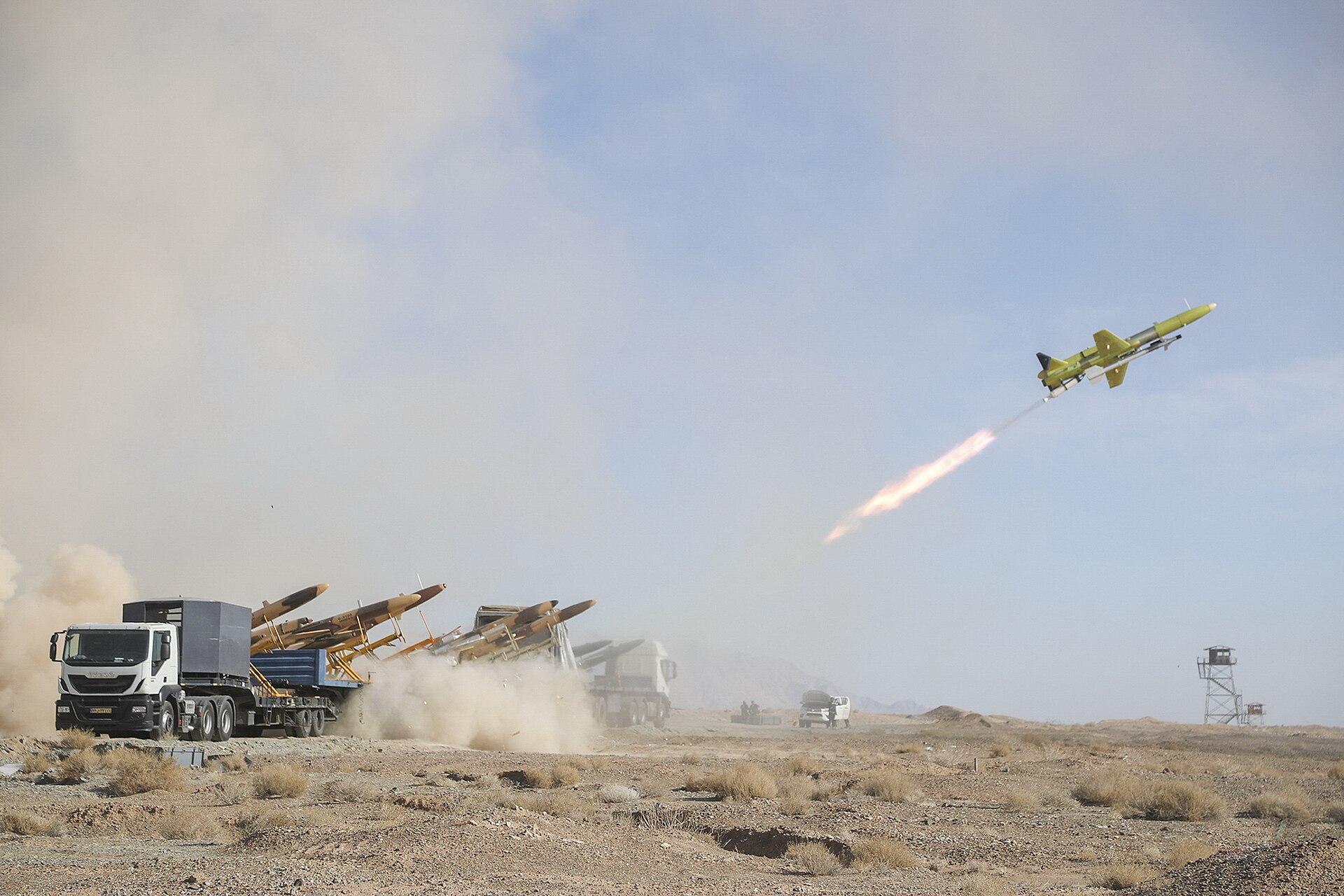

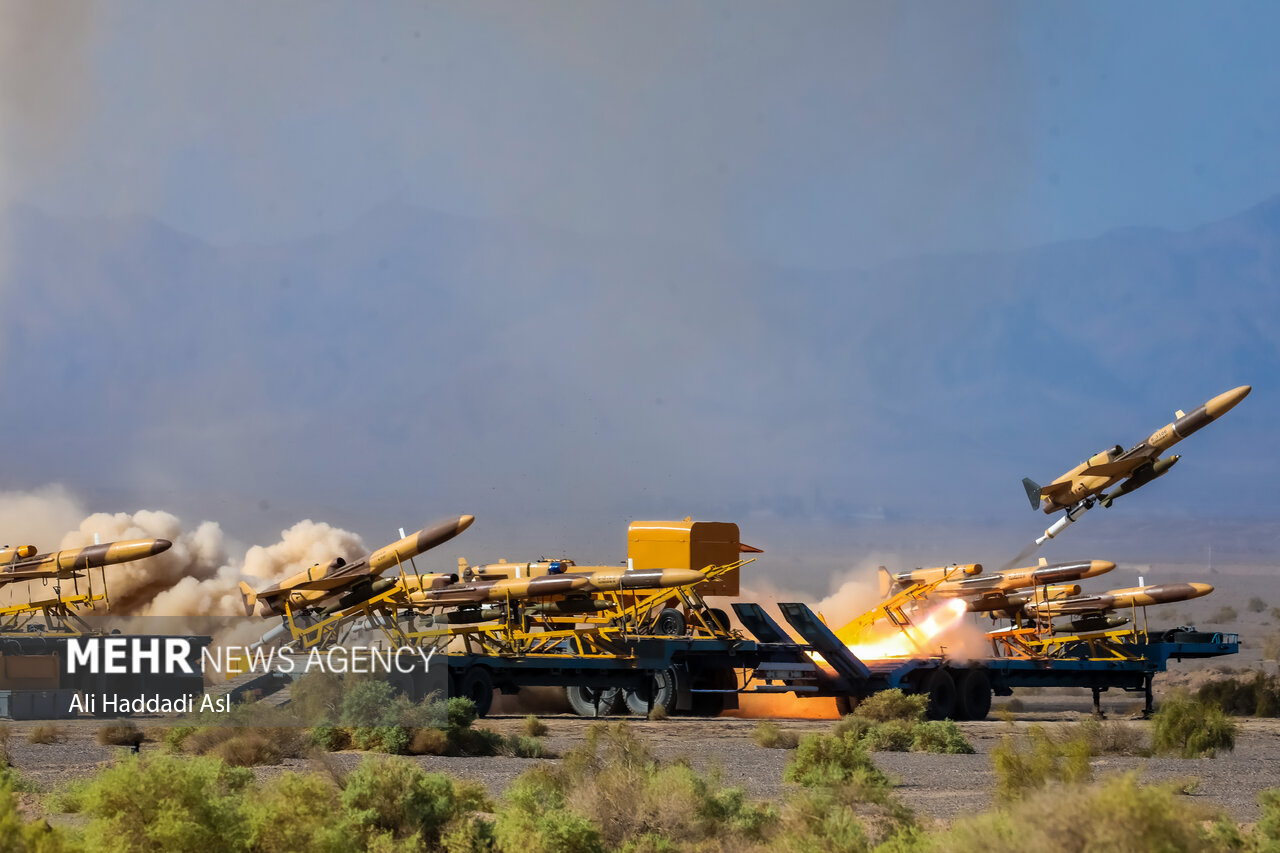
RIYADH — The United States and Israel have killed at least sixteen of Iran’s most senior military and political leaders since February 28, including the Supreme Leader himself, and yet the number of drones striking Saudi Arabia is not declining. It is increasing. On March 22 alone, Tehran launched nearly one hundred drones at the Kingdom — the largest single-day barrage since the war began. The explanation lies not in some hidden reserve of leadership talent but in a military doctrine the Islamic Revolutionary Guard Corps adopted two decades ago, one designed from inception to survive exactly this kind of decapitation. The IRGC calls it mosaic defense — a structure that AI-driven war simulations systematically underestimated — and it may be the single most important factor determining how this war ends — and whether it can end at all.
The latest replacement came on 24 March, when Iran named IRGC brigadier general Mohammad Bagher Zolghadr as Secretary of the Supreme National Security Council, filling the vacancy left by Ali Larijani, who was killed in an Israeli airstrike on Tehran one week earlier.
Three weeks into the most intense aerial campaign since the 2003 invasion of Iraq, the conventional assumption driving American and Israeli strategy — that killing enough generals will collapse Iran’s war machine — is colliding with a military architecture purpose-built to make that assumption fatal. Every provincial IRGC commander in Iran possesses his own weapons stockpiles, drone launchers, intelligence apparatus, and Basij militia forces. Every one of them has been explicitly trained to wage war without orders from Tehran. The implications for Saudi Arabia’s air defense posture, for the trajectory of the Strait of Hormuz crisis, and for the prospects of any ceasefire agreement are profound.
Table of Contents
- What Is the IRGC’s Mosaic Defense Doctrine?
- Who Is Ahmad Vahidi and Why Does His Appointment Matter?
- How Many Iranian Commanders Have Been Killed Since February 28?
- Thirty-One Provinces, Thirty-One Independent Armies
- The Fourth Successor Protocol
- Why Are Iranian Drone Attacks Increasing Despite Leadership Losses?
- Iran’s Decentralized Drone Production Network
- What Does the Mosaic Doctrine Mean for Saudi Air Defense?
- Can a Ceasefire Hold When Provincial Commanders Answer to No One?
- The Decapitation Resilience Index
- Killing Generals Is Making the War Harder to End
- Frequently Asked Questions
What Is the IRGC’s Mosaic Defense Doctrine?
Mosaic defense is a military organizational principle that the IRGC adopted formally in 2008, though its intellectual foundations date to 2005, when then-IRGC commander Mohammad Ali Jafari initiated a radical restructuring of the entire force. The doctrine rests on a single, brutally pragmatic assumption: in any war with the United States or Israel, Iran will lose its senior commanders, its key facilities, its communications networks, and even centralized control over its forces. The only question is whether those losses end the war or merely change its character.
The answer the IRGC chose was to build a military that does not require centralized control to function. Jafari, according to analysis by the Soufan Center, studied the collapse of Saddam Hussein’s military in 2003 with forensic intensity. The Iraqi army was a classic centralized force — when American precision strikes destroyed its command-and-control infrastructure and killed or captured its senior leadership, the entire edifice crumbled within weeks. Jafari concluded that Iran needed the opposite: a force so thoroughly distributed that no single strike, no series of assassinations, and no communications blackout could paralyse it.
The restructuring transformed the IRGC from a conventional military hierarchy into thirty-one semi-autonomous provincial corps, each corresponding to one of Iran’s thirty-one provinces, with Tehran Province receiving two corps due to its strategic importance. Each provincial corps was given its own weapons arsenal, logistics chain, intelligence service, and command of the local Basij paramilitary militia. Provincial commanders were explicitly trained and authorized to make independent military decisions — including offensive operations — without consulting Tehran, according to reporting by Radio Free Europe/Radio Liberty.
The Middle East briefing 3,000+ readers start their day with.
One email. Every weekday morning. Free.
At the centre of this architecture is a concept Iranian military thinkers call “operational autonomy” — a protocol that activates automatically when communications with Tehran are severed or when the senior leadership is incapacitated. Under operational autonomy, each provincial commander becomes, in effect, the supreme military authority within his jurisdiction. He does not wait for orders. He executes pre-planned operations and adapts to local conditions using his own intelligence and his own resources. The system was not improvised in response to the current war. It was rehearsed for nearly twenty years.
Who Is Ahmad Vahidi and Why Does His Appointment Matter?
Ahmad Vahidi was appointed commander-in-chief of the IRGC on March 1, 2026 — three days after the war began and less than forty-eight hours after the previous commander, Mohammad Pakpour, was killed in the opening strikes. Vahidi’s selection was not random. Born in 1958 in Shiraz, Vahidi joined the IRGC at its founding in 1979 and holds a doctorate in strategic studies from Imam Sadegh University. His career trajectory reveals why the regime turned to him in its most desperate hour.
From 1988 to 1997, Vahidi commanded the Quds Force, the IRGC’s elite extraterritorial and unconventional warfare unit. The Quds Force specializes in asymmetric operations, proxy management, intelligence collection, and the kind of dispersed, low-signature warfare that the mosaic doctrine codifies at a national level. Vahidi did not merely understand decentralized warfare in theory; he spent nearly a decade commanding the force that practiced it across Lebanon, Iraq, Afghanistan, and the broader Middle East.
After leaving the Quds Force, Vahidi served as deputy minister of defense from 2005 to 2009, then as minister of defense under President Mahmoud Ahmadinejad from 2009 to 2013 — a period during which Iran significantly expanded its ballistic missile programme and drone production infrastructure, according to the International Institute for Strategic Studies. He subsequently led the Supreme National Defense University before serving as interior minister under the late President Ebrahim Raisi.
Vahidi is subject to sanctions by both the United States and the European Union. Interpol has sought him since 2007 in connection with the 1994 bombing of the AMIA Jewish community centre in Buenos Aires, which killed eighty-five people. His appointment signals that Tehran’s wartime leadership selection prioritizes operational capability over diplomatic acceptability. Vahidi knows how to run a decentralized war because he spent his career building the tools to fight one.
The choice matters for Saudi Arabia because it indicates Tehran has no intention of seeking a negotiated settlement through conventional channels. A leader with Vahidi’s background is an operator, not a negotiator. His elevation tells Riyadh and Washington alike that Iran’s military establishment has committed to the long war the mosaic doctrine was designed to sustain.
How Many Iranian Commanders Have Been Killed Since February 28?
At least sixteen senior Iranian officials and military commanders have been killed since the US-Israeli strikes began on February 28, 2026, according to a running tally maintained by Iran News Wire and confirmed by multiple independent sources. The scale of leadership losses is without modern precedent — no state has lost this many senior military and political figures in such a compressed timeframe since the Second World War.
| Name | Position | Date Killed | Circumstances |
|---|---|---|---|
| Ali Khamenei | Supreme Leader | Feb 28 | Opening strikes on Tehran |
| Mohammad Pakpour | IRGC Commander-in-Chief | Feb 28 | Israeli airstrike |
| Aziz Nasirzadeh | Defense Minister | Feb 28 | Opening strikes |
| Abdolrahim Mousavi | Chief of Staff, Armed Forces | Feb 28 | Opening strikes |
| Ali Shamkhani | Defence Council Secretary | Feb 28 | Israeli strike confirmed by IDF |
| Gholamreza Soleimani | Basij Commander | Feb 28 | Opening strikes |
| Ali Larijani | Head, Supreme National Security Council | Mar 1 | Israeli strike |
| 4 Intelligence Officials | Ministry of Intelligence | Feb 28-Mar 1 | Various strikes |
| Ali-Mohammad Naeini | IRGC Spokesperson | Mar 20 | Israeli strike |
| Esmail Ahmadi | Deputy Intelligence, Basij | Mar 20 | Israeli strike |
| Mehdi Rostami Shomastan | Senior Commander, Intelligence | Mar 20 | Israeli strike |
The pattern reveals a deliberate decapitation strategy targeting Iran’s command-and-control architecture at every level simultaneously. The Supreme Leader, his chief of staff, his defense minister, his intelligence apparatus, and the commander of his most powerful military force were all struck within the first seventy-two hours. Under any conventional military doctrine, this scale of leadership destruction would be catastrophic. Under the mosaic doctrine, it activated the very contingency the system was designed for.
This does not mean the losses are painless. Replacing institutional knowledge accumulated over decades is impossible in weeks. But the mosaic structure was never designed to replicate the old leadership — it was designed to function without it. The distinction matters enormously for those calculating how much longer Iran can sustain its campaign against Saudi Arabian territory.
Thirty-One Provinces, Thirty-One Independent Armies
The organizational heart of the mosaic doctrine is the division of the IRGC into thirty-two corps spanning Iran’s thirty-one provinces, supplemented by eleven regional military headquarters that function as autonomous operational units. Each provincial corps maintains a complete, self-contained military capability that mirrors, in miniature, the functions of a national military force.
A provincial IRGC commander in, for example, Khuzestan Province — which borders Iraq and sits atop Iran’s richest oil fields — controls his own drone inventory, his own missile units, his own intelligence-gathering network, and direct command of the local Basij militia. He maintains separate logistics chains for ammunition, fuel, and food. He has pre-planned operational orders covering a range of contingencies, from defensive operations within his province to offensive strikes against targets in neighbouring countries or in the Persian Gulf, according to the Business Today analysis of the structure.
| Province | Strategic Significance | Key Assets | Gulf Threat Vector |
|---|---|---|---|
| Khuzestan | Iran’s oil heartland, borders Iraq | Drone launchers, Basij, artillery | Strikes on Saudi Eastern Province |
| Bushehr | Persian Gulf coastline, naval base | IRGC Navy fast boats, coastal missiles | Hormuz interdiction, anti-ship attacks |
| Hormozgan | Controls Strait of Hormuz approach | Anti-ship missiles, mine warfare, drones | Direct Hormuz blockade enforcement |
| Sistan-Baluchestan | Pakistan border, Chabahar port | Long-range drone capability | Strikes on Oman, UAE eastern coast |
| Fars | Central Iran, strategic depth | Ballistic missile batteries | Long-range strikes on Saudi cities |
| Kerman | Southeast Iran, dispersed bases | Missile production, drone assembly | Strikes on UAE, Gulf shipping |
| Isfahan | Central military-industrial hub | Advanced missile production | Ballistic missile strikes on Riyadh |
The critical insight is that these provincial forces are not merely garrison units waiting for orders. They are trained, equipped, and psychologically prepared to wage independent offensive operations. The IRGC Ground Forces coordinate through those eleven regional headquarters, which function as intermediary nodes — not as bottlenecks. If a regional headquarters is destroyed, the provincial corps beneath it continues operations under pre-existing contingency plans. If the provincial commander is killed, his pre-designated successor assumes command immediately, without any ceremony, confirmation, or communication with Tehran.
For Saudi defense planners tracking where the next drone swarm will originate, this structure presents an almost impossible targeting challenge. The launch authority is not concentrated in a single command bunker that can be struck. It is distributed across more than forty separate command nodes scattered across a country roughly four times the size of Iraq.
The Fourth Successor Protocol
Before his death on February 28, Supreme Leader Ali Khamenei reportedly instructed senior officials to ensure that every key military and civilian position had four pre-designated successors, according to reporting by Al Jazeera. The protocol, sometimes called the “Fourth Successor” plan, creates a depth of leadership redundancy that makes traditional decapitation strategies mathematically futile.
Deputy defense minister Reza Talaeinik confirmed the system publicly in a television interview, stating that each figure in the IRGC command structure has named successors spanning three ranks, ready to replace them at any moment. The succession is not a contingency plan stored in a safe. It is an active, rehearsed protocol in which designated successors already understand their predecessor’s operational plans, maintain relationships with subordinate commanders, and have pre-positioned authority to assume control.
The arithmetic is stark. If the IRGC has approximately 350 senior command positions across its provincial corps, regional headquarters, and specialized forces, and each position has four designated successors, the system contains roughly 1,750 individuals pre-cleared for leadership roles. To functionally decapitate the IRGC through targeted killings, the US and Israel would need to identify and eliminate not sixteen people, not sixty, but potentially hundreds — many of whom deliberately maintain low public profiles and operate from dispersed locations.
“Every province is a mosaic, and the commanders have the ability and power to make decisions. Our command and control system is decentralized. It is designed to survive.”Reza Talaeinik, Iranian Deputy Defense Minister, March 2026
The protocol also addresses a subtler problem: institutional paralysis during leadership transitions. In centralized militaries, the death of a commander typically triggers a period of uncertainty as subordinates wait for the new chain of command to assert itself. The Fourth Successor system eliminates that gap entirely. When Pakpour was killed on February 28, Vahidi assumed command within hours — not because he was hastily appointed, but because the succession protocol had already designated him and the transition process had been rehearsed.
Why Are Iranian Drone Attacks Increasing Despite Leadership Losses?
The operational evidence from the first three weeks of the war provides the most concrete test of whether the mosaic doctrine works as designed. The answer, measured in drone launch rates, is unambiguous: the system is functioning.
In the war’s first week (February 28 to March 6), Iran launched an estimated average of fewer than twenty-five drones per day toward Saudi Arabia, according to Saudi Ministry of Defense statements compiled by Bloomberg. By week two, the daily average had risen. By March 22, Tehran launched nearly one hundred drones at Saudi Arabia in a single day — described by Bloomberg as “far above the previous daily average” and representing the largest single-day strike on the Kingdom since the war began.
| Period | Approximate Daily Average | Notable Strikes | Senior Leaders Killed by This Date |
|---|---|---|---|
| Week 1 (Feb 28 – Mar 6) | <25 | Initial strikes on Eastern Province | 8+ |
| Week 2 (Mar 7 – Mar 13) | 25-40 | Riyadh targeted, US Embassy hit | 12+ |
| Week 3 (Mar 14 – Mar 20) | 40-60 | Yanbu port struck, 60 drones in single day | 14+ |
| Day 23 (Mar 22) | ~100 | Largest single-day barrage, 3 ballistic missiles at Riyadh | 16+ |
The escalation trajectory is the opposite of what a successful decapitation campaign should produce. Under the conventional model, killing the commanders should degrade the force’s ability to coordinate and execute complex operations. Instead, the data suggests that the decentralization of launch authority has actually accelerated the tempo of attacks, as provincial commanders — freed from the need to seek approval from a central command that may or may not still exist — execute offensive operations on their own initiative and timeline.
This pattern validates the core thesis of the mosaic doctrine: that a decentralized military does not merely survive decapitation but may actually become more operationally aggressive in its aftermath. When provincial commanders know they are operating without oversight, they default to their most aggressive pre-planned posture rather than adopting a defensive crouch. The IRGC specifically trained them to behave this way.
Saudi Arabia’s Ministry of Defense has reported successfully intercepting the majority of incoming threats — on March 22 alone, Saudi forces shot down at least forty-seven drones, including a concentrated barrage of thirty-eight within three hours. But the interceptor-to-drone cost ratio remains punishing. Each Iranian Shahed-series drone costs an estimated $20,000 to $50,000 to produce, while each Patriot interceptor costs between $2 million and $4 million. The mathematics of attrition favour the side with the cheaper weapon and the distributed production capacity.
Iran’s Decentralized Drone Production Network
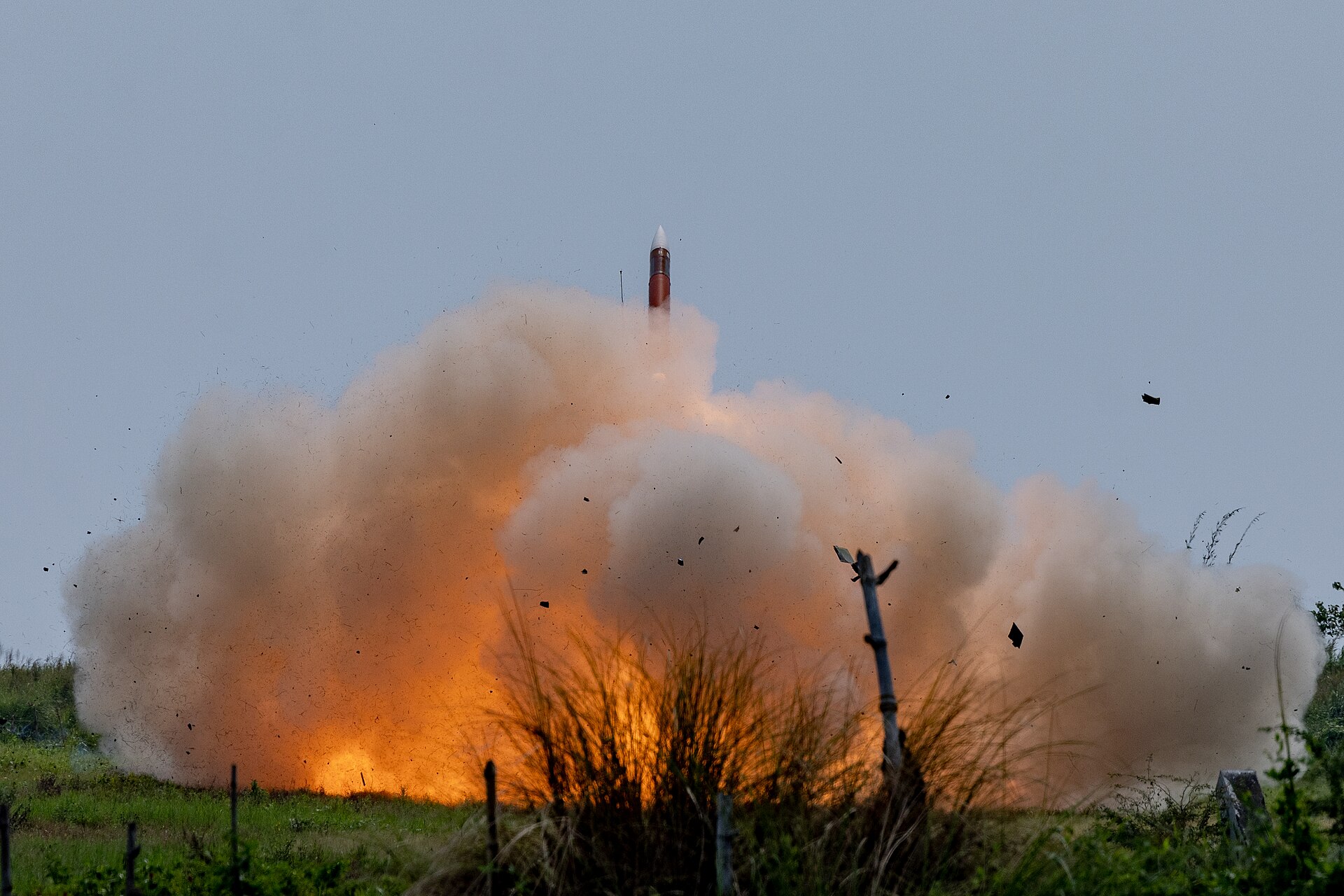
The mosaic doctrine’s principles extend beyond command-and-control to Iran’s military-industrial base. Iran’s drone production infrastructure is deliberately dispersed across multiple facilities in different provinces, a distribution strategy that mirrors the organizational decentralization of the IRGC itself.
US and Israeli airstrikes have struck known drone manufacturing facilities since the war’s opening hours. But Iran’s approach to drone production — like its approach to military command — was designed with the expectation that facilities would be destroyed. The IRGC maintains what the War on the Rocks analysis describes as a production network that cannot be accurately assessed by counting launch rates alone, because the relationship between manufacturing capacity and operational deployment is deliberately obscured through stockpiling, pre-positioning, and dispersed assembly.
For context on the scale involved, Russia — which acquired Iranian drone technology and established its own production lines — was manufacturing approximately 3,000 Shahed-variant drones per month by the end of 2025, according to defence industry reporting. Iran’s own monthly production figures remain classified, but the country maintained significant pre-war stockpiles and continues to assemble drones at dispersed facilities that have survived the bombing campaign.
The provincial dimension is critical here. Drone components can be manufactured in one province, assembled in another, and launched from a third — all without any single coordination point that, if destroyed, would halt the process. The IRGC treated its drone programme the way a technology company treats its distributed computing infrastructure: with enough redundancy that the loss of any individual node does not degrade overall system performance.
Iran’s pre-war drone inventory was substantial. The country developed and fielded at least a dozen distinct drone families — from the small, expendable Ababil series to the longer-range Shahed-136, which gained international notoriety for its effectiveness in the Ukraine conflict. Tehran also maintained significant stockpiles in hardened underground facilities, many of which were purpose-built in the decade before the war. The Council on Foreign Relations has noted that Iran entered the conflict as one of the world’s top five drone producers by unit volume, with a production ecosystem that spans state-owned defence companies, IRGC-affiliated workshops, and university research laboratories across at least eight provinces.
The dispersal extends to supply chains. Iranian engineers designed key drone components — guidance systems, engines, warhead assemblies — to use commercially available parts wherever possible, reducing dependence on specialised factories that could be identified and destroyed through satellite surveillance. This “dual-use” manufacturing philosophy means that a facility producing drone engine components may appear indistinguishable from a civilian automotive workshop, according to analysis by the Bulletin of the Atomic Scientists. The same workshop that builds irrigation pump motors on Monday may assemble drone propulsion units on Tuesday.
For Saudi Arabia and its allies, this means that destroying Iran’s drone capability requires not a handful of precision strikes on known factories but a sustained, intelligence-intensive campaign to identify and neutralize a production network that spans dozens of facilities across a country of 1.65 million square kilometres. Three weeks into the war, that campaign has demonstrably not succeeded in reducing the volume of drone attacks on the Gulf.
What Does the Mosaic Doctrine Mean for Saudi Air Defense?
Saudi Arabia’s air defense architecture was designed primarily to counter a centralized adversary — an enemy that coordinates attacks through a hierarchical command structure, launches from identifiable bases, and follows predictable operational patterns. The mosaic doctrine systematically undermines every assumption in that design.
The Kingdom’s integrated air defense system, anchored by Patriot PAC-3 batteries supplemented by THAAD systems and shorter-range point-defense weapons, excels at intercepting ballistic missiles launched from known positions and cruise missiles following predictable flight profiles. It is less optimized for the scenario the mosaic doctrine creates: simultaneous drone swarms launched from multiple dispersed locations across different provinces, arriving from different vectors, at different altitudes, with no single command node whose destruction would halt the incoming wave.
The March 22 attack illustrates the challenge with precision. Nearly one hundred drones launched from dispersed IRGC provincial positions arrived at Saudi airspace in irregular waves rather than a single coordinated salvo. Saudi defenses performed well, intercepting at least forty-seven. But the operational strain on radar operators, fire-control systems, and interceptor inventories was enormous. Patriot batteries have a finite magazine depth — typically sixteen ready-to-fire missiles per launcher — and reloading takes time. Each reload cycle creates a window of vulnerability that a dispersed, continuously attacking adversary can exploit.
The deployment of AI-enabled counter-drone systems by the United States represents one attempt to address this asymmetry. But the fundamental problem remains: a decentralized adversary launching cheap weapons from thirty-one independent positions can saturate defenses that were designed for a centralized threat launching expensive weapons from a handful of predictable locations.
Prince Khalid bin Salman, the Saudi minister of defense, faces a strategic dilemma with no clean solution. Building enough interceptor capacity to absorb unlimited decentralized drone attacks is prohibitively expensive and logistically impractical. Striking the provincial launch positions requires intelligence penetration of thirty-one separate IRGC commands — a task that would challenge any intelligence service even in peacetime. And negotiating a ceasefire that actually stops the attacks requires finding someone on the Iranian side with the authority to order thirty-one independent commanders to stand down. Under the mosaic doctrine, that person may not exist.
Can a Ceasefire Hold When Provincial Commanders Answer to No One?
This is the question that should concern Saudi policymakers more than any other. The mosaic doctrine was designed to ensure that Iran can keep fighting after losing its central leadership. It was not designed to ensure that Iran can stop fighting after its central leadership orders a halt.
In a centralized military, a ceasefire is mechanically straightforward: the supreme commander orders subordinates to cease fire, and the chain of command transmits and enforces the order. In the IRGC’s mosaic structure, the chain of command has been deliberately weakened to the point where provincial commanders operate with near-total autonomy. Some of those commanders may have personal, ideological, or strategic reasons to continue fighting regardless of what Tehran negotiates. Others may simply not receive the cease-fire order because the communications infrastructure the order would travel through has been destroyed by the same strikes that killed the commanders who would have issued it.
The precedent from proxy warfare is instructive. Iran’s Quds Force spent decades building proxy forces across the Middle East — Hezbollah in Lebanon, the Houthis in Yemen, Kata’ib Hezbollah in Iraq — that were designed to operate with significant autonomy from Tehran. In practice, these proxy forces frequently acted on their own initiative, sometimes in ways that contradicted Tehran’s strategic preferences. The mosaic doctrine essentially applies the proxy model to Iran’s own internal military structure. Every provincial IRGC commander is, in effect, a domestic proxy — empowered, equipped, and trained to act independently.
President Trump stated on March 20 that he was considering “winding down” military operations while simultaneously ruling out a ceasefire. Iran’s Foreign Minister Abbas Araghchi declared that Tehran had “never asked for a ceasefire” and was “ready to defend ourselves as long as it takes.” But even if both sides reversed their positions and agreed to stop fighting tomorrow, the mosaic structure creates a mechanical problem: who on the Iranian side has the authority to make thirty-one provincial commanders comply?
Mojtaba Khamenei, the late Supreme Leader’s son who has assumed the supreme leadership, may hold the political title. Ahmad Vahidi may hold the military one. But the mosaic doctrine was specifically designed to ensure that neither the political leader nor the military commander can be the single point of failure. The same resilience that keeps the war machine running also makes it extraordinarily difficult to turn off.
The Decapitation Resilience Index
Not all components of Iran’s military are equally resistant to leadership losses. Understanding which elements of Tehran’s war machine are most and least vulnerable to decapitation is essential for assessing how the conflict will evolve and where diplomatic or military pressure might actually produce results.
A systematic assessment of Iran’s major military components across five dimensions — command redundancy, operational autonomy, logistics independence, communications resilience, and succession depth — reveals a clear hierarchy of resilience.
| Military Component | Command Redundancy (1-10) | Operational Autonomy (1-10) | Logistics Independence (1-10) | Comms Resilience (1-10) | Succession Depth (1-10) | Overall Score |
|---|---|---|---|---|---|---|
| IRGC Provincial Corps (31) | 9 | 10 | 8 | 9 | 9 | 45 |
| IRGC Navy (Hormuz ops) | 7 | 8 | 7 | 7 | 8 | 37 |
| Basij Militia (provincial) | 8 | 9 | 6 | 8 | 7 | 38 |
| IRGC Aerospace Force | 5 | 4 | 4 | 5 | 6 | 24 |
| Regular Army (Artesh) | 4 | 3 | 5 | 4 | 5 | 21 |
| Ballistic Missile Force | 6 | 5 | 3 | 6 | 6 | 26 |
| Quds Force (external ops) | 7 | 9 | 7 | 6 | 7 | 36 |
| Cyber Warfare Units | 8 | 8 | 8 | 9 | 6 | 39 |
The index reveals three tiers of resilience. The provincial IRGC corps, the Basij militia, and the cyber units occupy the top tier — they are the components most likely to continue functioning effectively even after massive leadership losses. These are, not coincidentally, the components responsible for the drone campaign against Saudi Arabia and the Strait of Hormuz blockade.
The middle tier includes the IRGC Navy and the Quds Force — both capable of significant autonomous operation but more dependent on specialized equipment and training that is harder to replace. The bottom tier contains the conventional regular army and the ballistic missile force, which rely more heavily on centralized coordination, specialized technical personnel, and complex logistics chains that are vulnerable to disruption.
The strategic implication is that the US-Israeli decapitation campaign has been most effective against the components of Iran’s military that matter least to the current war, and least effective against the components that matter most. The drone swarms, the Hormuz operations, and the asymmetric attacks on Gulf infrastructure are all conducted by precisely the forces that score highest on the resilience index.
Killing Generals Is Making the War Harder to End
The conventional wisdom holds that eliminating Iran’s senior leadership degrades its military capability and brings the war closer to a conclusion. The evidence from three weeks of conflict suggests the opposite: each leadership kill deepens the decentralization that makes the war uncontrollable and pushes the end further away.
The paradox is structural, not accidental. Every time a senior IRGC commander is killed, the authority that commander held does not disappear — it disperses downward to his successors and outward to provincial commanders who now have even less oversight and even more operational freedom. The killing of Pakpour did not weaken the IRGC. It activated the mosaic doctrine’s most autonomous operating mode. The killing of the Basij commander did not demobilize the militia. It freed provincial Basij leaders to operate on their own initiative.
For Saudi Arabia, this creates a deeply uncomfortable reality. Riyadh cannot end the war by helping the US and Israel kill more Iranian generals, because each kill makes the remaining command structure more dispersed and less susceptible to both military pressure and diplomatic negotiation. The kingdom cannot negotiate a ceasefire with Tehran if Tehran’s operational commanders are structurally unable or unwilling to comply. And it cannot defend against an indefinite campaign of daily drone swarms without either accepting permanent attrition of its interceptor stocks or finding an entirely new defensive paradigm.
The analogy that best captures the dilemma is not military but biological. The IRGC’s mosaic structure functions like a starfish rather than a spider. Cut off a spider’s head and it dies. Cut off a starfish’s arm and it grows a new one — and the severed arm may grow into an entirely new starfish. The US-Israeli campaign has been cutting off arms with extraordinary precision and force. The organism keeps regenerating.
Three implications follow for Saudi strategy. First, Riyadh should expect the drone and missile campaign to continue at current or elevated levels regardless of how many more Iranian commanders are killed. The mosaic doctrine has been tested under real-world conditions and it works. Second, any ceasefire mechanism must account for the decentralized command structure — requiring not just an agreement with Tehran but verification mechanisms that reach down to the provincial level. Third, Saudi Arabia’s long-term security architecture must be redesigned around the assumption that Iran possesses a military capability that cannot be destroyed through conventional means, only managed through a combination of defense, deterrence, and exhaustion of the adversary’s economic capacity to sustain operations.
The war that Trump described as “obliterating the other side” has instead revealed that the other side was built to be un-obliterable. That fact will shape the Gulf’s security environment long after the last drone falls silent — assuming it ever does. The same decentralization dynamic is fragmenting Iran’s entire proxy network, with Hezbollah, Iraqi militias, and the Houthis all making autonomous decisions that Tehran can no longer control.
Frequently Asked Questions
What is Iran’s mosaic defense doctrine?
Iran’s mosaic defense doctrine is a military organizational principle adopted by the IRGC in 2008 that divides the force into thirty-one semi-autonomous provincial corps, each capable of independent operations including offensive drone and missile strikes. The doctrine was designed to ensure Iran’s military continues functioning even if senior leadership is killed and communications with Tehran are severed, making the force resistant to decapitation strategies.
Who is Ahmad Vahidi and what is his role in the 2026 Iran war?
Ahmad Vahidi is the current commander-in-chief of the Islamic Revolutionary Guard Corps, appointed on March 1, 2026, after his predecessor Mohammad Pakpour was killed in the opening US-Israeli strikes. Vahidi previously commanded the Quds Force from 1988 to 1997 and served as Iran’s defense minister from 2009 to 2013. His background in unconventional warfare makes him uniquely suited to lead a decentralized military campaign.
How many Iranian military leaders have been killed in the 2026 war?
At least sixteen senior Iranian officials and military commanders have been killed since February 28, 2026, including Supreme Leader Ali Khamenei, IRGC Commander Mohammad Pakpour, Defense Minister Aziz Nasirzadeh, and the chief of staff of Iran’s armed forces. Despite these losses, Iran’s drone attacks on Saudi Arabia and Gulf states have actually increased in frequency and intensity.
Why can’t the US and Israel stop Iran’s drone attacks by killing commanders?
The IRGC’s mosaic defense structure means each of Iran’s thirty-one provincial corps operates autonomously with its own weapons, logistics, and intelligence. The “Fourth Successor” protocol ensures every command position has four pre-designated replacements. Killing commanders activates more autonomous operating modes rather than degrading capability, and the decentralized drone production network ensures continued supply.
What does Iran’s mosaic doctrine mean for a potential ceasefire?
The mosaic doctrine creates a fundamental ceasefire problem: provincial IRGC commanders who have been empowered and trained to operate independently may not comply with cease-fire orders from Tehran, even if such orders are issued. Any ceasefire agreement must include verification mechanisms reaching the provincial level, making negotiations far more complex than a simple agreement between national leaders.
How does Iran’s mosaic defense affect Saudi Arabia’s security?
Saudi Arabia’s air defense systems were designed to counter centralized adversaries launching from predictable positions. Iran’s decentralized mosaic structure creates simultaneous threats from multiple provinces, arriving from different vectors, overwhelming traditional defense architectures. The cost disparity between $20,000 Iranian drones and $3 million Patriot interceptors makes sustained defense economically challenging, requiring Saudi Arabia to develop new defensive paradigms.