
RIYADH — Saudi Arabia’s non-oil private sector contracted in March for the first time since the COVID-19 lockdowns of August 2020, with the Riyad Bank Purchasing Managers’ Index falling to 48.8 from 56.1 in February — a 7.3-point collapse that broke a 66-month expansion streak and registered the second-lowest reading in the survey’s 17-year history. The data, compiled by S&P Global and released April 5, delivers a verdict that no amount of sovereign wealth fund arithmetic can obscure: Vision 2030’s diversification architecture was never decoupled from oil logistics. It was downstream of Hormuz.
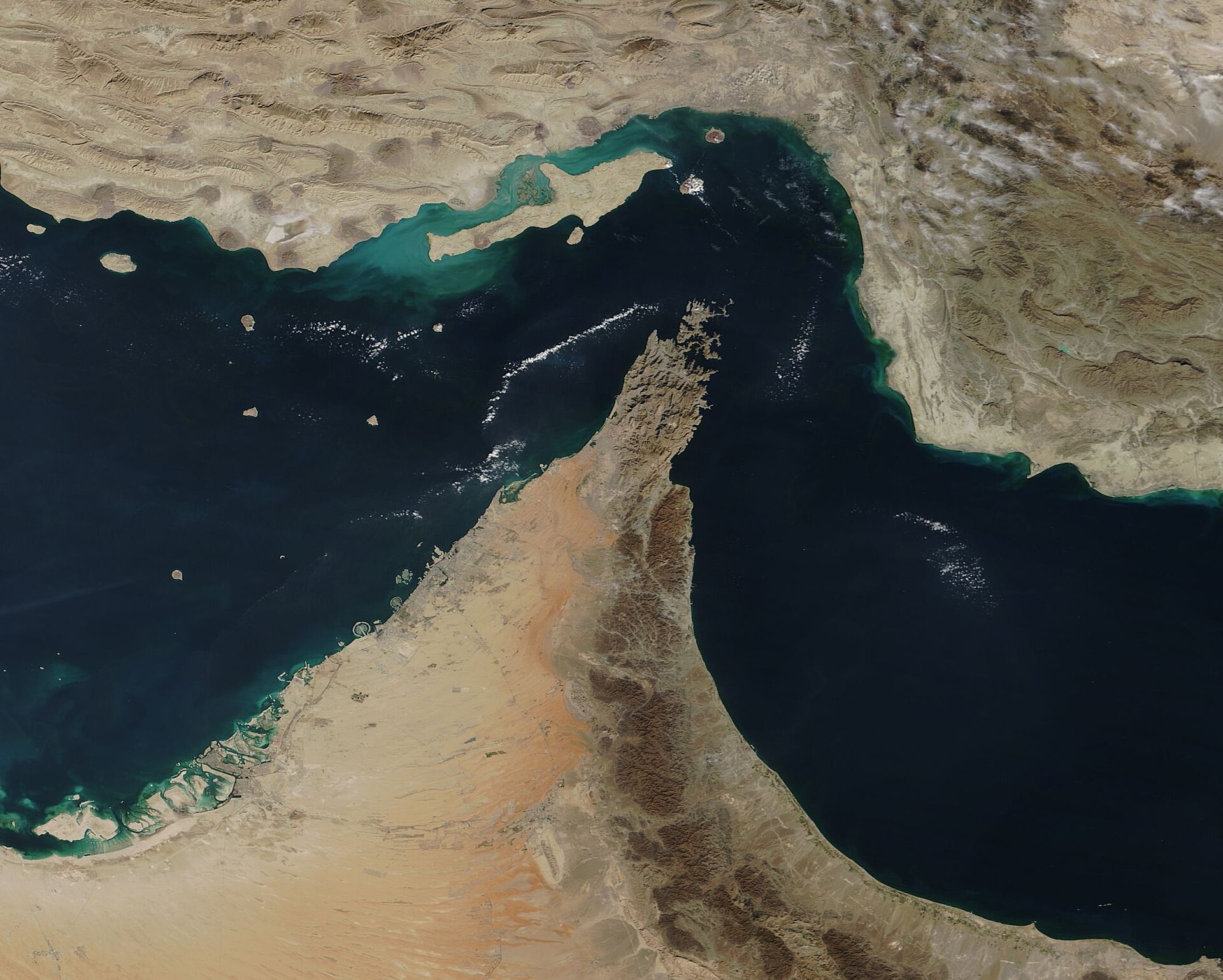
The editorial class that has spent a decade praising Saudi Arabia’s economic transformation tends to treat oil revenue and non-oil GDP as separate ledgers. The March PMI exposes how that separation was always notional. Export orders recorded their largest contraction in almost six years. Supplier delivery times lengthened at the fastest pace since June 2020. Order backlogs climbed to their highest since July 2018. These are not symptoms of a cyclical downturn. They are transmission signals from a chokepoint 1,200 kilometres east of Riyadh, where Iran’s selective naval interdiction has collapsed the freight assumptions on which Saudi Arabia’s non-oil supply chains were built. PIF’s formal 2026-2030 strategy, published the same week, shows how the fund reoriented its entire portfolio around this realisation — cutting construction spending by $41 billion and elevating Hormuz-immune digital infrastructure as Vision 2030’s new spine.
Table of Contents
- The Sixty-Six-Month Streak and What Killed It
- What Does the March PMI Actually Measure?
- The Hormuz Assumption Embedded in Vision 2030
- How Does a Strait Closure Collapse a Non-Oil PMI?
- Why Can’t the East-West Pipeline Fix This?
- The Fiscal Arithmetic at $109 Brent
- Capital as Coward
- Is This Really a ‘Temporary Adjustment’?
- Frequently Asked Questions
The Sixty-Six-Month Streak and What Killed It
From September 2020 through February 2026, the Saudi non-oil PMI stayed above 50.0 without interruption — 66 consecutive months of expansion that became one of the most-cited proof points for Vision 2030’s success. Government officials referenced it at Davos panels. PIF executives used it in roadshow decks. International consultancies built Saudi GDP forecast models on the assumption that the non-oil expansion would continue until at least 2028, barring a global recession. None of those models contemplated a regional war that would close a maritime chokepoint carrying 20 percent of the world’s oil.
The 7.3-point monthly decline from February to March is the second-largest in the survey’s history, behind only March 2020, when COVID-19 lockdowns shuttered entire sectors overnight. But the COVID comparison, while statistically apt, is structurally misleading. The pandemic was an exogenous demand shock that hit every economy simultaneously and resolved with reopening. The March 2026 collapse is a supply-side disruption specific to Saudi Arabia’s geographic position: a war next door, a chokepoint under interdiction, and an assumption baked into Vision 2030’s supply chains that nobody bothered to write down.
Naif Alghaith, chief economist at Riyad Bank, described the reading as “a temporary adjustment following a strong expansion phase” and attributed the decline to “short-term uncertainty linked to heightened geopolitical tensions in the region.” The language is careful. “Adjustment” implies a return to trend. “Short-term” implies the war has an expiration date. Neither is a given. Goldman Sachs has projected Saudi GDP could contract by 5 percent if the conflict runs through April 2026 — a threshold it has now crossed.
What Does the March PMI Actually Measure?
The Riyad Bank PMI, compiled monthly by S&P Global from surveys of approximately 400 private-sector firms, tracks five components: new orders, output, employment, supplier delivery times, and stocks of purchases. A reading above 50.0 indicates expansion; below 50.0, contraction. The March 2026 reading of 48.8 means that across the non-oil private sector — manufacturing, construction, wholesale, retail, services — more firms reported deteriorating conditions than improving ones.
The Middle East briefing 3,000+ readers start their day with.
One email. Every weekday morning. Free.
The sub-indices carry the detail. Export orders recorded their largest contraction in almost six years. Supplier delivery times lengthened at the fastest pace since June 2020 — driven by routing changes and war risk cost spikes linked to Iran’s selective exemption regime at Hormuz. Order backlogs rose to their highest level since July 2018.
Employment continued to rise, but at a markedly weaker rate. Business sentiment — the forward-looking component that captures firms’ expectations for the next twelve months — fell to its lowest point since June 2020. Government expenditure, still flowing, kept the contraction from being worse. Without that fiscal cushion, the headline number would have been lower.
The Hormuz Assumption Embedded in Vision 2030
Vision 2030 was announced in April 2016 with a premise that was stated and a premise that was not. The stated premise: Saudi Arabia needed to reduce its dependence on oil revenue, diversify its economy into tourism, entertainment, technology, logistics, and manufacturing, and grow the private sector’s share of GDP from 40 percent to 65 percent by 2030. The unstated premise: the Strait of Hormuz would remain open.
This was not an unreasonable assumption at the time. Hormuz had been the subject of Iranian threats for decades without ever being closed. The US Fifth Fleet sat in Bahrain. Global oil markets priced in a near-zero probability of sustained interdiction. And Vision 2030’s designers — led by Crown Prince Mohammed bin Salman and advised by McKinsey, Boston Consulting Group, and Oliver Wyman — were building an economic programme, not a war-contingency plan.
But the architecture they built was more dependent on Hormuz than the oil economy it was meant to replace. Oil, after all, has a bypass. The East-West Petroline can route up to 7 million barrels per day through Yanbu to the Red Sea. There is no equivalent bypass for the non-oil supply chains that Vision 2030 spent a decade building. The construction materials for NEOM came through Gulf ports. The imported machinery for Saudi Arabia’s growing manufacturing base transited Hormuz. The containerised consumer goods feeding the retail and hospitality sectors arrived via the same shipping lanes now subject to Iranian interdiction, war risk premiums of 800 percent, and transit delays of two weeks or more as vessels reroute via the Cape of Good Hope.
The non-oil sector accounted for 55.6 percent of real GDP in the first half of 2025, up from 45.4 percent in 2016. Non-oil exports hit a record SR97.5 billion ($25.9 billion) in Q4 2025, an 18.6 percent year-on-year increase — the highest quarterly level since 2017. The machinery and electrical equipment sector alone grew 78.6 percent year-on-year. Each of these numbers was celebrated as evidence that the diversification was working. Each of them was also a measure of how much more exposed the non-oil economy had become to the very supply chains that Hormuz carries.
How Does a Strait Closure Collapse a Non-Oil PMI?
The transmission mechanism from Hormuz to Saudi Arabia’s non-oil PMI operates through at least four channels — freight costs, export disruption, megaproject delays, and investor sentiment — and the March 2026 data registers all of them simultaneously. The 48.8 reading is not a single-cause outcome; it is a composite of supply-chain failures that each trace back to the same chokepoint.
The first is freight cost. War risk insurance premiums surged more than 800 percent within three days of the conflict’s onset in late February. Shipping container costs more than doubled. These cost increases do not stay in the maritime sector; they propagate through every industry that imports inputs or exports finished goods. A Saudi manufacturer buying German machine components faces a freight bill that has tripled. A Saudi food processor importing packaging material from India now waits two additional weeks for delivery via the Cape of Good Hope. The PMI’s supplier delivery time sub-index — at its worst since June 2020 — captures this directly.
The second channel is export disruption. Saudi Arabia’s non-oil export growth was one of Vision 2030’s headline achievements: $25.9 billion in Q4 2025, with particular strength in chemicals, plastics, and manufactured goods destined for Asian markets. Those exports transited Hormuz. The PMI’s export orders sub-index — recording its largest contraction in six years — reflects a market in which buyers in East Asia, South Asia, and Southeast Asia cannot reliably receive Saudi non-oil goods, and Saudi exporters cannot reliably ship them. The oil weapon Saudi Arabia cannot fire at Iran has a non-oil corollary: the export channels it spent a decade building are equally hostage to the same strait.
The third channel is construction and megaproject disruption. NEOM construction has been suspended since September 2025 pending a strategic review. Multiple contracts have been cancelled, including steel work by Eversendai, tunnel work by Hyundai E&C, and dam construction by Webuild for the Trojena ski resort. The Public Investment Fund wrote down $8 billion from the project, according to The Middle East Insider. But NEOM is only the most visible casualty. Across Saudi Arabia, construction firms that depend on imported steel, cement additives, electrical components, and specialised labour are reporting exactly the kind of input delays and cost overruns that the PMI’s sub-indices describe. The PIF has cut its domestic construction budget from approximately $71 billion to $30 billion, a 58 percent reduction announced before the March PMI was published.
The fourth channel is sentiment. “Capital is a coward; it doesn’t go into war zones,” F. Gregory Gause III of the Middle East Institute told AGBI in March. “Investors see the Gulf as a war zone, they’ve got other places to invest.” The PMI’s business expectations sub-index — at its lowest since June 2020 — captures the private-sector version of the same calculation: why expand capacity into a supply chain you cannot rely on?
Why Can’t the East-West Pipeline Fix This?
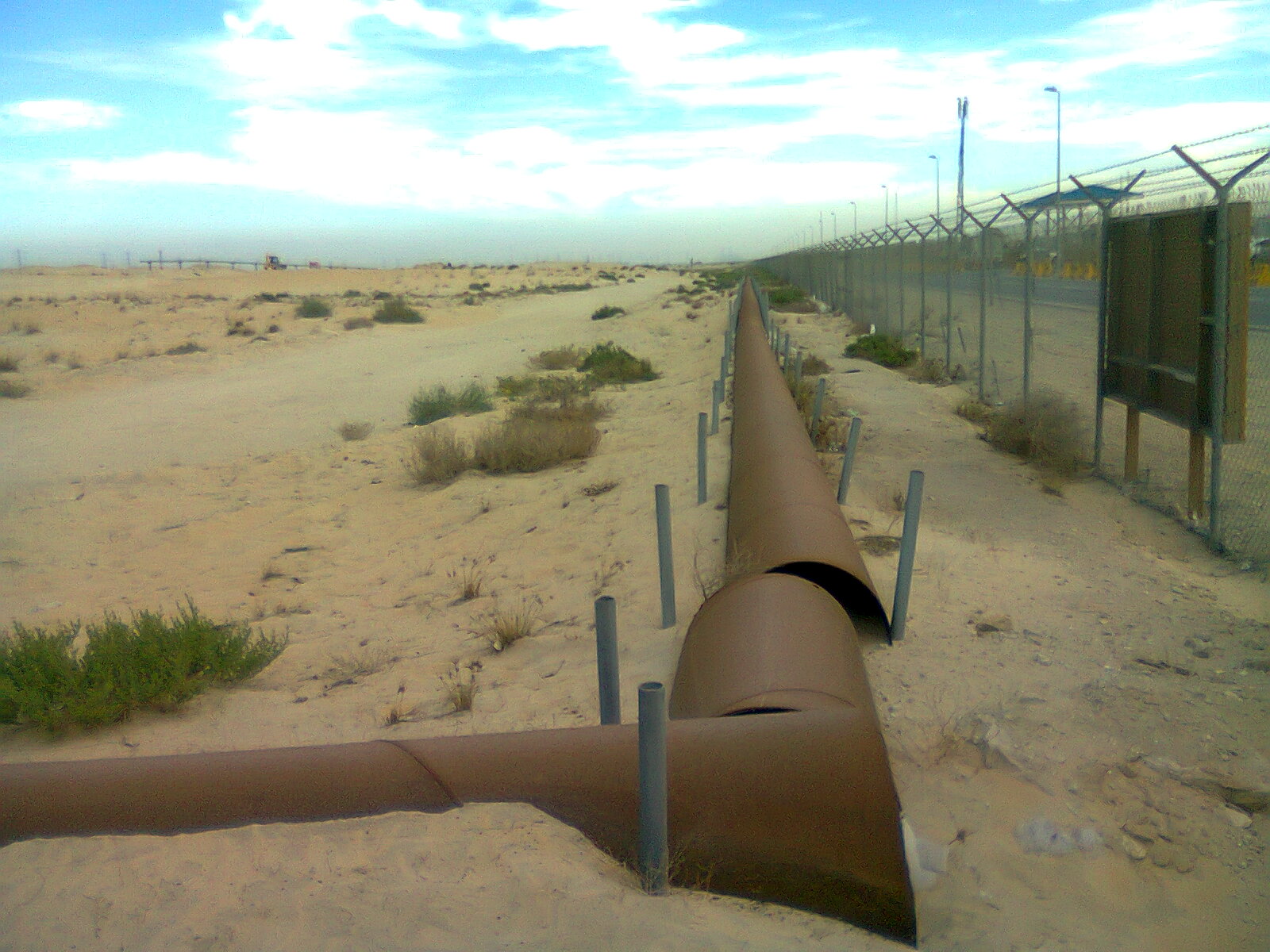
The East-West Petroline — with a capacity of 7 million barrels per day routed through Yanbu — has been the single most effective Saudi response to the Hormuz crisis. By mid-March, Saudi Arabia had reached approximately 80 percent utilisation, adding close to 3 million barrels per day of incremental Red Sea flows over pre-war levels. The bypass covers an estimated 80 to 85 percent of pre-war Saudi crude exports. It is a genuine strategic asset, and it is being used effectively.
But the pipeline carries crude oil. It does not carry containers. It does not carry construction equipment, automotive parts, consumer electronics, food imports, or the industrial inputs that the non-oil private sector consumes. Saudi Arabia’s non-oil economy cannot be piped to the Red Sea. It depends on ports — King Abdul Aziz Port in Dammam, Jubail Commercial Port, Ras Al Khair — that face the Persian Gulf. It depends on shipping lanes that pass through Hormuz. And it depends on global freight networks that have repriced the entire Gulf as a conflict zone.
The asymmetry is structural. Saudi Arabia spent decades building pipeline infrastructure to mitigate Hormuz risk for oil exports. It spent zero building equivalent redundancy for non-oil supply chains. Vision 2030 added an entire layer of economic activity — manufacturing, logistics, tourism, entertainment — on top of the same Gulf-facing infrastructure, without a bypass. The March PMI is the first quantitative measure of what that asymmetry costs when the assumption breaks.
Khaled Almezaini of Zayed University in Dubai estimated in March that “disruptions to aviation, tourism, shipping routes and energy exports combined with higher insurance premiums and freight costs mean the region is likely losing hundreds of millions of dollars per day.” He projected the outcome as “weaker growth and a delayed recovery rather than a broad, deep contraction.” The March PMI suggests the contraction is already here — not broad across the Gulf, but measurable in the Saudi non-oil private sector specifically.
The Fiscal Arithmetic at $109 Brent
The conventional wisdom before the war was that elevated oil prices would cushion Saudi Arabia against regional instability. Brent crude is trading at approximately $109 per barrel — well above the $94 per barrel fiscal breakeven estimated by Bloomberg Economics. On paper, the Kingdom should be running a surplus.
It is not. Saudi Arabia’s 2026 budget deficit is projected at approximately $44 billion, or 3.3 percent of GDP, even with war-elevated oil prices. The reason is volume. Saudi crude oil exports fell by 50 percent in March, averaging 3.33 million barrels per day — down from pre-war levels — as Iran’s Hormuz interdiction prevented tankers from leaving the Persian Gulf. Aramco cut crude supply to Asian buyers by 38.6 percent month-over-month between February and March, from 7.108 million to 4.355 million barrels per day. The volume collapse has swamped the price increase.
The fiscal breakeven is a moving target. Bloomberg’s $94 per barrel estimate covers the base budget. When PIF domestic spending commitments are included, the effective breakeven rises to $111 per barrel — above where Brent is currently trading. The Kingdom is operating at or below its consolidated fiscal breakeven even with oil at $109. The OPEC+ meeting that preceded the war was designed to manage an orderly production adjustment. It did not contemplate a scenario in which Saudi Arabia would be producing near capacity but unable to ship roughly half its output.
The war has not created a new fiscal problem so much as compressed an existing one. Chatham House noted in March that Saudi Arabia’s financial position “was already showing strain before the war, with a fiscal deficit of 5.3% of GDP in 2025 and capital spending being cut back. The kingdom has become increasingly reliant on capital inflows, including external borrowing, which has reached $156 billion.”
Capital as Coward
FDI inflows are projected to decline 60 to 70 percent in Q1 2026 compared to the same period last year — investment data that moves independently of the PMI but lands in the same direction.
Several European and American investment funds have halted new capital deployment to the Kingdom, adopting what one major investment bank described as a “wait and see” posture. More than 5,000 American employees are estimated to have left or to be preparing to leave Saudi projects. Justin Alexander of Khalij Economics told AGBI, “I’m sure in the short term lots will be stalled, but in the medium term it depends on whether Iran ends up somewhere stable.” The qualifier — “whether Iran ends up somewhere stable” — is doing a great deal of work in that sentence.
Héla Miniaoui of Lusail University drew a useful distinction: “Investment tied to state contracts is resilient…discretionary greenfield investment is more vulnerable to near-term slowdown.” This maps onto what the PMI data shows. Government-linked activity — defence procurement, state-funded infrastructure, Aramco-adjacent spending — continues to provide a floor. It is the private, discretionary, internationally funded layer of Vision 2030 that is retracting. The layer, in other words, that Vision 2030 was specifically designed to grow.
Karen Young of Columbia University’s Centre on Global Energy Policy captured the dual nature of the exposure: “The longer it goes, the more of a hit that takes to government revenue and non-oil GDP.” She noted that Saudi Arabia’s forays into tourism, financial services, logistics, and technology “may take a hit” from the conflict, but maintained that the region remains “absolutely essential to the growth of emerging market economies.” In a separate assessment, she described the scenario as potentially “the worst economic crisis that they could be facing, potentially ever.” Both can be true. Saudi Arabia can remain indispensable to emerging-market growth and still be in the middle of an unprecedented economic stress test. The March PMI is one data point in that test.
The tourism reforms proceeding into empty hotels are a microcosm of the broader FDI picture: regulatory liberalisation designed to attract Western visitors and investment capital now sits atop a regional security environment that repels both. Saudi Arabia’s $5 billion bet on Aramco’s downstream expansion was premised on a functioning export infrastructure that the March data no longer takes for granted.
Is This Really a ‘Temporary Adjustment’?
Alghaith’s characterisation of the March reading as “a temporary adjustment” rests on two implicit propositions: that the war will end soon, and that the non-oil economy will snap back when it does. Neither is certain, and the second is more doubtful than the first.
The war, as of April 5, shows no signs of resolution. The Trump administration’s April 6 Hormuz ultimatum has been shelved, replaced by a narrower focus on the rescued weapons systems officer. Ceasefire proposals have multiplied — at least 15 have circulated — without producing agreement. Iran’s selective exemption regime at Hormuz appears designed for endurance, not for rapid escalation to a crisis that would force US military intervention. The Dallas Fed analysis, published March 20, quantified the cost of the disruption at 3 to 5 times larger than the 1973, 1979, 1980, and 1990 geopolitical shocks combined. That is not the profile of a short-term event.
But even if the war ended tomorrow, the snap-back assumption is questionable. War risk insurance premiums do not normalise overnight; the maritime insurance market reprices slowly, and the precedent of a successful Hormuz interdiction — even a partial one — will permanently alter the risk calculus for Gulf-facing shipping lanes. FDI commitments that have been paused do not automatically resume; the institutional memory of a “war zone” repricing lingers in investment committee minutes for years. Supply chains that have been rerouted to avoid the Gulf develop new equilibria — new port relationships, new freight contracts, new logistics partnerships — that create switching costs even after the original disruption ends.
The COVID comparison is instructive precisely because it is different. The pandemic produced a V-shaped recovery in Saudi non-oil PMI: the sub-50 reading in August 2020 was followed by an immediate and sustained return to expansion. But the pandemic did not alter the physical geography of Saudi Arabia’s supply chains. Hormuz was open throughout. The current shock is different in kind: it has demonstrated that the non-oil economy’s supply chains are geographically vulnerable to a threat that Saudi planners have been discussing in the abstract for decades but never priced into Vision 2030’s implementation.
Goldman Sachs’s projection of a 5 percent GDP contraction if the conflict runs through April is a macro estimate, not a PMI-specific forecast. But it is consistent with the direction of the March data. If the PMI remains below 50 in April — and the conditions producing the March contraction have not changed — it will mark the first consecutive sub-50 readings since the survey began tracking Saudi non-oil activity in 2009.
Frequently Asked Questions
What was the Saudi non-oil PMI before the 2026 Iran war began?
The February 2026 reading was 56.1, comfortably in expansion territory and consistent with the trend that had held since September 2020. The February figure was itself slightly below the 12-month average for 2025, which hovered near 57, suggesting that even before the war, the pace of non-oil expansion had begun to moderate from the peaks of 58-59 recorded in mid-2024. The war did not interrupt a trend at its strongest; it broke a trend that was already gently decelerating.
How does Saudi Arabia’s March 2026 PMI compare to other Gulf states?
The UAE’s PMI, also compiled by S&P Global, declined in March 2026 but remained above 50.0, reflecting the UAE’s lower direct exposure to Hormuz-transiting export volumes and its more diversified port infrastructure across both Gulf and Indian Ocean coastlines. Qatar’s economy, heavily dependent on LNG exports through Hormuz, faces similar structural exposure to Saudi Arabia’s but publishes less frequent PMI data. Bahrain and Kuwait, both smaller economies with less-developed non-oil sectors, have not published March PMI readings but are expected to show similar or worse deterioration given their near-total reliance on Gulf-facing logistics.
Could Saudi Arabia build non-oil supply chain redundancy through Red Sea ports?
In theory, Jeddah Islamic Port and Yanbu Commercial Port could absorb a share of containerised trade currently routed through Dammam and Jubail. In practice, the infrastructure gap is substantial. Saudi Arabia’s eastern ports handle the majority of its industrial imports because the Kingdom’s manufacturing base, petrochemical complexes, and industrial cities — Jubail Industrial City, Ras Al Khair, and the Eastern Province broadly — are located on the Gulf coast. Redirecting supply chains to the Red Sea would require not just port expansion but rail and road investment to move goods 1,200 kilometres east across the country, a multi-year and multi-billion-dollar infrastructure programme that no one has begun planning.
Are Vision 2030’s 2030 targets still officially on track?
The Saudi government has not formally revised any of Vision 2030’s headline targets — including the 65 percent private-sector share of GDP, the 1 million new private-sector jobs, and the SAR 1.5 trillion non-oil export target — as of early April 2026. Interim milestones, however, are visibly slipping: non-oil exports had been tracking toward a record year as recently as Q4 2025 before war risk premiums and Hormuz disruptions reversed the trend. The programme’s chief vulnerability is the 2030 deadline itself, which leaves little runway to absorb a disruption that, at minimum, cost the Kingdom a year of non-oil growth.
The structural answer to that vulnerability arrived days later: PIF’s 2026-2030 strategy repriced Vision 2030 around a longer war horizon, cutting capital expenditure by 15%, suspending The Line, and pivoting to domestic AI infrastructure — an implicit acknowledgment that the non-oil growth numbers built on pre-war freight assumptions are no longer operative.
What would a sustained PMI contraction mean for Saudi employment?
The March PMI showed employment still rising, but at the weakest rate in recent memory. Saudi Arabia’s Saudisation programme (Nitaqat) requires private-sector firms to maintain minimum thresholds of Saudi national employees, which creates a floor under layoffs that does not exist in most economies. However, expatriate workers — who still constitute the majority of private-sector employment — can be released more quickly, and the departure of more than 5,000 American employees from Saudi projects signals that international staffing is already adjusting. A sustained contraction would pressure firms to reduce expatriate headcount first, which in turn would slow project execution timelines and create a feedback loop into further PMI weakness.