RIYADH — The war gave Mohammed bin Salman something no consultant or quarterly earnings call ever could: a reason to say out loud what the spreadsheets had been screaming since late 2024. Vision 2030’s most extravagant commitments were being dismantled months before the first Iranian missile struck Eastern Province on February 28, 2026 — the PIF’s domestic pivot announced in October 2024, a 20% spending cut mandated across more than 100 portfolio companies in December 2024, The Line formally suspended in September 2025, and $8 billion in megaproject write-downs disclosed before anyone in Riyadh was thinking about air defense interceptor counts.
The retrenchment now being reported as wartime austerity was fiscal triage that predates the conflict by five months at minimum and two years at the project level. PIF cash reserves had fallen to $15 billion by late 2024 — the lowest since the fund’s post-IPO recapitalization — while Aramco’s dividend to PIF was cut by $40 billion for 2025. Bloomberg’s PIF-inclusive fiscal break-even sat at $111 per barrel against a 2025 Brent average of $73, a $38-per-barrel hole that no amount of sovereign branding could fill. Goldman Sachs estimated a 6% GDP fiscal deficit at pre-war oil prices, nearly double the official 3.3% budget projection. The arithmetic was broken before a single barrel of Saudi crude was rerouted through Yanbu.
Table of Contents
- The Timeline That Matters
- How Deep Did PIF Cut Before February 28?
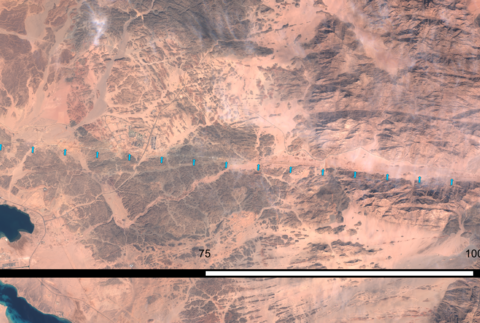
- The Line: 2.4 Kilometres of a 170-Kilometre Promise
- What Does the Fiscal Break-Even Actually Require?
- The Denominator Trick
- Where Is PIF Spending Now Instead?
- What Survives and What Doesn’t?
- The Accountability Gap Carnegie Found Before the War
- FAQ
The Timeline That Matters
The narrative Riyadh would prefer is clean: a war disrupted the Kingdom’s transformation, and prudent leaders adjusted. The timeline tells a different story, one where every major inflection point in Vision 2030’s retreat occurred before Iranian ordnance crossed the border. On October 29, 2024, PIF Governor Yasir Al-Rumayyan stood at the Future Investment Initiative in Riyadh and announced what he called “a big paradigm shift in how PIF is deploying investments,” disclosing that the fund had already cut its international portfolio from 30% to roughly 18-20% of assets under management. Six weeks later, Finance Minister Mohammad Al-Jadaan raised public concerns about “the ability of the economy to sustain this spending,” calling for “spending efficiency” — language that, from a Saudi cabinet minister, functions as a controlled detonation.
By December 2024, the PIF board had mandated a minimum 20% spending cut across its entire portfolio, with individual project budgets slashed by up to 60%. A $5 billion NEOM contract was cancelled the day before its signing ceremony that same month — a detail so cinematically wasteful it could only be real. In January 2026, Kazakhstan replaced NEOM’s Trojena as host of the 2029 Asian Winter Games, removing the anchor event that had justified the mountain resort’s $500 billion parent project. The Line’s construction was formally suspended on September 16, 2025, with 35% of the workforce cut and over 1,000 employees relocated from the construction site to Riyadh.
None of this required a war, and all of it preceded one. The conflict that began on February 28, 2026, arrived into a retrenchment that was already five months deep at the institutional level and accelerating — and the question that Riyadh has successfully avoided answering is whether the crisis created the need for cuts or merely provided the political environment in which cuts that were always coming could be announced without admitting failure.
How Deep Did PIF Cut Before February 28?
The Public Investment Fund’s construction commitments fell from $71 billion to $30 billion — a $41 billion reduction representing the single largest capex reversal in the fund’s history. This contraction was not a wartime emergency measure but a correction that had been building through 2024 and 2025 as the fund’s cash position deteriorated and its return profile weakened. PIF’s average annual return through the end of 2024 was 7.2%, down from 8.7% through 2023, and the headline number disguised something worse: of the $150 billion increase in PIF assets during 2024, approximately $140 billion came from a government transfer of Aramco equity rather than investment performance. Strip out the accounting transfer and the fund’s actual investment returns were close to zero.
The Middle East briefing 3,000+ readers start their day with.
One email. Every weekday morning. Free.
CNBC reported an $8 billion write-down on megaprojects in August 2025, six months before the war. The value of PIF’s gigaproject portfolio declined 12% across 2024. Karen Young at the Arab Gulf States Institute described PIF as “a parallel Saudi state” under Al-Rumayyan — a characterization that becomes more pointed when you consider that this parallel state’s cash reserves had fallen to $15 billion while its construction book was still nominally $71 billion, a debt ratio that would alarm a mid-tier property developer, let alone a sovereign wealth fund underwriting a national transformation.
The specific contract cancellations tell the granular story. Webuild’s $4.7 billion Trojena dam and lake project was terminated at 30% completion, Hyundai E&C lost a $1.6 billion tunnel contract for The Line, and Eversendai’s structural steel contract was terminated alongside it. Total Trojena cancellations exceeded $6 billion. These were not wartime casualties — they were the consequence of a fund that had committed capital it did not have, at oil prices it could not sustain, to projects whose timelines had already slipped beyond commercial viability.
The Line: 2.4 Kilometres of a 170-Kilometre Promise
When construction was formally suspended on September 16, 2025, The Line had completed 2.4 kilometres of foundation — 1.4% of the original 170-kilometre project. The population target had already been slashed from 1.5 million residents to under 300,000 before the suspension, a quiet admission that the original concept was not scaling. The workforce reduction of 35% and the relocation of over 1,000 employees to Riyadh were not emergency measures but an orderly wind-down of a construction programme that had consumed billions in earthworks, logistics infrastructure, and prefabrication contracts for a structure that was never going to reach the horizon line rendered in its promotional videos.
The Middle East Forum’s pre-war assessment was blunt: Vision 2030 “repeats old mistakes of relying heavily on new megaprojects” that “while offering a spectacular facade, tend to deliver few tangible economic results,” noting that Saudi Arabia’s landscape was already “strewn with the remains of white elephants.” Sindalah island — presented as NEOM’s first deliverable — held a grand opening party in October 2024, remains closed to the public, and is being transferred to a different management entity. The gap between announcement and execution had become the defining feature of the gigaproject ecosystem well before Iranian cruise missiles gave Riyadh a more dramatic explanation for the shortfall.
The war provides a clean external attribution for what was, in practice, a design failure compounded by fiscal overextension. A 170-kilometre mirrored wall in the desert was not going to be built at $73 Brent, and everyone who had access to PIF’s internal cash flow projections knew it. The suspension date — September 16, 2025 — deserves to be remembered as the real inflection point, not February 28, 2026.
What Does the Fiscal Break-Even Actually Require?
Saudi Arabia’s fiscal break-even price — the oil price at which government revenue covers government spending — sits at $111 per barrel on Bloomberg’s PIF-inclusive calculation, or $98 per barrel on JP Morgan’s narrower estimate that excludes some off-balance-sheet PIF commitments. Neither number was achievable in 2025, when Brent crude averaged $73 per barrel, and neither is achievable in the current wartime trading range of $90-95, which remains $16-21 below the Bloomberg threshold despite the largest supply disruption in decades.
The IMF’s August 2025 Article IV consultation — conducted entirely before the war — documented that Saudi Arabia “faces a more challenging environment characterized by lower oil prices and rising financing needs.” That assessment was written when production was still at 10.4 million barrels per day. March 2026 production collapsed to 7.25 million bpd, a 30% drop that blew a 3-million-barrel-per-day hole between OPEC+ quota and actual output. Goldman Sachs calculated a war-adjusted fiscal deficit of 6.6% of GDP against the official projection of 3.3% — but Goldman’s pre-war estimate was already 6% of GDP at $70-75 Brent, which means the war added perhaps 0.6 percentage points to a deficit that was already double the government’s public forecast.
The IMF revised Saudi Arabia’s 2026 GDP growth forecast from 4.5% in January to 3.1% in April, a downgrade driven by both the production collapse and the pre-existing fiscal trajectory. Aramco’s dividend cut of $40 billion to PIF for 2025 was announced before the war, reflecting lower oil revenues that had nothing to do with Iranian missiles and everything to do with a global market that was not paying $111 for a barrel of crude. The fiscal break-even problem is structural, not circumstantial, and it would exist in precisely its current form if Qassem Soleimani’s successors had stayed home.
| Metric | Pre-War | Wartime (April 2026) | Delta |
|---|---|---|---|
| Saudi production (bpd) | 10.4M (Feb 2026) | 7.25M (Mar 2026) | -3.15M (-30%) |
| Brent crude ($/bbl) | ~$73 avg 2025 | $90-95 range | +$17-22 |
| Break-even gap (Bloomberg, $/bbl) | $38 ($111 vs $73) | $16-21 ($111 vs $90-95) | Narrowed but unresolved |
| Goldman fiscal deficit (% GDP) | ~6.0% | 6.6% | +0.6 pts |
| PIF cash reserves | $15B (late 2024) | Not disclosed | — |
| PIF construction book | $71B | $30B | -$41B (-58%) |
The Denominator Trick
Riyadh’s preferred diversification metric — non-oil GDP as a share of total GDP — has risen from 50% in 2016 to approximately 57% in early 2026, a number that is routinely cited as evidence that Vision 2030’s core objective is succeeding. The number is real, and some of the underlying growth is genuine: non-oil GDP expanded at 4.9% through March 2026, driven by construction, tourism services, entertainment, and financial sector activity that did not exist a decade ago. But the metric contains a structural distortion that Riyadh does not volunteer and most coverage does not interrogate.
When oil production falls 30% — as it did between February and March 2026 — the oil sector’s contribution to GDP contracts mechanically. The non-oil share rises not only because non-oil activity grew but because the denominator shrank. If you earn $50 from oil and $50 from everything else, your non-oil share is 50%; if oil drops to $30 and everything else stays at $50, the share jumps to 63% — not because you diversified but because you lost oil revenue. The IMF’s pre-war assessment flagged this directly, noting that “productivity gains have been limited” and private non-oil growth “has not yet proven self-sustaining” without government fiscal stimulus. Much of the non-oil economy remains indirectly funded by oil revenues recycled through government spending; when the recycling mechanism weakens, the non-oil activity it supports weakens with it.
This matters because the 57% figure is doing heavy rhetorical work in Riyadh’s current framing — suggesting that the Kingdom has already built enough economic breadth to absorb a wartime oil shock. The reality is more circular: oil revenues fund PIF, PIF funds gigaprojects, gigaprojects generate non-oil GDP, and when oil revenues fall, the entire chain decelerates. Diversification that depends on the commodity you are diversifying away from is not diversification — it is rebranding.
Where Is PIF Spending Now Instead?
The $41 billion withdrawn from construction has not disappeared — it has been redirected, and the destination tells you what PIF’s leadership actually believes will generate returns. HUMAIN AI, PIF’s artificial intelligence subsidiary, has become the fund’s new flagship, anchoring more than $21 billion in strategic technology deals announced at the Future Investment Initiative’s Miami conference: a $10 billion AMD partnership for 500 megawatts of AI compute capacity over five years, a $5 billion AWS Saudi AI Zone, $3 billion in Blackstone/AirTrunk data centre commitments, and a $3 billion participation in xAI’s Series E round. NEOM itself pivoted to AI infrastructure through a $5 billion DataVolt data centre partnership announced in February 2026, repurposing the brand from mirrored desert walls to server farms.
Al-Rumayyan framed it explicitly: “Some priorities have been reshuffled and investment objectives repositioned with greater focus on AI infrastructure and investments in AI companies.” The language — reshuffled, repositioned — is doing careful work to avoid the word that applies: abandoned. The PIF’s new 2026-2030 strategy, approved on April 15, 2026, targets 80% domestic investment, up from roughly 70% in the previous five-year cycle, with international exposure cut to 20%. The domestic pivot Al-Rumayyan announced in October 2024 has been codified as institutional policy, and the fund achieved SAR 750 billion in domestic investment between 2021 and 2025 — a figure that includes considerable spending on projects that have since been cancelled or suspended.
“There is a big paradigm shift in how PIF is deploying investments. We are now more focused on the domestic economy and we have achieved so many things.”
— Yasir Al-Rumayyan, PIF Governor, Future Investment Initiative, October 29, 2024 — four months before the war
The pivot from megaprojects to AI infrastructure carries its own risks — $10 billion in AMD compute capacity requires sustained power generation that Saudi Arabia’s wartime energy grid may struggle to guarantee — but it represents a fundamentally different capital allocation philosophy: revenue-generating technology assets rather than speculative real estate at planetary scale. Whether PIF can execute this pivot better than it executed the last one remains the open question, but the direction of travel was established before anyone in Riyadh was counting PAC-3 interceptor rounds.
What Survives and What Doesn’t?
The survival logic follows a simple hierarchy: contractual obligations and fixed-deadline reputational events live; everything else is deferred, downsized, or quietly killed. Expo 2030 in Riyadh survives because it carries a fixed international deadline and cancellation would be a public admission of incapacity that MBS cannot afford at any oil price. The 2034 FIFA World Cup survives because the contractual penalties and reputational damage of withdrawal would exceed the cost of the stadium and infrastructure programme, and because the tournament generates its own economic activity through tourism, broadcasting rights, and the construction employment that Saudi Arabia needs to sustain non-oil GDP. HUMAIN AI survives because it is the replacement thesis — the new story PIF tells capital markets about where returns will come from.
Everything else occupies a spectrum from indefinite deferral to outright termination. Government funding has been removed from large-scale tourism projects including Red Sea Destination, and NEOM has been formally separated from the tourism ecosystem — a bureaucratic restructuring that functions as a death certificate for NEOM’s original identity as an integrated tourism-technology-lifestyle destination. The shift toward religious tourism, regional visitors, and events represents a return to Saudi Arabia’s proven revenue base rather than the speculative international luxury market that projects like Sindalah targeted. LIV Golf, which has reportedly lost more than $5 billion since inception, is reportedly on the cut list — a $5 billion write-off that would have been politically impossible to announce without a war consuming the front pages.
The pattern is consistent with crisis-as-cover: the projects being cut are precisely the ones whose commercial viability was already in question, and the projects being preserved are the ones with external accountability mechanisms — international deadlines, contractual counterparties, reputational tripwires — that prevent quiet abandonment. The war did not create the need for this triage — it created the conditions under which triage could be presented as prudent crisis management rather than the correction of a planning failure.
The Accountability Gap Carnegie Found Before the War
The Carnegie Endowment for International Peace published its assessment of Vision 2030 in March 2025, a full year before the conflict, and the findings deserve to be read as a pre-war audit of the programme MBS is now restructuring under the banner of wartime pragmatism. Carnegie concluded that Vision 2030 “has made undeniable progress” but warned that “with five years to go, the program is in danger of enriching elites while overlooking the needs of most Saudi citizens,” noting that many economic reforms “are currently not on track to hit their targets.” Education spending — the foundation of any genuine diversification — grew just 1% between 2016 and 2023, while discretionary “general items” spending, the budget line that includes gigaproject allocations, more than doubled.
The structural problem Carnegie identified is that “most policymaking processes remain insulated from bottom-up accountability” — citizens who criticize face detention, there is no external audit mechanism for PIF performance, and Saudi Arabia ranked 107th of 115 countries in budget transparency even before wartime information restrictions added another layer of opacity. PIF’s $925 billion in assets under management is a headline number; the actual investment return, stripped of government equity transfers, is not subject to independent scrutiny. The $8 billion megaproject write-down reported by CNBC in August 2025 surfaced through journalistic investigation, not institutional disclosure.
This accountability vacuum is what makes the wartime reframing so effective and so difficult to challenge from within Saudi Arabia. When every decision flows upward to MBS and downward as directive, there is no institutional mechanism to distinguish between a strategic pivot driven by changed circumstances and a retrospective justification for commitments that were never going to deliver. The Finance Minister’s November 2024 comments about spending sustainability were the closest thing to an internal signal that the trajectory was unsustainable — and even that was framed as a call for “efficiency” rather than an admission that the flagship programme was overextended. The war has made it possible to reframe retreat as resilience, and in the absence of accountability structures, the reframe will hold until the next crisis demands another one.
| Date | Event | Relation to War (Feb 28, 2026) |
|---|---|---|
| Oct 29, 2024 | Al-Rumayyan announces PIF domestic pivot at FII | 16 months before |
| Nov 2024 | Finance Minister Jadaan warns on spending sustainability | 15 months before |
| Dec 2024 | PIF board mandates 20% spending cut across 100+ companies | 14 months before |
| Dec 2024 | $5B NEOM contract cancelled day before signing | 14 months before |
| Jan 2026 | Kazakhstan replaces Trojena as 2029 Winter Games host | 2 months before |
| Aug 2025 | CNBC reports PIF $8B megaproject write-down | 6 months before |
| Sep 16, 2025 | The Line construction formally suspended | 5 months before |
| Feb 28, 2026 | Iran-US/Saudi conflict begins | — |
| Mar 29, 2026 | Webuild Trojena dam contract terminated | 1 month after |
| Apr 15, 2026 | PIF 2026-2030 strategy approved (80% domestic) | 6 weeks after |
| Apr 16, 2026 | Government tourism funding scrapped | 7 weeks after |
FAQ
Is PIF bankrupt or at risk of default?
PIF is not at risk of sovereign default — its $925 billion in assets under management, even discounting the Aramco equity transfers that inflated 2024 figures, provides a substantial balance sheet. The issue is liquidity rather than solvency: with cash reserves at $15 billion and Aramco dividends cut by $40 billion, PIF’s ability to fund new construction commitments without additional borrowing is constrained. The fund issued $3.5 billion in green bonds in early 2025 and is expected to increase debt issuance through 2026-2027 to bridge the gap between oil-funded cash flow and its remaining domestic investment targets. TASI trades at 11,554, within its 52-week range, suggesting equity markets have priced in the retrenchment without panic.
Will the 2034 FIFA World Cup still happen in Saudi Arabia?
The World Cup is among the most protected commitments in the surviving Vision 2030 portfolio, shielded by FIFA contractual obligations, an eight-year preparation runway, and the fact that stadium and transport infrastructure generates employment and non-oil GDP that Riyadh needs regardless of the broader gigaproject retrenchment. The estimated $50-60 billion total infrastructure spend is likely to be phased more conservatively than originally planned, with early-stage design contracts proceeding while later construction phases are deferred until the fiscal picture stabilises. FIFA has not publicly expressed concern about Saudi delivery capacity, though the organisation’s track record on host-country due diligence provides limited reassurance.
What happened to NEOM’s other components besides The Line?
NEOM comprised four announced sub-projects: The Line (linear city), Trojena (mountain resort), Oxagon (industrial port), and Sindalah (island resort). Trojena has absorbed over $6 billion in contract cancellations including the Webuild dam, lost its anchor event when Kazakhstan took the 2029 Asian Winter Games, and has no announced restart timeline. Sindalah held a grand opening party in October 2024 but remains closed to the public and is being transferred to a different management entity — the only NEOM component that was nominally “delivered” and the only one that demonstrably failed post-delivery. Oxagon’s industrial and logistics functions are the most likely to be partially preserved, as port infrastructure serves the broader Eastern Province economy, though at dramatically reduced scale from the original floating-city concept.
How does the Saudi retrenchment compare to other petrostate adjustments?
The closest structural parallel is not Iraq 1990 but Kuwait 1990-91: a petrostate whose infrastructure was externally damaged and which faced a binary choice between rebuilding fundamentals and restoring its pre-crisis development vision. Kuwait chose fundamentals and deferred its ambitious post-liberation development plans for over a decade. The UAE’s 2009-2010 Dubai debt crisis offers another data point — Abu Dhabi bailed out Dubai’s overextended real estate sector but imposed restructuring conditions that permanently reduced the emirate’s appetite for speculative megaprojects. Saudi Arabia’s version is larger in absolute terms ($41 billion in PIF construction cuts alone) but follows the same pattern: external shock provides the political licence for fiscal correction that internal accountability structures could not deliver on their own.