
NEOM — Saudi Arabia’s Public Investment Fund has reclassified NEOM as an “independent ecosystem” — a designation that severs the $500 billion megaproject from the KPI framework governing every other Vision 2030 initiative and makes its original targets unmeasurable. The move, buried inside the PIF’s 2026–2030 strategy approved April 15, completes a two-year retreat from the most ambitious development programme ever attempted by a sovereign wealth fund, and it does so by changing the unit of measurement rather than admitting the unit failed.
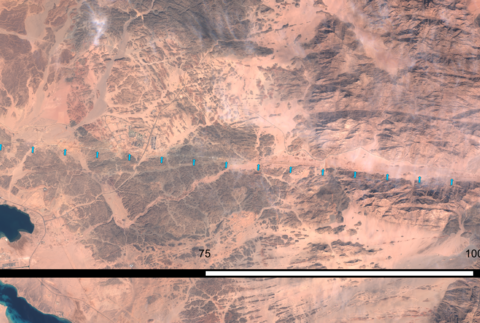
Construction on The Line — the 170-kilometre mirror-walled linear city that Crown Prince Mohammed bin Salman unveiled in January 2021 — was formally suspended on September 16, 2025. It has not resumed. The expected 2030 buildout is 2.4 kilometres, or 1.4 per cent of the original design. The 380,000 jobs and SAR 180 billion ($48 billion) in GDP contribution once attributed to The Line alone are no longer tracked against any public deadline. By reclassifying the project that contained those targets, PIF has made the gap between promise and delivery structurally invisible.
Table of Contents
- The Reclassification Mechanism
- What Does “Independent Ecosystem” Actually Mean?
- The Line’s Final Arithmetic
- Where Did PIF’s Cash Go?
- Oxagon and the Revenue Test
- How Does Vision 2030 Report 80 Per Cent Success?
- The FDI Gap No Reclassification Can Hide
- The King Abdullah Economic City Precedent
- War Costs and the Capex Squeeze
- From Linear City to AI — The New Flagship
- Frequently Asked Questions
The Reclassification Mechanism
Under PIF’s previous 2021–2025 strategy, NEOM sat within the “giga-projects” category alongside Red Sea Global, Diriyah, Qiddiya, ROSHN, and the 2030 World Expo — all subject to the same measurement framework, all benchmarked against Vision 2030 delivery milestones. The new five-year strategy creates six “strategic ecosystems.” Five are sector-based: tourism and travel, urban development, advanced manufacturing, industrials and logistics, and clean energy. The sixth is NEOM, standing alone.
PIF Governor Yasir Al-Rumayyan framed this as prioritisation. “No projects at NEOM have been cancelled,” he told Al Arabiya on April 15. On The Line specifically: “Is it necessary for The Line to be completed by 2030? I don’t think so.” The language is careful. Nothing cancelled. Timelines, however, are now indefinite.
NEOM’s official X account offered its own gloss: “Classifying NEOM as an independent ecosystem within the PIF upcoming five-year strategy embodies the depth of commitment in supporting the success of this project. Our long-term ambition is unchanged; a phased [approach].” The statement does not mention 2030. It does not mention The Line. It does not mention any target, by any date.
The practical effect is that NEOM’s performance can no longer be measured against the benchmarks MBS set when he announced the project. A senior NEOM executive, speaking to AGBI in January 2026, was blunter than the official communications: “Spending on nearly every project has been frozen and is under intense reassessment.”
The Middle East briefing 3,000+ readers start their day with.
One email. Every weekday morning. Free.

What Does “Independent Ecosystem” Actually Mean?
In PIF’s governance structure, an ecosystem designation determines how a project is evaluated, funded, and reported. Sector-based ecosystems — tourism, manufacturing, clean energy — are measured against national KPIs that roll up into Vision 2030’s aggregate scorecard. An “independent ecosystem” operates outside that roll-up. Its targets are internal. Its timelines are self-referencing. Its success criteria are whatever PIF’s board decides they are.
This is not a design decision. It is an accountability architecture. By decoupling NEOM from the Vision 2030 KPI framework, PIF ensures that the project’s failures — The Line’s suspension, the workforce reductions, the frozen contracts — do not drag down the programme’s overall reported success rate. The Vision 2030 2024 Annual Report already claims 80 per cent of KPIs are achieved or on track. Independent analysis puts the figure closer to 57 per cent on track, 26 per cent behind, and 17 per cent at risk. Removing NEOM’s weight from the denominator makes the official number easier to defend.
Al-Rumayyan has signalled the broader shift in PIF’s self-conception. At the PIF Private Sector Forum in October 2025, he described the fund’s evolution from “nation builder” to “nationally aligned investor and asset optimiser” by the 2030s, and “balance-sheet diversifier” by the 2040s. The vocabulary is instructive. Nation builders measure success in cities built and populations housed. Asset optimisers measure internal rate of return.
A PIF banker, speaking anonymously to AGBI, confirmed the new filter: “Each project is now assessed by detailed financial metrics, and anything below a certain internal rate of return will be shelved.” The Line — a project whose 2024 internal audit found executives had based business plans on “unrealistically positive assumptions” — would not survive that filter.
The Line’s Final Arithmetic
The Wall Street Journal reviewed a 100-page internal NEOM audit, presented to the board in spring 2024, and reported its findings in March 2025. The numbers were striking even by megaproject standards. Full completion of The Line would cost $8.8 trillion — 17.6 times the original $500 billion estimate for all of NEOM — and could not be finished before 2080. Auditors found “evidence of deliberate manipulation” by “certain members of management.”
The founding CEO, Nadhmi Al-Nasr, was removed in late 2024. His replacement, Aiman Al-Mudaifer, operates under direct PIF audit oversight, with PIF’s head of audit Mike Cheung embedded at NEOM. The workforce — roughly 5,000 full-time staff at peak — faces 1,000-plus planned layoffs, with another 1,000-plus already relocated from the NEOM site to Riyadh offices.
| Metric | 2021 Announcement | April 2026 Status |
|---|---|---|
| Length | 170 km | 2.4 km expected by 2030 (1.4%) |
| Population target | 9 million (later 1.5 million by 2030) | <300,000 |
| Jobs created | 380,000 | No longer tracked |
| GDP contribution | SAR 180B ($48B) | No longer tracked |
| Full completion cost (audited) | Part of $500B NEOM budget | $8.8 trillion |
| Full completion date (audited) | 2030 | 2080 |
| Construction status | Active | Suspended since Sept. 16, 2025 |
Bloomberg first reported the 2.4-kilometre revision in April 2024. The Wall Street Journal’s March 2025 report, drawing on the internal audit, confirmed that the scale-back was not a temporary adjustment but a structural admission. The “phased approach” language from NEOM’s April 2026 X post retroactively frames the suspension as planned sequencing. The audit’s finding of “deliberate manipulation” suggests otherwise.
Where Did PIF’s Cash Go?
PIF’s liquid cash reserves fell to approximately $15 billion in late 2024 — the lowest since 2020. The fund manages over $900 billion in assets, but the distinction between assets and deployable capital matters. Aramco’s 2025 dividend cut — from $124.3 billion to $85.5 billion, a $38.8 billion reduction — cost PIF roughly $6 billion in income on its 16 per cent stake. The Saudi government, holding 82 per cent, lost approximately $32 billion.
Tim Callen, a former IMF mission chief to Saudi Arabia now a visiting fellow at AGSI, assessed the cascading effect: the Aramco cut is “constraining capital available for projects and increasing competition for borrowing across the public sector.” The PIF spending contraction, he noted, “was evident much earlier last year” and aligns with “declining oil revenues.”
The contraction is visible in the contract data. Saudi construction contract awards fell from $113 billion in 2023 to $71 billion in 2024 to below $30 billion in 2025 — a 73 per cent decline in two years. In the first five months of 2025, infrastructure awards dropped 77 per cent year-on-year; PIF-backed company contracts fell 84 per cent in the same window. PIF’s share of all Saudi construction contracts dropped from 38 per cent in 2024 to 14 per cent in 2025. A source familiar with PIF’s tender pipeline told AGBI: “No contract of significance is going to be awarded this year unless it’s got the words Expo or World Cup.”
| Year | Total Saudi Construction Contracts | PIF Share |
|---|---|---|
| 2023 | $113B | 38% (est.) |
| 2024 | $71B | 38% |
| 2025 | <$30B | 14% |
Saudi foreign reserves reflect the broader fiscal pressure. SAMA reported $434 billion in February 2026, down from $451 billion in January — a $17 billion single-month drawdown. Brent crude sits near $96 per barrel. Saudi Arabia’s fiscal breakeven — the oil price needed to balance the budget — is $108 to $111 per barrel, a gap of $12 to $15 on every barrel produced.
Oxagon and the Revenue Test
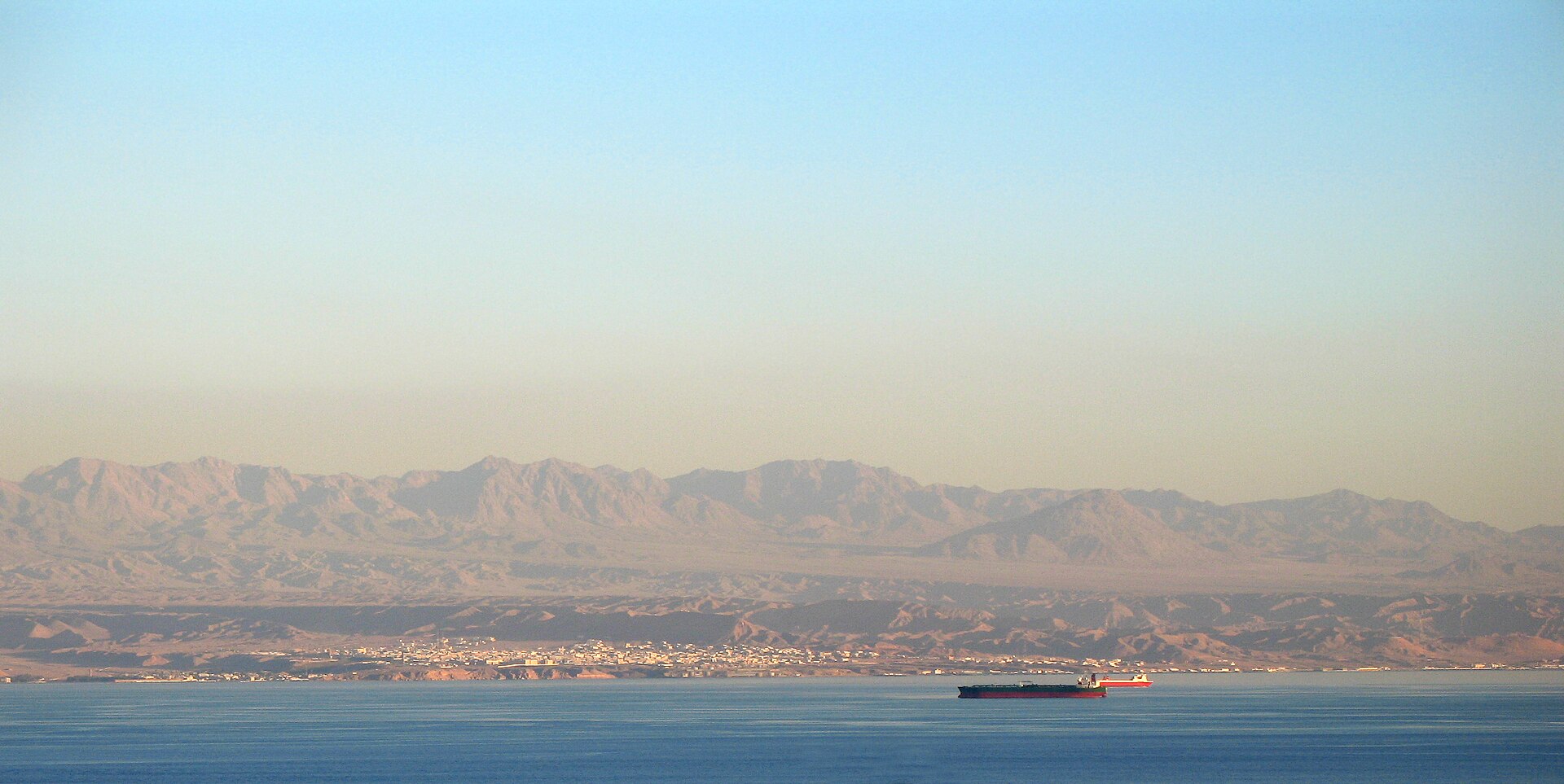
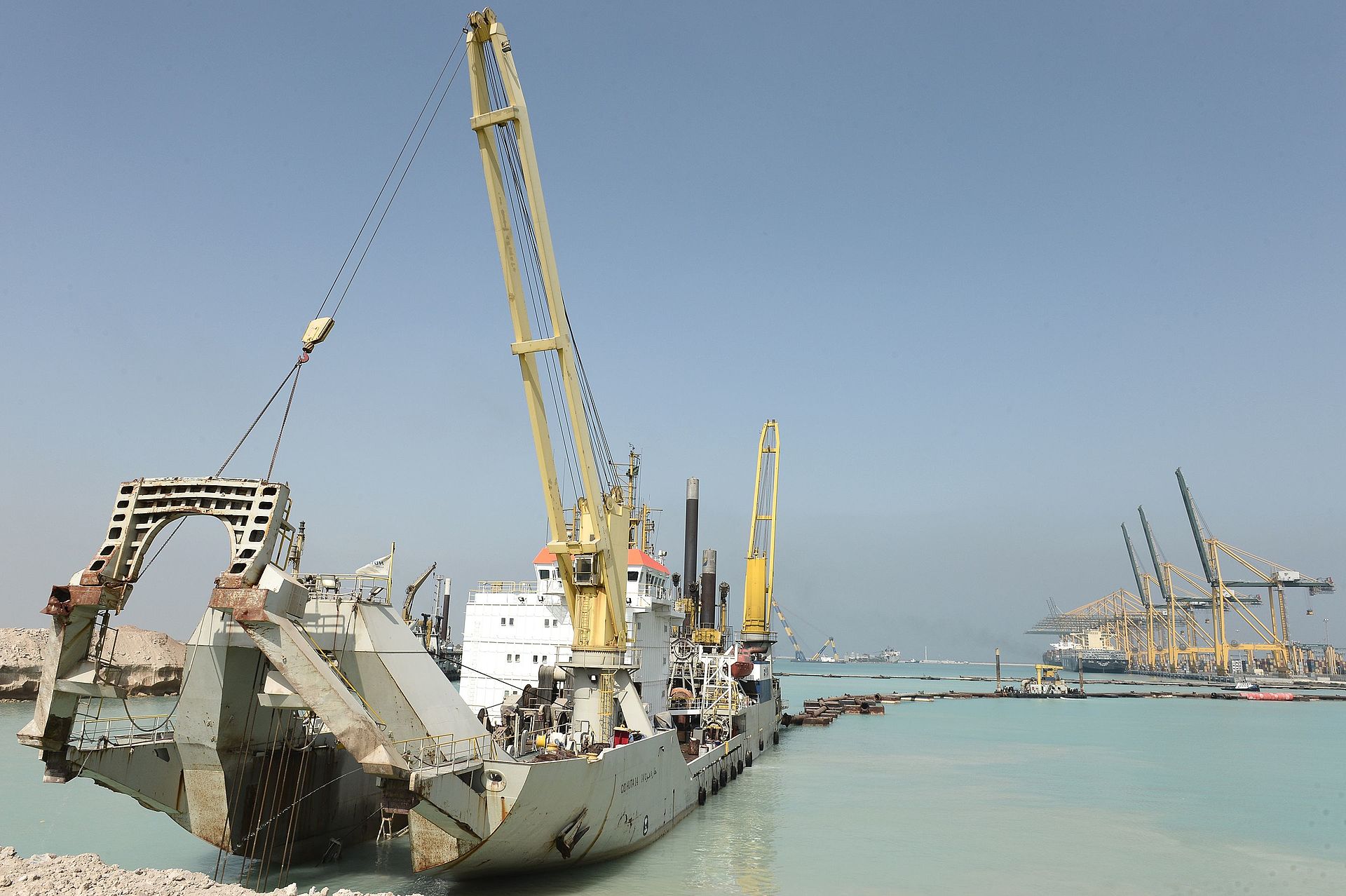
If The Line was NEOM’s signalling project — the architectural rendering that sold the vision — Oxagon is the component that PIF now treats as commercially viable. The octagonal industrial port, located at NEOM’s southern edge on the Gulf of Aqaba, is the only NEOM zone with physical infrastructure nearing operational status. Boskalis completed channel deepening in early 2026. BESIX delivered 4.6 kilometres of quay wall, seven berths at depths of 10.5 to 18.5 metres, and a 900-metre automated container terminal rated at 1.5 million TEU — capable of handling the world’s largest container vessels. Full container terminal operations are scheduled later this year.
Oxagon also hosts NEOM’s only asset approaching revenue generation: the NEOM Green Hydrogen Company. NGHC achieved financial close in May 2023 at $8.4 billion, with $6.1 billion in non-recourse debt from 23 banks. Solar and wind infrastructure is over 95 per cent complete. A 30-year off-take agreement with Air Products covers up to 1.2 million tonnes of green ammonia annually — 600 tonnes per day of carbon-free hydrogen. Production start has slipped to mid-2027, per Air Products CEO Eduardo Menezes, but the delay is months, not years. In a project littered with missed deadlines and suspended construction, NGHC is the exception — a facility with contracted revenue, third-party financing, and a timeline that has broadly held.
The rest of Oxagon is less advanced. Of 12 announced commercial tenant agreements signed between 2022 and 2025, only four have progressed to physical construction or equipment installation. Five remain in signed-agreement status with no visible ground activity. Three appear dormant. The floating industrial city concept — Oxagon’s original centrepiece — has been pushed to the early 2030s with no confirmed construction start and no procurement activity recorded through the first quarter of 2026.
Rachel Ziemba of Ziemba Insights framed the broader triage: “Projects less linked to key areas or very costly will likely be delayed, scaled back or cancelled.” Previous PIF spending targets, she said, were “too lofty.” Oxagon survives the triage because it has what The Line never had — an industrial tenant paying contracted revenue on a 30-year horizon.
How Does Vision 2030 Report 80 Per Cent Success?
The Vision 2030 2024 Annual Report claims 80 per cent of KPIs are achieved or on track. Andrew Leber of the Carnegie Endowment for International Peace, in a March 2025 paper titled “Vision 2030 in the Home Stretch,” found the real figure closer to 57 per cent on track, 26 per cent behind, and 17 per cent at risk.
The gap is partly methodological. Tourism — one of Vision 2030’s highest-profile targets — illustrates the technique. Saudi officials report visitor numbers that conflate Hajj and Umrah religious pilgrims with leisure tourists. Leber’s analysis found that 12 per cent of 2023 visits were officially classified as “religious,” yet 60 per cent of increased overnight stays occurred in Mecca. The numbers count the same way; the economic activity they represent is different.
The accountability structure makes correction unlikely. Leber writes that “any form of bottom-up accountability through public discussion… has been treated as a political threat.” The precedent is specific. Essam al-Zamel, a Saudi economist, was detained in 2017 for publicly questioning assumptions underlying the Aramco IPO. He has not been released.
Finance Minister Mohammed Al-Jadaan has offered the closest thing to an official acknowledgment of fiscal limits: “The anchor of the economy is public finance… critical not to compromise public finance for the sake of the economy.” The statement — delivered in January 2026 — reads as a direct response to the PIF spending contraction already underway. It also reads as a rebuttal to the spending ambitions Al-Jadaan’s own government announced four years earlier.
Net foreign direct investment compounds the shortfall. Saudi Arabia attracted $19 billion in net FDI in the first nine months of 2025 — against a Vision 2030 target of $100 billion annually by the end of the decade.
The FDI Gap No Reclassification Can Hide
NEOM’s original investment thesis depended on foreign capital following sovereign capital. PIF would build the infrastructure; international firms and investors would populate it. The independent ecosystem designation can insulate NEOM’s performance from Vision 2030’s scorecard, but it cannot manufacture the foreign direct investment the project was designed to attract.
Saudi Arabia attracted SAR 72 billion ($19 billion) in net FDI in the first nine months of 2025. The Vision 2030 target is $100 billion annually by the end of the decade — meaning the Kingdom is running at less than one-fifth of the required pace with four years remaining. The gap is not new, but the war has widened it. International firms calculating risk premiums on Saudi investments now price in IRGC missile strikes on Eastern Province facilities, a 30 per cent production crash, and a Hormuz Strait that IRGC Navy commanders have declared a “danger zone.”
Oxagon’s tenant pipeline illustrates the problem at project level. Twelve commercial agreements signed between 2022 and 2025 were announced with the kind of ceremony PIF deploys for milestone events. Four have reached physical construction. The other eight are, at best, contractually committed but physically absent. For a project whose value proposition is industrial cluster effects — tenants attracting tenants, supply chains co-locating — 33 per cent activation is below the threshold at which network effects begin to function.
The PIF banker’s IRR filter compounds the FDI challenge. Projects that clear the internal rate of return bar tend to be those with contracted off-take or government-guaranteed revenue — NGHC, the World Cup stadiums, Expo infrastructure. Projects that depend on speculative commercial tenancy and foreign investment volumes that have not materialised — The Line’s mixed-use districts, Trojena’s luxury ski resort, Sindalah’s superyacht marina — do not. The reclassification allows PIF to stop measuring NEOM against Vision 2030 targets. It does not make the capital arrive.
The King Abdullah Economic City Precedent
Saudi Arabia has attempted this before. The 2006 “Economic Cities Programme,” launched under King Abdullah, designated six new cities across the Kingdom. The flagship — King Abdullah Economic City, 100 kilometres north of Jeddah on the Red Sea coast — was designed to house 4.5 million people by 2020. Its 2024 population is approximately 4,000.
The Washington Institute’s analysis, published in 2021, identified the structural parallels to NEOM: top-down planning disconnected from market demand, population targets set by political ambition rather than economic modelling, and no mechanism for public accountability when targets were missed. King Abdullah Economic City was not formally cancelled. It was simply never discussed again.
The parallels extend to governance. King Abdullah Economic City was managed by Emaar, the Economic Cities Authority, and a succession of executive teams — none of whom were held publicly accountable for the gap between 4.5 million projected residents and 4,000 actual ones. The project was not declared a failure. It was deprioritised, defunded, and eventually ignored. No KPI was revised. No official was dismissed for the shortfall. The city simply stopped appearing in government communications.
The “independent ecosystem” designation gives NEOM the same structural option. A project that exists outside the KPI framework cannot fail against that framework. It can only be “phased.”
War Costs and the Capex Squeeze
The Iran war has introduced a new category of PIF obligation that competes directly with diversification spending. PAC-3 missile restocking — Saudi Arabia expended a substantial portion of its interceptor inventory defending energy infrastructure — requires immediate procurement from Lockheed Martin at roughly $4 million per round. The $11 billion Pakistan financial package, negotiated as part of MBS’s broader wartime alliance architecture, draws on the same sovereign balance sheet. Pipeline repair following IRGC strikes on the East-West Pipeline and associated infrastructure adds further unbudgeted capital expenditure. Saudi Arabian National Guard expansion — accelerated since the war began — consumes defence appropriations that might otherwise have been available for dual-use infrastructure.
And then there is Sadara Chemical’s $3.7 billion debt cliff, arriving June 15, 2026, when the principal repayment grace period from the 2021 restructuring expires. SABIC — Sadara’s joint venture partner with Dow — told the Tadawul on April 8 that it cannot estimate when its Jubail plants will resume production following war-related strikes. If Sadara requires a PIF-backed bailout, the fund’s discretionary capex for non-oil GDP diversification shrinks further.
Al-Jadaan’s January 2026 formulation — public finance as “anchor” rather than accelerant — inverts the language MBS used when he launched Vision 2030 in April 2016. Then, public spending was the engine of transformation: the state would invest ahead of demand, build the infrastructure, and the private sector would follow. A decade later, the finance minister frames public spending as a constraint to be managed, not a tool to be deployed. Goldman Sachs estimates the war-adjusted Saudi budget deficit at 6.6 per cent of GDP — roughly double the official 3.3 per cent projection. At $96 Brent, every barrel Saudi Arabia produces loses $12 to $15 against the fiscal breakeven.
The PIF’s 2026–2030 strategy reflects these competing claims. Total construction spending is cut by approximately $41 billion. The money that remains is concentrated on projects with near-term revenue or geopolitical utility — the 2030 World Expo, the 2034 World Cup, and Oxagon’s green hydrogen facility. The Line, which had none of those attributes, is the residual.
From Linear City to AI — The New Flagship
PIF has committed $23 billion to Humain AI, a new entity launched in May 2025. The money is already being deployed: $10 billion to AMD for 500 megawatts of AI compute over five years, over $5 billion to an AWS-dedicated AI zone, $3 billion to Blackstone and AirTrunk data centres, and $3 billion into Elon Musk’s xAI Series E round in February 2026. Aramco is acquiring a minority stake in Humain, with PIF retaining majority control. A separate $10 billion venture fund is being launched under the Humain umbrella.
The government has simultaneously scrapped government tourism funding as part of what officials describe as a Vision 2030 “shake-up.” Red Sea Destination’s plans for 81 luxury resorts by 2030 are being scaled back. AI infrastructure has been elevated as PIF’s new priority vertical.
The substitution carries its own risks. AI infrastructure requires sustained electricity supply — a commodity under strain in a kingdom where war-related disruptions to oil production have complicated domestic energy planning. It requires technical talent that Saudi Arabia does not yet produce at scale. And it requires patient capital at a moment when PIF’s liquid reserves are at a four-year low.
But Humain AI has one advantage The Line never did: it does not require moving nine million people into a mirrored corridor in the desert. Its failure mode is financial underperformance, not physical implausibility. Data centres can be built incrementally. Their output is measurable in compute cycles, not in residents per linear kilometre. And unlike a 170-kilometre mirror wall, a data centre that falls short of projections does not become a monument to its own ambition visible from satellite imagery.
The substitution also reflects a practical lesson from the NEOM audit. A project whose full cost was found to exceed its original estimate by a factor of 17.6 teaches a sovereign fund something about the relationship between architectural ambition and capital discipline. AMD servers arrive with a price list. A city in the desert does not.
Whether Humain AI succeeds on its own terms is an open question — Saudi Arabia’s track record with flagship technology initiatives is thin, and the global AI infrastructure build-out is producing overcapacity warnings from some analysts. But the bet is structurally different from The Line. PIF can deploy $10 billion to AMD and receive physical hardware. It can deploy $5 billion to AWS and receive operational data centre capacity. The Line consumed years of spending and produced 2.4 kilometres of foundation work and a 100-page audit documenting how the business case was fabricated.
“Is it necessary for The Line to be completed by 2030? I don’t think so.”
— Yasir Al-Rumayyan, PIF Governor, Al Arabiya, April 15, 2026
Frequently Asked Questions
Has NEOM been cancelled?
No. PIF Governor Al-Rumayyan stated on April 15, 2026, that “no projects at NEOM have been cancelled.” However, construction on The Line has been suspended since September 16, 2025, workforce reductions of 1,000-plus are planned, another 1,000-plus staff have been relocated from the NEOM site to Riyadh, and founding CEO Nadhmi Al-Nasr was removed in late 2024. The distinction between “cancelled” and “indefinitely suspended with no resumption date” is primarily semantic. Oxagon’s NGHC green hydrogen plant — the only NEOM component with contracted third-party revenue — continues toward a 2027 commissioning date.
What happens to the $500 billion originally budgeted for NEOM?
The original $500 billion figure was always aspirational rather than committed. The 2024 internal audit found full completion would require $8.8 trillion. PIF’s 2026–2030 strategy cuts total construction spending by $41 billion and redirects capital toward Humain AI ($23 billion), the 2030 World Expo, and the 2034 World Cup. PIF’s approved minimum 20 per cent expenditure reduction across its 100-plus portfolio companies — with some budgets cut by up to 60 per cent — was implemented in December 2024, months before the “independent ecosystem” reclassification was announced.
Why does the “independent ecosystem” classification matter?
Under the previous PIF strategy, NEOM was measured against Vision 2030’s KPI framework alongside other giga-projects. The Line’s original targets — 380,000 jobs and SAR 180 billion in GDP contribution by 2030 — were part of that framework. The independent ecosystem designation creates a separate governance silo with internally defined success criteria, meaning NEOM’s suspended targets no longer affect Vision 2030’s aggregate reported performance. PIF’s head of audit, Mike Cheung, is now embedded at NEOM — a level of oversight typically reserved for entities under remediation, not entities being given greater autonomy.
Is any part of NEOM generating revenue?
The NEOM Green Hydrogen Company at Oxagon is the nearest to revenue generation. Its $8.4 billion facility is over 95 per cent complete, backed by a 30-year off-take agreement with Air Products for up to 1.2 million tonnes of green ammonia annually. First export is targeted for 2027. Of the remaining 12 announced Oxagon commercial tenants, only four have reached physical construction. Trojena — the mountain resort planned to host the 2029 Asian Winter Games — remains under construction but faces its own timeline questions given PIF’s broader spending freeze.
How does the war affect Vision 2030’s funding?
The Iran war has created unbudgeted obligations — PAC-3 restocking, the $11 billion Pakistan package, pipeline and infrastructure repair, SANG expansion — that compete directly with diversification capex. Aramco’s dividend cut cost the Saudi government approximately $32 billion and PIF approximately $6 billion. With Brent at roughly $96 per barrel and the Saudi fiscal breakeven at $108–111, every barrel produced widens the deficit. Goldman Sachs estimates a war-adjusted budget deficit of 6.6 per cent of GDP, roughly double the official 3.3 per cent projection. Saudi foreign reserves fell $17 billion in a single month (January to February 2026), from $451 billion to $434 billion. An additional claim on PIF’s balance sheet arrives June 15, 2026: Sadara Chemical’s $3.7 billion debt cliff, when the principal repayment grace period from the 2021 restructuring expires — a potential bailout that would further reduce discretionary capex for diversification projects.