{“content”: “
Table of Contents
n
- n
- Two Ships, Three Hours, Zero Warning
- The Touska Trigger
- Who Gave Permission?
- Can a Headless Navy Honor Its Own Clearances?
- Four Cycles in Seven Years
- Does Anyone Have Recourse?
- Brent at the Door of $100
- FAQ
- n
n
The Middle East briefing 3,000+ readers start their day with.
One email. Every weekday morning. Free.
n
n
n
n
n
n
n
n
n
n
DUBAI u2014 Iran’s Islamic Revolutionary Guard Corps seized two commercial vessels in the Strait of Hormuz on April 22 u2014 a 131,771-gross-ton MSC container ship and a Greek-operated bulk carrier u2014 three days after the US Navy boarded and captured an Iranian cargo ship in the same waters. The seizures, carried out with RPG fire and no prior radio contact according to one vessel’s master, represent the fourth documented tit-for-tat seizure cycle between Iran and Western naval powers since 2019 and the first since the IRGC lost its entire senior naval command structure to an Israeli airstrike 27 days ago.
n
The IRGC did not frame the action as retaliation. It used the regulatory language of its self-declared transit management regime u2014 “operating without required authorization,” “manipulating navigation systems” u2014 and tagged one vessel as linked to Israel without evidence. But the operational pattern is unmistakable: every US enforcement action in the strait now generates an automatic Iranian counter-seizure, a dynamic that the London-based DWF Group, in a legal analysis published this month, called “two can play that game.” The result is a strait that is structurally ungovernable regardless of what happens at the negotiating table in Islamabad or on Donald Trump’s Truth Social feed.
n
n
Two Ships, Three Hours, Zero Warning
n
The MSC Francesca u2014 Panama-flagged, 363 metres long, one of the largest container ships operating in the Persian Gulf u2014 was intercepted after departing Dammam, Saudi Arabia. The IRGC claimed the vessel was “linked to the Zionist regime,” a designation it provided no evidence to support. Mediterranean Shipping Company, the world’s largest container line and the Francesca’s operator, has not publicly responded. Both the vessel’s AIS transponder and its crew went dark; ship tracking data showed it stationary off the Iranian coast near Sirik by midday.
n
The Epaminondas, a 299-metre Liberian-flagged bulk carrier operated by Greek interests and bound for Mundra, India, was hit harder. UKMTO u2014 the Royal Navy’s Dubai-based commercial shipping coordination centre u2014 reported that an IRGC gunboat opened fire approximately 15 nautical miles northeast of Oman, striking the bridge with RPGs and causing what the agency described as “heavy damage.” The vessel’s master reported that no radio contact was made before the shooting started. A third vessel, the Panama-flagged Euphoria, was also fired upon and became stranded on the Iranian coast; Greece’s Foreign Minister Nikos Gerapetritis told Euronews he could not confirm whether the Euphoria had actually been seized.
n
Iran’s Nour News, the semi-official outlet aligned with the IRGC’s intelligence directorate, reported that forces fired “only after ships ignored warnings.” The master’s account says otherwise. Both versions cannot be true, and the discrepancy points to something more operationally alarming than a disputed narrative.
n
The Touska Trigger
n
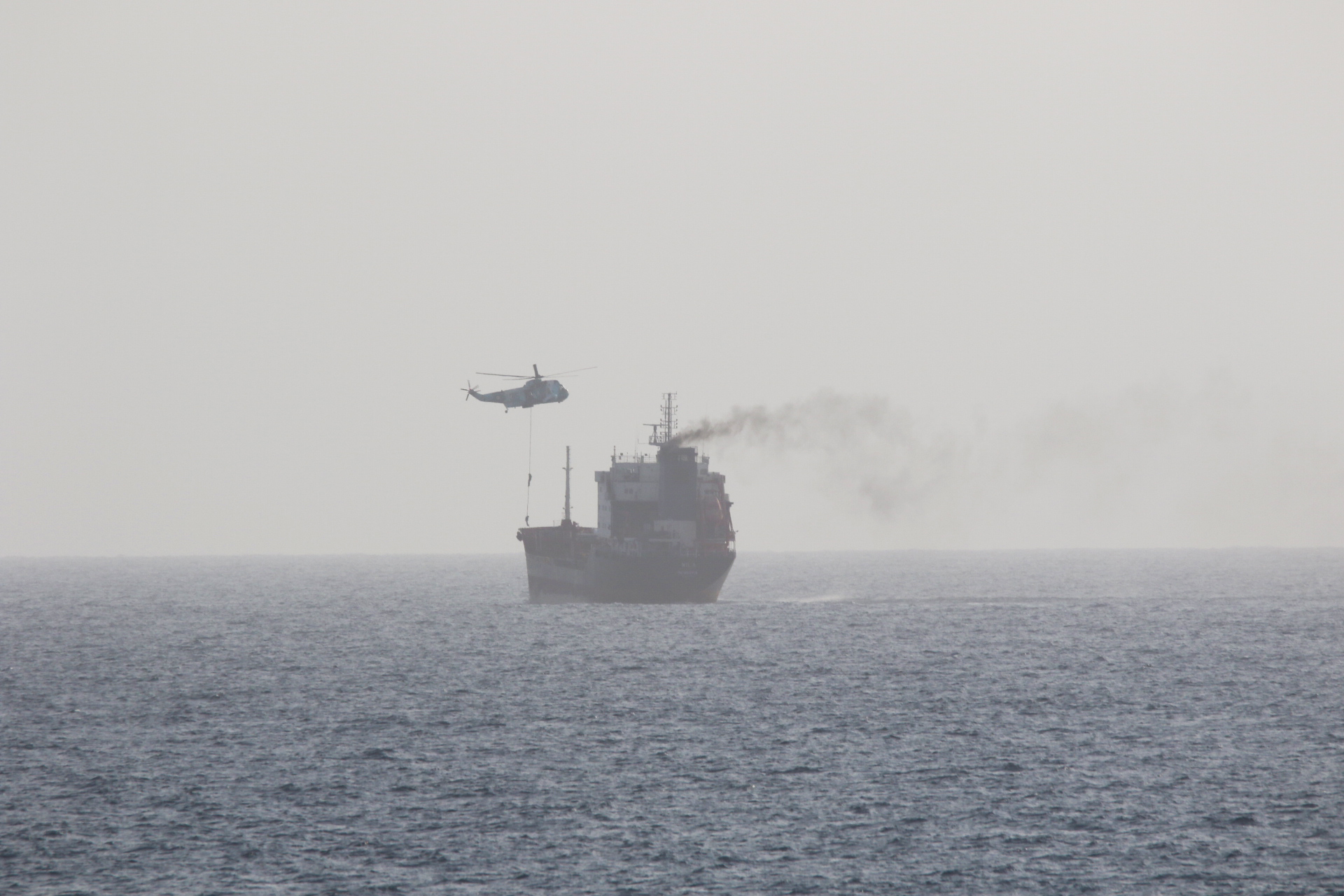
Three days earlier, on April 19, the USS Spruance fired multiple rounds from its 5-inch MK 45 gun into the engine room of the M/V Touska, a 294-metre Iranian-flagged cargo vessel operated by Hafiz Darya Shipping Lines u2014 part of the IRISL group, both under US Treasury sanctions. The Touska had been attempting to reach Bandar Abbas from China. After a six-hour standoff in which the vessel failed to comply with repeated warnings, US Marines from the 31st Marine Expeditionary Unit deployed by helicopter from the USS Tripoli and boarded her. CENTCOM cited blockade violation, OFAC sanctions, and suspected contraband u2014 possibly rocket fuel precursors u2014 as its legal basis. The Touska was the first Iranian cargo vessel captured since the US naval blockade began a week earlier, though CENTCOM said 27 other vessels had been directed to turn back before it.
n
Iran’s Khatam al-Anbiya u2014 the joint military command u2014 called the Touska boarding “armed piracy” and vowed forces would “soon respond and retaliate.” Iran cancelled its participation in the Islamabad talks. Foreign Minister Abbas Araghchi, in a statement carried by CNN and NBC on April 21, laid down the marker: “Blockading Iranian ports is an act of war and thus a violation of the ceasefire. Striking a commercial vessel and taking its crew hostage is an even greater violation.”
n
The retaliation came 72 hours later. The IRGC did not use Araghchi’s language of reciprocity u2014 it used the procedural vocabulary of its self-declared Hormuz management authority. The gap between Araghchi’s rhetoric and the IRGC’s framing is itself a data point. The foreign ministry promises retaliation in public. The navy executes seizures under a different rubric entirely, as though the transit-management regime and the retaliatory impulse are running on parallel tracks that happen to converge on the same vessels at the same time.
n
Who Gave Permission?
n
The most operationally telling detail from April 22 is not the seizures themselves but the Epaminondas master’s account of what happened before the RPGs hit his bridge. According to reports relayed through UKMTO and the Greek government, the master stated that the vessel “had been initially informed that it had permission to transit the Strait of Hormuz.” Then an IRGC gunboat opened fire without radio contact.
n
The source of that permission is unclear from available reporting. It could have come from UKMTO itself u2014 which issues transit advisories and coordination signals to commercial operators but has no authority over IRGC units. It could have come from an Iranian port authority, from the FM-linked permit system that Araghchi’s ministry has intermittently operated, or from a commercial broker intermediary. The reporting does not specify, and the ambiguity matters. If the clearance came from an Iranian government entity, then the IRGC gunboat crew either did not know about it or did not care. If it came from UKMTO or a commercial intermediary, then the entire clearance architecture rests on an assumption that no longer holds: that there is a single Iranian authority capable of both granting and enforcing transit permissions.
n
UKMTO’s role is often misunderstood. It is a Royal Navy coordination service, not a regulatory body. Its “cleared” notifications tell commercial operators and coalition naval partners that a vessel has been registered and tracked. They do not u2014 and never did u2014 bind the IRGC to anything. But the system functioned, before the war, on a shared fiction: that Iran’s naval forces would broadly respect the vessels Iran’s own bureaucracy had acknowledged. That fiction died somewhere between March 26 and April 22.
n
Can a Headless Navy Honor Its Own Clearances?
n
Admiral Alireza Tangsiri, commander of the IRGC Navy, was killed on March 26 in an Israeli airstrike on Bandar Abbas. The IDF stated that “all of the IRGC Navy’s key commanders” were eliminated in the same strike. As of April 22 u2014 27 days later u2014 no named successor has been publicly announced. The seizure decisions on April 22 were made by unit commanders operating on standing orders, not by a coherent command authority capable of issuing, tracking, or revoking clearances.
n
This is the structural problem the Epaminondas discrepancy reveals. A transit-management regime requires, at minimum, a single node that can both authorize passage and communicate that authorization to the units controlling the waterway. With Tangsiri dead and his senior staff gone, that node does not exist. The IRGC Navy is operationally active u2014 it just seized two ships and fired on a third u2014 but it is not operationally coherent in the way required to run a permit system. The unit that may have issued a clearance and the unit that fired RPGs at the Epaminondas’s bridge may not share a commander, a communications chain, or even a common understanding of which vessels are authorized.
n
The IRGC’s broader command problem extends beyond the navy. Khatam al-Anbiya, which issued the retaliation threat, operates above the IRGC Navy in Iran’s military hierarchy. But Khatam al-Anbiya commands campaigns, not individual gunboat intercepts. The gap between strategic direction (“retaliate for Touska”) and tactical execution (“fire on this specific vessel at these coordinates”) is where clearances go to die. A headless navy can still seize ships. It cannot run a bureaucracy.
n
n
Four Cycles in Seven Years
n
The April 22 seizures are not an escalation. They are a pattern executing on schedule. DWF Group’s legal analysis, authored by Christopher Dunn (Head of Marine) and Freddie Mehlig (Legal Director), documents four distinct retaliatory seizure cycles since 2019, each following the same grammar: a Western power detains an Iranian or Iran-linked vessel; the IRGC seizes one or more commercial vessels in the strait within days or weeks.
n
The hardliner bloc’s parallel moves on ceasefire expiry day — Mohseni-Ejei’s prosecution threat, the Khorramshahr-4 parade through Enghelab Square, and Ghalibaf’s defiant public statement — are documented in Iran’s Judiciary Chief and IRGC Answer Trump’s Ceasefire Extension with Missile Parade and Prosecution Threat.
n
In July 2019, the UK detained the Iranian tanker Grace 1 in Gibraltar. The IRGC seized the British-flagged Stena Impero in Omani territorial waters 15 days later, claiming “maritime rule violations.” It held the vessel for 71 days. In 2022, Greece impounded the Iranian tanker Pegas on behalf of the United States. Within a month, the IRGC seized two Greek tankers u2014 the Delta Poseidon and the Prudent Warrior. In April 2023, the US seized the Suez Rajan for carrying sanctioned Iranian crude. The IRGC seized the Advantage Sweet, a Marshall Islands-flagged tanker chartered by Chevron, within days.
n
The 2026 cycle compressed the timeline further. The Touska was seized on April 19. The MSC Francesca and Epaminondas were seized on April 22 u2014 a 72-hour turnaround that suggests either pre-positioned assets or, more likely, standing orders to seize targets of opportunity whenever the political trigger is pulled. The addition of RPG fire to the sequence u2014 the Stena Impero and 2022-2023 seizures involved boarding, not shooting u2014 marks a qualitative escalation within a quantitatively predictable framework.
n
| Year | Western Action | IRGC Response | Time Gap |
|---|---|---|---|
| 2019 | UK seizes Grace 1 (Gibraltar) | Stena Impero seized (Omani waters) | 15 days |
| 2022 | Greece impounds Pegas (US request) | Delta Poseidon + Prudent Warrior seized | ~30 days |
| 2023 | US seizes Suez Rajan (sanctioned cargo) | Advantage Sweet seized | ~7 days |
| 2026 | US boards Touska (blockade) | MSC Francesca + Epaminondas seized; Euphoria fired upon | 3 days |
n
n
Does Anyone Have Recourse?
n
Commander Mark P. Nevitt (ret.), now Associate Professor of Law at Emory University, has documented Iran’s Hormuz toll and transit management regime as “coercive extraction enabled by unlawful conduct” in a Just Security analysis. Iran’s declaration that the strait will “never return to its previous status” constitutes, in Nevitt’s assessment, “a formal repudiation of the transit passage regime” under UNCLOS Article 44, which requires states bordering international straits not to hamper or suspend transit passage. Article 26 separately prohibits transit charges. Iran is in violation of both.
n
None of that matters to the master of the Epaminondas, whose bridge was hit by RPGs fired by men who answer to no named commander and who may or may not have known his vessel had been told it could pass. The DWF Group analysis reaches a blunt conclusion on the commercial side: “there is unlikely to be any realistic recourse for commercial entities against the states involved.” The legal framework exists. The enforcement mechanism does not. IMO Secretary-General Arsenio Dominguez called in March for member states to demonstrate that “inaction is not an option,” but the IMO Council’s condemnation of “threats and attacks against vessels and the purported closure of the Strait of Hormuz” has produced no operational consequence.
n
The IRGC, for its part, frames the entire enterprise as lawful administration. “Disrupting the order and safety of the Strait of Hormuz is our red line,” the corps stated via CBS News. The vessels were seized, the IRGC said, for “operating without the necessary permits and by tampering with navigation systems.” This is the language of a coast guard, not a retaliating military u2014 and that is the point. Iran has built a legal fiction in which every seizure is a regulatory action, every boarding is an enforcement operation, and the Touska never happened.
n
Brent at the Door of $100
n
Brent crude rose to approximately $99.20 per barrel on news of the April 22 seizures, briefly touching $100 before pulling back u2014 up from sub-$95 the previous session. The Trump administration has estimated that Iran’s blockade-related disruption costs approximately $500 million per day, a figure that reflects not just lost cargo but insurance repricing, route diversions, and the slow strangulation of Gulf export capacity. Saudi Arabia’s March production had already crashed to 7.25 million barrels per day from 10.4 million in February u2014 a 30 percent drop driven by the combination of Hormuz restrictions and damage to Eastern Province infrastructure.
n
The seizure of the MSC Francesca u2014 departing Dammam, Saudi Arabia’s primary eastern port u2014 directly threatens the container trade that Saudi Arabia’s non-oil economy depends on. If its vessels are being seized on departure from Saudi ports, the insurance and routing implications extend far beyond the two ships currently anchored off Sirik. Windward Maritime Intelligence data from April 19-20 showed 138 Panama-flagged vessels and 66 Liberian-flagged vessels operating in the Gulf u2014 the two flag states now directly targeted by IRGC seizures. Separately, Windward identified 177 tankers carrying Iranian cargo worldwide, 163 of them operating under what the firm called “fraudulent flag registries.”
n
The seizures also arrived on the same day Trump announced an indefinite ceasefire extension u2014 a timing coincidence that CNN’s live coverage framed as a direct test of that extension’s meaning. The ceasefire, such as it is, has no enforcement mechanism. Pakistan, the sole mediator with physical access to both sides, watched its Islamabad framework collapse when Iran pulled out after the Touska boarding. The Vance trip to Islamabad has been postponed indefinitely. Iran’s UN envoy Majid Takht Ravanchi’s precondition u2014 end the blockade first u2014 remains unmet. Two days later, on April 23, CENTCOM confirmed it had turned back 31 vessels since the blockade began u2014 while Trump’s removal of any Iran deadline made clear the interdiction has no planned endpoint.
n
The seizures also coincided with a shift in the MCM picture: USS Pioneer (MCM-9) and USS Chief (MCM-14) are transiting the Indian Ocean toward the Persian Gulf, closing the MCM capability gap that Pioneer and Chiefu2019s transit is designed to fill u2014 the first dedicated Avenger-class mine countermeasures ships to approach the theater since the Bahrain decommissions in September 2025.
n
The diplomatic response to the seizures has been muted across most of the Gulf, but on April 20 China broke from its usual restraint: Xi Jinping called MBS and publicly demanded Hormuz remain open, marking the first time Beijing has contested Iran’s control at presidential level and significantly raising the political cost for Iran of treating Chinese-brokered transits as a private commercial arrangement while seizing Western-linked vessels.
n
n
FAQ
n
What happened to the crews of the seized vessels?
n
As of April 22, no information has been released about the crews of the MSC Francesca, Epaminondas, or Euphoria. In previous IRGC seizure cycles, crews were typically held aboard their vessels during detention. The Stena Impero’s 23 crew members were held for 71 days in 2019 before release. The Touska’s crew is in US custody following the April 19 boarding. The crew nationalities of the April 22 vessels have not been publicly confirmed, though Greek-operated vessels in the Gulf typically carry multinational crews from the Philippines, India, and Eastern Europe.
n
Can shipping companies avoid the Strait of Hormuz entirely?
n
Not if they need to reach Gulf ports. The strait is the only sea exit from the Persian Gulf. Saudi Arabia’s East-West Pipeline to Yanbu on the Red Sea bypasses Hormuz for crude oil, but its effective capacity is 4-5.9 million barrels per day against pre-war throughput of 7-7.5 million u2014 a structural gap of at least 1.1 million barrels per day. Container traffic, LNG, and non-Saudi exports have no bypass. Hapag-Lloyd and Maersk have already begun avoiding the strait where possible, but for vessels serving Dammam, Jebel Ali, or Kuwait, there is no alternative route.
n
What is UKMTO and why couldn’t it prevent the seizures?
n
UKMTO (UK Maritime Trade Operations) is a Royal Navy coordination service based in Dubai that tracks and advises commercial vessels transiting the Gulf. It issues transit advisories and coordination signals but has no regulatory authority and no power to compel any military force u2014 including the IRGC u2014 to comply. Its clearances tell commercial operators and coalition navies that a vessel has been registered and is being tracked. They are not permissions from Iran and were never designed to be. That gap between diplomatic clearance and IRGC operational authority proved fatal on April 18, when Indian-flagged vessels carrying Iranian FM clearances were fired on by IRGC gunboats — the central case study in India’s Authorization-Ceiling Injury: The IRGC Fired on Ships That Held Iranian FM Clearance.
n
Has any international body taken enforcement action over the Hormuz seizures?
n
No. The IMO Council has condemned Iran’s actions and Secretary-General Dominguez has called for collective action, but the IMO has no enforcement mechanism. UNCLOS provides the legal framework u2014 Articles 26 and 44 prohibit transit charges and require states not to hamper passage u2014 but the International Tribunal for the Law of the Sea has no power to compel Iranian compliance. The UN Security Council route is blocked by Russia and China. Commercial entities have, per DWF Group’s assessment, “no realistic recourse.”
n
Could the US Navy have intercepted the IRGC units before they reached the Epaminondas?
n
The US Fifth Fleet operates from NSA Bahrain and maintains destroyer patrols in the strait u2014 DDG-121 and DDG-112 transited Hormuz on April 11. But the IRGC Navy operates fast attack craft from bases on the Iranian coastline minutes from the shipping lanes. The interception window between an IRGC gunboat departing its base and reaching a target vessel is extremely narrow u2014 often under 15 minutes. Coalition naval forces can escort convoys but cannot prevent every fast-boat sortie from a coastline that borders the entire northern edge of the strait.
n
The political trap this created for Saudi Arabia — where the IRGC seizures on the same day as ceasefire expiry and Hajj opening removed MBS’s ability to cancel or de-escalate without invalidating the Custodian title — is analysed in The Hajj Opens Under an Expired Ceasefire: MBS’s Custodian Title Becomes a Trap.
n
The authorization chain behind those seizure orders — and how Iran’s Article 111 incapacitation protocol has been suppressed to prevent an interim council from constraining IRGC operational authority — is detailed in The Unconscious Sovereign: How the IRGC Captured Iran Without Triggering Article 111. Hours after the seizures, Press Secretary Leavitt confirmed that the White House’s two-tier ceasefire ruling excludes non-US, non-Israeli vessels from ceasefire protection — meaning every Panama-, Liberia-, and Marshall Islands-flagged tanker in the Gulf sails without the ceasefire’s cover. The sequence that made those seizures possible — from the disabling of the M/V Touska on April 20 through the 72-hour cascade of consequences — is documented in One Ship, 72 Hours, Three Crises: The M/V Touska Seizure. The following morning, on April 23, the IRGC fired on a third vessel, the M/V Euphoria, and released a professionally edited video of the MSC Francesca boarding — Iran’s information-warfare campaign in the strait entered a new phase.