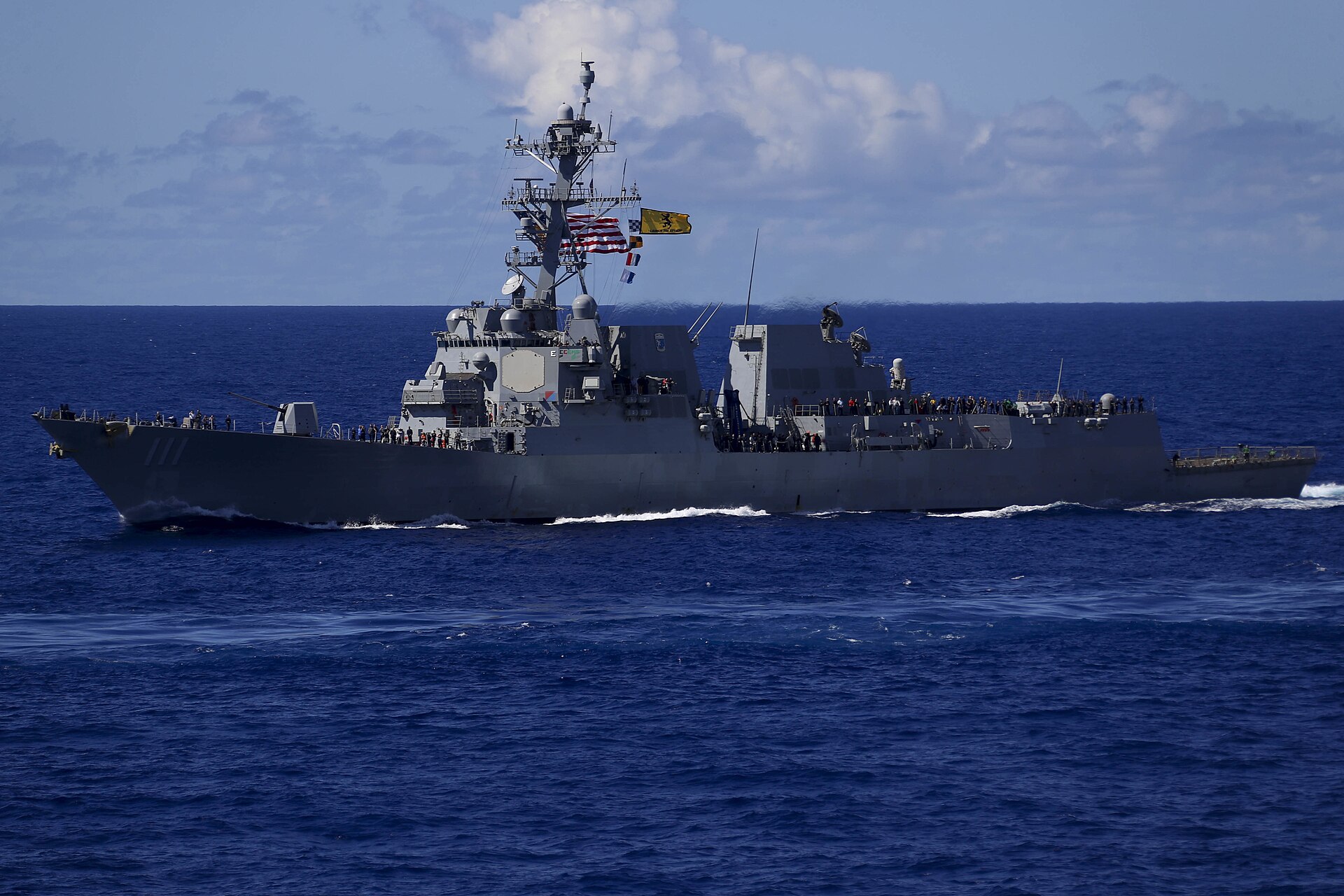
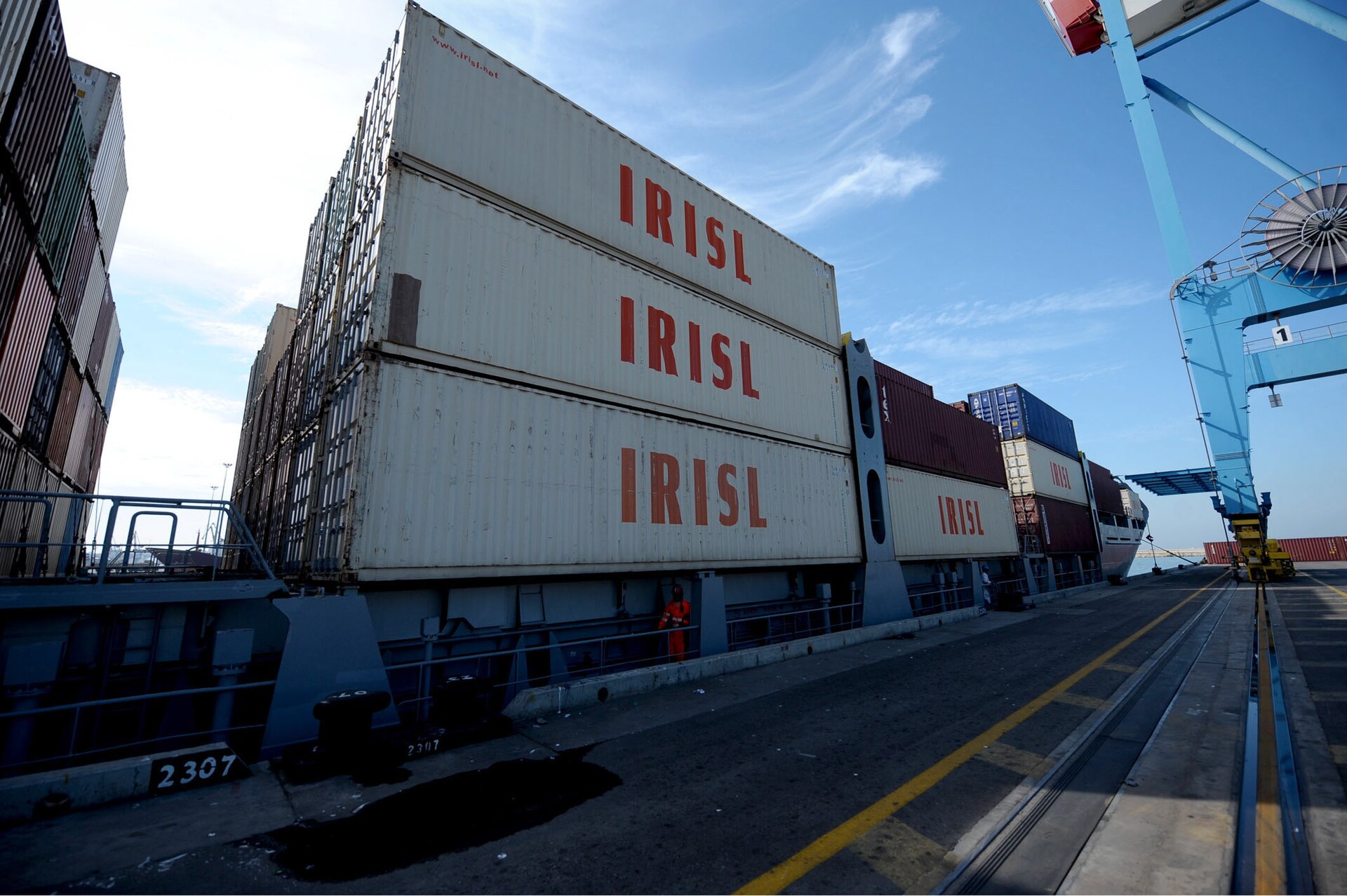
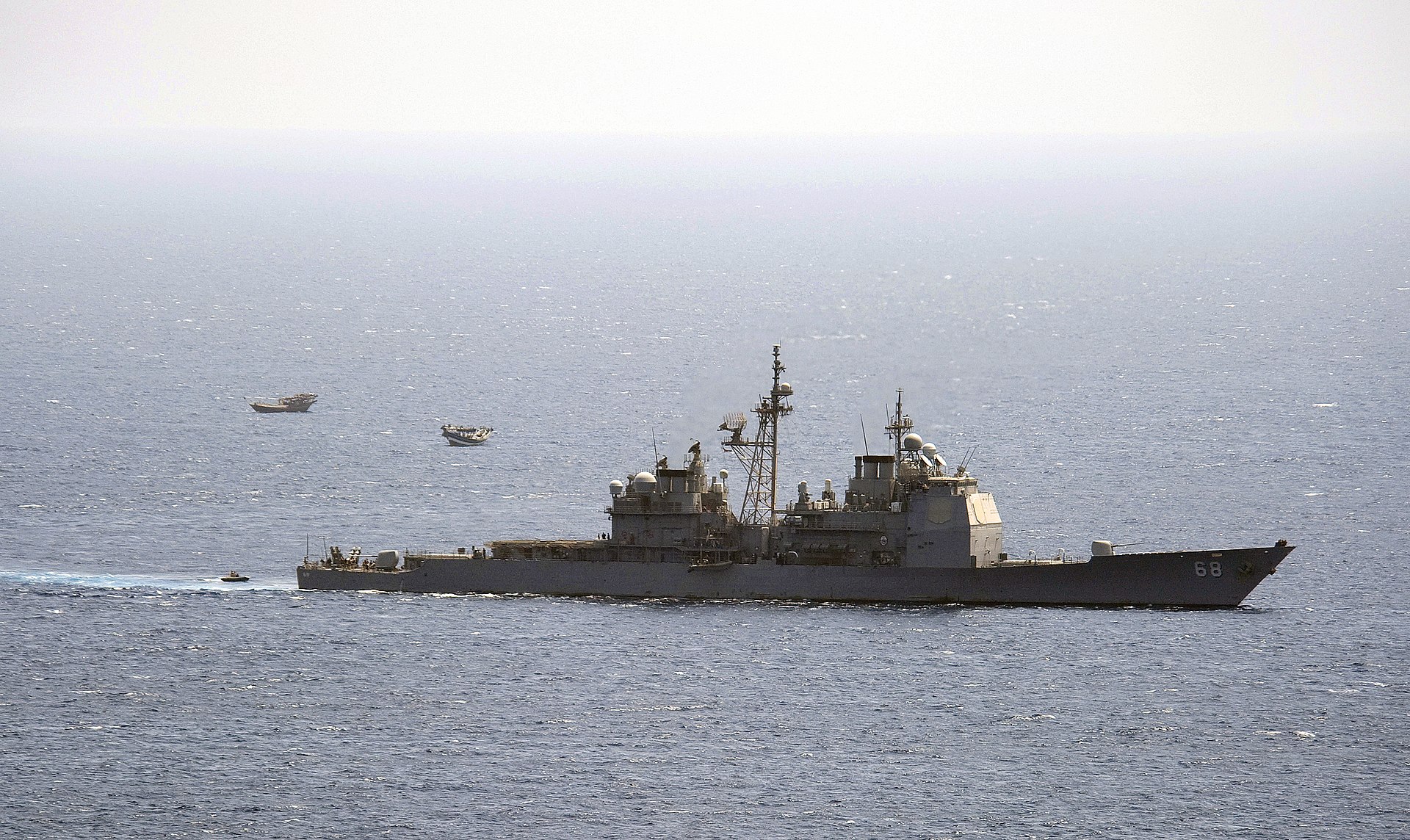
MUSCAT — The guided-missile destroyer USS Spruance fired on and boarded the Iranian-flagged container ship TOUSKA in the Gulf of Oman on April 19, the first time the United States has physically seized a vessel since imposing its naval blockade on Iranian ports six days ago. The 295-meter ship, designated under U.S. Treasury sanctions for links to Iran’s Islamic Republic of Iran Shipping Lines, is now under the custody of U.S. Marines, President Trump announced on Truth Social.
The seizure came three days before the ceasefire between the United States and Iran is set to expire on April 22. Within hours, Iran formally re-closed the Strait of Hormuz, rejected participation in the second round of Pakistan-mediated talks, and accused Washington of “piracy and maritime theft.” Oil markets rose sharply on the news.
Table of Contents
The Seizure
Trump’s account of the interception was unusually specific. “Today, an Iranian-flagged cargo ship named TOUSKA, nearly 900 feet long and weighing almost as much as an aircraft carrier, tried to get past our Naval Blockade, and it did not go well for them,” he wrote. “The U.S. Navy Guided Missile Destroyer USS SPRUANCE intercepted the TOUSKA in the Gulf of Oman, and gave them fair warning to stop. The Iranian crew refused to listen, so our Navy ship stopped them right in their tracks by blowing a hole in the engineroom.”
The House of Saud Daily Briefing
Saudi Arabia's news in 3 minutes, every morning. Free. See today's issue
The Spruance, an Arleigh Burke-class Flight IIA destroyer homeported at Naval Station San Diego, is deployed in the Arabian Sea as part of the Abraham Lincoln Carrier Strike Group under Operation Epic Fury. The ship had already turned back at least one Iranian vessel before TOUSKA, according to a Times of San Diego report dated April 15. CENTCOM said on April 16 that “ZERO ships have broken through since the start of the U.S. blockade on Monday,” with approximately 23 vessels turned back by the time of the TOUSKA boarding.
TOUSKA is the first and only vessel physically seized. All prior interceptions resulted in vessels being turned back without boarding, according to NBC News and Pentagon statements reported by CNBC on April 16. The cargo aboard TOUSKA has not been publicly disclosed. The crew is Iranian, per Trump’s statement; the crew count has not been confirmed in any available source.
What Is the TOUSKA and Why Was It Targeted?
TOUSKA (IMO 9328900, MMSI 422032600) is a 54,851-gross-ton container ship built in 2008, 295 meters long and 32 meters wide, with a deadweight capacity of 66,432 tonnes, according to VesselFinder and MarineTraffic records. Her registered owner is Mosakhar Darya Shipping Co.; her commercial manager is Rahbaran Omid Darya Ship Management, per VesselTracker. Both are linked to IRISL — the Islamic Republic of Iran Shipping Lines — according to MaritimeOptima and OpenSanctions data.
IRISL was first designated by OFAC in September 2008 under Executive Order 13382 for involvement in weapons of mass destruction proliferation. The designation was lifted in January 2016 as part of the JCPOA nuclear deal. OFAC re-designated IRISL on June 8, 2020, applying the [IRAN], [NPWMD], and [IFSR] tags that remain active today.
“The TOUSKA is under U.S. Treasury Sanctions because of their prior history of illegal activity,” Trump wrote. The legal pathway from OFAC designation to physical seizure follows what Lawfare has described as the “sanctions to forfeiture pipeline” — the same architecture applied to the tanker MT Skipper in December 2025, where OFAC designation established probable cause, a magistrate issued a seizure order, and the vessel was interdicted and taken into custody pending forfeiture litigation.
Iran’s Response: Hormuz Re-Closed, Talks Rejected
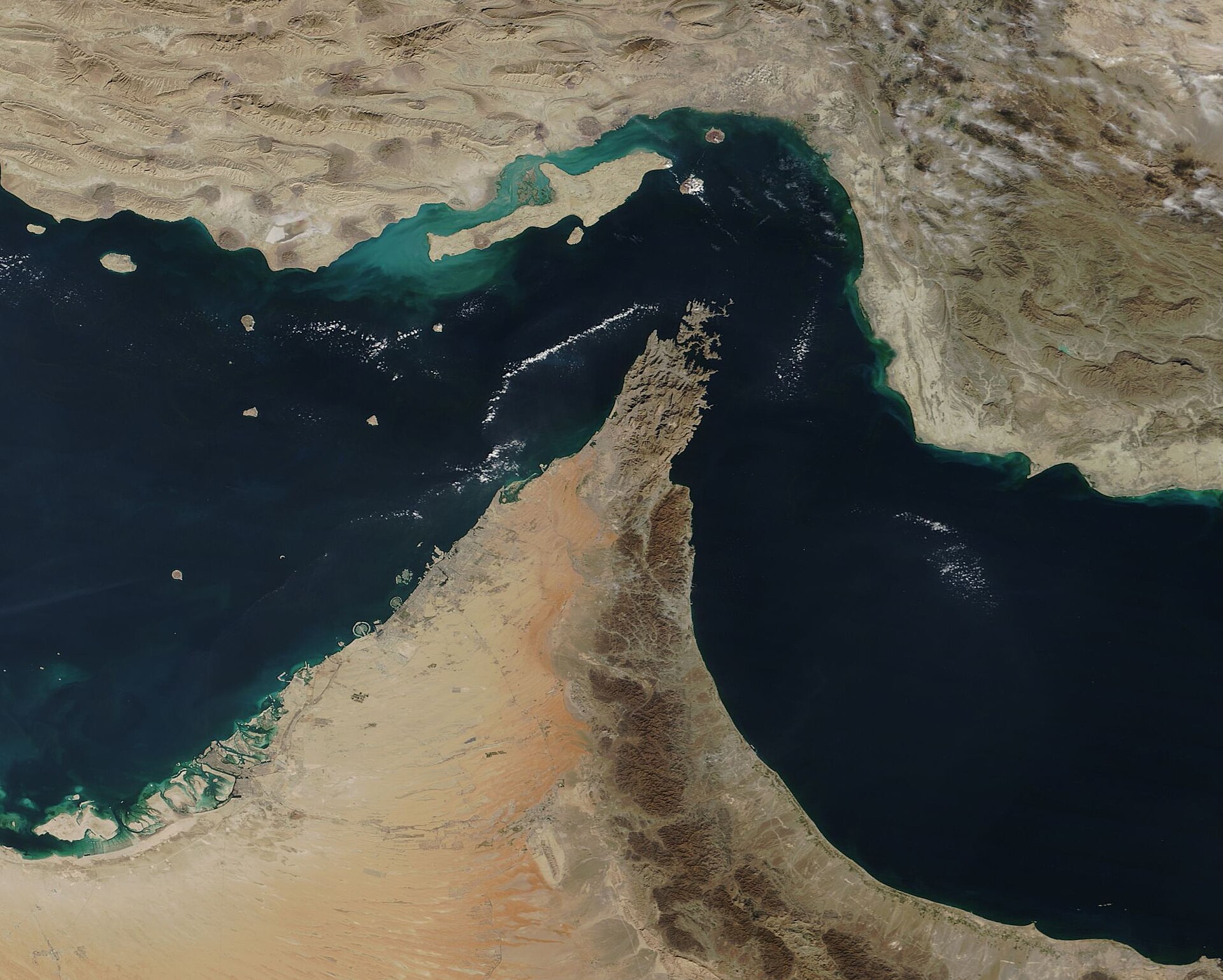
Iran’s response arrived in three channels within hours of the seizure. The IRGC announced that “in violation of the ceasefire agreement, the American enemy did not lift the naval blockade on Iranian vessels and ports. Therefore, starting this evening, the Strait of Hormuz will be closed until this blockade is lifted,” according to Al Jazeera’s liveblog coverage.
Iran’s Supreme National Security Council, quoted by IRNA and reported by CBC and the Irish Times, rejected participation in a second round of Pakistan-mediated talks. It cited “Washington’s excessive demands, unrealistic expectations, constant shifts in stance, repeated contradictions, and the ongoing naval blockade, which it considers a breach of the cease-fire.”
Khatam al-Anbiya, Iran’s joint military operational command, described the U.S. blockade as “piracy” — a term it had used since the blockade’s origins on April 13, according to Life News Agency and Al Arabiya English. After the TOUSKA seizure, the language escalated to “piracy and maritime theft.”
Khatam al-Anbiya’s military headquarters vowed retaliation for the seizure while IRNA simultaneously published statements rejecting the second round of Islamabad talks — the two responses arriving in the same news cycle and serving the same purpose. Iran’s military HQ vowed retaliation while IRNA rejected round 2 talks, framing the US delegation’s flight to Islamabad as a “media game” staged for domestic audiences rather than a serious diplomatic offer.
Iran also rejected a 45-day ceasefire proposal from Pakistan that would have temporarily opened Hormuz without requiring the U.S. to lift the blockade, according to the Times of Israel. An Iranian negotiator quoted by Haaretz’s liveblog said “war could resume at any moment.” IRNA reported separately that Iran is “determined to exercise supervision and control over traffic through the Strait of Hormuz until the war is definitively ended.”
The IRGC had already declared full authority over the strait on April 5 and again on April 10 — both times while Iranian diplomats were in Islamabad. The pattern holds: military commands issue from Tehran while diplomatic signals are still in transit from the negotiating table.
The Legal Architecture: Sanctions, UNCLOS, and Belligerent Rights
The legal basis for the TOUSKA seizure sits at the intersection of three frameworks that do not cleanly align. U.S. domestic sanctions law — the OFAC designation of IRISL and its subsidiaries — provides the authorization the Treasury Department claims. UNCLOS Article 94 gives exclusive jurisdiction over a vessel on the high seas to its flag state, which in TOUSKA’s case is Iran. And the laws of armed conflict, or LOAC, apply a different set of rules entirely if Hormuz is treated as a belligerent strait during an international armed conflict.
Marc Weller, international law scholar and Chatham House associate, has argued that the U.S.-Israel strikes on Iran created an international armed conflict that transforms Hormuz into a belligerent strait — a status that gives belligerent navies broader authority to interdict enemy-flagged vessels than peacetime UNCLOS would permit. Under this reading, the U.S. does not need flag-state consent to board TOUSKA because Iran is a belligerent party whose vessels are subject to visit, search, and capture.
Iran’s legal counter-argument rests on UNCLOS Article 94: no state may board a foreign-flagged vessel on the high seas without the consent of the flag state, absent recognized exceptions for piracy, statelessness, or false flagging. None of those exceptions apply to TOUSKA, which is a documented Iranian-flagged vessel with a known owner and operator. Whether the armed conflict overrides this provision is a question no international court has adjudicated in the current context.
| Precedent | Date | Flag State | Seizing State | Legal Basis | Key Difference from TOUSKA |
|---|---|---|---|---|---|
| Grace 1 (Adrian Darya 1) | July 4, 2019 | Panama (Iranian-operated) | UK (Gibraltar) | EU Syria sanctions | Seized in territorial waters, not high seas; Panama-flagged, not Iranian-flagged |
| USS Monterey dhow seizure | May 2021 | Stateless | United States | UNCLOS stateless vessel exception | No flag-state protection; crew released |
| MT Skipper | December 2025 | Varies | United States | OFAC designation → magistrate order | Forfeiture pipeline, but not during active armed conflict |
| TOUSKA | April 19, 2026 | Iran | United States | OFAC + belligerent rights (claimed) | Iranian-flagged vessel fired on and boarded on high seas during armed conflict |
The distinction matters because it determines what comes next. If the U.S. claims authority under LOAC belligerent rights, TOUSKA becomes a prize-of-war case — a legal category that has not been applied since the Falklands War in 1982. If the U.S. claims authority under OFAC sanctions and domestic forfeiture law, TOUSKA enters the civilian court system, where Iran’s flag-state jurisdiction argument would be litigated. Trump’s Truth Social statement referenced Treasury sanctions, not belligerent rights.
Does the Grace 1 Playbook Apply?
On July 4, 2019, Royal Marines seized the Iranian-operated VLCC Grace 1 off Gibraltar under EU Syria sanctions. Fifteen days later, on July 19, the IRGC seized the British-flagged product tanker Stena Impero in the Strait of Hormuz — 23 crew members detained, AIS spoofing used to lure the vessel into Iranian territorial waters. The seizure was widely interpreted as direct retaliation by USNI Proceedings, Lloyd’s List, and the VIF India analysis. Gibraltar released Grace 1 on August 15 despite a U.S. request to hold it. Iran released the Stena Impero on September 27, approximately 70 days after seizure.
The structural parallel is obvious. An Iranian-linked vessel is seized; Iran retaliates by seizing a vessel linked to the seizing power or its allies. But the differences in 2026 are substantial. Grace 1 was Panama-flagged, not Iranian-flagged — seized in the territorial waters of a British overseas territory, not on the high seas by a U.S. warship. Stena Impero was UK-flagged, and the UK had no carrier strike group in the Gulf at the time. TOUSKA involves the U.S. Navy firing on an Iranian vessel during an active armed conflict, with the Abraham Lincoln Carrier Strike Group deployed in theater and A-10 Warthogs and Apaches operating over Hormuz.
Iran’s capacity to replicate the Stena Impero playbook is constrained but not eliminated. More than 150 tankers remain anchored outside Hormuz. The IRGC has already fired on vessels it had cleared to transit the strait. Any counter-seizure of a U.S.-allied vessel — Saudi, Emirati, or a Western-flagged commercial ship — would escalate the conflict into direct maritime confrontation at a moment when the ceasefire is 72 hours from expiry.
The 72-Hour Lock
The ceasefire between the United States and Iran expires on April 22. Kushner’s Islamabad mission, carrying $6 billion in Gulf money, was designed to extend it. Iran’s rejection of the second round of Pakistan-mediated talks, announced within hours of the TOUSKA seizure, removes the only active diplomatic channel.
The structural problem is that TOUSKA creates a condition neither side can concede. Iran’s SNSC has declared the blockade a “breach of the ceasefire” — a position that now requires the release of TOUSKA and the lifting of the blockade as preconditions for any negotiation. The U.S. cannot release TOUSKA without destroying the credibility of the blockade it spent six days constructing and the legal architecture it applied. Every prior vessel was turned back. TOUSKA was the one that refused. Releasing it would signal that refusal works.
Trump’s simultaneous threat — “the United States is going to knock out every single Power Plant, and every single Bridge, in Iran” if no deal is accepted, per CBS News — collapses the diplomatic space further. This is not a new threat; Trump used nearly identical language on April 5 in the “Power Plant Day and Bridge Day” Truth Social post. But the timing is different. On April 5, the ceasefire had not yet been agreed. On April 19, it has three days left, the only negotiating venue has been rejected, and U.S. Marines are sitting aboard an Iranian ship.
Brent crude moved toward $98 a barrel on April 19, according to Angle360ng and Fortune, up from approximately $90 on April 17-18. The price reflects both the TOUSKA seizure and the Hormuz re-closure — twin signals that the 45-day ceasefire framework proposed through Pakistan is functionally dead. Saudi Arabia’s fiscal break-even sits at $108-111 a barrel, per Bloomberg’s PIF-inclusive estimate. At $98, the kingdom is still underwater, with March production already down to 7.25 million barrels per day from 10.4 million in February — a 30 percent drop that the IEA called “the largest disruption on record.”
The 15-day gap between Grace 1 and Stena Impero in 2019 offers one frame. If Iran follows the same retaliation timeline, a counter-seizure would fall around May 4 — twelve days after the ceasefire expires. But in 2019, Iran and the United States were not at war. The IRGC’s Hormuz re-closure statement does not reference a timeline for reopening. It conditions reopening on lifting the blockade, which conditions on TOUSKA’s release, which conditions on Iran’s acceptance of terms that its SNSC has already rejected.
The IRGC Navy commander who oversaw Hormuz operations — Rear Admiral Alireza Tangsiri — was killed on March 30. No named successor has been announced in 20 days. The command is headless but operational, issuing “last warning” radio calls to U.S. destroyers DDG-121 and DDG-112 as recently as April 11.
President Pezeshkian publicly accused IRGC commanders Vahidi and Abdollahi on April 4 of wrecking the ceasefire — an extraordinary confession that he lacks authority over the institution that controls the strait. Article 110 of Iran’s constitution gives the Supreme Leader, not the president, command of the armed forces. Khamenei has been absent from public view for approximately 46 days.
TOUSKA sits in the Gulf of Oman with a hole in its engine room and U.S. Marines on its deck. Iran’s negotiating position requires its return. America’s blockade requires its retention. The ceasefire expires Tuesday.
What the Touska seizure means for the April 22 deadline — and why the ceasefire may have already ended before it expires — is examined in The Ceasefire Already Ended — Trump’s Deadline Is for Everyone Else.
FAQ
What was TOUSKA carrying?
The cargo aboard TOUSKA has not been publicly disclosed by the U.S. military, CENTCOM, or the Trump administration as of April 19. Trump’s Truth Social statement referenced the ship’s Treasury sanctions designation but did not describe the cargo. Previous IRISL vessels interdicted by Western navies have carried weapons components, dual-use technology, and conventional goods. Without official disclosure, the cargo remains unknown. The OFAC forfeiture pipeline applied in the MT Skipper case in December 2025 does not require the cargo itself to be sanctioned — the vessel’s designation under the SDN List provides independent legal authority for seizure.
Can Iran legally retaliate by seizing a U.S.-flagged vessel?
Very few commercial vessels in the Gulf carry the U.S. flag. The more likely targets for Iranian retaliation — based on the 2019 Stena Impero precedent — would be vessels flagged to U.S. allies: the United Kingdom, Marshall Islands, Liberia, or Panama. Under the belligerent rights framework that Chatham House’s Marc Weller has described, both sides in an armed conflict have the right to interdict enemy vessels. Iran could claim reciprocal belligerent rights over U.S.-allied shipping. The practical constraint is that the Abraham Lincoln Carrier Strike Group, A-10 Warthogs, and Apache gunships are now operating over Hormuz, making any Iranian boarding operation a direct confrontation with U.S. air and naval power — a qualitative escalation beyond the 2019 playbook, when no carrier strike group was present.
Has any country other than the U.S. recognized the blockade as legal?
No formal recognition of the blockade’s legality has been issued by any allied government as of April 19, though no allied government has publicly challenged it either. The UK, which deployed a Sky Sabre air defense battery to Saudi Arabia in late March, has not commented on the blockade’s legal basis. The European Union’s position is further complicated by the fact that the E3-triggered snap-back mechanism on Iran sanctions — invoked in August 2025 — already expired on October 18, 2025, meaning the EU’s Iran sanctions architecture is itself in legal limbo. Secretary Rubio urged EU allies to reimpose sanctions on April 18, the day before the TOUSKA seizure.
What happens to the TOUSKA crew?
Trump confirmed the crew is Iranian but did not disclose the number of personnel aboard. In the USS Monterey dhow seizure of May 2021, the crew of a stateless vessel was questioned and released. In the 2019 Stena Impero case, seven of the 23 detained crew were Indian nationals — a diplomatic pressure point that eventually accelerated their release. Under the OFAC forfeiture framework, the crew of a seized vessel is typically separated from the forfeiture proceeding; crew members are not themselves sanctioned property. However, if the U.S. applies LOAC belligerent rights rather than civilian forfeiture law, Iranian military personnel aboard could be detained as prisoners of war or combatants — a determination that depends on whether any IRGC personnel were part of the crew, which has not been disclosed.
How does the TOUSKA seizure affect Saudi Arabia’s Eastern Province?
The Eastern Province hosts three targets the IRGC has already demonstrated intent to strike: the Ras Tanura export terminal, the Abqaiq stabilization facility, and the East-West Pipeline pumping stations (struck April 8). Critically, it also hosts NSA Bahrain’s logistics support infrastructure and the King Fahd Causeway — named on the IRGC’s April 3 counter-target list alongside seven other bridges across four countries. The causeway was Saudi Arabia’s sole international overland corridor after Bahrain’s airspace closed on February 28, and it was briefly shut on April 7 when Iran fired seven ballistic missiles at the Eastern Province. A sustained IRGC kinetic campaign timed to the ceasefire expiry on April 22 could simultaneously target export infrastructure and restrict the causeway — compounding damage at the moment Saudi Arabia has the least margin to absorb it.
The downstream consequence of that infrastructure pressure lands today: JPMorgancompounding damage at the moment Saudi Arabia has the least margin to absorb it.
#8217;s April 20 supply exhaustion date marks when the last pre-blockade Hormuz barrel physically clears refinery tanks, meaning any further IRGC strike on the Eastern Province draws from reserves that are no longer being replaced at any pace approaching consumption.
The House of Saud Daily Briefing
Saudi Arabia's news in 3 minutes, every morning. Free. See today's issue