TEHRAN — On May 15, Iran’s foreign minister told reporters at a BRICS meeting in New Delhi that nuclear talks with the United States had reached “almost a deadlock” and that the transfer of enriched uranium was “not on the agenda.” In the same period, Iran’s security establishment — the Supreme National Security Council, the IRGC command, the parliament speaker — said nothing at all about the American nuclear proposal transmitted through Pakistani intermediaries. No acknowledgment, no rejection, no engagement with its terms.
Both positions are coherent. They come from different institutions, operate under different mandates, and answer to different chains of command. The first is a diplomatic signal from the Ministry of Foreign Affairs, whose chief negotiator has been inside the room and can describe the impasse in granular detail. The second is the position of the security track that holds the constitutional authority to accept or reject a nuclear deal. The third SNSC secretary in four months has not authorized the conversation his foreign minister is describing.
Table of Contents
- What Did Araghchi Actually Say in New Delhi?
- The Silence That Functions as a Denial
- Who Sets Iran’s Nuclear Mandate?
- The April 14 Walkout Established the Pattern
- Why Can’t Anyone in Tehran Ratify a Nuclear Agreement?
- Does Russia’s Uranium Offer Give the Security Track a Structural Exit?
- Trump’s Own Authorization Ceiling
- What Happens When Neither Side Can Formally Accept?
- Frequently Asked Questions
What Did Araghchi Actually Say in New Delhi?
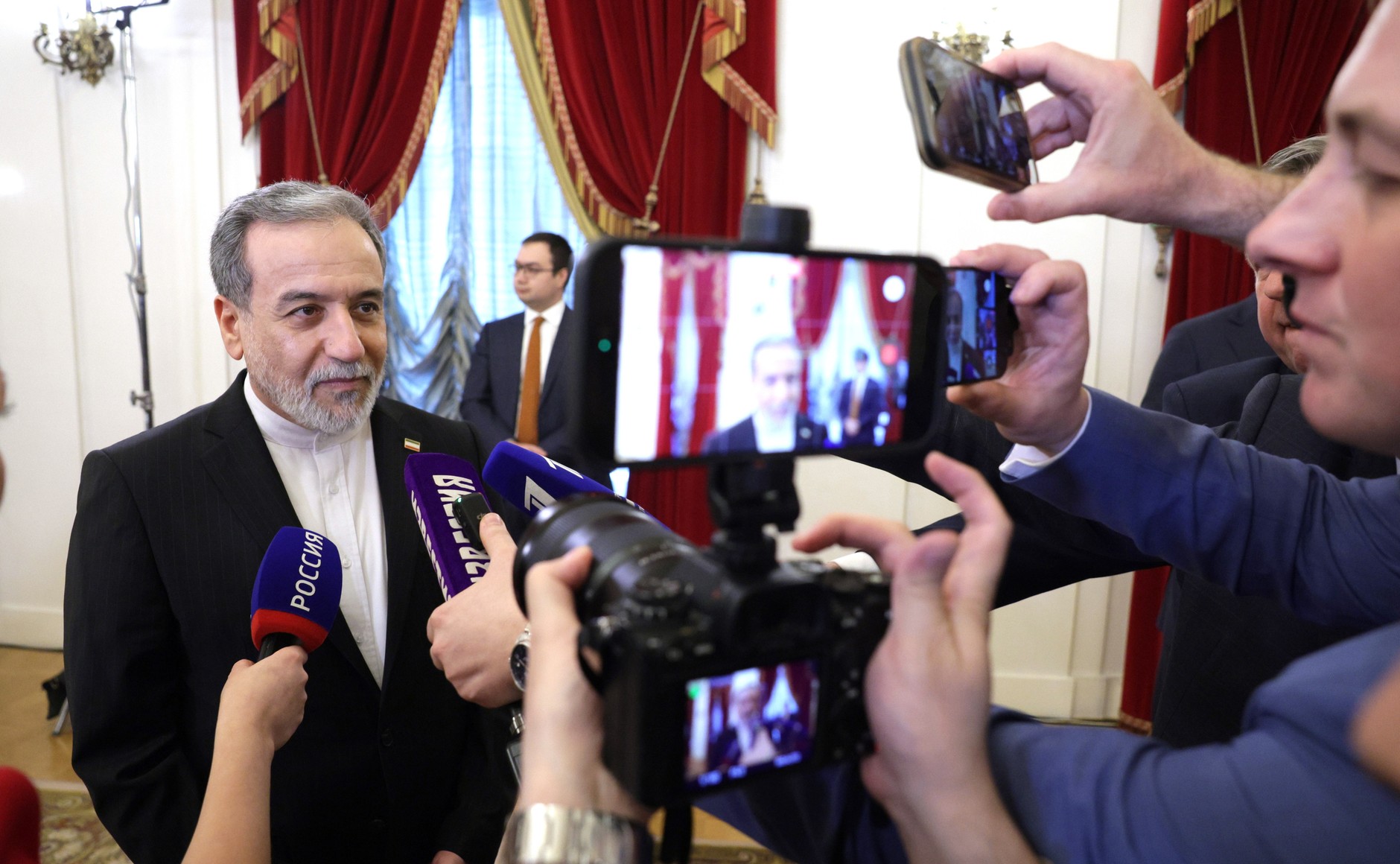
Abbas Araghchi, Iran’s foreign minister, spoke to reporters on May 15 during the BRICS foreign ministers meeting in New Delhi. His language was precise, and it mapped a negotiation that his own government’s security establishment has not publicly acknowledged.
“We have come to a conclusion with the Americans that, since it is very difficult, we are almost in a deadlock on this particular question,” he said. “Let’s postpone it to the later stages of our negotiations.”
He said Iran would not transfer enriched uranium abroad. He said trust was the central obstacle: “We cannot trust the Americans at all.” He expressed doubt about American seriousness, noting that contradictory messages from Washington had “made us reluctant about the real intentions of Americans.” He acknowledged the Russian proposal to store Iran’s uranium but deferred it: “When we come to that stage, obviously we will have more consultations with Russia and see if the Russian offer can help or not.”
Four days earlier, Iran’s foreign ministry spokesman Esmail Baghaei had offered a parallel formulation to NBC News: “At the current stage, our focus is on ending the war. Later, regarding the nuclear issue, Iran’s materials and matters related to enrichment, we will discuss those issues when the time comes.”
The Middle East briefing 3,000+ readers start their day with.
One email. Every weekday morning. Free.
These are the words of diplomats who have been negotiating — who have exchanged proposals, identified sticking points, and arrived at an impasse they can describe in detail. Araghchi knows where the deadlock sits because he has been inside the room. On May 4, the same Araghchi told Iranian lawmakers that nuclear talks with the United States were “not on the agenda.” Eleven days later, he described those same non-existent talks as having reached a deadlock.
The shift is not a contradiction. It is the difference between what a foreign minister tells parliament — where the security track monitors every phrase — and what he signals at a multilateral summit in New Delhi, where the intended audience is Washington and the Gulf states, not the SNSC.
The Silence That Functions as a Denial
No statement from Mohammad Bagher Zolghadr, Iran’s Supreme National Security Council secretary, has acknowledged the existence of American nuclear proposals. No statement from Ahmad Vahidi, the IRGC commander-in-chief appointed March 1, has addressed the terms. No statement from Mohammad Bagher Ghalibaf — the parliament speaker who sat across from Vice President Vance in Islamabad in April — has engaged with the 14-point framework the United States transmitted through Pakistani intermediaries.
The silence is the position.
When Baghaei told NBC News that nuclear issues would be discussed “when the time comes,” he was describing an institutional gate. The security track — Zolghadr, Vahidi, and the constellation of IRGC commanders who now dominate Iran’s decision architecture — has not authorized the nuclear file to be opened in a way that binds the state. The MFA can talk about the war, the ceasefire, even Hormuz. It cannot commit on enrichment, because the mandate for that commitment has not been released.
Iran International reported on May 11 that “Tehran rejects US terms as hardliners push escalation.” The same day, an unnamed Iranian source told Al Jazeera that Iran was prepared to dilute its highly enriched uranium from 60 percent to 3.7 and 20 percent levels — but only in-country, only under IAEA supervision, with no transfer abroad. One day later, Euronews reported that Iran threatened weapons-grade enrichment as peace talks faltered.
Three signals in 48 hours: rejection, conditional willingness, and escalation threat. The first came from the security track’s media ecosystem. The second came from an unnamed source — almost certainly an MFA backchannel, given that it matched Araghchi’s public language and exceeded what the security track has authorized. The third overwrote the diplomatic signal with a threat that moved in the opposite direction. The unnamed source who told Al Jazeera about Iran’s willingness to dilute HEU in-country was floating a position that Zolghadr’s SNSC has never endorsed on the record.
Who Sets Iran’s Nuclear Mandate?
Mohammad Bagher Zolghadr was appointed SNSC secretary on March 24, 2026, replacing Ali Larijani, who was killed in an Israeli airstrike on March 17. Before Larijani, the post had been held by Ali Shamkhani — killed alongside Supreme Leader Ali Khamenei on February 28 in a targeted US-Israeli strike on a Defense Council meeting in Tehran. Three SNSC secretaries in less than a month. The institutional address to which the United States has been sending nuclear proposals keeps changing occupants.
Zolghadr’s appointment was not a replacement. It was a restructuring. A career IRGC commander who founded the Ramadan Headquarters in 1984 — the predecessor organization to the Qods Force — and served as deputy IRGC commander-in-chief from 1997 to 2005, Zolghadr brought the security council under direct IRGC operational control.
Grey Dynamics, a defense intelligence consultancy, assessed in March 2026 that the appointment was aimed at “militarizing Iran’s national security strategy.” The Washington Institute’s analysis was more specific: “In any negotiation — whether over a ceasefire, maritime de-escalation, or a broader nuclear and missile framework — Zolghadr would likely be a key decisionmaker, and in some operational respects he probably will matter even more than Supreme Leader Mojtaba Khamenei.”
The Foundation for Defense of Democracies published an assessment on April 6, 2026, titled “5 Men Now Running Iran.” Among those named: Ghalibaf, Zolghadr, Vahidi, and Mohsen Rezaei. President Masoud Pezeshkian was explicitly excluded from the list. Grey Dynamics’ conclusion on Zolghadr’s gatekeeping function was direct: “Whoever is sitting at the negotiation table will have to get Zolghadr’s approval before anything passes.”
When Araghchi describes a deadlock, he is describing a negotiation he conducted. When the security track stays silent, it is exercising the authority it actually holds: the authority to acknowledge or withhold acknowledgment, to release or withhold the mandate. The deadlock Araghchi identified in New Delhi is not only between Iran and the United States. It runs through Tehran itself — between a foreign ministry that has been inside the room and a security council that controls the door.
The April 14 Walkout Established the Pattern
The mechanism was tested and confirmed in Islamabad.
On April 14, Iran’s negotiating team — led by Araghchi — was ordered to return to Tehran from Islamabad following a directive from what Iran International described as “a top security official.” The walkout ended the most direct contact between American and Iranian officials since 1979: the face-to-face meeting between Vice President Vance and parliament speaker Ghalibaf.
Zolghadr submitted a report to IRGC leadership after the walkout, citing “deviation from the delegation’s mandate” and engagement in discussions that exceeded leadership’s directives. Iran International reported the report triggered anger at the highest IRGC levels.
The sequence established a structural model that has operated continuously since. The MFA negotiates. The SNSC defines the mandate before departure. When the diplomatic track exceeds that mandate — as it did in Islamabad, where the conversation reportedly moved toward enrichment and missile limitations — the SNSC recalls the delegation and retroactively invalidates what was discussed.
Vahidi had demanded before the Islamabad round that Zolghadr be placed directly on the negotiating team. Araghchi’s side opposed this, and Zolghadr did not travel. The compromise was a monitoring arrangement: Zolghadr’s team assessed compliance with the mandate after each session. The “deviation” report was that mechanism producing its intended output.
Pezeshkian confirmed the fault line on April 4, when he publicly named Vahidi and Abdollahi as having wrecked the ceasefire process — an accusation by a sitting president against his own IRGC commander-in-chief. Nothing changed afterward. The Conversation and Asia Times reported that “with the new supreme leader apparently incapacitated and the clergy sidelined, Vahidi and his group of allies — IRGC commanders and security council hardliners such as Zolghadr — have set the mandate and red lines for the ceasefire talks.”
What happened in Islamabad in April is happening again in May. Araghchi negotiates, acknowledges a deadlock at BRICS, and describes the impasse in language that proves he has been inside the room. The security track does not dispute his account. It does something more effective: it does not acknowledge the room exists.
Why Can’t Anyone in Tehran Ratify a Nuclear Agreement?
Article 176 of the Iranian constitution is unambiguous: “The decisions of the Supreme Council for National Security shall be effective only after confirmation by the Supreme Leader.”
This is not a formality. It is a constitutional requirement that separates discussion from commitment, signaling from binding action. Every SNSC decision — on enrichment levels, on uranium disposition, on the scope of IAEA access, on Hormuz — requires ratification by the Supreme Leader before it takes legal effect.
Ali Khamenei was killed on February 28, 2026. His son Mojtaba Khamenei has been referenced as the presumed successor since early March, but he has not been publicly seen. The National reported on May 10 that Iranian officials claimed Mojtaba suffered “only a fracture” behind his ear during the February 28 strike. US and Israeli intelligence assessments shared with Gulf allies described him as incapacitated and, in some reports, unconscious, receiving treatment in Qom.
Ali Vaez of the International Crisis Group provided the most precise public assessment: Mojtaba “is not in a state where he can actually make critical decisions or micromanage the talks.” Vaez added that “the system is using him to get final approval for key broad decisions” — a description that suggests a signature function without the deliberative capacity that ratification of a nuclear agreement would require.
On May 15, PressTV published a written message attributed to the “Leader” — understood to be Mojtaba — lauding the “third sacred defence” and urging cultural figures to commemorate the war effort. The message was written, not spoken. It was broadcast through state media, not delivered in person. It addressed culture, not policy. It ratified nothing about enrichment, Hormuz, or the disposition of 440 kilograms of uranium enriched to 60 percent.
The constitutional architecture produces a double lock. The first lock: the SNSC, now under Zolghadr, must approve any nuclear commitment. The second lock: the Supreme Leader must ratify that approval. The first lock is held by a commander who voided the Islamabad round for exceeding his mandate. The second lock requires a ratifier who — 77 days after the strike that killed his father — has not appeared in public, has not spoken on camera, and has not engaged with nuclear policy in any verifiable way.
This is the structural reason the MFA can describe a deadlock inside a negotiation while the state apparatus treats the negotiation as nonexistent. Araghchi is authorized to talk. He is not authorized to conclude. And the constitutional chain that would authorize a conclusion has a gap at the top that no institutional workaround has filled.
Does Russia’s Uranium Offer Give the Security Track a Structural Exit?
In April 2026, Alexei Likhachev, head of Russia’s Rosatom, described Russia’s proposed role as including “the reprocessing of highly enriched uranium into fuel-grade uranium and the transfer of a certain amount to Russia for storage.” Likhachev positioned Russia as “the only country with positive experience cooperating with Iran” on nuclear matters — a reference to the Bushehr reactor and the fuel supply arrangements that preceded the JCPOA.
The Trump administration rejected Russia as a custody option. Axios reported in March 2026 that Washington insisted on US custody of Iran’s enriched uranium, dismissing the Russian proposal.
This rejection gave the security track an argument. If the problem the 14-point plan addresses — the disposition of Iran’s 440 kilograms of uranium enriched to 60 percent — has a third-party solution through Moscow, then Washington’s demand for US custody can be framed as a control mechanism rather than a nonproliferation imperative. The American proposal asks Iran to hand material to a country that has been bombing its nuclear facilities for eleven weeks. Russia offers to take the same material under conditions that do not require trusting Washington.
Araghchi acknowledged the Russian track in New Delhi: “When we come to that stage, obviously we will have more consultations with Russia and see if the Russian offer can help or not.” The phrasing — “when we come to that stage” — echoes Baghaei’s “when the time comes.” Both formulations defer the nuclear question to a phase the security track has not authorized and may never authorize.
The Russian offer also provides institutional cover. Iran’s security establishment is not positioned as rejecting a nuclear deal. It is positioned as having an alternative path — one that does not require submitting to American terms or acknowledging American proposals. The silence toward Washington coexists with an open channel toward Moscow. For Zolghadr, the Russian offer makes it possible to avoid engaging with the 14-point framework without appearing to have foreclosed diplomacy entirely.
Trump’s Own Authorization Ceiling
Iran is not the only government where the person at the negotiating table cannot guarantee what the person above him will accept.
On May 14, fifty-two Republican senators — every member of the caucus except Rand Paul — joined 177 House Republicans in a letter to Trump. The letter, led by Senator Pete Ricketts and Representative August Pfluger, demanded that any agreement require Iran to “give up any capacity for enrichment.” Their reasoning: “The scope and breadth of Iran’s nuclear buildout have made it impossible to verify any new deal that allows Iran to continue enriching uranium.”
One day later, speaking to reporters aboard Air Force One departing Beijing, Trump conceded ground his own party had just told him not to give. He said he would accept a 20-year enrichment suspension — a retreat from his earlier demand for a permanent halt. “No, 20 years is enough,” he said. “But the level of guarantee from them is not enough.”
He described the uranium buried beneath bombed Iranian nuclear sites as a non-negotiable element: “We have to get everything. I call it the nuclear dust.” He said Iran had initially agreed to uranium removal but then withdrew consent. His approach to Iranian counterproposals was dismissive: “If they have any nuclear of any form, I don’t read the rest of their letter.” And: “I looked at it, and if I don’t like the first sentence, I just throw it away.”
The Arms Control Association assessed in April 2026 that “U.S. Negotiators Were Ill-Prepared for Serious Nuclear Talks With Iran.” The gap between Trump’s 20-year freeze and his own party’s demand for zero enrichment is a version of the same structural problem Tehran faces: the negotiator’s position and the authorization ceiling above him do not align. If Iran’s security track reads the American domestic situation — and the 52-senator letter is not a classified document — it can reasonably conclude that Trump cannot deliver congressional support for any deal that permits enrichment, making the 14-point proposal structurally undeliverable on the American side.
Jane Darby Menton and Mohammad Ayatollahi Tabaar of the Carnegie Endowment wrote in May 2026 that “Tehran may conclude that its ability to disrupt the global economy via the Strait of Hormuz provides enough deterrence to begin quietly rebuilding its nuclear program.” If the Iranian reading is that Trump’s proposal cannot survive his own Senate — and there is a 52-to-1 letter on the record supporting that reading — then the security track’s decision not to engage is not irrational. It is a judgment that the offer cannot be fulfilled.
What Happens When Neither Side Can Formally Accept?
The 14-point framework transmitted to Iran demands: a halt to all enrichment for at least 12 years, handover of approximately 440 kilograms of uranium enriched to 60 percent, IAEA supervision of remaining facilities, gradual sanctions lifting, and the reopening of the Strait of Hormuz within 30 days of signing.
Iran’s counter-position, as reconstructed from backchannel signals and Araghchi’s public language: dilution of HEU to 3.7 and 20 percent levels in-country, continued enrichment under IAEA monitoring, no transfer of nuclear material abroad. The gap between “hand over your uranium” and “we will dilute it ourselves” is not a negotiating distance. It is a structural incompatibility between what Washington demands as a precondition and what Tehran’s security track has defined as a red line.
On May 12 — the same week Iran’s unnamed source signaled willingness to dilute — Iran also threatened weapons-grade enrichment, a signal directed at its domestic security audience rather than at Washington. Trump called the ceasefire “on massive life support” on May 10 and rejected Iran’s counterproposal as “TOTALLY UNACCEPTABLE.” Upon returning from Beijing on May 16 with no breakthrough, he warned that Iran would “have a very bad time” — language CNN reported was accompanied by active consideration of renewed military strikes.
Pakistan continues to function as the intermediary. Interior Minister Mohsin Naqvi was in Tehran on May 16. Araghchi described the mediation as “on a very difficult course.” The Pakistani channel has operated since the April Islamabad round, though its effectiveness is constrained by the same problem it is being asked to solve: the person on the Iranian side who receives the message is not the person who decides whether to accept it.
The structural problem is that neither government’s negotiating representative can constitutionally bind what he brings back to the table. Iran’s foreign minister describes a deadlock he has encountered, but the security council secretary who holds the mandate did not authorize the conversation that produced it. America’s president proposes a 20-year freeze, but 229 members of his own party have told him in writing that any freeze is unacceptable.
What remains is a negotiation conducted by two diplomats who can describe where the impasse sits but who cannot close the gap — because the authorization to close it sits above both of them, and in both capitals, that authorization is either absent or contested. The military balance continues to evolve while the diplomatic architecture stalls. The ceasefire depends on a deal that neither side’s negotiator has the constitutional authority to deliver. Araghchi can describe the deadlock because he was in the room. The room is real. The authority to resolve what happened inside it is not.
Frequently Asked Questions
What is the US 14-point nuclear proposal to Iran?
The framework, transmitted through Pakistani intermediaries in early May 2026, demands Iran halt all uranium enrichment for at least 12 years, hand over approximately 440 kilograms of uranium enriched to 60 percent, accept IAEA supervision of remaining nuclear facilities, and reopen the Strait of Hormuz within 30 days of signing. In return, the United States would gradually lift sanctions and release frozen Iranian assets. Trump initially demanded a permanent enrichment halt but shifted to a 20-year suspension on May 15, telling reporters aboard Air Force One: “No, 20 years is enough. But the level of guarantee from them is not enough.” The shift placed him in direct tension with the 52 Republican senators who had demanded — one day earlier — zero enrichment capacity.
Who is Mohammad Bagher Zolghadr and why does he matter for nuclear talks?
Zolghadr was appointed secretary of Iran’s Supreme National Security Council on March 24, 2026, replacing Ali Larijani, killed in an Israeli airstrike a week earlier. A career IRGC commander who founded the predecessor to the Qods Force in 1984, Zolghadr has transformed the SNSC from a coordinating body into an operational extension of IRGC authority. The Washington Institute assessed that in nuclear negotiations, Zolghadr “probably will matter even more than Supreme Leader Mojtaba Khamenei.” After the Islamabad talks in April, Zolghadr submitted a report accusing Iran’s diplomatic team of “deviation from the delegation’s mandate” — the mechanism by which the security track overrode what Araghchi had negotiated. He holds US sanctions and an INTERPOL connection through his decades of IRGC service, including command roles during the Iran-Iraq War and as deputy commander-in-chief under Mohsen Rezaei.
Why does Article 176 of Iran’s constitution matter for nuclear negotiations?
Article 176 stipulates that all SNSC decisions are “effective only after confirmation by the Supreme Leader.” This is not a formality — it separates discussion from binding commitment. With Ali Khamenei killed on February 28 and Mojtaba Khamenei reportedly incapacitated, the requirement creates a ratification vacuum that institutional workarounds can manage for routine security decisions but likely cannot bridge for a nuclear agreement with the United States. A ceasefire extension or a maritime deconfliction protocol is a different order of commitment than surrendering 440 kilograms of enriched uranium and permitting IAEA access to surviving facilities. The constitutional gap is not just about incapacity; it is about the magnitude of what requires ratification.
Why did Russia offer to take Iran’s enriched uranium, and what happened to the offer?
Rosatom head Alexei Likhachev proposed in April 2026 that Russia would reprocess Iran’s highly enriched uranium into fuel-grade material and store a portion in Russia, citing Moscow as “the only country with positive experience cooperating with Iran.” The Trump administration rejected Russian custody in March, insisting only the United States could hold the material. For Iran’s security track, the Russian offer provides a third path that does not require acknowledging Washington’s 14-point plan — a way to appear open to uranium disposition without engaging with American terms. Araghchi referenced the offer in New Delhi, saying consultations with Moscow would happen “when we come to that stage.” The refusal of Russian custody also exposes a tension in the US position: if the goal is nonproliferation, Russia’s proposal addresses the material; if the goal is control, only US custody achieves it.
How does the April 14 Islamabad walkout relate to the current nuclear impasse?
The Islamabad walkout established the operational model: the MFA can enter talks, but the SNSC defines the mandate and voids whatever exceeds it. Zolghadr’s “deviation” report — accusing Araghchi’s team of engaging on enrichment and missile topics beyond what leadership authorized — became the formal mechanism for retroactively invalidating what was negotiated. The May posture is an evolved version of the same logic. In April, the security track recalled a delegation that had already engaged and then audited it. In May, it has not released a mandate at all, which is cleaner: there is nothing to audit, no deviation to document, and no record of engagement that might later be treated as a concession. The Pentagon has applied comparable logic to its own authorisation problem: renaming the air campaign as Operation Sledgehammer to reset the 60-day War Powers clock, with the Saudi basing veto as the unresolved constraint that determines whether the new clock means anything. That analysis is in Operation Sledgehammer Is a War Powers Clock-Reset. The Saudi Veto Is What Decides Whether It Runs.