
JEDDAH — India’s last Hajj charter flight departs today, May 19, closing the outbound airlift for 175,025 Indian pilgrims — while Indonesia’s final departure, carrying the last of 221,000 pilgrims on 548 flights, is scheduled for May 21. More than 860,000 foreign pilgrims are now inside Saudi Arabia, according to Hajj Minister Tawfiq Al-Rabiah, with no dedicated evacuation fleet, no published emergency-extraction plan, and a nine-day scheduling gap between the last inbound flight and the first return service on May 30 — a gap that covers the Day of Arafah on May 26, when up to 1.5 million people will stand from dawn to sunset on an open, unsheltered plain 20 kilometres east of Mecca.
The airlift closure collides with two other timelines that should concern every pilgrim inside the kingdom. President Trump confirmed Sunday that a “very major attack” on Iran, scheduled for today, was called off at the request of Saudi Crown Prince Mohammed bin Salman, UAE President Mohamed bin Zayed, and Qatar’s Emir Tamim — who told Trump a deal was “two to three days away,” according to ms.now and the Philadelphia Inquirer. That two-to-three-day window expires on May 20–21 — the same 48-hour period in which Indonesia’s airlift closes and Saudi Arabia’s inbound aviation infrastructure shuts down entirely.
Table of Contents
India Closes Today, Indonesia Closes Wednesday
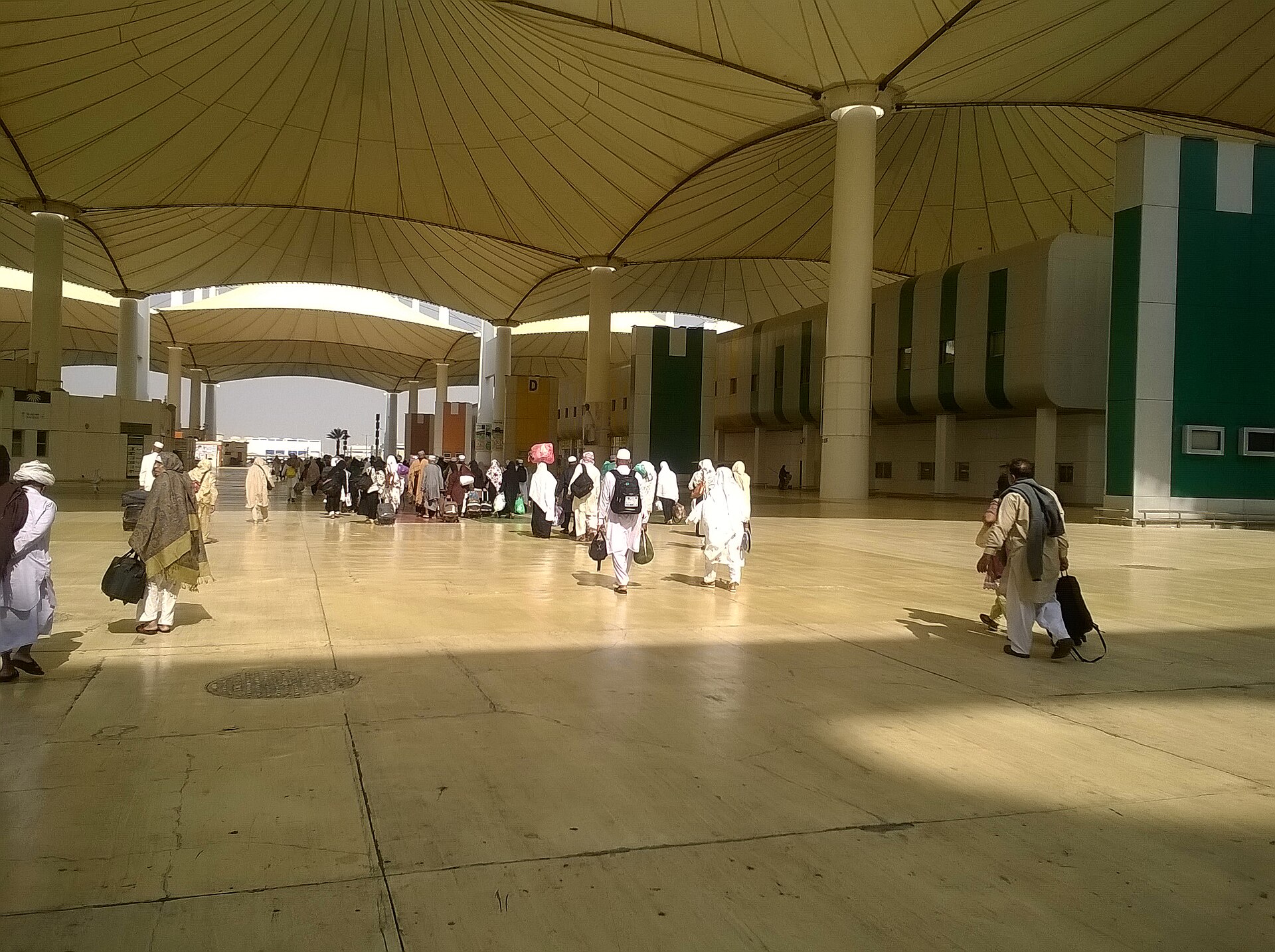
India’s Hajj airlift ran in two phases: Madinah-bound flights from April 18 to May 4, and Jeddah-bound flights from May 5 to today, May 19, according to the Haj Committee of India. All 175,025 Indian pilgrims allocated under the 2026 quota will be inside Saudi Arabia by tonight. India operates the second-largest single-country airlift after Indonesia, and its closure today removes one of the two remaining major inbound pipelines.
Indonesia’s airlift — the largest national Hajj operation in the world — follows an identical two-phase structure: Madinah flights from April 22 to May 6, then Jeddah flights from May 7 to May 21, with 221,000 pilgrims transported on 548 flights operated by Garuda Indonesia and Mukhtara Air, according to Wego Travel Blog and Hajj Reporters. Garuda alone is carrying 102,502 pilgrims on 15 wide-body aircraft — A330s and Boeing 777s — according to VOI.
Pakistan’s airlift of 179,210 pilgrims across 202 flights — operated by PIA, Airblue, AirSial, and Saudia — began April 18 and has largely completed, according to Hajj Reporters. By Wednesday night, the entire international inbound airlift will have run its course, and return flights do not begin until May 30.
The Nine-Day Gap Between Last Arrival and First Departure
Between May 21 and May 30, Saudi Arabia’s Hajj aviation infrastructure enters what amounts to a structural dead zone — the inbound phase finished, the outbound phase not yet started, and the 3.1 million seats across 12,000-plus flights that carried pilgrims in not staged for emergency extraction. That 3.1 million figure covers both directions over roughly 66 operational days — an average daily throughput of approximately 47,000 seats, a fraction of what would be needed to move more than a million people under emergency conditions.
The Middle East briefing 3,000+ readers start their day with.
One email. Every weekday morning. Free.
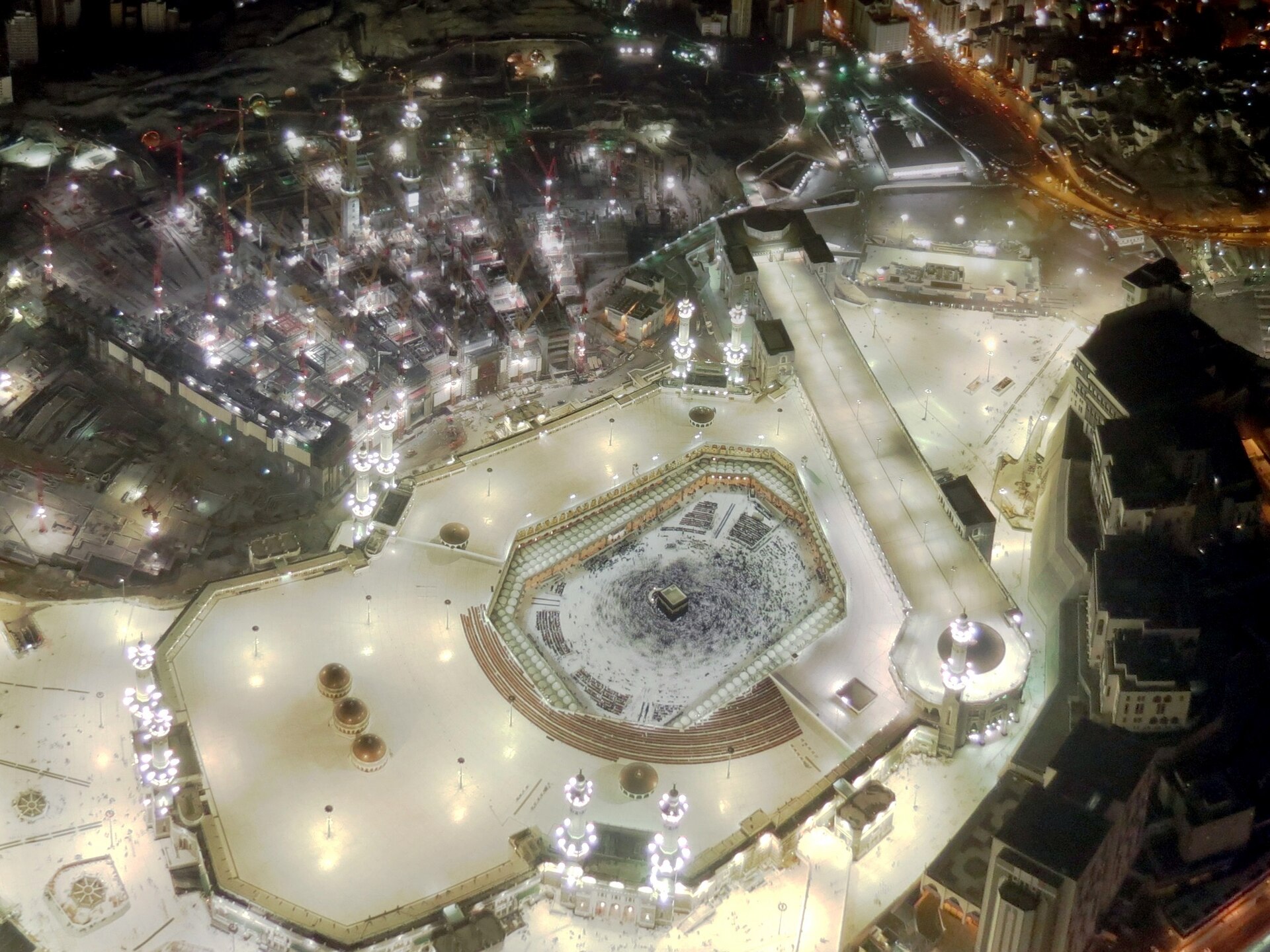
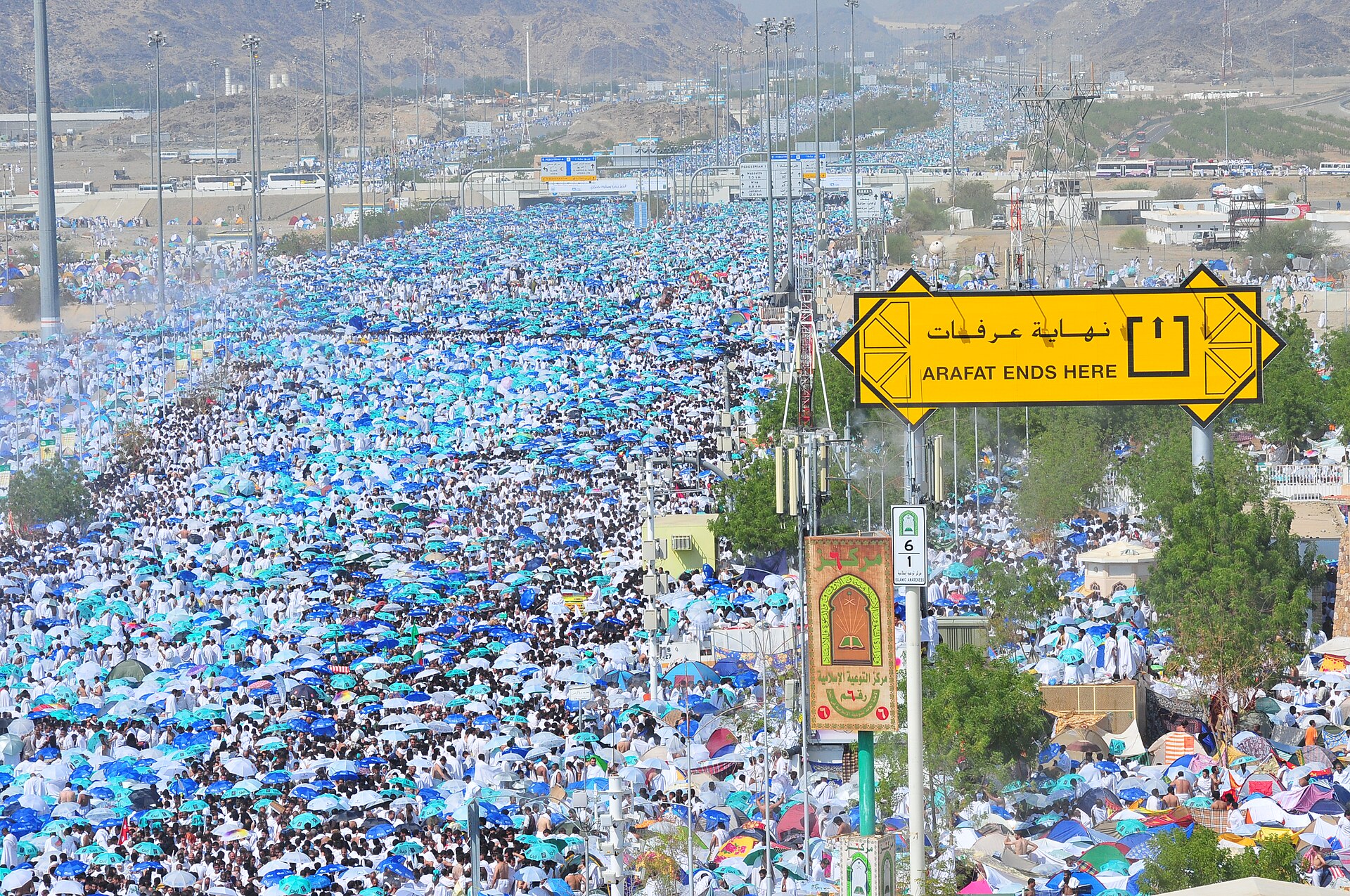
The Day of Arafah falls squarely inside this nine-day window, its date confirmed by the Saudi Supreme Court’s moon sighting on May 18. The wuquf, the standing at Arafat, is the single obligatory ritual without which the entire Hajj is invalid — it cannot be moved, rescheduled, or relocated to a safer site. Between 1.2 and 1.5 million pilgrims will stand from dawn to sunset on an open, barren plain with no hardened shelter above them and approximately 400 PAC-3 MSE interceptor rounds — roughly 14 per cent of Saudi Arabia’s pre-war stockpile of 2,800 — providing the only missile defence umbrella, with no resupply possible before Hajj under the Pentagon’s existing Lockheed Martin contract.
No Saudi official has publicly quantified emergency evacuation capacity for this period, according to a review of GACA, Ministry of Hajj, and Saudi Press Agency statements through May 18. None of the Kingdom’s published operational plans address the scenario of extracting pilgrims under fire, and the gap between what Saudi Arabia has prepared for and what the threat environment demands has only widened since April.
Can Saudi Arabia Evacuate 1.5 Million Pilgrims?
The short answer, based on publicly available logistics, is no — not at the speed a military escalation would demand. The Saudia fleet dedicated to Hajj comprises 160 aircraft serving 145 destinations, according to Travel and Tour World, and Flynas is transporting 147,000 pilgrims from 20 destinations. But this fleet is configured for the scheduled return phase beginning May 30, not emergency extraction — and each aircraft cycle of loading, flying, unloading, and repositioning requires hours per sortie even to nearby destinations.
Other countries have built their own contingencies precisely because Saudi Arabia has not announced one. Pakistan’s Religious Affairs Minister Sardar Muhammad Yousaf confirmed that Islamabad has developed an emergency airlift plan “in tandem with Saudi officials,” according to Arab News, though he did not specify how many aircraft Pakistan could deploy or how quickly they could reach Jeddah. Indonesia’s Hajj Minister Mochamad Irfan Yusuf told the DPR — parliament — that Jakarta has prepared three scenarios, including rerouting all charter flights via the southern Indian Ocean and East African airspace to avoid Iraqi, Syrian, Iranian, Israeli, UAE, and Qatari airspace entirely — a detour that would add hours to each flight and increase fuel costs substantially, according to ANTARA News.
“The main principle in preparing these scenarios is to ensure the safety and security of Indonesian pilgrims as the highest priority.”Mochamad Irfan Yusuf, Indonesian Minister of Hajj and Umrah, to the DPR
Indonesia’s worst-case scenario — Scenario 3 — involves Saudi Arabia cancelling Hajj operations entirely, at which point Jakarta would seek full refunds for all accommodation, catering, and transport already paid. The fact that this scenario exists in an official government document presented to parliament reflects a level of institutional anxiety that Saudi Arabia’s public communications have conspicuously not matched. Irfan Yusuf’s assurance that the schedule “remains on track despite rising tensions” was delivered in the same session where he acknowledged the government was “assessing several scenarios to ensure the safety of Indonesian pilgrims should the regional conflict escalate and affect flight corridors” — two statements that, taken together, describe a government hedging a bet it cannot control.
How Does Trump’s ‘2-3 Day’ Deal Window Fit?
Trump confirmed Sunday that he had received requests from MBS, MBZ, and Tamim “to hold off on our planned Military attack of the Islamic Republic of Iran, which was scheduled for tomorrow, in that serious negotiations are now taking place,” according to Bloomberg and the Washington Times. Trump added: “We had a very major attack, we put it off for a little while, hopefully maybe forever.”
The “two to three days” that the Gulf leaders cited as the timeline for a deal puts the expiry on May 20–21, as House of Saud reported Sunday. May 21 is the same day Indonesia’s airlift closes — the last day any large-scale inbound aviation operates. If the deal materialises, the airlift closure becomes irrelevant and pilgrims proceed to Hajj under whatever security framework exists. If it does not, the strike Trump postponed returns to the table on the same day the last inbound flight lands, and Saudi Arabia’s aviation infrastructure transitions from arrival mode to nine days of silence.
The structural problem for MBS is that the diplomatic window he helped create does not run against the military clock — it runs into the logistical one. A deal that collapses on May 21 does not give Saudi Arabia time to extract anyone, because no evacuation flights exist until May 30. The Custodian commitment, as House of Saud reported in April, is not a political position MBS can hedge — it is the foundational legitimacy claim of the Saudi monarchy, adopted by King Fahd on October 27, 1986, and it makes the king personally responsible for every Muslim who undertakes the pilgrimage.
What Barakah Revealed About the Ceasefire
Two days before Trump’s cancelled strike — on May 17 — three drones entered UAE airspace from the western border and targeted the Barakah Nuclear Energy Plant in the Al Dhafra region, according to Al Jazeera and The National. Two were intercepted by air defences, but one breached the outer perimeter and ignited an electrical generator fire. Radiation levels remained normal and no injuries were reported, while UAE Deputy Prime Minister Sheikh Abdullah bin Zayed condemned what he called a “treacherous terrorist attack” — though no group claimed responsibility.
The strike on the Arabian Peninsula’s only operational nuclear power plant demonstrated that the ceasefire framework, whatever its diplomatic value, does not prevent kinetic operations against civilian infrastructure, as House of Saud reported. Barakah sits approximately 750 kilometres from Mecca — well within the demonstrated range of Iranian-affiliated drone systems that have struck targets at distances exceeding 1,000 kilometres throughout this conflict. The distance is not theoretical; it is operational, and the ceasefire did not stop it.
The US Overseas Security Advisory Council issued a Level 3 “Reconsider Travel” advisory against Hajj 2026 participation on April 7, citing “regional missile activity, air-defence saturation, and unresolved ceasefire status.” That assessment was made six weeks before Barakah was struck, and the ceasefire has become measurably more porous in the interval.
Iran’s 30,000 Pilgrims and the Broken Deterrence Logic
In 1987, 402 people — 275 Iranian pilgrims, 85 Saudi security personnel, and 42 of other nationalities — were killed after Saudi forces cordoned an Iranian political demonstration inside the Grand Mosque, according to contemporaneous wire agency reporting. The aftermath severed Iran-Saudi diplomatic relations, barred Iranian pilgrims for four years, and cut Iran’s quota by 87 per cent when access was restored in 1991. That incident cemented a logic that had held for decades: Iranian pilgrims inside Mecca gave Tehran a structural reason to protect the holy sites from military action, because its own citizens were there.
In 2026, that logic is structurally weakened. Iran dispatched approximately 30,000 pilgrims for Hajj — only 34 per cent of its official quota of 87,550 — with the dispatch explicitly authorised under “the command, approval, and viewpoint” of Ayatollah Mojtaba Khamenei, according to Tasnim News Agency. Iran and Saudi Arabia signed a formal Hajj 2026 organisational agreement between Alireza Rashidian of Iran’s Hajj and Pilgrimage Organisation and Saudi Hajj Minister Al-Rabiah — but this agreement contains no enforcement mechanism and no ceasefire clause covering holy sites specifically, establishing a diplomatic track entirely separated from the IRGC’s military operations. A detailed analysis of what 30,000 Iranian nationals inside the Kingdom means for the war’s deterrence calculus is available in Iran Has 30,000 Nationals Inside Saudi Arabia. The Hajj Deterrence Logic Has Reversed.
The IRGC’s command structure has been operating without a named Navy commander since Tangsiri was killed on March 30 — 50 days without a public successor. President Pezeshkian publicly named IRGC Commander-in-Chief Vahidi and Khatam al-Anbiya commander Abdollahi as the officials who “deviated from the delegation’s mandate” and wrecked the Islamabad ceasefire, as House of Saud reported in April. Under Article 110 of the Iranian constitution, Pezeshkian has zero authority over the IRGC — and no IRGC official has explicitly designated Hajj sites as targets, but no IRGC official claimed the Barakah strike either.
Mohammad Hassan Rahimian, the Supreme Leader’s representative for Iran at Hajj, told Tasnim on April 8 that the ceasefire agreement demonstrated “the historical and unique greatness of Iran” — a diplomatic formulation that made no reference to the IRGC’s ongoing operations. The gap between Iran’s diplomatic posture and its military operations has never been tested with 30,000 Iranian nationals inside a potential target zone and a decentralised military command structure that may not consult the diplomatic track before acting.
The Custodian’s obligation
MBS asked Trump to stand down, and Trump stood down — but the standing-down does not change the structural position. The pilgrims are inside Saudi Arabia, with more arriving until Wednesday, and the aviation infrastructure that brought them in will not be configured to take them out for nine days. During those nine days — seven of which count down to the Day of Arafah — MBS’s Custodian obligation transforms from a political commitment into a physical fact, because he cannot evacuate them even if he wants to.
Pakistan has an emergency plan and Indonesia has three contingency scenarios, but Saudi Arabia has 46,000 staff deployed for crowd control and a return-phase fleet that does not activate for nine more days. The Custodian of the Two Holy Mosques holds a title that was designed to answer questions of sovereignty, not logistics — and this week, the logistics are the sovereignty.
FAQ
Has Saudi Arabia ever suspended Hajj?
Yes — at least 40 times across Islamic history, including for plague, political instability, and armed conflict. Most recently, Saudi Arabia reduced Hajj to approximately 1,000 domestic residents in 2020 during the COVID-19 pandemic, expanded to 60,000 domestic pilgrims in 2021, and restored international participation in 2022 with one million pilgrims. None of these cancellations or reductions occurred during an active state-to-state war involving the kingdom itself, with foreign pilgrims already inside the country when military operations were ongoing — the scenario Saudi Arabia faces this week.
What ground evacuation routes exist if airspace closes?
The Haramain High-Speed Railway connects Mecca, Medina, and Jeddah with 2.21 million seat-capacity allocated for this Hajj season. Road routes lead to Jeddah Islamic Port on the Red Sea and south toward the Yemeni border. The King Fahd Causeway connects Saudi Arabia’s Eastern Province to Bahrain, but Bahraini airspace has been closed since February 28 and the causeway itself appeared on an IRGC counter-target list published in April. Ground routes would be subject to the same missile and drone threats that necessitated evacuation — Iran has struck Saudi pipeline corridors, highway infrastructure, and the Ras Tanura oil complex during this conflict.
What insurance coverage do Hajj 2026 pilgrims carry?
Standard Hajj travel insurance policies exclude acts of war, terrorism, and civil unrest. Khaleej Times reported heavy premium surcharges for 2026 Hajj policies, reflecting underwriter anxiety about the conflict. Most national Hajj committees provide basic medical and repatriation coverage, but none have publicly confirmed that their policies extend to war-zone evacuation scenarios — creating a gap between the coverage pilgrims believe they have and the coverage that would actually apply if airspace closed.
How has Saudi Arabia handled mass-casualty events at previous pilgrimages?
The 2015 Mina stampede killed at least 2,400 pilgrims according to Associated Press counts, though Saudi Arabia’s official figure was 769. In 2024, more than 1,300 pilgrims died from heat-related illness when temperatures exceeded 51°C at the holy sites. Both events occurred during peacetime with full aviation infrastructure operational, and neither required mass evacuation — surviving pilgrims completed their rituals and departed on scheduled flights. A wartime scenario requiring simultaneous extraction from the Mecca-Medina-Jeddah corridor would be without precedent in the kingdom’s history.
How many days of missile defence does Saudi Arabia’s current stockpile provide?
At the expenditure rates seen during the heaviest Iranian bombardments in March — when Saudi defences were firing multiple interceptors per day (at peak operations) — the approximately 400 remaining PAC-3 MSE rounds would last one to two weeks of sustained attack. The Pentagon’s $4.76 billion Lockheed Martin PAC-3 MSE production contract runs through June 30, 2030, but production timelines mean no resupply is possible before Hajj concludes in late May. The pre-war stockpile of 2,800 rounds was depleted by 86 per cent between March 3 and early April.