
RIYADH — Saudi Arabia has, for the first time since the 2023 Beijing rapprochement, publicly accused Iran of bearing responsibility for the Houthi campaign against the kingdom. Deputy Minister for Public Diplomacy Rayed Krimly told journalists on 15 October that the escalation “is encouraged by Iran” and that Tehran is acting “in violation of its commitments in the Beijing agreement,” according to the AP. The accusation shifts Saudi diplomatic posture from treating the Houthis as an autonomous insurgency to treating them as an extension of Iranian state policy — a category change with consequences under international law, within the Makkah Defence Agreement coalition, and in every capital where Riyadh is requesting military support.
That shift has not been matched by any partner. The UN Security Council’s presidential statement of the same day affirmed Saudi Arabia’s right to self-defence but did not name Iran. A joint condemnation issued four days earlier by Saudi Arabia, Egypt, Pakistan and Turkey named the Houthis, not Tehran. Iran’s foreign ministry rejected the charge on 17 October, calling it “not credible to those familiar with relations between Iran and its friends.”
Table of Contents
- What Krimly Said — and What He Chose Not To
- Why Did Saudi Arabia Break the Proxy Frame Now?
- The First Public Breach of the Beijing Agreement
- Does International Law Support the Attribution?
- What Did Saudi Arabia’s Allies Actually Say?
- Iran’s Counter — Deny the Role, Offer the Mediation
- How the Houthis Undermined Their Patron’s Case
- What Can the Accusation Produce Before 3 November?
- Frequently Asked Questions
What Krimly Said — and What He Chose Not To
Krimly’s briefing was described by Middle East Eye as “a rare public statement” and “the first public sign that the Yemen war is straining Riyadh’s ties with Tehran.” In it, he said Iran “continues to arm, train and support the Houthi militia in violation of relevant U.N. Security Council resolutions” and is acting “in violation of its commitments in the Beijing agreement.” He widened the attribution further, suggesting that “at least elements in Russia or China” may be supplying capabilities or intelligence to Iran and the Houthis.
The verb he chose was “encouraged.” Not “directed,” not “ordered,” not “controlled.” That distinction — between encouragement and direction — carries legal weight that extends well beyond a press conference, as the section on international law below examines. Krimly was accusing Iran of a relationship with the Houthis that every Western intelligence service and multiple UN panels of experts have already documented. The content of the accusation was not new. A Saudi official saying it on the record, under his own name, and framing it as a breach of the Beijing deal — that was new.
He also closed two diplomatic doors in the same briefing. Saudi Arabia “has not asked Iran to mediate,” he said — a direct rebuff of foreign minister Abbas Araghchi’s October offer to “facilitate dialogue” between Riyadh and the Houthis. The Oman channel, Krimly clarified, involves “a facilitator of these talks and not as a mediator.” He added that Riyadh had invited the Houthis to Muscat at the start of the current tensions and that they had declined.
Why Did Saudi Arabia Break the Proxy Frame Now?
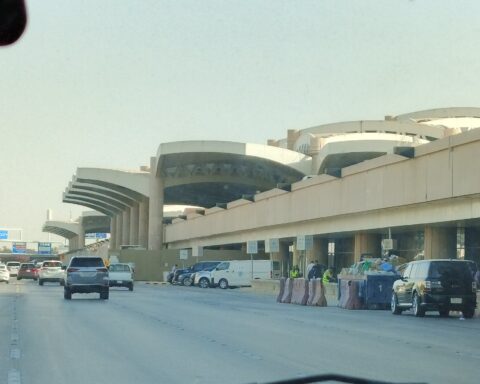
Saudi Arabia’s public accusation followed the deadliest stretch of Houthi strikes against the kingdom. A coalition spokesperson told the AP that twenty attacks hit King Khalid International Airport in October alone, killing at least nineteen people including foreign nationals. Two direct appeals from Crown Prince Mohammed bin Salman to President Trump for US strikes on the Houthis were declined, CNN reported on 10 October.
The Middle East briefing 3,000+ readers start their day with.
One email. Every weekday morning. Free.
The single deadliest attack came on 10 October, when a strike on King Khalid International Airport killed twelve people and wounded 309, Al Jazeera reported; the BBC put the injured at 308. An Indian victim’s death the following day raised the toll to thirteen. Secretary of State Rubio confirmed that a US citizen was among the dead, CBS News reported. On 11 October a projectile struck Terminal 4, killing a Pakistani resident and injuring eleven, and Dammam airport was attacked the same day, according to CNN.
Under the old framing, the conflict was a Saudi-Houthi war in which Iran played an acknowledged but undefined supporting role. That construction had served all parties. Riyadh could pursue its Yemen campaign without invoking the far more dangerous language of inter-state war with a nuclear-threshold power. Tehran could arm, train and advise the Houthis while maintaining the legal position that it was not a party to the conflict. The UN system could sanction the Houthis — as it did under Resolution 2216 in 2015 — without confronting a state shielded by permanent-member vetoes.
The October 2026 strikes broke that equilibrium. The escalation from scattered military targets to sustained strikes on civilian infrastructure — airports, the Aramco headquarters in Dhahran, a cruise missile over Madinah — changed what Saudi Arabia needed from its partners. Air defence reinforcement against Houthi drones and missiles was one category of assistance. Confronting the state that Riyadh now says is encouraging the campaign was another, and the proxy frame foreclosed it.
Prince Khalid bin Salman, the defence minister, had edged toward the new language on 5 October, announcing that the Makkah Defence Agreement committee had agreed to “activate collective deterrence measures… in response to the attacks and all those responsible for them,” Al Jazeera reported. The phrase “all those responsible” — not “the Houthis” — left room for Tehran without naming it. Krimly, ten days later, named it.
The First Public Breach of the Beijing Agreement
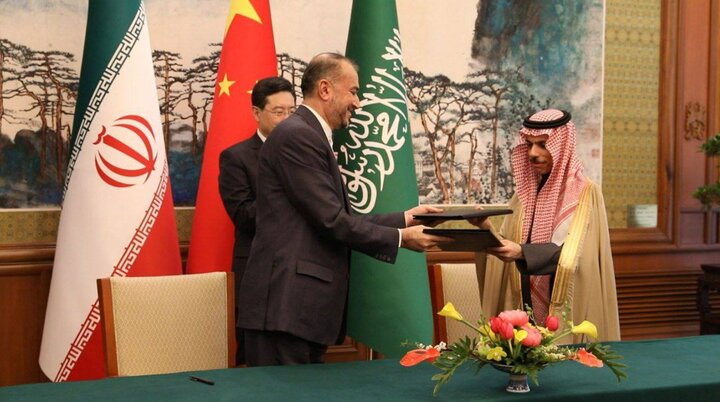
China brokered the restoration of Saudi-Iranian diplomatic ties in March 2023, ending a seven-year rupture. The deal was understood — by diplomats, analysts and the Chinese government — to carry implicit commitments from Tehran to restrain the Houthis and reduce tensions in Yemen. No public text of the agreement has been released, and the specific obligations it imposed on either side remain a matter of interpretation rather than documented record.
Krimly’s accusation that Iran is acting “in violation of its commitments in the Beijing agreement” is, according to Middle East Eye, the first time Riyadh has publicly declared the deal breached. The Saudi-Iranian relationship had already deteriorated sharply by that point. Saudi Arabia declared Iran’s military attaché and embassy staff persona non grata in March 2026, giving them 24 hours to leave, Qatar Tribune reported, after Iranian retaliatory attacks struck Saudi territory during the broader US-Iran war. But Riyadh did not, at that stage, publicly repudiate the Beijing framework or accuse Tehran of violating it. The framework, however frayed, remained nominally intact.
The speed of the collapse is instructive. In January 2026, the crown prince told Iran’s President Pezeshkian by phone that Saudi Arabia “will not allow its airspace or its territory to be used for any military actions against” Iran, The News reported. By March, the kingdom had expelled Iran’s diplomatic staff with 24 hours’ notice. By October, Krimly was declaring the Beijing agreement breached.
The October accusation ended that ambiguity. By naming Iran’s support for the Houthis as a violation of the agreement that restored their diplomatic ties, Krimly declared the central premise of the 2023 reconciliation — that Iran would use its influence to reduce Houthi violence — to be broken. His suggestion, noted above, that complicity may extend to the country that brokered the agreement was the sharpest element of the briefing.
Does International Law Support the Attribution?
Under the International Law Commission’s 2001 Articles on State Responsibility, attributing one state’s conduct to another requires evidence that the sponsor gave “instructions, directed or controlled” specific operations — the Article 8 standard that legal scholars refer to as “effective control.” Krimly’s language of “backing and encouraging” describes a pattern of support but does not assert the level of operational direction the law requires for formal state responsibility.
The distinction is not academic. If Riyadh were to bring a state-responsibility claim against Iran before the International Court of Justice, or seek a Security Council resolution holding Iran directly liable, the evidentiary threshold would be higher than what Krimly’s public language establishes. The US Naval War College’s International Law Studies journal has analysed this standard at length: effective control requires showing that the sponsor directed or controlled specific operations, not merely that it provided weapons and training. Saudi Arabia may possess intelligence that meets the standard. Nothing in Krimly’s briefing precludes that. But his public formulation was calibrated below it.
The UN Security Council’s response on 15 October (S/PRST/2026/4) reflects that gap. The presidential statement affirmed Saudi Arabia’s “inherent right to self-defence in accordance with international law” and condemned the Houthi attacks. It did not mention Iran. Saudi Arabia’s foreign ministry welcomed the statement and said the kingdom “reserved the right to take all necessary measures to defend its security and protect its territory,” Arab News reported. The right was affirmed. The question of what defends Saudi Arabia — and against whom — remains a separate and more difficult conversation.
What Did Saudi Arabia’s Allies Actually Say?
None of Saudi Arabia’s major partners has publicly endorsed the attribution of the Houthi campaign to Iran. A joint condemnation issued on 11 October by Saudi Arabia, Egypt, Pakistan and Turkey named the Houthis, not Tehran, as the responsible party, CBS News reported. The Makkah Defence Agreement, invoked in the weeks prior, names no adversary in its published summary.
The table below maps the language each actor used and whether it named Iran.
| Actor | Date | Named Iran? | Language used |
|---|---|---|---|
| Joint statement (Saudi Arabia, Egypt, Pakistan, Turkey) | 11 Oct | No | Condemned “Houthi” attacks on the kingdom |
| UN Security Council (S/PRST/2026/4) | 15 Oct | No | Affirmed Saudi right to self-defence; condemned Houthi attacks |
| Krimly briefing (Saudi MFA) | 15 Oct | Yes | “Encouraged by Iran”; Beijing agreement violated |
| Saudi foreign ministry response | 15 Oct | No | “Reserved the right to take all necessary measures” |
| Iran MFA (Baqaei) | 17 Oct | N/A | “Yemen’s armed forces act according to their own interests” |
| Makkah Defence Agreement | Sep 2026 | No | Names no adversary in published summary |
The gap between Krimly’s statement and the coalition’s own documents is worth examining. The Washington Times reported on 24 September that Makkah pact partners have “little appetite” for joining a broader war against Iran. Turkey’s parliament has not ratified the agreement, Al Jazeera reported on 6 October. Pakistan’s defence minister told Al Jazeera that combat inside Yemen “is practically being conducted by Saudi Arabia’s own forces.” The coalition was built to defend Saudi territory against Houthi strikes. Its partners have defined their commitments in terms that exclude a wider confrontation with the state Riyadh now names as the instigator.
Washington’s position is more directly constrained. President Trump told reporters on 8 October that the United States “will not be attacking Iran at any time prior to the midterm elections” on 3 November, The National reported. Both of the crown prince’s direct appeals to Trump for US strikes on the Houthis were declined, CNN reported. Secretary of State Marco Rubio said on 5 October that “we intend to live by” the US-Saudi defence agreement. CNN reported on 11 October that more than one hundred US military advisers had been sent to Saudi Arabia under a new joint command for intelligence support — a commitment that fell short of the direct strikes the crown prince had requested.
Iran’s Counter — Deny the Role, Offer the Mediation
Tehran’s response followed a pattern Iranian diplomacy has refined across decades of proxy relationships: deny operational responsibility while claiming relational influence. Foreign ministry spokesman Esmaeil Baqaei said on 17 October that “Yemen’s armed forces act according to their own interests and assessments, and such claims are not credible to those familiar with relations between Iran and its friends,” the Manila Times reported via AFP. The phrasing denies that Yemen’s forces take Iranian orders. It does not deny that Iran has “friends” in Yemen.
“The Islamic Republic of Iran rejects any claim that Iran has played a role in Yemeni operations. Yemen’s armed forces act according to their own interests and assessments.”
Esmaeil Baqaei, Iran foreign ministry spokesman, 17 October 2026
Foreign minister Abbas Araghchi had taken a different approach around 11 October, offering to “provide any assistance to help initiate a dialogue between the sides,” the Hurriyet Daily News reported. The offer to mediate between Riyadh and the Houthis carried its own contradiction: an Iran with no influence over the Houthis has nothing to mediate, and an Iran that can deliver a ceasefire is an Iran whose relationship with the Houthi leadership extends beyond what Baqaei’s denial describes.
Krimly shut that door. “We have not asked Iran to mediate,” he said. Saudi Arabia’s foreign ministry confirmed a phone call between Prince Faisal bin Farhan and Araghchi around the same period but offered no acknowledgement of the mediation proposal — maintaining a channel of communication with the state Krimly was publicly accusing while refusing to accept Tehran as an intermediary for the conflict it stood charged with fueling.
How the Houthis Undermined Their Patron’s Case
Laurent Bonnefoy, a researcher at Sciences Po and the French National Centre for Scientific Research, argued on 16 October that the Houthis’ own behaviour weakens the Iranian-proxy narrative that Krimly’s briefing sought to establish. The Houthis declined Iranian requests to close the Bab al-Mandeb strait for months after US and Israeli strikes on Iran began in February 2026, Bonnefoy wrote on Juan Cole. They had halted Red Sea attacks after the October 2025 Gaza ceasefire, remained quiet for four months, and resumed their campaign only after the US and Israel struck Iran in late February 2026 — a sequence that suggests alignment with the broader regional war but not operational subordination to it. “Acting for a Persian, Twelver Shia state was harder to justify” to a largely Sunni Yemeni audience, Bonnefoy noted, and the Houthis deliberately recast their 2026 campaign as “an act of national defense.”
The Houthis have rejected the proxy label more directly than Tehran itself. They called Saudi accusations of Iranian involvement “a shameless and brazen lie,” according to the same report. Where Iran’s denial preserved ambiguity — Yemen’s forces act independently, but Iran acknowledges having “friends” there — the Houthi denial aimed to eliminate it entirely. The Houthis present their war as a Yemeni war, fought for Yemeni reasons, against a Saudi-led coalition they frame as an occupying force.
This creates an analytical problem for Riyadh. Krimly’s accusation rests on a claim about Iranian direction. Both Iran and the Houthis have reasons to deny that direction, but they deny it from different positions and with different evidence. The Houthis’ own actions — declining Iranian requests, timing their escalation to domestic and regional triggers, framing their strikes as national resistance — provide material for analysts like Bonnefoy who argue the relationship is one of alignment rather than command. Iran’s aggressive posture in the Strait of Hormuz is extensively documented. Its operational control of specific Houthi attacks is a more contested claim, and one Krimly’s carefully chosen language did not attempt to make.
What Can the Accusation Produce Before 3 November?
With Trump having ruled out US strikes on Iran before the 3 November midterm elections, Krimly’s accusation faces a hard ceiling on what it can achieve from Saudi Arabia’s most powerful ally. The attribution frame may strengthen Riyadh’s diplomatic case after the midterms, but in the immediate term, the kingdom’s security depends on existing air defence arrangements rather than on the diplomatic recategorisation Krimly’s briefing initiated.
The strikes are not aimed at destroying Saudi Arabia but at exhausting it — forcing Riyadh to negotiate on terms it has so far rejected: an end to the Yemen campaign, relief from the US blockade, and a wider diplomatic settlement. CENTCOM reported on 10 October that 135 ships had been turned around since the Hormuz blockade began on 14 July, CBS News reported. The two fronts — Houthi strikes on Saudi territory and Iran’s closure of the strait — are applying pressure from different directions toward a connected set of demands.
Saudi Arabia has been in this position before. In November 2017, after Saudi forces intercepted a Houthi ballistic missile near King Khalid International Airport — the same airport struck repeatedly in October 2026 — Crown Prince Mohammed bin Salman accused Iran of “direct military aggression,” according to Arab News — language considerably stronger than Krimly’s “encouraged by.” The 2017 missile was intercepted with no reported casualties. The Saudi-led coalition said the missile was manufactured in Iran. Tehran denied arming the Houthis, and foreign minister Mohammad Javad Zarif called the accusation “dangerous.” No coalition mobilisation followed. No Security Council action against Iran resulted. The two countries, after years of hostility, eventually restored ties under the Beijing agreement that Krimly now says Iran has broken.
The parallel is not exact — the scale of the current campaign is far greater than a single intercepted missile, and the broader US-Iran war has transformed the region. Chatham House’s Sanam Vakil argued in March 2026 that Tehran’s “decades-long cultivation of the ‘axis of resistance’ led to the war with US and Israel that it long sought to avoid.” But the structural question is the same one Riyadh faced nine years ago: whether publicly accusing Iran can produce a response from allies and institutions that the accusation alone has not generated. The threat the conflict poses to Vision 2030 and Saudi Arabia’s transformation agenda adds urgency that 2017 lacked, but urgency and diplomatic weight are not the same thing. The EU-GCC summit is scheduled for Riyadh on 24 October, The National reported, with the Future Investment Initiative following from 26 to 29 October — both events planned before the escalation, both now requiring security guarantees the kingdom is still working to establish.
Frequently Asked Questions
Has Saudi Arabia formally invoked Article 51 of the UN Charter?
No publicly available source confirms that Saudi Arabia has filed a formal Article 51 self-defence notification with the UN Security Council in response to the current Houthi campaign. When Saudi Arabia launched the 2015 Yemen coalition, it preceded operations with an Article 51 letter that provided legal cover under international law. The absence of a comparable filing in 2026, despite Krimly’s accusation and the kingdom’s stated reservation of its right to “all necessary measures,” may reflect a judgment that the current legal framing does not yet require it — or that a formal Article 51 invocation against Iran would demand the kind of allied support Riyadh has not secured.
What is the legal precedent for the ‘effective control’ test?
The standard originates from the International Court of Justice’s 1986 Nicaragua v. United States ruling. The ICJ found that although the United States funded, trained and armed the Contras in Nicaragua, that support alone did not make specific Contra operations attributable to the US government. The ruling established that “effective control” over individual operations — not merely a pattern of assistance — is required for state responsibility. The ILC codified this in Article 8 of its 2001 Articles on State Responsibility. The precedent is directly relevant to the Saudi-Iran dispute: Iranian training and arms supply to the Houthis may not, under the Nicaragua standard, constitute legal responsibility for specific Houthi attacks.
What is the status of the Omani-mediated ceasefire proposal?
The Jerusalem Post reported on 18 September, citing the Lebanese newspaper Al Akhbar, that Saudi Arabia offered the Houthis a two-week ceasefire through the Oman channel. Riyadh has not confirmed the report. Separately, Krimly revealed that Houthi negotiators declined to meet in Muscat at the start of the current tensions, and described Iranian engagement through the channel as slow. Iran’s foreign minister offered separately to mediate, but Krimly rejected the overture, saying Riyadh had not asked Iran to play that role. No ceasefire framework has been publicly announced.
How has the broader US-Iran war affected the Saudi-Houthi front?
The Houthis largely halted attacks on Saudi Arabia after the October 2025 Gaza ceasefire and resumed their campaign only after US and Israeli strikes on Iran began in February 2026. This timing lends some support to the view that the current escalation is connected to the broader conflict, though analysts including Bonnefoy argue the Houthis have autonomous domestic motivations. Iran’s foreign minister set conditions for reopening Hormuz in late September 2026, including ending the war, lifting the US blockade and releasing about $12 billion in frozen assets, Al Jazeera reported. Trump rejected the plan, and the Wall Street Journal reported he expects renewed bombing after the midterms.