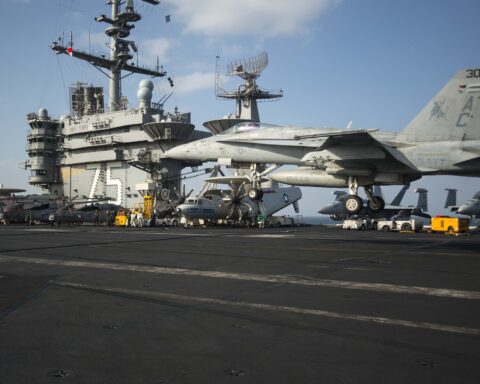
RIYADH — Iran’s Islamic Revolutionary Guard Corps attacked at least three tankers in or near the Strait of Hormuz between Sunday and Monday, bringing the October total to 15 vessels targeted in 12 days, as Mohsen Rezaei, secretary of Iran’s Supreme National Security Council, accused the US military of directing an oil-smuggling operation through the waterway.
Brent crude stood at approximately $106.65 a barrel on Monday, up roughly 2 per cent from the previous session, according to Bloomberg. By naming CENTCOM’s commander as a participant in what Iran calls smuggling, Tehran has given itself a declared basis for targeting any vessel cooperating with the US Navy in the strait — regardless of flag, cargo or destination.
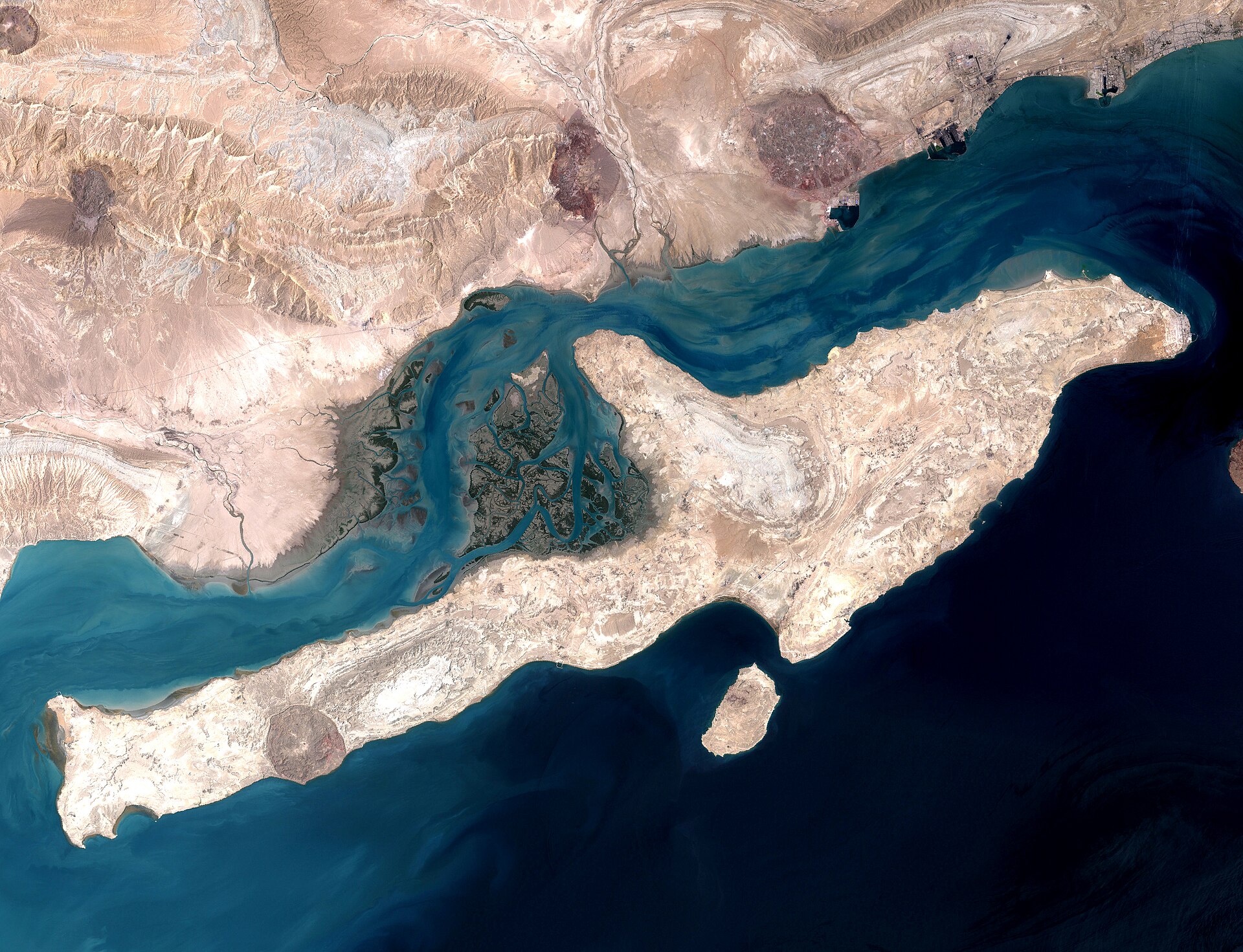
Table of Contents
What Happened in the Strait Between Sunday and Monday
The IRGC Navy confirmed Monday morning that it had struck a third tanker in approximately 48 hours. The vessel had disabled its navigation systems, ignored warnings and attempted an unauthorized route, according to Anadolu Agency and IranWire. Its name, flag and cargo have not been confirmed by independent maritime trackers.
Two strikes preceded it on Sunday. The MT Valthera, a Marshall Islands-flagged Suezmax tanker, was hit in the strait. The IRGC said the vessel struck a mine in a route Iran had declared hazardous. All 11 Indian crew members were reported safe, according to Seatrade Maritime and Marine Insight. Iran’s Tasnim news agency quoted the IRGC Navy on Saturday.
“The massive fire is the fate of any non-compliant oil tanker that seeks to disregard the security and laws of the Strait of Hormuz.” — IRGC Navy, via Tasnim, 11 October 2026
The VLCC Angola Prosperity, owned by South Korea’s Sinokor, was also struck on Sunday. Its crew was reported safe, according to Seatrade Maritime.
The Middle East briefing 3,000+ readers start their day with.
One email. Every weekday morning. Free.
A Nicaragua-flagged tanker was attacked by a drone near the Sohar anchorage off Oman’s coast during the same window. Two Indian seafarers from the 14-member crew were reported missing, according to Marine Insight.
The sequence had begun earlier. On 9 October the IRGC targeted the MV Sun Shine, owned by Natwit, hitting its engine room and propulsion systems and setting the vessel on fire, according to Euronews and The New Arab.
| Vessel | Flag / Owner | Type | Date | Reported Outcome |
|---|---|---|---|---|
| MV Sun Shine | Natwit | Tanker | 9 Oct | Engine room hit, fire (Euronews) |
| MT Valthera | Marshall Islands | Suezmax | 11 Oct | Struck; 11 crew safe (Seatrade Maritime) |
| Angola Prosperity | Sinokor (South Korea) | VLCC | 11 Oct | Struck; crew safe (Seatrade Maritime) |
| Unnamed | Nicaragua | Tanker | ~11 Oct | Drone strike near Sohar; 2 crew missing (Marine Insight) |
| Unnamed | Unknown | Unknown | 12 Oct | Navigation off, unauthorized route (Anadolu Agency) |
How Did Iran Frame the Strikes?
Rezaei, in remarks carried by Al Jazeera, Anadolu Agency and Yeni Şafak on Monday, accused Admiral Brad Cooper, the CENTCOM commander, of coordinating an oil-smuggling network. He claimed Cooper was directing five or six small boats to transfer crude to larger tankers with UAE military assistance.
“You are smuggling, but the strait is under Iran’s control, and we manage it,” Rezaei said, according to Al Jazeera. “From now on … we will maintain control over the management of the Strait of Hormuz,” he added, according to Anadolu Agency.
No US or UAE response to Rezaei’s accusation has been reported.
The Iranian Foreign Ministry, in a separate statement carried by IranWire, accused the United States of “maritime piracy.” The IRGC said after the 9 October strike on the MV Sun Shine that “direct responsibility for these incidents and the escalation of tensions in maritime transport in the region lies with the aggressive US army,” according to Euronews. It added that its actions would “no longer be confined to the Strait of Hormuz.”
Iran has defined “offending” vessels as those using the southern Hormuz channel without Iranian clearance, operating with navigation transponders disabled, or cooperating with US operations, according to IranWire. The mechanism under attack, according to Al Jazeera: VLCCs load at Arab ports, use the southern corridor near Oman’s coast, and conduct ship-to-ship transfers in the Gulf of Oman with transponders off, often at night.
Michelle Wiese Bockmann, a maritime analyst, told Al Jazeera: “The more effective the route has become in facilitating oil transport, the less leverage Iran has.” By attacking vessels using this corridor, the IRGC is attempting to restore the coercive leverage the alternative channel had eroded.
How High Is October’s Attack Tempo?
In the third quarter of 2026, 45 vessels were attacked; 87 per cent were tankers, according to Al Jazeera.
The week ending 4 October had already set a wartime record: 11 tankers attacked, according to CNBC. The United Kingdom Maritime Trade Operations recorded nine attacks in the first week of October alone, according to the Insurance Journal.
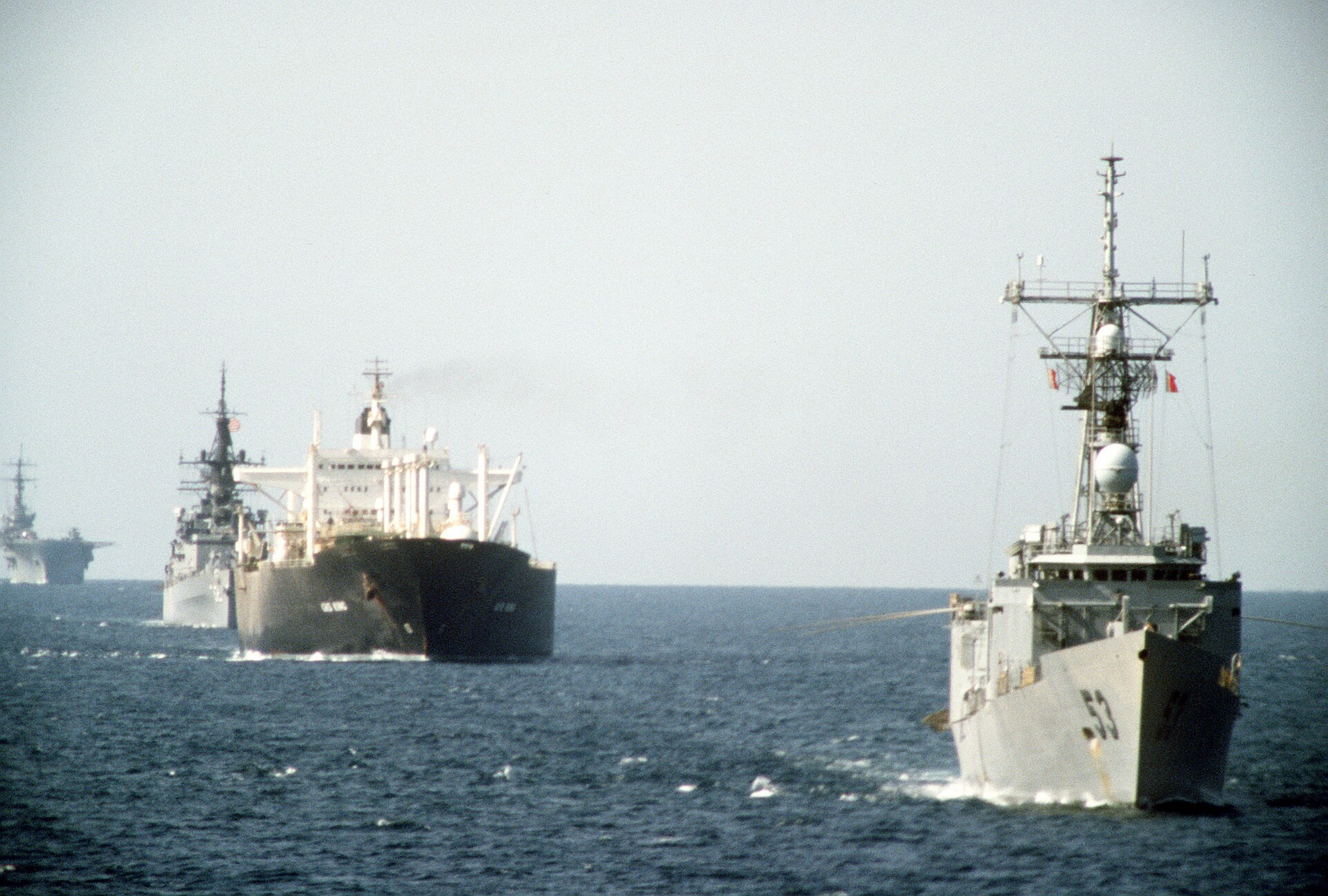
On the US side, CENTCOM said on 10 October that since the blockade of Iranian ports began on 14 July it had disabled four vessels, turned around 135 ships and destroyed 10 IRGC-linked tankers, according to CBS News and the Jerusalem Post.
The commercial cost is concentrated in freight. Gulf-to-China VLCC rates reached a record $1.3 million per day, up from approximately $60,000 a day a year earlier, according to the Insurance Journal. Dimitris Maniatis, CEO of shipping company Marisks, described the IRGC’s approach: “Iran does not need to stop every vessel; it needs the maritime industry to believe that any vessel could be next,” he told the Insurance Journal on 7 October.
Hormuz oil clearance has fallen sharply. Flows averaged 8.5 million barrels per day in the week ending 7 October, approximately 40 per cent below normal levels, according to Al Jazeera. Habibollah Sayyari, chief of staff of Iran’s armed forces, said on 11 October: “We have struck blows against enemy vessels. If anything else happens against Iran, we will strike them again,” according to Al Jazeera.
Can Saudi Arabia Export Without Hormuz?
Saudi Energy Minister Prince Abdulaziz bin Salman said on 6 October that the East-West pipeline had reached throughput of 5.8 million barrels per day, according to Al Jazeera. The pipeline’s design capacity is approximately 7 million bpd, according to the Saudi Gazette via Zawya.
But throughput is not export capacity. Aramco said in March that the pipeline can carry up to 7 million bpd, with about 5 million exportable from the Yanbu terminal on the Red Sea, according to Reuters. In practice, Yanbu exports peaked at approximately 4 million bpd in the week from 16 March — the highest sustained level recorded since the blockade began, according to Reuters.
Aramco cut its November Arab Light official selling price to Asia by $3, to $5 below the Oman/Dubai benchmark — the widest discount since June 2020, according to Reuters via bdnews24. The IEA estimated Saudi crude supply at 5.97 million bpd in August, according to its September report. Saudi Arabia’s OPEC+ production target for November stands at 10.5 million bpd, according to Enerdata — roughly 4.5 million barrels per day above what the kingdom was actually producing two months ago.
The fiscal pressure is visible. Saudi Arabia’s pre-budget statement projected the 2026 deficit at 245 billion riyals, revised upward from a budgeted 165 billion riyals, according to Reuters via Zawya. The same statement forecast a 3.6 per cent contraction in real GDP for 2026, driven by a 21.8 per cent decline in oil activities. Diversification targets have not insulated the budget from the volume loss.
Why Is Diplomacy Frozen Until November?
President Trump wrote on 8 October that the United States “will not be attacking Iran at any time prior to the midterm elections” on 3 November, and said the Hormuz blockade remains “in full force,” according to The National.
After the 10 October Houthi strike on King Khalid International Airport — which killed 13 and wounded at least 308, according to Al Jazeera and the BBC — Trump said “We may. We’re going to look at it,” and described Saudi Arabia as “good fighters” who are “able to defend,” according to CNN. He said he would speak to the crown prince. No source has confirmed that call taking place.
CNN reported that Crown Prince Mohammed bin Salman made two separate appeals to Trump in September for US strikes on the Houthis. Both were declined. Trump reversed his initial order to the Pentagon to prepare strikes after the first appeal, according to the New York Times via the Philadelphia Inquirer.
Iran has offered to talk — on its terms. Foreign Minister Abbas Araghchi said on 11 October that Iran was ready to “facilitate dialogue between Saudi Arabia and Yemen,” according to the BBC. Rezaei called the latest US response “insufficient,” according to IRNA, as cited by CBS News.
Iran’s earlier seven-day roadmap, submitted via Qatar in late September, proposed reopening Hormuz in return for the US lifting its blockade, sanctions waivers and release of approximately $12 billion in frozen assets, according to Al Jazeera. The Wall Street Journal reported that Trump rejected the plan.
Background: The Strait Since July
Iran declared the Strait of Hormuz closed on 12 July after the collapse of the Islamabad Memorandum, a 14-point agreement signed on 17 June that had provided 60 days of toll-free passage. CENTCOM imposed a counter-blockade on Iranian ports starting 14 July, according to CBS News.
The confrontation has since produced a pattern: Iran targets tankers attempting to transit without Iranian clearance while the US Navy interdicts Iranian-linked vessels. By early August, only 33 vessels transited Hormuz in a four-day period from 3 to 6 August, down from a pre-war baseline of 130 to 140 per day, according to Reuters.
CENTCOM struck Iranian tankers in September — destroying three on 5 September after Iranian attacks on a US carrier and destroyer, and five more on 8 September after IRGC missile attempts on a US warship, according to Business Today and dpa via GNA.
Saudi Arabia suspended East-West pipeline flows as a precaution on 12 September after the pipeline was targeted in the Riyadh and Madinah regions, according to the Saudi Gazette via Zawya. It restarted on 22 September, though full capacity could take six weeks or more, Reuters reported. The Houthis declared a maritime blockade of Saudi Arabia on 20 July, adding a second chokepoint to an economy already shut out of Hormuz.
Frequently Asked Questions
How many non-Iranian vessels transited Hormuz in August?
Lloyd’s List Intelligence counted at least 346 non-Iranian-linked transits in August 2026, a fraction of the pre-war rate of 130 to 140 vessels per day cited by Reuters. Many of these transits used the southern channel near Oman’s coast with transponders disabled — the practice Iran now calls smuggling and cites as justification for its strikes.
What was the Islamabad Memorandum?
A 14-point agreement signed on 17 June 2026 between the United States and Iran, mediated by Pakistan, Qatar, Turkey and Egypt. It provided 60 days of toll-free Hormuz passage, lifting of the US blockade within 30 days, a reconstruction plan of at least $300 billion and Iran-Oman talks on the strait’s future administration, according to Iran International. It collapsed on 8 July after three ships, including the Saudi-flagged Wedyan, were struck near Hormuz.
Has Saudi Arabia struck Iran directly?
Reuters reported in May 2026, citing Western and Iranian officials, that the Royal Saudi Air Force carried out unpublicised retaliatory strikes on Iran in late March — the first known direct Saudi military action on Iranian soil. A Saudi foreign ministry official did not directly address the claim when asked, according to Reuters via the Korea Herald.
What OPEC+ target does Saudi Arabia hold versus actual output?
Saudi Arabia’s November OPEC+ production target is 10.5 million barrels per day, according to Enerdata. The IEA estimated actual Saudi crude supply at 5.97 million bpd in August — a gap of approximately 4.5 million bpd. The shortfall reflects lost Hormuz access, pipeline disruptions, and attacks on oil infrastructure including Abqaiq and Yanbu.
When is the next OPEC+ meeting?
OPEC+ members are scheduled to meet on 1 November, two days before the US midterm elections, according to the Nation Thailand. Saudi Arabia’s actual production is running so far below its target that the quota has become largely academic — the constraint is not policy but physical access to export routes.