
RIYADH — Canadian Prime Minister Mark Carney condemned Houthi attacks on Saudi Arabia during a phone call with Crown Prince Mohammed bin Salman on Monday, affirming what the readout described as “Canada’s solidarity with the Kingdom against all threats to its security,” the Kuwait News Agency reported on November 10.
Six additional nations — the UAE, Egypt, Qatar, Jordan, Yemen’s internationally recognized government and Bahrain — issued their own condemnations on the same day, the Saudi Gazette reported, while the Gulf Cooperation Council and the Muslim World League added institutional weight. The statements followed a November 8 barrage in which the Saudi-led coalition said it intercepted Houthi ballistic missiles aimed at Riyadh and the Eastern Province, an attack sequence that left Aramco Tower in the capital’s King Abdullah Financial District visibly damaged, according to footage authenticated by BBC Verify.
The House of Saud Daily Briefing
Saudi Arabia's news in 3 minutes, every morning. Free. See today's issue
Table of Contents
What Did Carney Tell the Crown Prince?
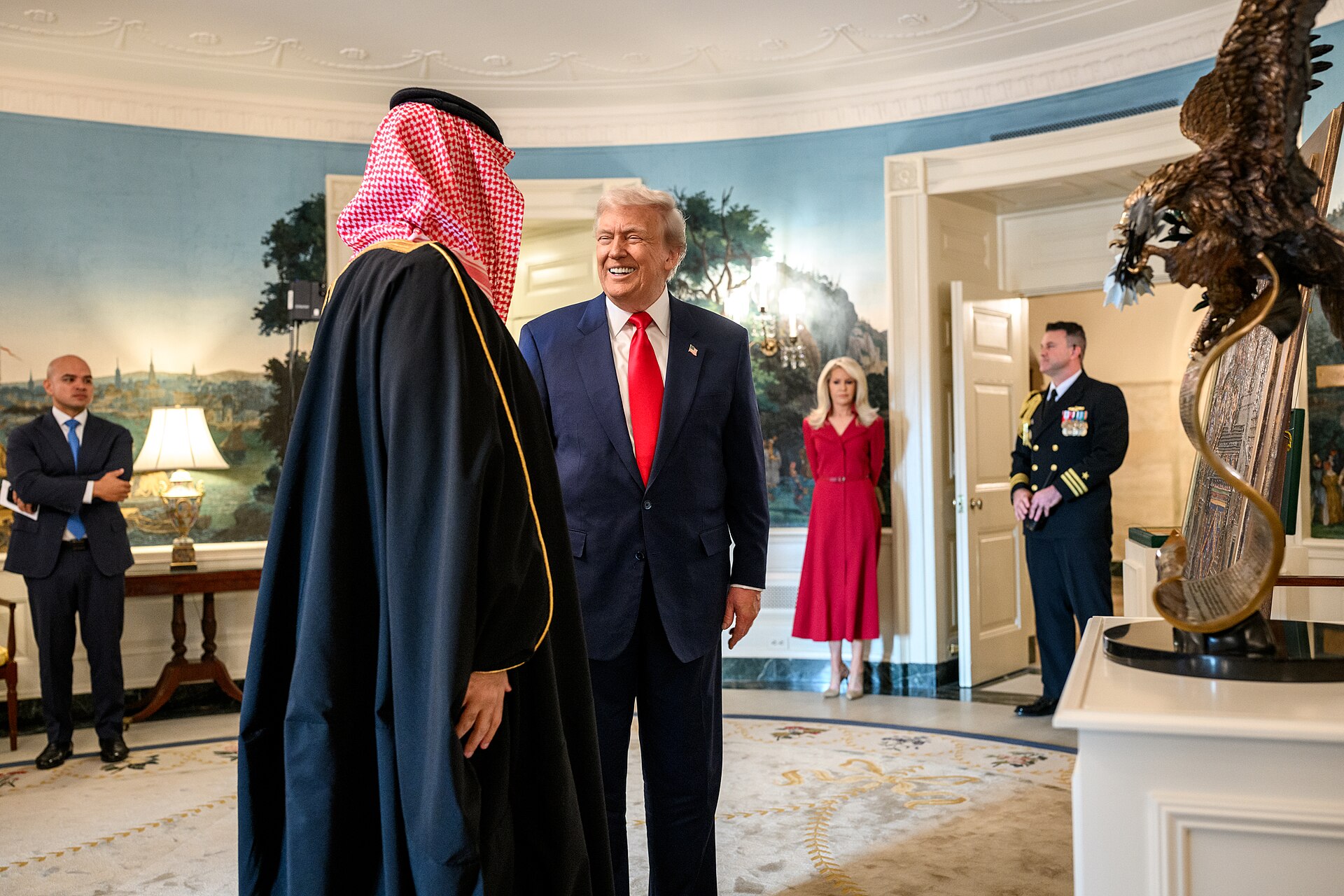
The readout of the November 9 call, distributed by the Kuwait News Agency from a KUNA Riyadh dateline, said Carney condemned attacks carried out by “the Houthi militia” on Saudi Arabia and affirmed Canada’s solidarity with the kingdom against all threats to its security. The Saudi Gazette also reported the call, identifying it as a direct conversation between Carney and the crown prince. No separate readout from the Canadian Prime Minister’s Office was immediately available, and the call’s duration and scope beyond the Houthi issue were not disclosed.
It was not Carney’s first public rebuke of the Houthis. In October 2026, after a Houthi strike on King Khalid International Airport that killed civilians, the Canadian prime minister called the attacks “abhorrent” and said “Canada condemns these reckless acts of violence in the strongest possible terms,” according to the Saudi Gazette. The November 9 readout used more measured language — “condemned” and “affirmed solidarity” — but the channel was more direct: a head-of-government phone call rather than a written statement.
Canada designated the Houthis as a terrorist entity under its Criminal Code on December 2, 2024, according to Public Safety Canada — a step that predated the current Saudi-Houthi escalation by more than a year and made knowingly participating in or contributing to the group’s activities a criminal offense under Canadian law.
Six Nations, GCC and Muslim World League Condemn Attacks
The broader condemnation wave on November 9 brought together a geographically and institutionally diverse set of voices. It followed an earlier round of condemnations from Syria and Kuwait issued on November 8, the Saudi Gazette reported separately.
The UAE’s Foreign Ministry called the Houthi targeting “a flagrant violation of the sovereignty of the Kingdom of Saudi Arabia” and pledged “full solidarity” with the kingdom, according to Gulf Times. Egypt’s Foreign Ministry condemned the attacks as a violation of international law and a direct threat to civilians. Qatar’s Foreign Ministry described the attacks as “aggressive,” said they showed disregard for civilian lives, and called for “an immediate halt to attacks on civilians.”
Jordan’s Foreign Ministry condemned the continued attacks, including the strikes directed at Riyadh. Yemen’s internationally recognized government said the attacks “violated Saudi Arabia’s sovereignty and international law,” according to the Syrian Arab News Agency, which carried the Yemeni statement. Bahrain said Saudi Arabia’s security is “inseparable from that of Bahrain and other GCC member states,” per the same SANA report — phrasing that echoed a formulation Kuwait had used in its October condemnation of Houthi strikes.
At the institutional level, GCC Secretary-General Jasem Albudaiwi said member states “stood united with Saudi Arabia and expressed full solidarity,” the Saudi Gazette reported. The Muslim World League, headquartered in Mecca, issued a separate condemnation through its secretary-general, Sheikh Mohammed bin Abdulkarim Al-Issa, who said the attacks violated religious values and international humanitarian norms, according to Malaysia’s state news agency BERNAMA.
The MWL statement, as reported by BERNAMA, said the Houthi militia’s continued attacks on Saudi Arabia — including attempts to target civilians, civilian areas and residential neighborhoods with missiles and drones — had been intercepted by Saudi air defenses.
The MWL statement specifically cited the targeting of “civilians, civilian areas and residential neighborhoods” — language that directly contested the Houthi claim of striking only military and oil infrastructure. Al-Issa also declared the league’s “full solidarity with Saudi Arabia” against what he called continued militia aggression, BERNAMA reported.
What Attacks Prompted the Condemnation Wave?
The condemnations followed several days of sustained Houthi operations against Saudi cities and infrastructure. On November 8, the Saudi-led coalition said it intercepted two ballistic missiles aimed at Riyadh and one aimed at the Eastern Province, the Syrian Arab News Agency reported. Debris or blast effects from the Riyadh interceptions damaged Aramco Tower in the King Abdullah Financial District, with BBC Verify authenticating footage showing shattered windows on the skyscraper. Reuters and the South China Morning Post carried additional reports of the damage to the building, which sits in one of the capital’s most prominent commercial zones and houses Riyadh offices of Saudi Arabia’s state oil company, whose main headquarters is in Dhahran.
The previous day, the Houthis claimed six operations against Aramco facilities, King Khalid International Airport and a National Guard camp in Najran, according to Hindustan Times and Middle East Eye. The coalition intercepted a Houthi cruise missile over Riyadh on November 7, Anadolu Agency reported. Saudi civil defence issued and then lifted an aerial alert over Riyadh on November 9 as the threat persisted, and airlines cancelled more than a third of Saudi flights in the preceding days. Multiple governments maintained travel advisories across the kingdom.
The coalition’s air campaign against Houthi positions in Yemen continued in parallel. On November 7, the Houthis said Saudi airstrikes killed 27 people in a village in Sanaa province, a claim reported by the BBC but not independently verified. On November 6, strikes hit a market in Taiz province — an incident that Iran’s Foreign Ministry later said killed 33 people when it issued its own condemnation of the Saudi campaign on November 8, the Tehran Times reported.
The condemnation wave itself had been building for days. In early November, Qatar, Kuwait, Bahrain and Jordan condemned a Houthi missile aimed at the Madinah region on November 5. Syria and Kuwait issued statements on November 8. The November 9 round — with the UAE, Egypt, Qatar, Jordan, Yemen, Bahrain, the GCC, the Muslim World League and Canada all weighing in — was the broadest in the current escalation, bringing seven governments and two multilateral bodies to bear on a single day.

Canada-Saudi Relations Since the 2018 Rift
Carney’s willingness to align publicly with Riyadh on security reflects a diplomatic trajectory that would have been difficult to imagine four years ago. In August 2018, Canada criticized the detention of women’s rights activists in Saudi Arabia — including Samar Badawi — prompting Riyadh to expel the Canadian ambassador, freeze new trade and investment, and recall Saudi students from Canadian universities, according to CNBC. The dispute was rooted in human rights, not in the Khashoggi affair that followed weeks later, and it ruptured relations for nearly five years.
The two countries restored full diplomatic ties on May 24, 2023, the CBC reported, exchanging ambassadors and reopening embassy operations after what had become one of the most visible diplomatic ruptures between a Western nation and a Gulf state. The thaw accelerated rapidly. Foreign Minister Anita Anand visited Riyadh in March 2026, by which time bilateral trade had exceeded 12 billion Saudi riyals in 2024, Arab News reported, citing Saudi trade data. Then came Carney’s July 9, 2026 visit — the first by a Canadian prime minister in 26 years, his office said. The trip produced 13 commercial agreements valued at more than $1 billion and a memorandum of understanding establishing the Canada-Saudi Arabia Coordination Council, a bilateral body intended to formalize regular government-to-government consultations across trade, investment and strategic affairs.
The November 9 call was Carney’s second direct engagement with the crown prince since that July visit. In the intervening four months, Houthi attacks escalated from sporadic strikes on southern cities to sustained barrages against Riyadh, Dammam and Saudi oil infrastructure. A single Houthi strike on King Khalid International Airport on October 10 killed 13 people and wounded more than 300, according to Al Jazeera and the BBC, and the attacks had continued almost daily since.
How Has Iran Responded?
Iran, which backs the Houthis but does not claim direct control over their military operations, took a different posture. Its Foreign Ministry’s November 8 statement — which cited the Taiz market strike and called for dialogue — described the Saudi campaign as a breach of international law, the Tehran Times reported. The charge mirrored, in reverse, the language the UAE, Egypt and Yemen used against the Houthis a day later. Both sides accused the other of violating sovereignty, targeting civilians and breaching international norms.
No Houthi official response to the November 9 condemnation wave was found in available sources as of November 10. The Houthis have previously described their operations as targeting “only oil facilities and military bases,” a framing that several of the condemning governments explicitly disputed. The UAE cited a violation of sovereignty; the MWL named “civilians, civilian areas and residential neighborhoods” as targets. The documented pattern — including the KAFD financial district damage on November 8, repeated strikes on civilian airports and debris falling in residential neighborhoods — provided the evidentiary basis for those statements.
The MWL’s invocation of “religious values” added a dimension that Iran’s own clerical establishment has not publicly contested. The league’s condemnation, issued from Mecca, carried an Islamic institutional authority that the Houthi movement — which draws its legitimacy partly from its Zaidi Shia identity and opposition to Saudi intervention — has not directly addressed.
Frequently Asked Questions
How many nations condemned Houthi attacks on Saudi Arabia in November 2026?
At least nine nations issued formal condemnations in the first 10 days of November 2026: the UAE, Egypt, Qatar, Jordan, Yemen’s internationally recognized government, Bahrain, Syria, Kuwait and Canada. Qatar, Kuwait, Bahrain and Jordan had condemned a Houthi missile aimed at Madinah on November 5-6. Syria and Kuwait issued separate statements on November 8. On November 9, the UAE, Egypt, Qatar, Jordan, Yemen, Bahrain and Canada all condemned, while the GCC and the Muslim World League added institutional statements. The tally does not include condemnation waves in October, when Saudi Arabia, Egypt, Pakistan and Turkey issued a joint statement after the King Khalid International Airport strikes.
Has the Muslim World League condemned Houthi attacks before November 9?
Secretary-General Sheikh Mohammed bin Abdulkarim Al-Issa issued condemnations of Houthi attacks on Saudi Arabia on multiple occasions in 2026, including in September and October, according to the Saudi Gazette and BERNAMA. The MWL’s position has been consistent: it frames the Houthi strikes as targeting civilians and violating Islamic norms, language that directly challenges the group’s claim to be acting in defense of the Yemeni people against a Saudi-led military campaign. The league’s headquarters in Mecca gives its statements a proximity to Islam’s holiest sites that few other condemning bodies can claim.
Have the Houthis responded to the condemnation wave?
No official Houthi response to the November 9 statements was found in available sources as of November 10. The group has previously framed its strikes as retaliatory operations against Saudi military and oil targets, but it has not publicly addressed the statements from the nine condemning nations or from the GCC and the Muslim World League.
How does Canada’s Houthi terrorist designation work?
Canada listed the Houthis — formally “Ansarallah” — as a terrorist entity under its Criminal Code on December 2, 2024, according to Public Safety Canada. The listing makes it a criminal offense to knowingly participate in, contribute to or facilitate the group’s activities, including fundraising and recruitment, and it enables the freezing of associated assets held in Canadian financial institutions. The designation carries criminal rather than administrative penalties and is separate from Canada’s sanctions regime, which operates under different legislation.
The House of Saud Daily Briefing
Saudi Arabia's news in 3 minutes, every morning. Free. See today's issue