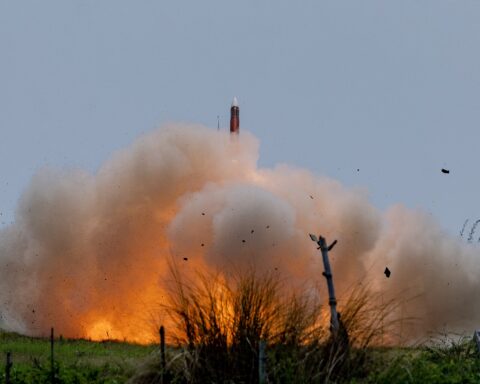
DHAHRAN — Saudi-led coalition air defenses intercepted a Houthi ballistic missile over the Eastern Province before dawn on November 8, with civil defense authorities issuing alerts across Dhahran, Dammam, Abqaiq and Al-Ahsa governorate — four zones that contain Aramco’s global headquarters, the Abqaiq crude processing complex and the kingdom’s main Eastern Province port city. The interception came less than a day after the coalition downed a cruise missile over Riyadh, Reuters reported, shifting the Houthi targeting from the political capital to the province that holds, in Reuters’ words, “most of the kingdom’s oil and gas reserves.”
No casualties and no confirmed damage have been reported from the event, according to Kuwait Times, Arab News and Reuters. But the civil defense alert’s four-zone footprint tells a story the word “intercepted” alone does not — those four zones span the corporate nerve center of the world’s largest oil company, the processing hub that links Persian Gulf crude to the Red Sea export route via the East-West pipeline, and the industrial port of Dammam, a concentration of energy infrastructure that no other Saudi province comes close to matching.
The House of Saud Daily Briefing
Saudi Arabia's news in 3 minutes, every morning. Free. See today's issue
Table of Contents
What Happened Over the Eastern Province on November 8?
Saudi civil defense issued warnings of “potential danger” covering Dhahran, Dammam, Abqaiq and Al-Ahsa governorate early on November 8, Reuters reported. The all-clear was subsequently issued, and coalition spokesman Maj. Gen. Turki Al-Maliki announced on X that air defenses had “intercepted and destroyed a ballistic missile launched by the Yemeni Iran-allied Houthi group towards the Eastern region,” as paraphrased by Kuwait Times and Middle East Eye. The coalition’s formal statement arrived after the civil defense clearance — a sequence consistent with post-interception debris tracking and threat assessment before any public announcement.
The weapon was identified as a ballistic missile, a designation that distinguishes it from the cruise missile the coalition intercepted over Riyadh on November 7 — a different munition class with a different flight profile, aimed at a different part of the kingdom on the following day. As of the time of reporting, no Houthi claim for the November 8 Eastern Province intercept had surfaced.

Why Dhahran Is a Different Kind of Target
The shift from Riyadh to the Eastern Province is not merely geographic — it is functional, with direct implications for Saudi Arabia’s oil export capacity that attacks on the capital do not carry. Riyadh is the political center and the site of King Khalid International Airport, which has absorbed the deadliest Houthi strikes of the war, including the October 10 attack that killed at least 13 and wounded 309, according to multiple reports including Al Jazeera and Reuters — initial reports put the death toll at 12, with the figure rising as additional victims died of their wounds in subsequent days. The Eastern Province, by contrast, is where Saudi Arabia earns its revenue: it houses Aramco’s corporate headquarters, the crude processing infrastructure that prepares oil for export, and the pipeline and port systems that deliver it to buyers.
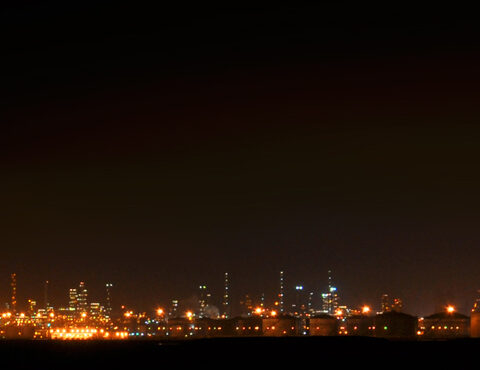
Dhahran, named first in the civil defense alerts, is home to Aramco’s global headquarters — a fact Reuters noted explicitly in its November 8 dispatch. Abqaiq, also under the alert’s coverage, is the main crude processing complex that feeds the East-West pipeline, a system with a design capacity of 7 million barrels per day, according to MEED. That pipeline links Abqaiq to the Red Sea port of Yanbu, serving as Saudi Arabia’s primary bypass route around the Strait of Hormuz, which has been contested between the US and Iran since the war began. A disruption at Abqaiq would therefore threaten both Gulf-side exports through Ras Tanura and the Hormuz bypass route through Yanbu, exposing the two main arteries of Saudi oil revenue at their shared origin point. The four civil defense zones activated on November 8 traced that geography precisely: Aramco’s headquarters in Dhahran, the kingdom’s main processing complex at Abqaiq, the industrial port of Dammam and the Al-Ahsa region stretching toward Ras Tanura — the places where Saudi oil is processed, piped and shipped, all within a single alert perimeter.
How Many Aerial Threats Has Saudi Arabia Faced in November?
Arab News, citing the Saudi Press Agency, reported on November 8 that the coalition had intercepted “at least 15 ballistic and cruise missiles and unmanned aerial vehicles” targeting the kingdom since the beginning of the month. That figure covers the first eight days of November and encompasses multiple weapon types aimed at multiple Saudi regions, an operational tempo that has kept coalition air defenses and civil defense authorities on a near-continuous footing.
The attacks in the days preceding the Eastern Province interception illustrate both the pace and the geographic spread of the campaign. On November 7, the coalition intercepted a cruise missile over Riyadh, the capital’s latest exposure to Houthi aerial threats since the devastating airport strikes in October. On the same day, Houthi military spokesman Yahya Saree claimed six separate operations targeting Aramco facilities, King Khalid International Airport and a National Guard camp in Najran — claims the coalition did not individually confirm. On November 5, the coalition intercepted and destroyed a drone over the Eastern Province without naming a launch source, Anadolu Agency reported — a reminder that the province had already been in the targeting pattern before the ballistic missile arrived on November 8.
Those events unfolded against a regional escalation that extends well beyond the Houthi air campaign. On November 7, President Trump confirmed new US strikes on Iran as Qatar pressed a 48-hour diplomatic plan, and on November 8, the IRGC said two tankers had struck mines near the Strait of Hormuz as US forces disabled a vessel in the waterway. The ballistic missile aimed at the Eastern Province landed, in temporal terms, on a day that also saw mine attacks in the Gulf and continuing US-Iran military confrontation — multiple fronts converging on the same calendar page, each compounding the risk to the energy infrastructure at the province’s core.

The Eastern Province Under Fire
The November 8 interception was the latest in a series of attacks targeting the Eastern Province during the current escalation. On October 29, the coalition intercepted a ballistic missile fired at the province, with civil defense issuing alerts for both the Eastern Province and Najran, Asharq Al-Awsat reported. The Houthis claimed that day that three ballistic missiles had hit Ras Tanura and Abqaiq, along with a drone targeting King Fahd International Airport in Dammam — but the coalition confirmed only a single intercept over the Eastern Province and did not confirm any Ras Tanura strike, according to FXStreet and the Malay Mail.
The most consequential recent attack on the area came on October 13-14, when missiles targeted both Riyadh and Dhahran. The Saudi Energy Ministry said a missile attack caused a “limited fire” at an administrative building belonging to Aramco in Dhahran, Gulf Business reported on October 14, while Reuters described the same incident as causing “extensive damage” — a discrepancy in characterization that neither Saudi officials nor Reuters have reconciled. By October 22, Reuters reported that Aramco had told staff to evacuate the Dhahran headquarters complex, a decision that reflected the company’s own assessment of the threat environment around its main offices.
The province’s exposure predates the Houthi escalation by months. In March, drones targeting the Ras Tanura refinery were intercepted, with debris sparking a limited fire and forcing Aramco to shut processing units, the Saudi Energy Ministry and multiple outlets including MEED reported. Iran denied involvement through Tasnim, which, according to the Maritime Executive’s account, quoted an IRGC-linked source as saying that Aramco facilities had not been among the targets of Iranian attacks to that point. On July 27, Saudi Arabia intercepted drones launched from Iraq at Eastern Province oil facilities and blamed “terrorist militias affiliated with Iran,” Gulf Times reported, citing QNA — an attribution that placed the threat not only from Yemen to the south but from Iraq to the north, framing the province’s air defense challenge as multi-directional. On October 11, Houthi military spokesman Yahya Saree warned airlines and travelers against using Saudi airports and airspace, announcing that all airports except those serving Mecca and Medina were potential military targets.
Pakistan confirmed in April that fighter jets and support aircraft had deployed to King Abdulaziz Air Base in the Eastern Province under the September 2025 mutual defence pact, Al Jazeera reported, adding an allied air defense layer to the coalition systems already guarding the province — a deployment that, as the tempo of attacks on the province has increased, has become one of the more consequential elements of the Makkah pact’s military provisions.
Where Is the Houthi Claim?
As of the time of reporting, the Houthis had not claimed the November 8 ballistic missile that targeted the Eastern Province. Searches of Al Masirah-linked outlets, statements from military spokesman Yahya Saree and Iranian state media including IRNA, PressTV and Tasnim produced no specific claim for this event, a gap worth noting given the group’s pattern of rapid public acknowledgment of operations against Saudi Arabia throughout the war.
The most recent Houthi claim before the interception came on November 7, when Saree announced six operations against Aramco, KKIA and Najran — a different set of targets in a different statement that predated the Eastern Province missile by several hours. On October 29, by contrast, the Houthis claimed three strikes on Eastern Province targets including Ras Tanura and Abqaiq on the same day the coalition confirmed an interception there — a detailed operational claim they have not repeated for November 8. That earlier willingness to claim Eastern Province operations makes the November 8 silence notable, though without a statement from the group, the reason for it is unknown.
Aramco facilities had not been among the targets of Iranian attacks to that point, an IRGC-linked source told Tasnim in March 2026 — a statement that addressed only Iran’s direct role and said nothing about Houthi or proxy-group operations.
IRGC-linked source via Tasnim, March 2026 (as reported by the Maritime Executive)
Iran’s own position on attacks against Saudi oil infrastructure has been one of official distance, at least regarding its own forces. That March statement, made after drones attacked the Ras Tanura refinery, addressed only Iran’s direct role and said nothing about the Houthis or other proxy groups. The coalition’s November 8 statement attributed the missile to “the Yemeni Iran-allied Houthi group,” the same formulation it has used throughout the war, placing the origin in Yemen without comment on the supply chain behind the weapon. What the absence of a claim leaves unanswered is not whether the missile was fired — the coalition confirmed that — but what it was aimed at within a province where Aramco’s headquarters, the kingdom’s main processing complex and the origin point of its Hormuz bypass pipeline sit within a single civil defense alert zone.

Frequently Asked Questions
What air defense systems protect the Eastern Province?
The coalition operates Patriot missile defense batteries across Saudi Arabia, supplemented by allied deployments under the Makkah pact. Reuters reported in May 2026 via The Standard that Pakistan had deployed approximately 8,000 troops, around 16 mostly JF-17 aircraft, two drone squadrons and an HQ-9 air defense system financed by Riyadh to the Eastern Province — the HQ-9 adding a medium-to-long-range air defense capability distinct from the American-supplied Patriot systems. Pakistani security sources called the Reuters report “angled” without disputing its figures, according to The News.
Has Saudi Arabia’s oil output been affected by attacks on the Eastern Province?
The International Energy Agency reported in September 2026 that Saudi output had fallen by 2.3 million barrels per day on the month to 6 million barrels per day in August, according to Trend News Agency. Saudi Arabia suspended flows through the East-West pipeline as a precaution on September 10 and restarted them on September 22, but Baird Maritime, citing Reuters, reported that reaching full capacity could take six weeks or more. Aramco CEO Amin Nasser said disruptions typically lasted “days, not weeks or months,” according to Saudi Gazette via Zawya.
What is the current travel advisory status for Saudi Arabia?
The UK advises against all travel to Saudi Arabia within 10 kilometers of the Yemen border, according to BBC reporting from October 2026. The US barred its embassy staff from travel within 20 miles of the border, Gulf News reported on October 7, and the European Union Aviation Safety Agency widened its Saudi airspace warning in October, Fortune reported. GACA has imposed varying restrictions on Saudi airports during the conflict, including closures and prior-permission requirements at King Khalid International Airport in Riyadh and King Fahd International Airport in Dammam.
What is Saudi Arabia’s current OPEC+ production target?
OPEC+ set Saudi Arabia’s November 2026 production target at 10.5 million barrels per day, with targets unchanged at the group’s October meeting, Enerdata reported on October 4. Aramco cut its November official selling price for Arab Light crude to Asia by $3, to $5 below the Oman/Dubai benchmark — the widest discount since June 2020, according to bdnews24, citing Reuters — a pricing signal that reflected both the physical disruption to Saudi export logistics and the competition for market share from producers unaffected by the Hormuz closure.
The House of Saud Daily Briefing
Saudi Arabia's news in 3 minutes, every morning. Free. See today's issue