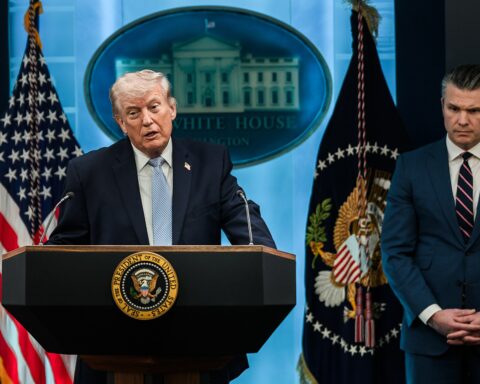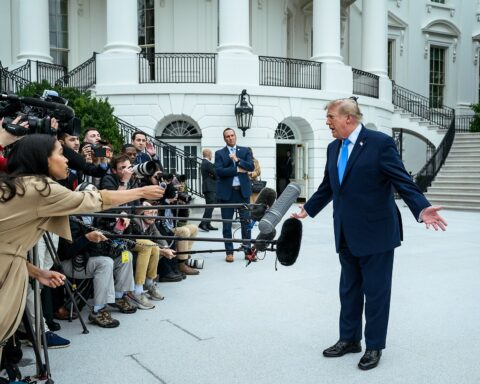
WASHINGTON — Donald Trump told Reuters on April 17 that Iran had agreed to let the United States “go in, at a nice leisurely pace, and go down and start excavating with big machinery” to retrieve what he called “nuclear dust” buried under the bombed-out remains of Iran’s enrichment facilities. Hours later, Bloomberg reported that the nuclear issue “remains in limbo,” citing Iranian officials who denied agreeing to surrender their enriched uranium stockpile. By the time both stories had circulated, Iran’s Foreign Ministry spokesman Esmaeil Baghaei was on state television declaring that transferring enriched uranium to America “has never been under consideration” and that “enriched uranium is as sacred to us as Iranian soil.”
The contradiction is not a gap in messaging. It is the negotiation itself — conducted in public, through press conferences and cable news hits, with 440.9 kilograms of highly enriched uranium and a ceasefire expiring April 21-22 as the stakes. And for Saudi Arabia, which is party to neither the talks nor the enrichment framework being discussed, both versions of reality lead to the same destination: a kingdom locked out of the nuclear architecture being drawn around it for the second time in eleven years.
Table of Contents
- What Trump Actually Said — and What Bloomberg Found
- What Is Actually Underground?
- Did Iran Accept Trump’s Nuclear Framing?
- Commitment by Announcement: The North Korea Playbook
- Why Did the Islamabad Nuclear Talks Collapse?
- Saudi Arabia’s Double Bind
- The 123 Agreement Contradiction
- The Window Has Closed
- FAQ
What Trump Actually Said — and What Bloomberg Found
Trump’s claims escalated across three interviews in 48 hours. On April 14, he told the New York Post: “I’ve been saying they can’t have nuclear weapons, so I don’t like the 20 years” — repudiating the 20-year enrichment moratorium his own vice president had been negotiating in Islamabad before the Iranian side had even responded to it. By April 16-17, speaking to Reuters and NewsNation, Trump said Iran had agreed to “everything,” including stopping uranium enrichment entirely, and described a joint US-Iran excavation of the bombed Fordow, Natanz, and Isfahan sites to recover buried nuclear material for shipment to the United States.
Bloomberg’s diplomatic sourcing told a different story. The wire service reported on April 18 that Trump “sees Iran deal as imminent” while the nuclear file “remains in limbo.” The specific sticking points were unresolved: the US wanted all highly enriched uranium shipped to American territory, while Iran had offered only in-country monitored down-blending. The US demanded a 20-year enrichment moratorium; Iran countered with five years. Trump then publicly leapfrogged both positions, demanding a permanent ban — longer than what his own negotiating team had proposed.
The Kremlin added a third dimension. Moscow disclosed that Washington had turned down a Russian offer to receive Iran’s enriched uranium stockpile, suggesting that the American insistence on retrieval to US territory was driven as much by domestic political optics as by technical non-proliferation requirements. Trump wants the material on American soil, not merely out of Iranian hands.
The Middle East briefing 3,000+ readers start their day with.
One email. Every weekday morning. Free.
What Is Actually Underground?
Possibly not dust at all. The last verified IAEA figure was 440.9 kilograms of uranium enriched to 60% purity. Satellite imagery published in March 2026 shows 18 containers leaving Fordow for Isfahan’s underground complex on June 9, 2025 — one day before US strikes began. Whether that material was destroyed or survived intact is the central unresolved fact of the negotiation.
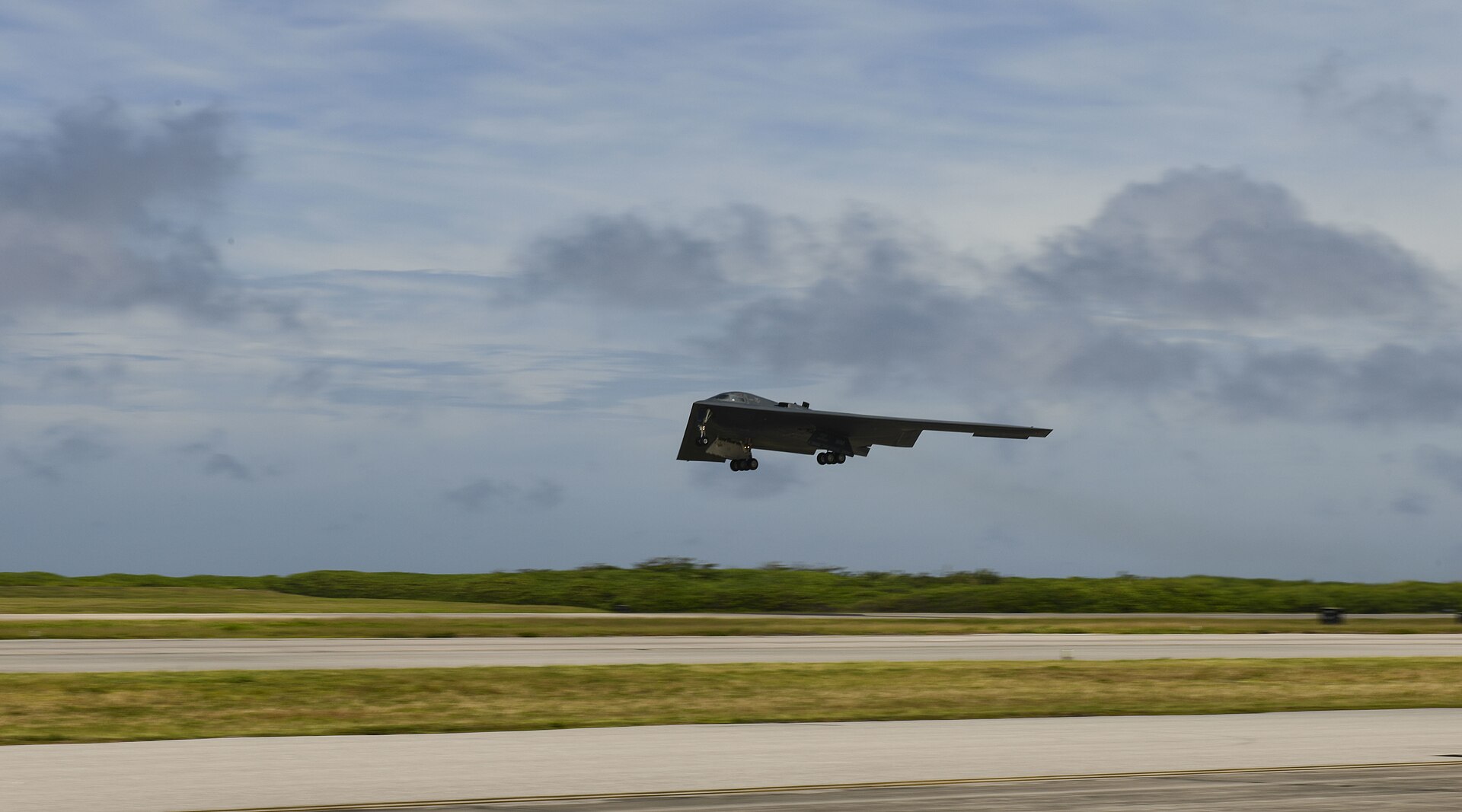
Trump’s phrase “nuclear dust” assumes enriched uranium was destroyed in place during the June 2025 B-2 strikes and now sits as irradiated rubble requiring excavation. The reality is more complicated — and potentially more dangerous. Satellite imagery published by the Bulletin of the Atomic Scientists in March 2026 showed 18 containers being moved from Fordow’s south tunnel entrance to Isfahan’s underground complex on June 9, 2025, one day before American strikes began.
The verified IAEA figure, recorded before inspectors were expelled on February 28, 2026, was 440.9 kilograms enriched to 60% purity. The Defense Intelligence Agency assessed in May 2025 that Iran could produce weapons-grade HEU from its 60%-enriched stockpile in “probably less than one week.” At 90% enrichment, the total stockpile yields fuel for approximately nine nuclear weapons.
Iran has not confirmed the June 9 transfer. The IAEA cannot verify it because Tehran expelled inspectors. And Trump’s public framing assumes a reality — dust, rubble, joint excavation — that may not correspond to what is actually underground. A single cascade of 175 IR-6 centrifuges could convert 60%-enriched material to weapons-grade fuel for one device in approximately 25 days. If the Isfahan stockpile is intact, the timeline from political decision to weapons capability is measured in weeks, not years.
Did Iran Accept Trump’s Nuclear Framing?
No. Tehran’s rejection was immediate, coordinated across civilian and military channels, and deliberately framed as a matter of national sovereignty. Foreign Ministry spokesman Baghaei stated that a uranium transfer “has never been under consideration.” Parliament Speaker Ghalibaf called Trump’s claims “lies.” The IRGC then restricted Hormuz access the same day — a physical punctuation mark on the verbal denial.
Tehran’s response came fast and from multiple directions. Baghaei’s television appearance was the diplomatic channel: transferring enriched uranium to America “has never been under consideration,” delivered with the weight of a formal position statement rather than a press-conference dodge. His invocation of enriched uranium as “sacred as Iranian soil” placed the stockpile explicitly within Iran’s sovereignty framework, borrowing the language Tehran has used since the Ahmadinejad era to frame enrichment as an NPT Article IV right that cannot be bargained away.
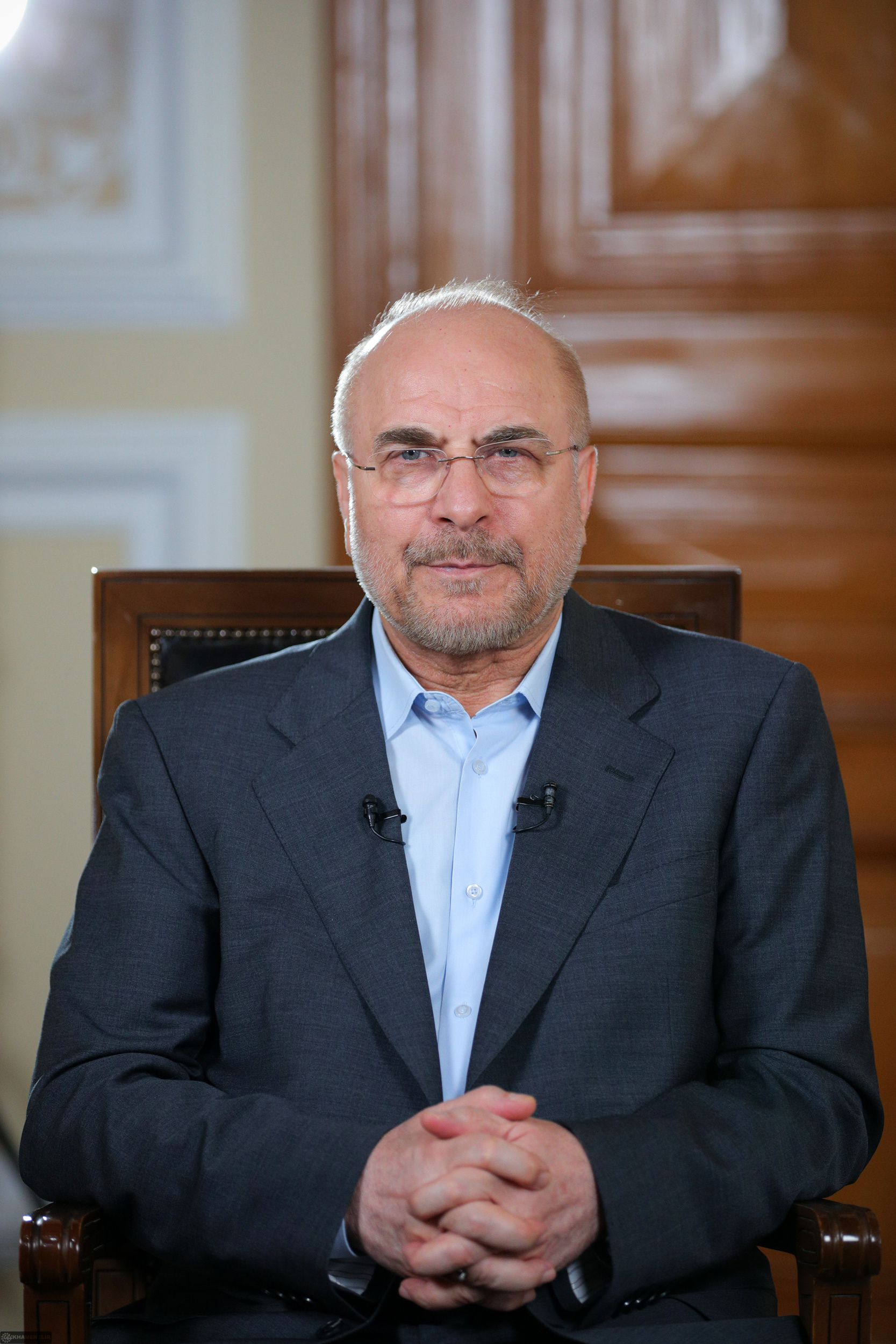
Parliament Speaker Mohammad Bagher Ghalibaf — whose IRGC Aerospace Force background (1997-2000) gives his words operational credibility that civilian politicians lack — posted on X that “with these lies, they did not win the war, and they certainly will not get anywhere in negotiations either.” The word choice mattered. By calling Trump’s claims “lies” rather than “mischaracterizations” or “premature,” Ghalibaf signaled that the IRGC-parliamentary bloc will not permit any formulation that resembles capitulation on the nuclear file. This is the same Ghalibaf who validated the IRGC’s reversal of Foreign Minister Araghchi on Hormuz with operational language about “field, not social media.”
The IRGC’s own response was characteristically physical rather than verbal. A senior Khatam al-Anbiya Central Headquarters source announced that the Strait of Hormuz was “once again heavily restricted” under “strict management of armed forces” — directly contradicting Trump’s separate claim about Hormuz being “permanently open.” The pattern is documented: Araghchi or Pezeshkian makes a conciliatory statement, and the IRGC overrides it within hours, as it did on April 17 with Hormuz and as Pezeshkian himself publicly accused on April 4, naming Vahidi and Abdollahi as the officials who wrecked the ceasefire mandate.
Commitment by Announcement: The North Korea Playbook
Trump’s tactic has a name and a precedent. After the June 2018 Singapore summit with Kim Jong-un, Trump announced that North Korea had committed to complete denuclearization. Kim had not agreed to the same terms. The public announcement forced Pyongyang into a binary: accept the American framing and be seen as having capitulated, or publicly repudiate it and be blamed for killing the deal. Academic literature on coercive diplomacy calls this “commitment by announcement” — the use of public claims to create political facts that constrain the other side’s negotiating space.
The Iran application follows the same structure. Trump’s public assertion that Tehran agreed to “everything” forces Iran to either stay silent (which Washington will treat as confirmation) or loudly deny it (which Trump will use to cast Iran as the spoiler). Baghaei and Ghalibaf chose the second path within hours. The North Korea precedent is instructive for what happened next: the deal collapsed, sanctions remained, and Kim retained his nuclear weapons. The announcement created a brief window of diplomatic theatre and a permanent stalemate.
The difference in 2026 is that a war is underway, a ceasefire expires in days, and the material under discussion has a weapons-conversion timeline measured in weeks. The Singapore summit’s failure cost diplomatic credibility. This one’s failure has a physics problem attached to it.
Why Did the Islamabad Nuclear Talks Collapse?
The core impasse was physical: Iran refused both to ship enriched uranium out of the country and to accept a moratorium longer than five years. The US demanded permanent cessation and physical transfer to American territory. Neither side had a mandate to bridge that gap. Vance walked out. Araghchi reportedly left “inches away” from a memorandum of understanding that was never signed.
Vice President JD Vance, special envoy Steve Witkoff, and Jared Kushner spent 21 hours in marathon talks with the Iranian delegation in Islamabad. Iran refused to commit to abandoning enrichment and refused to physically transfer HEU out of the country. Vance articulated the US position publicly: “The simple fact is that we need to see an affirmative commitment that they will not seek a nuclear weapon and they will not seek the tools that would enable them to quickly achieve a nuclear weapon.” The Iranians countered with a five-year moratorium offer and in-country down-blending — proposals the US rejected as insufficient.
Former diplomats told TIME that “Iranian officials were confused when the White House again sent Kushner and Witkoff, neither of whom has a background in nuclear policy.” The Arms Control Association reported that Araghchi “explained the stages of nuclear fuel production to Witkoff on several occasions” during the talks, and concluded that Witkoff had “failed to learn the nuclear file and surround himself with necessary technical expertise” — a judgment the association called “a diplomatic disservice to US and international nonproliferation goals.”
The 21-hour session produced no agreement, no framework, and no scheduled follow-up. What it did produce was Trump’s public claim, days later, that Iran had agreed to everything. The gap between the negotiating room and the press conference is not a communications failure. It is the strategy — and the contradiction was already explicit by April 17.
Saudi Arabia’s Double Bind
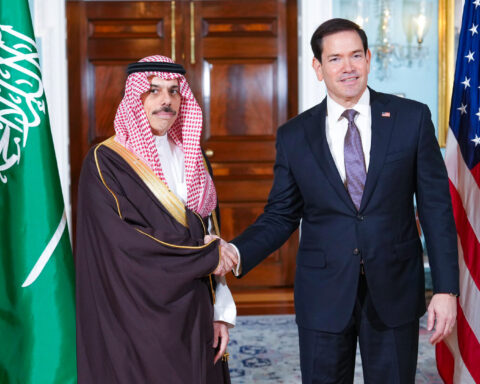
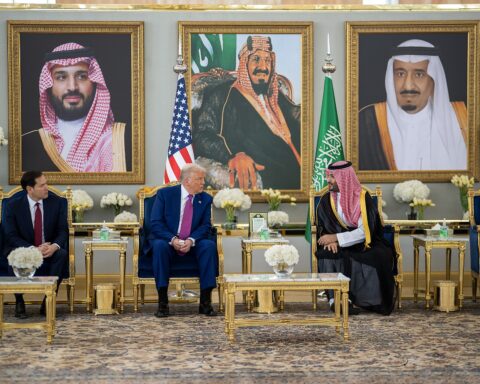
Riyadh’s problem is structural, not tactical. Saudi Arabia is not a party to the US-Iran nuclear talks, has not been consulted on terms, and is not represented in any negotiating framework — yet the enrichment moratorium under discussion directly constrains the kingdom’s own civilian nuclear programme. The three demands Saudi Arabia has consistently articulated — Hormuz sovereignty resolution, war reparations, and constraints on IRGC conventional force posture — do not appear in any version of the negotiating text. This is the JCPOA Gulf exclusion repeated: the second time in eleven years that a US-Iran nuclear bargain is being written over the heads of the states most directly affected by it.
The double bind is this: if Trump’s claim is true and Iran has genuinely agreed to surrender its nuclear programme, the resulting framework will almost certainly lock in an enrichment moratorium that applies regionally — constraining Saudi Arabia’s own nuclear ambitions without Riyadh having negotiated the terms. If Trump’s claim is false and the deal collapses, the escalation spiral resumes with a ceasefire expiring April 21-22, no extension mechanism, and Saudi Arabia bearing the brunt of a conflict it cannot end and did not start. Neither outcome protects the kingdom. Both outcomes were designed without its input.
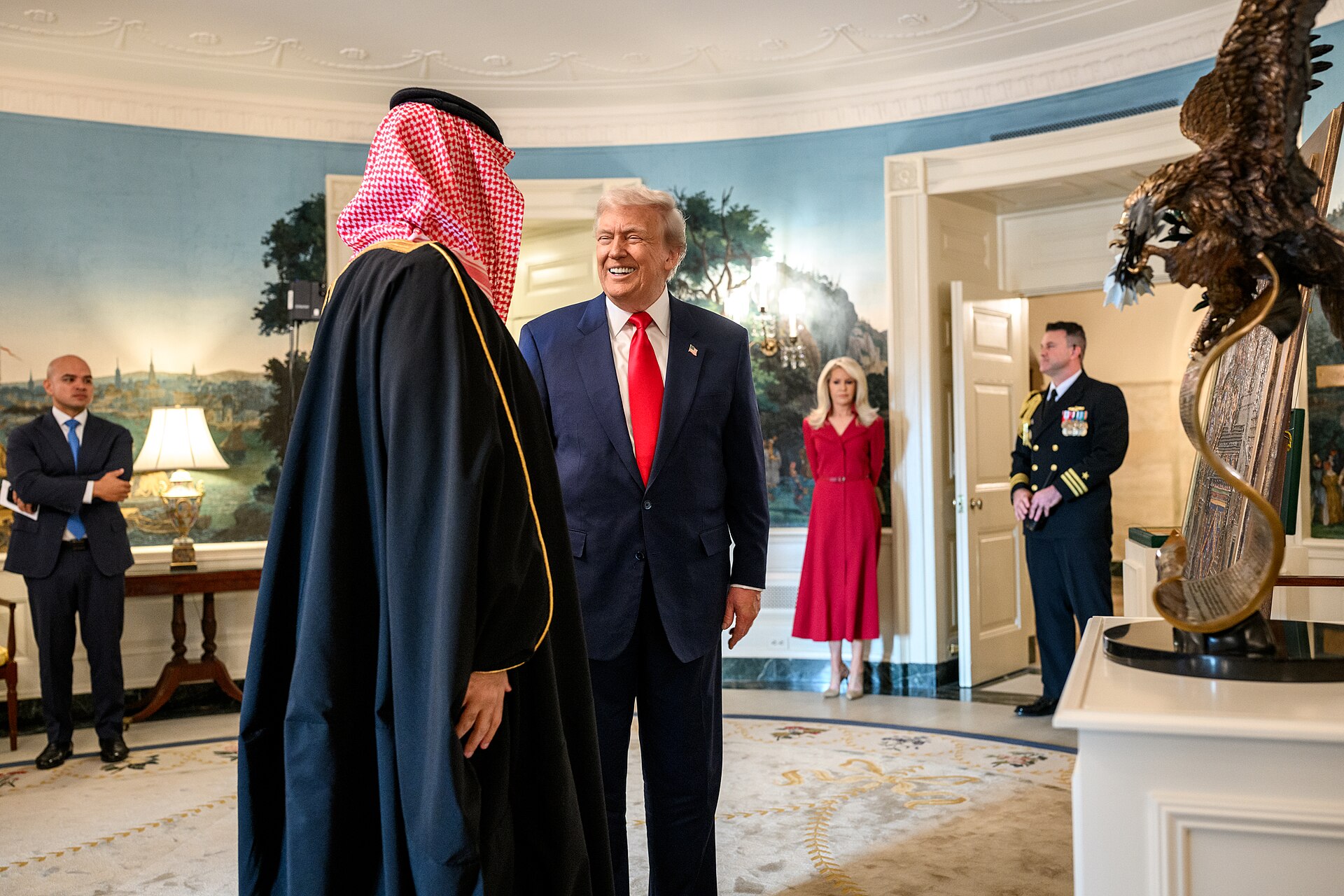
“Saudi Arabia does not want to acquire any nuclear bomb, but without a doubt if Iran developed a nuclear bomb, we will follow suit as soon as possible.” — Mohammad bin Salman, CBS 60 Minutes, 2018
MBS made that statement eight years ago. It remains Saudi Arabia’s declared position. The Stimson Center noted in April 2026 that the current talks proceed as though this position does not exist — as though the kingdom’s nuclear future is a variable that can be determined in a bilateral negotiation between Washington and Tehran.
The 123 Agreement Contradiction
The draft US-Saudi 123 civil nuclear cooperation agreement contains a clause stating that cooperation terms “shall be no less favorable in scope and effect” than agreements with other countries in the region. This is the same formulation embedded in the 2009 US-UAE nuclear agreement, which preserved potential enrichment rights for Abu Dhabi if other regional states received that right. The clause was designed as a parity guarantee — ensuring that the UAE would not be permanently disadvantaged by accepting restrictions that its neighbours avoided.
Applied to Saudi Arabia, the clause creates a direct contradiction with the US negotiating position in Islamabad. If Washington demands that Iran permanently abandon enrichment while simultaneously offering Saudi Arabia a cooperation agreement that preserves enrichment rights under certain conditions, the normative basis for the American non-proliferation argument collapses. Iran would be told it cannot enrich under any circumstances while Saudi Arabia retains the contractual right to do so if regional conditions change. The $20 billion under discussion for Iran’s stockpile transfer sits alongside a 123 agreement that implicitly values Saudi enrichment rights as a negotiable asset rather than a prohibited activity.
This is not a hypothetical tension. It is a drafting contradiction visible in parallel documents. The Arms Control Association flagged it in March 2026. PBS reported the clause’s existence. The Washington Institute analysed its implications. None of these warnings have altered the negotiating posture in Islamabad, because the talks are bilateral — and Saudi Arabia is not at the table.
The Window Has Closed
Iran cancelled the April 20 follow-up Islamabad round after the IRGC fired on an Indian tanker. The ceasefire expires April 21-22 with no confirmed extension mechanism — the Islamabad Accord’s structural deficiencies were evident from the start, and the Soufan Center noted the absence of any renewal clause. The negotiating window that opened with Vance’s 21-hour marathon has closed without producing a framework, a memorandum of understanding, or even a date for the next meeting.
What it produced instead was a public spectacle: Trump claiming total agreement, Iran denying everything, Bloomberg reporting limbo, and the IRGC re-restricting Hormuz while the diplomatic statements were still being parsed. The DIA’s “less than one week” assessment remains operative whether the stockpile is entombed rubble or an intact mobile cache. And the $20 billion the US was reportedly considering as an incentive for stockpile transfer remains unspent.
For Riyadh, the arithmetic is bleak. Saudi March oil production crashed to 7.25 million barrels per day — down 3.15 million from February’s 10.4 million. The kingdom’s fiscal break-even sits at $108-111 per barrel (Bloomberg’s PIF-inclusive estimate) against Brent crude at roughly $90. Goldman Sachs projects a war-adjusted deficit of 6.6% of GDP against the official 3.3% forecast. Every week the conflict continues without a nuclear framework costs the Saudi treasury money it does not have budgeted and narrows the diplomatic space it has not been invited to occupy.
The exclusion is the architecture. The JCPOA was negotiated without Saudi input in 2015 and produced a decade of regional instability that contributed directly to the current war. Its 2026 successor is being written in the same bilateral format, at a moment when the kingdom is simultaneously absorbing missile strikes, running an oil bypass at reduced capacity, and preparing to host 1.2-1.5 million Hajj pilgrims under wartime air-defence coverage with PAC-3 stocks at roughly 14% of pre-war levels. Riyadh has no mechanism to change the outcome from outside the room.
FAQ
What is Iran’s NPT Article IV enrichment right — and why does it matter for these talks?
Article IV of the Nuclear Non-Proliferation Treaty guarantees all signatory states the “inalienable right” to develop nuclear energy for peaceful purposes, which the IAEA has interpreted to include uranium enrichment under safeguards. Iran has cited this provision since the early 2000s as the legal basis for its enrichment programme. The US negotiating demand for a permanent enrichment ban effectively asks Iran to accept a treaty obligation below what Article IV grants, which is why Tehran frames any surrender of enrichment rights as a sovereignty violation rather than a non-proliferation concession.
What happened to Iran’s nuclear facilities in the June 2025 strikes — what was destroyed and what survived?
US B-2 bombers struck Fordow, Natanz, and Isfahan in June 2025. Fordow’s deep-buried centrifuge halls sustained structural damage, though independent assessments of how many operating IR-6 cascades were destroyed vary. Natanz’s above-ground enrichment hall was heavily damaged in earlier Israeli strikes in 2024. Isfahan’s underground complex, however, is the facility where the Bulletin of the Atomic Scientists’ March 2026 satellite analysis detected 18 containers being moved in on June 9 — one day before strikes began — suggesting a portion of the enrichment infrastructure or stockpile may have been pre-positioned and survived. No open-source assessment has confirmed total destruction of enrichment capacity.
How does the US naval blockade connect to the nuclear negotiation?
CENTCOM’s blockade, effective April 13, applies to Iranian-flagged vessels and ships paying IRGC Hormuz tolls rather than to all Strait traffic. Its coercive logic is economic: cutting Iran’s oil export revenue accelerates the Central Bank’s documented collapse timeline (180% inflation, 12-year recovery projection) and is designed to increase pressure on the Iranian government to accept nuclear terms. The five-day window between April 13 and April 18 — when the Hajj cordon raised the kinetic threshold for further escalation — was the intended pressure period. Iran cancelled the April 20 Islamabad round during that window rather than capitulating.
How would the $20 billion incentive payment actually reach Iran?
Axios reported the figure as part of frozen-asset release discussions rather than a direct cash transfer. Iran holds an estimated $6-10 billion in frozen assets in South Korea, Japan, and Iraq under US sanctions, with additional funds frozen in European jurisdictions. The mechanism under discussion would unblock these accounts in tranches tied to verified stockpile transfer milestones — similar in structure to the $6 billion South Korea release under the September 2023 prisoner swap, which was subsequently re-frozen after the Hamas October 7 attack. Any release requires OFAC authorisation, meaning the US Treasury controls the tap regardless of what the political track agrees.
What enrichment rights does the UAE’s 2009 123 agreement actually grant — and why does this create a problem for US policy?
The 2009 US-UAE agreement, known as the “gold standard” 123 deal, required Abu Dhabi to voluntarily forswear uranium enrichment and plutonium reprocessing. The parity clause — “no less favorable in scope and effect” — was inserted to protect the UAE from being permanently disadvantaged if a regional neighbour later obtained enrichment rights through a different agreement. In practice, this means that if the US-Saudi 123 deal preserves enrichment rights for Riyadh (as the current draft reportedly does, conditioned on regional parity), the UAE’s voluntary forswearing could be revisited. More immediately, it means the US is simultaneously negotiating a framework that denies Iran any enrichment while offering Saudi Arabia a contractual path to enrichment — a normative inconsistency that Iran’s negotiating team has explicitly raised in Islamabad.