Table of Contents
- “Delays” Is Not De-Escalation — The Tasnim Headline as Countdown Clock
- What Happened to the MV Touska on April 19?
- The Family-Inhibition Statement as Removal Trigger
- Why Did Islamabad Round 2 Collapse Before It Started?
- Forty-Eight Hours of Convergent Deadlines
- Who Authorizes the Strike When There Is No Commander?
- Saudi Arabia’s Bab el-Mandeb Problem
- How Many Days of Air Defense Does Saudi Arabia Have Left?
- The Grace 1 Precedent and the Compressed Timeline
- Frequently Asked Questions
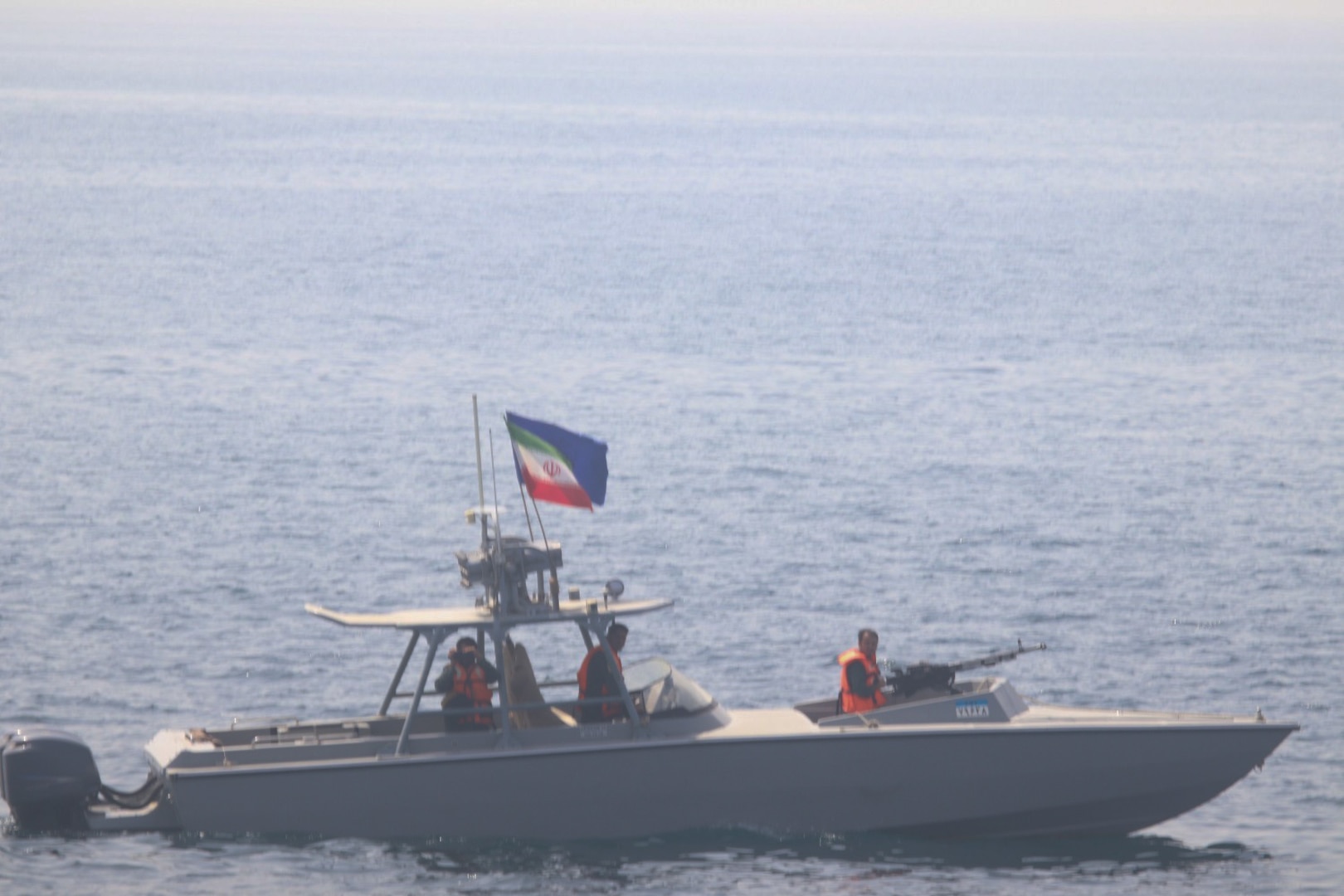
ISLAMABAD — Iran’s top military command told the world on April 20 exactly what is preventing a retaliatory strike against the United States Navy — and every Western newsroom that reported it as restraint missed the sentence that makes it a countdown. The Khatam al-Anbia Central Headquarters, the IRGC’s joint command responsible for coordinating cross-service operations, published a statement through Tasnim News Agency declaring its forces “constrained in order to preserve the lives and security” of crew family members aboard the seized cargo ship MV Touska, “which were in danger at any moment,” and that Tehran would “take the necessary action” once that safety condition was met. The operative word in Tasnim’s own headline — “Iran Delays Response to US Attack on Cargo Ship over Crew Family Safety” — is “delays,” not “cancels,” and the distinction between those two words is the difference between a diplomatic signal and an armed countdown with a publicly named removal trigger.
That distinction lands in the middle of a 48-hour window during which three separate clocks are running simultaneously: the ceasefire expires April 22 with no extension mechanism, Islamabad Round 2 has collapsed before a single negotiator sat down, and Saudi Arabia — whose formal request that the United States lift the Hormuz blockade was reported by the Wall Street Journal on April 20 — is watching its only remaining functional export corridor at Bab el-Mandeb come under threat precisely because the action it asked Washington to stop is the same action that created the IRGC’s stated trigger. None of these clocks can be paused independently of the others, and the family-inhibition statement connects all three to a single variable: whether and when the Touska’s civilian passengers are removed from the vessel.
“Delays” Is Not De-Escalation — The Tasnim Headline as Countdown Clock
The standard Western reading of Iran’s restraint statements since the war began on February 28 has been to treat them as face-saving language — the kind of formulation that allows an adversary to absorb a blow without responding, provided the domestic audience accepts the framing. That reading has been correct often enough to become reflexive: when Iran “warns” and then does not strike, analysts score it as deterrence working. But the April 20 Khatam al-Anbia statement does something structurally different from prior warnings, and the difference is visible in the grammar before it becomes visible in the military posture.
Prior IRGC statements on Hormuz — including the April 12 “full authority” declaration and the April 18 reversal of Araghchi’s opening signal — asserted capability and intent without specifying a condition that would trigger action. They were posture statements: we can, and we will, at a time of our choosing. The Touska statement inverts that structure by naming the specific inhibition and, by implication, announcing that the inhibition’s removal is the trigger. “Constrained in order to preserve the lives and security” of family members is not a capability claim or a timeline threat; it is a conditional hold with a known binary variable. Either the families are aboard, or they are not.
This is the first time in the current conflict that the IRGC has publicly identified a humanitarian condition as the sole stated barrier to a military response. Tasnim — an outlet aligned with IRGC intelligence and consistently used to signal operational intent rather than diplomatic messaging — headlined the statement as a “delay,” not a stand-down. That editorial choice is itself a signal, and it is one that CNN’s April 20 legal analysis of the Touska seizure and Al Jazeera’s diplomatic-collapse coverage both failed to flag.
What Happened to the MV Touska on April 19?
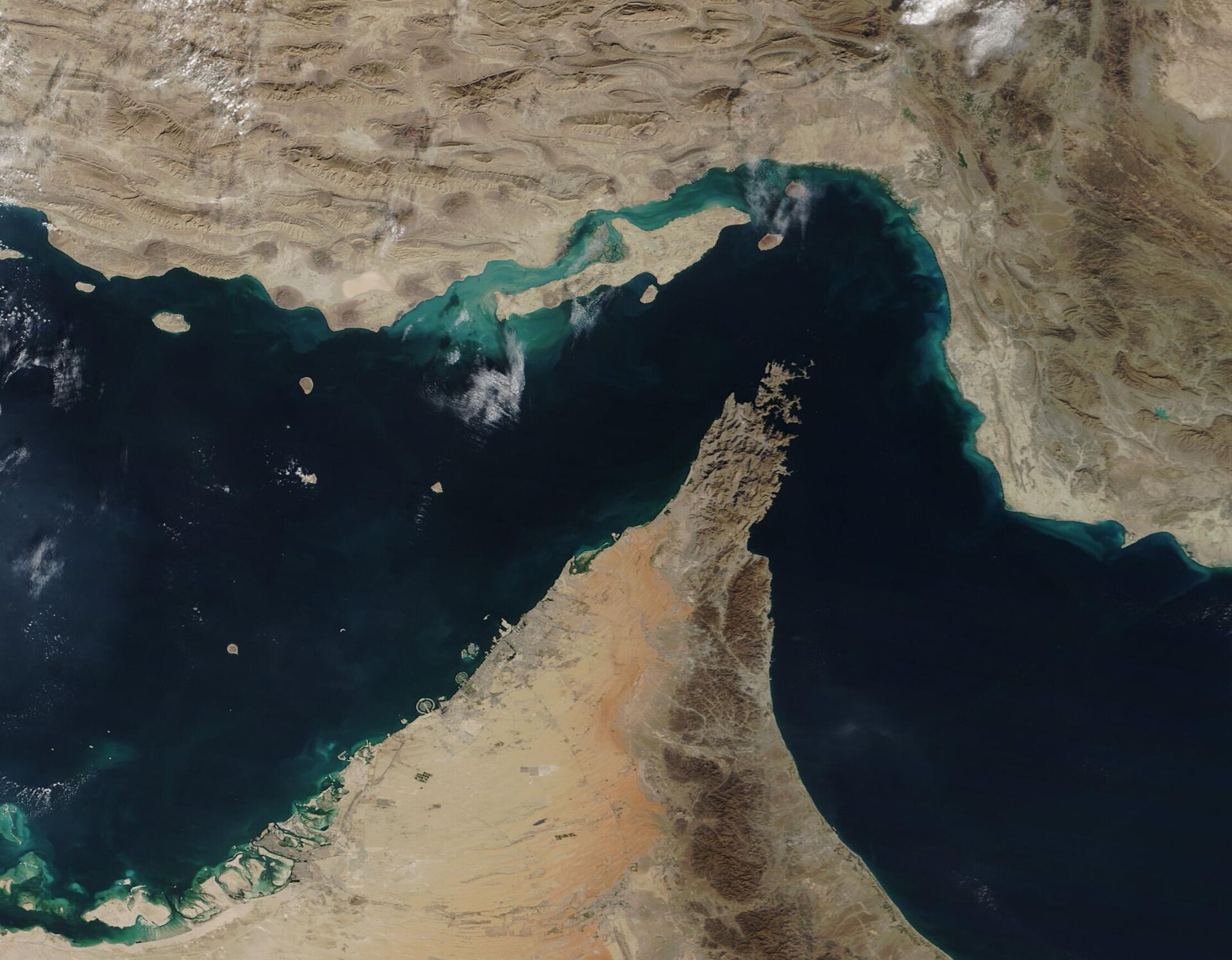
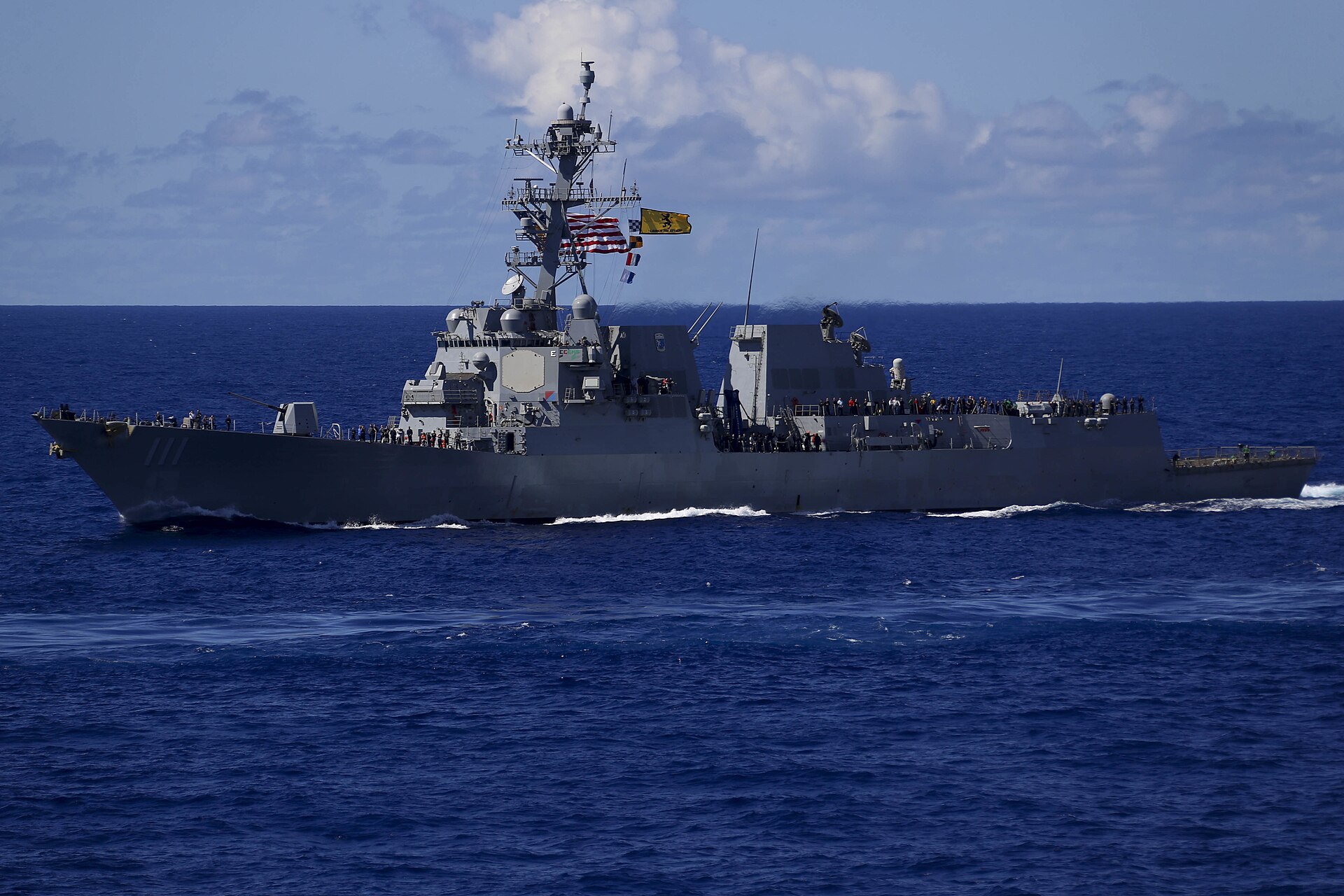
The MV Touska is a 54,851 gross-tonnage, 294-metre cargo vessel operated by Hafiz Darya Shipping Line under Rahbaran Omid Darya Ship Management — both subsidiaries of the Islamic Republic of Iran Shipping Lines (IRISL), which has been under OFAC sanctions since 2008. On April 19, the Touska was transiting toward Bandar Abbas at 17 knots through the north Arabian Sea when USS Spruance (DDG-111), an Arleigh Burke-class guided-missile destroyer, intercepted and initiated a standoff that lasted approximately six hours, according to CENTCOM, CNN, and CNBC reporting published that day. After the vessel refused to comply with boarding orders, Spruance disabled the Touska’s propulsion by firing its 5-inch MK 45 gun — an act that Donald Trump described on Truth Social as the Navy having “stopped them right in their tracks by blowing a hole in the engine room” after the crew “refused to listen.”
The Middle East briefing 3,000+ readers start their day with.
One email. Every weekday morning. Free.
Visit, Board, Search, and Seizure (VBSS) teams from USS Tripoli (LHA-7), a Wasp-class amphibious assault ship, then fast-roped aboard the Touska at night. As of April 20, the cargo manifest had not been released; Trump said US troops were “seeing what’s on board,” per Al Jazeera and CNN. The vessel’s cargo status remains unknown. What is known is that family members of the crew were aboard — a detail that would ordinarily be a footnote in a maritime-interdiction story but has become the central variable in the IRGC’s stated decision calculus.
IRGC spokesperson Ebrahim Zolfaghari, speaking on Iranian state television on April 19, delivered the threat component before the conditional component was published: “We warn that the Armed Forces of the Islamic Republic of Iran will soon respond to this act of armed piracy and theft by the American military and will retaliate.” The Khatam al-Anbia statement the following day added the inhibition — and by adding it publicly, converted a general threat into a specific mechanism.
The Family-Inhibition Statement as Removal Trigger
The analytical problem with treating the family-inhibition statement as de-escalation is that the statement itself provides the conditions under which it ceases to apply. If the IRGC had said “we will not retaliate while diplomatic channels remain open,” the removal trigger would be ambiguous — diplomacy can be declared alive or dead at will, and the IRGC has previously used that ambiguity to defer action indefinitely (as it did through the first three weeks of the Islamabad process). But “constrained in order to preserve the lives and security” of specific people aboard a specific ship is a binary condition that resolves in one of two ways: the families leave the ship, or they don’t.
No timeline for crew disembarkation has been announced by CENTCOM, the US Navy, or any Iranian source. CNN, NBC, and Al Jazeera all reported the family-safety framing on April 20 without noting that the absence of a disembarkation timeline means the countdown has no known endpoint — which, from the IRGC’s operational perspective, is an advantage rather than a deficiency. An unspecified removal window forces the adversary to maintain a heightened defensive posture across an indefinite period, consuming readiness and attention in a theatre where both are already depleted.
Meanwhile, partial retaliation is already underway beneath the family-inhibition threshold. Iranian forces launched drones at US warships in the Gulf of Oman on April 19 and 20, according to Tasnim, IRIB, Mehr, Iran International, and ANI. The drone strikes — which the inhibition statement does not address — suggest the IRGC is distinguishing between proportional harassment (drones, which continue) and a major escalatory response (which is paused). The inhibition, in other words, applies only to the upper register of the retaliation spectrum, while the lower register is already active.
Why Did Islamabad Round 2 Collapse Before It Started?
The Touska seizure landed on April 19. Iran’s Foreign Minister Araghchi declared “no plans to send negotiators” to Islamabad within hours, calling US demands “childish” — a word borrowed from First Vice President Mohammad Reza Aref, who told BusinessToday.in on April 20 that Washington was “seeking a ceasefire and negotiations under pressure, then adopting a more hardline attitude afterwards.” The sequencing is important: the seizure did not interrupt ongoing talks; it pre-empted talks that had not yet started, converting what Pakistan had prepared as a “multi-day” framework (per unnamed Pakistani officials cited by Al Jazeera on April 20) into a venue without participants.
Iran’s state news agency IRNA was explicit about the cause, citing “excessive U.S. demands, shifting positions and the continued naval blockade” as reasons there was “no clear prospect” for resumption. The blockade reference connects directly to Saudi Arabia’s own position: the Wall Street Journal reported on April 20 that Riyadh had formally asked Washington to lift the Hormuz blockade, warning it risked Houthi activation of Bab el-Mandeb. Saudi Arabia, in other words, was asking the United States to remove the same coercive pressure that Witkoff and Kushner (both en route to Islamabad, per Axios and Fortune) intended to use as negotiating pressure — a structural contradiction that neither capital appears to have resolved.
The collapse also exposes the authorization ceiling that President Pezeshkian publicly named on April 17, when he accused SNSC Secretary Vahidi and Khatam al-Anbia commander Abdollahi of wrecking the first Islamabad round. Araghchi’s refusal to travel is consistent with a diplomat who knows his mandate will be overridden by military commanders operating outside presidential authority — a pattern that has repeated at every stage of the Islamabad process and one that the Touska seizure has now rendered moot, because the IRGC no longer needs to wreck a diplomatic process that has already collapsed on its own terms.
Forty-Eight Hours of Convergent Deadlines
Three separate clocks are now running toward the same 48-hour window, and none of them has a pause mechanism. The ceasefire negotiated under the Islamabad Accord expires on April 22 — a deadline the Soufan Center, CNN, and CBS News have all confirmed has no extension provision in the original text. Pakistan’s PM Sharif and CDF Munir are, per unnamed Pakistani officials quoted by Al Jazeera on April 20, “reassuring Gulf allies and attempting to build a broader support coalition” while Munir is “engaged in hard negotiations between the two sides to narrow gaps between Iran and the US, with an eye on extending the ceasefire.” But extension requires both parties to agree, and one party has just declared no plans to send negotiators.
The family-inhibition window sits inside this expiry timeline. If crew families are removed from the Touska before April 22, the IRGC’s stated constraint lifts before the ceasefire’s legal (such as it is) framework expires — creating a window in which retaliation would be both operationally uninhibited and juridically unconstrained. If the families remain aboard past April 22, the ceasefire expires anyway, removing the diplomatic architecture that gave restraint its political utility. Either path converges on the same endpoint: a post-April 22 environment in which the IRGC faces no stated reason to hold fire.
The third clock is Hormuz itself. Iran re-closed the strait on April 18 after briefly signaling openness on April 17 — a reversal that followed the now-familiar pattern of the IRGC overriding diplomatic signals within hours. As of April 20, Brent crude had climbed 6.5% to $96.25, per CNBC, still well below Saudi Arabia’s fiscal break-even of $108–111 per barrel (Bloomberg, PIF-inclusive estimate). Saudi March production stood at 7.25 million barrels per day, down from 10.4 million in February — a 30% collapse documented by the IEA and covered in the April 17 production-crash analysis.
| Deadline / Variable | Date | Status (April 20) | Source |
|---|---|---|---|
| Ceasefire expiry | April 22 | No extension mechanism; Iran refuses talks | Soufan Center, CNN, CBS News |
| Touska family disembarkation | Unknown | No timeline announced; families still aboard | CENTCOM, CNN, Al Jazeera |
| Islamabad Round 2 | Was April 20–21 | Collapsed; Araghchi refuses to travel | IRNA, Al Jazeera, BusinessToday.in |
| Hormuz status | Re-closed April 18 | Closed; IRGC “full authority” in effect | PressTV, CNN Business |
| Brent crude | April 20 | $96.25 (+6.5%); Saudi break-even $108–111 | CNBC, Bloomberg |
| Saudi production | March 2026 | 7.25M bpd (down 30% from Feb 10.4M) | IEA |
Who Authorizes the Strike When There Is No Commander?
Rear Admiral Ali Reza Tangsiri, commander of the IRGC Navy, was killed on March 30. As of April 20, no successor has been named — a 21-day vacancy in what is arguably the most operationally active command in the Iranian military during a maritime conflict. The April 12 “full authority” declaration by the IRGC Navy asserted control over Hormuz even while the command structure that would authorize and coordinate a major naval response remained headless, a condition that has persisted through the mine-chart publication, the Larak corridor redirection, and now the Touska crisis.
The vacancy matters not because it prevents action but because it decentralizes the decision to act. Under Article 176 of the Iranian constitution, IRGC Navy orders require Supreme National Security Council authorization and, in theory, Supreme Leader ratification. But Khamenei’s absence from public life — now at approximately 47 days — and the authorization ceiling Pezeshkian described on April 17 (in which Vahidi and Abdollahi operated outside the president’s mandate at Islamabad Round 1) mean that the formal chain of command is not functioning as designed. Retaliation timing, in a decentralized structure without a named navy commander and without visible Supreme Leader engagement, cannot be predicted from a single authorized decision-maker.
Marc Weller, a Chatham House associate fellow specializing in international law and armed conflict, has argued that the US-Israel strikes “created an international armed conflict that transforms Hormuz into a belligerent strait — a status that gives belligerent navies broader authority to interdict enemy-flagged vessels than peacetime UNCLOS would permit.” If that framing is correct, the IRGC’s decentralized commanders may not believe they need centralized authorization to act against US naval assets in what they consider a belligerent waterway — particularly when their own joint command has already published the removal condition for restraint.
The U.S.-Israel strikes on Iran created an international armed conflict that transforms Hormuz into a belligerent strait — a status that gives belligerent navies broader authority to interdict enemy-flagged vessels than peacetime UNCLOS would permit.
Marc Weller, Chatham House associate fellow, April 2026
Saudi Arabia’s Bab el-Mandeb Problem
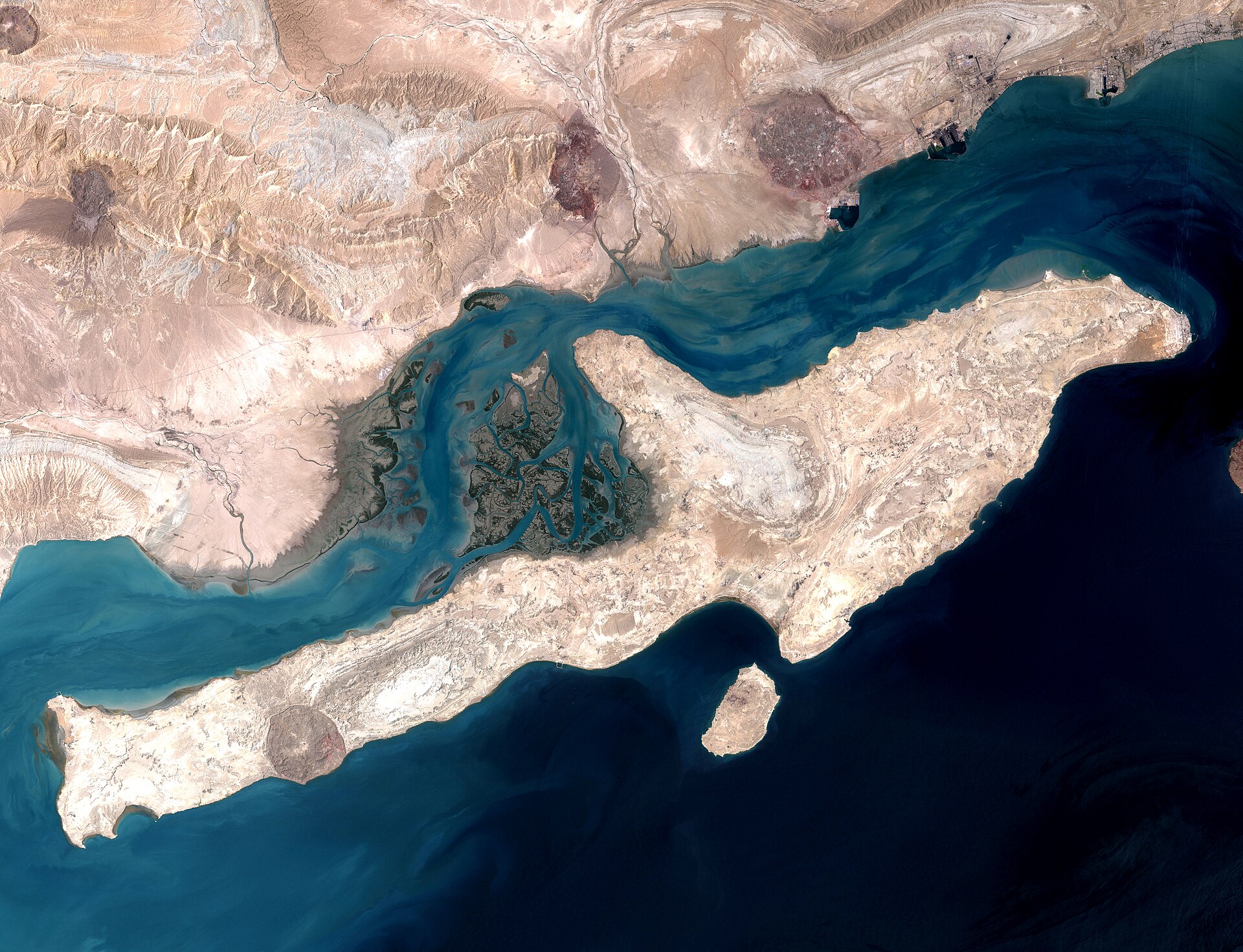
The Wall Street Journal report that Saudi Arabia formally asked the United States to lift the Hormuz blockade is, on its face, a story about Riyadh’s concern over the strait. But the warning Riyadh attached — that the blockade risks Houthi activation of Bab el-Mandeb — reveals which chokepoint Saudi planners are actually most worried about, and it is not the one that dominates the headlines. With Hormuz already closed since April 18, Saudi crude exports have been rerouted through the East-West Pipeline to Yanbu on the Red Sea coast, a bypass that covers a theoretical maximum of 7 million barrels per day but operates at an effective ceiling of 4–5.9 million barrels per day given the pipeline damage and Yanbu loading constraints documented as early as April 5.
Every barrel that exits Yanbu must transit Bab el-Mandeb — the 20-mile-wide strait between Yemen and Djibouti that Houthi forces have been intermittently disrupting since November 2023. If the Hormuz blockade triggers Houthi activation at Bab el-Mandeb (whether through direct Iranian instruction or through the Houthis’ own escalation logic), Saudi Arabia loses both chokepoints simultaneously. That is not a hypothetical scenario Riyadh is gaming out; it is the explicit warning Saudi officials delivered to Washington, per the WSJ, and the fact that they delivered it publicly enough to be reported suggests the private conversations were more pointed.
Iran MFA spokesman Esmaeil Baghaei reinforced the pressure on April 20, citing “breaches of the truce as well as international law” — language that frames the Touska seizure not as an isolated incident but as a pattern of ceasefire violations that, under the IRGC’s own logic, releases Iran from obligations it accepted under the Islamabad Accord. The Khatam al-Anbia statement on PressTV from April 19 was even more direct: the US had “violated the ceasefire and committed maritime piracy by firing at an Iranian merchant ship in the waters of the Sea of Oman,” and the vessel “was peacefully sailing from China to Iran.” Whether that characterization is legally accurate is secondary to its operational function: it provides the institutional justification for retaliation that the family-inhibition statement has only temporarily paused.
How Many Days of Air Defense Does Saudi Arabia Have Left?
Saudi Arabia’s PAC-3 missile-defense inventory stands at approximately 400 rounds, roughly 14% of the pre-war stockpile, according to the April 17 analysis of Hajj wartime air-defense arithmetic. The pre-ceasefire burn rate — the rate at which interceptors were consumed during active Iranian strikes on Saudi infrastructure — averaged approximately 63 rounds per day. At that rate, 400 rounds provides fewer than seven days of sustained combat coverage, and Lockheed Martin’s replenishment timeline for PAC-3 MSE interceptors extends to mid-2027.
Those numbers land differently after April 22. During the ceasefire, the PAC-3 deficit was a vulnerability on paper — a risk that would materialize only if hostilities resumed. With the ceasefire expiring in 48 hours and no extension in sight, the deficit becomes an operational constraint on Saudi Arabia’s ability to absorb the kind of multi-axis strike the IRGC demonstrated in early April, when ballistic missiles hit the Eastern Province frequently enough to trigger the King Fahd Causeway closure on April 7. The five-layer defense architecture (THAAD, PAC-3, KM-SAM, directed energy, and point defense) remains nominally intact, but the PAC-3 layer — the one that intercepts ballistic missiles in their terminal phase — is the layer that matters most against the IRGC’s Zolfaqar and Emad inventory, and it is the layer running closest to empty.
| Defense Layer | Inventory / Status | Coverage at Pre-Ceasefire Burn Rate | Replenishment |
|---|---|---|---|
| PAC-3 MSE | ~400 rounds (~14% pre-war) | <7 days | Mid-2027 (Lockheed Martin) |
| THAAD | Operational (US-deployed) | Limited interceptor count (classified) | Dependent on US resupply |
| KM-SAM (Cheongung II) | Deployed | Medium-altitude layer; not terminal BMD | South Korean production line |
| Directed energy / laser | Developmental | Point defense only | N/A |
The Grace 1 Precedent and the Compressed Timeline
In July 2019, Royal Marines seized the Iranian-flagged supertanker Grace 1 off Gibraltar on suspicion of carrying crude oil to Syria in violation of EU sanctions. Approximately 14 days later, the IRGC seized the British-flagged tanker Stena Impero in the Strait of Hormuz — a tit-for-tat counter-seizure that followed a period of public warnings and back-channel negotiations. The 2019 sequence is the closest historical analogue to the Touska situation, and the timeline compression between then and now is the detail that matters most.
In 2019, the IRGC had 14 days, no competing deadline, and a functioning command structure under Tangsiri (who was alive and in post). In 2026, the ceasefire expires in 48 hours, the IRGC Navy command is headless, and the inhibition mechanism — the family-safety condition — could resolve in hours rather than weeks. The IRGC’s stated mechanism is faster than its own historical precedent, and the convergent deadlines give it less room to extend the timeline even if it wanted to. The 2019 counter-seizure was a calibrated response designed to create a symmetrical hostage situation that would force a negotiated swap; the 2026 situation offers no equivalent symmetry because the US is not a trading partner whose commercial vessels regularly transit waters Iran controls.
The Tanker War of 1984–1988 offers a deeper but less precise parallel: Iran maintained tactical restraint at sea while building operational readiness onshore, a pattern that produced sudden escalations (the mining of USS Samuel B. Roberts in April 1988, for instance) after extended periods of apparent calm. The IRGC’s current posture — drone strikes already underway, major retaliation paused on a named condition, mine charts published, the Larak corridor operational — fits the same profile of restrained surface behavior layered over prepared escalation infrastructure.
We warn that the Armed Forces of the Islamic Republic of Iran will soon respond to this act of armed piracy and theft by the American military and will retaliate.
Ebrahim Zolfaghari, IRGC Khatam al-Anbia spokesperson, state television, April 19 (via CNN, CNBC)
The word “soon” in Zolfaghari’s statement, delivered before the family-inhibition condition was published, establishes a timeline expectation that the subsequent Khatam al-Anbia statement did not retract — it merely specified what was holding “soon” in place. When that hold lifts, “soon” is the only stated timeline, and in a decentralized command without a named navy commander, “soon” is whatever the next operational commander in the chain decides it means.
Frequently Asked Questions
What is the MV Touska’s cargo and why hasn’t it been disclosed?
As of April 20, neither CENTCOM nor the White House has released the Touska’s cargo manifest. Trump’s comment that US troops were “seeing what’s on board” suggests the inspection is ongoing or that the contents are being assessed for intelligence value before public disclosure. The cargo’s nature matters because it determines whether the seizure can be legally framed as sanctions enforcement (if the cargo includes dual-use or sanctioned materials) or whether Iran’s characterization of “maritime piracy” against a vessel “peacefully sailing from China” gains traction in international legal forums. IRISL vessels have historically carried both commercial goods and military components, and the distinction will shape the legal arguments both sides make if the case reaches the International Maritime Organization or the International Court of Justice.
Could the US Navy transfer the Touska’s crew families to a neutral vessel to defuse the crisis?
Theoretically, yes — the US Navy has conducted humanitarian transfers at sea before, and moving civilians to a neutral or allied vessel would be logistically straightforward from an Arleigh Burke-class destroyer or the Tripoli’s deck. But doing so would remove the IRGC’s stated inhibition, which means the transfer itself could be the trigger for escalation. The US may be calculating that keeping families aboard — however uncomfortable the optics — buys time that their removal would eliminate. That calculation becomes harder to sustain past April 22 when the ceasefire framework, which provides at least nominal diplomatic cover for restraint on both sides, expires.
What legal authority did the USS Spruance invoke for the seizure?
CENTCOM has not specified the legal basis. Possible frameworks include UN Security Council Resolution 2231 (which governs Iran’s arms-related transfers), the International Emergency Economic Powers Act (IEEPA, which underpins OFAC sanctions on IRISL and its subsidiaries), or belligerent-rights doctrine under the law of armed conflict — the framework Marc Weller at Chatham House has argued now applies to Hormuz. The choice of legal framework matters because belligerent-rights seizure implies the US considers itself in an armed conflict with Iran (which Washington has not formally declared), while sanctions enforcement implies a law-enforcement action that sits uneasily with firing a 5-inch gun at a merchant vessel’s engine room. Iran’s MFA, through spokesman Esmaeil Baghaei, has cited “breaches of the truce as well as international law” without specifying which legal framework it considers violated — a deliberate ambiguity that preserves maximum response options.
Has Iran ever publicly announced a humanitarian condition before striking?
Not in this form. The IRGC has previously delayed responses — the 2020 retaliation for the Soleimani assassination was telegraphed hours in advance through back-channel warnings to Iraqi intermediaries, per reporting by the New York Times and NBC at the time. But publicly naming a specific humanitarian inhibition condition through state-aligned media, with the explicit framing that action will follow once the condition is resolved, is without precedent in the IRGC’s operational history. The transparency is itself the signal: it ensures that when the inhibition lifts, the subsequent action carries the institutional legitimacy of a announced response rather than the stigma of a surprise attack, both domestically and in the court of international opinion.
What happens to Hajj pilgrims if hostilities resume after April 22?
The Hajj arrival window opened April 18, with Pakistan’s 119,000 pilgrims arriving that day and Indonesia’s 221,000 departing April 22 — the same day the ceasefire expires. Between 1.2 and 1.5 million pilgrims will be in or en route to the Hejaz during the post-ceasefire period. Saudi Arabia’s Custodian of the Two Holy Mosques title, adopted by King Fahd in 1986 specifically to assert sovereign religious authority after the 1979 Grand Mosque seizure and the 1987 Makkah massacre (in which 402 people were killed, 275 of them Iranian pilgrims), makes pilgrim safety a legitimacy issue that transcends military calculation. Resumed hostilities during Hajj would force Saudi Arabia to defend pilgrims with depleted air-defense stocks while simultaneously managing a population that cannot be evacuated quickly through a single remaining international corridor — a constraint that Iran, which has zero Hajj pilgrims this year (Iranian participation has been barred since the war began), does not share.