
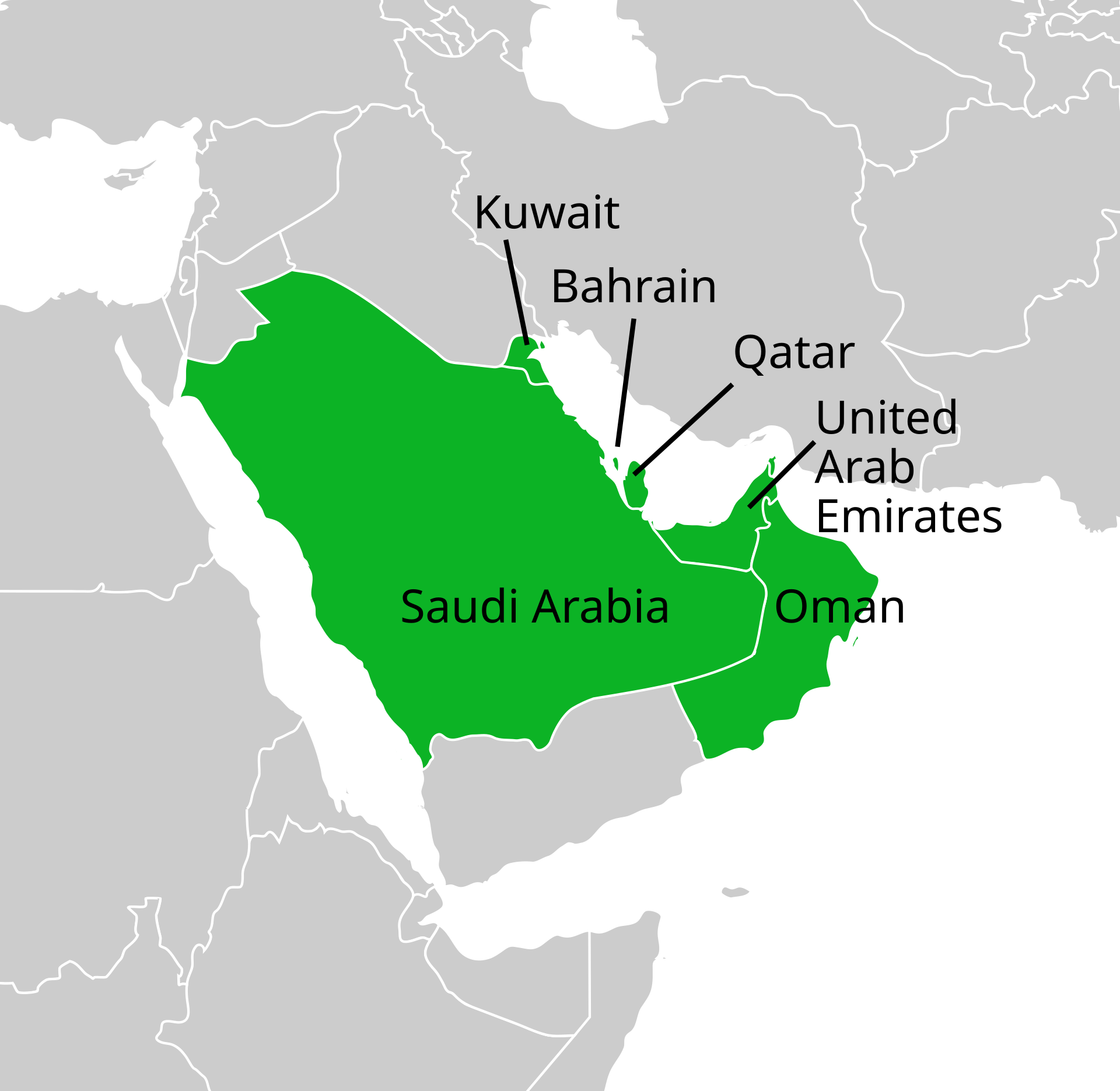
ABU DHABI — The United Arab Emirates has formally committed naval forces to the US-led multinational coalition tasked with reopening the Strait of Hormuz, making it one of only two Middle Eastern states — alongside Bahrain — to join a 22-nation military grouping that Saudi Arabia, Qatar, Oman, and Kuwait have all declined to enter. The coalition, anchored by the USS Gerald R. Ford and USS Abraham Lincoln carrier strike groups, began mine-clearance operations on April 11 under CENTCOM General Dan Caine, with UAE Baynunah-class corvettes assigned to escort and patrol duties in the strait’s approaches.
The split is the most consequential formal break in Gulf Cooperation Council collective security posture since the 2017 Qatar blockade — but its logic runs deeper than diplomatic preference. Saudi Arabia holds the only pipeline bypass large enough to sustain the bulk of its crude exports outside Hormuz, maintains the only direct energy-negotiating channel with Tehran that Iran has accepted since the war began, and faces an air-defence stockpile crisis that makes additional Iranian escalation an existential fiscal risk. Joining the coalition would compromise all three.
Table of Contents
The Coalition: 22 Nations, Two Gulf States
The coalition’s formal genesis was the March 21 joint statement, co-signed by 22 nations, condemning Iran’s “de facto closure” of the Strait of Hormuz and declaring readiness to “contribute to appropriate efforts to ensure safe passage.” The UAE and Bahrain are the only Middle Eastern signatories. Every other regional state — Saudi Arabia, Qatar, Oman, Kuwait, Turkey — stayed out.
The UAE had signalled its position earlier than any Gulf state. On March 18, Abu Dhabi became the first Middle Eastern capital to publicly declare willingness to join a US-led military effort to secure Hormuz, three days before the joint statement was finalised. The UAE subsequently proposed a named structure — a multinational “Hormuz Security Force” — and communicated the proposal directly to Washington and partner capitals, according to The Defense News.
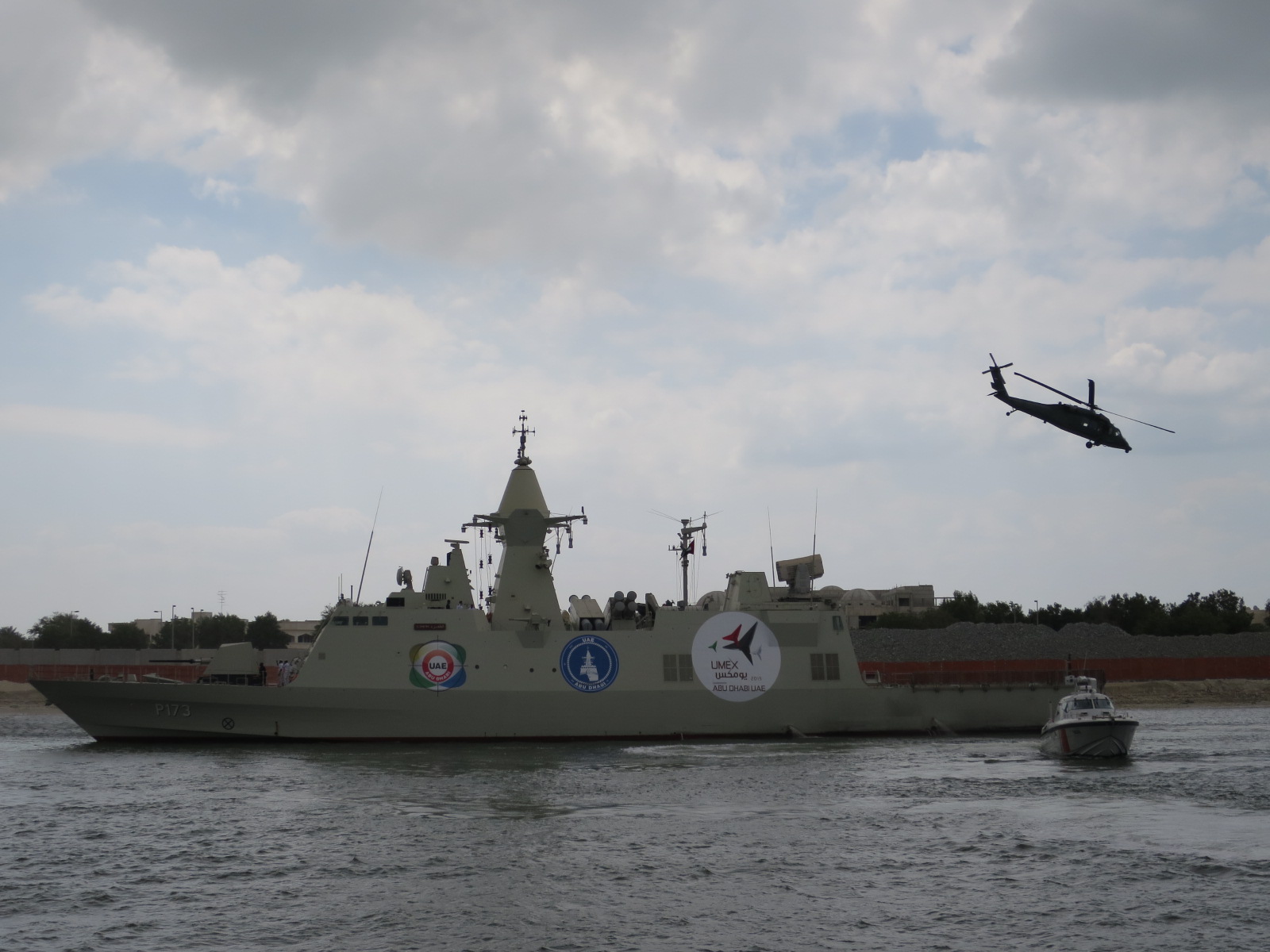
Abu Dhabi’s naval contribution is not symbolic. The UAE Navy’s six Baynunah-class corvettes carry MM40 Exocet Block 3 anti-ship missiles with a range of approximately 180 kilometres and RIM-162 ESSM air-defence missiles — a surface combatant capability that exceeds what most of the coalition’s smaller European contributors have deployed. The UAE Navy fields 79 active vessels in total.
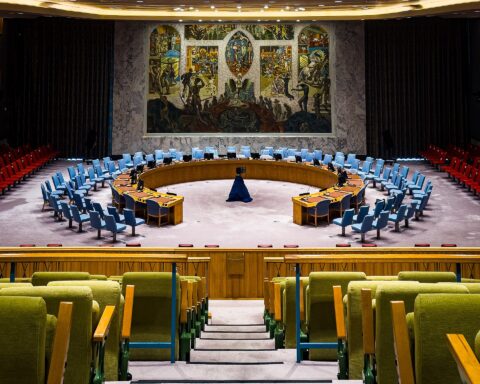
Bahrain’s role is architecturally different. The kingdom hosts Naval Support Activity Bahrain, the 79-acre facility that serves as headquarters for the US Fifth Fleet, and has been the most forward-leaning GCC state on the diplomatic track — co-drafting a UNSC resolution through six drafts over 15 days that called on the Security Council to authorise “all necessary means” to reopen the strait. Russia, China, and France blocked the resolution on April 7.
The Middle East briefing 3,000+ readers start their day with.
One email. Every weekday morning. Free.
The UAE Ministry of Foreign Affairs issued a statement on April 8 that framed the coalition commitment in expansive terms: “Addressing Iranian threats must include its proxies in the region and stopping the threat to freedom of navigation in the Strait of Hormuz.” The statement demanded Iran pay full reparations for 2,819 missiles and drones — the figure cited in the UAE’s formal reparations demand — a demand Saudi Arabia has not echoed publicly.
Why Did the UAE Join Despite 2,469 Iranian Projectiles?
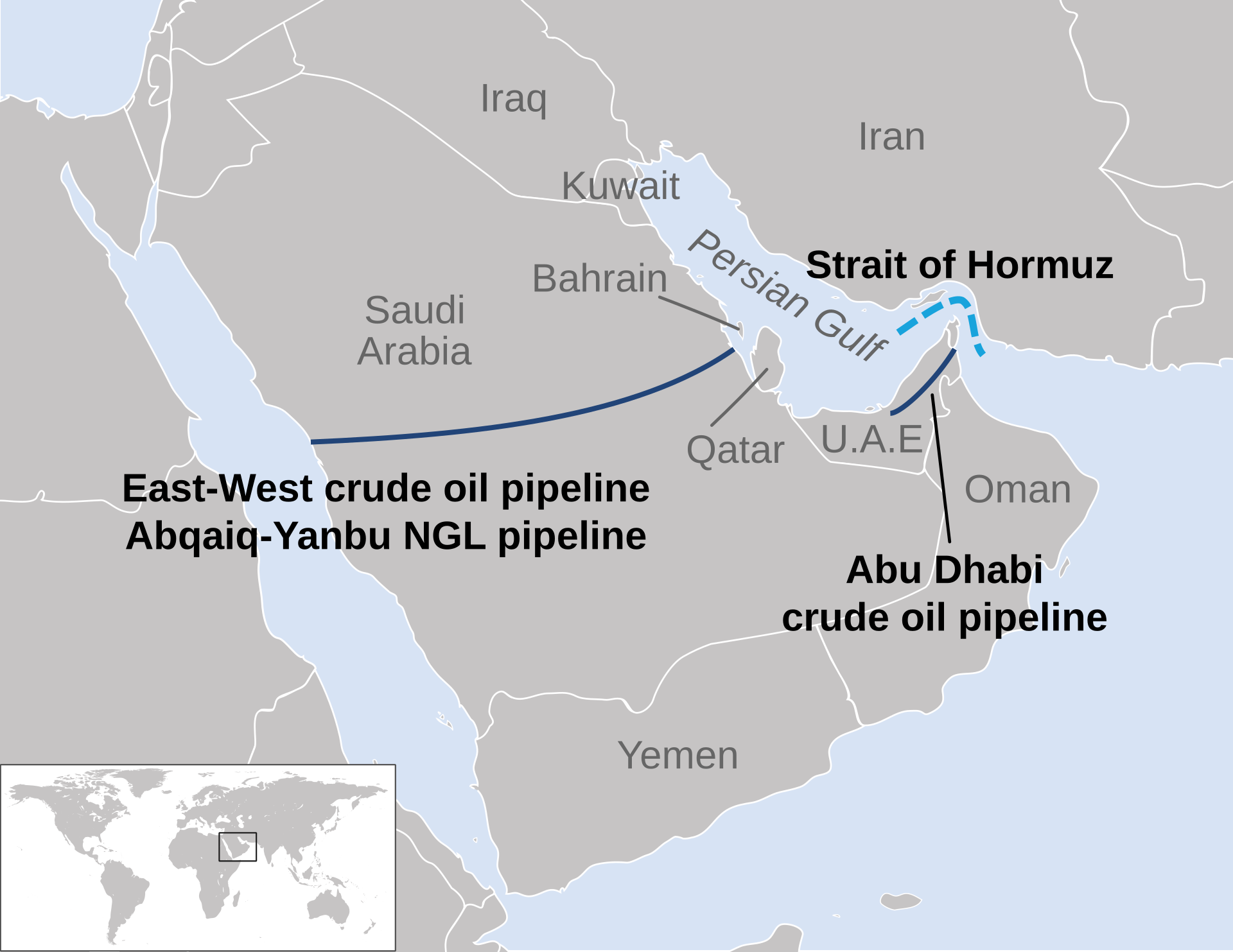
The UAE has absorbed the heaviest Iranian fire of any GCC state since the war began on February 28. Iran has launched 438 ballistic missiles, 19 cruise missiles, and 2,012 drones at Emirati targets — 2,469 projectiles in total, roughly 85 percent of all GCC-directed fire. Thirteen Emiratis have been killed and 221 injured. Fujairah, the terminus of Abu Dhabi’s crude oil pipeline bypass, has been struck at least seven times, with storage tanks destroyed and fires at the petrochemicals complex.
The exposure calculus explains the decision rather than contradicting it. The UAE’s Abu Dhabi Crude Oil Pipeline (ADCOP) runs from Habshan to Fujairah, bypassing Hormuz entirely, but its capacity ceiling covers only 60 percent of the UAE’s normal crude export volume of 2.5 to 2.8 million bpd. Nameplate capacity is approximately 1.5 million bpd, expanded to roughly 1.8 million bpd, with peak loading of 1.9 million bpd recorded during the March 20-24 surge. Forty percent of Emirati exports remain Hormuz-dependent even at maximum pipeline throughput.
Iran has already targeted Fujairah directly and repeatedly. The marginal retaliation risk of coalition membership is real but bounded — Abu Dhabi is already absorbing the fire. The UAE’s strategic bet is that coalition participation purchases a seat at the post-war maritime security architecture and accelerates the timeline for Hormuz reopening, which is worth more than the incremental targeting exposure.
Mohammed al-Bukhaiti, a senior Houthi Politburo member, warned on March 21 that the UAE and Bahrain joining the Hormuz campaign would make them “the first to lose in this battle.” He threatened Houthi entry into the war if US allies attacked Iran or used the Red Sea corridor for coalition operations — a threat that adds a second front to Abu Dhabi’s risk matrix but has not altered the Emirati position.
The Structural Logic of Saudi Arabia’s Silence
Saudi Arabia has issued no public statement explaining its absence from the coalition. The Saudi Foreign Ministry, the Royal Court, and the Ministry of Defence have all declined to address the question directly. But the structural logic is legible from five interlocking constraints that coalition membership would compromise.
The first is the East-West Pipeline. Saudi Arabia’s Petroline system runs from Abqaiq in the Eastern Province to Yanbu on the Red Sea coast, with a physical capacity ceiling of 7 million bpd — the largest Hormuz bypass in the Gulf by a factor of four. Pre-war Saudi exports through Hormuz ran at 7 to 7.5 million bpd, leaving a structural gap of 0.5 to 1.5 million bpd even at maximum Yanbu throughput, but the pipeline covers a far larger share of Saudi export capacity than ADCOP covers for the UAE. The pipeline was damaged in an Iranian strike on April 8 — one day after the ceasefire — but has been restored to full capacity. Yanbu’s port berths, not the pipeline, are the binding constraint: effective loading capacity runs at roughly 5.9 million bpd against the 7 million bpd the pipeline can deliver.
The second constraint is the negotiating channel. On April 9, Saudi Foreign Minister Prince Faisal bin Farhan held the first Saudi-Iranian foreign minister call since the war began, speaking directly with Abbas Araghchi. The official readout — the ministers “reviewed the latest developments and discussed ways to reduce tensions to restore security and stability in the region” — disclosed no demands, no concessions, and no joint communiqué. The call’s significance is not what was said but that it happened at all. Saudi Arabia is the only GCC state that Iran has accepted as a direct energy-architecture interlocutor since February 28. Joining a US-led military coalition would foreclose that channel.
The third is IRGC targeting doctrine. Iran’s co-belligerence framework — articulated repeatedly by IRGC commanders since early March — treats infrastructure belonging to states that host or support US military operations as legitimate counter-strike targets. Ras Tanura, the world’s largest offshore oil-loading facility, was struck on March 2 in the war’s opening hours. Abqaiq, the nerve centre of Saudi crude processing, sits within range of Iranian ballistic missiles already demonstrated to penetrate Saudi air defences. Joining the coalition would formally convert Saudi energy infrastructure from collateral risk to doctrinal target.
The fourth constraint is air defence. Saudi Arabia has intercepted 799 drones and 95 missiles — 894 total — since March 3, but the cost has been severe. PAC-3 MSE interceptor stocks have fallen to approximately 400 rounds from a pre-war inventory of roughly 2,800 — an 86 percent depletion rate, at a replacement cost of $3.9 million per round. The Camden, Arkansas production facility manufactures 620 PAC-3 rounds per year. Poland refused a Patriot battery transfer request on March 31. Additional escalation from coalition membership would arrive against a depleted intercept inventory that cannot be replenished at war tempo.
The fifth is fiscal. Saudi Arabia’s fiscal break-even oil price runs at $108 to $111 per barrel on a Goldman Sachs war-adjusted basis that includes PIF capital requirements. Brent crude sits at approximately $91 to $96. Goldman estimates the 2026 Saudi deficit at $80 to $90 billion against the official projection of $44 billion. Every incremental barrel that cannot reach market through Hormuz — and every retaliatory strike on export infrastructure — widens a deficit that is already structurally unfinanceable at current prices.
Iran’s Selective Exemption Architecture
Iran’s management of the strait since its effective closure has operated through a selective exemption system that functions as an economic weapon calibrated by diplomatic alignment. Abbas Araghchi stated that “safe passage through the Strait of Hormuz will be possible via coordination with Iran’s Armed Forces and with due consideration of technical limitations.” The exemption list — China, Russia, India, Iraq, and Pakistan — includes every major Iranian trading partner and excludes every coalition member.
The exemption architecture is the inverse image of the coalition roster. States that joined the US-led grouping face total transit denial. States that stayed out retain at least theoretical access to IRGC-mediated passage. The IRGC’s February 28 to April 9 chart declaring the standard shipping lanes a “danger zone” and redirecting vessels through a five-nautical-mile channel between Qeshm and Larak islands — inside Iranian territorial waters — makes transit permission contingent on Iranian naval escort, transforming freedom of navigation into a licensing regime.
Iran’s 10-point plan, circulated during the Islamabad talks, includes as Point 7 a requirement for IRGC “coordination” over Hormuz as a permanent treaty condition — a demand explicitly incompatible with any Western-led security force operating without Iranian consent. The coalition’s existence is, from Tehran’s perspective, the problem the 10-point plan was designed to prevent.
For Saudi Arabia, staying outside the coalition preserves — however tenuously — the possibility of bilateral energy transit arrangements with Iran. The Faisal-Araghchi call on April 9 is the only evidence that such arrangements are under discussion, but its mere occurrence positions Riyadh differently from Abu Dhabi in Tehran’s calculus. The UAE’s coalition membership has placed it in the same targeting and denial category as the United States and United Kingdom. Saudi Arabia’s absence has not.
Is This the End of GCC Collective Security?
The GCC Charter does not require unanimous consent for individual member-state security decisions. But the political convention of consensus on collective external security posture has defined the organisation’s diplomatic identity since its founding in 1981. Two member states joining a military coalition that the other four have declined to enter — with the two largest economies (Saudi Arabia and Qatar) and the organisation’s traditional diplomatic broker (Oman) all absent — breaks that convention in a manner that has no direct precedent.
The 2017 Qatar blockade, in which Saudi Arabia, the UAE, Bahrain, and Egypt severed diplomatic and economic ties with Doha, fractured GCC unity along a different axis: it was a punitive action by a majority against a minority member. The current split is structural rather than punitive. Each state’s position follows from its specific exposure profile, bypass infrastructure, and diplomatic positioning.
Qatar’s absence follows the logic of its LNG export dependency. The emirate hosts Al Udeid Air Base — the largest US military installation in the Middle East — but has maintained a posture of studied neutrality, with its foreign minister stating: “We are not a party to this war, but we are in daily contact with key actors to reduce escalation.” Qatar’s LNG carriers have required Chinese intermediation to transit Hormuz, and joining the coalition would eliminate that channel entirely.
Oman’s absence protects its role as Iran’s longstanding diplomatic back-channel — a function that predates this war by decades and that Muscat treats as a core sovereign interest. Kuwait’s absence reflects a combination of geographic exposure (the shortest flight time from Iranian launch sites to Kuwaiti territory of any GCC state) and institutional caution rooted in the 1990 invasion.
Dr. Dania Thafer of the Gulf International Forum framed the underlying dynamic on March 2, before the coalition had formalised: all six GCC states are “implicated within a single escalation cycle.” The coalition split does not change that shared implication. It changes how each state has chosen to manage it.
The operational consequence is that CENTCOM’s Hormuz transit operations — the April 11 destroyer passage by USS Frank E. Petersen Jr. (DDG-121) and USS Michael Murphy (DDG-112) — proceed with Emirati and Bahraini support but without Saudi territorial waters access, Saudi port logistics beyond existing bilateral arrangements, or Saudi naval participation.
The mine-clearance campaign that began simultaneously must cover approximately 200 square miles of mined waters with no Avenger-class mine countermeasure ships — all four were decommissioned from Bahrain in September 2025 — using three Littoral Combat Ships redeployed from Asia. The 1991 Kuwait benchmark suggests 51 days to clear a comparable area.
Imtiaz Gul, a security analyst, offered a frame for reading the broader regional posture when commenting on Pakistan’s deployment of three jets to Saudi Arabia: “Three jets won’t make much of a difference militarily… It’s messaging Tehran to be flexible.” The same logic applies to Saudi Arabia’s coalition absence. The message is not military. It is diplomatic: Riyadh is keeping a door open that Abu Dhabi has chosen to close.
Background
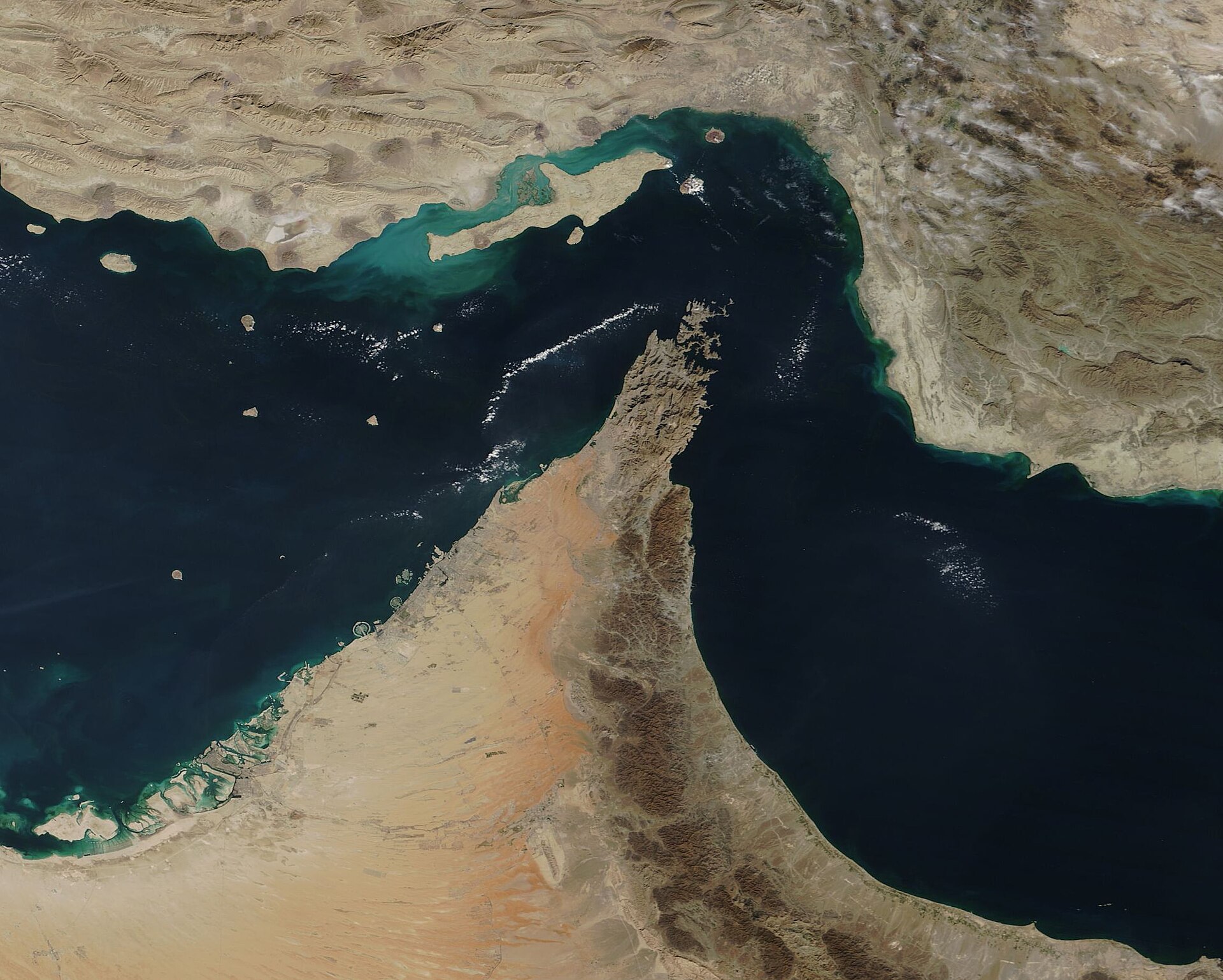
The Strait of Hormuz, a 21-nautical-mile-wide passage between Iran and Oman, carried approximately 20 million barrels per day of crude oil and petroleum products before the war — roughly 20 percent of global consumption. Iran’s effective closure of the strait beginning February 28, 2026, through a combination of mining, IRGC naval patrols, and selective transit denial, triggered the most severe disruption to global energy supply since the 1973 Arab oil embargo.
Combined Gulf pipeline bypass capacity — including Saudi Arabia’s East-West Pipeline, the UAE’s ADCOP, and Iraq’s Kirkuk-Ceyhan line — totals roughly 9 million bpd against the 20 million bpd that normally transits Hormuz. The 55 percent shortfall is structural and cannot be closed by any combination of existing infrastructure.
The UAE-Iran relationship carries a territorial dimension absent from Saudi-Iranian relations. Iran seized the islands of Abu Musa and the Greater and Lesser Tunbs from the UAE (then the Trucial States) in 1971, one day before the federation’s independence. The dispute remains formally unresolved. Despite this, the UAE and Iran maintained extensive trade ties through Dubai’s re-export hub until the war — a commercial relationship now severed.
The US naval blockade declared on April 12, built around two carrier strike groups, represents the first formal US naval blockade of a sovereign state since the 1962 Cuban Missile Crisis quarantine. Its legal basis — an executive order rather than a UNSC Chapter VII resolution, after the April 7 veto — remains contested under international law.
Frequently Asked Questions
Has Saudi Arabia ever participated in a US-led maritime coalition in the Gulf?
Yes. Saudi Arabia contributed naval vessels to the Combined Maritime Forces (CMF) framework, which includes Combined Task Force 152 responsible for Gulf maritime security. Riyadh also participated in the 1991 Operation Desert Storm naval component and provided port access during the 2019 International Maritime Security Construct (IMSC) established after Iran’s tanker seizures. The current refusal to join is a departure from three decades of incremental maritime security cooperation with the United States, driven by the specific risk calculus of this war rather than a philosophical objection to coalition operations.
Could the UAE withdraw from the coalition if Iranian retaliation escalates?
The coalition is an ad hoc operational grouping, not a treaty alliance — there is no Article 5 mutual defence commitment and no withdrawal penalty. However, Abu Dhabi’s political investment in the coalition is substantial: the UAE proposed the “Hormuz Security Force” name, co-drafted the UNSC resolution, and publicly demanded Iranian reparations. Withdrawal would damage Emirati credibility with Washington at a moment when the UAE is positioning for a central role in post-war Gulf security architecture. Abu Dhabi’s pattern — proposing the coalition’s name, co-drafting the UNSC resolution, demanding Iranian reparations — suggests the UAE is treating coalition membership as an investment in the post-war security order rather than a response to the immediate crisis.
What happens to GCC joint military exercises and the Peninsula Shield Force?
The Peninsula Shield Force, a nominally 40,000-strong joint GCC military force based at King Khalid Military City in Saudi Arabia, has not been activated during the current war. Its last operational deployment was the 2011 intervention in Bahrain, when approximately 1,200 Saudi Arabian National Guard troops crossed the King Fahd Causeway. The coalition split does not formally dissolve the Peninsula Shield framework, but it creates a practical problem: two member states are now operating under a US-led command structure that the other four have declined to join, making joint exercise planning and interoperability coordination between the two groupings politically fraught.
Does the coalition have legal authority to operate in the strait without a UNSC resolution?
The legal basis is contested. The coalition invokes UNCLOS Article 38, which guarantees transit passage through international straits, and the inherent right of collective self-defence under UN Charter Article 51. Iran, which has not ratified UNCLOS, rejects both frameworks. The April 7 UNSC vote — blocked by Russia, China, and France — means the coalition operates without Chapter VII authorisation. The US executive order declaring the blockade cites the International Emergency Economic Powers Act (IEEPA) and national security authorities rather than international law. Legal scholars at the Naval War College have noted that the US simultaneously asserting freedom of navigation while co-sponsoring Iran’s toll architecture in earlier ceasefire drafts complicates the legal position.
Is there a historical precedent for GCC members taking opposing positions on a Gulf military operation?
The closest precedent is the 1980-1988 Iran-Iraq War, during which GCC states maintained formally unified support for Iraq but diverged sharply in practice. Kuwait and Saudi Arabia provided direct financial support to Baghdad totalling an estimated $35 to $50 billion, while the UAE maintained commercial ties with both belligerents, and Oman kept its diplomatic channel to Tehran open throughout. The Tanker War phase (1984-1988) saw Kuwait request US naval escort for its tankers — reflagged as American vessels — while other GCC states declined to participate in the escort operations directly. The current split echoes that pattern: shared threat assessment, divergent response based on individual exposure and diplomatic positioning.