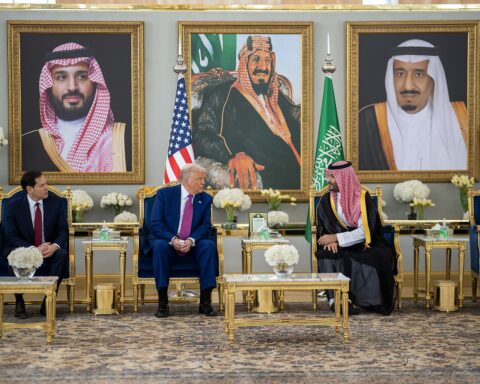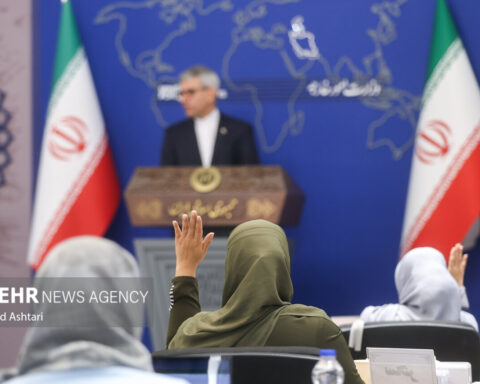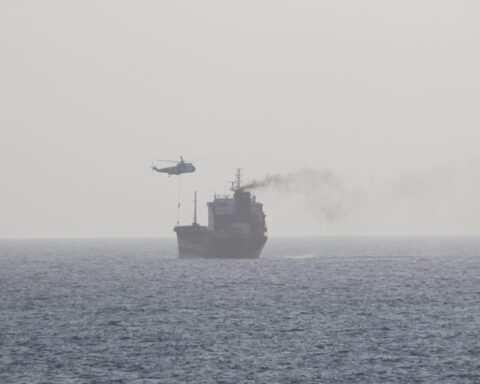

RIYADH — Saudi Arabia has intensified its direct diplomatic backchannel to Iran in a high-stakes bid to de-escalate the most dangerous military conflict the Persian Gulf has witnessed since 1991, according to Bloomberg and three regional diplomatic sources. As American and Israeli warplanes continue to pound Iranian nuclear and military facilities for a seventh consecutive day, and Iranian drones and ballistic missiles rain down on oil infrastructure, military bases, and embassies across six Gulf states, Crown Prince Mohammed bin Salman faces the defining diplomatic test of his career — negotiating with the very regime whose proxies have struck Saudi soil, while maintaining the alliance with Washington that made those strikes possible. The outcome of this backchannel will determine whether the Gulf descends into a protracted regional war or finds an off-ramp that preserves Saudi Arabia’s $3.3 trillion economic transformation.
Table of Contents
- What Is Saudi Arabia’s Backchannel to Iran and Who Is Running It?
- How Did the 2023 China-Brokered Saudi-Iran Deal Collapse in Six Days?
- Why Is Saudi Arabia Trying to End a War It Did Not Start?
- What Has Iran Actually Hit Inside Saudi Arabia?
- How Is MBS Balancing Washington and Tehran at the Same Time?
- Can Oman’s Mediation Model Survive a Shooting War?
- What Does Iran Want From Saudi Arabia to Stop the Attacks?
- The Diplomatic Calculus Matrix — Mapping Every Player’s Leverage and Vulnerability
- Why the Conventional Wisdom About Saudi Arabia Wanting This War Is Wrong
- What Role Are Russia and China Playing in the Backchannel?
- How Does the Oil Weapon Factor Into the Diplomacy?
- What Would a Saudi-Brokered Ceasefire Actually Look Like?
- Frequently Asked Questions
What Is Saudi Arabia’s Backchannel to Iran and Who Is Running It?
Saudi Arabia’s diplomatic backchannel to Iran is a direct, high-level communication line that bypasses formal diplomatic channels and operates through senior intelligence and foreign ministry officials on both sides. It is now the last functioning channel between the GCC and Tehran, after Qatar’s diplomatic relationship with Iran collapsed under the weight of Iranian missiles striking Qatari territory. Bloomberg reported on March 6, 2026, that Saudi officials have deployed this channel with “greater urgency” since the war began on February 28, transmitting messages aimed at preventing the conflict from widening further into a full Gulf war. The urgency of that effort has grown since the Assembly of Experts appointed Mojtaba Khamenei as Iran’s new supreme leader on March 8, installing an IRGC-backed hardliner who analysts predict will resist compromise.
The backchannel operates through at least three parallel tracks. The primary channel runs between Saudi Arabia’s General Intelligence Presidency (GIP) and Iran’s Ministry of Intelligence and Security (MOIS), according to regional analysts at the Middle East Council on Global Affairs. A secondary diplomatic track involves Prince Faisal bin Farhan Al Saud, the Saudi Foreign Minister, communicating through intermediaries in Oman and Iraq. A third, less formal track involves senior Saudi business figures with longstanding Iranian counterparts — a legacy of the commercial ties rebuilt during the 2023-2025 rapprochement period.
The choice of personnel reveals the gravity Riyadh assigns to this effort. Prince Khalid bin Salman, the Defence Minister and MBS’s brother, has reportedly been directly involved in the messaging to Tehran, despite his earlier reported support for the US-Israeli military operation. This dual role — simultaneously managing Saudi Arabia’s military posture against incoming Iranian projectiles while authorising peace overtures to the regime launching them — captures the extraordinary contradictions of Riyadh’s position in this conflict.
The GIP, Saudi Arabia’s primary foreign intelligence agency, has maintained a quiet working relationship with Iranian counterparts since the 2023 normalisation. Khalid al-Humaidan, the GIP’s director, is believed to have direct contact with Iranian intelligence officials through a secure communication system established during the Beijing negotiations. This infrastructure — tested during the Hajj pilgrim coordination in 2024 and 2025, when Saudi Arabia facilitated direct flights for Iranian pilgrims — now serves a far more consequential purpose.
| Channel | Saudi Side | Iranian Side | Intermediary | Status |
|---|---|---|---|---|
| Intelligence | GIP (al-Humaidan) | MOIS | Direct | Active — intensified March 2-6 |
| Diplomatic | FM Faisal bin Farhan | FM Abbas Araghchi | Oman, Iraq | Active — limited by Araghchi’s rhetoric |
| Commercial | Senior business figures | Iranian business networks | UAE, Oman | Informal — supplementary |
| Multilateral | Saudi UN mission | Iranian UN mission | UN Secretary-General | Active — UN Security Council session |

How Did the 2023 China-Brokered Saudi-Iran Deal Collapse in Six Days?
The Saudi-Iranian rapprochement, brokered by Beijing in March 2023, was the most significant diplomatic breakthrough in the Gulf in a generation. The agreement restored full diplomatic relations after a seven-year rupture, reopened embassies, and established mechanisms for economic cooperation, security dialogue, and pilgrim facilitation. By February 2026, the relationship had produced tangible results: direct flights between Iranian cities and Jeddah for Hajj pilgrims, reduced Houthi attacks on Saudi territory, and a series of bilateral working groups on trade and investment.
The Middle East briefing 3,000+ readers start their day with.
One email. Every weekday morning. Free.
The deal collapsed not because of any failure between Riyadh and Tehran, but because of a decision made 8,000 kilometres away in Washington. On February 28, 2026, the United States and Israel launched coordinated strikes on Iranian nuclear facilities, military installations, and leadership compounds in Tehran, Isfahan, Qom, Karaj, and Kermanshah. The strikes killed Supreme Leader Ali Khamenei, IRGC Quds Force commander Esmail Qaani’s successor, and several members of Iran’s Supreme National Security Council, according to the Jerusalem Post and multiple intelligence sources.
Iran’s retaliation was immediate and indiscriminate. Within hours, Tehran launched what a Joint Statement from the US State Department described as a barrage of “missiles and drone attacks” across the region. Iran targeted 11 countries with over 1,481 projectiles, according to the Jerusalem Post’s tracking data. Saudi Arabia — despite having privately counselled Washington against the operation, according to Middle East Eye — was hit multiple times. The Chinese-brokered peace, painstakingly constructed over three years, was shattered in under 72 hours.
The irony is bitter and instructive. Saudi Arabia’s Ministry of Foreign Affairs, in its initial statement on the strikes, called on “all parties” to end the spiral of violence, pointedly noting that the events “are of a nature that risks the future of our region and global stability.” The ministry’s careful phrasing — shaped by Foreign Minister Prince Faisal bin Farhan’s wartime diplomatic strategy — — emphasising that the spiral “started with US-Israeli attacks on Iran” — marked a notable departure from the unqualified US alliance messaging that characterised earlier Saudi communications. Riyadh was publicly distancing itself from the operation that destroyed the diplomatic architecture it had spent three years building.
The 2023 Beijing deal contained a clause committing both sides to “non-interference in internal affairs” and “respect for sovereignty.” Tehran’s decision to launch missiles at Saudi oil infrastructure and military bases, even in retaliation for a war Saudi Arabia did not initiate, has technically voided this commitment. Yet the diplomatic infrastructure — the communication channels, the intelligence contacts, the back-channel relationships — survived the missiles. It is this infrastructure that Saudi Arabia is now leveraging in its bid to stop the war.
Why Is Saudi Arabia Trying to End a War It Did Not Start?
Saudi Arabia’s desperation to halt the conflict stems from a brutal economic and strategic calculus that grows more punishing with every day the war continues. Six interconnected factors are driving Riyadh’s urgency, each reinforcing the others in a compounding crisis that threatens the foundations of Vision 2030.
The first and most immediate factor is infrastructure damage. Aramco’s Ras Tanura refinery, the Kingdom’s largest, was attacked twice — on March 2 and March 4 — forcing a shutdown of a facility that processes over 550,000 barrels per day, according to Bloomberg. The refinery’s closure has forced Aramco to reroute exports through the East-West Pipeline to Yanbu on the Red Sea coast, a capacity-constrained alternative that cannot fully compensate for the lost throughput.
The second factor is financial contagion. The Tadawul, Saudi Arabia’s stock exchange, dropped 7.2 percent in the first three trading days of the conflict, wiping approximately $180 billion from market capitalisation, according to AGBI analysis. Foreign direct investment inflows, which had reached $7.9 billion in 2025 according to the Saudi General Authority for Statistics, face an immediate freeze as global investors reassess Gulf risk premiums. Every day of war erodes the “stability premium” that MBS has marketed as Saudi Arabia’s core investment proposition.
The third is the threat to megaproject timelines. Saudi Arabia is committed to hosting Expo 2030 in Riyadh and the 2034 FIFA World Cup — events requiring hundreds of billions of dollars in infrastructure investment and, crucially, an image of stability and safety. A protracted regional war makes both events untenable. The Kingdom has already lost the 2029 Asian Winter Games, which Kazakhstan replaced as host after NEOM’s ski resort plans were scaled back.
The fourth factor is expatriate safety. Approximately 13 million foreign nationals live and work in Saudi Arabia, comprising roughly 38 percent of the total population. Iranian drone and missile strikes on Riyadh, Al-Kharj, and the Eastern Province have created evacuation pressure from governments whose citizens are at risk. Several embassies have issued travel advisories urging non-essential personnel to leave, according to the US Embassy travel advisory dated March 3, 2026.
The fifth driver is OPEC+ credibility. Saudi Arabia led OPEC+ to agree to a 206,000 barrel-per-day production increase for April, according to the OPEC Secretariat’s statement of March 1. Implementing this increase while Ras Tanura remains offline and Hormuz shipping lanes face disruption undermines Saudi Arabia’s position as the world’s swing producer and reliable energy supplier.
The sixth and most strategic concern is the precedent. If Iran succeeds in using attacks on Gulf states to pressure Washington into a ceasefire — what the Times of Israel described as Iran’s strategy of “raising the costs of the war’s continuation for the region” — it establishes a template for future conflicts. Every future US military operation in the Middle East would carry the implied threat of Gulf infrastructure being used as Iranian leverage. Saudi Arabia has a profound interest in ensuring this precedent does not solidify.
| Category | Impact | Estimated Cost | Source |
|---|---|---|---|
| Ras Tanura shutdown | 550,000+ bpd offline | $44M/day | Bloomberg, Aramco estimates |
| Stock market decline | Tadawul -7.2% (3 days) | ~$180B | AGBI analysis |
| Air defense expenditure | 50+ interceptors fired | $200M+ | Interceptor cost data, CSIS |
| Insurance premiums | Gulf shipping war-risk surge | 300-500% increase | Lloyd’s market data |
| FDI freeze | Investment decisions paused | Unquantified | Market analysts |
| Tourism cancellations | Umrah/tourism disrupted | $500M+/month | Saudi Tourism Authority data |
What Has Iran Actually Hit Inside Saudi Arabia?
Iran’s retaliatory strikes on Saudi Arabia have been sustained but strategically selective, targeting military infrastructure, energy assets, and Western diplomatic facilities rather than civilian population centres — a calibration designed to inflict maximum economic and political pressure while avoiding the kind of mass civilian casualties that would make Saudi-Iranian reconciliation impossible. The question of whether that restraint reflects policy or merely operational limitation became starker when Iran’s president apologized to Gulf states while the IRGC continued firing, exposing a fundamental split in Tehran’s war leadership.
The most consequential strike hit Aramco’s Ras Tanura refinery complex on March 2, when two Shahed-136 one-way attack drones penetrated Saudi air defenses. The Saudi Defence Ministry reported that both drones were intercepted en route, but debris from the interception caused a fire within the complex, according to Arab News. Aramco shut down the entire facility — the Kingdom’s largest domestic refinery — as a precautionary measure. A second attack on March 4 hit the facility again while it remained offline, with Saudi Arabia claiming to have intercepted five additional hostile drones targeting the same complex.
On March 3, Iranian drones struck the US Embassy in Riyadh, causing what the Washington Post described as “a limited fire and minor structural damage.” The same day, Saudi air defenses intercepted eight drones near Riyadh and Al-Kharj. The attacks on the American embassy were part of a broader Iranian strategy of targeting US facilities across the Gulf — the CIA station in the Saudi capital was also hit, according to the Washington Post’s national security reporting.
Saudi air defenses have performed credibly under sustained pressure. On a single Friday in early March, Saudi defenses intercepted and destroyed five missiles and five drones aimed at targets including the central Al-Kharj military area and the Eastern Province, according to Arab News. Prince Sultan Air Base received three ballistic missiles, all intercepted. Three cruise missiles targeting industrial areas were shot down outside Al-Kharj governorate.
The pattern reveals Iran’s strategic logic. Tehran is not attempting to conquer Saudi territory or destroy its military capacity — objectives that would be suicidal given the US military umbrella over the Kingdom. Instead, Iran is attacking the economic assets and Western diplomatic infrastructure that make Saudi Arabia valuable to Washington, hoping to turn Riyadh into a lobbyist for ceasefire within the American policy apparatus. As the Times of Israel analysis noted, Iran is “aiming fire at Arab neighbors” in the hope that “pressure builds to agree to a ceasefire.” This is coercion through collateral damage — a strategy as old as warfare itself, adapted to the drone age.
How Is MBS Balancing Washington and Tehran at the Same Time?
Crown Prince Mohammed bin Salman is executing what may be the most complex diplomatic balancing act in modern Middle Eastern history. He must simultaneously maintain the US security alliance that is the foundation of Saudi defence, pursue a backchannel to the very regime America is fighting, manage domestic public opinion that is furious about Iranian attacks on Saudi soil, and protect an economic transformation programme that depends on the perception of regional stability.
The diplomatic challenge is compounded by Iraq, which sits between the two belligerents and is tearing apart under the twin pressures of Iranian-backed militia attacks and collapsing oil exports. Baghdad has become both a diplomatic channel and a potential casualty of a war it cannot control.
The Saudi Cabinet session of March 3-4, chaired by MBS, captured this tension in a single communiqué. The Cabinet “condemned the reprehensible Iranian attacks” and affirmed that Saudi Arabia “reserves the full right to respond” and “will take all necessary measures to safeguard its territory, citizens, and residents,” according to the Saudi Press Agency. Yet in the same period, Saudi officials were intensifying backchannel communications with Tehran aimed at de-escalation.
Middle East Eye reported a critical detail that illuminates MBS’s strategy: Saudi Arabia privately told other GCC states to “avoid any steps that could inflame tensions with Iran.” This instruction — delivered while Saudi soil was being struck by Iranian missiles — reveals a leader who has concluded that the war cannot be won through escalation and must be managed toward a negotiated conclusion. MBS acquiesced to Trump’s decision to attack Iran, according to the Washington Post’s account of the decision-making process, but has privately sought to limit the Gulf’s involvement in the resulting conflict.

The balancing act has three operational components. First, military cooperation with Washington: Saudi Arabia is sharing intelligence on Iranian launch positions, providing airspace access, and coordinating air defense with US CENTCOM forces. This cooperation is non-negotiable — the $9 billion Patriot missile deal approved in January 2026, which supplied 730 PAC-3 interceptors, was specifically designed for this scenario. Without US resupply, Saudi Arabia would exhaust its interceptor stockpile within weeks at the current rate of expenditure. The dependence on American resupply underscores a deeper fracture — the first seven days of the war have cracked the US-Gulf alliance in ways that may take years to repair.
Second, diplomatic restraint toward Iran: despite the Cabinet’s tough language, Saudi Arabia has not conducted any offensive military operations against Iranian targets. It has not joined the US-Israeli strike campaign. It has not activated the Peninsula Shield Force for offensive operations. And it has continued to operate its diplomatic backchannel to Tehran — a backchannel that requires, at minimum, a functional relationship with Iranian officials who are simultaneously ordering attacks on Saudi infrastructure.
Third, regional coalition management: MBS is positioning Saudi Arabia as the responsible adult in a Gulf neighbourhood increasingly terrified by the war’s escalation. By urging GCC restraint while maintaining defensive military readiness, the Crown Prince is building diplomatic capital that he intends to spend on a ceasefire initiative — one that positions Saudi Arabia, not the United States, as the architect of peace.
The Carnegie Endowment for International Peace analysis published this week described the Gulf monarchies as “caught between Iran’s desperation and the U.S.’s recklessness.” MBS appears to have concluded that the only escape from this trap is to become the mediator — transforming Saudi Arabia from a target of Iranian missiles into the indispensable broker of a ceasefire that both sides need but neither can publicly request.
Can Oman’s Mediation Model Survive a Shooting War?
Oman has been the Gulf’s indispensable mediator for decades, facilitating the secret talks that led to the 2015 Iran nuclear deal, hosting the Houthi-Saudi peace negotiations, and providing the venue for the indirect US-Iran talks that nearly produced a breakthrough in February 2026. The Sultanate’s approach — colloquially known as “friend to all, enemy to none” — made Muscat the natural venue for any diplomatic solution to the current crisis.
But the February 28 strikes shattered Oman’s mediating position in a way that has no precedent. NPR reported in late February that Oman had been hosting indirect US-Iran talks in Muscat, mediated by Foreign Minister Badr bin Hamad Al Busaidi. On February 6, 2026, Iran had agreed during these talks “never to stockpile enriched uranium” — a concession Al Busaidi described as a “major breakthrough,” telling Al Jazeera that “a peace deal is within our reach, if we just allow diplomacy the space it needs to get there.”
Three weeks later, the bombs fell instead of a peace agreement. The Omani mediation track, which had been making genuine progress on the nuclear issue, was destroyed by a military operation that chose regime change over negotiation. The irony is excruciating: a deal that would have addressed Western concerns about Iranian nuclear capability without a single missile being fired was within weeks of conclusion when Washington and Tel Aviv decided that only force would suffice.
Even more damaging to Oman’s mediating role: Iran reportedly struck Omani territory as part of its regional retaliation. The SpecialEurasia analysis noted that “even Oman fell victim to an Iranian attack,” an act that “underscores that in the current conflict, all countries in the region are being pushed to choose a side.” If Iran has targeted its most sympathetic Gulf interlocutor, the traditional mediation model — neutral intermediary facilitating dialogue between adversaries — may be functionally dead.
This is where Saudi Arabia’s backchannel becomes critical. Riyadh cannot be a neutral mediator; it is a party to the conflict, with Iranian missiles hitting its infrastructure. But it can be something potentially more powerful: an interested intermediary whose own suffering gives it credibility with both sides. Saudi Arabia can tell Iran, “We are being hit too — we share your interest in ending this.” And it can tell Washington, “Our oil infrastructure is at risk — end this before our economy collapses and your energy supply chain breaks.”
The Omani model also failed in a more structural sense. Traditional mediation requires a degree of trust between the warring parties — a belief that the mediator can transmit messages accurately and that agreements made through the intermediary will be honoured. The February 28 strikes, which came after the Omani-facilitated near-breakthrough on nuclear issues, have destroyed this trust entirely. Iran’s surviving leadership now regards all diplomatic processes as potential cover for military operations — a suspicion that only a mediator with real skin in the game can overcome. Saudi Arabia, with its burning refineries and intercepted missiles, has more skin in this game than any other potential interlocutor.
Iraq has emerged as a secondary mediation channel, leveraging its unique position as a country with deep ties to both Iran and the Gulf states. Iraqi intelligence officials have reportedly facilitated message exchanges between Saudi and Iranian counterparts, drawing on relationships built during the 2019-2023 period when Baghdad hosted preliminary Saudi-Iranian talks that preceded the Beijing agreement. The Iraqi channel offers a geographical advantage — the Iran-Iraq border provides physical proximity that Oman’s maritime separation cannot match.
What Does Iran Want From Saudi Arabia to Stop the Attacks?
Iran’s demands in the backchannel negotiations are shaped by a regime fighting for survival with a decapitated leadership structure. The assassination of Supreme Leader Ali Khamenei has thrown Iran’s decision-making apparatus into what the LSE described as “deeper disarray,” creating a negotiating environment where “it is unclear whether anyone can enforce” a ceasefire “across Iran’s fractured power centres.”
Analysis of Iranian statements, regional diplomatic sources cited by Bloomberg, and the Jerusalem Post’s report that Iran’s MOIS “quietly reached out indirectly to the CIA with an offer to discuss terms” suggest Tehran’s demands fall into three categories: immediate, transitional, and structural.
Iran’s immediate demands centre on a cessation of US-Israeli bombing. Tehran wants a complete halt to strikes on Iranian territory and a commitment not to target remaining leadership figures. This demand is directed at Washington and Tel Aviv, not Riyadh — but Iran expects Saudi Arabia to use its leverage with President Trump to deliver it. Trump’s public insistence on “unconditional surrender,” reported by Al Jazeera on March 6, makes this demand extremely difficult to meet through direct US-Iran channels, which is precisely why the Saudi backchannel has gained importance.
The transitional demands involve Gulf security arrangements. Iran wants a commitment from GCC states not to permit their territory to be used for staging future strikes against Iran — a demand that strikes at the heart of the US basing structure in the Gulf. Saudi Arabia hosts US forces at Prince Sultan Air Base and has provided logistical support for the current operation. Accepting Iran’s demand would require renegotiating the terms of the US military presence — something MBS might privately welcome if it were framed as a Saudi sovereign decision rather than an Iranian demand.
The structural demands are the most ambitious and least likely to be met in the near term. Iran wants a regional security architecture that gives it a formal role — something between the pre-2023 adversarial relationship and the post-2023 normalisation. Tehran’s surviving leadership recognises that the pre-war status quo cannot be restored; the question is whether a new equilibrium can be constructed before the bombing destroys Iran’s remaining state capacity.
The challenge for Saudi Arabia’s backchannel negotiators is that they are not the primary belligerent. Iran’s core conflict is with the United States and Israel. Saudi Arabia can facilitate, transmit messages, and offer incentives, but it cannot deliver a ceasefire without Washington’s agreement. And Trump, who told CBS News on March 6 that he “must have a role in choosing the country’s next leader,” appears more interested in regime change than de-escalation.
| Tier | Demand | Directed At | Saudi Leverage | Feasibility |
|---|---|---|---|---|
| Immediate | Halt all bombing of Iranian territory | US, Israel | Moderate — can lobby Trump | Low (Trump wants surrender) |
| Immediate | No further leadership assassinations | US, Israel | Low — operational decision | Medium |
| Transitional | GCC pledge against staging future strikes | GCC states | High — Saudi leads GCC | Medium (conflicts with US basing) |
| Transitional | Restoration of diplomatic channels | All parties | High — already operating | High |
| Structural | Regional security framework with Iranian role | All parties | Moderate | Low (requires US buy-in) |
| Structural | Sanctions relief | US, EU | Low | Very low (requires regime change reversal) |
The Diplomatic Calculus Matrix — Mapping Every Player’s Leverage and Vulnerability
Understanding Saudi Arabia’s backchannel requires mapping the leverage and vulnerability of every actor in this conflict. The following framework — a diplomatic calculus matrix — assigns each major player two scores: their leverage over the conflict’s trajectory (ability to start, stop, or escalate) and their vulnerability to its continuation (economic, military, or political costs of the war persisting). Players with high vulnerability but low leverage are trapped. Players with high leverage but low vulnerability are dangerous. Saudi Arabia, uniquely, has moderate levels of both — making it the conflict’s natural mediator.
| Actor | Leverage (1-10) | Vulnerability (1-10) | Position | Interest |
|---|---|---|---|---|
| United States | 10 | 3 | Primary belligerent | Regime change / maximum pressure |
| Israel | 8 | 5 | Co-belligerent | Eliminate Iranian nuclear threat |
| Iran (surviving leadership) | 6 | 10 | Defender | Regime survival, halt bombing |
| Saudi Arabia | 6 | 7 | Non-belligerent target | War termination, stability |
| Russia | 4 | 2 | Interested observer | US overextension, oil prices |
| China | 5 | 4 | Economic stakeholder | Energy supply stability |
| UAE | 3 | 7 | Non-belligerent target | War termination |
| Oman | 3 | 5 | Damaged mediator | Restore mediation role |
| Qatar | 2 | 6 | Host of US base (Al Udeid) | Avoid further Iranian strikes |
| Houthis (Yemen) | 4 | 3 | Iranian proxy, undecided | Leverage for Yemen settlement |
The matrix reveals a structural asymmetry that favours Saudi Arabia’s mediation bid. The United States has maximum leverage but minimal vulnerability — it can continue bombing indefinitely from aircraft carriers and regional bases without its homeland being threatened. Iran has maximum vulnerability but declining leverage — every day of bombing degrades its ability to retaliate. Saudi Arabia occupies the critical middle position: enough leverage (oil supply, Trump relationship, Iran backchannel) to matter, and enough vulnerability (infrastructure damage, economic costs) to be credible when it says the war must end.
The framework also exposes the Houthi variable as the most unpredictable element. Yemen’s Houthis maintain significant strike capability against Saudi infrastructure and Red Sea shipping. If they enter the war fully on Iran’s side, Saudi Arabia’s vulnerability score jumps from 7 to 9, dramatically increasing Riyadh’s urgency to broker a ceasefire. This Houthi ambiguity is itself a form of leverage — one that the Houthis will extract concessions for, regardless of the war’s outcome.
The matrix should be read dynamically, not statically. Every day that the war continues, Iran’s leverage decreases (as its military infrastructure is degraded) while its vulnerability remains constant (the bombing continues regardless). Conversely, Saudi Arabia’s vulnerability increases over time (cumulative economic damage, infrastructure degradation, possible Houthi escalation) while its leverage holds steady. This divergence explains the urgency of the backchannel: Saudi Arabia is in a race against its own rising vulnerability.

Why the Conventional Wisdom About Saudi Arabia Wanting This War Is Wrong
Understanding the scale of Saudi Arabia’s backchannel effort requires first understanding what the Kingdom stands to lose. Before the war, the Public Investment Fund had deployed over $925 billion across global and domestic portfolios, according to PIF’s 2025 annual report. Giga-projects including NEOM, the Red Sea tourist development, Qiddiya, and the Diriyah Gate were collectively absorbing $150 billion in investment. Vision 2030, already under pressure from lower oil revenues and scaling challenges, cannot absorb the dual shock of a regional war and an energy market crisis. Every day of conflict pushes the 2030 targets further from reach.
The domestic economic impact extends beyond headline numbers. Saudi Arabia’s non-oil GDP growth, which reached 4.6 percent in 2025 according to the General Authority for Statistics, depends on tourism, entertainment, and foreign investment — all of which require security and stability as prerequisites. The Riyadh Season entertainment festival, which attracted 15 million visitors in its 2025 edition, cannot operate under missile threat. The Kingdom’s tourism investment programme, targeting 150 million annual visits by 2030, becomes aspirational rather than operational when Iranian drones are striking the capital.
The dominant narrative in Western media and think-tank analysis holds that Saudi Arabia actively sought the US-Israeli military operation against Iran. The Washington Post reported that “push from Saudis” helped move Trump toward the strikes. Multiple commentators have described MBS as a co-architect of the operation. The implication is clear: Saudi Arabia got the war it wanted and is now merely managing the consequences.
This narrative is wrong — and the evidence of Saudi Arabia’s backchannel diplomacy is the strongest proof. A country that genuinely wanted war with Iran would not be frantically negotiating with Tehran six days into the conflict. It would not be telling GCC allies to avoid provocative actions. It would not be positioning itself as a potential ceasefire broker. The conventional wisdom confuses Saudi support for containing Iran’s nuclear programme with Saudi support for a full-scale regional war — two fundamentally different propositions.
Three pieces of evidence support the contrarian interpretation. First, Saudi Arabia’s pre-war diplomatic behaviour. Riyadh had invested three years and enormous political capital in the China-brokered normalisation with Iran. MBS personally endorsed the 2023 deal, hosted Iranian officials in the Kingdom, and expanded bilateral cooperation in areas from pilgrim facilitation to trade. A leader planning for war does not simultaneously invest in peace infrastructure.
Second, the timing. The US-Israeli strikes came just three weeks after Oman’s foreign minister declared that a peace deal on Iran’s nuclear programme was “within reach.” If Saudi Arabia wanted war, it would not have allowed the Omani mediation to progress to the point of near-success. The diplomatic track and the military track were operating simultaneously — but in different capitals, driven by different interests.
Third, the Saudi Ministry of Foreign Affairs statement explicitly noted that the crisis “started with US-Israeli attacks on Iran.” No country that orchestrated a war would publicly attribute its origin to its own allies. This was a deliberate signal — aimed at Tehran, at domestic audiences, and at history — that Riyadh did not order what happened on February 28.
What Saudi Arabia did want — and what it communicated to Washington, according to the Washington Post’s reconstruction — was a credible military threat that would force Iran to the negotiating table on nuclear and missile issues. MBS wanted leverage, not war. He wanted the threat of force to succeed where diplomacy alone had not. The problem is that threats, once authorised, have a logic of their own. The transactional alliance with Trump delivered the threat MBS wanted — and then delivered the war he did not.
The Gulf monarchies are caught between Iran’s desperation and the U.S.’s recklessness. None of them initiated this war. All of them are paying for it.
Carnegie Endowment for International Peace analysis, March 2026
What Role Are Russia and China Playing in the Backchannel?
Russia and China occupy dramatically different positions in the current crisis, despite both maintaining relationships with Iran and Saudi Arabia. Their roles in the backchannel diplomacy reflect these differences — and expose the limitations of great-power mediation in a conflict where the United States holds overwhelming military superiority.
China’s position is defined by the 2023 breakthrough it brokered. Beijing invested significant diplomatic capital in the Saudi-Iranian normalisation, hosting the secret talks, providing the venue for the signing ceremony, and positioning itself as the new guarantor of Gulf stability. The destruction of that deal by American bombs represents a humiliating setback for Chinese diplomacy in the region. Beijing has strong incentives to rebuild the framework it created, but limited ability to influence the military trajectory of a war being fought primarily by American and Israeli forces.
Chinese diplomatic engagement has focused on two tracks. On March 8, Beijing escalated from rhetoric to action by sending special envoy Zhai Jun to Riyadh to deliver a detailed five-point ceasefire proposal directly to Faisal bin Farhan and GCC Secretary-General Al-Budaiwi. At the United Nations, China has called for an immediate ceasefire and respect for Iranian sovereignty — positions that align with Saudi Arabia’s private preferences but conflict with Washington’s objectives. Bilaterally, Chinese officials have maintained contact with both Saudi and Iranian counterparts, playing both sides in ways that preserve Beijing’s role as a potential future mediator while avoiding any action that might provoke Washington.
Russia’s role is more cynical and more useful. Moscow maintains operational relationships with both Iran (as a military partner in Syria) and Saudi Arabia (as an OPEC+ co-leader). Russian intelligence channels to Tehran remain functional, and Moscow has been passing messages between various parties in the conflict, according to regional diplomatic sources. The Atlantic Council’s assessment that “the Gulf that emerges from the Iran war will be very different” implicitly acknowledges that Russia will seek to exploit the conflict’s aftermath to expand its own influence.
For Saudi Arabia’s backchannel, Russia’s value lies in its unique access to Iran’s military and intelligence establishment. The IRGC has worked closely with Russian military advisors in Syria for a decade. If Iran’s surviving leadership needs a secure communication channel that bypasses American signals intelligence, Russian military-to-military contacts provide it. Saudi Arabia, through its own relationship with Moscow — cemented through years of OPEC+ cooperation — can tap into this network.
The risk for Saudi Arabia is that both Russia and China have interests that do not align with Riyadh’s. Moscow benefits from elevated oil prices caused by the conflict. Beijing benefits from American overextension in the Middle East. Neither power has a strong interest in a quick ceasefire — both prefer a prolonged conflict that weakens the United States while leaving their own relationships intact. Saudi Arabia’s backchannel operators must navigate these competing agendas while pursuing a ceasefire that none of the great powers are genuinely committed to delivering.
How Does the Oil Weapon Factor Into the Diplomacy?
Oil is the currency of this conflict’s diplomacy — the commodity that gives Saudi Arabia leverage over every other player and the asset most at risk from the war’s continuation. OPEC+’s decision to increase production by 206,000 barrels per day for April, announced on March 1, was itself a diplomatic signal — a demonstration that the cartel can and will stabilise markets even during a war, provided the conflict does not escalate further.
Brent crude futures surged past $100 per barrel in the days following the February 28 strikes, reaching levels not seen since the 2022 post-Ukraine invasion spike, according to CityIndex analysis. The Strait of Hormuz — through which approximately 20 percent of the world’s oil supply transits — has been partially disrupted by Iranian naval operations, though not fully closed. Maritime insurance premiums for Gulf shipping have increased by 300-500 percent, according to Lloyd’s market data, effectively adding a war premium to every barrel of crude exported from the Arabian Peninsula.
Saudi Arabia’s oil leverage operates in three diplomatic dimensions. With Washington, high oil prices create domestic political pressure on Trump — every $10 increase in crude adds approximately $0.25 to US gasoline prices, according to the US Energy Information Administration. MBS can quietly remind the White House that a ceasefire would lower prices, while continued war would push them higher. This is not a threat; it is a market reality that serves Saudi diplomatic interests.
With Iran, Saudi Arabia’s ability to flood the market and crash prices represents an existential threat to whatever government emerges from the rubble of the Islamic Republic. Iran’s economy, even before the war, depended on oil revenues that sanctions had already constrained. A post-war Iran facing both a devastated military infrastructure and suppressed oil prices would be entirely dependent on Saudi restraint within OPEC+ — giving Riyadh permanent leverage over Tehran’s economic recovery.
With China and the global economy, Saudi Arabia’s position as the world’s most reliable crude supplier gives it indirect influence over every major economy. Asian economies — China, Japan, South Korea, India — depend on Gulf crude for 60-70 percent of their oil imports, according to International Energy Agency data. If the war disrupts these flows, these economic powers have a direct interest in supporting Saudi-led ceasefire efforts. Saudi Arabia can leverage this dependency to build a coalition of energy-importing nations pressuring Washington to accept a negotiated end to the conflict.
The OPEC+ production increase was also a message to Russia. Moscow benefits from high oil prices, which fund its own war in Ukraine. By signalling willingness to increase output, Saudi Arabia reminded Russia that Riyadh, not Moscow, controls the marginal barrel. Any Russian temptation to prolong the Iran war for oil-price reasons must reckon with Saudi Arabia’s ability to unilaterally suppress prices by unleashing spare capacity — estimated at approximately 3 million barrels per day by the IEA.
What Would a Saudi-Brokered Ceasefire Actually Look Like?
A Saudi-brokered ceasefire would need to satisfy four parties with fundamentally incompatible objectives — making it one of the most complex diplomatic undertakings of the twenty-first century. Analysis of the backchannel’s likely negotiating parameters, drawn from regional diplomatic reporting, think-tank assessments, and the structural interests of each party, suggests the following framework.
Phase one would involve an immediate mutual cessation of hostilities. Iran stops launching missiles and drones at Gulf states and Israel. The United States and Israel halt bombing operations against Iranian territory. This “silence for silence” phase would last 72-96 hours and would be verified by satellite intelligence shared between all parties. Saudi Arabia would serve as the communication hub, relaying compliance reports between Tehran and Washington through its backchannel.
Phase two would establish humanitarian corridors and address immediate consequences. This includes safe passage for diplomatic personnel trapped in damaged embassies, medical evacuation flights for wounded civilians and military personnel, and the reopening of civilian airspace over the Gulf. Saudi Arabia would leverage its existing Hajj and aviation infrastructure to facilitate these operations — turning the Kingdom’s civilian logistics capacity into a ceasefire implementation tool.
Phase three — and by far the most contentious — would involve a political framework for post-war Iran. Trump’s demand for “unconditional surrender” and his insistence on a role in “choosing the country’s next leader” are non-starters for any Iranian interlocutor, including the moderate factions that the Saudi backchannel is attempting to empower. Saudi Arabia’s likely position would push for something between these extremes: a transitional arrangement that addresses nuclear concerns (building on the February 2026 Muscat concessions), guarantees against future attacks on Gulf states, and provides Iran’s surviving institutions enough legitimacy to enforce a ceasefire domestically.
The most realistic ceasefire framework would include five core elements drawn from historical precedents and current diplomatic positioning. First, a UN Security Council resolution mandating a ceasefire and establishing a monitoring mechanism — something Russia and China would support, and which would give both sides political cover to stop fighting. Second, a Gulf security compact, negotiated separately from the US-Iran track, committing GCC states and Iran to non-aggression and non-interference — essentially a more robust version of the 2023 Beijing agreement. Third, an enhanced nuclear inspections regime incorporating Iran’s February 2026 concession on stockpile limits. Fourth, an economic reconstruction package for Iran, funded in part by Gulf sovereign wealth funds, that creates positive incentives for compliance. Fifth, a regional arms control framework addressing Iran’s ballistic missile and drone programmes — the issue that precipitated the crisis.
| Phase | Duration | Key Actions | Saudi Role | Main Obstacles |
|---|---|---|---|---|
| Phase 1: Silence | 72-96 hours | Mutual cessation, satellite verification | Communication hub, compliance relay | Iranian factional compliance |
| Phase 2: Humanitarian | 1-2 weeks | Corridors, evacuations, airspace | Logistics provider, aviation infrastructure | US demands for Iranian concessions |
| Phase 3: Political | 3-6 months | Nuclear deal, security compact, reconstruction | Co-guarantor, economic incentives via PIF | Trump’s regime change demands |
The probability of this framework being implemented in full is low — perhaps 15-20 percent given the current positions of the belligerents. But the probability of some version of Phase 1 being achieved through Saudi mediation is significantly higher — perhaps 40-50 percent within the next two weeks. Trump, despite his maximalist rhetoric, faces rising domestic opposition (the Senate war powers vote, while unsuccessful, signalled bipartisan concern), escalating economic costs, and the practical reality that regime change in Iran has no realistic endpoint. A “silence for silence” ceasefire, brokered through Saudi channels and presented as a Trump victory, may ultimately prove more attractive than an indefinite air campaign with no exit strategy.
Saudi Arabia’s unique qualification for this role is not neutrality — it is interested involvement. Unlike Oman, which mediates from a position of detachment, Saudi Arabia mediates from a position of shared suffering. Its refineries have been hit. Its airspace has been violated. Its economy is bleeding. This gives the Kingdom credibility that no neutral party can match: when Saudi Arabia says the war must end, everyone believes its sincerity.
The diplomatic backchannel operates alongside a parallel military commitment. Britain announced on March 6 that it would deploy fighter jets, a destroyer, and intelligence assets to support Saudi defense, marking the most significant British military commitment to the Gulf since the withdrawal from East of Suez in 1971.
The diplomatic channel takes on particular urgency with Hajj 2026 approaching in late May. A ceasefire before the pilgrimage would spare Saudi Arabia the politically charged task of hosting nearly two million pilgrims under wartime air defense conditions.
The backchannel to Tehran is only one component of a broader Saudi diplomatic strategy that now spans four simultaneous mediations, including the Ukraine-Russia peace process and the Sudanese ceasefire. For a comprehensive assessment of how Saudi Arabia is brokering peace across multiple conflicts while under Iranian fire, the Kingdom’s diplomatic infrastructure has proven more resilient than critics anticipated.
Frequently Asked Questions
What is Saudi Arabia’s backchannel to Iran?
Saudi Arabia’s backchannel to Iran is a direct diplomatic communication channel operating through intelligence services, foreign ministry officials, and intermediary states including Oman and Iraq. Bloomberg reported on March 6, 2026, that Saudi officials have intensified this channel to de-escalate the war between the United States, Israel, and Iran that has resulted in missile and drone strikes on Saudi territory since February 28.
Why is Saudi Arabia negotiating with Iran while being attacked?
Saudi Arabia faces compounding economic costs from the war — including the Ras Tanura refinery shutdown, stock market declines exceeding $180 billion, a freeze in foreign investment, and rising insurance premiums on Gulf shipping. Riyadh has concluded that military defense alone cannot protect its economic transformation programme and that diplomacy is essential to ending the conflict before the damage becomes irreversible.
Who is leading the Saudi diplomatic effort?
Multiple Saudi officials are involved across parallel tracks. Saudi Foreign Minister Prince Faisal bin Farhan Al Saud manages the diplomatic channel through intermediaries. The General Intelligence Presidency maintains direct intelligence-to-intelligence communication with Iranian counterparts. Defence Minister Prince Khalid bin Salman is reportedly involved in messaging to Tehran despite his role managing the military response to Iranian attacks.
What does Iran want from the negotiations?
Iran’s demands include an immediate halt to US-Israeli bombing, commitments from GCC states not to stage future strikes from their territory, restoration of diplomatic channels, and ultimately a regional security framework that preserves Iran’s sovereignty. The absence of a unified Iranian leadership following the assassination of Supreme Leader Khamenei has complicated the negotiating process.
Could Saudi Arabia broker a ceasefire?
Saudi Arabia has moderate prospects of facilitating an initial cessation of hostilities within the next two weeks, though a comprehensive political settlement would take months. The Kingdom’s unique position — maintaining relationships with both Washington and Tehran, suffering direct damage from the war, and controlling the global oil supply — gives it leverage and credibility that neutral mediators lack. The main obstacle is President Trump’s demand for Iranian “unconditional surrender.”
What happened to the 2023 China-brokered Saudi-Iran deal?
The 2023 normalisation agreement, which restored diplomatic relations and established cooperation mechanisms, was functionally destroyed by the February 28 US-Israeli strikes on Iran. Iran’s retaliatory attacks on Saudi infrastructure voided the deal’s non-aggression commitments. However, the communication infrastructure built during the rapprochement — intelligence contacts, diplomatic channels, and commercial networks — survived and now forms the basis of Saudi Arabia’s backchannel diplomacy.
How has the war affected Saudi oil exports?
The Ras Tanura refinery, Saudi Arabia’s largest, was forced offline after Iranian drone strikes on March 2 and March 4, removing over 550,000 barrels per day of processing capacity. Aramco has rerouted exports through the East-West Pipeline to Yanbu, but this alternative cannot fully compensate. Strait of Hormuz disruptions and a 300-500 percent increase in maritime insurance premiums have further constrained Gulf oil flows.
What role does Prince Khalid bin Salman play in the negotiations?
Prince Khalid bin Salman, the Saudi Defence Minister and MBS’s brother, reportedly plays a dual role — managing the military response to Iranian attacks while participating in the diplomatic messaging to Tehran. His involvement signals the highest level of Saudi commitment to the backchannel. As a former Saudi ambassador to Washington, Khalid bin Salman also bridges the Saudi-American communication on the conflict. The broader diplomatic wreckage is detailed in the reporting on how eleven days of war destroyed three years of Gulf-Iran détente. The full scope of barriers preventing a ceasefire — from Iran’s fractured command structure to Washington’s maximalist demands — is explored in the analysis of why the ceasefire everyone wants remains undeliverable.