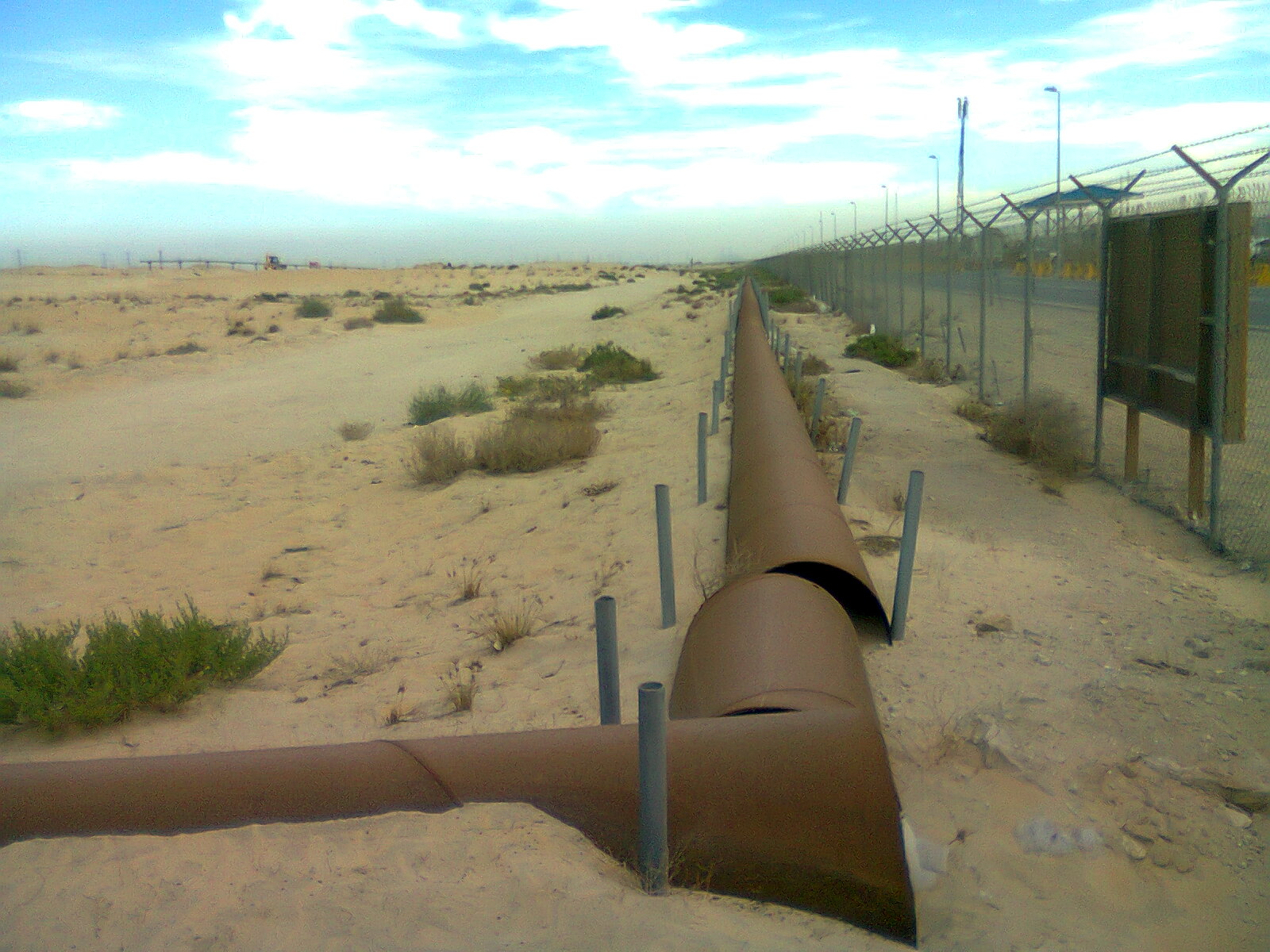

RIYADH — The 1,201-kilometre pipeline running beneath the Saudi desert from the Eastern Province to the Red Sea port of Yanbu now carries the weight of the global economy on its steel casing. Three weeks into the Iran war, with the Strait of Hormuz effectively sealed and Persian Gulf loading terminals sitting idle, the East-West Crude Oil Pipeline — known as the Petroline — has become the single most critical piece of energy infrastructure on Earth. Its throughput increased 192 percent in the first nine days of March alone. Every barrel of Saudi crude reaching international markets passes through this corridor. Every economic forecast for 2026, from Tokyo to Frankfurt, depends on whether Iranian drones can reach it.
The shift is not temporary. The war has triggered a geographic reorientation of the Saudi state that will outlast the fighting, reshape the kingdom’s economic architecture, and alter the strategic balance of the Middle East for a generation. Saudi Arabia is becoming, for the first time in its modern history, a Red Sea power — and the infrastructure, investment, and defence decisions made in March 2026 will lock that transformation in place long before any ceasefire is signed.
Table of Contents
- What Is Saudi Arabia’s East-West Pipeline and Why Does It Matter Now?
- How Much Oil Can the Pipeline Actually Move?
- The Yanbu Bottleneck That Caps Saudi Exports
- Why Did Iran Strike Yanbu’s SAMREF Refinery?
- Can Saudi Arabia Defend 1,200 Kilometres of Exposed Pipeline?
- The Red Sea Port Transformation
- Jeddah, NEOM, and the New Economic Geography
- The Saudi Landbridge — A Railway That Just Became Urgent
- The Strategic Geography Rebalancing Index
- The Contrarian Case — This War Validated MBS’s Geographic Vision
- Will Saudi Arabia Ever Go Back to the Gulf?
- Frequently Asked Questions
What Is Saudi Arabia’s East-West Pipeline and Why Does It Matter Now?
The East-West Crude Oil Pipeline is a 1,201-kilometre pipeline system that transports crude oil from the Abqaiq processing facility in Saudi Arabia’s Eastern Province across the Arabian Peninsula to export terminals at Yanbu on the Red Sea coast. Originally built in 1981 during the Iran-Iraq War — the last time Hormuz faced a serious closure threat, in what analysts now call the first tanker war — the Petroline was designed as an insurance policy against exactly the scenario unfolding in March 2026.
For decades, the pipeline operated below capacity. Saudi Arabia exported the vast majority of its crude through Ras Tanura, Ju’aymah, and other terminals along the Persian Gulf coast, where loading infrastructure was larger, closer to the oil fields, and connected to the primary tanker routes serving Asia. Yanbu handled a fraction of the kingdom’s exports, primarily serving European and Mediterranean customers. The East-West Pipeline was strategic infrastructure kept warm for an emergency that many analysts believed would never come.
That emergency arrived on 28 February 2026, when Iran began targeting commercial shipping in the Strait of Hormuz in retaliation for US-Israeli military strikes. Within days, tanker traffic through the strait plunged more than 95 percent, according to S&P Global Market Intelligence. Saudi Arabia’s Persian Gulf terminals — responsible for roughly 80 percent of the kingdom’s pre-war oil exports — became functionally inaccessible. The Petroline shifted from backup to lifeline overnight.
The pipeline now represents the only viable export route for Saudi crude oil reaching global markets without transiting waters controlled by Iran. Its strategic importance cannot be overstated. Before the war, losing the East-West Pipeline would have been an inconvenience. Today, losing it would remove approximately 2.5 million barrels per day from an already strained global oil supply, triggering what the International Energy Agency has called the potential for “catastrophic price escalation beyond any modern precedent.”
The Middle East briefing 3,000+ readers start their day with.
One email. Every weekday morning. Free.
How Much Oil Can the Pipeline Actually Move?
The East-West Pipeline’s theoretical capacity significantly exceeds its current throughput, but the gap between what the pipeline can carry and what Yanbu can load onto tankers defines the ceiling on Saudi export recovery. Understanding this distinction is essential for anyone tracking the oil market’s trajectory through the second quarter of 2026.
Under normal operations, the Petroline carried approximately 5 million barrels per day of crude oil. On 11 March 2026, Saudi Aramco converted the accompanying natural gas liquids pipelines to carry crude, raising the system’s combined capacity to approximately 7 million barrels per day, according to Aramco’s operational disclosures. This conversion took eleven days — remarkably fast for infrastructure modifications of this scale, reflecting contingency plans that Aramco had maintained since the 2019 Abqaiq-Khurais attack.
Of that 7 million barrel capacity, approximately 5 million barrels per day are allocated to export operations through Yanbu, with the remaining 2 million barrels per day serving domestic refineries along the western coast, including the SAMREF joint venture with ExxonMobil and the Yanbu Aramco Sinopec Refining Company facility.
| Component | Pre-War Capacity | Current Capacity | Utilisation (mid-March) |
|---|---|---|---|
| Petroline (crude) | 5.0 million bpd | 5.0 million bpd | ~70% |
| NGL lines (converted) | 0 (NGL only) | 2.0 million bpd | ~40% |
| Total system | 5.0 million bpd | 7.0 million bpd | ~57% |
| Export allocation | ~1.3 million bpd | ~5.0 million bpd | ~52% |
| Domestic refinery allocation | ~1.5 million bpd | ~2.0 million bpd | ~80% |
Actual throughput has risen sharply but remains below maximum capacity. Yanbu loadings surged from 1.1 million barrels per day in February to approximately 2.6 million barrels per day by mid-March, with Aramco targeting 3.8 million barrels per day by month’s end, according to consultancy Vortexa. The constraint is not the pipeline itself but the loading infrastructure at its terminus — a bottleneck that defines the upper limit of Saudi Arabia’s wartime export potential.
The Yanbu Bottleneck That Caps Saudi Exports
Yanbu’s two export terminals — Yanbu North and Yanbu South — have a nominal loading capacity of approximately 4.5 million barrels per day. Tested under operational conditions, actual throughput peaks at roughly 4 million barrels per day. Under wartime conditions, with increased security protocols, vessel queuing, and the logistical friction of redirected tanker fleets, consultancy Vortexa estimates sustainable capacity at approximately 3 million barrels per day.
The arithmetic is stark. Saudi Arabia was exporting roughly 7.4 million barrels per day before the war, according to the Joint Organisations Data Initiative. Even at maximum theoretical Yanbu throughput, the kingdom can move only 4 million barrels per day to international markets — a shortfall of 3.4 million barrels per day. At current operational throughput of 2.6 million barrels per day, the shortfall exceeds 4.8 million barrels per day.
This gap explains the persistence of oil prices above $110 per barrel despite Saudi Arabia’s frantic infrastructure mobilisation. It also explains why the fourth great oil shock continues to intensify even as the pipeline operates at historically unprecedented volumes. The problem is not that Saudi Arabia lacks oil or pipeline capacity. The problem is that four decades of infrastructure investment concentrated export capacity on the Gulf coast, and no amount of emergency conversion can replicate that infrastructure on the Red Sea overnight.
Aramco has begun implementing dual-port loading operations, using Jeddah’s commercial port facilities as a supplementary crude export terminal. This is a stopgap — Jeddah Islamic Port was designed for container and bulk cargo, not crude oil — but it adds an estimated 300,000 to 500,000 barrels per day of additional export capacity. The improvisation underscores both the severity of the crisis and the determination to maximise every available barrel.
Why Did Iran Strike Yanbu’s SAMREF Refinery?
On 19 March 2026, a sophisticated drone breached the SAMREF refinery’s security perimeter in Yanbu, setting off a fire that emergency teams contained within hours. A secondary missile aimed at the nearby port was intercepted by Saudi Patriot batteries. Industry sources reported minimal operational disruption, and Aramco briefly paused crude loadings before resuming operations. The attack caused no casualties.
The restraint of the damage should not obscure the strategic significance of the target selection. Iran did not strike Yanbu by accident or as part of a random barrage. The IRGC targeted the single facility where Saudi Arabia’s entire export capacity converges — the one point of failure in the kingdom’s wartime energy architecture. A successful large-scale strike on the Yanbu terminal complex would accomplish what the Hormuz blockade alone could not: the complete elimination of Saudi oil from global markets.
The Yanbu attack revealed a vulnerability that Saudi defence planners had understood theoretically but had never confronted operationally. When export capacity is concentrated at a single terminus, that terminus becomes an irresistible target. The pre-war distribution of exports across multiple Gulf terminals provided natural redundancy. The wartime concentration on Yanbu eliminated it.
Iran’s targeting logic is transparent. The IRGC statement released after the attack referenced “the infrastructure that enables aggression” — a clear reference to the pipeline corridor’s role in sustaining Saudi Arabia’s economic position while American aircraft operate from Saudi bases. Subsequent Iranian warnings have specifically mentioned the East-West Pipeline and the Yanbu terminal complex as legitimate targets, according to statements reported by Reuters and Al Arabiya.
The attack accelerated decisions that were already under consideration in Riyadh. Within 48 hours of the Yanbu strike, Saudi Arabia’s Ministry of Defence announced the deployment of additional Patriot batteries along the pipeline corridor, and the Royal Saudi Air Force relocated fighter squadrons from eastern bases to King Faisal Air Base in Tabuk — closer to NEOM and the Red Sea coast, according to the Saudi Press Agency.
Can Saudi Arabia Defend 1,200 Kilometres of Exposed Pipeline?
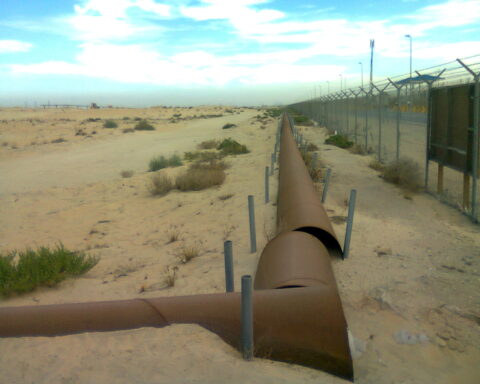
The East-West Pipeline stretches 1,201 kilometres across some of Saudi Arabia’s most remote terrain, from the industrial heartland of the Eastern Province through the Empty Quarter’s northern fringes to the Red Sea coast. Much of the route runs above ground. Pump stations are spaced at intervals of approximately 100 to 150 kilometres. A successful strike on any single pump station would reduce throughput for days; simultaneous strikes on multiple stations could halt flow for weeks.
Defending linear infrastructure of this length against drone and missile attack presents challenges that no military in history has solved completely. The United States spent billions protecting the Trans-Alaska Pipeline from far less sophisticated threats. Ukraine’s defence of its pipeline and railway network against Russian attack has demonstrated both the vulnerability of linear infrastructure and the limits of point defence.
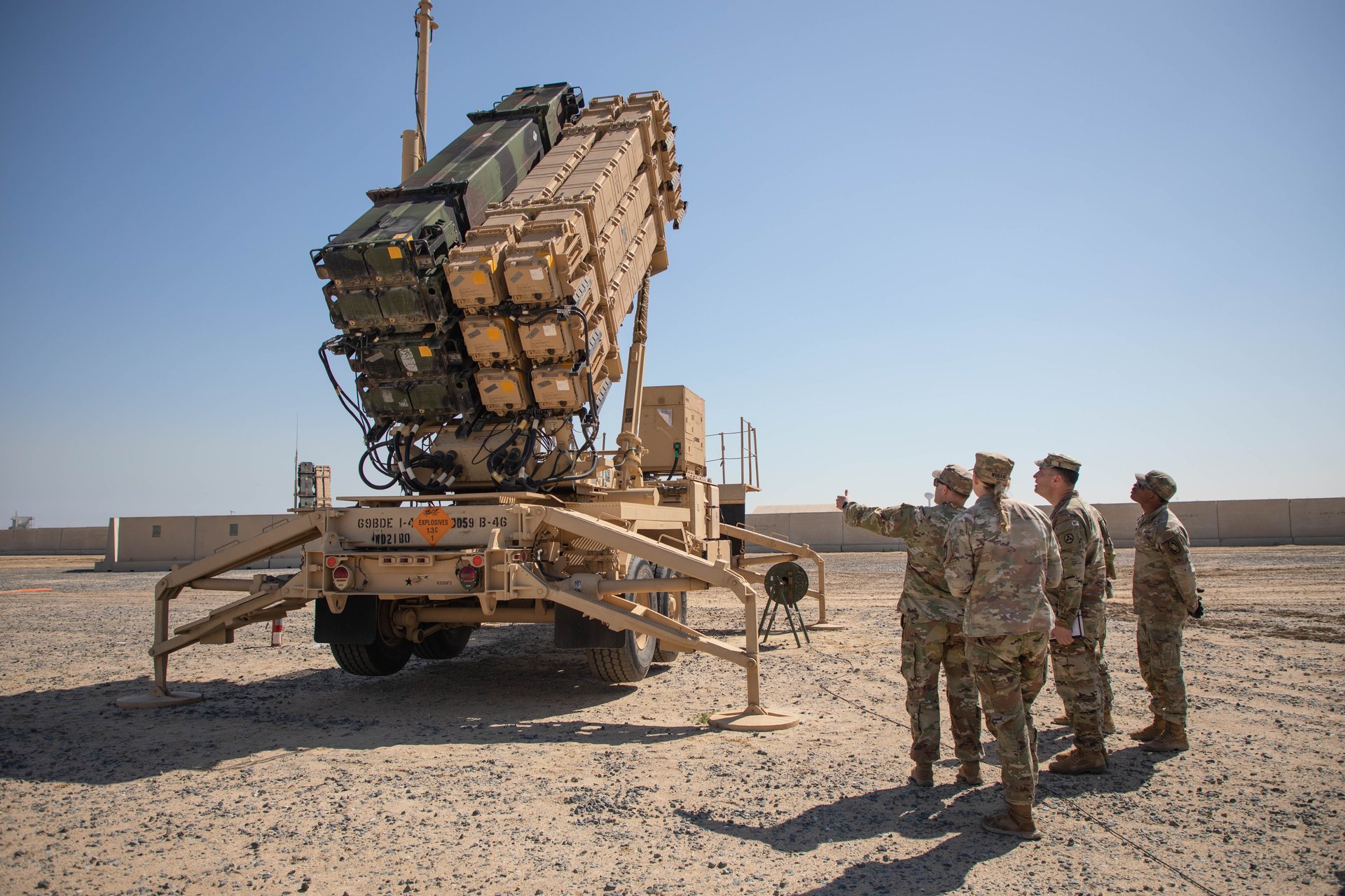
Saudi Arabia’s response has combined fixed-point defence with mobile interdiction. Patriot PAC-3 batteries now protect the major pump stations and the Yanbu terminal complex. Saudi air defence forces, which intercepted sixty drones and three ballistic missiles targeting Riyadh on 22 March alone, have extended their coverage westward along the pipeline route. Greek-operated Patriot batteries, deployed under a bilateral defence agreement, provide additional coverage for the critical central section where the pipeline is most exposed.
The cost equation is punishing. A single Patriot PAC-3 interceptor costs approximately $4 million. An Iranian Shahed-136 drone costs an estimated $20,000 to $50,000. Iran can launch dozens of drones for the cost of a single interceptor. Iran’s own economic constraints limit its production capacity, but the asymmetry remains severe. Saudi Arabia’s 2026 defence budget, projected at $78 to $80 billion according to the International Institute for Strategic Studies, includes emergency allocations for pipeline protection that the Stockholm International Peace Research Institute estimates at $3 to $5 billion for the year.
The medium-term solution lies in layered defence incorporating electronic warfare, counter-drone systems, and surveillance networks. Saudi Arabia has deployed South Korean-manufactured Chunma short-range air defence systems along the pipeline corridor, and Israeli-designed drone detection radars — acquired through a third-party transfer before the war — provide early warning capability. The Royal Saudi Air Force maintains combat air patrols along the pipeline route around the clock, using F-15SA aircraft stationed at Taif and Tabuk.
| System | Type | Coverage Zone | Effective Against |
|---|---|---|---|
| Patriot PAC-3 | Ballistic missile / cruise missile | Pump stations, Yanbu terminal | Ballistic missiles, large drones |
| Chunma (K-SAM) | Short-range air defence | Pipeline route, 6 locations | Low-altitude drones, cruise missiles |
| SkyGuard laser (trial) | Directed energy | Yanbu terminal | Small drones, rocket-assisted munitions |
| F-15SA CAP | Combat air patrol | Full pipeline corridor | All aerial threats |
| Ground-based radar | Surveillance / early warning | 12 sites along route | Detection and tracking |
The Red Sea Port Transformation
Saudi Arabia’s Red Sea coast hosts four major port complexes: Jeddah Islamic Port, King Fahd Industrial Port at Yanbu, King Abdullah Port at the King Abdullah Economic City, and the emerging Port of NEOM. Before the war, these facilities handled a combined throughput heavily weighted toward container cargo, bulk goods, and petrochemical products. Crude oil loading was concentrated at Yanbu’s dedicated terminals. Jeddah, the kingdom’s largest commercial port, processed 7.4 million TEUs of container traffic in 2025 but loaded almost no crude oil.
The war has rewritten the purpose of every facility on the western coast. Jeddah Islamic Port now serves as a supplementary crude export terminal, with Aramco engineers retrofitting berths to handle very large crude carriers. King Abdullah Port, designed as a container logistics hub, has absorbed overflow commercial traffic displaced from Gulf ports. The Red Sea Gateway Terminal, a private operator managing multiple Red Sea port facilities, announced on 15 March a $418 million accelerated investment programme to expand capacity at Jizan, Yanbu Commercial Port, King Fahd Industrial Port, and Jeddah Islamic Port over the next three years — a timeline compressed from the original twenty-year plan, according to a company statement reported by Arab News.
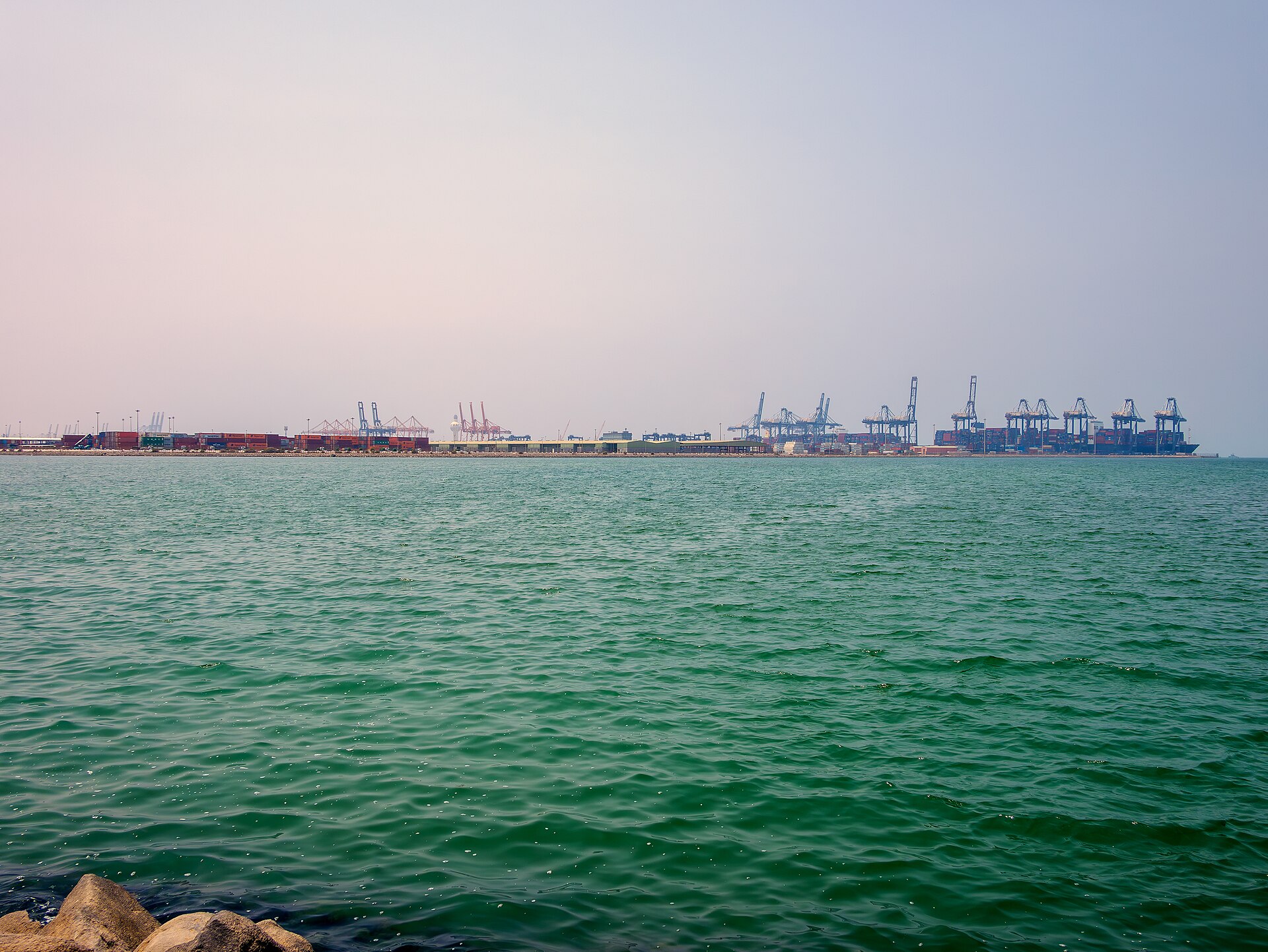
King Fahd Industrial Port at Yanbu, the largest Red Sea facility for crude oil and petrochemical loading, has a handling capacity of 210 million tonnes annually, according to Saudi Ports Authority data. Current utilisation has surged from roughly 35 percent in January to over 70 percent in March. Port Authority officials told Asharq Al-Awsat that they are implementing 24-hour loading operations and have requested additional tugboats and pilot vessels from commercial operators across the Red Sea.
The transformation extends beyond oil. Gulf airspace closures have redirected cargo flights to Red Sea coast airports. Jeddah’s King Abdulaziz International Airport reported a 40 percent increase in cargo movements during the first two weeks of March, according to the General Authority of Civil Aviation. Food imports, which previously arrived through the Gulf ports of Dammam and Jubail, are being rerouted through Jeddah and Jizan. The entire logistics architecture of the Saudi state is tilting westward under the pressure of war.
Jeddah, NEOM, and the New Economic Geography
The geographic centre of gravity of the Saudi economy has been shifting westward for years. Crown Prince Mohammed bin Salman’s Vision 2030 programme concentrated its most ambitious investments along the Red Sea coast and in the Riyadh capital region, rather than in the Eastern Province where Saudi Arabia’s wealth originates. NEOM, the $500 billion megaproject occupying 26,500 square kilometres of northwestern Saudi Arabia, sits on the Red Sea. The Red Sea Global tourism development, with its 50 resort islands across 28,000 square kilometres of coastline, faces the same waters. Jeddah’s transformation into a cultural and entertainment hub — with the Jeddah Tower, the world’s tallest building when completed, and the Formula 1 street circuit — orients the kingdom’s international image toward the west.
Critics dismissed these investments as vanity projects disconnected from Saudi Arabia’s economic fundamentals. The oil fields are in the east. The refineries are in the east. The export terminals were in the east. Building a $500 billion city on the opposite coast seemed, to sceptics, like an exercise in geographic illogic.
The Iran war has inverted that critique. The war MBS did not want is building the economy he did — and the geographic logic of Vision 2030 now appears less like vanity than prescience. The Red Sea coast is the only part of Saudi Arabia that is not within range of Iranian ballistic missiles launched from the western Iranian plateau, though it remains vulnerable to cruise missiles and drones. NEOM’s location in the far northwest places it at maximum distance from the Iranian threat envelope. The Red Sea Global resorts, if they survive the current tourism collapse, will recover in a geographic zone that investors may eventually perceive as safer than the Gulf coast.
Riyadh itself functions as the hinge point of the geographic reorientation. The capital sits roughly equidistant between the Gulf coast and the Red Sea — connected to both by pipeline, road, and planned railway. The decision to consolidate government, finance, and corporate headquarters in Riyadh rather than the eastern cities means that the administrative and decision-making apparatus of the state does not depend on Gulf coast access. The financial centre can function regardless of which coast is accessible.
Foreign direct investment patterns are already reflecting the shift. Saudi Arabia sent its top dealmakers to Miami during the third week of fighting, pitching Red Sea coast projects to American investors even as drones struck the Eastern Province. The message was unmistakable: the investable future of Saudi Arabia lies on its western coast, and the war has merely accelerated a transition that was already underway.
The Saudi Landbridge — A Railway That Just Became Urgent
The Saudi Landbridge project — a 1,500-kilometre railway connecting Jeddah on the Red Sea to Dammam on the Persian Gulf via Riyadh — was announced with a $7 billion budget and a completion target of 2034. Before the war, it was an ambitious but leisurely infrastructure project, one of dozens competing for attention and capital within the Vision 2030 portfolio. Tenders for construction work were expected by mid-2026, with operations not anticipated until the late 2020s.
The war has transformed the Landbridge from an aspirational project into an existential priority. Moving freight by rail between the two coasts would reduce dependence on road transport, which currently handles the bulk of internal logistics at significantly higher cost and lower volume. Saudi Railway Company CEO Bashar Al-Malik told Arab News in March that the Landbridge “takes on new significance in the current environment,” a diplomatic understatement that industry observers interpreted as a signal of accelerated timelines.
The railway’s planned capacity — over 50 million tonnes of freight per year — would create a second east-west corridor independent of the pipeline system. Containerised cargo, manufactured goods, food imports, and construction materials could move between ports on either coast without relying on the road network or the pipeline infrastructure. Officials estimate the Landbridge could save the kingdom $4.2 billion annually in transportation costs while generating 200,000 jobs across related sectors, according to Saudi Railways.
The strategic logic extends beyond economics. A functional rail link between Red Sea ports and Gulf industrial facilities would allow Saudi Arabia to maintain a two-coast economy even during prolonged periods of Gulf instability. Raw materials from the eastern oil fields could reach Red Sea ports for export. Imported goods arriving at Jeddah could reach eastern cities without Gulf shipping. The Landbridge would be, in infrastructure terms, what the East-West Pipeline is to oil: a corridor that makes the kingdom’s two coasts function as a single economic space.
Financing negotiations, which had stalled after talks with a Chinese consortium failed to meet Saudi local content requirements, have reportedly resumed with Korean and Japanese consortia. The war has made foreign governments considerably more willing to support Saudi infrastructure projects — particularly those that enhance the resilience of global energy supply chains.
The Strategic Geography Rebalancing Index
The scale of Saudi Arabia’s geographic reorientation can be measured across five dimensions: energy export infrastructure, commercial logistics capacity, defence force positioning, development investment, and population distribution. Each dimension is shifting westward at a different rate, and the aggregate movement reveals a kingdom in the early stages of a structural transformation comparable to its original eastward orientation toward Gulf oil in the 1950s.
| Dimension | Pre-War Gulf Share | Current Gulf Share | Red Sea Share (Current) | Projected Red Sea Share (2030) | Rebalancing Velocity |
|---|---|---|---|---|---|
| Oil Export Throughput | ~80% | ~5% | ~95% | ~55-60% | Extreme (war-driven) |
| Container Port Volume | ~45% | ~25% | ~75% | ~60% | High |
| Air Defence Assets | ~65% | ~40% | ~35% | ~45% | Moderate |
| Naval Force Deployment | ~60% | ~40% | ~60% | ~55% | Moderate |
| V2030 Investment Allocation | ~20% | ~15% | ~55% | ~60% | Low (already westward) |
| Major Construction Projects | ~30% | ~25% | ~50% | ~55% | Low-Moderate |
The index reveals three distinct patterns. Energy infrastructure has rebalanced almost entirely — a forced, wartime shift that will partially reverse when Hormuz reopens but will never return to pre-war concentrations. Commercial logistics are rebalancing at a high rate, driven by the need to maintain import flows for food, medicine, and construction materials. Military assets are rebalancing moderately, constrained by the need to maintain eastern defences against ongoing Iranian strikes.
The most significant finding is in the investment allocation column. Vision 2030 had already directed the majority of its capital toward the Red Sea coast and Riyadh before the war began. The geographic reorientation visible in 2026 is not a wartime improvisation — it is the acceleration of a deliberate strategy that positioned the kingdom’s growth assets in exactly the region that has proven most resilient under fire.
Development spending tells a similar story. NEOM alone accounts for $500 billion of committed investment on the Red Sea coast. The Red Sea Global tourism project represents another $10 billion. King Abdullah Economic City, between Jeddah and Yanbu, has absorbed an estimated $25 billion since its inception. Jeddah Tower, the entertainment district, and the city’s cultural infrastructure add billions more. The eastern coast, by contrast, has received significant investment in refining capacity and petrochemical plants but relatively little in the diversified economic activities that Vision 2030 prioritises.
The pre-war distribution of Saudi economic assets now looks less like a planning failure and more like a hedge — one that is paying off at exactly the moment when the kingdom’s eastern flank has become a war zone.
Analysis of Vision 2030 investment distribution, March 2026
The Contrarian Case — This War Validated MBS’s Geographic Vision
The prevailing narrative frames the Iran war as a catastrophe for Saudi Arabia’s development plans. NEOM, the argument goes, is an irrelevance when missiles are falling on Riyadh. Vision 2030 is dead, the sceptics claim, because the kingdom cannot simultaneously fight a war and build a post-oil economy.
The evidence points to a more nuanced and considerably more uncomfortable conclusion: the war has validated the geographic logic of MBS’s development strategy, even as it has disrupted its timeline. The investments that critics called extravagant — a megacity on the Red Sea, a tourism industry on the western coast, a railway linking both shores, a pipeline system with excess capacity — are precisely the assets that have prevented the Iran war from becoming an existential economic crisis for the kingdom.
Consider the counterfactual. If Saudi Arabia had continued to concentrate its economic future on the Gulf coast — if NEOM had been built in the Eastern Province, if the entertainment sector had been developed in Dammam, if the tourism projects sat on the Gulf rather than the Red Sea — the kingdom would have no viable economic activity outside the Iranian threat envelope. Every investment, every job, every visitor would be within range of the weapons now striking Saudi territory daily.
Instead, the western coast offers a geographic sanctuary. NEOM’s construction site, 1,400 kilometres from the nearest Iranian border, has not been targeted. Red Sea Global’s island resorts, while empty of tourists, remain physically intact. Jeddah’s commercial and cultural infrastructure continues to function. The kingdom’s non-oil future exists in a geographic space that the war has, paradoxically, made more attractive to long-term investors who now understand the risk of Gulf coast concentration.
The oil price environment reinforces the case. With Brent crude above $114 per barrel, Saudi Arabia is generating record revenue per barrel even at reduced export volumes. The kingdom’s 2026 fiscal position is likely to show a surplus despite war-related expenditure, according to preliminary estimates from Jadwa Investment. The combination of high prices and reduced volume means Saudi Arabia is earning roughly 60 to 70 percent of pre-war oil revenue while exporting only 35 to 40 percent of pre-war volumes. The revenue per barrel has more than compensated for the volume loss.
MBS’s geographic bet was not, it turns out, a bet at all. It was diversification in its most literal form: spreading the kingdom’s assets across its full geographic extent to ensure that no single point of failure could cripple the state. The fact that this diversification preceded the crisis by nearly a decade suggests either remarkable strategic foresight or fortunate coincidence. The result, either way, is a kingdom that is weathering a major war with its long-term economic architecture largely intact.
Will Saudi Arabia Ever Go Back to the Gulf?
When the war ends — and it will end, whether through negotiated settlement, Iranian capitulation, or exhaustion on all sides — the Strait of Hormuz will eventually reopen to commercial traffic. Saudi Arabia’s Persian Gulf terminals will resume loading crude. Tanker fleets will return to their pre-war routes. The question is whether the kingdom will return to its pre-war dependence on Gulf coast infrastructure, or whether the geographic reorientation forced by the conflict will become permanent.
The historical precedent suggests permanence. The original East-West Pipeline was built during the Iran-Iraq War of the 1980s, when Hormuz faced a similar — though ultimately less severe — threat. That pipeline was never decommissioned after the crisis passed. Instead, it became a permanent feature of Saudi energy infrastructure, gradually integrated into the kingdom’s export architecture. Each subsequent crisis reinforced its value and justified continued investment.
Three factors make a return to pre-war concentration unlikely. First, the demonstrated vulnerability of Gulf coast infrastructure to Iranian attack will permanently alter risk calculations. Insurers, shipping companies, and downstream customers will demand diversified supply routes as a condition of doing business with Saudi Arabia. Even with a ceasefire, the threat of Iranian closure will be priced into every contract and investment decision for years.
Second, the infrastructure investments now being made on the Red Sea coast create their own momentum. The expanded Yanbu terminals, the adapted Jeddah loading berths, the accelerated Landbridge railway, the Port of NEOM container terminal — these are not temporary installations. They represent billions of dollars in capital expenditure that will demand utilisation long after the war ends. Saudi Arabia will not build capacity and then abandon it.
Third, the strategic logic of two-coast redundancy is now proven. No Saudi defence planner, no Aramco executive, no royal decision-maker will again accept a situation in which 80 percent of the kingdom’s exports depend on a single chokepoint controlled by an adversary. The two-coast model will become doctrine — not because of ideology, but because of lived experience.
The likely post-war equilibrium will see Saudi Arabia maintaining roughly 55 to 60 percent of its export capacity through the Gulf and 40 to 45 percent through the Red Sea — a permanent shift from the pre-war ratio of approximately 80 to 20. This distribution would maximise flexibility while maintaining the cost advantages of Gulf coast proximity to Asian markets. It would also create redundancy: if either coast were disrupted, the kingdom could sustain the majority of its export capacity through the other.
| Scenario | Gulf Coast Share | Red Sea Share | Total Capacity | Redundancy Rating |
|---|---|---|---|---|
| Pre-War (2025) | ~80% | ~20% | ~9.5 million bpd | Low |
| Wartime (March 2026) | ~5% | ~95% | ~3.0 million bpd | Critical (single coast) |
| Post-War Conservative | ~65% | ~35% | ~10 million bpd | Moderate |
| Post-War Balanced (likely) | ~55% | ~45% | ~11 million bpd | High |
| Post-War Maximum Diversification | ~50% | ~50% | ~12 million bpd | Maximum |
Frequently Asked Questions
What is the East-West Pipeline and when was it built?
The East-West Crude Oil Pipeline, also called the Petroline, is a 1,201-kilometre pipeline connecting Saudi Arabia’s eastern oil fields at Abqaiq to the Red Sea port of Yanbu. It was originally constructed in 1981 during the Iran-Iraq War as an alternative to Persian Gulf export routes vulnerable to the Tanker War. Its capacity has been expanded multiple times, most recently in March 2026 when natural gas liquids lines were converted to carry crude oil, bringing total system capacity to 7 million barrels per day.
How much oil can Saudi Arabia export through the Red Sea?
Saudi Arabia’s Red Sea export capacity is currently constrained by the Yanbu terminal complex, which has a maximum tested throughput of approximately 4 million barrels per day. In practice, wartime operations have sustained approximately 2.6 million barrels per day through mid-March 2026, with a target of 3.8 million barrels per day by month’s end. Supplementary loading at Jeddah adds an estimated 300,000 to 500,000 barrels per day. Total Red Sea export capacity could reach 4.5 million barrels per day with full infrastructure mobilisation — roughly 60 percent of pre-war Persian Gulf exports.
Is NEOM still being built during the Iran war?
Construction at NEOM continues, though at a reduced pace. The megaproject’s location in northwestern Saudi Arabia, 1,400 kilometres from the Iranian border, places it outside the primary threat envelope for ballistic missiles. The Port of NEOM’s new container terminal, with 1.5 million TEU capacity and fully automated ship-to-shore cranes, is scheduled to begin operations in late 2026. MBS restructured NEOM in March 2026, scaling back some components while maintaining core infrastructure investments.
What is the Saudi Landbridge railway project?
The Saudi Landbridge is a planned 1,500-kilometre railway connecting Jeddah on the Red Sea to Dammam on the Persian Gulf via Riyadh. Budgeted at $7 billion with a completion target of 2034, the railway would carry over 50 million tonnes of freight annually and create a rail corridor between Saudi Arabia’s two coasts. The project has gained urgency since the Iran war demonstrated the vulnerability of Gulf coast logistics, and financing negotiations have accelerated with Korean and Japanese consortia.
Will the Strait of Hormuz reopen after the war?
The Strait of Hormuz will likely reopen to commercial traffic following a ceasefire, but the pre-war status quo of unimpeded transit is unlikely to return immediately. Iran has demonstrated the capability to close or severely restrict the strait, and that demonstrated capability will permanently alter risk pricing for Gulf shipping, according to Lloyd’s of London. Saudi Arabia’s strategic planning now assumes that Hormuz will face periodic disruption for the foreseeable future, driving permanent investment in Red Sea export redundancy and the maintenance of the East-West Pipeline at full capacity.
How is Saudi Arabia defending the East-West Pipeline?
Saudi Arabia has deployed a layered defence system along the pipeline corridor, including Patriot PAC-3 batteries at major pump stations and the Yanbu terminal, South Korean Chunma short-range air defence systems at six positions along the route, ground-based surveillance radars at twelve sites, and continuous F-15SA combat air patrols from Taif and Tabuk. Greek-operated Patriot batteries provide additional coverage for the central section. The 2026 defence budget includes an estimated $3 to $5 billion in emergency allocations specifically for pipeline protection, according to SIPRI estimates.