TEHRAN — Iran’s Supreme National Security Council declared on April 18 that it is “currently reviewing” fresh US proposals delivered via Pakistan’s army chief, a statement that would be unremarkable except for who controls the institution making it. Mohammad Bagher Zolghadr, the SNSC secretary appointed under direct IRGC pressure less than a month ago, is the same figure whose “deviation from mandate” report triggered the recall of Iran’s delegation from Islamabad and collapsed the most advanced round of talks since the war began.
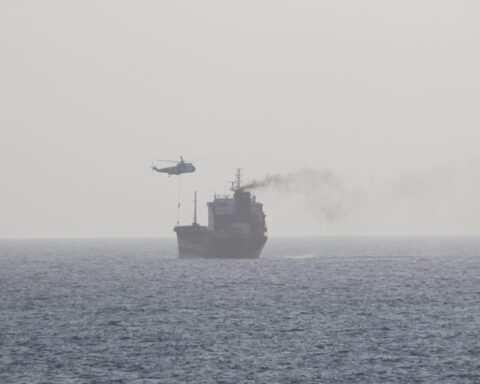
The announcement landed on a day when Tehran sent contradictory signals within the same news cycle. While the SNSC statement told wire services that proposals were under serious institutional review, IRGC gunboats fired on a tanker twenty nautical miles northeast of Oman without issuing a VHF challenge — the second live-fire incident in 48 hours. Three days remain before the Islamabad Accord ceasefire expires on April 22, and the man positioned at the intersection of Iran’s diplomatic and coercive machinery has chosen this moment to step into public view.
Table of Contents
What the SNSC Statement Actually Said — and Didn’t
The statement, carried by state broadcaster IRIB and Tasnim News Agency on April 18, contained two operative clauses. The first confirmed that “new proposals have been put forward by the Americans, which the Islamic Republic of Iran is currently reviewing.” The second declared that Iran would “continue strict monitoring and control over the Strait of Hormuz until the US-Israeli war of aggression fully ends” and labelled the US naval blockade a “violation of the ceasefire.” Western wire agencies — CBS News, the Irish Times, the Manila Times — ran the first clause as their headline. IRGC-aligned outlets Tasnim and Fars ran the second.
That editorial split is the first indicator of audience management. The statement was attributed to the SNSC as an institution, not to Zolghadr by name, giving it the veneer of collective governance rather than personal authority. But the SNSC secretariat under Zolghadr’s predecessor Ali Larijani — killed in a US-Israeli strike on March 17 — operated as a mediating body between the civilian government and IRGC command. Under Zolghadr, appointed March 24 at Vahidi’s insistence, the institution has functioned as an IRGC policy-laundering mechanism. Farzin Nadimi of the Washington Institute assessed at the time that Tehran wanted a secretary whose “comparative advantage is not negotiating skill, but integration of coercive power under crisis conditions.”
The statement also embedded a structural poison pill. It insisted that any deal must include “cessation of fire on all fronts, including Lebanon” — a condition the United States and Israel have explicitly rejected. Trump posted on Truth Social that Lebanon “is not the agreement we have.” Including Lebanon as a mandatory condition inside a statement nominally about reviewing proposals sets the terms of rejection before the review concludes.
Who Is Zolghadr and Why Does His Review Matter?
Zolghadr is not a diplomat who became a security official. He is an Iran-Iraq War veteran who commanded the IRGC’s Ramazan Headquarters — the cross-border irregular warfare unit that ran operations inside Iraqi territory — before serving as Chief of IRGC Joint Staff from 1989 to 1997 and Deputy Commander-in-Chief of the entire IRGC. Historian Shahram Kholdi described him as “one of the last remnants of the radical revolutionaries that armed themselves” against the Shah, originating in “the early networks that evolved into the Quds Force.” His civilian postings — Deputy Interior Minister under Ahmadinejad, Deputy Judiciary Chief from 2012 to 2021 — were IRGC placements in government, not government appointments of a military figure.
The Middle East briefing 3,000+ readers start their day with.
One email. Every weekday morning. Free.
In 1999, Zolghadr was among the IRGC commanders who signed a letter to President Khatami warning the Guards would act independently if the government failed to crush student protests. That letter established a template he has followed ever since: using institutional position to override civilian authority when he judges it insufficiently committed. Al Jazeera reported on March 25 that “whoever is sitting at the negotiation table will have to get Zolghadr’s approval before anything passes.” He has been SNSC secretary for 26 days. In that time, he has sabotaged one round of talks and claimed ownership of the follow-on process.
His appointment was engineered by Ahmad Vahidi, the newly installed IRGC Commander-in-Chief who holds an INTERPOL red notice for the 1994 AMIA bombing in Buenos Aires. Iran International reported that Pezeshkian appointed Zolghadr “under direct pressure” from Vahidi, and that the existing diplomatic team called him “too inexperienced for strategic negotiations.” The objection was not about competence — it was about function. The diplomatic corps understood that Zolghadr’s role was not to negotiate but to constrain what negotiators could offer.
The Deviation Report That Killed Islamabad
The documented sequence of the Islamabad collapse is precise enough to reconstruct the authorization chain. After Iran’s delegation — led by Foreign Minister Araghchi — showed what Iran International described as “flexibility on reducing support for Hezbollah and the Axis of Resistance,” Zolghadr was briefed around April 11-12. He submitted a report to senior IRGC commanders and Iran’s leadership citing “deviation from the delegation’s mandate.” Following consultations involving Hossein Taeb — a senior adviser in Supreme Leader Ali Khamenei’s inner circle, operating through his son Mojtaba during Khamenei’s extended absence — an order was issued for the delegation’s immediate return to Tehran. By April 14, the most advanced US-Iran engagement since 1979 — Vice President Vance and Parliament Speaker Ghalibaf had met face to face in Islamabad — was dead.
What triggered the recall was not the nuclear file. It was not Hormuz. It was Araghchi’s willingness to discuss reducing Iranian support for Hezbollah — the proxy network that represents the IRGC’s primary instrument of regional force projection. Iran’s authorization ceiling on its proxy commitments proved lower and more rigidly held than its nuclear red lines. Zolghadr did not need to be in the room in Islamabad. He exercised veto power from Tehran by writing a report that activated Taeb, who activated the Khamenei proxy chain. The mechanism was bureaucratic. The effect was absolute.
That sequence is why the April 18 statement demands close reading. The same institution, under the same secretary, that determined Islamabad deviated from its mandate is now claiming to conduct a genuine review of follow-on proposals. Either the mandate has changed — meaning someone above Zolghadr authorized a broader negotiating framework — or the review is being conducted against the same mandate that made Islamabad’s outcome unacceptable.
Is This Diplomacy or Clock-Running Theater?
The evidence tilts heavily toward theater, with one structural caveat worth tracking. Start with the timeline. Pakistan Army Chief Field Marshal Asim Munir arrived in Tehran around April 15-16, met both Araghchi and General Ali Abdollahi Aliabadi of the Khatam al-Anbiya Central Headquarters — the IRGC’s engineering, logistics and strategic infrastructure command — and departed for Washington on April 17 carrying Iran’s initial response. The SNSC’s “currently reviewing” statement came one to two days after Iran had already transmitted a preliminary answer through Munir. If the review were genuine and incomplete, Tehran would not have sent Munir to Washington with a response. The formal review is running behind the informal channel, which suggests it exists for a different purpose.
What Munir carried to Washington was more consequential than a ceasefire status report. Iran’s preliminary response included an in-principle agreement to a four-country nuclear monitoring framework — making Pakistan Iran’s nuclear guarantor in addition to its ceasefire enforcer. Saudi Arabia, which financed the mediation, had no role in designing the nuclear architecture being built in the room it could not enter. Pakistan’s function as Iran’s nuclear broker while cashing the Saudi cheque is examined here.
Then there is the operational signal. On the same day the SNSC announced its review, UKMTO confirmed that “two IRGC gunboats” fired on a tanker northeast of Oman without issuing a VHF challenge — standard maritime protocol. This was the second live-fire incident in 48 hours, following the April 18 attack that collapsed the brief Hormuz “opening” Araghchi had announced. A government conducting a genuine diplomatic review does not simultaneously escalate kinetic operations in the waterway at the centre of the dispute. The SNSC statement and the IRGC gunboats are products of the same system but addressed to different audiences.
The Lebanon condition is the third indicator. Including “cessation of fire on all fronts, including Lebanon” as a mandatory precondition ensures the review will find the proposals insufficient regardless of their nuclear or maritime content. Saeed Khatibzadeh, Iran’s Deputy Foreign Minister, told the Antalya Diplomacy Forum on April 18-19 that “the maximalist approach by the other side, trying to make Iran an exception from international law prevented us from reaching an agreement.” The language of pre-formatted rejection — “maximalist,” “exception from international law” — was already circulating before the review concluded.
The structural caveat is Taeb. His involvement in the Islamabad recall means the authorization chain runs through Ali Khamenei’s inner circle, not just through the IRGC command structure. If Mojtaba Khamenei — exercising authority during his father’s more than 44 days of absence from public view — authorized Zolghadr to conduct a genuine review, it would also run through Taeb. Pakistan’s assessment that a “major breakthrough on the nuclear front” remains possible, reported by RFE/RL, suggests at least one mediating party believes the proposals are receiving real evaluation. But Pakistan’s optimism has been consistently ahead of Iranian institutional behaviour throughout this crisis.
What Each Reading Means for Saudi Arabia
If reading (a) is correct — that the authorization ceiling has genuinely shifted and Zolghadr has been brought inside a broader framework — the implications for Riyadh are paradoxically worse in the medium term. A deal brokered through the SNSC rather than the Foreign Ministry would carry IRGC institutional commitment, making it more durable than anything Araghchi could sign alone. But Saudi Arabia has been excluded from both the Islamabad bilateral and the Antalya four-nation coordination framework as a formal participant. A US-Iran agreement engineered through Pakistan’s military channel and ratified by Iran’s security establishment would present Riyadh with settled terms it had no role in shaping — on Hormuz transit, on enrichment thresholds, on the status of Iranian proxies along Saudi Arabia’s borders.
If reading (b) is correct — that Zolghadr is running the clock toward April 22 — the exposure is more immediate and more measurable. Saudi March 2026 production dropped to 7.25 million barrels per day from 10.4 million in February, a 30 percent collapse that the IEA called “the largest disruption on record.” The Yanbu bypass via the East-West Pipeline has a loading ceiling of 4 to 5.9 million bpd. Pre-war Hormuz throughput ran at 7 to 7.5 million bpd, leaving a structural gap — at best 1.1 million bpd at the favourable end of both ranges, and potentially exceeding 3 million bpd if Yanbu operates below peak — that no pipeline configuration can close. Every day between now and April 22 that the SNSC spends “reviewing” is a day that gap compounds against Saudi fiscal reserves. Goldman Sachs estimated a 6.6 percent GDP war-adjusted deficit against the government’s official 3.3 percent projection.
The Hormuz Traffic Licensing Committee that Zolghadr also oversees has issued 60 permits, sent 8 payment requests, and collected zero dollars in 36 days. The toll architecture he was meant to monetize has produced nothing. The review process he now leads has a documented track record of one entry — the Islamabad talks — and one outcome: collapse. Even the enrichment gap is structural rather than bridgeable within three days. The US proposed a 20-year moratorium on enrichment; Iran countered with 3 to 5 years. Trump then personally rejected his own negotiators’ position, telling the New York Post “I don’t like the 20 years.” Iranian officials have characterized the US proposal as “extremely maximalist and unreasonable” — language that, like Khatibzadeh’s Antalya phrasing, arrived before any formal review outcome was announced.
Background
The Islamabad Accord, reached in early April 2026 with Pakistan as guarantor, established a ceasefire framework that expires April 22 with no built-in extension mechanism. The Soufan Center has confirmed the absence of any renewal clause, meaning the ceasefire lapses automatically if no new agreement replaces it. Iran cancelled the April 20 Islamabad follow-up round on the same day as the SNSC statement, leaving no scheduled forum for reaching a replacement before expiry.
The SNSC sits directly below the Supreme Leader in Iran’s constitutional hierarchy under Article 176. Its decisions require Supreme Leader ratification to become binding. Ayatollah Ali Khamenei has been absent from public view for more than 44 days, with his son Mojtaba operating through intermediaries including Taeb — and new reporting confirms that Mojtaba Khamenei has been functioning as Iran’s de facto supreme leader for 40 days, making the ceasefire authorization decisions analysts attributed to a vacuum. Zolghadr’s appointment collapsed the civilian-military distinction that Larijani had maintained as SNSC secretary — Larijani was a conservative politician with negotiating credentials, while Zolghadr’s career has been entirely within the IRGC and its institutional extensions into government. The mine-clearance timeline — 51 days minimum using the 1991 Kuwait benchmark, with the four Avenger-class MCM ships previously based in Bahrain decommissioned in September 2025 — means that even a deal signed on April 22 cannot physically reopen Hormuz before mid-June.
FAQ
What exactly did the SNSC statement say?
The statement, carried by Tasnim and IRIB on April 18, was attributed to the SNSC as a body rather than to Zolghadr by name — a framing choice that signals collective institutional authority rather than personal accountability. It confirmed new American proposals were under review, declared continued “strict monitoring and control” over Hormuz, and called the US naval blockade a ceasefire violation. IRGC-aligned outlets Tasnim and Fars buried the review clause and led with the Hormuz control declaration; Western wire services did the reverse.
How were the US proposals delivered?
Pakistan Army Chief Field Marshal Asim Munir served as the physical courier, travelling to Tehran around April 15-16 before departing for Washington on April 17 carrying Iran’s preliminary response. The White House said it “feels good about the prospects of a deal,” while an unnamed source told Reuters that Iran’s response was “not positive.” The divergence between those two characterisations captures the interpretive split that has run through every mediation attempt since the ceasefire was agreed.
What is the enrichment gap between the two sides?
The US proposed a 20-year moratorium on Iranian uranium enrichment. Iran countered with 3 to 5 years. Iranian Foreign Ministry spokesman Esmail Baghaei said Iran is “open to discussing the type and level of its uranium enrichment” but must “based on its needs, be able to continue enrichment.” Trump undercut his own team’s position by saying “I don’t like the 20 years,” but has not publicly named an alternative number. Iran holds 440.9 kilograms of uranium enriched to 60 percent — roughly 25 days from weapons-grade material using IR-6 centrifuge cascades, though IAEA access was terminated on February 28, 2026, meaning current stockpile figures are estimates.
Can the ceasefire be extended past April 22?
Not under the existing Islamabad Accord framework, which contains no extension mechanism. Iran cancelled the April 20 follow-up round in Islamabad, eliminating the scheduled venue for a replacement agreement. A new framework would require agreement between parties that currently disagree on whether Lebanon is included in the conflict and whether Hormuz transit fees are legal.
What is Zolghadr’s role beyond the SNSC?
An unnamed Iranian military adviser told PBS Newshour that “unlike the Americans who are afraid of continuous war, we are fully prepared and familiar with a long war” — language consistent with Zolghadr’s institutional profile as a figure whose career incentive has always been confrontation over settlement. He also chairs the Strait of Hormuz Traffic Licensing Committee, which has issued 60 permits, made 8 payment requests, and collected zero revenue in 36 days. Both roles — the toll committee and the SNSC secretariat — have now produced the same result under his leadership.
That same interpretive impasse was on display on April 19, when the White House called the latest round of US-Iran negotiations “productive” even as the IRGC re-closed Hormuz and fired on ships it had cleared to transit. How Washington is framing the talks as leverage while the IRGC erases each concession in real time is examined in White House Calls Iran Talks ‘Productive’ as IRGC Re-Closes Hormuz. The new US delegation arriving in Islamabad with Jared Kushner alongside Vance and Witkoff — and the conflict-of-interest architecture of a private $6.16 billion Gulf fund negotiating the wars that fund it — is documented in Kushner Returns to Islamabad With $6 Billion in Gulf Money and 72 Hours Before the Ceasefire Dies.
That authorization ceiling acquired its most explicit form on April 24, when Trump named Hezbollah financing as a deal condition. As Trump’s Hezbollah Ultimatum Demands IRGC Self-Amputation Iran Cannot Deliver documents, the financing route runs through Unit 190 of the Quds Force — the same IRGC command structure that Zolghadr’s SNSC appointment was designed to protect from civilian interference.