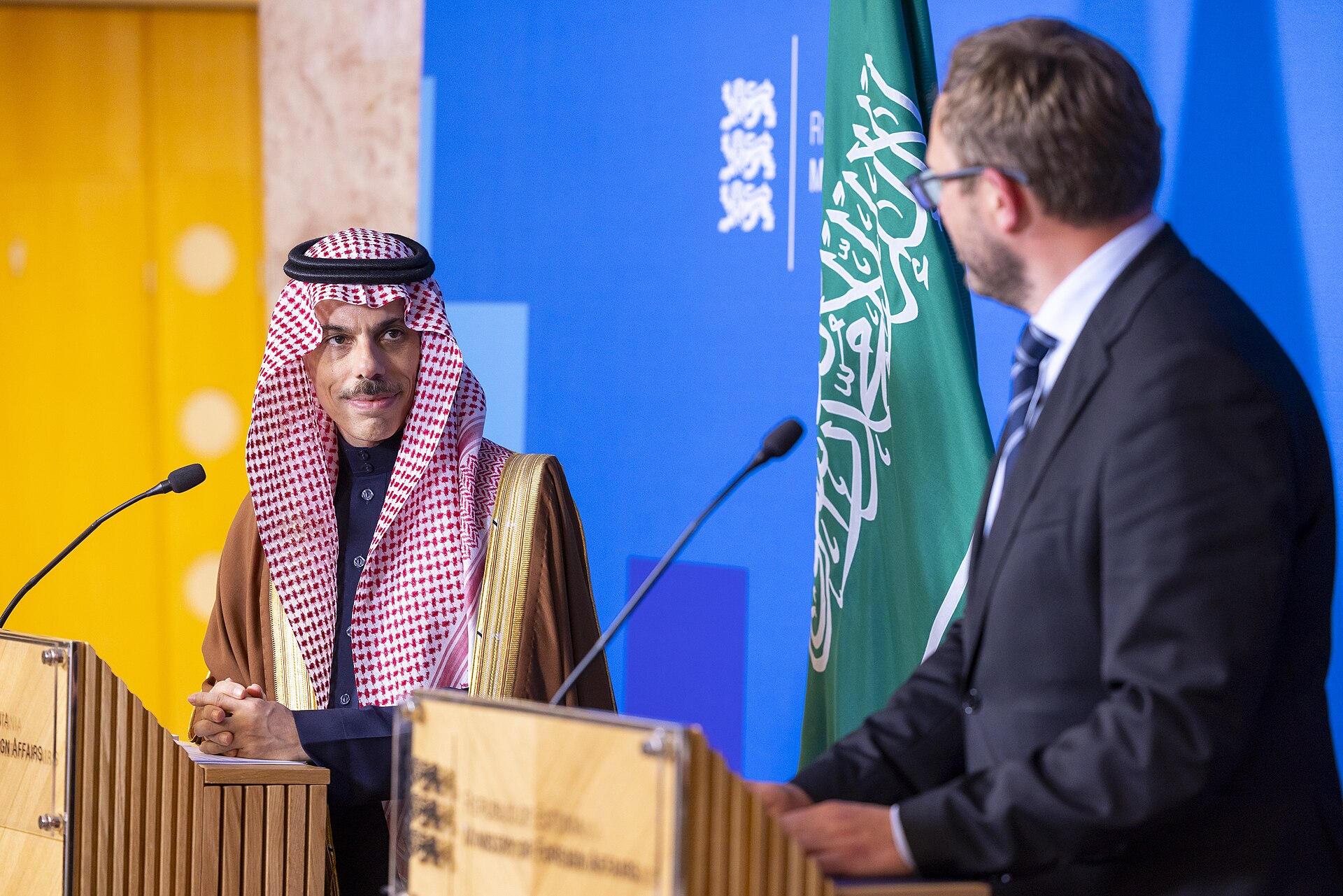
RIYADH — Saudi Foreign Minister Prince Faisal bin Farhan praised President Donald Trump on May 20 for giving “negotiations with Iran additional time to reach an agreement” — a public endorsement of American firmness delivered five to six days after Trump told Fox News host Sean Hannity that retrieving Iran’s 970-pound stockpile of highly enriched uranium is “not necessary, except from a public relations standpoint.”
The gap between what Bin Farhan appeared to endorse and what Trump had already conceded places Saudi Arabia in a position the kingdom’s diplomacy has spent six months trying to avoid: publicly aligned with a negotiating posture that Washington is actively softening, with no mechanism to shape the terms of any eventual deal. The Carnegie Endowment for International Peace wrote in April 2026 that “the GCC has no seat at the table, despite its entreaties, for negotiations that will shape the bloc’s economic and security environment for years to come.” Bin Farhan’s May 20 statement confirmed the absence. It did not remedy it.
Table of Contents
- The Timeline: From Rejection to Acceptance in Thirty Days
- What Did Bin Farhan Know on May 20?
- Iran’s Position: HEU Stays, Hormuz Stays Separate
- The Structural Exclusion
- The Fiscal Dimension of Diplomatic Exposure
- Can Saudi Arabia Recover Influence It Never Held?
- Background
- Frequently Asked Questions
The Timeline: From Rejection to Acceptance in Thirty Days
On April 14, Trump told the New York Post he had rejected his own negotiators’ proposed 20-year enrichment moratorium. “I don’t like the 20 years,” he said. “I don’t want them to feel like they have a win.” The Foundation for Defense of Democracies flagged the statement the following day as a hardening of the American position — a rejection not merely of Iran’s counter-offer but of the US team’s own framework.
By mid-May, speaking to reporters aboard Air Force One departing Beijing after his summit with Chinese President Xi Jinping, Trump reversed course. “Twenty years is enough,” he said, “but the level of guarantee from them is not enough. In other words, it’s got to be a real 20 years.” The Times of Israel reported the statement as a concrete shift in the American negotiating position.
Then came the Hannity interview, aired May 14–15. Hannity asked whether the United States would retrieve or “entomb” Iran’s approximately 970 pounds of HEU — the material that, if further enriched, could produce multiple nuclear weapons. Trump responded: “I don’t think it’s necessary, except from a public relations standpoint. I think it’s important for the fake news that we get it.” He added: “I just feel better if I got it, actually, but it’s — I think, it’s more for public relations than it is for anything else.”
Bloomberg reported the exchange on May 15. MSNBC’s Rachel Maddow Blog characterized it as Trump having “appeared to abandon a position that has been central to his entire premise for this disastrous war and instantly undermined his insistence on it as a key term of a peace deal.”
The Middle East briefing 3,000+ readers start their day with.
One email. Every weekday morning. Free.
Five days later, Bin Farhan praised Trump’s Iran approach at a press conference carried by Al Arabiya.
What Did Bin Farhan Know on May 20?
Two interpretations exist for the Saudi foreign minister’s timing. The first: Riyadh’s diplomatic apparatus failed to register a statement that Bloomberg, MSNBC, and Breitbart all reported within hours of its airing. This would represent an intelligence failure at the most senior level of Saudi foreign policy — unlikely given the kingdom’s investment in Washington monitoring since 2017.
The second: Bin Farhan knew precisely what Trump had said on May 14, and endorsed the broader diplomatic framework anyway, calculating that public alignment with Washington — even a Washington retreating from its own stated red lines — remained preferable to public distance. Under this reading, the endorsement was not a mistake. It was a concession dressed as praise.
Neither interpretation strengthens Riyadh’s position. Under the first, Saudi Arabia endorsed terms it did not understand. Under the second, it endorsed terms it could not influence. Both outcomes leave the kingdom providing diplomatic cover for a deal whose contours it did not shape.
Michael Ratney, a former US ambassador now at the Center for Strategic and International Studies, has noted that Crown Prince Mohammed bin Salman extracted AI chips, a strategic defense agreement, major non-NATO ally designation, F-35 agreements, and civil nuclear cooperation from Trump’s May visit to Riyadh. On the Iran nuclear file — the single issue that most directly determines whether the Strait of Hormuz reopens on terms favourable to Saudi commerce — MBS gets no formal say.
Iran’s Position: HEU Stays, Hormuz Stays Separate
Tehran has flatly rejected physical transfer of its HEU stockpile to any third country. Three Iranian officials told the New York Times in early May that talks remained stalled because the US demanded Iran commit in advance to surrendering its HEU, closing the Fordow, Natanz, and Esfahan facilities, and suspending enrichment for 20 years. Iran’s military media outlet Defa Press stated on May 7 that diluting uranium was equivalent to handing it to “the enemy.”
Iran has proposed an alternative: diluting “some” HEU domestically and transferring the remainder to Russia — a formula that would leave Tehran with residual enrichment capability and Moscow with a custodial role. PressTV described the full American demand on May 17 as “illegal and humiliating,” citing enrichment for peaceful purposes as an “inalienable right” under the Non-Proliferation Treaty.
Trump’s Hannity statement — that HEU retrieval is necessary only “from a public relations standpoint” — aligns more closely with Iran’s counter-proposal than with the position Saudi Arabia has treated as its minimum threshold for an acceptable deal.
The decoupling problem is sharper still. Iranian Foreign Ministry spokesman Esmaeil Baghaei said on May 21 that “the plan we have presented is centred on ending the war. There are absolutely no details regarding the country’s nuclear issues in this proposal.” Iran is negotiating the nuclear file and the Hormuz file on separate tracks. For Riyadh — whose $33.5 billion first-quarter fiscal deficit depends on Hormuz normalisation for recovery — a nuclear deal that leaves the strait’s status unresolved is worse than no deal at all. It removes the pressure that makes Hormuz negotiable.
The Structural Exclusion
Iran’s refusal to allow Arab participation in nuclear negotiations is not new. The Atlantic Council has documented that Iran “will not accept Arab participation because it would mean recognizing Saudi concerns about Iran’s nuclear and ballistic missile program” — a structural position Tehran has maintained since the original JCPOA talks in 2014–15.
What has changed is the cost of that exclusion. During the JCPOA era, Saudi Arabia could lobby Washington to include missile provisions or regional behaviour constraints as conditions for sanctions relief. The current war — and the 39-day silence between Washington and Tehran that preceded the current round — has compressed the negotiating space. Axios reported on May 6 that the parties were “closing in on” a one-page memorandum of understanding with a 12-year moratorium floor. The format itself — a one-page MOU — suggests a deal structure too narrow to accommodate Saudi equities on missiles, regional proxies, or Hormuz.
RUSI’s analysis of Saudi threat perception reinforces the point from a different angle. “Riyadh’s concerns about Iran have never been primarily focused on the nuclear danger,” RUSI wrote. “The Saudis have long calculated the risk of Iranian use of nuclear weapons as low.” Saudi Arabia’s actual red lines — Iran’s missile programme and regional proxy network — are not on the US-Iran negotiating table. A nuclear deal, even a weak one, could remove whatever pressure exists to address them.
Kelly A. Grieco of the Stimson Center has described Iran’s Hormuz position as “the most meaningful setback for the U.S.,” noting that “Iran has effectively established itself as gatekeeper of the strait” — a “fundamentally different status quo than existed before the conflict.” If Washington settles the nuclear file while leaving this status quo intact, Saudi Arabia will have endorsed the process that ratified its own diminished position.
The Fiscal Dimension of Diplomatic Exposure
Saudi Arabia’s first-quarter fiscal deficit reached $33.5 billion — 194% of the kingdom’s full-year deficit target, according to Ministry of Finance data. The Public Investment Fund’s cash position has fallen to approximately $15 billion, the lowest since 2020. The IMF calculates Saudi Arabia needs oil prices above $90 per barrel to balance its budget; the EIA’s May 2026 Short-Term Energy Outlook projects Brent falling to $89 per barrel by Q4 2026 and $79 per barrel as a 2027 average — contingent on Middle East production normalising.
That normalisation depends on Hormuz. Aramco’s CEO has indicated that full transit normalisation may not occur “until 2027.” Every month the strait remains under IRGC toll architecture — with only 45 confirmed transits since April 8, representing 3.6% of the pre-war baseline — Saudi Arabia’s fiscal trajectory worsens.
A nuclear deal that does not include Hormuz reopening provisions would lock in this trajectory. Bin Farhan’s endorsement of Trump’s approach carries an implicit fiscal bet: that Washington’s nuclear diplomacy will, eventually, produce Hormuz outcomes. Baghaei’s May 21 statement — that Iran’s proposal is “centred on ending the war” with nuclear issues handled separately — suggests Iran intends precisely the opposite sequence. Settle the war first, on terms that preserve Hormuz as a bargaining instrument. Discuss nuclear later, if at all.
Can Saudi Arabia Recover Influence It Never Held?
The Trump administration has given Saudi Arabia one asset in these negotiations, though not intentionally. On May 19, Trump publicly identified MBS as one of three Gulf leaders — alongside the Emir of Qatar and the President of the UAE — who personally asked him to halt a planned strike on Iran. The disclosure, reported by Axios, Bloomberg, and CNN, eliminated Saudi Arabia’s ability to maintain private distance from Washington’s Iran posture. But it also confirmed Saudi Arabia’s role as an interlocutor whose preferences Trump values — at least on the question of military restraint.
On May 23, MBS joined a multi-leader call urging Trump to accept a deal that includes enrichment rights Riyadh does not possess and a Hormuz timeline Riyadh does not control — the clearest test yet of whether Saudi lobbying translates into terms.
Whether that influence extends to deal terms is untested. Secretary of State Marco Rubio said on May 21 that “there are some good signs” but that the US is “dealing with a system that itself is a little fractured.” He added that Iranian Hormuz toll demands would make any deal “unfeasible” — a statement that, if operationalised, would align American and Saudi interests on the strait. But Rubio’s “unfeasible” is a characterisation, not a red line. It does not bind the president who just described HEU retrieval as a public relations exercise.
Aaron David Miller of the Carnegie Endowment for International Peace has warned that if the conflict ends with Iran’s HEU stockpile intact, this “constitutes a historic strategic defeat for the U.S., especially when this was a war of choice.” For Saudi Arabia, the exposure is compounded: a defeat for Washington that Riyadh publicly endorsed as firmness.
“The GCC has no seat at the table, despite its entreaties, for negotiations that will shape the bloc’s economic and security environment for years to come.”
Carnegie Endowment for International Peace, April 2026
The Hajj adds a temporal constraint. Day of Arafah falls on May 26; Eid al-Adha on May 27. Approximately 1.8 million pilgrims — including Iranian pilgrims — will converge on Mecca within days. Any deal collapse, escalation, or public rupture between Riyadh and Washington during this window carries costs that transcend diplomacy. The custodianship of the Two Holy Mosques is not a negotiating position. It is the irreducible core of Saudi legitimacy, and it requires stability precisely when Bin Farhan’s endorsement has made instability’s consequences harder to manage.
Background
The US-Iran war entered its 84th day on May 21. The conflict began after the collapse of the Islamabad talks on April 11–12, when 21 hours of negotiations between US envoy J.D. Vance and Iranian Parliament Speaker Mohammad Bagher Ghalibaf ended without agreement. The US imposed a naval blockade on April 13. A second round of talks, planned for April 25, was cancelled. Axios reported on May 6 that a 14-point MOU framework had emerged, with a 12-year moratorium floor, but Iran’s Foreign Ministry rejected it on May 10 as “garbage.” Trump cancelled a planned military strike on May 19 after Gulf leaders intervened.
The Stimson Center’s Nour Eid has argued that “Saudi Arabia’s nuclear path will not depend on Iran or the war’s outcome” — that Riyadh’s own nuclear calculus is driven by erosion of US security guarantees, Israeli assertiveness, and Saudi strategic autonomy ambitions. If true, the kingdom’s exposure on the Iran deal is not merely diplomatic. It is a preview of a broader pattern: Saudi Arabia’s security architecture depending on American commitments that Washington treats as adjustable.
Tasnim News Agency, aligned with Iran’s Islamic Revolutionary Guard Corps, described the latest US proposal as “aimed at justifying Trump’s retreat from his recent hostile action.” The choice of the word “retreat” — by adversary media — mirrors the structural reality that Bin Farhan’s endorsement was designed to obscure.
Frequently Asked Questions
What exactly is the moratorium gap between the US and Iran?
Iran initially offered a “single-digit” number of years for an enrichment moratorium. The Axios-reported MOU framework from May 6 established a floor of 12 years. The US has demanded 20 years, which Trump now accepts. The gap narrowed from roughly 15 years (Iran’s initial position vs. the US demand) to 8 years (the Axios floor vs. the US demand). On May 17, Iran introduced new preconditions: retaining 400 kg of HEU and keeping one enrichment facility operational — conditions that would make even a 20-year moratorium less restrictive than the term suggests. Neither the moratorium length nor the HEU disposition directly addresses Hormuz transit, missile development, or regional proxy activities — the issues Saudi Arabia considers primary.
Has Saudi Arabia ever had formal input into US-Iran nuclear negotiations?
No. Saudi Arabia was excluded from the P5+1 talks that produced the 2015 JCPOA, despite lobbying for inclusion. The kingdom was briefed but not consulted on terms. The Atlantic Council has documented that Iran’s structural refusal to accept Arab participation dates to 2014 and is rooted in Tehran’s unwillingness to legitimate Saudi concerns about Iran’s nuclear and missile programmes. During the JCPOA period, Saudi Arabia influenced US policy through congressional lobbying — helping to secure the Iran Nuclear Agreement Review Act of 2015 (Corker-Cardin) — but had no direct negotiating role. The current bilateral US-Iran format is even more exclusionary than the P5+1 structure, which at least included France and the UK as potential Saudi-sympathetic voices.
Could a US-Iran nuclear deal actually worsen Saudi Arabia’s Hormuz position?
Yes, through pressure removal. The current Hormuz closure creates international pressure on Iran from multiple directions simultaneously — nuclear sanctions, naval confrontation, and strait-closure costs to neutral parties like China, India, and Japan. A nuclear deal that resolves the enrichment dispute while leaving Hormuz governance to a separate track would remove the nuclear pressure vector without guaranteeing its replacement. Iran has explicitly framed its current proposal as “centred on ending the war,” with nuclear treated as a separate file to be addressed later. If Washington agrees to this sequencing, Saudi Arabia loses the convergence of pressures that currently makes Hormuz negotiable.
What do Gulf states actually want from the negotiations — and are they getting it?
Euronews, citing Atlantic Council analysis from May 19, reported that for Gulf states “the opening of the Strait of Hormuz and addressing Iran’s missile programme that has launched thousands of missiles at the Gulf States are the core issues” — not Iran’s nuclear programme per se. This characterisation aligns with RUSI’s assessment that Riyadh’s concerns “have never been primarily focused on the nuclear danger.” The disconnect is that Washington is negotiating on the nuclear track — the issue Gulf states care about least — while the issues they care about most (Hormuz, missiles, proxies) remain outside the deal framework entirely. Saudi Arabia has staked its Hormuz strategy on a parallel UNSC track — co-sponsoring a 137-nation enforcement draft with no fallback if Russia and China veto again, an exposure examined in Saudi Arabia’s UNSC co-sponsorship strategy and why it leads to a dead end.
Two days after bin Farhan’s endorsement, Al-Arabiya — the PIF-controlled broadcaster — published what it described as a “final draft” of the US-Iran deal, claiming an announcement was imminent. The text tracked bin Farhan’s language precisely: ceasefire terms and Hormuz navigation guarantees, with nuclear provisions conspicuously absent. The Al-Arabiya decision to publish the leaked text before either government confirmed it extended Saudi diplomatic signaling through media where official channels could not reach.
Three days later, Araghchi’s declaration that “no enrichment would mean we do not have a deal” made explicit the enrichment deadlock that emerged from Round 5 — the same week bin Farhan had publicly endorsed a Trump firmness the US president had already privately retreated from.
Austria’s annual intelligence report, published while Saudi Arabia remained excluded from all five rounds of US-Iran talks, concluded that Iran’s nuclear programme constitutes a weapons acquisition effort — not an enrichment leverage play. That framing matters for Gulf states: if the programme’s intent is a bomb rather than a bargaining chip, the moratorium framework bin Farhan endorsed resolves the wrong problem. Austria’s DSN assessment and its implications for the deal architecture are examined in Austria Sees an Iranian Bomb. The Deal Sees a Bargaining Chip.
The same Faisal bin Farhan who endorsed a concession Trump had already made was present at a two-hour private meeting between MBS and evangelical Trump ally Mike Evans — a detail no outlet reporting the story has examined. Evans subsequently reported that MBS said he would recognize Israel “today,” with King Salman as the sole obstacle. Whether Bin Farhan was there to validate the channel or manage it is the sharpest unresolved question in MBS’s private normalization signal to a Trump ally.