VIENNA — Saudi Foreign Minister Prince Faisal bin Farhan told the European Council on Foreign Relations on June 18 that economic cooperation with Iran requires “a rebuilding of trust and a rebuilding of relationships” — a condition he imposed ninety-one days after declaring that “what little trust there was before has completely been shattered.” The statement was not diplomatic caution. It was the only instrument Saudi Arabia possesses to slow a $300 billion Iran reconstruction fund that Riyadh cannot block, cannot shape, and has no institutional seat to challenge.
The fund, enshrined in Section 6 of the US-Iran Memorandum of Understanding, commits Washington and “its regional partners” to develop “a comprehensive plan agreed upon by both sides for the reconstruction and economic development of the Islamic Republic of Iran, while ensuring funding of at least $300 billion.” More than half of that figure was already committed by June 16, according to Reuters. Vice President JD Vance said the same day that the fund would be “funded by the Gulf Coast Coalition” — meaning GCC states, including Saudi Arabia. Faisal, when asked about it on Al Arabiya, said he had “no information.”
The gap between endorsing the MOU and claiming ignorance of its largest financial commitment is not confusion. It is policy.
Table of Contents
- Trust as Instrument
- What Does Section 6 Actually Commit?
- From Reparations to Investment: Iran’s $400 Billion Retreat
- Who Pays for Reconstruction of the Country That Attacked Them?
- Faisal’s Three Statements and What Each Foreclosed
- How Does the Fund Compare to Any Precedent?
- The June 18 Call: Two Readouts, Two Agendas
- Why Saudi Arabia Cannot Block the Fund
- Tehran’s Dignity Problem
- What ‘Trust Before Cooperation’ Actually Means
Trust as Instrument
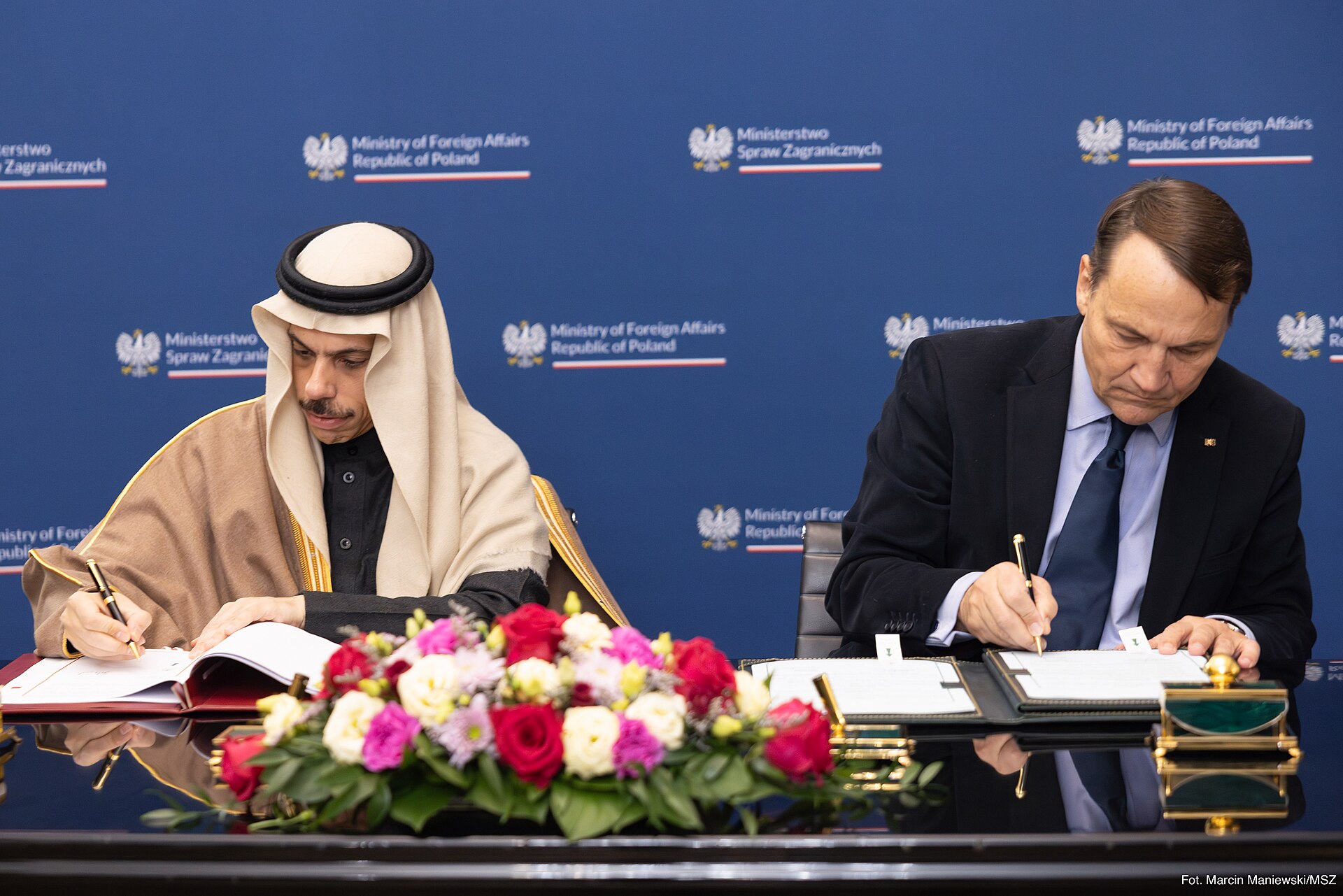
Prince Faisal’s language at the ECFR panel was precise enough to reward close reading. He did not reject the fund. He did not confirm the fund. He placed a temporal condition in front of it: “We will have to hold a dialogue on how to rebuild that trust and rebuild the relationship before any concept of economic cooperation, mutual investment, or anything of that sort can be rationally addressed.”
The sentence does several things simultaneously. It accepts that economic cooperation will eventually be addressed — “before” implies an “after.” It defines what must come first without specifying how long that process takes. And it converts Saudi Arabia’s structural weakness — no seat on the Phase 2 nuclear track, no seat on the Lebanon monitoring committee, no role in the Hormuz clearance chain — into what sounds like principled restraint. Trust is unquantifiable. Its absence cannot be disproved. It has no deadline.
This is not the same as having power. Saudi Arabia cannot convene a vote on the fund. It cannot condition its participation on specific terms because it was not consulted on those terms. What it can do is publicly state, at a European diplomatic forum, that the prerequisite for participation has not been met — and leave unnamed who must meet it, and by when.
The Middle East briefing 3,000+ readers start their day with.
One email. Every weekday morning. Free.
The distinction matters because every other Saudi instrument has been neutralized. The GCC-IMO letter of May 21, in which five of six GCC states challenged Iran’s Strait of Hormuz authority, produced no change to the PGSA fee structure that still costs Saudi Arabia an estimated $2 billion per year. A UN General Assembly resolution condemning Iran’s attacks on GCC states produced no enforcement mechanism. Saudi Arabia’s endorsement of the MOU itself — issued before the G7 endorsed it, before the text was publicly available — purchased no input on Section 6.
Trust, then, is what remains.
What Does Section 6 Actually Commit?
The MOU’s reconstruction provision is deliberately vague about implementation and deliberately specific about scale. The $300 billion floor — not ceiling — is written into the text. The mechanism for administering it, the timeline for disbursement, the governance structure, the conditionality framework: all deferred to the 60-day Phase 2 window that began with the June 19 Geneva signing ceremony. A source familiar with the negotiations told Ynetnews that details on who will administer the fund “were still to be worked out.”
The fund is structured as a private investment vehicle, not a government grant program. Companies from the United States, Gulf Arab states, Asia, South America, and Africa have committed financing, according to Reuters. Iranian sources have named Mobarakeh Steel complex, refineries, and airports as target projects. The distinction between private investment and government funding is politically essential — it allowed Trump to post “There is no 300 Billion Dollar payment to Iran by the U.S. That’s Fake News!” on Truth Social even as his vice president confirmed the fund exists and attributed its financing to the GCC.
Three separate financial tracks are operating simultaneously. The $300 billion reconstruction fund. Sanctions relief under the MOU framework. And the release of frozen Iranian assets estimated at over $100 billion. They are structurally independent, but politically entangled: progress on one creates pressure to advance the others.
For Saudi Arabia, the fund’s private-investment framing creates a specific problem. If the capital is private, Saudi Arabia cannot use sovereign objections to prevent Saudi-domiciled companies from participating. If the capital is sovereign, Saudi Arabia is being asked to fund the reconstruction of a country that attacked it. The framing oscillates between these two descriptions depending on who is speaking and to which audience.
From Reparations to Investment: Iran’s $400 Billion Retreat
The reconstruction fund did not emerge from the MOU negotiations. It emerged from the failure of an earlier Iranian demand.
Iran originally sought $400 billion in direct war compensation from the United States. The figure was not arbitrary — Iran’s government spokesperson Fatemeh Mohajerani cited “direct and indirect damages” of $270 billion from the conflict in April 2026. Iran’s UN Ambassador Amir-Saeid Iravani supplemented this with a formal letter to the Secretary-General demanding that Saudi Arabia, UAE, Qatar, Bahrain, and Kuwait “make full reparation” for “internationally wrongful acts” — specifically, allowing their territory to be used for US-Israeli military operations.
Washington declined the reparations framing. What replaced it was Qatar’s “prosperity fund” concept, discussed with the US and Iran for several weeks before appearing in the MOU text, according to Al Jazeera. The $300 billion investment fund is, structurally, a reparations substitute engineered to avoid the word “reparations.” Private capital instead of government transfers. Investment instead of compensation. Reconstruction instead of restitution.
The laundering of the concept did not change its direction of flow. Money still moves from countries Iran attacked to Iran. Iran’s state media — Mehr and IRNA — described the fund using language indistinguishable from compensation: reconstruction for infrastructure damage, service fees, investment-for-recovery. For Iranian domestic audiences, the fund is reparations by another name. For American domestic audiences, it is private enterprise. For Gulf audiences, it is neither — it is a bill.
Who Pays for Reconstruction of the Country That Attacked Them?
The question is not rhetorical. Vice President Vance answered it on June 16: the “Gulf Coast Coalition.” Saudi Arabia, UAE, Bahrain, Kuwait, Oman, Qatar — the same states targeted in Iran’s UN reparations letter, minus Jordan.
The Jerusalem Post, citing Gulf officials, reported that Saudi Arabia, the UAE, and Bahrain collectively feel the fund “risks rewarding aggression and undermining deterrence.” The specific concern: freed resources would “empower Tehran’s regional networks of militias and proxies” in Iraq, Syria, Lebanon, and Yemen.
Abu Dhabi’s position, per the same reporting, was more conditional than Riyadh’s. The UAE would contribute if the fund met four criteria: conditional, transparent, phased, and tied to verifiable Iranian restraint. The permitted sectors — civilian infrastructure, energy stabilization, transport under international monitoring — were defined by exclusion. Not IRGC. Not military production. Not drone networks. Not dual-use procurement. The UAE’s conditions are a negotiating position. Saudi Arabia’s “no information” is not.
Qatar, which originated the fund concept, immediately distanced itself from financing it. Foreign Ministry spokesperson Majed al-Ansari stated: “No Qatari capital has been committed for this purpose.” Any initiative, he added, would require “an international character.” Qatar brokered the idea, then disclaimed ownership of the check.
The pattern across the GCC is consistent. No state has publicly committed funds. Every state has been publicly named as a source. The fund exists in the MOU text. The financing exists in Vance’s attribution. The consent of the financiers does not yet exist in any public record.
| GCC State | Named as Funder (by Vance) | Public Position on Fund | Named in Iran’s Reparations Letter |
|---|---|---|---|
| Saudi Arabia | Yes (as GCC member) | “No information” — Faisal, June 18 | Yes |
| UAE | Yes | Conditional: transparent, phased, verified | Yes |
| Qatar | Yes | “No Qatari capital has been committed” | Yes |
| Bahrain | Yes | “Risks rewarding aggression” (per JPost) | Yes |
| Kuwait | Yes | No public statement | Yes |
| Oman | Yes | No public statement | No |
Faisal’s Three Statements and What Each Foreclosed
Faisal’s public positioning on Iran has moved through three distinct phases in ninety-one days, each narrowing Saudi Arabia’s options further.
March 19, 2026, Riyadh press conference: “What little trust there was before has completely been shattered.” And: “If Iran doesn’t immediately cease its attacks, then nothing will be able to restore trust with it.” And, most surgically: “Iran was never a strategic partner to the Kingdom.” This was the maximum-distance position — a formal burial of the Beijing normalization framework signed barely three years earlier. The word “never” retroactively erased the 2023 agreement’s premise.
June 18, 2026, ECFR Vienna (morning session): “We will have to hold a dialogue on how to rebuild that trust and rebuild the relationship before any concept of economic cooperation, mutual investment, or anything of that sort can be rationally addressed.” The shift from March is structural. In March, Faisal said trust was shattered. In June, he described a process for rebuilding it — which means he accepted, implicitly, that rebuilding is possible. The word “before” is a delay mechanism, not a rejection.
June 18, 2026, Al Arabiya interview (same day): He had “no information” about the $300 billion fund. Iran’s attacks on GCC states resulted in “a significant loss of trust in Tehran.” This was the tightest formulation — combining ignorance of the fund’s specifics with the trust condition that blocks engagement with it. The statement is sustainable precisely because it commits to nothing: not opposition, not participation, not a timeline.
Each statement moved Riyadh from rejection toward conditional engagement while maintaining enough ambiguity to avoid being caught endorsing a fund that its own public finds indefensible. The trajectory suggests that Saudi Arabia is managing its domestic audience’s timeline for accepting the fund, not building a case against it.
How Does the Fund Compare to Any Precedent?
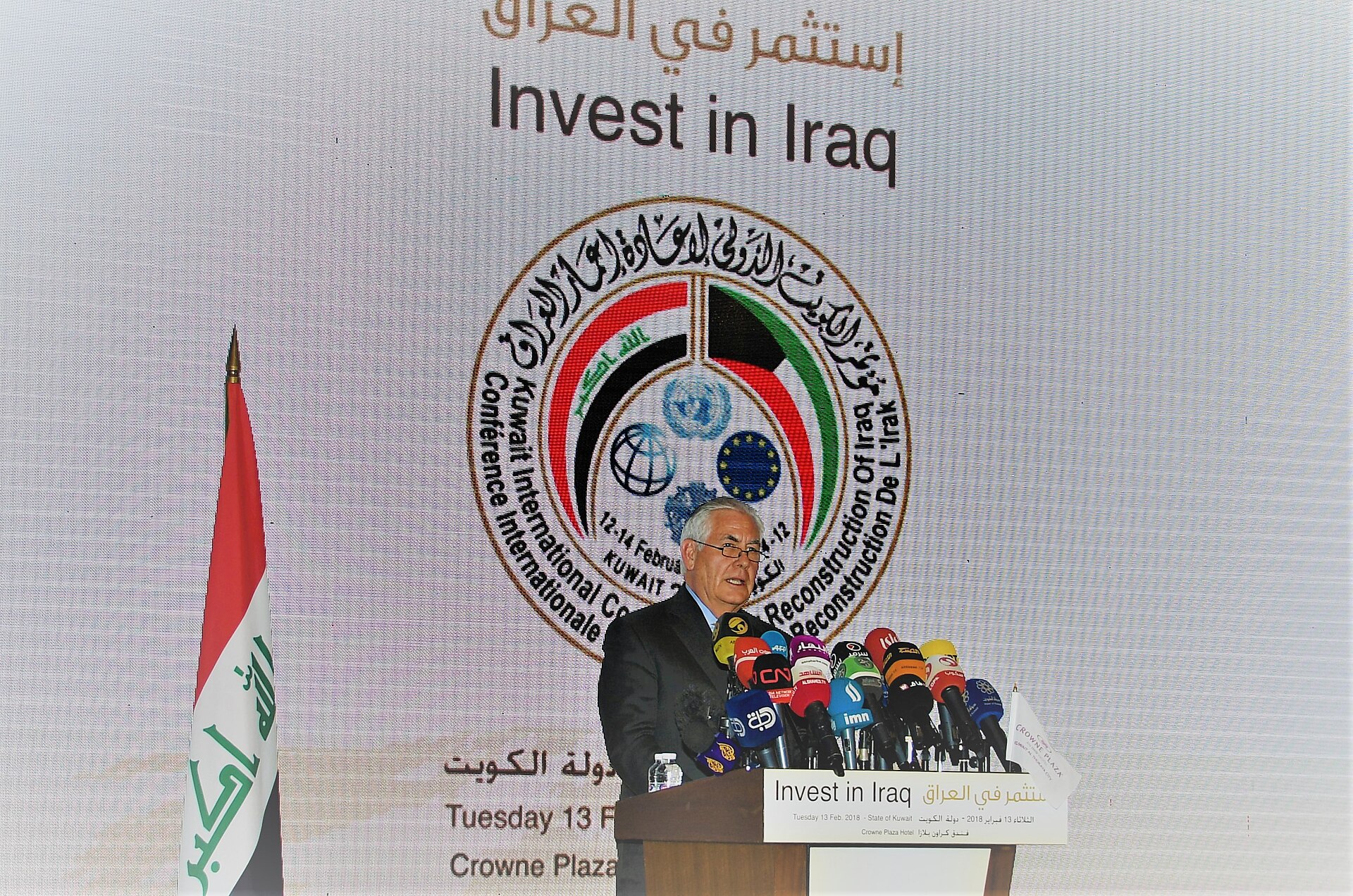
The closest analogue is the February 2018 Kuwait International Conference for Reconstruction of Iraq. Organized by Kuwait, Iraq, the EU, the UN, and the World Bank after the territorial defeat of ISIS, it mobilized nearly $30 billion from 67 participating states. Saudi Arabia pledged $1.5 billion. Kuwait pledged $2 billion. Qatar pledged $1 billion.
The $300 billion Iran fund is ten times that total. The Iraq conference mobilized $30 billion for a country that had not attacked the donors. Iraq was not simultaneously demanding reparations from the Gulf states. Iraq did not maintain proxy networks in the donor countries. Iraq’s government had not sent a formal UN letter calling Saudi Arabia, UAE, Qatar, Bahrain, and Kuwait co-belligerents who owed “full reparation.”
Senator Roger Wicker invoked the 2015 JCPOA comparison, which released approximately $55 billion in frozen Iranian assets (with realistic accessibility estimates of $29–50 billion in cash). The $300 billion floor is between five and ten times the JCPOA’s financial component. The JCPOA had its sanctions-relief framework in place before the text was publicly agreed. The 2026 MOU inverts this: endorsement came before any public text existed.
| Precedent | Amount | Structure | Recipient Attacked Donors? |
|---|---|---|---|
| Iraq Reconstruction (Kuwait 2018) | ~$30B pledged | Government + multilateral | No |
| JCPOA 2015 asset release | ~$55B (est.) | Frozen asset unfreezing | Not directly |
| Iran MOU Fund 2026 | $300B floor | Private investment vehicle | Yes — targeted all five Gulf donors |
No multilateral reconstruction effort in modern diplomatic history has asked the targets of a belligerent to fund that belligerent’s recovery while the belligerent simultaneously claims reparations from those same targets.
The June 18 Call: Two Readouts, Two Agendas
Faisal and Araghchi spoke by phone on June 18 — their sixth call since the conflict began, and the most structurally asymmetric in its public presentation.
Iran’s readout, via Tasnim, said Araghchi “briefed” Faisal on the MOU’s clauses, raised the Lebanon ceasefire, and discussed US implementation conditions. The verb “briefed” is doing deliberate work: it positions Iran as the agenda-setter and Saudi Arabia as the recipient of information. Araghchi also “commended Saudi Arabia’s contributions to the diplomatic process” and “expressed gratitude for Riyadh’s efforts” — language that frames Saudi Arabia as a supportive bystander.
Saudi Arabia’s readout, via the Saudi Press Agency, said only that Faisal “welcomed” the agreement. One verb. No agenda items. No indication that Faisal raised the fund, the trust condition, or any of the concerns he had articulated publicly at ECFR hours earlier.
The asymmetry is not accidental. Iran uses the call readout to demonstrate that it controls the bilateral agenda — briefing Faisal rather than negotiating with him, commending rather than consulting. Saudi Arabia narrows its readout to a single endorsement verb that avoids creating any record of specific positions that could later constrain Riyadh’s options on the fund, the nuclear track, or Lebanon. Faisal’s public statements at ECFR and on Al Arabiya operated on a separate channel from the bilateral call — addressed to European and Arab audiences, respectively, rather than to Tehran directly.
Why Saudi Arabia Cannot Block the Fund
The question of whether Saudi Arabia can prevent the reconstruction fund from advancing has a specific answer: it cannot, through any formal institutional mechanism currently in place.
Saudi Arabia holds no seat on the Phase 2 nuclear negotiating track. It has no role in the enrichment ceiling discussions. The Lebanon monitoring committee — comprising the United States, France, Israel, Lebanon, and UNIFIL — excludes Saudi Arabia. The Hormuz mine clearance operation, led by British and French naval assets, has no Saudi command authority. The 60-day Phase 2 window within which the fund’s implementation mechanism must be agreed operates on a US-Iran bilateral track with no formal GCC consultation process.
Max Becker-Hicks of the New Lines Institute wrote in April that “the lack of any codified U.S.-Saudi mutual defense treaty raises the risk of a U.S. disengagement or an inadequate settlement with Iran.” The $300 billion fund confirms that risk. Washington negotiated the largest financial commitment in the MOU without consulting the states expected to finance it — or at minimum, without those states acknowledging consultation. The result is a commitment that exists in treaty text and in the vice president’s public statements but in no Gulf capital’s public budget.
The Beijing normalization agreement of March 2023 — Saudi Arabia’s most ambitious attempt to manage the Iran relationship through an institutional framework — is, by Faisal’s own admission, dead. “We were starting to gather momentum and were beginning to explore potential areas of economic cooperation,” he told Asharq Al-Awsat. “We are now actually regressed.” Not “paused.” Not “complicated.” Regressed — moved backward from a starting point that was itself years away from the trust Faisal now demands as a precondition.
Tehran’s Dignity Problem
Saudi Arabia is not the only party struggling with the fund’s framing. Iran’s domestic positioning on the $300 billion carries its own contradictions.
Muhanad Seloom, a non-resident senior fellow at the Middle East Council on Global Affairs, told Al Jazeera that Tehran reads the fund as “supervised, conditional money rather than sovereign relief” — creating what he called a “dignity problem” for Iranian leadership. The fund’s private-investment structure means Iran does not control disbursement. Its conditionality — Vance tied access to dismantling Iran’s nuclear program, eliminating enriched material stockpiles, and accepting stringent inspections — means Iran must perform compliance to access reconstruction capital. This is functionally an incentive payment, not reparations.
Iran’s state media resolved this tension by ignoring the conditionality. Mehr and IRNA described the fund as reconstruction for war damage — implying Iran is receiving what it is owed, not what it must earn. But Iran’s original demand was $400 billion in direct reparations. The $300 billion private investment fund, with conditions, administered by an entity yet to be determined, is a 25 percent reduction from the reparations ask before accounting for conditionality, governance, and time value.
Seloom observed that both sides are “not really talking to each other” but “talking past each other, to domestic audiences.” This applies to the fund as much as to the broader agreement. For American audiences, the fund is private enterprise and not a cent of taxpayer money. For Iranian audiences, it is compensation for war damage. For Gulf audiences, it is an unsigned bill. For Saudi Arabia specifically, it is a bill that arrives without an invoice, from a debtor who claims to be a creditor, through a process in which the payer had no seat.
What ‘Trust Before Cooperation’ Actually Means
Faisal’s trust condition functions differently depending on who is listening.
For European audiences at ECFR Vienna, it signals that Saudi Arabia is not rejecting diplomacy — it is sequencing it. Trust first, then economic engagement. This protects Riyadh from the charge of obstructing a deal the United States brokered and Europe endorsed.
For Gulf audiences, the trust condition provides domestic political cover. Saudi Arabia cannot publicly oppose a fund the United States supports without jeopardizing the broader US-Saudi relationship — a relationship that includes the May 13 US-Saudi 123 Agreement on civilian nuclear cooperation, the $142 billion defense package, and the diplomatic architecture of the Abraham Accords extension. The trust condition lets Riyadh say: we are not opposed, but the conditions are not yet met.
For Washington, the trust condition is a message about pace. Saudi Arabia cannot stop the fund, but it can slow GCC financial participation by maintaining ambiguity about its own commitment. If the largest Gulf economy declines to specify its contribution — or even to acknowledge the fund’s existence — smaller GCC states have cover to withhold as well. Qatar has already demonstrated this: its Foreign Ministry spokesperson’s denial of committed capital came within days of Vance’s attribution.
The UAE’s conditional framework — transparent, phased, tied to verified restraint — offers a more detailed version of what Faisal sketched in broad strokes. Abu Dhabi and Riyadh are reading from similar scripts but at different levels of specificity, likely coordinated. UAE diplomatic adviser Anwar Gargash’s statement that any resolution must include “Iranian compensation for targeting civilian and vital infrastructure” inverted the fund’s premise entirely: Iran should be paying the Gulf states, not receiving from them.
The question no Gulf state has answered publicly is what happens if the 60-day Phase 2 window closes with fund implementation terms agreed between Washington and Tehran but without explicit GCC consent to the financing Vance attributed to them. The MOU text says “regional partners.” Vance said “Gulf Coast Coalition.” Neither formulation required the coalition’s agreement before committing it.
Saudi Arabia’s exposure to this timeline is compounded by the PGSA. If the fund proceeds and Saudi Arabia participates, it will simultaneously be paying Iran approximately $2 billion per year in Strait of Hormuz transit fees and contributing to a reconstruction fund for the country collecting those fees. If it refuses to participate, it risks isolation from a US-brokered framework that its own vice president has publicly attributed to it.
Faisal’s “trust before cooperation” is not a solution to this dilemma. It is an acknowledgment that no solution exists within Saudi Arabia’s current institutional reach, stated in the only register available to a party with no formal seat at the table where the bill is being drafted.
FAQ
Has any GCC state formally agreed to contribute to the $300 billion fund?
No. As of June 19, 2026, no GCC state has publicly confirmed a financial commitment. Qatar’s Foreign Ministry spokesperson explicitly denied any Qatari capital had been committed. The UAE outlined conditional criteria — transparency, phasing, verified restraint — without pledging a figure. Saudi Arabia claimed no knowledge of the fund’s specifics. The reported $150+ billion in existing commitments (Reuters: “more than half” of $300 billion) appears to come entirely from private-sector entities across the United States, Gulf Arab states, Asia, South America, and Africa — not from sovereign pledges by any GCC government.
What is the legal relationship between Iran’s UN reparations demand and the reconstruction fund?
They are formally separate but strategically linked. Iran’s UN Ambassador Iravani submitted a letter to the Secretary-General demanding five Gulf states and Jordan “make full reparation” for allowing their territory to be used in US-Israeli strikes — a claim under international law for state responsibility. The $300 billion fund emerged after the United States declined Iran’s initial $400 billion bilateral reparations demand. There is no legal instrument connecting the two, but Iran’s domestic framing treats the fund as partial satisfaction of its compensation claim. For Gulf states, this linkage is the core objection: participating in the fund could be read as implicit acknowledgment of the reparations premise Iran advanced at the UN.
Could Saudi Arabia use OPEC+ production policy to counter the fund’s economic effects?
Theoretically, but the mechanism works against Riyadh in current conditions. Additional Saudi production would lower the Brent price that is already $30–36 below Saudi Arabia’s fiscal breakeven of $108–111 per barrel. Iran’s reconstruction — particularly in energy infrastructure like refineries — would eventually increase Iranian export capacity, adding supply pressure that further depresses prices Saudi Arabia depends on. OPEC+ coordination is also complicated by the MOU’s implicit promise of Iranian oil returning to global markets upon sanctions relief, which several OPEC+ members have already begun pricing into forward contracts.
What role does China play in the reconstruction fund framework?
China is not named in the MOU’s Section 6 or in any public US statement about the fund’s financing. However, China brokered the March 2023 Saudi-Iran normalization agreement that Faisal declared “regressed,” and Chinese companies are among the Asian entities that have reportedly committed capital to the private investment vehicle. China’s PGSA exemption — Chinese-flagged vessels transit Hormuz without paying the $1/barrel fee — also positions Beijing as a beneficiary of the current arrangement. If the fund proceeds with substantial Chinese private-sector participation, Saudi Arabia would face the prospect of Chinese capital flowing to Iranian reconstruction while Saudi crude remains subject to PGSA fees that Chinese shipments avoid.
What happens to the fund if Phase 2 negotiations collapse?
The MOU text commits to the fund’s creation but ties implementation details to the 60-day Phase 2 window. If that window closes without agreement — a scenario already complicated by Khamenei’s pre-set ceilings on negotiating authority and the Lebanon precondition — the fund’s legal status becomes ambiguous. Private commitments already made would not automatically dissolve, but without an agreed implementation mechanism, disbursement infrastructure, or governance framework, the committed capital has no destination. The Kuwait 2018 Iraq conference offers a cautionary precedent: of the ~$30 billion pledged, actual disbursement lagged well behind commitments, with only a fraction reaching project stage within the first two years. For Saudi Arabia, a collapsed Phase 2 would paradoxically resolve the fund dilemma by removing the timeline pressure — but would leave every other Saudi exposure (PGSA fees, Hormuz mine clearance delays, nuclear sequencing) unresolved. A ceasefire between Israel and Hezbollah that took effect June 19 nominally removed Iran’s suspension trigger for Phase 2, though Iran’s stated precondition — full IDF withdrawal from the Lebanese buffer zone — remained unmet.