
MANILA — The Philippine Department of Foreign Affairs confirmed on 19 October that seven Filipino workers had been wounded in Saudi Arabia’s airport attacks, three of them critically, with one still comatose in a Riyadh hospital — and in the same week, DMW Secretary Hans Leo Cacdac confirmed there would be no ban on deploying more workers to the country where the missiles keep falling. The attacks were “targeted,” Cacdac told reporters, and economic activity continues in the Kingdom, so Saudi-bound workers should simply confirm their flights before heading to the airport, as though the problem were scheduling rather than shrapnel.
What Manila chose not to do matters more than what it said. OFW cash remittances reached $20.39 billion in the first seven months of 2026, according to the Bangko Sentral ng Pilipinas, and Saudi Arabia is the third-largest source of those inflows, accounting for 6.7% of the total. The broader remittance economy was worth 7.3% of Philippine GDP in 2025. No Alert Level 4, which under Philippine law would trigger mandatory evacuation, has been declared for Saudi Arabia, and no diplomatic demand has been made of Riyadh. The Filipino workers caught in the deadliest sustained assault on King Khalid International Airport are citizens of a government that needs Saudi dollars more than it needs to protect the people who earn them.
Table of Contents
- What Happened to Filipino Workers at King Khalid Airport?
- Why Did Manila Refuse to Issue a Deployment Ban?
- How Did Manila Respond When Workers Were Caught in Past Wars?
- The Diplomatic Grammar of Condolences Without Demands
- Who Else Sends Workers Into This Bargain?
- What Protection Does Philippine Law Actually Promise?
- Frequently Asked Questions
What Happened to Filipino Workers at King Khalid Airport?
King Khalid International Airport in Riyadh has been hit repeatedly since early October in a Houthi campaign that represents the most sustained aerial assault on a civilian airport in the current Gulf conflict. The deadliest single strike, on 10 October, killed 12 and wounded 309 according to Al Jazeera — the BBC put the injured figure at 308 — and a thirteenth victim, an Indian national, was later confirmed dead. A further attack on 11 October struck Terminal 4, killing a Pakistani resident and injuring 11 more, while Dammam airport was also targeted. The running toll at KKIA since 1 October now exceeds 17 dead and 333 wounded, according to the Global Arab Network and the Times of India.
Among the injured are seven Filipino overseas workers. The DFA confirmed the figure on 19 October, noting that three were initially in critical condition. One remains comatose: a SunStar Manila report from 17 October said the worker’s Glasgow Coma Scale score had improved from 3 out of 15 to 9 out of 15 following surgery — a move from the lowest possible consciousness reading to one that still means the patient cannot speak or obey commands. That worker is in a Riyadh hospital bed, in a city whose airport is closed, while the government that sent them to Saudi Arabia debates whether to call the situation an emergency.
These are not the only Filipino casualties of the Gulf conflict. Two Filipino seafarers were killed in a separate incident in September 2026, when the oil tanker SIDR was attacked in the Strait of Hormuz, according to DZRH. Those deaths — the only confirmed Filipino fatalities in the conflict — received far less attention in Manila than the airport wounded, in part because merchant seamen occupy an even more invisible tier of the overseas labour economy than airport ground staff.
Philippine Airlines suspended its Riyadh-Manila route until 29 November, according to the Inquirer. The Overseas Workers Welfare Administration said it had assisted 258 stranded OFWs with food, shelter, transport, financial aid, and medical care, and that 149 of 200 workers set for government-assisted repatriation had been processed by 16 October, according to the Tribune. The repatriation is voluntary — and that word, in the context of workers who need their Saudi wages to feed families back home, carries rather less freedom than it implies.
The Middle East briefing 3,000+ readers start their day with.
One email. Every weekday morning. Free.
Why Did Manila Refuse to Issue a Deployment Ban?
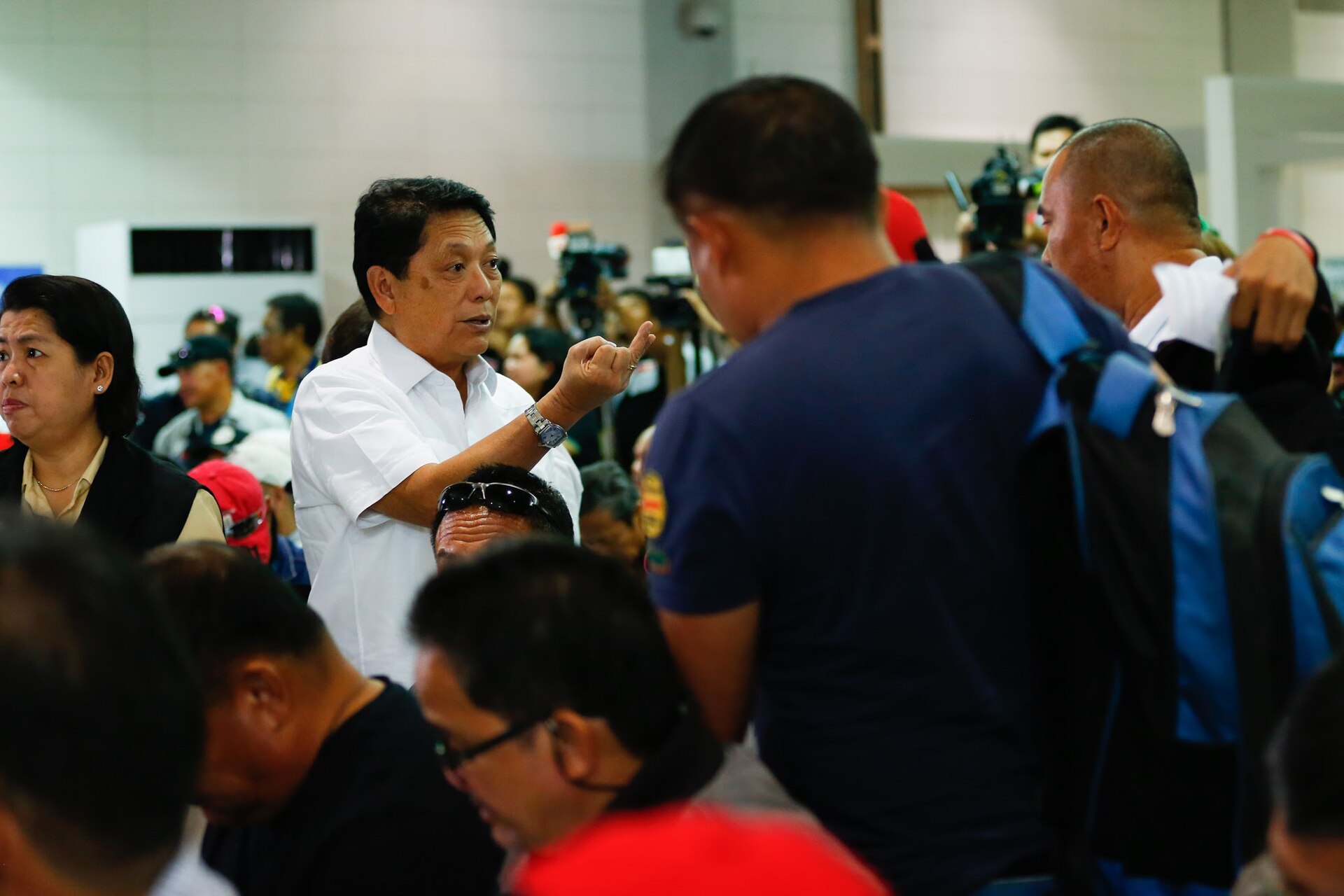
The clearest window into Manila’s reasoning came not from a diplomatic statement but from a deployment briefing. Secretary Cacdac’s language on 13 October — reported by Philstar, GMA Network, and the Filipino Times — was precise in what it avoided: no suspension, no restriction, no advisory against travel beyond a suggestion to check flight status. He characterised the Houthi strikes as “targeted,” implying that workers outside the airport’s immediate perimeter face no exceptional risk, and said economic activity in Saudi Arabia continues, as though the closure of the country’s busiest airport and the suspension of international flights were peripheral to the question of worker safety.
Senator Erwin Tulfo, vice-chairman of the Senate Committee on Foreign Relations, offered the most candid expression of the government’s posture. His advice to OFWs in Saudi Arabia, reported by the Manila Times on 19 October, was to “monitor security advisories before going to work” and to check news reports about Houthi attacks — a senator on the foreign relations committee telling workers in a war zone to read the news before clocking in, as though CNN might tell them something that an incoming cruise missile would not.
“Monitor security advisories before going to work.”
Senator Erwin Tulfo, vice-chairman, Philippine Senate Committee on Foreign Relations, advising OFWs in Saudi Arabia (Manila Times, 19 October 2026)
The reason for the restraint is structural, not callous. OFW remittances grew 2.3% year on year in the first seven months of 2026, according to BSP data reported by the Tribune, and the Saudi-origin share of that pipeline — 6.7% of all inflows, the third-largest single source — has only become more politically sensitive as the conflict has intensified. A deployment ban would not merely inconvenience individual workers — it would put a visible dent in a revenue stream equivalent to 7.3% of the country’s GDP. Manila cannot afford to be the government that orders its citizens home from their biggest Gulf employer, because every month those workers stay, they wire home the dollars that keep the peso stable and the consumer economy afloat.
The conflict is already doing damage without a ban. Total OFW deployments fell 34% in the first seven months of 2026 compared to the same period in 2025, dropping to 980,673 from roughly 1.49 million, according to DMW data reported by Gulf News. Saudi-origin remittance growth slowed from 2.8% in June to 1.3% in July as the Gulf conflict intensified, according to a Maybank analysis of BSP data. The pipeline is contracting on its own, which is precisely why Manila will not accelerate the contraction with a formal order — a deployment ban would turn a market correction into a policy crisis, and every finance ministry official in Quezon City knows it.
How Did Manila Respond When Workers Were Caught in Past Wars?
The contrast with Manila’s own history is the sharpest indictment of its 2026 posture. The Philippines has evacuated overseas workers from war zones three times in the past thirty-five years, and in each case, the government acted with a speed and decisiveness that is entirely absent from its response to Saudi Arabia.
When Saddam Hussein invaded Kuwait in August 1990, approximately 30,000 Filipino workers were stranded. Manila organised what was then the largest evacuation of overseas workers in Philippine history, airlifting citizens through Jordan and deploying embassy staff across the Gulf, according to the International Union for the Scientific Study of Population. That crisis produced Republic Act 8042, the Migrant Workers and Overseas Filipinos Act of 1995, which created OWWA’s emergency repatriation mandate and a dedicated hundred-million-peso contingency fund. In Lebanon in 2006, during the Israeli bombardment, OWWA spent approximately $1.5 million evacuating 1,047 workers, according to Bulatlat. In Libya in 2011, the collapse of the Gaddafi regime prompted the repatriation of roughly 10,000 of the 30,000 Filipinos in the country, with the DFA activating its alert-level system and deploying rapid response teams, according to the Middle East Institute.
| Crisis | Year | Workers affected | Manila’s response | Economic stake in host country |
|---|---|---|---|---|
| Kuwait invasion | 1990–91 | ~30,000 evacuated | Mandatory evacuation, full airlift | Low (pre-Gulf labour boom) |
| Lebanon war | 2006 | 1,047 evacuated | $1.5M emergency spending | Low (small bilateral labour relationship) |
| Libya civil war | 2011 | ~10,000 repatriated of ~30,000 | Alert Level 4, rapid response teams | Low (collapsing state, no labour future) |
| Saudi Arabia attacks | 2026 | 7 wounded, 200 voluntary returnees | No deployment ban, no evacuation order | 6.7% of all remittances, 3rd-largest source |
The table tells the story Manila’s diplomats will not say aloud. In Kuwait, Lebanon, and Libya, the government acted because it could afford to — the bilateral labour relationships were either small, already collapsing, or not yet central to the national economy. In Saudi Arabia in 2026, with Filipino workers taking casualties from a war they have no part in, the government has processed 200 voluntary returnees, distributed food parcels to 258 stranded workers, and otherwise changed nothing, because the economic cost of action now exceeds the political cost of inaction. Kuwait in 1990 was a rescue, Saudi Arabia in 2026 is a calculation — and the difference is not courage but cash.
The Diplomatic Grammar of Condolences Without Demands
There is a specific vocabulary that labour-exporting governments use when their citizens are wounded in a country they cannot afford to confront, and Manila’s 2026 statements are a textbook example of the form. The grammar has three rules: express grief, avoid attribution, and never make a demand that the host government might refuse. Condolences flow freely, ultimatums do not. The result is a diplomatic posture that signals concern to domestic audiences while signalling compliance to Riyadh — the bureaucratic equivalent of lowering a flag without raising a fist.
Human Rights Watch documented this silence in broader terms in March 2026, when it interviewed 38 Indian, Nepali, and Bangladeshi workers caught in the Gulf conflict’s early months. The organisation sent formal letters to every GCC government asking what protections were being offered to migrant workers. None of the GCC governments provided substantive responses, according to HRW’s report. Michael Page, HRW’s Deputy Director for the Middle East and North Africa, said that “governments and employers should take concrete steps to protect workers caught in the crossfire” — a recommendation directed at both the host countries and the sending countries, and one that, six months later, neither side has acted on. One injured worker, paraphrased in the HRW report, expressed anger that innocent workers were suffering for no reason of their own making.
The “no reason” is the quiet centre of the story. These workers are not combatants, not political actors, not citizens of belligerent states. They are in Saudi Arabia because the Kingdom’s transformation programme and its broader economy require millions of imported labourers to function, and because their home governments require the remittances those labourers send back. The workers are the connective tissue of a relationship that benefits both governments and protects neither the people in between.
When a Houthi cruise missile strikes an airport terminal, it does not distinguish between a Saudi national and a Filipina cleaner who arrived on a two-year contract to support a family in Mindanao. The difference is that the Saudi government will rebuild the terminal, and the Philippine government will count the wounded and continue booking deployment flights.
By May 2026, the Labor Justice for Gulf Migrants Coalition had counted at least 24 migrant workers killed across the Gulf conflict. That number is almost certainly higher now — two Bangladeshis were among those killed in the 10 October KKIA strike, according to the Business Standard, and a Pakistani resident was killed on 11 October, according to CNN — but no organisation has updated the tally for the October escalation. The dead do not have a lobby, the wounded do not have a union, and the governments that sent them have not demanded a single concession from Riyadh in exchange for the continued supply of the workers that keep the Kingdom’s airports, oil facilities, construction sites, and households running.
Who Else Sends Workers Into This Bargain?
Manila’s silence is not unique — it is simply the best-documented case of a dynamic that binds half a dozen South and Southeast Asian governments to the same structural trap. Bangladesh sent 750,000 workers to Saudi Arabia in 2025 alone, the highest single-country overseas deployment in Bangladeshi history, according to Arab News. Pakistan sent 530,256 workers in the same year, representing 69.54% of all Pakistani overseas deployments, according to Pakistan’s Bureau of Emigration and Overseas Employment data reported by Radio Pakistan. Both countries have citizens among the dead and wounded at KKIA, and neither has made a public demand of Riyadh that goes beyond the language of sympathy and solidarity.
Bangladesh’s vulnerability is particularly acute. A state minister warned in mid-October that the Gulf conflict “could seriously affect overseas employment and remittances,” according to BD-Pratidin — a statement that named the threat without proposing any response to it. Two Bangladeshi workers were among the 12 killed in the 10 October airport strike, according to the Business Standard. Dhaka issued condolences but did not issue demands, and the arithmetic behind that restraint is the same as Manila’s, only larger in absolute terms: Saudi Arabia is Bangladesh’s single most important labour destination, and a confrontation with Riyadh over worker safety could jeopardise a migration pipeline that supports millions of families in one of the world’s poorest countries.
Pakistan occupies an even more compromised position, because it is simultaneously a labour exporter and a military partner under the Makkah Defence Agreement. Pakistani forces are deploying to Saudi Arabia under the pact’s collective deterrence provisions, according to Al Jazeera, while Pakistani workers continue arriving on construction and service contracts. A Pakistani resident was killed when a projectile hit Terminal 4 on 11 October. The joint condemnation issued by Saudi Arabia, Egypt, Pakistan, and Turkey — the same four countries named in the coalition’s diplomatic response to the attacks — was directed at the Houthis, not at any failure to protect the workers those same governments had sent. The countries condemning the violence are the countries supplying the labour that absorbs it, and not one of them has acknowledged the contradiction in public.
The United Nations Security Council condemned the KKIA attacks in an October statement, according to UN Press. The condemnation addressed the strikes as a violation of international norms. It did not mention migrant workers, did not ask GCC governments to account for foreign civilian casualties, and offered no framework for the labour-sending countries to demand protections their citizens were not receiving. The international architecture, like the bilateral relationships, treats migrant workers as an input rather than a constituency.
What Protection Does Philippine Law Actually Promise?
The gap between what Philippine law promises overseas workers and what the government actually delivers in Saudi Arabia in 2026 is wide enough to fit several hundred wounded civilians and an entire deployment pipeline through without touching the sides. Republic Act 8042, the Migrant Workers Act of 1995 — born directly from the Kuwait evacuation that proved the government needed a legal framework for protecting citizens abroad — created OWWA’s mandate to provide emergency repatriation, established a dedicated contingency fund, and required the government to deploy consular assistance in crisis zones, according to the IUSSP’s analysis of the law’s origins. Its 2010 amendment, RA 10022, expanded those obligations to require more systematic state responses when Filipino workers face security threats abroad.
In 2026, the government is technically compliant with both statutes. OWWA has processed 149 voluntary returnees and is preparing another 50, according to OWWA Administrator Patricia Yvonne Caunan, quoted in the Tribune on 16 October. Emergency assistance — food, shelter, transport — has reached 258 workers, and the consular apparatus is functioning. But compliance is the minimum, and the minimum is the point: Manila has done precisely enough to satisfy the letter of the law without triggering the mechanism that would force meaningful action. The alert-level system, which governs the government’s crisis response to overseas threats, has four tiers, and Alert Level 4 — mandatory evacuation — has not been declared for Saudi Arabia.
The distinction between voluntary and mandatory repatriation is not procedural — it is the entire strategy. Voluntary repatriation allows Manila to assist the workers who can afford to leave while maintaining the fiction that conditions are manageable for everyone else. Mandatory evacuation would require the government to bring all workers home, which would collapse the deployment pipeline, trigger an immediate shortfall in remittance inflows, and — most damaging of all — force Manila into a public confrontation with Riyadh that it has no bargaining power to win. Saudi Arabia does not need Filipino workers the way the Philippines needs Saudi remittances, and Riyadh’s problem is that it cannot keep its airports open, not that it cannot replace a ground crew. Manila’s problem is that it cannot replace the 6.7% of remittance inflows that Saudi Arabia provides, and every diplomatic choice it has made since October reflects that asymmetry with perfect clarity.
The legal framework built after Kuwait was designed for a world in which the Philippines could afford to evacuate, and while the framework remains on the books, the affordability that made it meaningful does not. The workers in Riyadh’s hospitals are living inside the gap between what the law says and what the economy allows.
On 17 October, the comatose Filipino worker in a Riyadh hospital had a Glasgow Coma Scale score of 9 out of 15 — improved from 3, the lowest survivable reading, which is where the surgeons found them after the airport attack. The improvement means the brain is trying, but it does not mean the worker will recover, or speak, or fly home on the PAL route that will not resume until 29 November. In Manila, the deployment paperwork for the next batch of Saudi-bound workers is already being processed, because the economy that wounded this worker is the same economy that pays for the next one’s plane ticket — and the air defences that failed to stop the missile will not be mentioned on the application form.
Frequently Asked Questions
What is the Philippine alert-level system for overseas workers and why does it matter?
The Department of Foreign Affairs maintains a four-tier crisis alert system: Level 1 (Precaution) advises vigilance, Level 2 (Restriction) limits new deployments, Level 3 (Voluntary Repatriation) triggers government-assisted returns, and Level 4 (Mandatory Evacuation) compels the repatriation of all citizens. The last Level 4 declaration was issued for Libya in 2011. As of 19 October 2026, the alert level for Saudi Arabia has not been publicly confirmed, and no Level 4 has been issued — the threshold that would force Manila to recall all OFWs regardless of economic consequences.
Have the Houthis addressed migrant worker casualties in their public statements?
No Houthi statement has specifically addressed migrant worker casualties as of 19 October 2026. Houthi leader Abdul-Malik al-Houthi has denied targeting the holy cities of Mecca and Medina, according to Al Jazeera, and Houthi military spokespeople have characterised their strikes as responses to coalition bombardment of Yemen, but the deaths and injuries of foreign workers at Saudi airports have not featured in any official Ansar Allah communication. The absence is consistent across the conflict: the workers are invisible to the attacking force as well as to the governments that employ and export them.
How many Filipino workers are currently in Saudi Arabia?
The exact number is not publicly confirmed. The Department of Migrant Workers reported that total OFW deployments across all destinations fell to 980,673 in the first seven months of 2026, down 34% from the same period in 2025, according to Gulf News. Saudi Arabia is the third-largest destination by remittance volume, but DMW has not released a Saudi-specific headcount for 2026. Earlier estimates from non-government sources place the figure above one million, though no official Philippine or Saudi data supports a precise number.
What happened to the Filipino seafarers killed in the Strait of Hormuz?
Two Filipino seafarers were killed in a security incident involving the oil tanker SIDR in the Strait of Hormuz in September 2026, according to DZRH. These are the only confirmed Filipino fatalities in the Gulf conflict to date and are separate from the seven OFWs wounded in Saudi airport attacks. The DMW confirmed the deaths but provided limited public detail on the circumstances, and the incident received minimal domestic media coverage in the Philippines compared to the later airport casualties — reflecting the lower visibility of maritime workers within the OFW advocacy ecosystem.
What financial assistance has the Philippine government provided to affected workers?
The direct aid figures — 258 workers assisted, 149 of 200 government-assisted repatriations processed by 16 October — come from OWWA Administrator Patricia Yvonne Caunan’s statement reported by the Tribune. What those figures leave unanswered is cost: the DMW has not disclosed the total spend for the 2026 Saudi operation, nor whether the RA 8042 contingency fund — originally set at 100 million pesos — has been drawn upon. For comparison, the broader regional conflict has displaced workers across multiple GCC states, and OWWA’s budget for Gulf-wide emergency operations has not been made public.