Table of Contents
- The Numbers That Cannot Be Spoken Aloud
- How Did Aramco Post Record-Adjacent Profits on 30% Less Oil?
- Anatomy of a Wartime Quarter
- What Does the June OSP Reset Mean for Q2 Revenue?
- The Infrastructure Deficit Behind the Headline
- Why Does Aramco’s Dividend Matter More Than Its Profit?
- The Fiscal Illusion and the Goldman Gap
- Why the 2019 Abqaiq Precedent Does Not Apply
- What the May 11 Earnings Call Cannot Say
- The Cliff Ahead
The Numbers That Cannot Be Spoken Aloud
DHAHRAN — Saudi Aramco is expected to report approximately SAR 108.8 billion ($29 billion) in net income for Q1 2026 when results land on May 10 — a 56.7% surge from the previous quarter, generated in the same three months that Iranian strikes collapsed Saudi production from 10.4 million barrels per day to 7.25 million. That number, which AlJazira Capital published on April 23 alongside an “Overweight” rating and a SAR 29.6 target price, represents one of the stranger artifacts of wartime economics: profits rising sharply because the war that destroyed Saudi Arabia’s oil infrastructure also detonated the price of whatever remained flowing through it.
The thesis is not complicated, and the kingdom’s silence on Aramco’s expected performance confirms it. This is not a windfall, not resilience, not the triumph of operational flexibility over adversity. It is a one-quarter accounting artifact produced by the collision of a Brent average that surged from $61 in January to $103 in March with a volume collapse that only hit the books for 31 days of a 90-day quarter. The revenue line will look healthy on May 10. The volume line, the Juaymah LPG suspension, the Khurais restoration timeline that still does not exist, and the June Official Selling Price reset from +$19.50/bbl to +$2.90/bbl all point toward a Q2 cliff that these Q1 results will paper over completely.
How Did Aramco Post Record-Adjacent Profits on 30% Less Oil?
The mechanism is simple enough that AlJazira Capital stated it in a single sentence in their April research note: the price surge “wipes out the impact of lower production of 600,000 bpd of crude and 700,000 BOE/day of total hydrocarbons.” Brent crude averaged $78.7 per barrel across Q1 2026, a 24.8% increase quarter-on-quarter, but that average conceals the true shape of the quarter. January traded around $61. February drifted toward $72 before the February 28 onset of hostilities. March — with Iranian missiles striking Manifa, Khurais, Juaymah, and the East-West Pipeline pumping station — averaged approximately $103. One month of extreme pricing overwhelmed two months of normal volume operations and one month of production collapse to deliver a result that will superficially resemble a strong quarter.
Revenue is forecast at SAR 455.3 billion, up 6% year-on-year and 9.4% quarter-on-quarter, with EBIT margins expected to widen to 47.1% from 43.1% adjusted in Q4 2025. Bank of America characterized Aramco in an April equity note as “poised to see strong Q1 results amid higher oil prices,” and none of this framing is wrong on its own terms. All of it is misleading without the context that Aramco cannot provide without acknowledging the structural position it now occupies: a company whose facilities are partially destroyed, whose production capacity has been forcibly reduced by nearly a third, and whose pricing power is a temporary function of the same conflict that caused the destruction. The Q1 result is what happens when a fever is measured by the thermometer reading alone — elevated vital signs produced by the disease, not by health.
Anatomy of a Wartime Quarter
Q1 2026 divides into three distinct phases that the headline number collapses into a single figure. January was an entirely normal month: Saudi Arabia produced at approximately 9.0 million bpd under its OPEC+ quota, Brent traded in the low sixties, and Aramco’s operational profile matched Q4 2025 conditions. February ran normal until February 28, when Iranian missile and drone strikes initiated what IEA Director-General Fatih Birol would later describe as “the biggest energy security threat in history.” That gives Aramco roughly 59 days of pre-war operations and 31 days of wartime conditions inside a single quarterly reporting period — a ratio that flatters the headline number enormously, because the two months of normal volume dilute the one month of production collapse that actually defines the structural story.
The March production figure of 7.25 million bpd per IEA data reflects the combined impact of Manifa going offline (300,000 bpd), Khurais going offline (300,000 bpd), Juaymah LPG terminal suspending operations, and precautionary cuts that CEO Amin Nasser acknowledged on the Q4 2025 earnings call when he said Aramco “began cutting production across multiple oil fields before reaching storage capacity.” AlJazira Capital’s model uses a conservative -600,000 bpd crude and -700,000 BOE/day total hydrocarbons figure applied only to March, which means the mathematical result is a blended number that looks like outperformance but describes something closer to fragility coated in price effects.
The Middle East briefing 3,000+ readers start their day with.
One email. Every weekday morning. Free.
| Metric | Q4 2025 | Q1 2026 (forecast) | Change |
|---|---|---|---|
| Net income (SAR B) | 69.4 | 108.8 | +56.7% |
| Net income ($ B) | 18.5 | 29.0 | +56.7% |
| Revenue (SAR B) | 416.1 | 455.3 | +9.4% |
| EBIT margin (%) | 43.1 (adj) | 47.1 | +4.0pp |
| Brent average ($/bbl) | 63.1 | 78.7 | +24.8% |
| Crude production (M bpd, March exit) | ~9.0 | ~7.25 | -19.4% |
The table exposes the dissonance directly. Every financial metric improved while the physical metric that sustains all of them — crude production — deteriorated by nearly a fifth at quarter-end. That one-month divergence will last the entirety of Q2, with none of the pre-war January and February cushion to dilute the impact.
What Does the June OSP Reset Mean for Q2 Revenue?
The Official Selling Price for Arab Light crude to Asia — Aramco’s benchmark pricing mechanism for its largest export market — was set at +$19.50 per barrel above the Oman/Dubai average for May 2026 loadings, the highest differential in Aramco’s history and a war premium that priced in both extreme scarcity and the assumption that Hormuz would remain functionally closed. For June loadings, Aramco slashed that differential to +$2.90 per barrel — a drop of $16.60 in a single month. The reset is the market’s verdict on the sustainability of May’s pricing, and it is devastating for Q2 revenue projections even if Brent itself remains elevated in the $106-116 range where it traded through late April.
The OSP differential is not identical to the absolute price, but for Aramco’s realized revenue per barrel it functions as a direct multiplier on margin. At +$19.50, every barrel Aramco shipped in May earned nearly twenty dollars above the benchmark — revenue that flowed straight to the bottom line because lifting costs in the Eastern Province remain below $3 per barrel regardless of the selling price. At +$2.90, that compression is immediate and total across every Asian-bound cargo. The scarcity differential that lifted Q1 margins to 47.1% has effectively been surrendered: Aramco now charges Asian refiners roughly what it charged in peacetime, even though the war that justified the premium has not ended and the infrastructure damage has not been repaired.
Analysts who are extrapolating Q1 margins into full-year forecasts are modeling a price environment that the June OSP already proves will not persist. AlJazira Capital’s SAR 427 billion ($114 billion) full-year estimate implicitly requires margins closer to Q1’s 47.1% EBIT across all four quarters, but the June OSP collapse tells any refiner in Ulsan or Jamnagar that Aramco is competing for market share again, not rationing scarce supply at record premiums. The pricing power that created Q1’s headline number has already been surrendered for Q2 cargoes, and no analyst model has yet incorporated that reality because the June OSP was announced after the April 23 forecasts were published.
The Infrastructure Deficit Behind the Headline
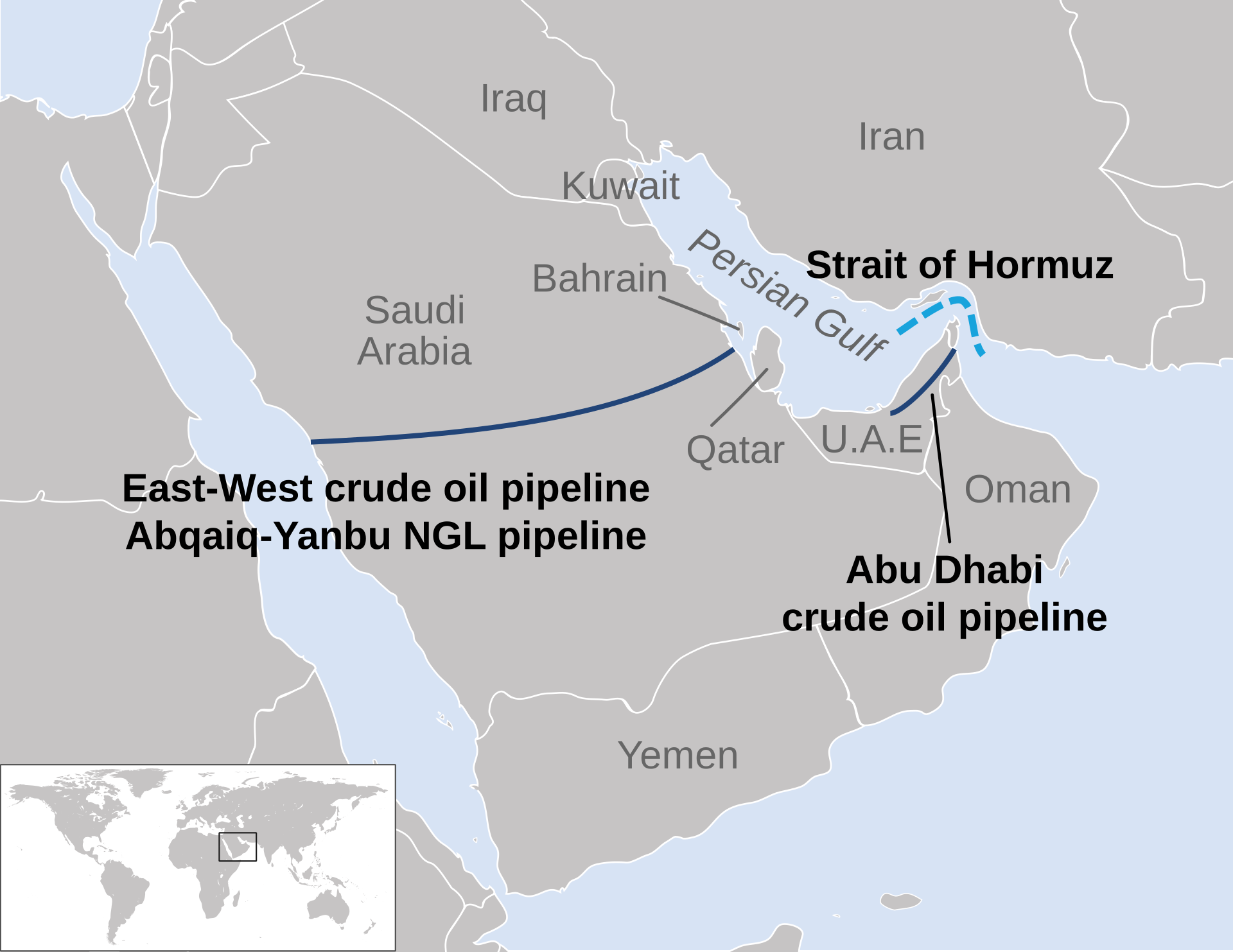
Manifa, the 300,000 bpd heavy-crude field in the Persian Gulf’s shallow waters, was restored to production around April 12 according to reporting from The National. The East-West Pipeline — Saudi Arabia’s critical bypass connecting Eastern Province fields to the Red Sea terminal at Yanbu — was similarly restored to its 7 million bpd design capacity by mid-April after the pumping station strike on April 8. These restorations are genuine operational achievements, and Aramco will present them as evidence of the institutional resilience that Nasser has been telegraphing since his March 10 call, when he told analysts the company was “still able to export around 70% of its usual crude output” by “tapping crude stored outside the Gulf and rerouting some supplies.”
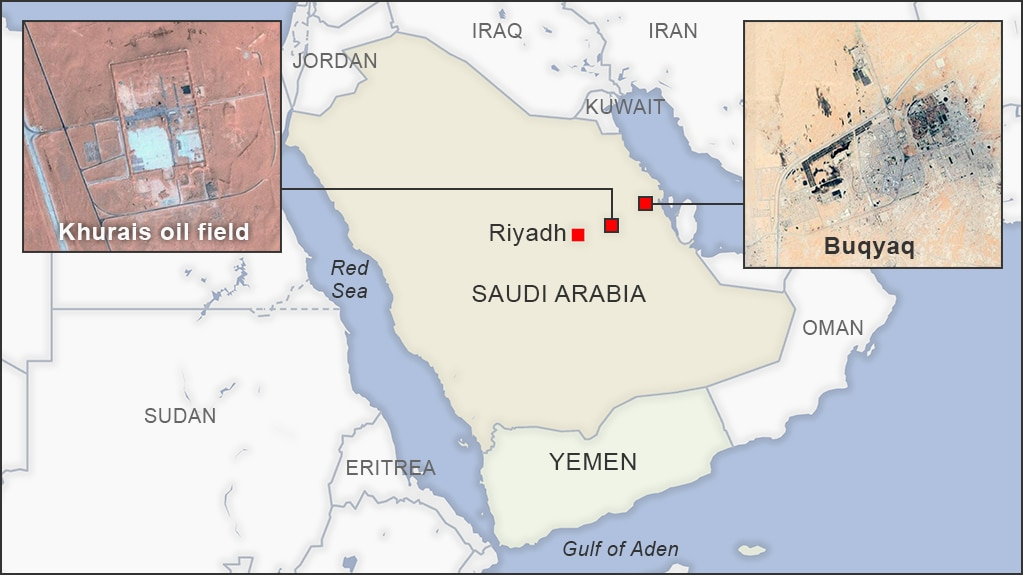
What the earnings presentation will not emphasize is what has not been restored. Khurais — also 300,000 bpd, a light-crude field producing the Arab Light grades most valuable to Asian refiners and the grade whose OSP is Aramco’s flagship pricing signal — has been offline for 66 days as of May 5 with no announced restoration timeline. Argus Media reported as recently as late April that no schedule had been communicated to customers. Juaymah, the LPG terminal responsible for approximately 3.5% of global seaborne LPG trade, remains suspended through at least May 2026 per Bloomberg reporting from April 28. These are not footnotes to a recovery story; they represent permanent or at minimum quarter-spanning capacity losses that will hit Q2 volumes without Q1’s price tailwind to mask them.
The 2026 capex guidance of $50-55 billion, reaffirmed in Aramco’s March earnings release, was set before the war and designed to fund expansion — Jafurah gas development, the Berri increment, downstream petrochemical integration. Reconstruction spending on Khurais, Juaymah, and the Ras Tanura export facility (damaged but partially operational) will now compete with that expansion pipeline. Either the guidance holds and growth projects slow, or the guidance rises and free cash flow declines. Both outcomes undermine the equity narrative that currently supports AlJazira Capital’s target price, and neither will be acknowledged on May 10 because acknowledging either would require quantifying damage that Saudi Arabia has been careful to characterize in operational rather than financial terms.
Why Does Aramco’s Dividend Matter More Than Its Profit?
Saudi Arabia’s Ministry of Finance holds approximately 81.5% of Aramco’s equity, with the Public Investment Fund holding another 16% and the publicly traded free float at roughly 2.5%. This ownership structure means Aramco’s quarterly dividend is not an investor-relations decision but the primary cash transmission mechanism between Saudi Arabia’s oil production and its government budget. When Aramco declares a dividend, roughly 97.5% of that cash flows to the Saudi state in one form or another, though the destination within the state — Ministry of Finance versus PIF — determines whether it reaches the operational budget or remains locked in the sovereign wealth fund’s balance sheet.
Q4 2025’s base dividend was SAR 82.08 billion total ($21.9 billion), representing SAR 0.3393 per share and a 3.5% year-on-year increase. AGBI noted in February 2026 that “subdued oil prices and production levels and high capital expenditure commitments make it probable the company will only pay a base dividend for its 2025 performance,” and no performance-linked dividend was declared for FY2025. The Q1 2026 dividend — declared alongside May 10 results and paid in Q2 — arrives at a moment when the Saudi government simultaneously faces war expenditure, reconstruction obligations, reduced non-oil revenue from disrupted commerce, and a widening fiscal deficit that Goldman Sachs estimates at 6.6% of GDP against the official 3.3% projection.
AGSI’s observation that “the transfer of Aramco equity from the government to the PIF is a zero-sum game — what the PIF gains, the central government budget loses” captures the deeper structural problem. PIF’s 16% stake means roughly $4.6 billion of every $29 billion in quarterly profit accrues to the sovereign wealth fund rather than the Treasury’s operational budget. In peacetime, this is strategic patience — MBS designed PIF as a long-term investment vehicle insulated from short-term fiscal pressure. In wartime, when the Treasury faces a $44-90 billion deficit depending on whose estimate you use, it represents an architecture that cannot direct all of its own oil revenue toward the emergency without unwinding the governance credibility that supports Aramco’s public market valuation.
The Fiscal Illusion and the Goldman Gap
Saudi Arabia’s 2026 budget, published by the Ministry of Finance in December 2025, projected a deficit of SAR 165 billion ($44 billion, 3.3% of GDP) under assumptions of Brent in the mid-sixties and Saudi production at or near OPEC+ quota levels. Both assumptions are now wrong in opposite directions: oil is roughly $40 higher than budgeted while production is 2.85 million bpd lower. Goldman Sachs’ war-adjusted estimate doubled the deficit projection to 6.6% of GDP — approximately $80-90 billion total, versus the official $44 billion — a figure that accounts for production losses, infrastructure damage, military expenditure, and the fiscal break-even price that Bloomberg calculates at $108 per barrel when PIF spending commitments are included.
Aramco’s Q1 earnings will appear to vindicate the official view. A $29 billion quarterly profit annualizes to $116 billion, and the government’s approximately 82% share of Q1 dividends delivers roughly $18 billion for the quarter at a moment when reserves need replenishment. But annualizing Q1 requires assuming that Q2-Q4 will resemble Q1, and the structural evidence says the opposite. Q2 faces the June OSP collapse; continued Khurais and Juaymah offline status; the Yanbu export ceiling problem where 5.9 million bpd maximum throughput to the Red Sea cannot replace 7-7.5 million bpd of pre-war Hormuz-routed exports; and Brent that, while elevated, has stabilized in a range that no longer carries March’s panic premium.
The gap between official and Goldman estimates is not a disagreement about methodology — it is a disagreement about whether the war has permanently altered Saudi fiscal reality or merely disrupted it temporarily. Q1’s headline number supports the temporary-disruption reading. Everything underneath it — the Khurais timeline, the OSP reset, the Asia export decline of 38.6% per Kpler data — supports the permanent-alteration reading. The Goldman gap will widen through 2026 even as May 10 makes it temporarily invisible to anyone reading only the profit figure. The non-oil side of this divergence — how April’s PMI rebound to 51.5 intensifies rather than relieves fiscal pressure — is examined in Saudi Arabia’s Economy Is Recovering. That Is the Problem.
Why the 2019 Abqaiq Precedent Does Not Apply
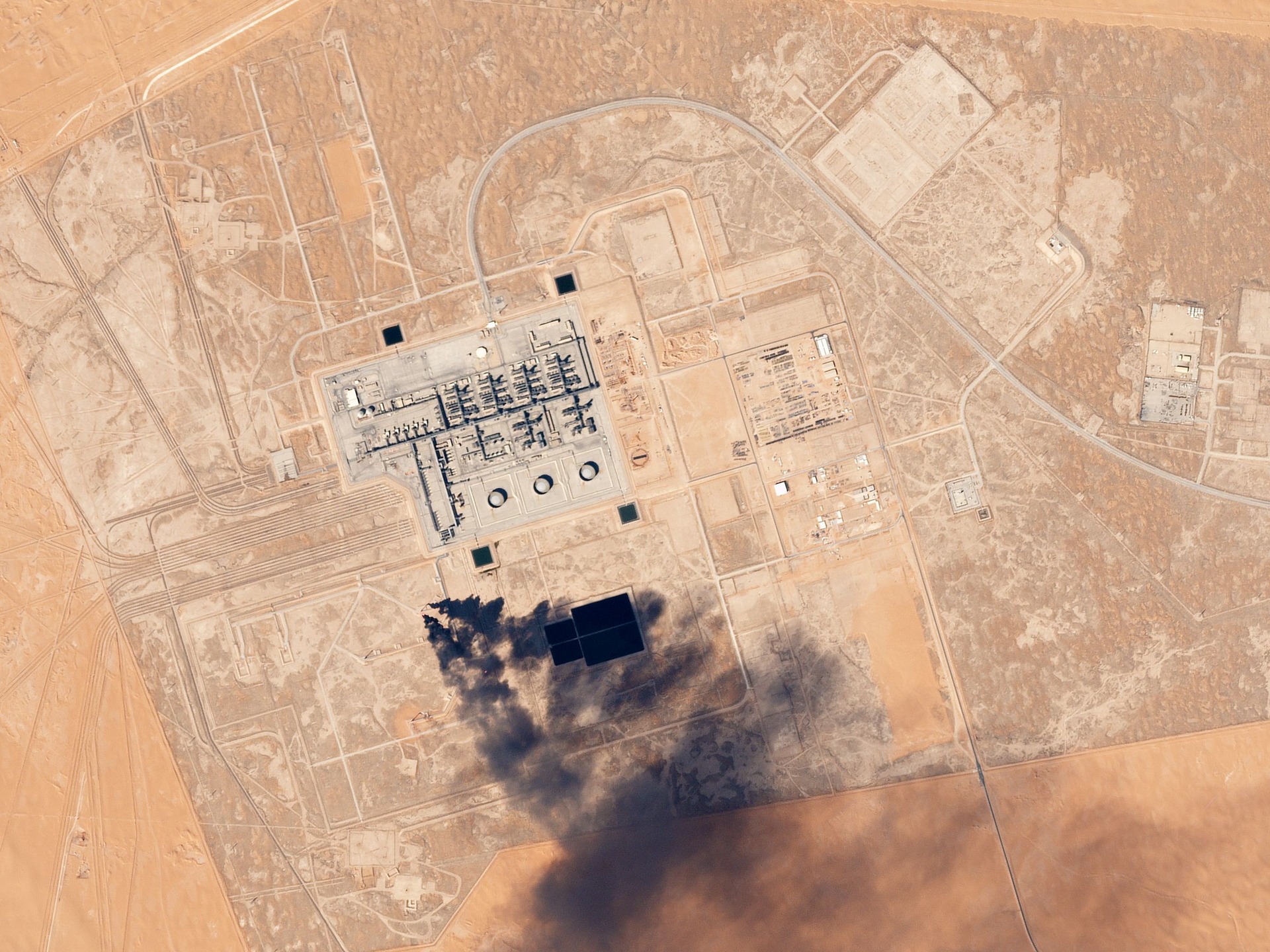
The reflex comparison for Aramco wartime damage is September 14, 2019, when drone and missile strikes on Abqaiq and Khurais knocked out 5.7 million bpd — over half of Saudi output at the time and approximately 5% of global supply. That attack was devastating in scale but contained in duration: 2 million bpd was restored within 48 hours, Aramco announced full 9.9 million bpd capacity within 11 days, and FY2019 net income came in at $88.2 billion — down from $111.1 billion in 2018, but with the attack’s financial impact absorbed entirely within one quarter without altering Aramco’s production trajectory. In the corporate narrative, Abqaiq became proof of resilience and rapid-response capability.
The 2026 comparison fails on every axis that matters. Khurais has been offline 66 days with no announced timeline — the 2019 Khurais disruption lasted under two weeks. The 2019 attack targeted two facilities in a single coordinated strike; the 2026 campaign has hit Manifa, Khurais, Juaymah, Ras Tanura, the East-West Pipeline pumping station, and SAMREF Yanbu across multiple waves over ten weeks. The 2019 Brent spike ($60 to $72) lasted approximately one week before retracing fully; the 2026 elevation ($61 to $103-116) has persisted for nine weeks with no sign of reversion while Hormuz remains functionally blocked. And the 2019 attack occurred in a peacetime environment where restoration proceeded unimpeded — repair crews in 2026 work under the constant threat of follow-on strikes that have materialized repeatedly since March.
| Factor | Abqaiq-Khurais 2019 | Iran Campaign 2026 |
|---|---|---|
| Peak disruption (bpd) | 5.7M (single day) | 3.15M (sustained 66+ days) |
| Restoration timeline | 11 days to full capacity | Khurais: no timeline announced |
| Facilities hit | 2 (single coordinated strike) | 6+ (multi-wave campaign) |
| Brent spike duration | ~7 days | 9+ weeks (ongoing) |
| Ongoing military threat | None post-strike | Active operations, follow-on risk |
| Quarterly earnings impact | Absorbed in Q3 2019 | Q1 masked by timing; Q2 fully exposed |
| Capex redirection required | Minimal (rapid restore) | Competes with $50-55B guidance |
The single most important distinction is temporal. In 2019, Aramco could credibly say the attack was over and recovery complete before reporting quarterly results. In 2026, the conflict is ongoing when Q1 results publish — Nasser cannot present a recovery narrative because recovery has not occurred, only a price narrative whose expiration date the June OSP has already stamped on every refiner’s forward planning calendar.
What the May 11 Earnings Call Cannot Say
Nasser’s Q4 2025 earnings call on March 10 — delivered ten days into the war — was remarkably direct by the standards of CEO communication during active military conflict. He warned of “catastrophic consequences for the world’s oil and markets the longer the disruption goes on,” described “a severe chain reaction” extending into “a drastic domino effect” beyond shipping and into “aviation, agriculture, automotive, and other industries,” and disclosed that Aramco was exporting “around 70% of its usual crude output.” That candor was possible precisely because the Q4 results themselves predated the war entirely, requiring no reconciliation between the damage narrative and the financial narrative.
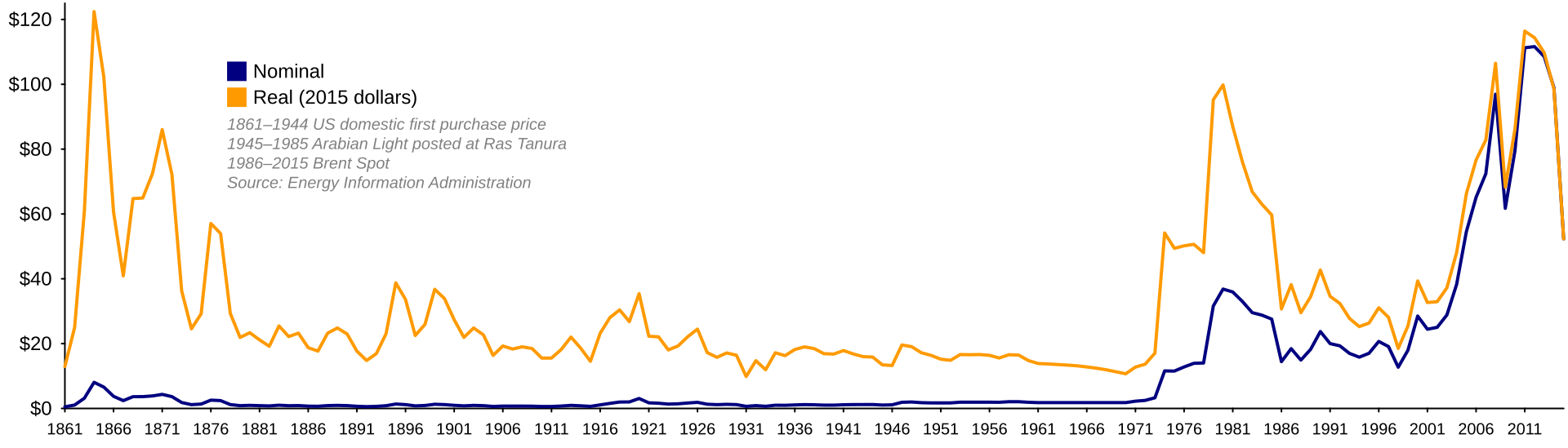
The May 11 call presents the opposite challenge — Nasser must explain how a company that lost 30% of its production capacity in a single month simultaneously produced its best quarterly profit since Q2 2022 (which delivered $48.4 billion on the FY2022 peak of $161.1 billion). The answer, that price more than compensated for volume, is arithmetically obvious but politically impossible to celebrate. Saudi Arabia cannot publicly treat a war-driven price surge as positive when its population is living with the consequences of that war, when its infrastructure remains damaged, when Aramco’s own CEO described the same dynamics as “catastrophic” ten weeks earlier. Nasser will present the results clinically — operational continuity, capex reaffirmation, customer commitment — without any language implying the war has been financially beneficial to the company he runs.
What he cannot say, and what institutional investors will need to infer from the OSP data and restoration timelines embedded in supplementary disclosures, is that Q1’s price-volume relationship was unique to Q1 and will not repeat. The war continues, which means volumes remain constrained, but the price has already incorporated the disruption and begun moderating from March’s panic levels as the first convoy transits and partial supply alternatives reach Asian refiners. Q2 will deliver the inverse of Q1’s accidental gift: constrained volumes at normalized (if elevated) prices, with a dramatically compressed OSP differential eliminating the per-barrel premium that drove Q1’s margin outperformance. The call cannot project Q2 guidance without either acknowledging this cliff or conspicuously omitting forward-looking commentary, and institutional investors trained to read Aramco’s disclosure style will interpret the omission correctly.
The Cliff Ahead
The structural position Aramco enters Q2 2026 can be described with precision that the May 10 headline will obscure. Khurais remains offline with no public timeline — 300,000 bpd of Arab Light production, the grade carrying highest Asian refiner demand, gone from the export slate indefinitely. Juaymah remains suspended through at least end of May, removing approximately 3.5% of global seaborne LPG and eliminating an entire product line from Aramco’s revenue mix. The East-West Pipeline operates at 7 million bpd capacity but the facilities feeding it produce below that ceiling, creating a bypass corridor that cannot be fully utilized. The Yanbu export route, which Aramco has relied upon since Hormuz became functionally inaccessible, has a practical loading ceiling of 4-5.9 million bpd against pre-war Hormuz throughput of 7-7.5 million — a structural gap of 1.1-1.6 million bpd that no operational effort can close without either Hormuz reopening or new terminal capacity that does not exist.
Against this volume constraint, the June OSP tells the pricing story. The reset from +$19.50 to +$2.90 represents $16.60 per barrel of margin compression on every cargo shipped to Asia from June loadings onward. At current production levels and the IEA’s reported Asia export decline of 38.6%, Aramco is shipping roughly 2.8-3.2 million bpd to Asian refiners; on that volume, the OSP reset alone represents $46-53 million per day in lost premium revenue, or approximately $4.2-4.8 billion across a full quarter. That single pricing adjustment, applied to Q2, eliminates a substantial portion of the margin outperformance that Q1 will report. Add continued volume losses from Khurais and Juaymah, elevated capex required for reconstruction, and the absence of any performance-linked dividend mechanism, and Q2 2026 begins to resemble Q4 2025’s $18.5 billion far more than Q1’s $29 billion.
AlJazira Capital’s full-year forecast of SAR 427 billion ($114 billion) requires averaging approximately $28.5 billion per quarter across FY2026. If Q1 delivers $29 billion and Q2 drops to $20-22 billion — which the OSP reset and continued volume constraints strongly suggest — then Q3 and Q4 must deliver $31-33 billion each to meet the annual target. That requires either Hormuz reopening to restore pre-war export volumes, Khurais restoration adding 300,000 bpd of premium crude back to the slate, or Brent sustaining above $120 indefinitely to compensate for structural volume losses through price alone. None of these conditions is guaranteed; the first depends on a ceasefire that does not exist, the second on reconstruction under ongoing military threat, and the third on demand elasticity that history suggests breaks well before $120 becomes a sustained equilibrium. The “Overweight” rating rests on assumptions that the war’s one-quarter financial gift extends through the calendar year, and every piece of operational evidence — from the double blockade’s persistence to the June OSP collapse — indicates it will not.
FAQ
When does Saudi Aramco report Q1 2026 earnings and what should investors watch for?
Aramco’s Q1 2026 financial results publish May 10, 2026, with the earnings conference call scheduled for May 11. Beyond the headline net income figure, the critical disclosure items will be: any update to the Khurais restoration timeline (currently unannounced after 66+ days offline); whether Aramco adjusts its $50-55 billion capex guidance to accommodate reconstruction spending; the wording around forward customer commitments, particularly the percentage of “usual crude output” that Nasser will cite versus his March 10 estimate of 70%; and any signal on performance-linked dividend reinstatement, which Fitch assumed would not occur through 2028 but which Q1’s earnings technically support.
How much of Aramco’s profit actually reaches the Saudi government budget?
The transmission mechanism is more complex than ownership percentages suggest. The Ministry of Finance’s 81.5% dividend share delivers approximately $18 billion per quarter at current base-dividend rates, but the government also receives tiered royalties (15%/45%/80% on production above price thresholds) and a 50% upstream income tax — both of which are volume-dependent and fell proportionally with the 30% production collapse. PIF’s 16% share ($3.5 billion per quarter) sits on the sovereign wealth fund’s balance sheet rather than entering the operational budget, creating what AGSI described as a “zero-sum” fiscal split where $14 billion annually goes to long-term investment rather than Treasury operations during a period of acute fiscal pressure.
What is the Official Selling Price and why did its collapse signal Q2 weakness?
The OSP is Aramco’s monthly differential above the Oman/Dubai benchmark charged to Asian refiners for each crude grade, announced one month ahead of loading. The May 2026 Arab Light OSP of +$19.50/bbl was a record reflecting extreme scarcity during the Hormuz closure; the June reset to +$2.90/bbl represents a $16.60 single-month collapse driven by partial convoy reopening, competition from Russian and Iraqi alternative supplies reaching Asian buyers, and refiner resistance to the war premium after initial panic subsided. Because the OSP is set before the loading month begins, the June figure is a leading indicator that Q2 per-barrel margins will not sustain Q1 levels regardless of where Brent trades — Aramco has already surrendered its scarcity pricing power through its own forward-pricing mechanism.
Could Aramco’s Q1 results trigger a performance-linked dividend?
Aramco’s dividend structure includes the base component (SAR 82.08 billion quarterly, growing 3.5% per year) and a discretionary performance-linked payout that was suspended after Q4 2024 and which Fitch projects will not return through 2028. Q1 2026’s $29 billion earnings would technically support reinstatement, but the board faces a capital allocation conflict: paying excess cash to shareholders now depletes the reconstruction reserves needed for Khurais, Juaymah, and Ras Tanura while the $50-55 billion capex guidance does not yet include war-damage rebuilding costs. Any performance-linked declaration on May 10 would signal confidence that the board may not possess about FY2026’s full trajectory given the Q2 margin compression visible in June OSP data. The fiscal dimension of that same May 10 date — with Saudi Arabia’s Q1 2026 budget data showing SR125.7 billion (3.5B) consumed in a single quarter against a SR165B full-year forecast — is examined in Saudi Arabia’s $44B Deficit Forecast Ate Itself in Q1.
How does the 2026 situation differ from the 2019 Abqaiq attack for Aramco’s financial outlook?
Beyond the duration and scope differences covered above, the critical distinction is institutional context. In September 2019, Aramco was preparing for its December IPO — management had every incentive to demonstrate rapid recovery, the company’s debt position was modest, and Saudi Arabia’s fiscal break-even was considerably lower than today’s Bloomberg-calculated $108 per barrel. Repair crews faced no follow-on threat; the full 9.9 million bpd capacity was restored before Q3 2019 results were reported, meaning FY2019 carried only a one-quarter disruption without any structural production impairment. In 2026, Aramco must reconstruct under active military threat, the fiscal break-even already exceeds current Brent, the $50-55 billion capex envelope was sized for expansion not rebuilding, and the disruption will span at minimum two full quarters — conditions that made the 2019 episode a reputational test Aramco passed and the 2026 campaign a structural test whose outcome remains open. Saudi Arabia’s structural exclusion from the MOU negotiations designing the Hormuz reopening timeline — the table where Aramco’s Q2 production recovery will effectively be decided — is examined in Thirty Days, Six Months, and No Seat at the Table.