
{“content”: “
{“content”: “
n
RIYADH u2014 Saudi Arabia’s first-quarter budget deficit of SR125.7 billion, disclosed by the Ministry of Finance on May 5, consumed 76% of the SR165 billion full-year forecast that the same ministry published in December. One quarter of fiscal year 2026 produced more than three quarters of the deficit the kingdom told investors to expect across all twelve months. Public debt rose from SR1.52 trillion at the start of the year to SR1.67 trillion at the end of March u2014 the entire SR125.7 billion shortfall was financed through borrowing.
n
n
The Middle East briefing 3,000+ readers start their day with.
One email. Every weekday morning. Free.
n
The forecast has not been revised. It will not be revised soon. A formal revision of the budget deficit triggers the rating agency review calendar at Moody’s, S&P, and Fitch, and a sovereign downgrade would widen spreads on the SR217 billion borrowing program that the National Debt Management Center pre-authorized in January u2014 a program that has already absorbed 58% of its envelope in three months. The fiction is the bond market’s collateral. The question is whether the war ends before Q2 actuals make the fiction mathematically indefensible.
n
n
n
n
Table of Contents
n
n
n
- n
- The $44 billion fiction
- Why did Saudi oil revenue fall when Brent was elevated?
- The 20% spending surge nobody is explaining
- What is the Wall Street estimate of Saudi Arabia’s actual 2026 deficit?
- Why hasn’t a rating agency downgraded Saudi Arabia yet?
- The spread question and why Riyadh is buying time
- Reserves, the lever that no longer works the same way
- How does the Aramco-PIF transfer hurt the Ministry of Finance?
- The 2020 precedent and why it does not apply
- May 10 and the Q2 cliff
- Frequently asked questions
n
- n
n
n
n
n
n
n
n
n
n
n
n
n
n
n
n
n
n
n
n
n
n
n
n
n
n
n
n
n
n
n
n
n
n
n
n
n
n
n
n
n
n
The $44 billion fiction
n
n
n
The Ministry of Finance’s December 2025 Budget Statement projected a 2026 deficit of SR165 billion, equivalent to 3.3% of GDP and roughly $44 billion at the official peg. The number rested on two assumptions. The first was a Brent price near $72u201375 per barrel. The second, less prominently disclosed, was Saudi production around 10.1 million barrels per day, consistent with the OPEC+ baseline that prevailed before February 28.
n
n
n
By March, the production assumption was already obsolete. The International Energy Agency reported Saudi output at 7.25 million barrels per day, a 2.85 million bpd shortfall against the budget’s working figure of 10.1 million bpd. Brent ran higher than $72, but the kingdom was selling nearly three million fewer barrels of it each day. The price line on the budget spreadsheet held; the volume line did not.
n
n
n
The Arab Gulf States Institute in Washington’s reverse-engineering of the budget u2014 published before the Hormuz closure u2014 found that the kingdom’s revenue projections required production close to OPEC+ baseline. Karen Young’s analysis described the budget as “optimistic” on the production assumption alone. That assessment now reads as charitable. AGSI’s separate work on the Aramco equity transfer to the Public Investment Fund concluded that the structural flow of dividends had already been weakened on the Ministry of Finance side; a war that compresses Aramco’s distributable cash hits the treasury before it hits PIF.
n
n
n
The Q1 numbers settled the argument. Revenue came in at SR261 billion, down 1% year-on-year. Expenditure came in at SR386.7 billion, up 20%. Oil revenue specifically dropped 3% to SR144.7 billion, even as Brent traded above the budget assumption for most of the quarter. The price advantage was eaten by the volume collapse and then some, exactly as the institute had warned in December and as the kingdom’s macroeconomic communications had declined to acknowledge.
n
n
n
n
n
n
Why did Saudi oil revenue fall when Brent was elevated?
n
n
n
Oil revenue fell because Saudi Arabia is not exporting at pre-war volumes. Yanbu’s actual loading ceiling is between four and 5.9 million bpd against the East-West pipeline’s seven million bpd nameplate, creating a structural export gap of 1.1 to 1.6 million bpd. Higher prices attach to fewer barrels; Saudi crude exports to Asia fell 38.6% on Kpler tracking through April.
n
n
n
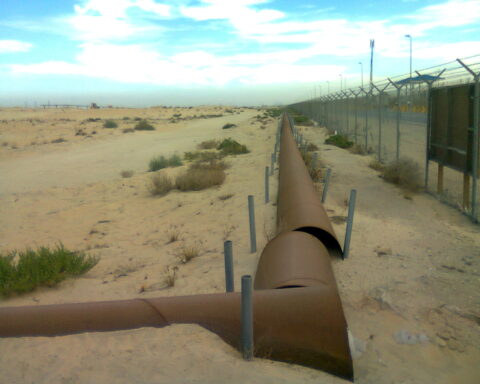
The East-West pipeline runs from Abqaiq to Yanbu on the Red Sea coast. That gap u2014 between what the pipeline can pump and what the port can load u2014 sits on top of any production constraints upstream. Brent above the budget assumption is therefore not the rescue line on a spreadsheet. The May Official Selling Price was set at +$19.50 per barrel above benchmark u2014 pricing for war-disrupted volumes u2014 but the volumes themselves are constrained by physical infrastructure on the Red Sea, not by demand or by the kingdom’s stated production policy.
n
n
n
n
| Metric | Budget assumption / prior | Q1 2026 actual | Variance |
|---|---|---|---|
| Production (M bpd) | ~10.1 | 7.25 | -2.85 |
| Quarterly oil revenue (SR bn) | 149.8 (Q1 2025) | 144.7 | -3% |
| Quarterly expenditure (SR bn) | ~322 (Q1 2025) | 386.7 | +20% |
| Quarterly deficit (SR bn) | ~57 (implied 1/4 of 165 forecast) | 125.7 | +121% |
| Public debt stock (SR tn) | 1.52 (Jan 1) | 1.67 (Mar 31) | +0.15 |
n
n
n
n
n
n
The expenditure side is the more politically sensitive number. Spending up 20% year-on-year u2014 adding roughly SR65 billion to a single quarter u2014 does not appear in the headline Bloomberg coverage and is treated as ambient context in the Saudi Gazette write-up. The Gazette frames it as a revenue story; the spending side is where the war is actually showing up in the books.
n
n
n
The 20% spending surge nobody is explaining
n
n
n
The Ministry of Finance’s report does not break out the SR65 billion year-on-year increase in quarterly spending by category. Defense outlays, energy subsidy adjustments, and emergency operational expenditure are all plausible sources, but the disclosure is opaque. What the kingdom has confirmed elsewhere is consistent with a wartime cost ramp: Khurais offline at 300,000 bpd with no announced restart, the Sky Sabre battery deployed under UK-Saudi defense arrangements, expanded SANG operations along the Eastern Province, and the Hajj 2026 cordon costs that the Ministry of Interior has not itemized publicly.
n
The official Q1 GDP report released May 6 filled part of that gap: defense spending rose 26% year-on-year in Q1, accounting for the largest single identifiable driver of the SR65 billion expenditure increase. That figure, buried in the General Authority for Statistics GDP release, does not appear in the Ministry of Finance’s own budget disclosure.
n
n
n
Capital expenditure on Vision 2030 projects has been cut, not increased u2014 PIF reduced spending up to 60% across more than 100 portfolio companies in its December 2024 board review, NEOM tunneling and Trojena ski resort contracts were cancelled in March, and direct government tourism funding to NEOM was scrapped in April. The 20% spending rise is therefore not a giga-project story. It is a war and entitlements story, which is harder to scale back politically. Cost-of-living allowances are easy to suspend in peacetime, as the kingdom did in 2020. Suspending them while Iranian missiles hit the Eastern Province is a different proposition.
n
n
n
The NEOM retrenchment is now official. PIF Governor Al-Rumayyan confirmed in April that The Lineu2019s 2030 residential targets have been abandoned and that Oxagon is the only NEOM component PIF is treating as a deliverable in the current strategy cycle u2014 a formal pivot that reframes the spending cuts as a managed exit from an unfinanceable flagship rather than a temporary pause.
n
n
n
n
n
n
“The kingdom’s strong policy flexibility, including its ability to shift crude oil exports to the Red Sea via East-West pipeline.”S&P Global, sovereign rating affirmation, March 14, 2026
n
n
n
n
n
n
S&P’s March affirmation language reads now as an artifact. The agency cited the East-West pipeline as a flexibility mitigant six weeks after the Yanbu loading ceiling had become the binding constraint on Saudi exports. That is not a criticism unique to S&P; the Moody’s and Fitch reaffirmations issued in the same window relied on similar boilerplate. Each of the three relied on the existence of a backup route, not on its measured throughput.
n
n
n
n
n
n
What is the Wall Street estimate of Saudi Arabia’s actual 2026 deficit?
n
n
n
Goldman Sachs models Saudi Arabia’s war-adjusted full-year deficit at 6.6% of GDP u2014 roughly twice the official 3.3% u2014 implying $80 to $90 billion. Deutsche Bank, Emirates NBD, and Abu Dhabi Commercial Bank cluster at 5.0u20135.3% of GDP, implying $65 to $70 billion. Even the lower end of Wall Street consensus exceeds the official $44 billion figure by 50%.
n
n
n
The gap between official projections and the Goldman estimate has a strategic dimension that the fiscal data alone does not capture: Goldman’s May 1 analysis also found that Saudi Arabia is running a net fiscal surplus on the war at $112 Brent, meaning MBS is not spending to recover from catastrophe but managing against the peace that would end his price windfall.
n
n
n
At the official GDP base, Goldman’s 6.6% translates to a shortfall roughly $40 billion above the Ministry of Finance’s SR165 billion figure. A nau00efve linear extrapolation of Q1 actuals implies a full-year deficit near $134 billion u2014 but Saudi spending is not evenly distributed across quarters and Q1 typically runs hot, so that figure overstates the likely outcome.
n
n
n
n
| Source | Deficit (% of GDP) | Implied $bn | Notes |
|---|---|---|---|
| Saudi Ministry of Finance (Dec 2025) | 3.3% | ~44 | Pre-war forecast; not revised |
| Deutsche Bank / Emirates NBD / ADCB | 5.0u20135.3% | ~65u201370 | War-adjusted, conservative |
| Goldman Sachs (war-adjusted) | 6.6% | ~80u201390 | Reflects production shortfall |
| Q1 2026 actual annualized (linear) | ~9.0% | ~134 | Nau00efve extrapolation; spending front-loaded |
n
n
n
n
n
n
Even discounting for seasonality, the gap between the Q1 print and the December forecast is too wide to close without a fiscal event the kingdom has not signaled: a dividend boost from Aramco, a draw on PIF, a withdrawal from SAMA reserves, or a sovereign issuance that exceeds the NDMC’s pre-approved envelope. Each of these has a downstream cost the kingdom has reasons to defer.
n
n
n
The behavioral signal that the official forecast is not believed inside the kingdom is the SR217 billion NDMC borrowing program itself. Pre-approved in January for a stated SR165 billion deficit plus SR52 billion in maturing debt, the borrowing authorization left almost no headroom. Q1 alone consumed SR125.7 billion of that envelope through new issuance. Roughly SR91 billion of the program remains for the next nine months, against expected debt service obligations that have not gone away. The kingdom raised $11.5 billion in its first issuance of January and has issued steadily since. The plan was always over-tight; the war made it inadequate.
n
n
n
Why hasn’t a rating agency downgraded Saudi Arabia yet?
n
n
n
No quantitative trigger has fired. SAMA reserves remain above $400 billion, debt-to-GDP stays below 35% through 2026 on even the highest Wall Street estimates, and the Ministry of Finance has not revised its forecast u2014 the step that would move agencies from scheduled review to credit-event review. All three reaffirmed Saudi Arabia before Q1 actuals were published.
n
n
n
S&P affirmed at A+ stable on March 14, Moody’s at Aa3 stable, Fitch at A+ stable. Each cited the kingdom’s $475 billion of foreign reserves, its low debt-to-GDP ratio (32% projected for 2026, against an emerging market average above 60%), and the East-West pipeline as a redundancy mechanism. Each reaffirmation was a 2026 calendar event scheduled before the war disrupted the Q1 print.
n
n
n
The IMF’s April 2026 Regional Economic Outlook is more pointed than the agencies have allowed themselves to be. The fund warned of “growing pressure on Gulf public finances” and projected Saudi public debt above 42% of GDP by 2031, against a 2025 base of 31.7% and a 2026 figure now revised upward to 32.1% on Q1 actuals. A trajectory from 32% to 42% in five years is not catastrophic. It is also not the trajectory that supported the current ratings.
n
n
n
The agencies can wait, and have institutional reasons to. A formal budget revision u2014 the step that would convert a scheduled annual review into a credit-event review u2014 is the trigger Riyadh is withholding. A non-oil PMI reading at 4.8% Q1 growth gives them cover to talk about diversification rather than the deficit headline.
n
n
n
What changes the calculus is a Q2 print that confirms the Q1 trajectory. If the Ministry’s July report shows another SR100-plus billion deficit, the formal revision becomes unavoidable, and the revision becomes the trigger. Riyadh’s Q2 management u2014 what it spends, what it withholds, what it pre-announces u2014 is being shaped by exactly that arithmetic.
n
n
n
The spread question and why Riyadh is buying time
n
n
n
A sovereign downgrade does not just embarrass a finance minister. It widens the credit spread on every subsequent issuance, and on every outstanding instrument that prices off the sovereign curve. Saudi Arabia issued $11.5 billion in January in an oversubscribed transaction priced tight to US Treasuries u2014 the kind of execution that argued, at the time, that the war’s fiscal impact had been absorbed by the market. Subsequent issuances through Q1 came in at progressively wider levels, but the cumulative widening has not exceeded what the kingdom can absorb at current ratings.
n
n
n
A one-notch downgrade u2014 Aa3 to A1 at Moody’s, A+ to A at S&P, A+ to A at Fitch u2014 would push Saudi sovereign paper into a different index bucket and trigger forced selling from passive Aa-mandate funds. Passive Aa-mandate fund managers at firms such as PIMCO and BlackRock monitor this trigger as a systematic portfolio risk. The estimated spread widening on a one-notch action across the curve runs 35 to 60 basis points based on prior emerging-market sovereign downgrade events, which on a SR217 billion borrowing program implies roughly SR760 million to SR1.3 billion in additional annual interest expense. The number is not catastrophic in isolation. It compounds, however, every year the new debt remains outstanding.
n
n
n
The procedural sequencing matters more than the spread arithmetic. A formal Ministry of Finance revision of the deficit forecast moves the rating timeline from “scheduled annual review” to “credit-event review,” which is a different track with different evidence requirements and different language. The kingdom’s behavior u2014 holding the December forecast, issuing on schedule, drawing reserves quietly u2014 is consistent with running out the clock until the war’s trajectory is clear enough to revise once rather than twice. Non-oil PMI strength is part of the same calendar management strategy, giving the agencies a positive data point to weigh against the deficit headline at their next scheduled look.
n
n
n
Reserves, the lever that no longer works the same way
n
n
n
SAMA foreign reserves stood at SAR 1.78 trillion (approximately $475 billion) in February 2026, a six-year high going into the war. Argaam reported the April reading at SAR 1.66 trillion, implying a SAR 120 billion ($32 billion) drawdown in roughly two months. The Q1 deficit was financed entirely through borrowing, per the Ministry of Finance, which means the reserves drawdown is doing different work u2014 likely supporting the riyal peg, settling external obligations, or financing PIF and Aramco capital calls that no longer flow through the budget proper.
n
n
n
The 2020 reserves comparison is misleading in two directions. Saudi Arabia entered 2020 with $474 billion in reserves and exited with $442 billion after a $32 billion drawdown that financed roughly half the year’s deficit. The 2026 entry point is similar in dollar terms. The 2026 deficit, on Wall Street estimates, is 2.5 to 3 times larger. The reserves cushion has roughly the same depth against a fiscal hole that is materially deeper u2014 and against a structural revenue impairment the 2020 collapse did not feature.
n
n
n
n
n
n
How does the Aramco-PIF transfer hurt the Ministry of Finance?
n
n
n
The Public Investment Fund holds approximately 16% of Aramco, transferred from government holdings since 2022. That 16% stake diverts roughly $14 billion in annual Aramco dividends to PIF’s balance sheet rather than to Ministry of Finance revenue. PIF is a sovereign wealth vehicle, not a fiscal buffer, so the money does not narrow the deficit.
n
n
n
The Government of Saudi Arabia holds approximately 82.5% of Aramco directly. The remainder trades on the Tadawul. In peacetime, the PIF transfer was an asset reallocation that strengthened the kingdom’s diversification arm. In wartime, it is a leak in the bucket the budget actually depends on u2014 particularly when Aramco’s distributable cash is compressed by lower volumes.
n
n
n
Aramco’s Q4 2025 base dividend was SAR 0.3393 per share, totaling SAR 82.08 billion. The Ministry of Finance captured 82.5% of that, or roughly SAR 67.7 billion. PIF captured 16%, or SAR 13.1 billion.
n
n
n
The Aramco Q1 2026 results land on May 10. Analyst consensus is SAR 108.8 billion in net income, a 56.7% quarter-on-quarter increase driven by higher prices despite lower volumes. The base dividend is the variable to watch. A maintained dividend at SAR 82 billion preserves the Ministry’s quarterly oil-equity revenue at roughly SAR 68 billion u2014 barely. A dividend cut, or the deferral of any performance dividend, removes that floor. The Aramco performance dividend has been the pressure-release valve in prior cycles; in this one, the cycle compresses faster than the valve can respond.
n
n
n
The 2020 precedent and why it does not apply
n
n
n
The 2020 fiscal collapse produced a SR298 billion full-year deficit, the largest in modern Saudi history at that point. The kingdom’s response toolkit was visible and aggressive: roughly $32 billion drawn from reserves, the entire Q1 2020 deficit (around $9 billion) financed through borrowing, VAT tripled from 5% to 15% in July 2020, and the cost-of-living allowance suspended. Brent recovered through the second half of the year. Aramco increased production into the recovery and captured the price upswing. By 2022, Saudi Arabia ran a fiscal surplus.
n
n
n
The Q1 2026 deficit of $33.5 billion is 3.7 times the entire Q1 2020 shortfall. The 2020 toolkit is also less available. VAT was already raised to 15%; another increase compounds inflation that is already running above target. The cost-of-living allowance was reinstated in 2022 and is politically harder to suspend during active conflict than during pandemic lockdown. Most fundamentally, in 2020 Aramco could lift production into a price recovery; in 2026, the Yanbu loading ceiling and the broader Hormuz constraint mean production cannot rise until the war ends and the Strait reopens at scale. There is no production lever to pull.
n
n
n
The 2014u20132016 precedent is the closer analogue, and it ended in austerity. Deficits of $98 billion in 2015 and $79 billion in 2016 drew reserves from $737 billion to $514 billion in two years before the kingdom resorted to debt issuance at scale, and the National Transformation Program of 2016 introduced the spending discipline that survived into Vision 2030. The 2026 fiscal cycle starts from a reserves base ($475 billion) that the 2014u20132016 cycle would have considered a depleted endpoint, not a starting position.
n
n
n
May 10 and the Q2 cliff
n
n
n
Three near-term events will determine whether the $44 billion forecast survives the second quarter intact. The first is Aramco’s Q1 results on May 10, where any dividend deferral or downward guidance flows directly into the Ministry of Finance’s revenue line. The second is the Q2 budget performance report, due in early August, which will print at a moment when the rating agencies’ summer review windows are open. The third, and the most important, is the war itself u2014 the April 22 ceasefire expiry came and went, the IRGC has not returned Hormuz to pre-war operating conditions, and the first convoys since the closure produced spot prices below Saudi break-even. The May 6 Brent collapse adds a further dimension: deal optimism itself is now compounding Saudi Arabia’s fiscal exposure, delivering the revenue hit of a reopened strait before the volume recovery that would justify it.
n
n
n
The IMF’s projection of public debt above 42% of GDP by 2031 assumes the war fades within twelve to eighteen months and the kingdom resumes deficit financing on a manageable trajectory. A war that grinds through 2027 u2014 with Yanbu still binding, Hormuz still selectively closed, and Aramco still producing nearly 3 million bpd below the budget’s working figure u2014 pushes the debt trajectory steeper. Higher Brent does not solve this, because the volume side of the revenue equation cannot recover until the infrastructure recovers.
n
n
n
Riyadh’s communications strategy is already adjusting. The Saudi Gazette frames Q1 as an oil revenue story; the Arab News piece leads with non-oil revenue growth at 2%. The Juaymah LPG shutdown is reported as an operational matter, not a fiscal one. The Ministry of Finance has not held a press conference. Rating agencies have not been briefed on a revised path. The kingdom is doing what kingdoms do when arithmetic moves faster than diplomacy: holding the line on the published number, drawing reserves quietly, issuing debt at the scheduled cadence, and waiting for the war to end before the books have to be reopened.
n
n
n
What it cannot do is stop the calendar. The Q2 print drops in eight weeks. Aramco reports in five days.
n
n
n
Frequently asked questions
n
n
n
What was Saudi Arabia’s Q1 2026 budget deficit and why does it matter?
n
n
n
Saudi Arabia recorded a Q1 2026 budget deficit of SR125.7 billion ($33.5 billion), the largest quarterly shortfall since 2018 according to Bloomberg. The figure matters because it consumed 76% of the SR165 billion full-year deficit forecast in a single quarter and was financed entirely through borrowing, raising public debt from SR1.52 trillion to SR1.67 trillion in three months.
n
n
n
Has Saudi Arabia revised its 2026 budget forecast after the Q1 numbers?
n
n
n
No. The Ministry of Finance’s December 2025 budget statement projecting a SR165 billion full-year deficit remains the official forecast. A formal revision would activate rating agency review processes that the kingdom has procedural reasons to delay until Q2 actuals force the issue in early August.
n
n
n
Is Saudi Arabia’s riyal peg at risk from the fiscal pressure?
n
n
n
The riyal has been pegged at 3.75 to the dollar since 1986 and is backed by SAMA’s foreign exchange reserves. A peg break would require reserves to fall toward $150 billion u2014 a threshold the kingdom has never approached. The $32 billion reserve drawdown between February and April 2026 narrows the cushion but leaves it wide. The more immediate risk is not the peg breaking but the cost of defending it compressing the fiscal space available for other obligations.
n
n
n
What would a Saudi Arabia sovereign downgrade actually cost?
n
n
n
A one-notch downgrade u2014 A+ to A at S&P and Fitch, Aa3 to A1 at Moody’s u2014 would shift Saudi paper out of the FTSE World Government Bond Index Aa sub-index, triggering forced selling from passive funds mandated to hold only Aa-rated sovereigns. Based on comparable emerging-market downgrade events, the spread widening runs 35 to 60 basis points across the curve. On Saudi Arabia’s SR217 billion ($57.8 billion) borrowing program, that implies SR760 million to SR1.3 billion in additional annual interest expense u2014 a figure that compounds every year the new debt remains outstanding. The mark-to-market loss on existing Saudi bonds would be immediate.
n
n
n
How is the Aramco-PIF ownership structure affecting the budget?
n
n
n
The Public Investment Fund holds approximately 16% of Aramco, transferred from government holdings in tranches since 2022. Roughly $14 billion in annual Aramco dividends now flows to PIF rather than to Ministry of Finance revenue. PIF operates as a sovereign wealth vehicle, not a fiscal buffer, so the dividends it receives do not narrow the budget deficit even as they strengthen the kingdom’s investment arm.
n
n
n
How PIF is actively responding to the fiscal pressure u2014 accelerating its 2026u20132030 domestic deployment while cutting international exposure u2014 is documented in PIF’s $92 billion domestic pivot, which traces the mechanism from dividend capture to capital reallocation.
n
n
n
Can Saudi Arabia raise VAT again to close the deficit?
n
n
n
VAT was tripled from 5% to 15% in July 2020 and has not been adjusted since. A further increase is arithmetically possible but politically constrained: inflation is already running above target, the cost-of-living allowance reinstated in 2022 was designed to offset the 2020 increase, and suspending it again while Iranian missiles hit the Eastern Province carries a different political cost than the 2020 pandemic context. VAT is not a lever Riyadh can pull without compounding domestic economic pressure.
n
n
n
The mechanism by which Brent crude fell approximately 10% on MOU optimism before Hormuz has reopened by a single additional tanker — and what that means for Saudi fiscal arithmetic — is detailed in Washington’s Hormuz-First Concession Hands the IRGC a Structural Veto Over Nuclear Talks.
n
n
n
n
n”}
n”}