JEDDAH — The Saudi-led coalition on November 20 ordered civilians to evacuate Hodeidah port and struck what it described as military targets at Yemen’s main import gateway, drawing an immediate Houthi threat to attack Jeddah and all Saudi Red Sea ports and a declaration that Saudi airspace is “unsafe.”
The exchange of threats brought both sides’ primary commercial seaports into direct targeting calculations on the same day. Jeddah Islamic Port has absorbed the majority of Saudi Arabia’s diverted shipping since Strait of Hormuz closures rerouted Persian Gulf traffic to the Red Sea. Any sustained disruption to either port would hit the import lifeline of the party that controls it.
The House of Saud Daily Briefing
Saudi Arabia's news in 3 minutes, every morning. Free. See today's issue
Table of Contents
- What Did the Coalition Strike at Hodeidah?
- Houthi Threats Target Jeddah Port and Saudi Airspace
- How Much Trade Depends on Hodeidah and Jeddah?
- Coalition Intercepts and Arab League Condemnation
- Have Both Sides Threatened Each Other’s Ports Before?
- Hodeidah: From Stockholm Agreement to Frontline
- Frequently Asked Questions
What Did the Coalition Strike at Hodeidah?
Coalition spokesman Turki al-Malki posted on X calling on civilians to evacuate Hodeidah port “for their safety,” sharing a map of a designated evacuation route but specifying no timeframe for the warning or the scope of planned operations, Reuters reported on November 20.
The coalition subsequently said it “targeted operational capabilities at Hodeidah port” used for smuggling and transporting weapons and ballistic missiles, according to Asharq Al-Awsat. Across Yemen, the coalition said it destroyed 7 military targets and 6 workshops manufacturing ballistic missile launcher structures and drones, and disabled a main Houthi supply depot in Sanaa. Operations were ongoing in Sanaa, Saada, and Taiz provinces, the coalition said.
Al Jazeera correspondent Yousef Mawry, reporting from the region, called the November 20 campaign “the heaviest air strikes that we have witnessed since the conflict began.” The assessment came two days after the coalition hit 60 targets across Yemen on November 18 as Houthi forces advanced toward Aden.
Yemen’s Information Minister disputed the coalition’s characterization, telling Reuters that the port “remains fully operational and the flow of goods will continue.” The statement suggested the Houthi-run administration intended to keep the facility open despite the strikes.
Available reporting did not make clear whether the coalition’s evacuation warning preceded or followed the initial strikes on the port. Al-Malki’s post on X included a location map showing a designated route away from the facility, but no outlet reported a specific time gap between the warning and the first bombs landing.
Houthi Threats Target Jeddah Port and Saudi Airspace
Houthi military spokesman Yahya Saree issued a series of escalatory warnings on November 20 in response to the Hodeidah operation. Saree declared that Jeddah port and all Saudi Red Sea ports would become “targets” if the coalition struck Hodeidah, according to Al Jazeera.
“We also urge all shipping companies to immediately evacuate their ships from these ports.”
— Yahya Saree, Houthi military spokesman, via Reuters
Saree then declared Saudi airspace “unsafe,” stating it “will be the scene of our operations in the coming hours,” Al Jazeera and Middle East Eye reported. Middle East Eye timestamped the airspace declaration at 12:53 GMT. Saree exempted airspace over Mecca and Medina from the threat.
The European Union Aviation Safety Agency had already extended airspace warnings for six Gulf zones through January 31, 2027, before the latest Houthi statements.
The Houthis also named al-Shuqaiq power plant in Jizan province and an unnamed financial centre in Riyadh as military targets, calling for immediate evacuation of workers and residents near those facilities, according to Middle East Eye and the Free Press Journal. Al-Shuqaiq Steam Power Plant has a generating capacity of approximately 2,640 megawatts and sits roughly 140 kilometres north of Jizan city on the Red Sea coast, according to Power-Technology.
Saree attributed the threats to alleged coalition strikes on power stations in Saada province and Mocha in Taiz province, Al-Masirah TV reported, as cited by Middle East Eye. The coalition had previously struck targets in Sanaa and Mocha during earlier operations this month.
As of November 20, no reports confirmed an actual Houthi strike on Jeddah or any Saudi Red Sea port. No aviation authorities had announced new airspace closures in response to Saree’s declaration.
How Much Trade Depends on Hodeidah and Jeddah?
The threatened ports anchor each side’s import lifeline. Hodeidah handles approximately 70 percent of Yemen’s commercial imports, according to UN News, and approximately 80 percent of the country’s humanitarian aid deliveries, according to Human Rights Watch. Any sustained disruption to port operations would compound a food crisis already in motion: the World Food Programme suspended operations in northern Yemen in January 2026 after Houthi restrictions, cutting coverage of 18 million Yemenis facing acute food insecurity, the Foundation for Defense of Democracies reported.
The coalition’s framing of its Hodeidah strikes as targeting military infrastructure — missile workshops, smuggling networks, and supply depots — did not address how continued operations would affect the commercial and humanitarian cargo that transits the same facility. No UN agency, including the WFP or OCHA, had issued a public statement specifically responding to the November 20 events at the time of reporting.
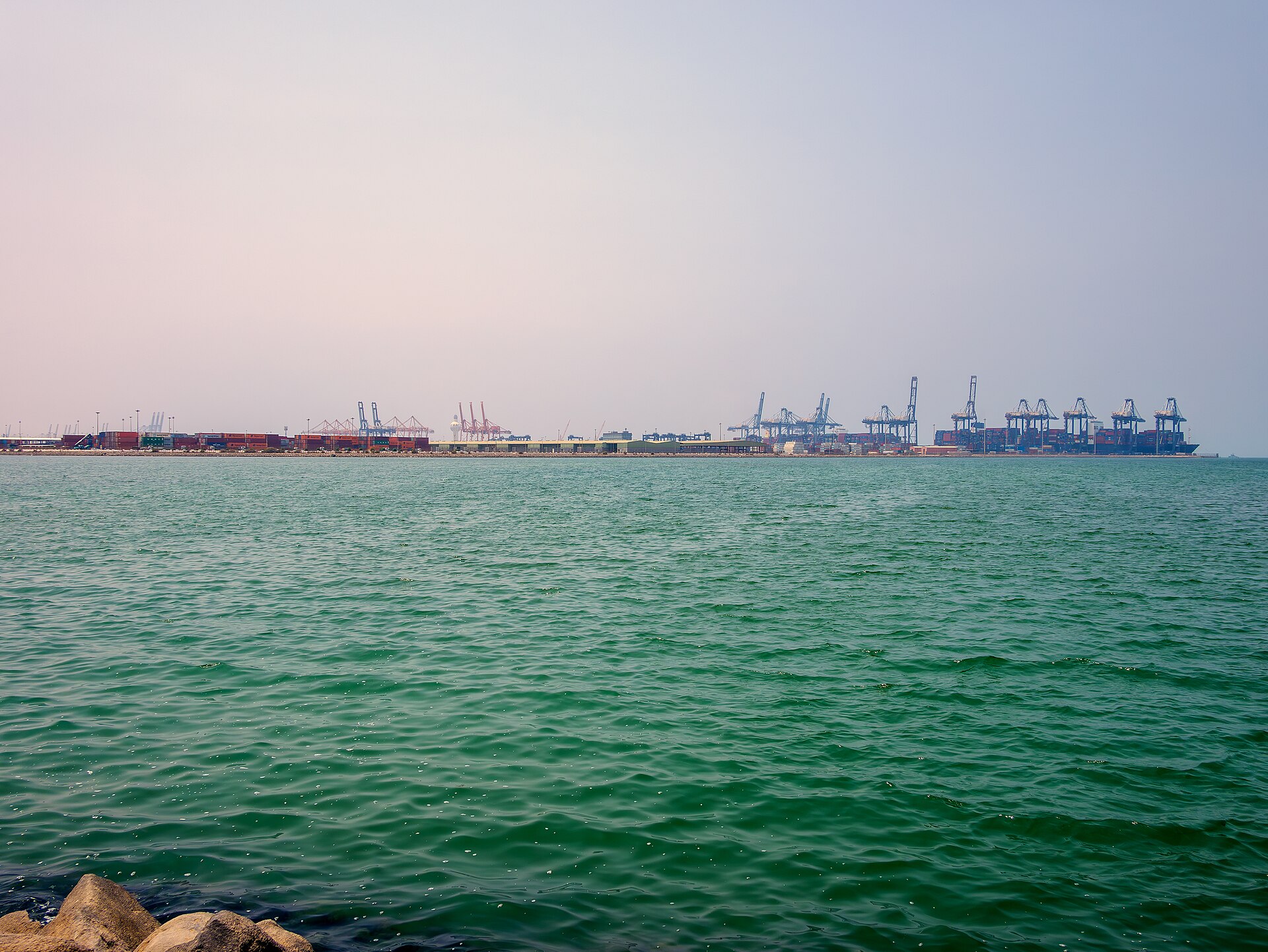
Jeddah’s wartime role has expanded in the opposite direction. As Iranian mining of the Strait of Hormuz diverted tanker and container traffic to the Red Sea, Jeddah Islamic Port absorbed the overflow. The port hit a record 582,900 twenty-foot equivalent units in October 2026, according to Mawani data reported by Food Business MEA. Jeddah South Container Terminal, operated by DP World, processed 221,200 TEUs in July 2026 — its highest throughput since 1999, DP World disclosed in August.
Before the Iran war, Jeddah handled 64 percent of ship calls to Saudi Arabia. That figure reached 76 percent by March 2026 as Iranian attacks near the Strait of Hormuz pushed vessels to Red Sea alternatives, according to Kpler data reported by AGBI. Houthi threats to target the port arrive at the moment when Jeddah is already operating under wartime surge volumes and absorbing freight that once transited the Persian Gulf.
Coalition Intercepts and Arab League Condemnation
Separate from the Hodeidah operation, the coalition said on November 20 that it intercepted and destroyed 1 ballistic missile and 3 drones targeting the Southern Region, and 2 additional drones targeting Riyadh, according to Asharq Al-Awsat and the Free Press Journal. The coalition reported intercepts over Asir and Jizan provinces as part of ongoing air defense operations that day.
The November 20 escalation came one day after a suspected Houthi missile struck the PIF Tower in Riyadh’s King Abdullah Financial District on November 19, according to Reuters. That attack prompted Brent crude to rise 0.9 percent in immediate trading. The unnamed financial centre in Riyadh that the Houthis designated as a military target on November 20 was not identified in any available Houthi statement.
The Arab League condemned attacks on Saudi Arabia on November 20, calling the targeting of civilian objects and vital facilities “a dangerous escalation,” Asharq Al-Awsat reported. The statement aligned with condemnations from individual member states, including Egypt, which backed Saudi Arabia’s right to self-defence after the PIF Tower strike.

Have Both Sides Threatened Each Other’s Ports Before?
November 20 was not the first time Hodeidah and Jeddah appeared in each side’s targeting rhetoric. In July 2024, Houthi propaganda posters listed Jeddah Islamic Seaport among implied targets, according to MEMRI. A year later, in July 2026, senior Houthi adviser Mohammad Taher Anaam told Intellinews that the Houthi naval blockade would extend to Jeddah and Yanbu.
The coalition has previously struck in and around Hodeidah. In July 2026, coalition aircraft hit Houthi military sites in Hodeidah governorate; the coalition denied targeting the port itself, though Reuters witnesses reported explosions near the facility, Al Jazeera reported on July 24.
Meanwhile, the Houthis retook the Bab el-Mandeb coast on November 15, strengthening their position over the Red Sea chokepoint that sits between Hodeidah and the approaches to Jeddah. The dual chokepoint grip — Bab el-Mandeb in the south and Iranian-contested Hormuz in the east — makes the Houthi threat to Jeddah more than rhetorical; vessels approaching the port must transit waters within reach of Houthi anti-ship systems.
The November 20 events marked a qualitative shift: for what appeared to be the first time, both sides issued explicit evacuation warnings for each other’s main port on the same day, coupling the threats with named targets — specific infrastructure facilities, airspace designations, and direct calls for shipping companies to withdraw.
Hodeidah: From Stockholm Agreement to Frontline
Hodeidah port’s status as a protected zone dates to the Stockholm Agreement of December 2018, brokered by then-UN Special Envoy Martin Griffiths. Under the deal, the Houthis were to withdraw from the ports of Hodeidah, Salif, and Ras Isa. A formal handover ceremony took place in December 2018, the Maritime Executive reported, but the Houthis effectively retained administrative control of the port, according to The National.
The UN Mission to Support the Hodeidah Agreement monitored the ceasefire until its mandate concluded on March 31, 2026, according to UN News. By that point, the Iran war had already reshaped the conflict’s geography. Saudi Arabia launched what officials described as a 6-month campaign against the Houthis extending into 2027, while Houthi forces advanced to within 60 kilometres of Aden by November 18.
The port itself has absorbed repeated damage. Israeli strikes in July 2024 heavily damaged the facility, with oil tanks burning for days, The National and Human Rights Watch reported. In April 2025, US strikes on the nearby Ras Isa port caused dozens of civilian casualties; HRW called the attack a possible war crime.
The coalition’s November 20 operation and the Houthi counter-threats placed Hodeidah and Jeddah into the same escalatory cycle — two ports handling the majority of their respective populations’ imports, each now designated as a military target by the other side.
Frequently Asked Questions
Has any party directly struck Jeddah Islamic Port?
As of November 20, 2026, no confirmed strike has hit Jeddah Islamic Port. The Houthis have struck targets elsewhere in the Kingdom, including the PIF Tower in Riyadh on November 19 and King Khalid International Airport on multiple occasions. Jeddah port first appeared in Houthi targeting rhetoric in July 2024, when MEMRI documented propaganda posters listing the facility among implied targets. The November 20 threat from Yahya Saree was the most explicit and operationally detailed warning to date, including a direct call for shipping companies to withdraw vessels.
How has the Iran war redirected Saudi Arabia’s port traffic?
Before Iranian mining campaigns shut down or restricted transit through the Strait of Hormuz, Saudi Arabia’s Red Sea and Persian Gulf ports shared commercial traffic more evenly. King Abdullah Port, on the Red Sea, saw its container ship calls drop approximately 70 percent — from 188 to 59 — between 2023 and 2024 as Houthi attacks disrupted Red Sea shipping, according to Middle East Eye citing MarineTraffic data. Jeddah Islamic Port absorbed the redirected freight, pushing its share of Saudi ship calls from 64 percent to 76 percent by March 2026. The concentration makes Jeddah a single point of failure for Saudi import supply chains.
What happened during the 2025 US strikes on Ras Isa port?
In April 2025, US forces struck the Ras Isa oil terminal near Hodeidah, causing dozens of civilian casualties. Human Rights Watch investigated the attack and called it a possible war crime, citing evidence that the strikes hit a facility with civilian workers and inadequate warning. Ras Isa, located north of Hodeidah city, served as one of the three ports covered under the 2018 Stockholm Agreement’s ceasefire provisions alongside Hodeidah and Salif.
What is UNMHA and why did its mandate end?
The United Nations Mission to Support the Hodeidah Agreement was established in January 2019 to monitor the ceasefire and mutual redeployment of forces agreed under the Stockholm Agreement. The mission’s mandate was renewed annually by the UN Security Council. UNMHA concluded operations on March 31, 2026, according to UN News. By that date, the broader Iran war had overtaken the original Yemen conflict framework, rendering the Hodeidah-specific ceasefire mechanism effectively obsolete as both sides escalated to nationwide military operations.
The House of Saud Daily Briefing
Saudi Arabia's news in 3 minutes, every morning. Free. See today's issue