BRUSSELS — The European Union’s June 8 sanctions designations targeting Iran’s Hormuz fee collection apparatus — the Hormozgan Provincial Command of the IRGC Navy, Deputy Commander Mohammad Akbarzadeh, and oil industry representative Hamid Hosseini — remain fully in force as of June 17, nine days after their adoption and two days into the G7 Evian summit where the same EU member states endorsed the US-Iran memorandum of understanding.
The designations target the entities operating and advocating for Iran’s Persian Gulf Strait Authority, which collects approximately $1 per barrel on vessels transiting a five-nautical-mile corridor between Qeshm and Larak islands. EU sanctions law prohibits making funds or economic resources available to designated persons or entities — a prohibition that applies to any EU person or legal entity. The vast majority of the world’s tanker fleet is insured by EU-domiciled Protection and Indemnity clubs.
Table of Contents
The Three Designations
The EU Council’s June 8 designations were the bloc’s first use of its new freedom-of-navigation sanctions powers, created on May 22 when the Council extended existing restrictive measures to cover “individuals and entities involved in Iran’s actions and policies threatening the freedom of navigation in the Middle East,” according to the EU Council press release. The framework extension followed a political agreement reached at the Foreign Affairs Council on April 21 — a seven-week legislative timeline completed before any MOU draft existed.
The Hormozgan Provincial Command of the IRGC Navy was listed as an entity. The EU Council stated that the IRGC Navy “established a system requiring ships transiting the waterway to submit identifying documentation, cargo details and destination information, which are then reviewed by the Hormozgan Provincial Command.”
Mohammad Akbarzadeh, Deputy Commander for Political Affairs and spokesman of the IRGC Navy, was designated for “threatening the use of missiles and drones against commercial vessels crossing the waterway,” according to the EU Council press release and gCaptain reporting.
Hamid Hosseini — a representative of Iran’s Oil, Gas and Petrochemical Products Exporters’ Union and a member of Iran’s Chamber of Commerce — received the most operationally specific citation. The EU Council designated him for “promoting arrangements requiring shipping operators to submit to Iranian-controlled assessment and pay transit fees in exchange for passage through the strait.” He was further cited for “advocating compliance with Iranian transit procedures, including vessel assessments and the payment of fees in exchange for safe passage.” Unlike the other two designees, Hosseini is not a military figure; his listing targets the commercial advocacy infrastructure around the PGSA.
The Middle East briefing 3,000+ readers start their day with.
One email. Every weekday morning. Free.
What Does EU Sanctions Law Prohibit?
EU sanctions regulations prohibit making funds or economic resources available, directly or indirectly, to designated persons or entities. The West of England P&I Club published analysis in June 2026 confirming that this prohibition applies to all EU natural and legal persons, “directly or indirectly.”
The PGSA requires vessels to submit ownership, management, insurance, cargo, crew, and intended voyage details to [email protected] before authorization is granted, according to Steamship Mutual’s analysis titled “Strait of Hormuz: Sanctions Considerations.” Any payment of the approximately $1 per barrel fee flows to a mechanism operated under the authority of the Hormozgan Provincial Command, now an EU-designated entity.
Steamship Mutual stated: “Any toll payments — directly or indirectly — are likely to give rise to serious sanctions concerns.”
The enforcement mechanism is the insurance chain. Approximately 95% of the world’s tanker fleet purchases insurance from EU-based P&I clubs or reinsurers, according to reporting by Al Jazeera and analysis by propertycasualty360.com. In 2012, the EU’s ban on insuring ships carrying Iranian crude blocked not only European importers but also Asian buyers in India and Japan who relied on European reinsurance chains, according to the US Energy Information Administration.
gCaptain’s June 2026 analysis concluded that “an Iranian Hormuz service fee will be treated by P&I clubs, hull underwriters, banks and sanctions compliance lawyers as a geopolitical risk premium.”
The Lloyd’s Market Association has maintained war risk cancellation notices for the Persian Gulf since the conflict outbreak on February 28, 2026. War risk premiums have surged approximately 60 times pre-crisis rates, according to propertycasualty360.com reporting from March 2026.
The OFAC Parallel
The US Treasury reached the same position twelve days earlier. On May 27, the Office of Foreign Assets Control designated the PGSA as a Specially Designated National under the “Economic Fury” campaign. OFAC stated that the PGSA “spearheads an Iranian-controlled scheme that flagrantly violates international law” and that shipowners face sanctions exposure for “arranging transits with or paying tolls or fees to the PGSA.”
OFAC had signaled before the formal listing. On May 1 — twenty-seven days before the SDN designation — the Treasury issued a pre-designation advisory warning that any payment facilitating Iranian government revenue, including transit fees, could expose both US and non-US persons to sanctions risk, according to Steptoe’s legal analysis published June 1, 2026. The advisory covered any payment facilitating Iranian government revenue, not the PGSA specifically.
The two regimes are now parallel and reinforcing. A shipowner whose vessel transits Hormuz and pays the PGSA fee faces potential liability under both US secondary sanctions and EU primary sanctions. A vessel insured by a London P&I club and owned by a company with US dollar clearing relationships is subject to both.
Can a Tanker Pay the PGSA Fee Without Violating EU Law?
The MOU calls for Hormuz to reopen “without restrictions or tolls,” according to the G7 joint statement language. The word “tolls” appears. The words “service fees” do not.
Iran’s parliament codified the fee collection mechanism on March 30-31, 2026, before the PGSA was formally constituted in May and before any MOU draft existed. The legislative act is not subject to executive reversal. Iran officially characterizes the charges as fees for “navigational services,” according to Euronews reporting from May 25 — a deliberate invocation of UNCLOS Article 26(2), which carves out an exception from passage prohibitions for “specific services rendered.”
gCaptain reported that “the MOU prohibits the word ‘toll’ but does not prohibit the collection of service fees” and concluded that the semantic distinction could launder Iran’s revenue mechanism into treaty-adjacent language.
Shipping companies are pricing accordingly. Maersk is maintaining “significant cargo restrictions and emergency surcharges” on Persian Gulf routes — $1,800 per TEU, $3,000 per 40-foot container, $3,800 per reefer — as of its June 3 Middle East Operational Update 34. Commercial vessels remain at anchor across the region.
Iran has launched the “Hormuz Safe” platform and begun demanding payment in Bitcoin and USDT to avoid SWIFT-linked payment rails where EU and US sanctions apply, according to claimsjournal.com and cryptobriefing.com.
G7 Endorsed the MOU Without Suspending the Designations
The G7 summit at Evian (June 15-17) produced a joint statement calling for Hormuz to be reopened “without restrictions or tolls,” as reported by Tribune India and NBC News. France, Germany, and Italy — EU member states with voting authority on the sanctions designations — participated in both the G7 endorsement and the June 8 EU Council decision.
The EU Foreign Affairs Council met on June 15 and “took note” of the US-Iran MOU, according to INSIGHT EU Monitoring. The Council did not lift, suspend, or modify the June 8 designations.
The G7 endorsed a deal whose text calls for Hormuz to reopen. The EU designated the entities collecting the fees that make Hormuz, in commercial terms, closed.
Chatham House’s International Law Programme stated in April 2026 that “stopping over a hundred vessels a day in the Strait of Hormuz engaged in lawful trade violates international law, and charging a ‘toll’ is further violation of the transit passage regime.”
China and Russia, at the UN Security Council, vetoed a Bahraini-drafted resolution calling for an end to Iranian attacks on shipping, characterizing the measure as “biased against Iran,” according to PBS NewsHour and Al Jazeera reporting from April 7, 2026. China’s delegation at the same session called for freedom of navigation as “the shared call of the international community.”
The MOU grants no clearance authority over the mines that block the strait and contains no mechanism for lifting the EU designations that block fee payment.
Saudi Arabia’s Exposure
Saudi Arabia’s PGSA liability at current production stands at $5.5 million per day — 5.5 million barrels per day at $1 per barrel — or approximately $2 billion per year, confirmed against Steamship Mutual and Windward.ai reporting. Saudi Arabia is not exempted from the PGSA. Russia, China, India, Iraq, and Pakistan are.
Saudi crude bound for Asia must transit Hormuz or travel via the Petroline, maxed at approximately 7 million barrels per day including domestic throughput. Aramco’s Asian buyers rely on EU-insured or EU-nexus vessels for a substantial share of that transit.
The sanctions create a specific problem for Aramco’s customers. A refiner in Tokyo or Ulsan purchasing Arab Light, loaded at Ras Tanura, shipped through Hormuz on a vessel insured by a London P&I club, cannot authorize payment of the PGSA fee without exposing the insurer to EU sanctions liability.
Aramco cut its July Official Selling Price for Arab Light to Asia by $6 per barrel — the largest reduction since 2022 — for cargoes that cannot currently load. The PGSA exemption list tracks the nations that have maintained bilateral shipping arrangements with Iran or whose vessels operate outside EU and US insurance chains. Saudi Arabia, the Gulf state with the largest Hormuz-dependent export volume, has no such arrangement. Iran’s tankers, meanwhile, moved first through the corridor the PGSA controls.
Background
The EU’s freedom-of-navigation sanctions framework was not an emergency response to the MOU. The Foreign Affairs Council reached political agreement on April 21, 2026. The Council extended the restrictive measures framework on May 22. The first designations followed on June 8 — a deliberate seven-week legislative process, according to EU Council records.
The 2012 EU embargo against Iran provides the closest precedent. That year, the EU banned P&I clubs from insuring ships carrying Iranian crude. Iran’s exports fell from approximately 2.5 million barrels per day in 2011 to 1.5 million barrels per day in 2012, according to the US Energy Information Administration. India and Japan arranged government-backed insurance schemes to continue purchasing Iranian oil outside the European reinsurance chain, as reported by Al Jazeera.
In 2012, EU law blocked ships from moving Iranian oil. In 2026, EU law blocks ships from paying Iran to move anyone’s oil.
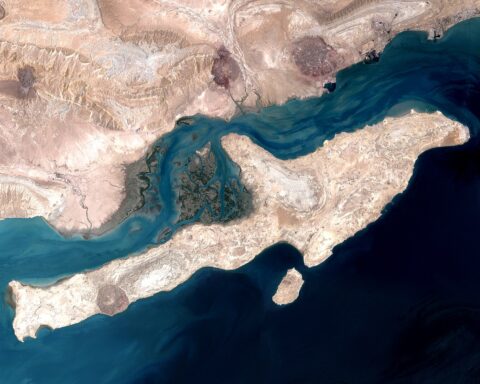
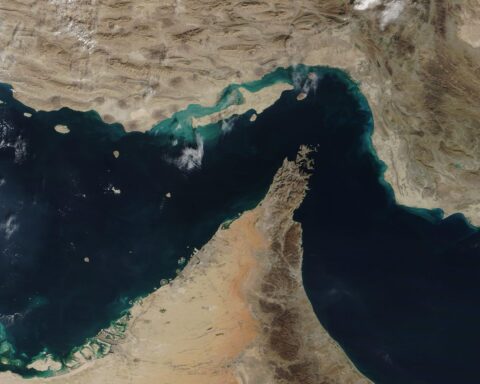
The PGSA was formally constituted around May 5, 2026 and operates a five-nautical-mile corridor between Qeshm and Larak islands, collecting approximately $2 million per VLCC, according to Windward.ai. The US Treasury designated the PGSA as an SDN on May 27. The EU designated the command structure overseeing it on June 8.
Frequently Asked Questions
Does UNCLOS Article 26 allow Iran to charge the Hormuz fee?
UNCLOS Article 26 prohibits charging ships “by reason only of their passage” through territorial waters, but Article 26(2) creates an exception for “specific services rendered to the ship.” Iran’s PGSA invokes this exception, classifying its per-barrel charge as payment for navigational services. No international court has ruled on whether a blanket per-barrel fee — applied uniformly to all vessels regardless of specific services received — meets the Article 26(2) test. Risk Intelligence and Steamship Mutual have both published analyses questioning whether the PGSA’s uniform charge structure qualifies. The EU and US designations have made the UNCLOS question largely moot for Western-insured vessels: the sanctions prohibit payment regardless of how the fee is classified under the law of the sea. Iran’s corridor fee under UNCLOS Art.26 and the legal architecture of the post-waiver insurance fee is covered separately.
What is Iran’s “Hormuz Safe” platform?
“Hormuz Safe” is a digital portal launched alongside the PGSA to process vessel transit applications and collect fees, according to claimsjournal.com. The platform demands payment in Bitcoin and USDT — a stablecoin pegged to the US dollar — to bypass SWIFT-linked payment rails where EU and US sanctions apply. Iran has also offered Bitcoin-backed ship insurance through the platform, according to cryptobriefing.com, creating a parallel insurance ecosystem designed to function outside Western regulatory reach. The platform’s name itself implies that Hormuz transit without PGSA authorization is unsafe — a framing inconsistent with the international law of transit passage.
Why are some countries exempted from the PGSA fee?
Russia, China, India, Iraq, and Pakistan are exempted from the PGSA’s per-barrel charge. These nations have maintained bilateral shipping or energy arrangements with Iran, and their vessels largely operate outside EU and US insurance and financial networks. The exemption architecture indicates the fee structure was designed to extract revenue primarily from Western-insured commercial traffic — which constitutes the majority of tanker movements through Hormuz — while preserving trade relationships with sanctions-resistant partners. Saudi Arabia, the largest single-country source of Hormuz-bound crude, has no bilateral arrangement with Iran and no exemption.
How did the EU sanctions framework on Hormuz develop?
The framework followed a deliberate legislative path: political agreement at the Foreign Affairs Council on April 21, formal framework extension on May 22, and first designations on June 8, 2026. The EU developed its sanctions track independently of both the US-Iran diplomatic process and OFAC’s own PGSA designation on May 27. The two regimes arrived at the same practical outcome — prohibiting payment to the PGSA and its operators — through legally independent mechanisms. Future designations under the same framework could target additional entities involved in Hormuz restrictions without requiring a new legislative basis.
The PGSA’s own operational rulebook — published June 19 and detailing the forty-category vessel declaration, Larak corridor, and five-day permit cycle — shows how Iran’s data-collection infrastructure functions independently of whether sanctions prevent fee payment. The full architecture is examined in what Iran collects from ships when the Hormuz transit fee is zero.