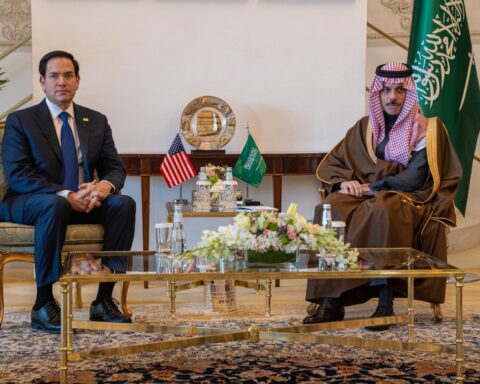
WASHINGTON — The US House of Representatives voted 215–208 on June 3 to pass H.Con.Res.38, a concurrent resolution invoking Section 5(c) of the War Powers Resolution and directing the president to remove US forces from hostilities against Iran unless Congress declares war or enacts a specific authorization. It is the first time either chamber has cleared a war powers resolution on a final vote since the conflict began on February 28.
Four Republicans crossed party lines to join a unified Democratic caucus: Brian Fitzpatrick of Pennsylvania, Thomas Massie of Kentucky, Tom Barrett of Michigan, and Warren Davidson of Ohio. Eighteen Republican members were absent on the day of the vote — a fact the White House cited in explaining the outcome, according to RedState.
The resolution cannot become law. A concurrent resolution is never presented to the president for signature, and the Senate does not have the votes for its own version. But 215 members of Congress have now attached their names to a formal determination that US forces are engaged in unauthorized hostilities — a record that exists independently of whether anyone acts on it.
Table of Contents
The Vote and the Delay That Failed
Speaker Mike Johnson saw the numbers before the vote happened. On May 21, Republican leadership sent members home early for Memorial Day recess when internal whip counts showed the resolution had enough support to pass, NPR reported. The maneuver bought two weeks. It did not change the arithmetic.
When H.Con.Res.38 reached the floor on June 3 — Day 96 of the conflict — the margin was seven votes. Johnson, opposing the resolution, told reporters it would have a “very negative” impact on ongoing nuclear negotiations with Iran and would “weaken” President Trump’s negotiating position, CBS News and RedState reported.
The White House attributed the passage in part to 18 absent Republican members. Had all 18 been present and voted with their leadership, the tally would have been 215–226.
The Middle East briefing 3,000+ readers start their day with.
One email. Every weekday morning. Free.
The House had rejected an earlier war powers measure on March 4, just six days into the conflict, when Republican unity held. Ninety-one days later, with gas prices at levels Thomas Massie was citing on the House floor and IRGC missiles reaching Camp Arifjan and Kuwait’s civilian airport, four members from the president’s own party broke ranks.
Why Is the Resolution Legally Contested?
H.Con.Res.38 is a concurrent resolution. It passes both chambers of Congress but is never sent to the president for signature or veto. Section 5(c) of the 1973 War Powers Resolution explicitly created this mechanism — it states that Congress may direct the removal of forces from hostilities “by concurrent resolution” at any time, without presidential approval.
The constitutional difficulty is INS v. Chadha. In 1983, the Supreme Court ruled 7–2 that the legislative veto — a category that includes concurrent resolutions used to direct executive action — violates the Constitution’s bicameralism and presentment requirements. The ruling, 462 U.S. 919, did not name the War Powers Resolution, but every presidential administration since 1973 has cited it or parallel reasoning to argue that Section 5(c) is unenforceable, according to Congressional Research Service reports R47603 and IF13134.
No president has ever complied with a Section 5(c) removal directive. The executive branch’s bipartisan, five-decade position is that the War Powers Resolution is either partially unconstitutional or inapplicable to the specific military operation at issue — a claim made by every president from Nixon to Trump, across wars in Lebanon, Kosovo, Libya, Yemen, and now Iran.
A White House spokesperson stated flatly that the resolution “will not reach” the president’s desk, Military.com reported.
The 60-Day Clock That Already Expired
The Trump administration submitted its War Powers Resolution notification report to Congress on March 2, covering hostilities that began on February 28, Stars and Stripes reported. Under Section 5(b) of the WPR, that report triggered a 60-day clock requiring either congressional authorization or withdrawal of forces. The deadline was May 1.
On that date, the administration declared the clock irrelevant. Hostilities had “terminated,” the White House stated, because there had been “no exchange of fire between United States Forces and Iran since April 7, 2026,” the day Trump ordered a ceasefire, PBS NewsHour reported.
Legal scholars rejected the characterization. In a May 2026 analysis published by Just Security, faculty at Yale Law School and New York University argued that the ongoing US naval blockade of Iranian ports constitutes “hostilities” under any reasonable statutory interpretation. “The current ceasefire does not affect the clock,” they wrote.
The war had cost $29 billion through May 12, according to Stars and Stripes. The Defense Department was assembling a supplemental war-funding request — a legislative vehicle that carried its own political risk. Senator Angus King of Maine, an independent who caucuses with Democrats, warned that any approval of supplemental funding “could be viewed as official congressional authorization of a broader war in Iran,” NOTUS reported.
Before approving a supplemental, you need to know what the real goals are and what the end game is.
— Senator Chuck Schumer (D-NY)
Is This an Anti-War Vote or a Pro-Authorization Vote?
The four Republican crossovers offered three different reasons for the same vote, and the distinctions matter for how the number 215 is read in Tehran and Riyadh.
Massie’s dissent was economic. “People are tired of this,” he told the Washington Post. “They’re tired of $5 gallon gas and $6 gallon diesel, and fertilizer we can’t afford to put on our fields in Kentucky.” Fitzpatrick, a former FBI agent, framed the issue as procedural compliance: “We must keep the world safe, and we must also follow the law,” he told NBC News.
Barrett went the furthest — and in two directions at once. He voted for the war powers resolution directing withdrawal while simultaneously introducing a separate, standalone Authorization for Use of Military Force. His AUMF would authorize 90 days of military operations to “demolish, degrade, or defeat the nuclear weapons program of Iran and its proxies without putting American boots on the ground or engaging in nation-building,” with a sunset date of July 30 and a 30-day wind-down, according to a press release from his congressional office. Asked by NBC News about constituent sentiment, Barrett — a West Point graduate and Iraq veteran — answered: “I think that people are frustrated, certainly.”
Three of the four Republican votes were not votes to end the war. They were votes to force Congress to take ownership of it. The center of Republican war-powers dissent is procedural — “Congress must authorize this” — not strategic. A single AUMF vote, if brought to the floor, could dissolve the coalition that produced the 215.
Whether Iran’s leadership would parse that distinction is a separate question.
What Does Saudi Arabia See in the Number 215?
The roughly 2,700 US servicemembers at Prince Sultan Air Base operate without a Status of Forces Agreement. Saudi Arabia retains sovereign legal authority over the base and can restrict or deny American access at any time, per CENTCOM and defense reporting by GlobMilitary.net. At Naval Support Activity Bahrain, 9,000 US personnel serve under a 1992 SOFA — a formal agreement that Kuwait, hosting troops at Camp Arifjan and Ali Al Salem, also maintains.
Every one of these facilities has been struck during the conflict. The IRGC has fired on NSA Bahrain three times. Camp Arifjan — the logistics hub that feeds Saudi Arabia’s own PAC-3 air-defense network — was hit in a barrage that demonstrated Iran’s understanding of Gulf defense supply chains. Kuwait International Airport’s Terminal 1 was struck 48 hours after reopening, prompting Kuwait to expel two Iranian diplomats — the first GCC diplomatic expulsion since the UAE closed its Tehran embassy in March.
The Carnegie Endowment for International Peace warned in March 2026: “Citizens are likely to wonder why they should bear the risk of hosting U.S. forces when the United States is unable or unwilling to protect the Gulf from Iranian attacks.”
Defense Secretary Pete Hegseth, at the Shangri-La Dialogue, added a second variable. “The era of subsidizing wealthy nations is over,” he said — language that, as HOS reported, described a framework in which Saudi Arabia has spent $142 billion on US arms purchases across the relationship without securing either a mutual defense treaty or a status of forces agreement.
Iran did not publicly comment on the House vote as of June 4. Its posture at the moment of the vote was the MOU suspension announced on June 1 through Tasnim, the IRGC-affiliated news agency — focused on Israel’s actions in Lebanon, not US domestic legislative procedure, Euronews reported. But the IRGC has consistently framed its strikes on Gulf host-nation infrastructure as designed to erode willingness to host American forces. Kuwait’s $1.02 billion NASAMS procurement, Saudi Arabia’s denial of overflight for Project Freedom, and the separate Saudi-led quadrilateral security framework with Egypt, Pakistan, and Turkey — three ministerial sessions in 31 days, none producing a communiqué — all suggest Gulf states are already making independent basing and procurement calculations.
The Atlantic Council assessed in 2026 that the Iran war had “forced the US-Gulf alliance out of the shadows,” with Gulf leaders initiating talks to diversify strategic partnerships. The fiscal context compounds the question: Aramco’s quarterly dividend now exceeds its free cash flow, and the IMF has conditioned Saudi economic recovery on Hormuz normalization. Saudi defense planning assumes an open-ended American commitment. The House just recorded 215 votes questioning that assumption. The same Congress that voted to end the war has introduced no legislation authorizing Iranian asset seizure — the legal gap Washington’s attempt to redirect Iranian frozen assets to Gulf reconstruction has not yet bridged.
Treasury Plans to Seize Iranian Assets to Pay Gulf Allies for War Damage examines the Bessent directive in detail: the IEEPA legal gap, the distribution of Iranian assets across China, India, Qatar, Iraq, Japan, and direct US jurisdiction, and the REPO Act precedent Congress has not yet applied to Iran.
The Senate and the Appropriations Track
The Senate voted 50–47 in a procedural vote to advance its own version of a war powers resolution. Senate Republican leaders told The Hill they expected a final vote to fail with full party attendance.
Under the War Powers Resolution’s own expedited procedures, a concurrent resolution in the Senate is privileged — not subject to filibuster. It requires 51 votes for passage, not 60, according to CRS report R47603. The barrier is not procedural. It is a head count: enough Republican senators would need to cross over, and the 50–47 procedural vote suggests the margin is close but not there.
Senator Tim Kaine of Virginia, a Democratic co-sponsor of the Senate resolution, indicated the party was exploring a parallel track. Democrats are “considering weighing in on the conflict through the appropriations process,” he told The Hill — a reference to the supplemental war-funding request under preparation at the Defense Department.
The appropriations route operates on different constitutional ground. Spending bills require presentment to the president and are subject to filibusters and vetoes. But they also require affirmative votes. The next time the Senate is asked to appropriate money for the Iran conflict, every member who votes to fund will do so with the House resolution on the public record.
Frequently Asked Questions
Has a war powers resolution ever forced a president to withdraw forces?
No. Congress has cleared war powers resolutions on final votes twice before: the 2019 Yemen war powers resolution (S.J.Res.7) and the 2020 Iran hostilities resolution (S.J.Res.68) following the Soleimani strike. Both were joint resolutions — meaning they were presented to President Trump, who vetoed them. Neither veto was overridden. H.Con.Res.38 is structurally different: as a concurrent resolution, it is never presented to the president and cannot be vetoed. It also cannot become law. No president has complied with a Section 5(c) concurrent resolution directing removal, and the constitutionality of that mechanism has never been tested in court, in part because of standing and political-question doctrines.
What happens if the Senate passes its own war powers resolution?
A concurrent resolution that clears both chambers still does not go to the president — that is the constitutional defect identified in INS v. Chadha. If the Senate passed its version, the administration would almost certainly refuse to comply, citing the Chadha precedent. The political consequence, however, would be a bipartisan, bicameral repudiation of the conflict’s authorization basis, recorded in both chambers during a midterm election cycle. Under WPR expedited procedures, the Senate version requires only 51 votes and is not subject to filibuster.
Could the supplemental funding vote become a de facto war authorization?
Senator King’s warning reflects a genuine constitutional ambiguity. During the Vietnam War, executive-branch lawyers repeatedly cited congressional appropriations as evidence of implicit authorization for ongoing operations — a position Congress rejected when it passed the War Powers Resolution in 1973 over President Nixon’s veto. The current supplemental request has not been formally submitted. Schumer’s demand for “real goals” and an “end game” before any vote, combined with Kaine’s reference to “the appropriations process” as a separate pressure track, suggests Democrats intend to attach conditions or force a standalone authorization debate before releasing war funding.
What is the relationship between the Rubio SFRC testimony and the House vote?
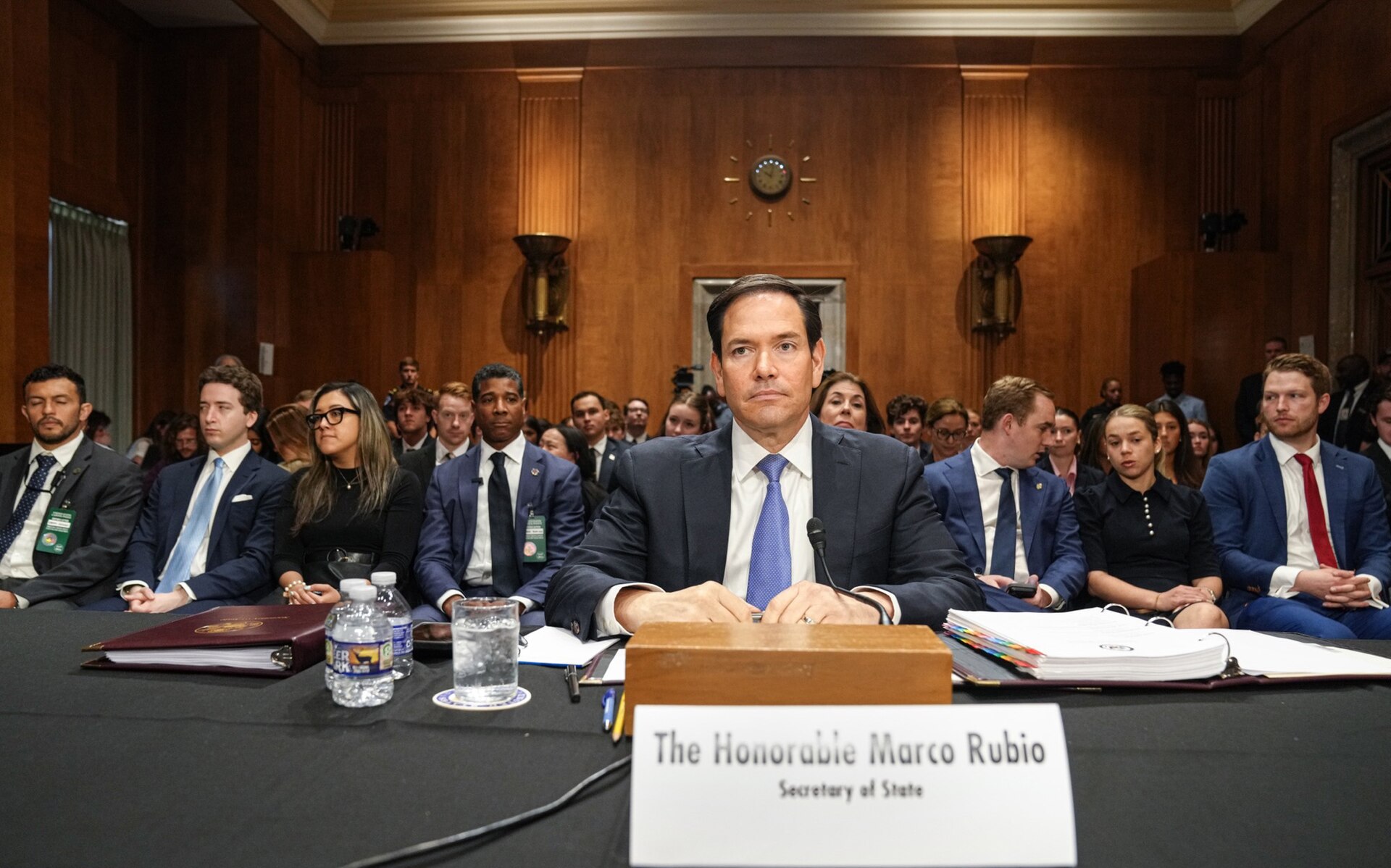
Secretary of State Marco Rubio testified before the Senate Foreign Relations Committee on June 2 — one day before the House vote — in a budget hearing where he confirmed that Iran’s supreme leader’s son Mojtaba Khamenei is “increasingly engaging” through written intermediaries and described a six-to-eight-person mixed IRGC and civilian advisory council handling the nuclear negotiations. The testimony was the first open-session confirmation of the courier architecture underlying US-Iran diplomacy. On June 2, Rubio outlined a phased deal framework that presumes ongoing US military presence in the Gulf as a bargaining instrument. On June 3, 215 House members voted to withdraw that presence.