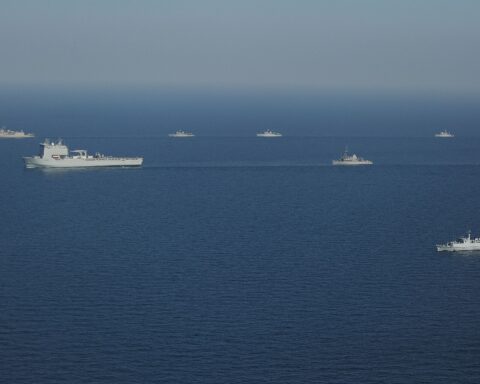
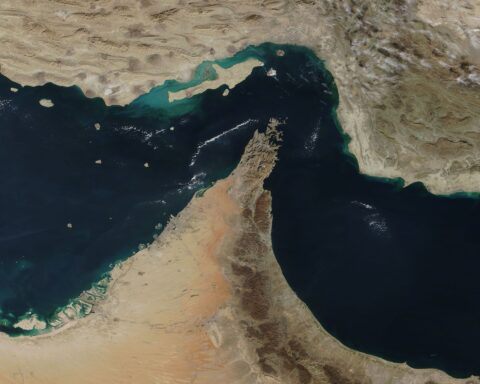
TEHRAN — Iran is conducting two foreign policies simultaneously, and on blockade day, neither authority knows whether the other speaks for the state. Parliament Speaker Mohammad Bagher Ghalibaf returned from Islamabad on April 12 telling Washington to “earn our trust” — a phrase calibrated for diplomats and Iran’s exhausted civilian population. Hours later, the IRGC Navy posted a video of vessels in crosshairs and warned that any military ship approaching the Strait of Hormuz “will be considered a violation of the ceasefire.” At 10AM Eastern on April 13, CENTCOM’s blockade of all Iranian port traffic became operational. The question facing every capital from Riyadh to Washington is not which Iranian message to believe. It is whether anyone inside Iran has the constitutional authority to reconcile them.
The collision is not rhetorical. Ghalibaf commands no military unit. Vahidi, the IRGC Commander-in-Chief since March 1, controls the SNSC through his installed secretary, Mohammad Bagher Zolghadr. The Supreme Leader who could override both has been absent for 43 days. Saudi Arabia — excluded from Islamabad, holding approximately 400 PAC-3 interceptors from a pre-war stockpile of 2,800 — sits nine days from ceasefire expiry with no diplomatic channel to either Iranian authority track.
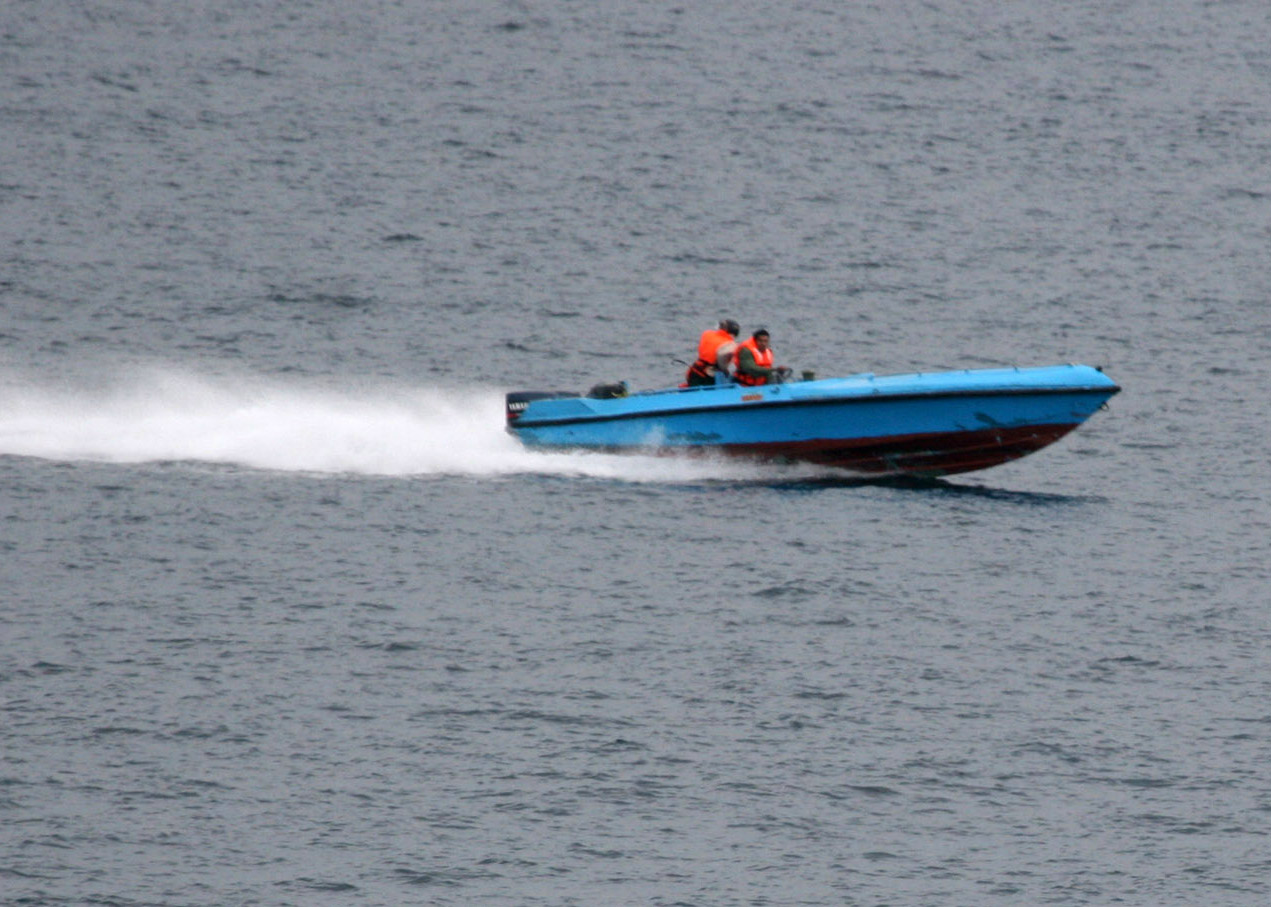
Table of Contents
- “Earn Our Trust” and “Deadly Vortex” — April 12 in Full
- Who Commands What in Iran’s Fractured State
- Why Can’t Iran’s President Override the IRGC?
- Why Can’t Iran’s Military Enforce Its Own Ceasefire?
- What Does the US Blockade Trigger Inside Iran?
- How Exposed Is Saudi Arabia in the Next Nine Days?
- Islamabad’s 21-Hour Collapse
- Ghalibaf’s IRGC Past and Its Limits
- Nine Days to April 22
- Frequently Asked Questions
“Earn Our Trust” and “Deadly Vortex” — April 12 in Full
Ghalibaf’s post-Islamabad statement, carried by AzerNews and Pakistan Today on April 12, was constructed with care. “Before the negotiations, I emphasized that we have goodwill and the necessary will, but due to the experience of the two previous wars, we do not trust the other side,” he said. The framing positioned Iran as a cautious partner burned by past American commitments — an appeal legible to European foreign ministries and to Iranians who remember the JCPOA collapse.
He went further: “America has understood our logic and principles, and now it’s time for it to decide whether it can earn our trust or not.” The phrasing inverted the usual dynamic in which Washington sets conditions. It was also, as a practical matter, addressed to an audience that cannot deliver what Ghalibaf is offering. The operational decisions about Hormuz — the ones that determine whether the ceasefire holds — are not made by Parliament Speakers.
Hours after Ghalibaf’s remarks, the IRGC Navy posted in Persian on X: “The enemy will become trapped in a deadly vortex in the Strait if it makes the wrong move.” The post included video of what appeared to be naval targeting systems tracking vessels. In a separate statement the same day, the IRGC declared that “the approach of military vessels to the Strait of Hormuz will be considered as a violation of the ceasefire.” This constituted an operational redefinition of the ceasefire’s scope — issued without SNSC procedure, without Supreme Leader ratification, and without reference to anything Ghalibaf had said in Islamabad.
The two statements were not contradictory in the way that bureaucratic mixed signals often are. They were addressed to different audiences through different command structures for different purposes. Ghalibaf spoke to the civilian and diplomatic track. The IRGC spoke to CENTCOM and to its own provincial corps commanders. The problem is that only one of these tracks controls the weapons.
The Middle East briefing 3,000+ readers start their day with.
One email. Every weekday morning. Free.
Who Commands What in Iran’s Fractured State
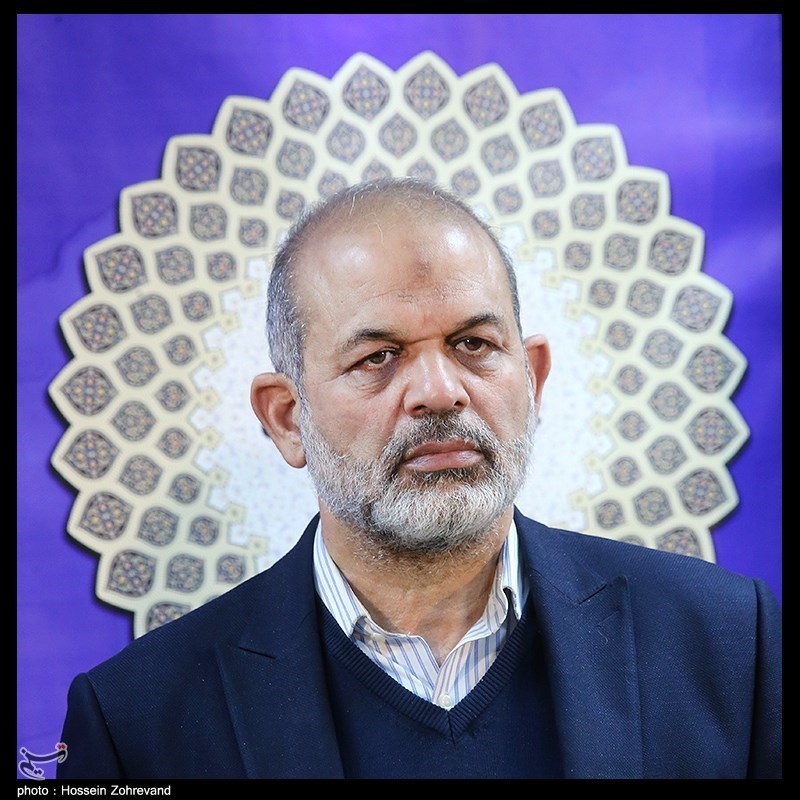
Ahmad Vahidi was appointed IRGC Commander-in-Chief on March 1, 2026, following the killing of his predecessor Hossein Salami in the June 2025 Israeli strikes. His career arc — Quds Force commander 1988–1997, Defense Minister under Ahmadinejad 2009–2013, Interior Minister 2021–2024, and now IRGC chief — traces a path through every coercive institution in the Islamic Republic. He has been wanted by Interpol since 2007 for the 1994 AMIA bombing in Buenos Aires that killed 85 people.
Vahidi’s first institutional move as IRGC commander was to install Zolghadr as SNSC Secretary, displacing the presidential preference. The Foundation for Defense of Democracies assessed on April 6 that “what is taking shape in Iran is no longer an Islamic Republic in its original sense, but a military junta in every respect.” Zolghadr, himself under US and EU sanctions, now controls the body whose decisions become state policy upon Supreme Leader ratification — a ratification that cannot currently occur.
Ghalibaf sits on the SNSC under Article 176 of the Iranian constitution, which grants the Parliament Speaker a standing seat. But the seat is advisory. Ali Akbar Mousavi Khoeini, a former Iranian parliamentarian now at George Mason University, told NBC News: “Vahidi is in charge of the country. Ghalibaf doesn’t have the strength to confront him.” He added: “The power is in the hands of the Revolutionary Guard and the most radical faction of the Revolutionary Guard.”
Beni Sabti of Israel’s INSS assessed for Fox News that Vahidi may be “more influential than other prominent figures in Tehran, including parliamentary speaker Mohammad Bagher Ghalibaf.” Ali Alfoneh of the Arab Gulf States Institute offered a more layered reading to NBC News: “Ghalibaf exhibits a dual posture — pragmatic when engaging pragmatic counterparts and hard-line when confronting hard-line adversaries.” The dual posture is real, but it operates within a structure where pragmatism holds no operational lever.
Why Can’t Iran’s President Override the IRGC?
Iran’s constitution vests SNSC decisions in collective ratification by the Supreme Leader — an authority only the Supreme Leader can grant. The president chairs the SNSC but cannot override it, cannot dismiss the IRGC commander, and cannot issue direct orders to any IRGC unit. With Khamenei absent 43 days, the ratification mechanism is inoperative.
Masoud Pezeshkian tried. On April 4–5, in what two sources described to Ynet and IBTimes as an “unusually difficult and highly charged” confrontation, the Iranian president accused Vahidi and Khatam al-Anbiya Central Headquarters commander Ali Abdollahi of “acting unilaterally and driving escalation through attacks on regional countries” and “destroying any remaining chance of a ceasefire.” He warned of a “huge catastrophe” and imminent economic collapse. The confrontation was the first public acknowledgment of civilian-IRGC friction at the executive level since the war began.
It changed nothing operationally. The Supreme Leader alone holds authority to appoint or dismiss the IRGC commander — and the Supreme Leader is absent.
The Times of London has reported Khamenei “unconscious in Qom.” His son Mojtaba Khamenei has reportedly been relaying decisions, but NBC News cited an insider source stating that “Ghalibaf acts only with approval from Mojtaba Khamenei. Even if talks were to take place, Ghalibaf would not be able to commit Iran without broader approval.” The constitutional mechanism that resolved the last comparable crisis — Khomeini’s 1988 acceptance of UN Resolution 598, overruling IRGC commander Mohsen Rezaei — required a functioning Supreme Leader with uncontested authority. That mechanism is currently offline.
Why Can’t Iran’s Military Enforce Its Own Ceasefire?
The IRGC’s Mosaic Defense doctrine — formalized in 2005, restructured in September 2008 — pre-delegates authority to 31 provincial corps to continue fighting if central command is lost. Each corps is trained to treat the absence of orders as permission to act. A ceasefire requires the opposite: a positive stand-down signal that no functioning authority can currently transmit.
The doctrine was formalized under General Mohammad Ali Jafari and documented by the Jerusalem Institute for Strategy and Security and Business Today India as a survivability measure against decapitation strikes. The design logic — that absence of orders means continuation, not stand-down — made the IRGC more resilient against targeted killing. It has the unintended consequence of making the force structurally resistant to the ceasefire orders it would need to receive from a functioning supreme authority.
The IRGC Navy commander, Alireza Tangsiri, was killed on March 30. No named successor has been announced. The “deadly vortex” statement of April 12 was issued by a command structure that is operationally autonomous at the unit level but headless at the top — a condition the Mosaic doctrine was designed to sustain, not resolve.
Kelly A. Grieco of the Stimson Center assessed that Iran has “effectively established itself as gatekeeper of the strait, representing a fundamentally different status quo than before the conflict.” The gatekeeper is not a person. It is a distributed network of coastal defense units, fast-attack craft squadrons, and mine-laying capabilities whose commanders have standing authorization to act on threats as they perceive them. When the IRGC says the blockade constitutes a ceasefire violation, the statement functions simultaneously as analysis and as operational pre-authorization.
What Does the US Blockade Trigger Inside Iran?
Within the IRGC’s Mosaic command structure, the blockade functions as an automatic trigger: 31 provincial corps have pre-delegated authority to respond to threats as they interpret them, and the IRGC has already classified US military presence near Hormuz as a ceasefire violation. No countermanding order from a functioning central authority exists to override that interpretation.
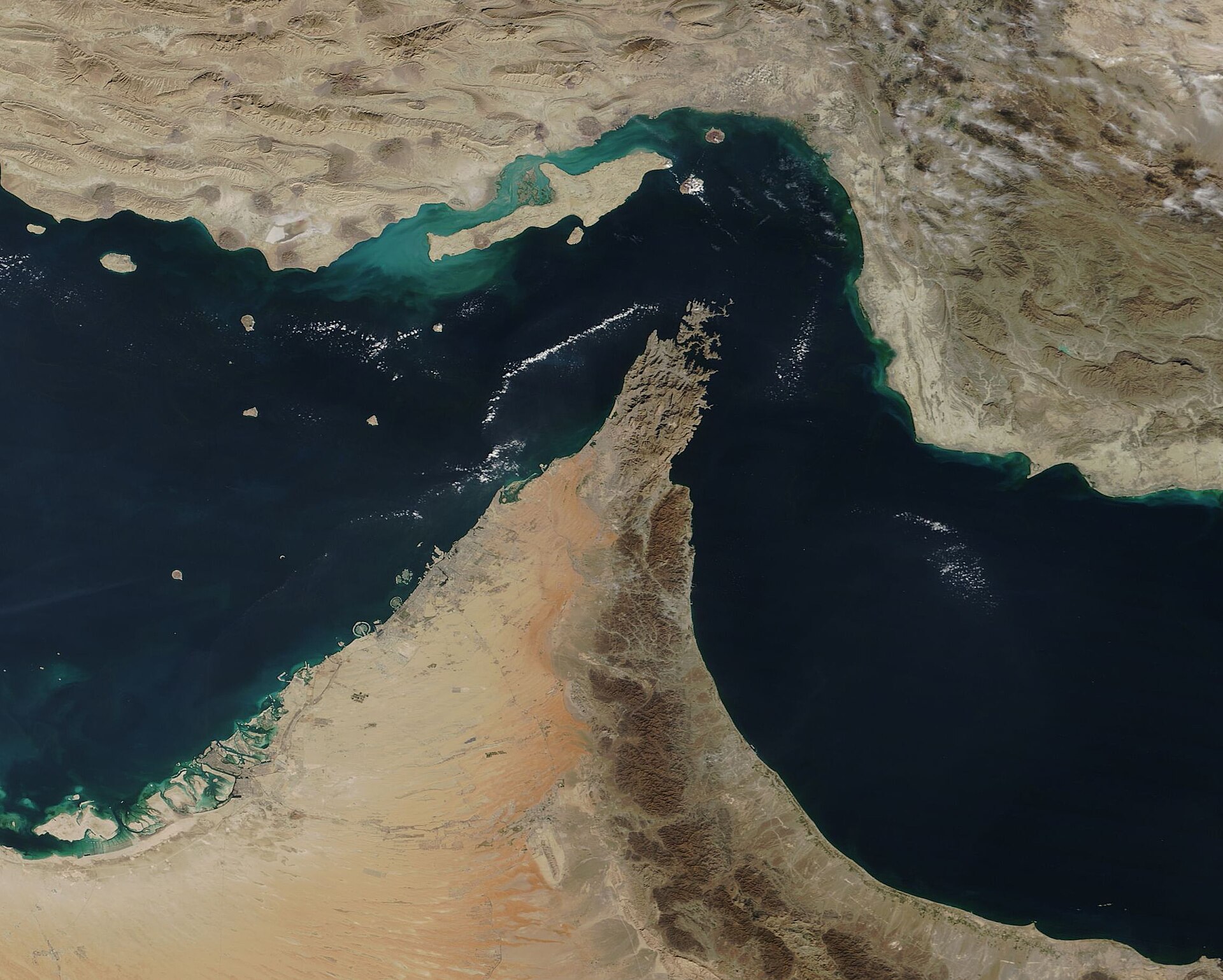
CENTCOM’s blockade, effective April 13 at 10AM ET (14:00 GMT), applies to all maritime traffic entering and exiting Iranian ports. CENTCOM specified one exception: it “will not impede freedom of navigation for vessels transiting Hormuz to and from non-Iranian ports.” The distinction — between Iranian-destined traffic and Hormuz transit traffic — is the load-bearing element. It is also the element the IRGC’s April 12 statement explicitly rejected.
The IRGC declared that any military vessel approaching Hormuz constitutes a ceasefire violation. CENTCOM’s blockade requires military vessels in Hormuz to enforce the restriction on Iranian port traffic. The two positions are geometrically incompatible. A US destroyer enforcing the blockade near the Strait’s Traffic Separation Scheme is, under the IRGC’s declared framework, committing an act that voids the ceasefire. Under CENTCOM’s framework, it is conducting a lawful blockade consistent with existing operations.
The SNSC’s own published text from the April 8 ceasefire announcement stated that “negotiations are continuation of battlefield.” This framing — carried by Iran International and aligned with Vahidi’s institutional posture — treats the ceasefire not as a cessation of hostilities but as a phase of warfare conducted through different means. The IRGC Navy’s prior declaration of “full authority” over the Strait, issued April 5 and April 10, had already established the institutional claim. The blockade gives it operational context.
The 72-hour window after blockade activation is the period of maximum ambiguity. IRGC coastal units in the 31-corps structure must interpret whether the blockade constitutes the “wrong move” referenced in the “deadly vortex” warning. Their interpretation will be shaped not by Ghalibaf’s diplomatic language but by standing operational doctrine and the absence of countermanding orders from a functioning central authority.
| Element | Ghalibaf (Diplomatic Track) | IRGC / Vahidi (Operational Track) |
|---|---|---|
| April 12 message | “Earn our trust” — conditional re-engagement | “Deadly vortex” — pre-authorized threat |
| Target audience | Washington, European FMs, Iranian civilians | CENTCOM, IRGC provincial commanders |
| Operational authority | None — SNSC advisory seat only | 31 provincial corps, IRGC Navy, coastal defense |
| Constitutional basis | Article 176 standing SNSC member | IRGC C-in-C appointment by Supreme Leader |
| Blockade interpretation | Not addressed | “Violation of the ceasefire” |
| Ceasefire framing | Diplomatic opportunity | “Continuation of battlefield” (SNSC text) |
| Requires Supreme Leader ratification | Yes, for any commitment | Yes, but operating on pre-delegated authority |
How Exposed Is Saudi Arabia in the Next Nine Days?
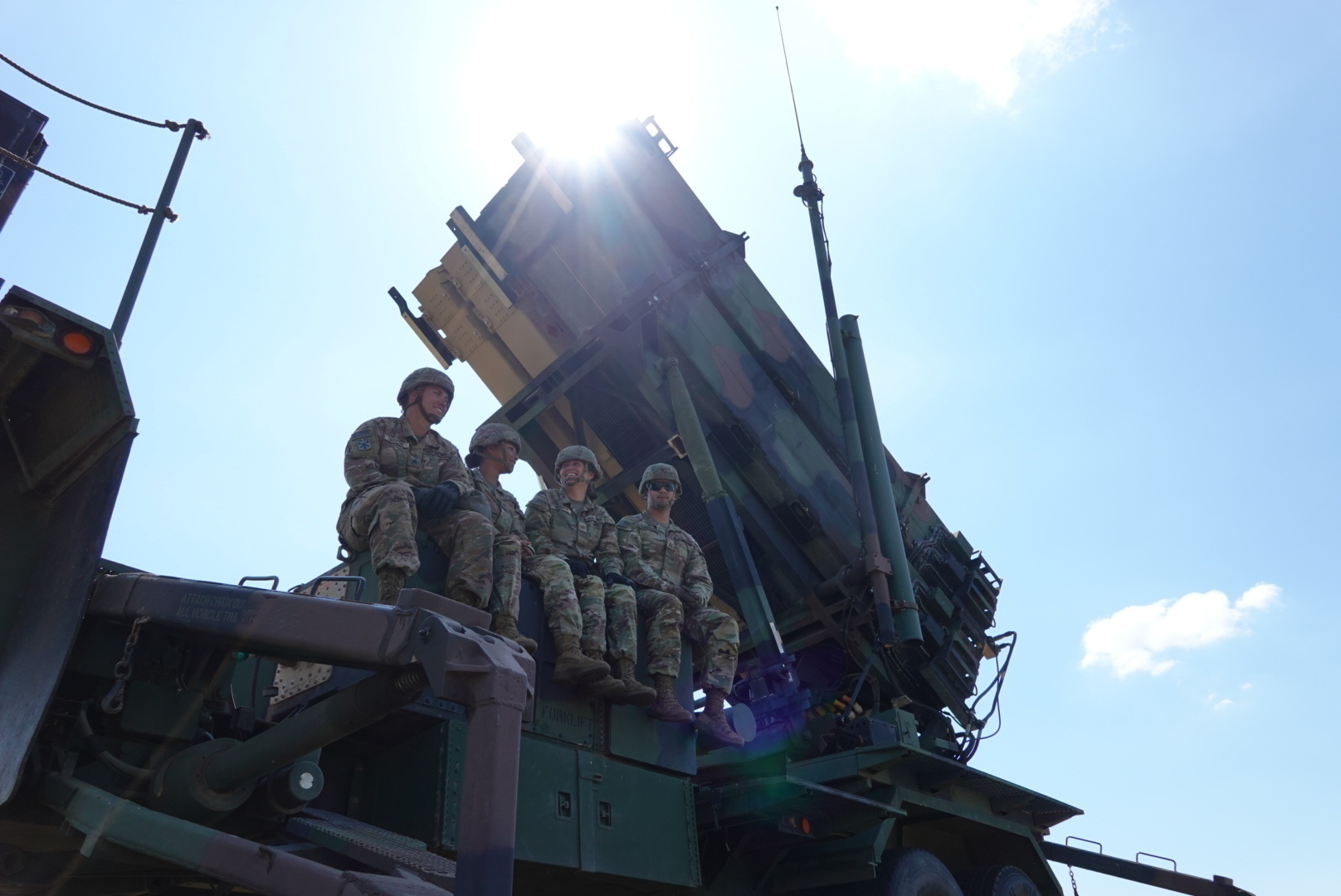
Saudi Arabia holds approximately 400 PAC-3 MSE interceptors from a pre-war stockpile of 2,800, with no rapid resupply available. It was excluded from Islamabad, holds no diplomatic channel to either Iranian authority track, and faces Hajj arrivals beginning April 18 — five days away — with its air defense mathematics already under strain.
By April 7, Saudi air defenses had intercepted 799 drones and 95 ballistic missiles — 894 total — at an implied cost of $3.49 billion in PAC-3 MSE rounds at $3.9 million per interceptor. The pre-war stockpile of approximately 2,800 rounds has been drawn down to roughly 400, a depletion rate of 86 percent. The Camden, Arkansas production line manufactures 620 rounds per year. Poland refused a Patriot battery transfer on March 31. The $16.5 billion emergency US arms package went to the UAE, Kuwait, and Jordan — not to Saudi Arabia.
Pakistan deployed approximately 13,000 troops and more than ten aircraft to Saudi Arabia’s Eastern Province on April 11 under the Saudi-Pakistan Mutual Defense Agreement signed September 17, 2025, according to Pakistani and Gulf media reporting. The deployment provides conventional ground defense but has no enforcement mechanism that reaches IRGC provincial corps commanders. If an IRGC coastal unit in Bushehr or Bandar Abbas decides the blockade violates the ceasefire — a decision that unit is doctrinally empowered to make independently — the Pakistani deployment cannot deter the response. It can only absorb the consequences alongside Saudi forces.
The 400-interceptor figure is not classified. Riyadh knows it. Tehran knows it. The IRGC’s pre-war counter-target list, leaked via Fars News, included eight bridges across four countries and named Ras Tanura — Saudi Arabia’s largest oil export terminal, 65–73 kilometers from Jubail, where SABIC’s petrochemical complex has already been hit by missile debris. The question is not whether Saudi Arabia can defend itself. It is how many more salvos it can absorb before the defense mathematics fail.
Islamabad’s 21-Hour Collapse
The Islamabad talks ran 21 hours before Vice President JD Vance declared them over. His stated reason was precise: “The simple fact is that we need to see an affirmative commitment that they will not seek a nuclear weapon, and they will not seek the tools that would enable them to quickly achieve a nuclear weapon.” Iran, per Fortune and NPR reporting on April 12, refused.
But the nuclear impasse was the stated cause, not the structural one. Vance sat across from Ghalibaf — a man whose constitutional authority to commit Iran is constrained by the same incapacity that makes any ceasefire ratification impossible. Vahidi was not in the room. Zolghadr, his SNSC secretary, was not in the room. The IRGC’s operational redline — that Hormuz sovereignty recognition must precede any phased agreement — was not a negotiating position Ghalibaf could modify.
Ghalibaf brought a 71-member delegation. The delegation’s size suggested seriousness. Its composition suggested constraint. Ghalibaf’s post-Islamabad statement included a line that received less attention than “earn our trust” but may matter more: “We consider every mirror to be another method of authority diplomacy, alongside military struggle, for upholding the rights of the Iranian nation, and we will not for a moment cease our efforts to consolidate the achievements of the forty days of Iran’s national defense.” The phrase “alongside military struggle” concedes the parallel track. Ghalibaf was not claiming to replace the IRGC’s posture. He was claiming to supplement it.
The ceasefire expires April 22. Pakistan, the host and sole enforcement mechanism, has no instrument that compels IRGC compliance. The $5 billion Saudi loan to Pakistan matures in June 2026. Islamabad’s 27th Constitutional Amendment placed ceasefire diplomacy under military coordinator Asim Munir’s authority, not the elected government’s. Every structural incentive pushes Pakistan toward maintaining the appearance of mediation without the capacity for enforcement.
Ghalibaf’s IRGC Past and Its Limits
Ghalibaf commanded the IRGC Aerospace Force from 1997 to 2000, appointed by Khamenei in 1996. He has described himself as “mastermind of the missile cities” — the underground launch network constructed during his tenure. The credential is real. It gives him standing within the IRGC’s institutional culture that a purely civilian politician would lack. Ali Larijani, the former SNSC head killed in the war, had similar hybrid credentials; Ghalibaf “quietly assumed responsibility for strategic decision-making” in the vacuum Larijani left, according to NBC News.
But the assumption of responsibility is informal, uncodified, and contested. Ghalibaf’s last operational IRGC role ended 26 years ago. The force he commanded — the Aerospace Force of the late 1990s — has been restructured twice since then, most recently under the Mosaic doctrine that diffused authority to the 31 provincial commands. His institutional memory of the IRGC is real. His institutional authority over it is not.
The dual posture Alfoneh identified — “pragmatic when engaging pragmatic counterparts and hard-line when confronting hard-line adversaries” — describes a survival strategy, not a power base. Ghalibaf ran for president five times. He lost to Ahmadinejad, withdrew for Raisi, and was defeated in 2024 by Pezeshkian. His route to influence runs through the Parliament speakership and the SNSC seat, both of which are constitutionally subordinate to the bodies Vahidi now controls.
Nine Days to April 22
The ceasefire expires in nine days. Within that window, several clocks are running simultaneously. CENTCOM’s blockade is now operational, creating daily friction points in the Strait where US naval vessels and IRGC coastal units will operate in proximity under incompatible rules of engagement: the IRGC has declared this proximity a ceasefire violation; CENTCOM has declared its operations lawful.
Hajj arrivals begin April 18 — five days from now, four days before ceasefire expiry. Pakistan’s 119,000 pilgrims arrive that day. Indonesia’s 221,000 begin departing April 22, the day the ceasefire ends. Saudi Arabia’s obligations as Custodian of the Two Holy Mosques create a parallel vulnerability: any IRGC escalation during Hajj arrival would force Riyadh to manage a military response and a mass-casualty civilian protection operation simultaneously.
Ghalibaf’s “earn our trust” framing assumes a negotiating partner with the authority to make and keep commitments. The IRGC’s “deadly vortex” framing assumes a military adversary that will interpret the blockade as Vahidi’s command structure interprets it. Neither framing accounts for the other’s existence within the same state.
“The power is in the hands of the Revolutionary Guard and the most radical faction of the Revolutionary Guard.”Ali Akbar Mousavi Khoeini, former Iranian parliamentarian, George Mason University — NBC News
In 1988, Khomeini resolved a similar institutional collision by accepting Resolution 598 over Rezaei’s objections — calling it drinking poison. The mechanism was personal authority: a Supreme Leader whose legitimacy was beyond institutional challenge. Khamenei, even before his incapacitation, lacked Khomeini’s founding-generation authority. He compensated with institutional balancing: empowering the IRGC while maintaining civilian counterweights.
The balancing act required his active presence. Forty-three days of absence have not produced a new equilibrium. The IRGC has used the interval to install its preferred officers in every institution that would normally constrain it.
The IRGC Navy’s April 12 threat was issued from a command whose leader was killed two weeks ago. No successor has been named. The threat was operationally coherent — the Mosaic doctrine ensures that — but institutionally orphaned. It carried the authority of standing doctrine and the weight of deployed weapons, but it was ratified by no constitutional process and countersigned by no identified commander. Ghalibaf, by contrast, holds a constitutional seat on the SNSC and no authority over any armed unit.
Saudi Arabia’s position between these two messages is not a diplomatic challenge. It is an exposure. Four hundred interceptors, no seat at any table, and nine days in which two Iranian governments — one that wants to negotiate and cannot enforce, one that wants to fight and cannot be restrained — will determine whether the ceasefire survives contact with a blockade that both sides have already declared incompatible with peace.
Frequently Asked Questions
Does Ghalibaf have any formal military command authority?
No. Ghalibaf’s last operational military role was commanding the IRGC Aerospace Force from 1997 to 2000. As Parliament Speaker, he holds a standing seat on the Supreme National Security Council under Article 176, but this grants advisory participation, not command authority. His informal assumption of “strategic decision-making” responsibilities after Ali Larijani’s death has no constitutional basis and is actively contested by Vahidi’s control of the SNSC through Secretary Zolghadr. Iran’s 1989 constitutional amendments concentrated military authority in the Supreme Leader, who alone can appoint or dismiss the IRGC commander.
What is the CENTCOM blockade’s legal basis and scope?
CENTCOM’s blockade, effective April 13, targets all maritime traffic entering and exiting Iranian ports while explicitly exempting vessels transiting Hormuz to non-Iranian destinations. The distinction relies on the US position that Hormuz remains an international strait under customary law governing transit passage — a position complicated by the fact that neither the United States nor Iran has ratified UNCLOS. The blockade’s enforcement requires US naval presence in the Strait’s Traffic Separation Scheme, which the IRGC has declared constitutes a ceasefire violation. Historical precedent for such maritime blockades during active ceasefires is thin; the closest analogue is the 1962 Cuban quarantine, which operated outside a ceasefire framework entirely.
How many PAC-3 rounds can the US resupply to Saudi Arabia before April 22?
Effectively none on the nine-day timeline remaining. Even an emergency government-to-government transfer requires end-user certification, TRANSCOM airlift scheduling, and — for any transfer from committed theater stockpiles — National Security Council authorization. The PAC-3 MSE and the older PAC-3 CRI variant are not interchangeable at the battery level without reconfiguration, adding a further logistical constraint. Saudi Arabia’s only near-term option for additional upper-tier coverage is the THAAD battery the US Army deployed to Prince Sultan Air Base in 2019, which uses a separate interceptor supply chain — but THAAD is optimized for longer-range ballistic threats, not the mixed drone-and-missile salvos that have characterized IRGC strikes since March.
Could Mojtaba Khamenei legally exercise Supreme Leader authority?
Not under the current constitutional framework. Article 111 of Iran’s constitution provides that if the Supreme Leader becomes incapacitated, a three-member council — comprising the president, the head of the judiciary, and a jurist from the Guardian Council — temporarily assumes his duties until the Assembly of Experts selects a successor. Mojtaba Khamenei holds no constitutional office. His reported role relaying decisions operates entirely outside formal channels, and NBC News sources indicated that even Ghalibaf requires Mojtaba’s approval to act — an arrangement that inverts the constitutional hierarchy and has no enforcement mechanism if Vahidi simply ignores it.
Has Iran ever operated two contradictory foreign policies simultaneously before?
The closest precedent is the 1986–1988 period when Prime Minister Mir-Hossein Mousavi pursued diplomatic channels to end the Iran-Iraq War while IRGC commanders expanded offensive operations in Iraqi Kurdistan. Khomeini resolved the contradiction by siding first with the IRGC (1986–1987) and then abruptly overruling them to accept Resolution 598 (July 1988). The current situation differs in a structural respect: in 1988, both tracks acknowledged a single supreme authority capable of choosing between them. In April 2026, that authority has been absent for 43 days, and Vahidi’s IRGC has filled the institutional vacuum by installing its preferred officers — Zolghadr as SNSC Secretary being the clearest example — in every body that would normally serve as a check.