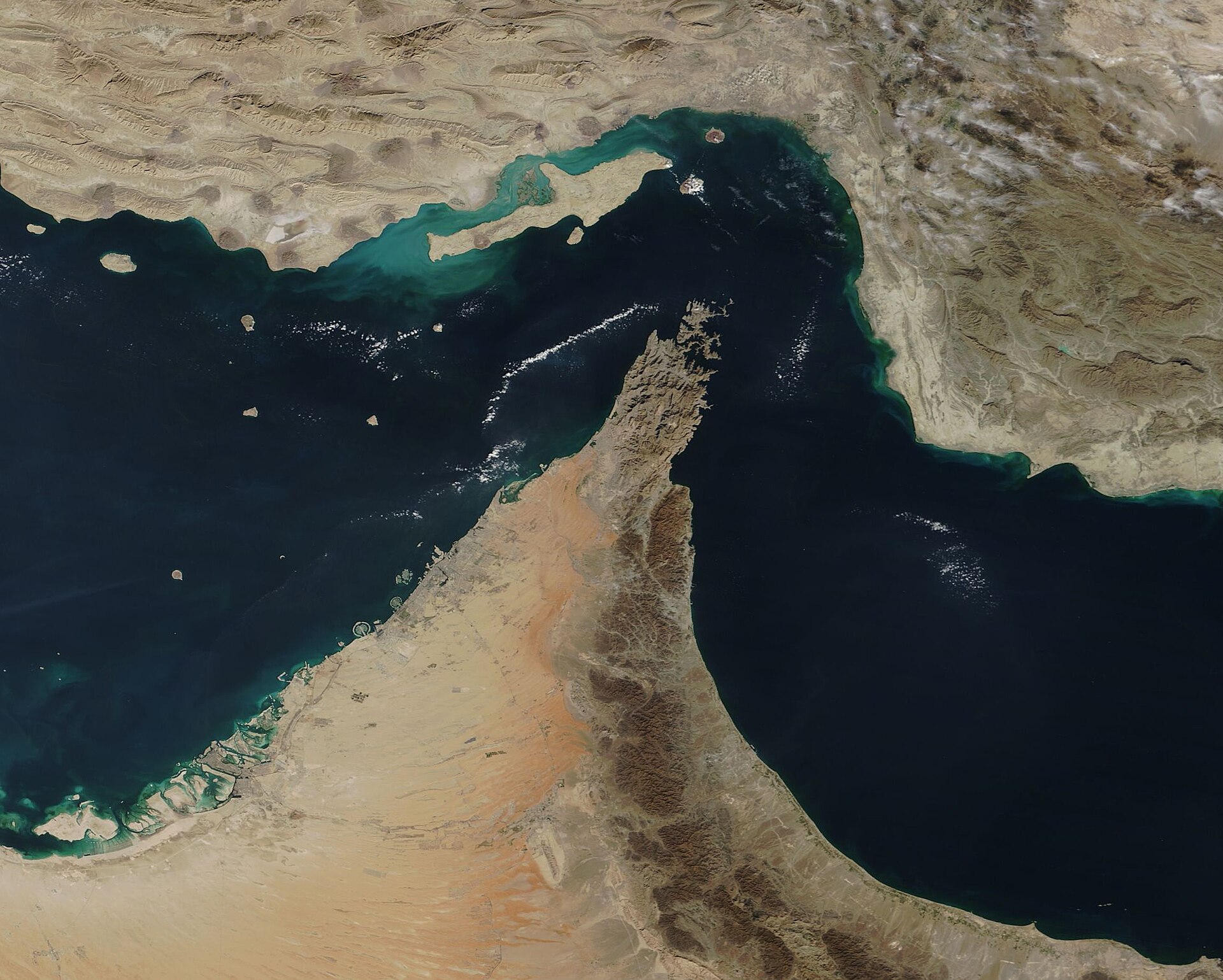
TEHRAN — The IRGC Navy warned on April 12 that any military vessel attempting to pass through the Strait of Hormuz “will face a harsh confrontation” — hours after President Trump declared a full US naval blockade of the waterway and Vice President Vance left Islamabad without a deal. The threat was issued anonymously, in the name of “IRGC Navy Command,” because the force has no confirmed commander: Commodore Alireza Tangsiri was struck on March 26, died of injuries on March 30, and no verified replacement has been named in the 13 days since.
The statement lands in a constitutional void that neither Washington nor Riyadh can read from the outside. Article 176 of Iran’s constitution requires Supreme Leader Khamenei to ratify every Supreme National Security Council decision, and Article 110 vests sole war-and-peace authority in Khamenei personally — but Khamenei has not been seen in public for 39 days, with the Times of London reporting a memo describing him as “unconscious in Qom.” The IRGC’s 2008 mosaic-corps restructuring, which created 31 autonomous provincial commands and five independent naval regional commands, means individual commanders may hold pre-delegated authority to fire without waiting for orders from above. The US Navy cannot operationally distinguish a constrained bluff from an autonomous shoot decision until a weapon is already in the air.
Table of Contents
Trump’s Blockade and the IRGC Response
Trump’s Truth Social post on April 12 left no room for interpretation: “Effective immediately, the United States Navy, the Finest in the World, will begin the process of BLOCKADING any and all Ships trying to enter, or leave, the Strait of Hormuz.” He added that the Navy would “seek and interdict every vessel in International Waters that has paid a toll to Iran” and that “any Iranian who fires at us, or at peaceful vessels, will be BLOWN TO HELL.” The declaration came hours after Vance departed Islamabad following 21 hours of talks that collapsed over two non-starters: the US demand that Iran commit to never developing nuclear weapons, and Iran’s insistence on retaining sovereign control over Hormuz.
The IRGC Navy’s response was immediate but structurally strange. The force claimed “full authority” over Hormuz and stated that “only civilian vessels will be permitted to pass under special regulations” — language that frames the US blockade as a ceasefire violation and positions the IRGC as the strait’s legitimate governing authority. But the statement was issued under the generic byline “IRGC Navy Command” with no individually named commander attached. The only named official in surrounding Iranian coverage was Lt. Col. Ebrahim Zolfaqari, spokesperson for Khatam al-Anbiya Central Headquarters — a different command entity entirely from the IRGC Navy.
CENTCOM Admiral Brad Cooper struck a different tone: “Today, we began the process of establishing a new passage and we will share this safe pathway with the maritime industry soon to encourage the free flow of commerce.” Cooper’s framing — mine clearance, safe passage corridors, commercial facilitation — is the language of maritime policing. The IRGC’s framing — sovereign authority, harsh confrontation, ceasefire violation — is the language of territorial defense. These two frameworks cannot coexist in the same 30-mile-wide waterway, and the mine-clearance operation CENTCOM launched the same day will force the question within days. For a detailed account of what the naval blockade actually squeezes — including Kharg Island’s 94% share of Iranian exports and the $139 million daily revenue the blockade targets — see House of Saud’s April 13 breaking coverage.
Who Commands the IRGC Navy Right Now?
The honest answer is that nobody outside Iran’s security establishment knows for certain, and there is evidence that nobody inside it fully knows either. Commodore Alireza Tangsiri, who commanded the IRGC Navy since 2018 and was the force’s public face during years of Gulf confrontations, was struck on March 26 and died of injuries on March 30. Intelligence chief Behnam Rezaei was killed in the same attack — a double decapitation of the force’s top operational and intelligence leadership in a single event. The Wikipedia page for the IRGC Navy, which Iranian editors actively maintain, lists the commander position as “Vacant” as of April 12.
The Middle East briefing 3,000+ readers start their day with.
One email. Every weekday morning. Free.
Radio Farda reported that Khamenei issued an appointment order for a successor, but no named individual has been independently confirmed by any second source. This is unusual — IRGC command appointments are normally announced through IRIB state media with the appointee’s name, rank, and a Khamenei decree citation. The absence of a named commander 13 days after Tangsiri’s death, combined with Khamenei’s 39-day public absence, raises a question that Behnam Ben Taleblu of the Foundation for Defense of Democracies framed bluntly: Iran operates as “a system of men, not a system of laws,” and the men at the top of the IRGC Navy are either dead or unnamed.
The de facto power structure, according to FDD analysis and Iran International reporting, runs through a triumvirate: Ahmad Vahidi, Mohammad Bagher Zolghadr (whom Vahidi installed as SNSC secretary), and Mohsen Reza’i. Vahidi blocked civilian appointments to the SNSC and refused to include missile negotiations in the Islamabad framework. But Vahidi is an IRGC ground forces figure, not a naval commander — his authority over the IRGC Navy’s five regional commands runs through institutional hierarchy, not operational familiarity with the strait’s daily confrontations.
The Mosaic Doctrine and Pre-Delegated Authority
In September 2008, IRGC commander Mohammad Ali Jafari completed the most extensive restructuring of the force since 1985, breaking the IRGC into 31 provincial corps that operate as self-contained military nodes. Each provincial command maintains its own organic weapons stockpiles, independent intelligence cells, and command succession plans spanning three ranks of pre-designated replacements. Deputy Defense Minister Reza Talaeinik confirmed in March 2026 that each command has “named successors who span three ranks, ready to replace them.” The restructuring was Jafari’s direct response to the 2003 Iraq invasion, which demonstrated to Tehran that centralized command structures are fatally vulnerable to the kind of precision decapitation strikes the US had perfected.
The IRGC Navy maintains five independent regional commands within this mosaic framework. Under the doctrine, commanders “no longer require prior approval from Tehran to act” — the entire architecture is designed, as Farzin Nadimi of the Washington Institute wrote in a 2021 assessment, “to be able to continue to function and make decisions somewhat autonomously without the top leadership being there.” Nadimi’s pre-war analysis of the IRGC Navy specifically noted that the force “encourages tactical freelancing” and that aggressive young commanders are “not required to seek permission where the Islamic Republic’s strategy is determined to be clear.”
Nadimi added a critical caveat in that same assessment: “As long as Tangsiri is still alive, I believe they will be able to maintain some cohesion of command.” Tangsiri is dead. Rezaei is dead. The force is operating inside precisely the scenario the mosaic doctrine was designed for — decapitation of senior leadership — using precisely the autonomous authority the doctrine was designed to preserve. The question is whether that autonomous authority extends to opening fire on US Navy warships, which is a categorically different decision from harassing commercial shipping or laying mines.
That distinction — between the IRGC’s operational reach and CENTCOM’s formal destination-based exemptions — is the core of The Blockade Has a Loophole. The IRGC Does Not.: the mosaic doctrine’s autonomous commanders have no doctrine requiring them to honour a legal corridor they did not agree to.
Can the IRGC Fire Without Khamenei?
Constitutionally, no. Operationally, possibly. Article 176 of Iran’s constitution requires that every SNSC decision receive “confirmation by the Supreme Leader” before it carries legal force. Article 110 reserves to the Supreme Leader alone the authority to declare war and peace, supreme command of the armed forces, and the power to appoint or dismiss the IRGC’s commander-in-chief. A shoot order against US Navy vessels — which would constitute an act of war against the world’s dominant naval power — sits at the very apex of decisions that require Khamenei’s personal authorization under Iran’s own constitutional framework.
But Khamenei has not been seen in public for 39 days. The Times of London reported a leaked memo describing him as “unconscious in Qom.” Iranian state media has attributed statements to him — including a written ceasefire directive broadcast on IRIB reading “this is not the end of the war, but all units must ceasefire” — but prior HOS analysis of the ceasefire halt order identified textual markers suggesting IRGC authorship of statements attributed to Khamenei. Media Line analysts flagged errors and triumvirate fingerprints in the language. Every fire order issued by the Vahidi-Zolghadr-Reza’i triumvirate exists in a constitutional grey zone: it carries the institutional weight of the SNSC but lacks the Article 176 confirmation that makes it legally binding under Iran’s own system.
Ben Taleblu’s assessment cuts through the constitutional analysis: President Pezeshkian “clearly does not have the authority to turn on or turn off a major military conflict.” If the elected civilian president cannot control the IRGC, the question of whether a constitutionally absent Supreme Leader can control it from what may be a hospital bed in Qom is not a legal question — it is a physical one. The IRGC triumvirate’s authority is functionally unchecked not because the constitution permits it, but because the only person with constitutional authority to check it may be incapable of doing so.
The April 11 Transit — What Actually Happened
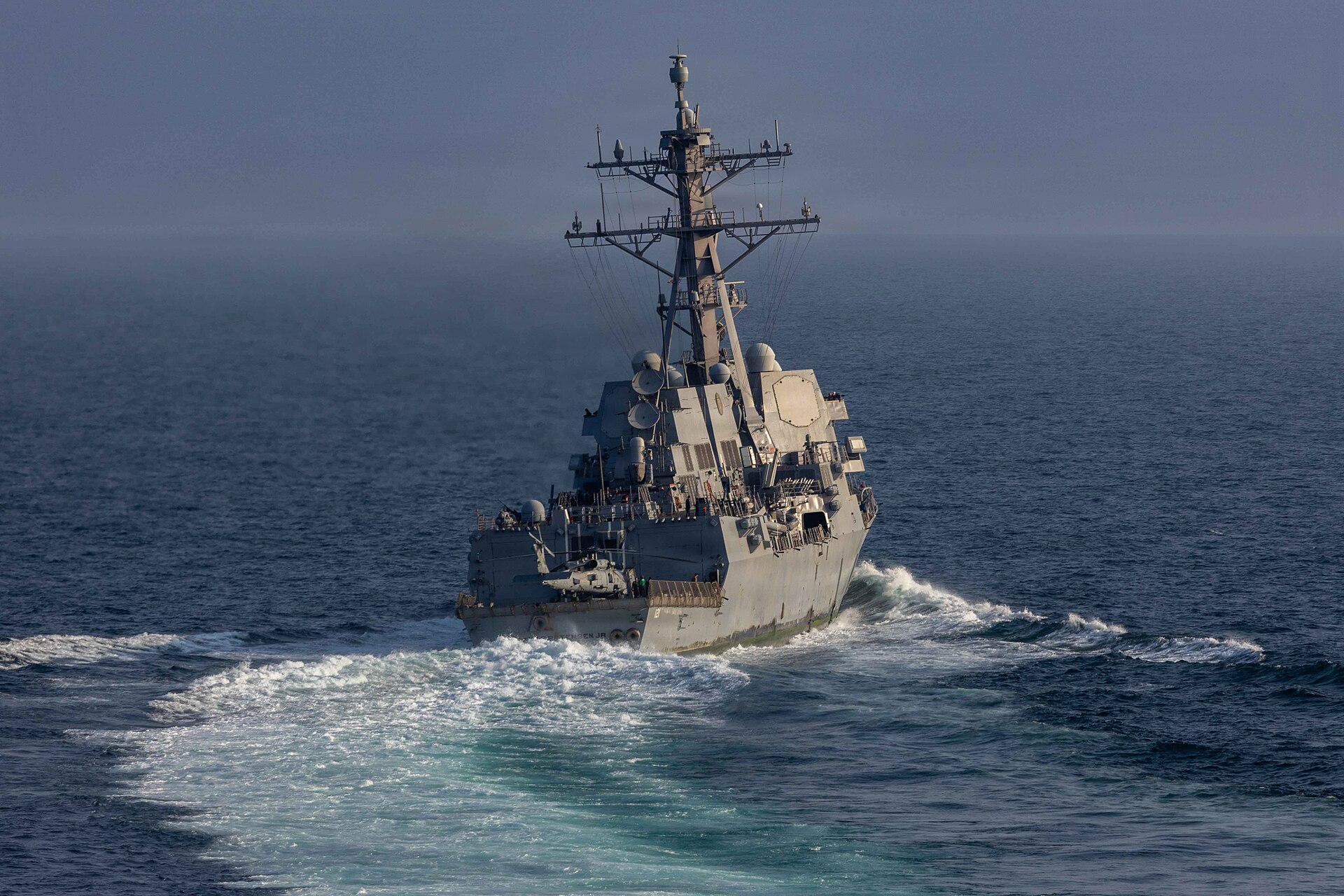
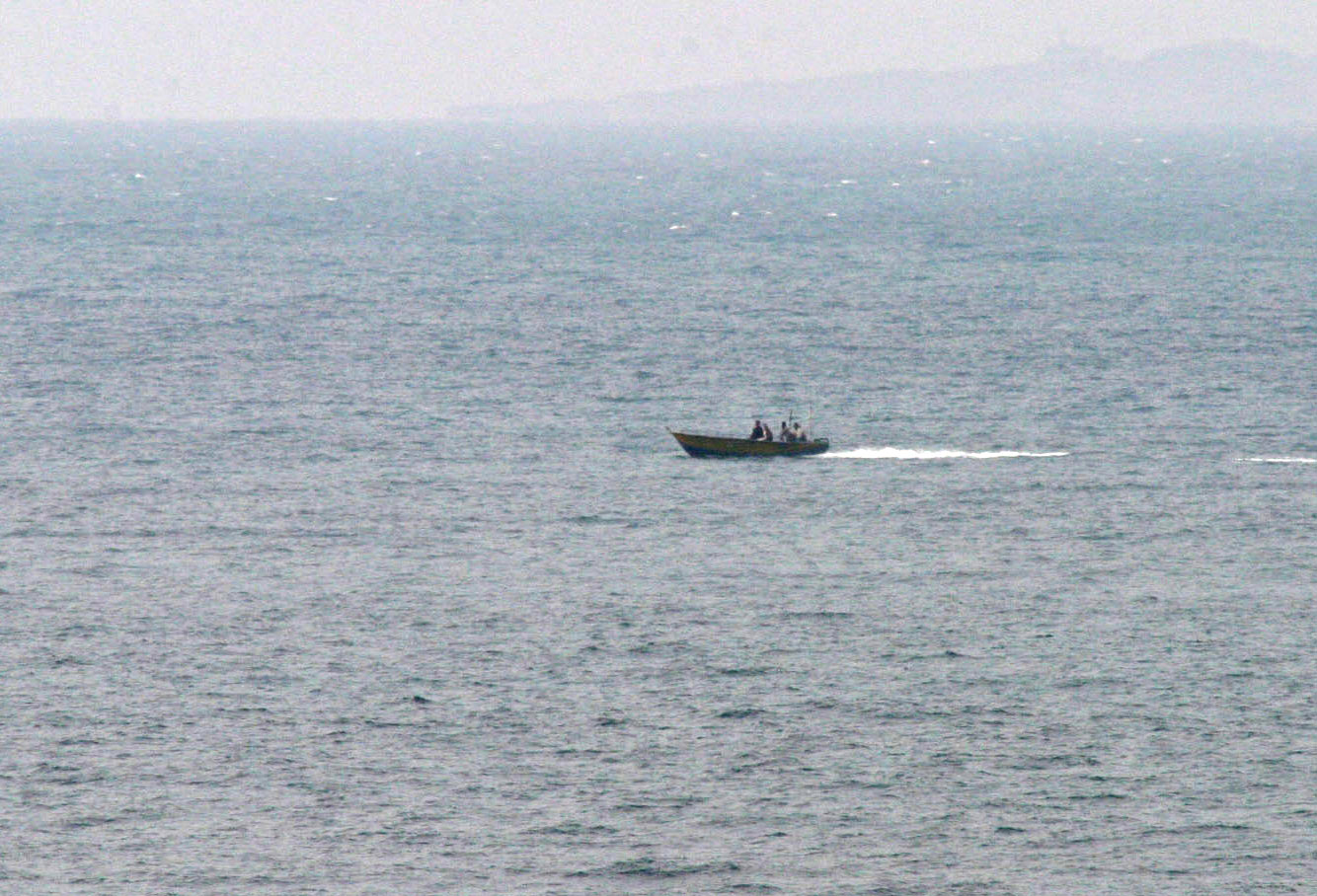
On April 11, USS Frank E. Petersen Jr. (DDG-121) and USS Michael Murphy (DDG-112) conducted a transit through the Strait of Hormuz, and the IRGC Navy issued a radio challenge — “This is the last warning. This is the last warning” — that Fortune first reported. CENTCOM stated both destroyers completed the transit successfully; Bloomberg, citing a regional intelligence source, reported the ships turned back. The two accounts are mutually exclusive, and neither side has provided visual evidence to settle the dispute.
What is not disputed is that no weapons were fired. The IRGC issued a verbal warning — aggressive, escalatory, unprecedented in its “last warning” framing — but did not fire a missile, launch a drone, or deploy a fast boat in an attack profile. This matters because it fits a 40-year pattern: the IRGC Navy has never independently opened fire on a US warship without central authorization. The 36 unsafe incidents logged by the State Department in 2016, the USS Mahan warning-shot confrontation in January 2017 when five boats closed within 900 yards, the USS Firebolt forced course-change in September 2016 when a boat came within 100 yards — all were deliberately sub-lethal, centrally sanctioned coercion designed to harass without crossing the threshold that would trigger a US military response.
The harassment campaign ended sharply after Trump’s April 2020 tweet ordering the Navy to “shoot down and destroy” Iranian gunboats. That the IRGC’s April 11 radio challenge maintained this same pattern — verbal escalation without weapons release — suggests the institutional restraint against firing on US warships may still be functioning, even inside a headless command.
Tehran itself offered an unintentional tell. The Week India reported on April 11 that Iranian officials claimed the Hormuz confrontation directly affected the Islamabad talks — framing the IRGC Navy’s challenge as a deliberate strategic signal timed to influence negotiations, not an autonomous act by a rogue regional commander. If Tehran is telling the truth, the April 11 warning was coordinated with the diplomatic track, which means someone above the IRGC Navy’s regional command level authorized it. If Tehran is lying to project coherence it does not have, the implications are worse.
1988 and the Myth of the Rogue Commander
The closest historical parallel — and the one the US Navy is certainly studying — is the USS Samuel B. Roberts mining on April 14, 1988. Roberts struck a moored contact mine in the central Arabian Gulf; serial numbers matched mines recovered from the Iran Ajr minelayer months earlier. The mining was not a rogue act — IRGC commander Mohsen Reza’i (the same Reza’i who now sits in the ruling triumvirate) initially proposed direct speedboat attacks on US vessels, and Ayatollah Khomeini personally vetoed the proposal and approved the covert mining strategy instead. The most consequential IRGC naval attack in history was a Supreme Leader-approved operation, not tactical freelancing.
Operation Praying Mantis followed four days later. The US Navy destroyed two Iranian oil platforms, sank the frigate Sahand and missile boat Joshan, and damaged the frigate Sabalan — the largest American naval engagement since World War II. The IRGC learned from 1988 that direct confrontation with the US Navy ends in catastrophic loss of Iranian assets, which is why the subsequent four decades of Gulf harassment stayed consistently below the lethal threshold. Every fast-boat provocation, every mine laid, every drone launched at commercial shipping has been calibrated to avoid the specific trigger — fire on a US warship — that would produce another Praying Mantis.
The difference in April 2026 is that the calibration mechanism may be broken. In 1988, Khomeini was alive, lucid, and actively overruling his IRGC commander’s more aggressive proposals — in 2026, Khamenei may be unconscious, and Tangsiri, who Nadimi identified as the key figure maintaining “cohesion of command” within the IRGC Navy, is dead. The five regional naval commanders operating under mosaic doctrine have pre-delegated authority designed for exactly this scenario: senior leadership eliminated, enemy naval forces in the strait, standing orders to defend Iranian sovereignty.
The decision of whether “defend Iranian sovereignty” includes firing on a US destroyer conducting mine clearance is a judgment call that the mosaic doctrine was explicitly designed to push down to regional commanders, not up to a Supreme Leader who may not be conscious to answer the phone. That is the structural trap at the center of the next ten days: the US Navy is entering a waterway governed by a command architecture built to function without the very authorization that international law and Iranian constitutional law both require before a shot is fired.
Background and Context
The Islamabad talks represented the first direct US-Iran engagement since 1979, with Vice President Vance meeting Iranian Parliament Speaker Mohammad Bagher Ghalibaf — himself a former IRGC Aerospace Force commander. The talks collapsed over two issues: Iran’s refusal to commit to nuclear non-proliferation and its demand for sovereign control over Hormuz. Vance’s departure statement was blunt: “They have chosen not to accept our terms.” The ceasefire reached in Islamabad expires April 22, leaving a ten-day window in which a US naval blockade and IRGC “harsh confrontation” threat must coexist with a ceasefire that neither side’s military appears bound to respect.
The IRGC Navy’s posture has escalated in distinct phases. On April 5, it declared “the Strait of Hormuz will never return to its previous status.” On April 10, it announced that “management of Strait of Hormuz has entered new stage” and that foreign hegemony over the waterway was “definitively over.” On April 12, it moved from declaratory to operational language: “harsh confrontation” for military vessels.
Each of these statements was anonymous — issued by “IRGC Navy Command” without an individually named commander — a pattern consistent with either a functioning command structure that chooses anonymity for operational security, or a fragmented structure in which no single individual has sufficient authority to put their name on the order. Saudi Arabia and the broader GCC have no way to determine which from the outside, and the PAC-3 stockpile standing at roughly 400 rounds means the margin for misreading the IRGC’s intentions is measured in interceptors that cannot be replenished until 2028. That structural uncertainty helps explain why Saudi Arabia has not publicly endorsed or opposed the US blockade — committing to either position before the IRGC’s command architecture stabilises would lock Riyadh into a posture it cannot reverse.
Frequently Asked Questions
Has the IRGC Navy ever fired on a US warship?
No. In four decades of Gulf confrontations, the IRGC Navy has never directly opened fire on a US Navy vessel. The 1988 Roberts mining was a covert operation personally approved by Khomeini, not a direct engagement. The fast-boat harassment campaigns of 2015-2019, which peaked at 36 unsafe incidents recorded by the State Department in 2016, were deliberately kept below the lethal threshold — including multiple close approaches to US warships that ended without weapons release on either side.
What is the US Navy’s mine-clearance capacity in the Gulf?
Severely degraded. The four Avenger-class mine countermeasure ships previously based in Bahrain were decommissioned in September 2025. CENTCOM is using destroyers DDG-121 and DDG-112 for the current clearance operation, supplemented by three Littoral Combat Ships deployed in Asia. Using the 1991 Kuwait operation as a benchmark, approximately 200 square miles would need to be swept — a process that took 51 days with dedicated minesweepers, according to a 1991 Kuwait War mine-clearance benchmark — and those assets are no longer in theater.
What happens if the ceasefire expires on April 22 without extension?
The Islamabad Accord contains no extension mechanism, as the Soufan Center has noted. With the talks collapsed, there is no diplomatic framework for renewal. The ten-day window between the blockade declaration and the ceasefire expiry is the period of maximum risk — IRGC regional commanders operating under mosaic doctrine, a headless naval command, a constitutional authorization chain that may terminate at an unconscious Supreme Leader, and US warships conducting mine clearance inside waters the IRGC claims sovereign authority to manage.
Could Iran’s civilian government override an IRGC Navy fire order?
FDD senior fellow Behnam Ben Taleblu assessed that President Pezeshkian “clearly does not have the authority to turn on or turn off a major military conflict.” The IRGC reports to the Supreme Leader, not the president. With Khamenei absent, the Vahidi-Zolghadr-Reza’i triumvirate has effectively severed the IRGC from civilian oversight. Pezeshkian warned in early April that Iran’s economy would “collapse in 3-4 weeks” without a deal, but his warnings have been ignored by the security establishment.
What is Trump’s stated threshold for military action?
Trump’s April 12 Truth Social post set the threshold explicitly: “Any Iranian who fires at us, or at peaceful vessels, will be BLOWN TO HELL.” This is a fire-for-fire rule — the US will respond to Iranian fire but has not declared it will fire first. The ambiguity lies in what constitutes “fire”: a missile launch is unambiguous, but whether mine-laying, fast-boat swarming at close range, or radar-lock without launch would trigger the threshold has not been publicly defined. CENTCOM has not released rules of engagement for the blockade.