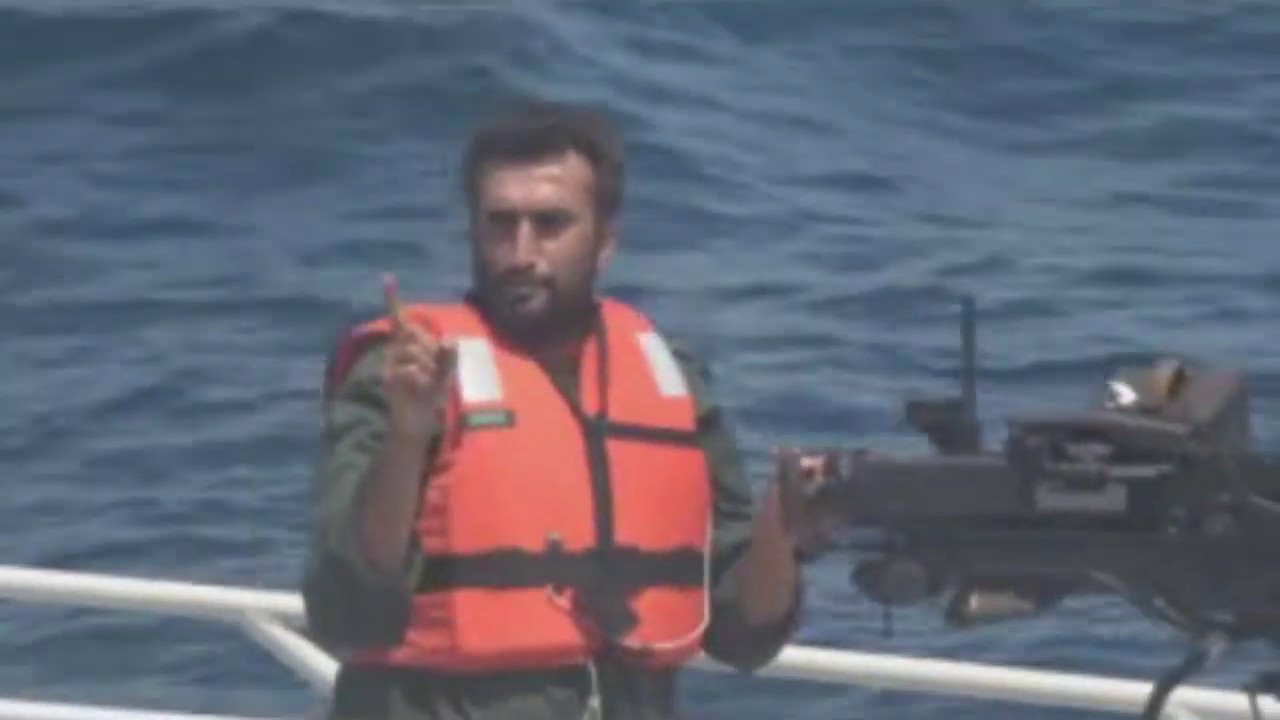
TEHRAN — On April 18, the captain of the Indian-flagged tanker Sanmar Herald did something no maritime officer had done in the forty-year history of Strait of Hormuz confrontations: he broadcast, on open Channel 16, that the Iranian military force firing on his ship was the same Iranian military force that had cleared him to transit. “Sepah Navy! You gave me clearance to go. My name second on your list. You are firing now!”
The 30-second audio clip, shared by the maritime intelligence firm TankerTrackers, is not evidence of Iranian aggression — every navy in the region has fired warning shots at tankers since March. It is evidence of something more dangerous: that the entity administering Hormuz transit clearances and the entity pulling triggers on Hormuz patrol boats are operating on separate command loops, inside the same institution, with no single officer bridging the gap.
That is not a policy disagreement between factions. That is a sovereignty architecture in which no Iranian official — not Foreign Minister Abbas Araghchi, not President Masoud Pezeshkian, not any ceasefire negotiator in any capital — can guarantee that a clearance, once granted, will be honoured by the unit holding the weapon.
Table of Contents
- What the Sanmar Herald Audio Actually Proves
- Two Clearance Bureaucracies, One Strait
- Why Did the Gunboats Skip the Radio Challenge?
- The Missing Keystone
- How Does Mosaic Defense Disable Ceasefire Compliance?
- Who Actually Controls the Strait of Hormuz Right Now?
- The April 18 Pattern
- Can Any Ceasefire Deal Survive This Command Gap?
- What Is an IRGC Clearance Worth?
- Frequently Asked Questions
What the Sanmar Herald Audio Actually Proves
The audio is unambiguous, and the word the captain chose matters. He said “Sepah Navy” — the common Persian shorthand for the IRGC’s naval forces, Sepah-e Pasdaran — meaning he was simultaneously addressing and accusing the same institutional actor. Not the regular Iranian Navy, which operates under the conventional military chain. Not a rogue militia. The IRGC Navy cleared his vessel, and the IRGC Navy fired on it, and both actions were performed under the same institutional banner by units that demonstrably did not share a decision loop.
The phrase “my name second on your list” carries its own weight. It indicates the Sanmar Herald had been formally logged on an IRGC-administered transit approval registry — a pre-clearance system that, according to Lloyd’s List, requires vessels to submit crew manifests and cargo details to IRGC-connected intermediaries in advance. This was not an informal verbal assurance relayed through a foreign ministry tweet. The captain had done the paperwork, received the stamp, and was second in a sequenced queue when live rounds started landing around his ship.
The gap between that clearance and the firing is where the real story sits. If one IRGC unit grants transit approval through an administrative registry and a different IRGC unit — operating under its own standing orders, with its own weapons, on its own patrol route — opens fire without consulting that registry, the problem is not miscommunication. The problem is architectural. Two parallel operational loops exist inside the same institution, and no mechanism synchronises them in real time.
The Middle East briefing 3,000+ readers start their day with.
One email. Every weekday morning. Free.
Two Clearance Bureaucracies, One Strait
The day before the Sanmar Herald was fired on, two separate Iranian institutions simultaneously claimed authority over Hormuz transit — and neither was binding on the other. Araghchi announced on April 17 that passage for all commercial vessels was “declared completely open for the remaining period of ceasefire, on the coordinated route as already announced by Ports and Maritime Organisation of the Islamic Republic of Iran,” according to PressTV and Al Jazeera.
The PMO is a civilian ministry body. It has staff, port offices, and bureaucratic procedures. It does not have gunboats.
On the same day, the IRGC’s own “new order” mandated that all transit authorisations must come from “the IRGC’s naval forces,” according to Iran International. These are distinct bureaucratic chains with distinct command structures issuing overlapping and contradictory guidance on the same waterway. The PMO channel carried the Foreign Minister’s political authority. The IRGC channel carried the patrol boats and the ammunition. When the two channels disagreed — as they did within hours of Araghchi’s tweet — the one with the weapons won.
An unnamed Supreme National Security Council source told Iran International on April 17-18 that Araghchi’s tweet had omitted three conditions the SNSC had actually set: vessels must be commercial only, must have no links to hostile countries, and must follow a designated route under Iranian force coordination. Araghchi’s declaration of “completely open” passage did not match the SNSC’s own parameters, which meant the Foreign Minister’s public assurance was, at the institutional level, already inoperative before the Sanmar Herald entered the strait. The IRGC was not overriding a standing order — it was enforcing conditions that Araghchi had publicly omitted.
Tasnim News Agency, the IRGC-aligned outlet, made the hierarchy explicit by calling Araghchi’s tweet a “bad and incomplete tweet that created misleading ambiguity about the reopening of the Strait of Hormuz” and describing it as “complete poor judgment in communication.” When your own side’s media apparatus calls the Foreign Minister’s public statement misleading, the audience isn’t foreign governments — it’s every IRGC patrol boat commander who might have been confused about whether the tweet outranked their standing orders.
Why Did the Gunboats Skip the Radio Challenge?
The UKMTO advisory on the Sanmar Herald incident used a phrase that carries precise operational meaning: the vessel was “approached by 2 IRGC gunboats, with no VHF challenge, and then fired upon.” Standard maritime rules of engagement — the rules every navy follows, including Iran’s, including during the 1980s tanker war — require a radio challenge before escalation to force. You hail the vessel, you identify yourself, you state your intent, you give the vessel time to comply or explain. The IRGC patrol boats skipped every step of this sequence and went directly to firing, which is consistent with a unit operating under pre-delegated standing orders that superseded the administrative clearance already on record.
This is the detail that separates the Sanmar Herald incident from a conventional naval confrontation. If the gunboat crews had challenged the tanker on VHF and then fired after receiving an unsatisfactory answer, the incident could be read as a deliberate IRGC decision to revoke clearance in real time — aggressive, but coherent. The absence of any VHF challenge suggests the patrol unit was not checking clearances at all. It was operating under a separate instruction set — one that treated all vessels in the area as potential targets regardless of what the administrative registry said.
Control Risks, the security consultancy, had warned before April 18 that even IRGC-issued clearance “provides no automatic guarantee” of safe passage because “individual units in Iran’s IRGC could delay transit or even seize vessels,” according to Lloyd’s List. The Sanmar Herald incident is the first publicly documented case where that prediction was validated by live fire. The clearance existed, the ship was on the list, and the guns fired anyway.
The Missing Keystone
The officer who designed the IRGC’s Hormuz transit protocol — the system of registries, designated routes, and coordination requirements — was Rear Admiral Alireza Tangsiri, the IRGC Navy commander killed in an Israeli strike at Bandar Abbas on March 30. As of April 18, he had been dead for 19 days with no publicly named successor, a command vacuum that Brigadier General Majid Mousavi of the IRGC Aerospace Force inadvertently underscored by honouring Tangsiri as “the architect of the new order in the Strait of Hormuz” in a PressTV interview on the same day the Sanmar Herald was fired upon.
Tangsiri’s role matters because he was the single named officer who held institutional memory of how the clearance-and-transit protocol was supposed to operate — who had designed the registry, who knew which units had access to it, who could adjudicate disputes between the administrative clearance function and the tactical patrol function. With no named successor, those two functions have no single human bridge.
The registry continues to operate, because bureaucracies generate paperwork whether or not anyone reads it. The patrol boats continue to operate, because the IRGC Navy declared “full authority to manage the Strait” on April 5 and again on April 10 under anonymous institutional authority. But the system that connected them — Tangsiri’s system — has no one running it.
Saeid Golkar, an Iran expert at the University of Tennessee Chattanooga, told Fortune on April 18 that “because the main arbitrator is gone, the fight between different factions has started,” adding that “the more extreme group in the IRGC are taking charge” and that “that makes the prolongation of the conflict more likely.” The arbitrator Golkar described was not just a political mediator — he was the operational bridge between the desk that grants clearances and the boat that carries the gun, and that bridge is now unmanned.
How Does Mosaic Defense Disable Ceasefire Compliance?
The IRGC restructured in 2008 into 31 provincial commands with pre-delegated operational autonomy — a doctrine designed explicitly to survive decapitation strikes by ensuring that no single command node’s destruction could paralyse the wider force. Each provincial command holds its own weapons, intelligence assets, and communications infrastructure, and each operates under pre-issued general instructions that allow it to act without waiting for central authorisation. The February 2026 “Smart Control of the Strait of Hormuz” exercise specifically tested this decentralised naval architecture, according to the Soufan Center.
Araghchi himself described the consequence of this structure in language that, in retrospect, reads as a forecast of the Sanmar Herald incident. “Our military units are now, in fact, independent and somewhat isolated, and they are acting based on general instructions given to them in advance,” he told interviewers, a statement cited in the Soufan Center’s IntelBrief of March 9, 2026. That sentence is the most honest description any Iranian official has offered of why a clearance granted by one IRGC desk cannot bind a patrol boat operating under a different IRGC command’s pre-delegated authority.
The doctrine was built for war. It works in war — decentralised commands are harder to destroy, harder to paralyse, harder to decapitate. But the same structural feature that makes the IRGC survivable in conflict makes it structurally incapable of complying with a ceasefire in a coordinated way.
A centralised military can receive a ceasefire order from its political leadership and transmit it down the chain within hours. The IRGC’s mosaic structure means the order has to reach 31 independent commands operating under pre-issued instructions that may or may not reflect the new political reality. In a command environment where the Supreme Leader is inaccessible to civilian officials and the IRGC Navy has no named commander, there is no mechanism to verify that the update has reached every unit.
Who Actually Controls the Strait of Hormuz Right Now?
The answer, as of April 19, is that no single Iranian authority controls the Strait of Hormuz in any operationally meaningful sense. Araghchi claims it on behalf of the Foreign Ministry. The PMO administers a civilian clearance process. The IRGC Navy claims “full authority” through institutional declarations issued without a named commanding officer. The SNSC sets conditions that the Foreign Minister publicly omits. And the patrol boats on the water operate under pre-delegated standing orders that may or may not reflect any of the above.
The alleged IRGC Navy radio transmission from the night of April 17-18 crystallised this fragmentation in a single sentence: “We will open it by the order of our leader, not by the tweets of some idiot,” according to HotAir and Israel National News, which described the transmission as unconfirmed but consistent with known IRGC radio traffic patterns. The “leader” reference invokes Mojtaba Khamenei — Ali Khamenei’s successor, who according to Fortune’s April 8 reporting has remained in a concealed location accessible only to senior IRGC commanders for 44+ days. Pezeshkian and Araghchi have no direct access. The civilian government cannot reach the one person whose authority the IRGC recognises, and the IRGC will not accept authority from anyone else. That transmission was not an isolated incident — a full analysis of what the IRGC’s Channel 16 broadcast means for the Islamabad framework and Iran’s authorization ceiling is here.
Gregory Brew of the Eurasia Group offered a more cautious reading, characterising the public disagreements as “evidence of miscommunication, not serious divisions,” according to Fortune on April 18. But miscommunication between the unit granting clearance and the unit holding the trigger produces the same outcome as a deliberate override — a tanker captain broadcasting on Channel 16 that he’s being fired on by the force that cleared him. Whether the gunboat crew was defying orders or simply never received them, the ship still took fire, and the distinction between structural incoherence and deliberate escalation is of limited comfort to the next captain entering the strait.
| Authority | Claimed Jurisdiction | Binding on IRGC Patrol Boats? |
|---|---|---|
| Foreign Minister Araghchi (April 17 tweet) | “Completely open” via PMO-coordinated route | No — PMO is civilian; IRGC patrol units do not report to FM |
| Ports and Maritime Organisation (PMO) | Civilian clearance, designated shipping lanes | No — PMO has no operational authority over IRGC Navy |
| IRGC Navy “new order” (April 17) | All authorisations must come from IRGC naval forces | Claimed yes — but no named commander to enforce consistency |
| SNSC (unnamed source, April 17-18) | Three conditions Araghchi omitted: commercial only, no hostile links, IRGC-designated route | Theoretically — but SNSC conditions were not publicly broadcast to patrol units |
| IRGC patrol boat units (April 18) | Fired on cleared vessels with no VHF challenge | Operationally self-authorising under pre-delegated mosaic doctrine |
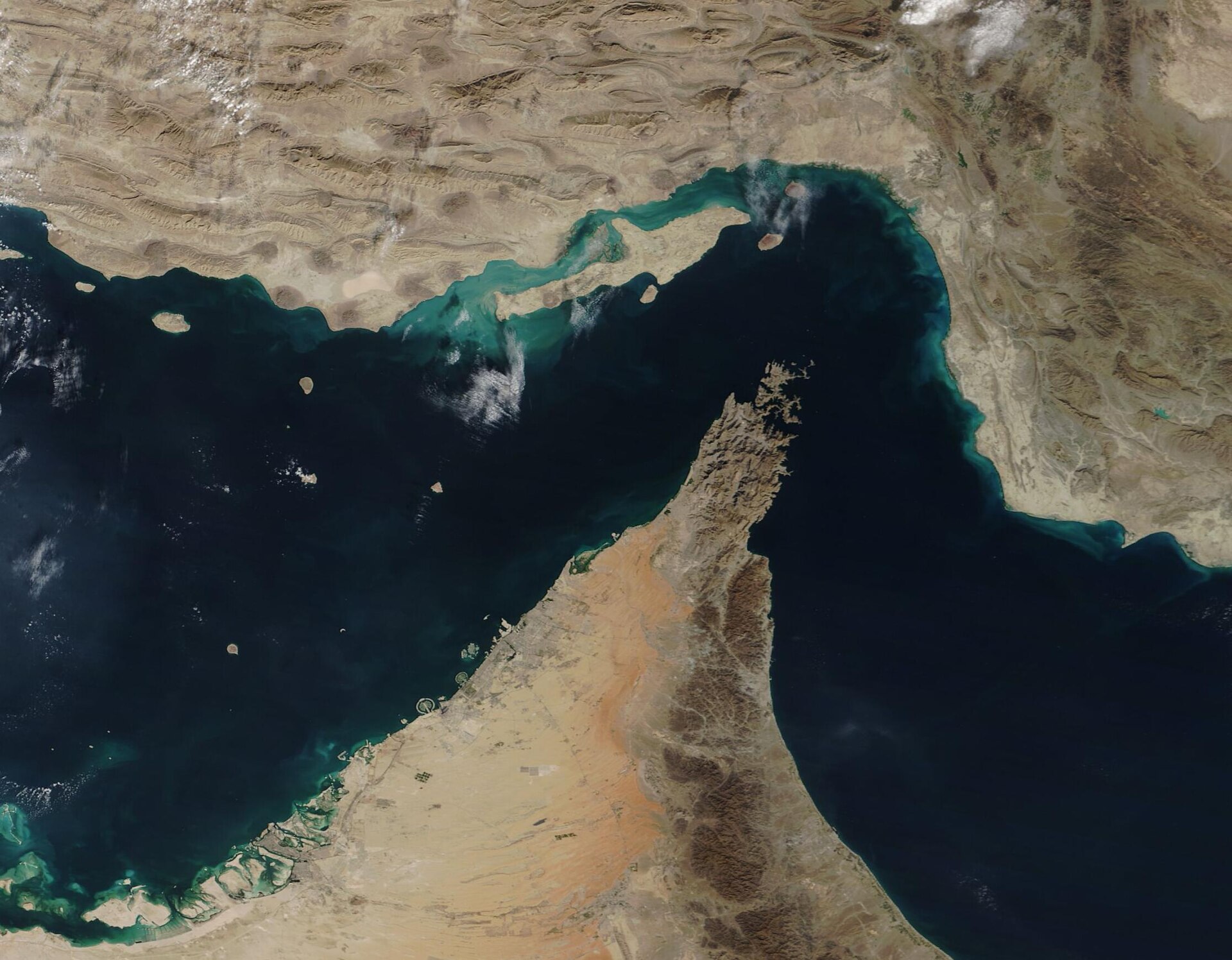
Five distinct Iranian authorities claimed jurisdiction over the same 21-nautical-mile waterway on the same day, and none had the operational capacity to override or even communicate with the others in real time. The Sanmar Herald’s captain addressed his distress call to “Sepah Navy” because that was the name on both the clearance and the gunfire — but the entity behind each was functionally different, connected by institutional branding rather than operational command.
The April 18 Pattern
The Sanmar Herald was not alone. On the same morning, the Indian-flagged bulk carrier Jag Arnav — operated by Great Eastern Shipping Company, loaded at Al Jubail in Saudi Arabia, carrying non-oil cargo — was also fired upon in the strait. Four additional Indian-flagged vessels were turned back. A separate container ship approximately 25 nautical miles northeast of Oman was struck by an unidentified projectile, confirmed by UKMTO as a distinct incident. And yet the Indian-flagged Desh Garima, operated by the Shipping Corporation of India, transited successfully as the 10th India-flagged vessel to cross since early March, according to the Deccan Chronicle.
The selective pattern — one ship cleared, two fired upon, four turned back, all on the same day, all Indian-flagged — is itself evidence of the command fragmentation. A coherent enforcement regime either blocks all vessels or clears all vessels meeting its criteria. The April 18 pattern is consistent with different patrol units applying different instructions in the same waterway at the same time, which is exactly what mosaic defense doctrine predicts under decentralised operations without a central coordinator. India’s Foreign Secretary Vikram Misri conveyed “deep concern at the shooting incident earlier today involving two Indian-flagged ships in the Strait of Hormuz” and urged Iran to resume “the process of facilitating India-bound ships across the Strait,” language that implicitly acknowledged the clearance system had existed and then failed.
The April 18 firing was the second IRGC override of Araghchi’s Hormuz declarations within 36 hours — the same structural pattern that played out on April 17-18 when the IRGC reversed Iran’s own Foreign Minister on Hormuz within hours. In both instances, the Foreign Ministry announced open or managed passage, and the IRGC Navy operationally contradicted the announcement within hours. The ISW assessed on April 18-19 that “the IRGC appears to be controlling Iranian decision-making instead of Iranian political officials who are engaging with the United States in negotiations,” according to Euronews, adding that the IRGC’s actions “reflect broader divisions within the Iranian regime.”
Can Any Ceasefire Deal Survive This Command Gap?
The Islamabad talks of April 11-12 — 21 hours of negotiations — broke down with Hormuz status as a principal unresolved issue. Araghchi told reporters he had been “inches away from an MoU” before the US delegation, led by Vice President Vance, walked out. But the structural problem the Sanmar Herald audio documents is the same problem that made any Islamabad MoU unenforceable before it was signed: the clearance function and the trigger function run on separate loops, and no mechanism exists to synchronise them.
Vahidi — the SNSC secretary who holds operational blocking authority within the IRGC and who, as Pezeshkian himself publicly accused, deviated from the negotiating delegation’s mandate at Islamabad — was not present in the negotiating room. The IRGC commanders who traveled to Islamabad as a parallel delegation operated outside Araghchi’s diplomatic chain. Any commitment Araghchi made on Hormuz was, by the structure of Iranian governance, a commitment he lacked the institutional authority to enforce. Article 110 of the Iranian constitution reserves military command authority to the Supreme Leader — and the Islamabad Accord was built without an enforcement clause precisely because no mediator could identify the Iranian official empowered to deliver IRGC compliance.
The ceasefire expires on April 22 — three days from the Sanmar Herald incident. Ibrahim Azizi, head of Iran’s National Security Commission, stated that Iran closed the strait in response to US naval sanctions on Iranian ports but offered no explanation for why vessels that already had IRGC clearance were fired upon. PressTV framed the IRGC override as “Iran’s legal command replaces US bluff in Strait of Hormuz” — a sovereignty narrative that treats the IRGC’s authority as self-evidently legitimate while ignoring the internal contradiction the audio documented. No Iranian official has publicly explained the gap between the pre-issued clearance and the gunboat attack, because explaining it would require acknowledging that the IRGC’s administrative and operational arms are functionally disconnected.
What Is an IRGC Clearance Worth?
Before April 18, the IRGC clearance system — the registry of approved vessels, the submitted manifests, the coordination through IRGC-connected intermediaries — functioned as the de facto operating system for Hormuz commercial transit. Shipping companies paid attention to it, insurers priced around it, and naval planners on both sides treated it as the baseline for predicting which vessels would transit and which would be turned back. The Sanmar Herald incident destroyed that system’s credibility in 30 seconds of open radio traffic, because a clearance that can be overridden by a patrol boat operating on a separate instruction set is not a clearance — it is an administrative artefact with no operational binding power.
The commercial consequences are immediate and measurable. The Sanmar Herald was carrying approximately two million barrels of Iraqi crude through a strait where VLCC day rates had already reached $423,000, according to market data, and where more than 150 tankers sat anchored waiting for conditions stable enough to justify the transit risk. Every one of those tankers’ operators now has to price in a new variable: even if you get IRGC clearance, even if your name is on the list, a patrol boat from a different IRGC command may fire on you without warning and without radio challenge. Lloyd’s List and the war-risk insurance market will reprice this within days — the premium was already at historic levels, and the Sanmar Herald audio provides the empirical evidence that the clearance system cannot be relied upon.
“Sepah Navy! Motor Tanker Sanmar Herald! You gave me clearance to go. My name second on your list. You gave me clearance to go. You are firing now! Let me turn back!”
— Sanmar Herald captain, VHF Channel 16, April 18, 2026 (audio shared by TankerTrackers)
The 1988 tanker war offers a useful but incomplete precedent. During Operation Earnest Will, Iran mined international waters while maintaining official deniability — the IRGC’s left hand laid mines while the government’s right hand denied knowledge. The difference in 2026 is that the clearance contradiction is now audible and attributable. The captain named the institution (“Sepah Navy”), named the clearance (“second on your list”), and named the contradiction (“you are firing now”) on an open maritime channel recorded by multiple monitoring services.
In 1988, Ayatollah Khomeini was alive and actively overruled IRGC commanders’ more aggressive proposals when they threatened broader escalation. In 2026, Mojtaba Khamenei communicates via Telegram and is inaccessible to civilian government, removing the one historical mechanism — supreme leadership intervention — that previously constrained IRGC operational autonomy when it conflicted with political strategy.
The IRGC firing on ships it had cleared to transit was not an aberration in a functioning system. It was the system functioning as designed — a mosaic defence architecture built to survive decapitation, operating without a head, in a domain where the absence of central coordination transforms every transit clearance into an unenforceable suggestion. The IRGC’s subsequent declaration of the entire Persian Gulf as a targeting zone only confirmed what the Sanmar Herald audio had already proved: the administrative clearance loop and the tactical patrol loop run on separate tracks, and no one alive has the authority, the access, or the institutional position to merge them.
Frequently Asked Questions
What type of vessel is the Sanmar Herald and what was it carrying?
The Sanmar Herald (IMO 9330563) is an Indian-flagged VLCC operated by Sanmar Shipping, carrying approximately two million barrels of Iraqi crude oil at the time of the April 18 incident. The vessel had loaded at an Iraqi terminal, not an Iranian one, which means it had no connection to Iran’s own export infrastructure — making the IRGC’s decision to fire on it despite clearance even more operationally puzzling, since Iraq’s crude exports generate revenue that Iran’s own economy partially depends on through shared border trade and energy cooperation agreements dating to 2019.
Has any country successfully negotiated safe passage guarantees with the IRGC since the war began?
China brokered the transit of the Qatari LNG tanker Al Daayen on April 6, which crossed the strait at 8.8 knots en route to China — but that transit was intermediated directly through CNPC and Sinopec’s existing IRGC relationships, bypassing both the PMO and the administrative clearance registry entirely. The Chinese model is bilateral, commodity-specific, and backed by 8 MTPA of contracted LNG offtake plus 5% equity in Qatar’s North Field East — a structural incentive that no Indian, European, or Saudi-linked vessel can replicate. No country has secured a blanket safe-passage guarantee that covers all commercial traffic.
What legal framework governs transit through the Strait of Hormuz?
UNCLOS Articles 37-44 establish the right of transit passage through international straits, and Article 26 explicitly prohibits charges for transit. IMO Secretary-General Arsenio Dominguez has called Iran’s toll and clearance regime “illegal” under these provisions, a position supported by international maritime law scholars including Craig Allen at the University of Washington and James Kraska at the Naval War College. Iran’s counter-argument — that the strait falls under its territorial waters and sovereign security authority during wartime — has no precedent in UNCLOS case law, though Iran has never ratified UNCLOS and maintains it is not legally bound by the convention’s transit passage provisions.
How many IRGC Navy commanders have been killed since the war began?
Tangsiri is the most senior confirmed IRGC Navy casualty, killed March 30 at Bandar Abbas. The second IRGC intelligence chief, Khademi, was killed at dawn on April 6 in a separate strike. Total IRGC command casualties across all branches are difficult to verify — Iran has confirmed some deaths and denied others — but the Soufan Center estimated in early April that at least 14 senior IRGC officers across the Navy, Aerospace Force, and Quds Force had been killed or seriously wounded since operations began, with the Navy disproportionately affected due to the concentration of command facilities at Bandar Abbas and along the Hormuz coastline.
What happens to Hormuz shipping if the ceasefire expires on April 22 without renewal?
Without the ceasefire’s nominal restraint, the IRGC loses even the diplomatic pretext for maintaining a clearance system — the registry existed partly to demonstrate Iran’s willingness to manage rather than close the strait during the ceasefire period. Post-expiry, the IRGC’s already-tenuous distinction between “managed passage” and “closed strait” collapses entirely. War-risk insurance premiums, already at record levels, would likely trigger force majeure clauses in existing charter contracts, and the approximately 150 tankers currently anchored outside the strait would have no incentive to attempt transit until a new security framework — military convoy, multilateral agreement, or IRGC command restructuring — provided enforceable guarantees that the Sanmar Herald audio proved do not currently exist.