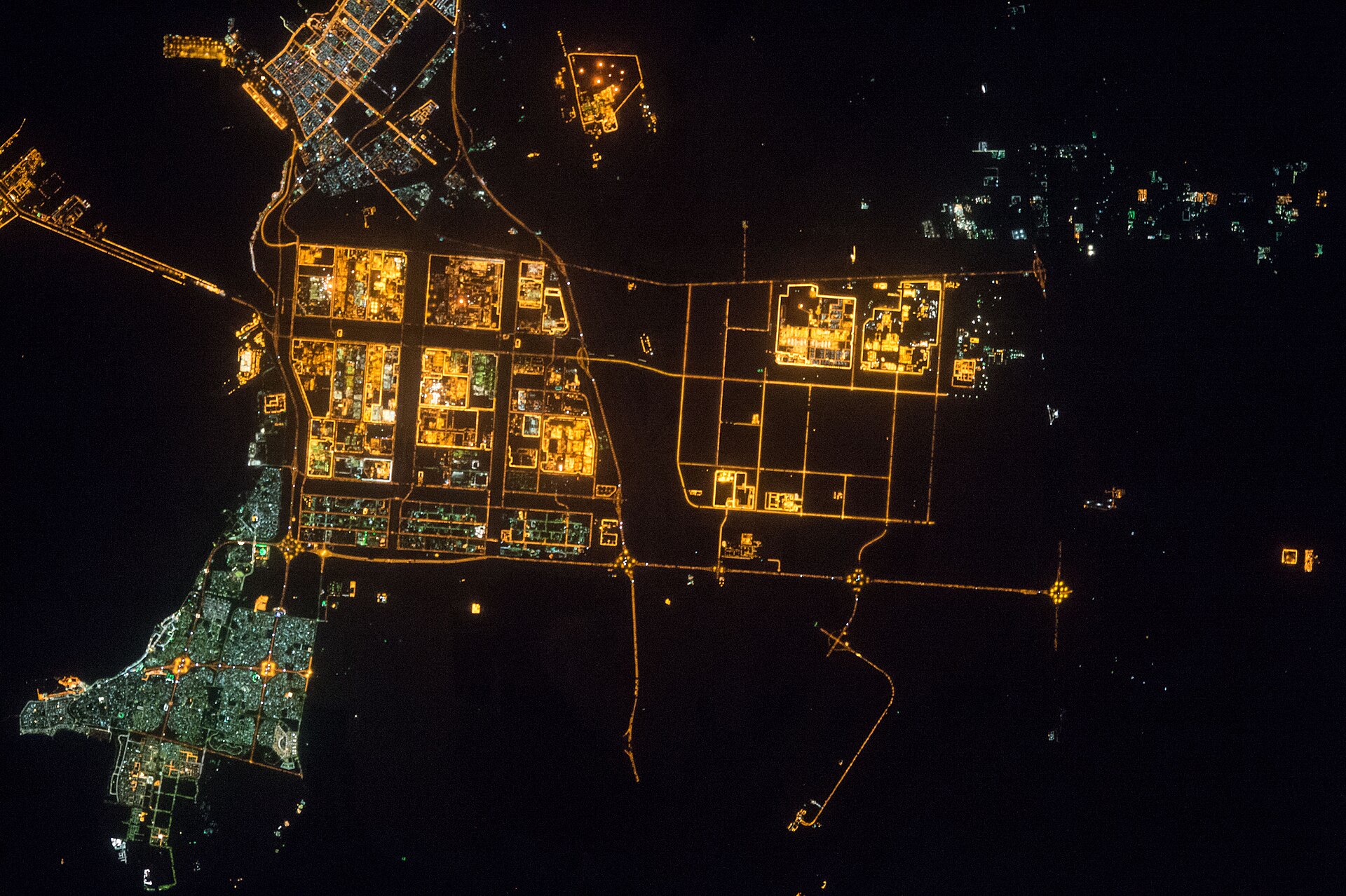
RIYADH — Four days after a $3.7 billion grace period expired with no payment, no disclosure, and no forbearance agreement, Dow Inc.’s stock sits 39 percent above where it started the year — and analysts are calling Sadara Chemical’s guaranteed debt a case of “tail risk removed.” The removal consists entirely of the fact that nobody demanded the money. All 26 of Sadara’s manufacturing units at Jubail Industrial City have been offline since March 31, the company has told regulators it cannot estimate when production will resume, no lender in the 28-bank syndicate has demanded payment, and Aramco — guarantor of $2.405 billion — has said nothing. Dow booked a $292 million impairment charge in Q1, hit the $1.4 billion GAAP ceiling on Sadara equity losses, and can now watch the joint venture deteriorate without its income statement registering a tremor. Wall Street read all of this as containment. The guarantee has not been contained; it has been rendered invisible.
Table of Contents
- What Did the Market See on June 16?
- How Does a $3.7 Billion Guarantee Disappear From an Income Statement?
- Twenty-Eight Banks and a Silence That Looks Like Consent
- Why Hasn’t Aramco Disclosed a Forbearance Agreement?
- The Gulf Forbearance Playbook
- What Happens If a Single Lender Breaks Ranks?
- The $100 Million Drip and the CEO Handoff
- Aramco’s Balance Sheet and the Cost of Quiet
- Frequently Asked Questions
What Did the Market See on June 16?
Markets saw an absence — no emergency 8-K from Dow, no lender demand from the 28-bank syndicate, no statement from Aramco — and interpreted it as resolution. Dow Inc. (NYSE: DOW) closed the week in the middle of a rally that has carried the stock up approximately 39 percent year-to-date from its post-strike lows in late March, with UBS maintaining a Neutral rating at a $37 price target and Citi holding Buy at $41, reduced from $48 but still comfortably above the spring trough. The consensus across sell-side desks and financial-data aggregators was clean and nearly unanimous: the deadline passed without shock, so the shock had been priced out.
Ad-hoc-news.de, summarizing the prevailing view among market participants, described the June 15 expiry as having “passed without shock, easing a key overhang” and credited Dow’s prior $292 million impairment charge with having “signaled the bulk of anticipated losses was recognized ahead of the deadline.” The conclusion — that Sadara represented a “meaningful reduction in tail risk for Dow Inc. investors” — was presented as settled fact, not inference, and in a narrow technical sense it was defensible: Dow had provisioned, the date had come and gone, and nobody had been sued. Patrick Cunningham at Citi lowered his price target from $48 to $41 but kept the Buy rating, treating Sadara as a known quantity rather than an unresolved exposure. UBS moved its target from $39 to $37 — not a downgrade on Sadara risk, but a broader adjustment to petrochemical-cycle assumptions that happened to absorb Sadara as background noise.
The consensus rests on two assumptions that have not been publicly verified by any of the parties involved. The first is that Dow’s Q1 impairment and equity-loss ceiling together represent full provisioning for Sadara exposure, when in fact they represent only the income-statement exposure — a distinction the GAAP framework actively obscures. The second is that the absence of a lender demand after June 15 means the 28-bank syndicate has informally agreed not to accelerate, which is an assumption dressed as a conclusion and supported by no public evidence from any lender, any export credit agency, or either guarantor. No analyst on Dow’s April 23 Q1 earnings call asked about the June 15 deadline by name — a silence within a silence that allowed the date to arrive, pass, and recede without the market ever pricing in the specific risk of guaranteed debt coming due with no one paying and no one objecting.
How Does a $3.7 Billion Guarantee Disappear From an Income Statement?
Once Dow’s cumulative Sadara equity losses reached the $1.4 billion ceiling — the total of its investment, advances, and guarantee commitments under U.S. GAAP — further loss recognition was suspended. Dow’s income statement no longer reflects Sadara’s deterioration, but the $1.295 billion contingent cash guarantee remains a live obligation, payable on demand by any lender in the 28-bank syndicate. The disappearance is an accounting convention, not an economic event.
In Q1 2026, Dow recognized $115 million in Sadara equity losses before hitting that threshold, then in the same quarter booked a $292 million pretax impairment charge against its Sadara guarantee liability — contributing to a total company GAAP net loss of $445 million on $9.8 billion in net sales, down 6 percent year-over-year. From this point forward, even as Sadara’s operational losses deepen with all 26 units shut, revenue at zero, and a grace period that has now expired with no resolution, Dow’s quarterly results will show no further Sadara equity charge. The GAAP treatment is technically correct under ASC 323 and structurally misleading to anyone reading only the income statement.
The Middle East briefing 3,000+ readers start their day with.
One email. Every weekday morning. Free.
Dow’s 35 percent share of the $3.7 billion restructured senior debt — $1.295 billion — remains a contingent cash liability that will crystallize the moment a lender exercises its contractual right to demand payment. The equity-loss suspension means the income statement no longer reflects Sadara’s condition, but the guarantee has not been extinguished, reduced, or renegotiated. Dow’s own investor relations materials confirm approximately $100 million per year in cash commitments to Sadara through 2038, totaling roughly $1.2 billion in remaining outflows entirely independent of whether any guarantee is called. The Q1 impairment, the equity-loss ceiling, and the analyst notes describing “tail risk removed” have together created a situation in which a $2.5 billion combined exposure — the guarantee plus the annual commitments — generates zero further impact on the number that equity investors actually watch.
| Exposure Component | Income Statement (GAAP) | Cash Liability |
|---|---|---|
| Further Sadara equity losses | Suspended at $1.4B ceiling | Continue to accumulate at JV level |
| Q1 2026 impairment | $292M already booked | Does not reduce guarantee obligation |
| Guarantee obligation (35%) | No further charges | $1.295 billion contingent on lender demand |
| Annual JV cash commitment | No income-statement impact | $100M/year through 2038 (~$1.2B remaining) |
| Total remaining exposure | $0 additional P&L impact | ~$2.5 billion |
The market treated the impairment and the GAAP ceiling as a kind of decontamination — as though Dow had sealed off its Sadara exposure and could now move on to cyclical-recovery narratives. What it actually reached was a point where future Sadara deterioration becomes invisible to investors scanning quarterly earnings, a ceiling that protects the income statement but leaves the $1.295 billion guarantee sitting beneath it, unchanged and waiting for a demand that has not yet come from any of the 28 institutions that hold the underlying debt.
Twenty-Eight Banks and a Silence That Looks Like Consent
The original Sadara project finance — approximately $12.5 billion — was syndicated across 28 lenders assembled for what was then the world’s largest single-phase petrochemical build, a $20 billion joint venture that was supposed to anchor Saudi Arabia’s downstream diversification. The syndicate includes seven export credit agencies — UK Export Finance, Coface (France), Euler Hermes (Germany), Kexim, K-Sure (Korea), US Ex-Im, and FIEM — alongside the Public Investment Fund, the Saudi Industrial Development Fund, and commercial banks led by Standard Chartered as agent bank, with JPMorgan, HSBC, Mizuho, SMBC, and Bank of Tokyo-Mitsubishi UFJ among the principals. The 2021 restructuring that replaced $10 billion in original shareholder completion guarantees with $3.7 billion in pro-rata principal guarantees was itself a concession from this group, negotiated after Sadara had posted losses in every year of its operations and after the original 2029 maturity was pushed out to 2038.
No member of this syndicate has publicly commented on the June 15 grace expiry, and no lender has disclosed a forbearance agreement, a standstill arrangement, or any modification to the restructured guarantee terms. Standard Chartered, as agent bank, would typically coordinate any collective action — but coordination has a specific meaning in a 28-party lending group that spans commercial banks answering to shareholders, ECAs answering to governments, and sovereign-linked institutions answering to the Saudi state. The legal architecture required to maintain this silence across seven jurisdictions and three categories of institutional creditor is itself a tell: somebody is managing the non-response, and that management costs money, even if no one is paying the principal.
What the market is calling forbearance is, structurally, something closer to the rational inaction of 28 institutions that each conclude, independently, that demanding payment from an offline joint venture guaranteed by Saudi Aramco and Dow Inc. during a regional war is less attractive than waiting. The problem with rational inaction is that it is not an agreement — it is a set of parallel individual calculations, any one of which can change when a single bank’s internal risk committee decides that waiting has become more expensive than demanding. Standard Chartered’s role as agent means it could coordinate a collective demand, but it also means it absorbs the reputational cost of being the bank that triggered a cascade against a sovereign guarantor, and that asymmetry has kept the silence intact so far. How long that calculation holds depends less on the debt itself than on the institutions’ internal appetites for unresolved exposure — and on whether anyone outside the syndicate forces the question.
Why Hasn’t Aramco Disclosed a Forbearance Agreement?
Aramco, listed on the Tadawul under Saudi Capital Market Authority rules, faces different disclosure thresholds than NYSE-listed Dow — and the gap between those two regimes is doing substantial structural work. No SEC Item 2.04 filing has been made because Dow’s counsel appears to have concluded the grace expiry, absent a formal lender demand, does not constitute a triggering event requiring disclosure. That conclusion is legally defensible only if lenders have genuinely agreed not to demand payment, but any such agreement is itself undisclosed.
The circularity is the architecture. Under Item 2.04 of SEC Form 8-K, disclosure is required when a triggering event “accelerates or increases a direct financial obligation or creates a material obligation under an off-balance sheet arrangement.” A grace period expiring without a formal lender demand sits in a regulatory gray zone: the contractual shield has lapsed, the exposure is live, but no lender has pulled the trigger. Dow’s silence implies no trigger has occurred. The lenders’ silence implies no demand has been made. The absence of a disclosed forbearance agreement implies no formal waiver exists. Each step is individually defensible, and the chain as a whole produces an information vacuum that favors the guarantors — because the burden of disclosure falls on the party that receives a demand, not on the party that refrains from making one.
Aramco’s $2.405 billion share — the largest single exposure in the Sadara debt structure — has received no impairment, no provision, and no public acknowledgement that the grace period expired. The CMA’s continuing obligations rules require disclosure of material events affecting a company’s financial position, but the materiality threshold for state-controlled entities in Saudi disclosure practice has historically been interpreted more flexibly than the SEC standard governing Dow. Aramco’s Q1 2026 report mentioned no Sadara provision — even as it disclosed, for the first time since the pandemic, free cash flow falling below the base dividend. Against a Brent price already more than $28 below Saudi fiscal breakeven, a $2.4 billion undisclosed guarantee is not a rounding error. That gap between CMA norms and SEC norms has a name in Gulf financial history, and it has precedents.
The Gulf Forbearance Playbook
Saudi Arabia’s financial system has a demonstrated capacity for extended informal forbearance that operates entirely outside the mechanisms Western debt markets would recognize, and the most instructive cases are the 2009 defaults of Ahmad Hamad Algosaibi & Brothers and Saad Group. Those two failures — approximately $22 billion in combined outstanding debt — triggered the largest corporate defaults in Gulf history and demonstrated that Gulf sovereigns and state-linked creditors can maintain years-long informal forbearance without formal insolvency proceedings, without public standstill agreements, and without the kind of disclosure that would be mandatory for a U.S.- or UK-listed entity. Recovery in both cases stretched across more than a decade of multi-jurisdictional litigation, and recovery rates bore almost no relationship to the original creditor expectations.
Saudi Arabia’s 2018 Bankruptcy Law (Royal Decree M/50) created a formal insolvency framework intended to prevent similar extended paralysis, but state-linked entities have historically operated outside its scope, and the law’s application to a joint venture between the kingdom’s national oil company and a U.S.-listed multinational has never been tested. The gap between the formal framework and the informal practice of relationship-banking forbearance — where sovereign influence over creditors substitutes for legal standstill agreements — is precisely the space in which the current Sadara non-resolution sits. What the market is calling “managed forbearance” is, in Gulf terms, a network of institutional relationships in which the cost of formal action exceeds the cost of quiet inaction, and the sovereign’s presence as co-guarantor and co-owner ensures that no commercial bank wants to be the first to break rank.
That model held for AHAB and Saad for years before the litigation wave eventually broke. The difference with Sadara is that one of the guarantors is a New York Stock Exchange-listed company whose shareholders are actively trading on the assumption that the forbearance is permanent rather than merely indefinite — and the distinction between those two words is the distinction between a resolved liability and a deferred one. If Dow’s investors have priced in resolution, and what they have actually received is deferral, then the next event that tests the assumption — a lender demand, an analyst question, an SEC inquiry, a single bank’s risk-committee review — reprices the entire position.
What Happens If a Single Lender Breaks Ranks?
A demand from any single lender in the 28-bank syndicate could trigger cross-default provisions that cascade across the entire Sadara facility, crystallizing the $3.7 billion guarantee call against both Aramco and Dow simultaneously. The seven export credit agencies are the most exposed to external pressure, because they report to national governments and parliaments rather than to commercial shareholders whose tolerance for quiet can be managed through investor-relations calls.
Cross-default provisions in syndicated project finance typically allow any lender whose loan has been defaulted — or whose guaranteed payment has not been made after the contractual deferral period has lapsed — to serve notice on the agent bank and force collective action. In a 28-bank syndicate, Standard Chartered cannot indefinitely manage the absence of a demand without the implicit or explicit consent of every participant, and that consent becomes harder to maintain as the offline period extends. Dow’s 39 percent rally has been built on the assumption that the GAAP ceiling is the ceiling of its Sadara exposure. A guarantee call would reveal it as the floor — the minimum recognised loss, not the maximum cash exposure — and the $1.295 billion contingent liability that currently sits off the income statement would arrive as an actual cash demand, bypassing every accounting convention that has kept it invisible.
The seven ECAs add a dimension that commercial banks do not face. UK Export Finance reports to Parliament on the performance of its guarantee portfolio; Coface and Euler Hermes report to their respective finance ministries; US Ex-Im reports to Congress. A $20 billion petrochemical facility that has been dark since March, with no borrower debt service and no guarantor payment and no disclosed recovery plan, is the kind of exposure that eventually draws questions in select committee hearings and government audit reports. The ECAs have the least institutional flexibility to remain silent indefinitely, because their silence is not a commercial decision — it is a political one, and political decisions are subject to review cycles that do not wait for Standard Chartered’s coordination timeline. Somebody at Dow is responsible for ensuring that no lender breaks ranks, and as of July 1, that person will be new to the job.
The $100 Million Drip and the CEO Handoff
On Dow’s Q1 2026 earnings call, outgoing CEO Jim Fitterling described Sadara negotiations in language that was careful, forward-looking, and conspicuously unresolved. “One of the things I will continue to do as Karen takes over the CEO role is finish up negotiations with Saudi Aramco on the restructuring of Sadara and trying to address some of the challenges they face there,” Fitterling told analysts on April 23, adding: “It’s more of a leverage issue and a balance sheet issue that we need to get right.” Karen S. Carter becomes Dow’s CEO on July 1 — twelve days from now — with Fitterling moving to executive chair and the Sadara restructuring explicitly named as a handoff task between the two.
It’s more of a leverage issue and a balance sheet issue that we need to get right.
Jim Fitterling, CEO, Dow Inc., Q1 2026 earnings call, April 23, 2026
The language is revealing for what it does not contain. Fitterling described “challenges they face there” — distancing Dow from Sadara’s operational paralysis — and characterised the issue in his own terms as one of “balance sheet” structure, which is a polite way of saying the debt is too large for the cash flows (which are zero) and the structure needs renegotiating (which it has not been, publicly). He did not reference the June 15 deadline, did not name the grace period, and did not indicate whether his negotiations with Aramco had produced any binding agreement. The market took the call as reassuring — a CEO who sounds calm about a problem is a CEO who has the problem in hand. A close read of the transcript suggests something closer to an executive flagging an unresolved file to his successor with enough specificity to establish a record that the issue was on the table.
Meanwhile, Dow’s annual cash commitment to Sadara — approximately $100 million per year through 2038 — continues regardless of the GAAP treatment, the equity-loss ceiling, or the income-statement invisibility. Over the remaining life of the restructured debt, that commitment amounts to roughly $1.2 billion in cash outflows from Dow to a joint venture that has no revenue, no production, and no disclosed timeline for restarting either. For a company that reported a $445 million GAAP net loss in Q1 on $9.8 billion in sales, that annual drip is not trivial — and it flows to a guarantor whose own balance sheet is stretched in directions that do not accommodate generosity.
Aramco’s Balance Sheet and the Cost of Quiet
Aramco’s decision not to disclose — not to provision, not to impair, not to acknowledge the June 15 expiry — must be read against a balance sheet under simultaneous pressure from every direction that matters. Q1 2026 free cash flow of $18.6 billion fell below the quarterly base dividend of $21.89 billion for the first time since the pandemic, a 0.85x coverage ratio compressed by a $15.8 billion working capital build. Brent crude at $79.95 sits $28-31 below the kingdom’s $108-111 fiscal breakeven; Saudi crude has only just begun to transit the Strait of Hormuz again after a four-month near-blockade; and the PGSA is accumulating $5.5 million per day in transit fees against Saudi shipments, adding $2 billion per year to the cost of exporting through waters the kingdom once treated as open. The Q1 Saudi fiscal deficit reached SAR 125.7 billion.
Against that backdrop, Sadara’s $2.405 billion guarantee is not the largest exposure on Aramco’s ledger — but it occupies a unique structural position as the one guaranteed liability where a U.S.-listed co-guarantor’s disclosure obligations could force Aramco’s hand. If Dow is eventually compelled by a lender demand, an analyst question, or an SEC inquiry to disclose the formal status of the Sadara guarantee, Aramco’s corresponding silence becomes untenable. The $20 billion Jubail complex — the physical symbol of Saudi downstream ambition before Vision 2030 rebranded the entire concept — sits dark, and its guarantors have collectively decided that the best strategy is to let the market construct its own narrative from the absence of bad news.
The market has obliged. “Tail risk removed,” the notes say, and Dow’s stock price agrees. The $3.7 billion in guaranteed debt has not moved, the 26 manufacturing units have not restarted, and the CEO who called it “a balance sheet issue we need to get right” is handing the file to his successor in twelve days. Aramco’s quiet has been expensive before — not in the sense that markets punished it, but in the sense that every quarter of non-disclosure raises the eventual cost of the disclosure that follows, whenever it comes, and whatever finally forces it. The contrast with Aramco’s concurrent infrastructure monetisation moves — including Project Yellowstone’s $7 billion sulfur terminal sale — is instructive: the company selectively surfaces assets whose value is rising while maintaining silence on liabilities whose cost is accumulating.
Frequently Asked Questions
Is Sadara Chemical in default?
Formally, no — and that distinction is doing considerable legal work. A default under the restructured facility would require either a missed scheduled payment or a lender declaration of default following the grace period expiry, and neither has occurred publicly. What happened on June 15 was that the contractual shield against lender demands expired, leaving the $3.7 billion guarantee callable at any time — but a callable guarantee is not a called guarantee. Most Gulf project finance facilities of this vintage are governed by English law, which means a formal demand would require the agent bank — Standard Chartered — to serve written notice on both guarantors specifying the amount due and the payment deadline, typically five business days. Until that notice is served, no court in any jurisdiction would recognise a default event, and neither Aramco nor Dow would face an enforceable obligation to pay.
What is Aramco’s total Sadara exposure beyond the $2.4 billion guarantee?
Aramco’s exposure extends well beyond its $2.405 billion guarantee share. As 65 percent owner of the joint venture, Aramco absorbs Sadara’s ongoing operational losses (which are undisclosed but plainly negative while the facility remains dark), its proportional share of maintenance and standing costs at Jubail, and the reputational cost of a flagship downstream project that has produced net losses every year since 2022 — including an SAR 1.1 billion loss in Q1 2023 alone. Aramco also faces indirect exposure through the Public Investment Fund and the Saudi Industrial Development Fund, both of which sit in the 28-bank lending syndicate and both of which answer to the same sovereign stakeholder that controls Aramco. The total blended exposure — direct guarantee, ongoing equity losses, sovereign-linked lending, and standing costs — is substantially larger than $2.4 billion, though the components beyond the guarantee have not been independently quantified in any public disclosure. Meanwhile, PIF’s broader restructuring of its flagship giga-project — converting NEOM from an active build into a structured wind-down — is documented in the $16 billion NEOM exit strategy.
Could Dow’s GAAP equity-loss ceiling be reversed or bypassed?
Yes, through two separate mechanisms. Under ASC 323, if circumstances change materially — for example, if Dow increases its financial commitment to Sadara or if a previously suspended loss becomes realised — the ceiling can be reassessed and additional losses recognised. More practically, a guarantee call bypasses the equity-method ceiling entirely because a cash demand is not an equity-method loss — it is a direct financial obligation that would appear as a cash outflow and a liability settlement, not as a line item flowing through the suspended equity-loss account. The ceiling protects Dow’s income statement from Sadara’s operational deterioration; it does not protect Dow from a $1.295 billion cash call.
When will Sadara’s Jubail manufacturing units restart?
No entity involved in Sadara — not Aramco, not Dow, not Sadara’s own management — has provided a timeline. Sadara’s most recent regulatory disclosure states it “cannot provide, at the present time, an estimate for the return to production, as this is contingent on domestic and international factors.” The 26 units have been offline since March 31 following the March 19 Iranian strikes on Jubail petrochemical infrastructure. Restart would require completed physical repairs, restored feedstock supply (contingent on reliable Strait of Hormuz access), reinstated insurance coverage (war-risk premiums in the Gulf have surged over 340 percent), and a security environment in which insurers and underwriters are willing to cover continuous operations at a facility that has already been struck. No insurer, engineering contractor, or government official has publicly committed to any of those prerequisites being met on any specific date.