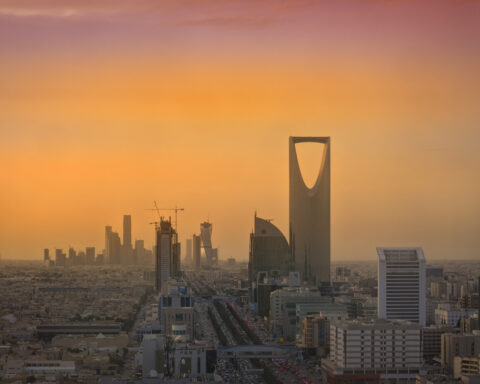
NEOM — PIF’s Board of Directors, chaired by Crown Prince Mohammed bin Salman, approved the fund’s 2026-2030 strategy on April 15, 2026, with a new designation for its most expensive project: “standalone pillar.” The reclassification is not a promotion. It is a financial firewall — a mechanism that separates NEOM’s cascading liabilities from PIF’s other domestic portfolios while the fund’s cash sits at $15 billion, a six-year low.
The strategy describes six domestic ecosystems. Five are organized by sector: tourism, urban development, manufacturing, industrials, clean energy. The sixth is NEOM — the only project-focused ecosystem, carved from the broader giga-projects layer where it sat during the 2021-2025 cycle. Robert Mogielnicki of the Arab Gulf States Institute in Washington called it “a curious inclusion” given “recent reassessments and scaling-down.” Curious is generous. The standalone pillar is the accounting architecture of a controlled write-down that PIF can execute without a royal statement, without a NEOM Authority press release, and without ever conceding the original promise is dead. What follows is the sequence — three stages, seven months, zero announcements — that connects the budget cuts, the reclassification, and the construction halt into a single operation.

Table of Contents
- What Did PIF’s 2026-2030 Strategy Do to NEOM?
- Three Acts of a Controlled Write-Down
- Why Is NEOM a ‘Standalone Pillar’ Instead of Part of the Vision Portfolio?
- The Termination Clause as Exit Without Announcement
- What Happened to The Line?
- Oxagon Survived Because the War Proved It Right
- Will Saudi Arabia Host the 2029 Asian Winter Games at Trojena?
- The Balance Sheet Behind the Silence
- Frequently Asked Questions
What Did PIF’s 2026-2030 Strategy Do to NEOM?
PIF’s 2026-2030 strategy reorganized NEOM from a giga-project within the broader Vision Portfolio into a dedicated, project-focused ecosystem — one of six domestic pillars but the only one defined by a single project rather than an economic sector. The strategy, branded as the “Value Realization” phase, also imposed an additional 15% capital expenditure cut on top of a $41 billion reduction already underway.
PIF Governor Yasir Al-Rumayyan framed the shift as routine. “The reassessment of our investments is continuous and natural,” he told The National at the April 15 announcement. He added that “some priorities have been reshuffled and investment objectives repositioned with greater focus on AI infrastructure and investments in AI companies” (Al Arabiya English). Neither statement mentioned NEOM’s construction commitments, which had already fallen from $71 billion to $30 billion before the strategy was published, according to AGBI’s January 2026 reporting.
A source familiar with PIF finances told AGBI in February 2026 that the fund was “likely to cut capital spending by up to 15 percent,” adding “that number and timeframes can change slightly, but the direction is clear.” The April strategy confirmed the direction. The 15% cut applies on top of the existing $41 billion reduction — meaning the baseline against which PIF measures spending has shrunk twice in six months.
Five weeks after the strategy’s publication, on May 22, Semafor reported that NEOM had formally halted all work on The Line until after 2030 and slashed its population target. No official NEOM or PIF statement accompanied the halt. The strategy document had already built the container for this announcement. The announcement arrived as a leak to a single outlet.
The Middle East briefing 3,000+ readers start their day with.
One email. Every weekday morning. Free.
Three Acts of a Controlled Write-Down
Read as separate stories — a budget cut in January, a strategy refresh in April, a construction pause in May — each appears manageable. Read as a sequence, they describe a single operation: the staged dismantlement of NEOM’s original ambition with no individual announcement large enough to trigger a confidence crisis.
January-February 2026. AGBI reported that NEOM was considering transferring major sub-assets to other state entities. Oxagon would move to Saudi Aramco’s oversight. Trojena would transfer to the Ministry of Sport and Qiddiya Investment Co. Sindalah would go to Red Sea Global. NEOM was simultaneously directed to cut staff to approximately one-third of existing levels. Finance Minister Mohammed Al-Jadaan provided the only official framing: “There is no issue, no shame, no ego in adjusting [and] slowing down certain sectors or projects so the economy can grow with you.”
April 15, 2026. PIF published the 2026-2030 strategy. NEOM received its own ecosystem designation — separated from the other giga-projects for the first time. An additional 15% capex cut was layered on top of the January reduction. Al-Rumayyan told The National that The Line was no longer a 2030 deliverable: “Is having The Line by 2030 important? I don’t think so. It would be good to have, but it’s not a must. What we must have is Oxagon.” This was the first public statement by a senior PIF official conceding The Line’s demotion.
May 22, 2026. Semafor reported The Line was formally halted until after 2030. The population target was slashed again. Oxagon was redesignated as the priority node with fresh capital committed to its Red Sea port and data connectivity infrastructure. NEOM CEO Aiman al-Mudaifer, appointed during a 2025 leadership change, had conducted the strategic review that produced the decision.
The proposed asset transfers reported by AGBI deserve particular attention. Moving Oxagon to Aramco, Trojena to the Ministry of Sport, and Sindalah to Red Sea Global would reduce what “NEOM” controls to a planning authority with a standalone pillar designation but diminishing operating assets. The transfers had not been formally executed as of May 2026. But the January reporting established the institutional logic: NEOM’s sub-projects have more value as components of existing state entities than as pieces of an integrated mega-city that will not be built to original specification.
Each act was absorbed by the press cycle within 48 hours. No act was large enough to force a royal response of the kind MBS has offered for the war. The cumulative effect — the scale of the expenditure, the negligible fraction of the flagship actually built, the population target cut to single digits of the original promise — was never stated in a single document by a single official.
Why Is NEOM a ‘Standalone Pillar’ Instead of Part of the Vision Portfolio?
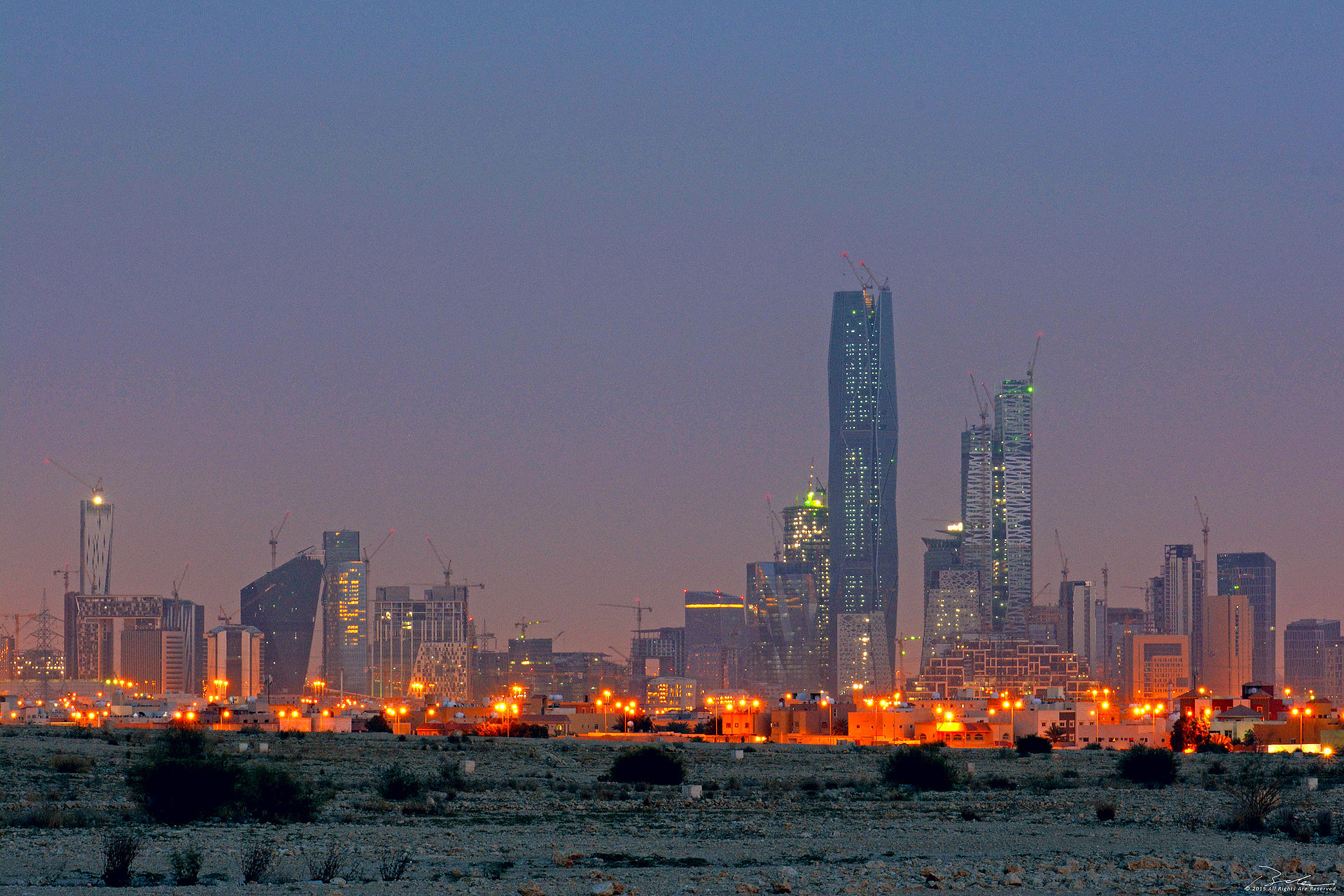
The standalone designation solves a specific financial problem. In PIF’s prior 2021-2025 strategy, NEOM sat within the giga-projects layer of the Vision Portfolio alongside Red Sea Global, Qiddiya, and other developments. That structure meant NEOM’s cost overruns, write-downs, and cash requirements flowed through the same portfolio as every other domestic initiative. A single project’s losses could depress the performance metrics of the entire Vision Portfolio.
Carving NEOM out creates a containment structure. PIF recorded an $8 billion write-down on its giga-projects in its 2024 financial reporting — the first on-record impairment acknowledgment. Under the new strategy, that impairment and any future write-downs sit in NEOM’s own dedicated ecosystem rather than dragging down the performance figures of the tourism, manufacturing, or clean energy portfolios that PIF needs to show progress on.
This matters for PIF’s credit profile. PIF maintains investment-grade ratings from Moody’s (Aa3, October 2025) and Fitch (A+), both with stable outlooks. Those ratings assess PIF’s aggregate balance sheet — NEOM write-downs flow through directly, with no legal ring-fencing by entity. The standalone pillar does not create legal separation. It creates reporting separation. PIF can present its other five domestic ecosystems as performing portfolios while NEOM’s impairments accumulate in an isolated line item.
Tim Callen, a former IMF mission chief for Saudi Arabia and AGSI scholar, calculated that PIF’s long-run annualized return averaged 7.2% from September 2017 through end-2024 — down from 8.7% the prior year — with the effective 2024 return “close to zero.” Callen noted that AUM growth came almost entirely from the Saudi government transferring an additional 8% Aramco equity stake, worth approximately $140 billion in paper value, rather than from investment returns. A fund reporting near-zero effective returns while its flagship project books an $8 billion impairment needs an accounting firewall. The standalone pillar is that firewall.
PIF’s 2026-2030 strategy targets $925 billion in assets under management with 80% domestic allocation. Projects are now assessed by “detailed financial metrics, and anything below a certain internal rate of return will be shelved,” according to AGBI. The internal rate of return test is the mechanism that killed The Line. The standalone pillar is the mechanism that buries it. Semafor’s June 7 report that NEOM has budgeted SAR 60 billion ($16 billion) in termination payments for 2026–2030 — a sum larger than PIF’s entire cash reserve — gives the cost of that burial a specific number for the first time: NEOM’s $16 billion exit bill.
The Termination Clause as Exit Without Announcement
The contracts NEOM cancelled reveal how Saudi Arabia manages a retreat that cannot look like one. The mechanism in every case was the same: “termination for convenience” — a standard clause that allows the client to end a contract without cause, provided the contractor is reimbursed for all costs incurred plus early termination expenses. No breach finding. No arbitration. No public dispute.
| Contract | Contractor | Value | Completion at Termination | Date |
|---|---|---|---|---|
| Trojena Dam System | Webuild | EUR 2.8B | ~30% | March 29, 2026 |
| Trojena Ski Village (structural steel) | Eversendai | Not disclosed | Unknown | March 2026 |
| Tunnel System | Hyundai | $1B | Unknown | March 2026 |
| Connector High-Speed Rail (57 km) | Webuild | EUR 1.4B | ~20% | May 2026 |
Total contract cancellations in March alone exceeded $6 billion (Dezeen, March 26, 2026). The Webuild Connector Rail termination in May concluded all of Webuild’s NEOM activities. The company’s statement was a single disclosure: “This termination concludes all of Webuild’s activities for NEOM” (Railway Pro, May 2026). Webuild confirmed that “all costs incurred up to the date of contract termination, as well as costs related to the early termination” would be reimbursed.
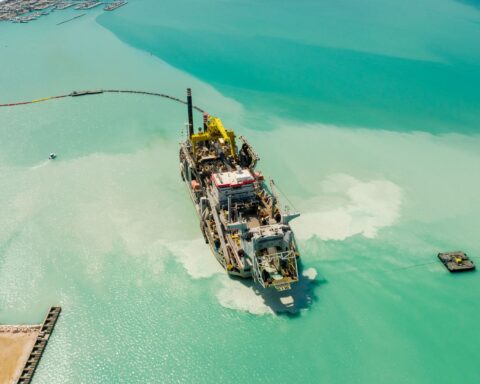
The Trojena dam was designed to create a 2.8-kilometer artificial freshwater lake at 1,500 meters elevation — the centerpiece venue for the 2029 Asian Winter Games. The Connector Rail would have linked Oxagon to The Line. Both were terminated at early-stage completion. Both produced single-paragraph disclosures in trade press. Neither generated a NEOM Authority press release, a PIF statement, or a comment from any Saudi government ministry.
“Termination for convenience” is the tool of quiet exit. The contractor is made whole financially and has no incentive to publicize the cancellation. The client issues no announcement. The project dies in a clause, not a headline.
Webuild’s two NEOM contracts alone totaled EUR 4.2 billion. The Italian contractor entered Saudi Arabia as one of NEOM’s largest single infrastructure partners. It left with full cost reimbursement, no contractual blemish, and a single-paragraph market disclosure. Four international contractors — Webuild, Eversendai, Hyundai, and additional firms involved in The Line’s foundation work — saw their NEOM commitments terminated or suspended within six months. For the international construction industry, the terminations carry a message that no NEOM press release will state: the client’s capacity to pay is intact, but the client’s commitment to build at original scope is not.
What Happened to The Line?
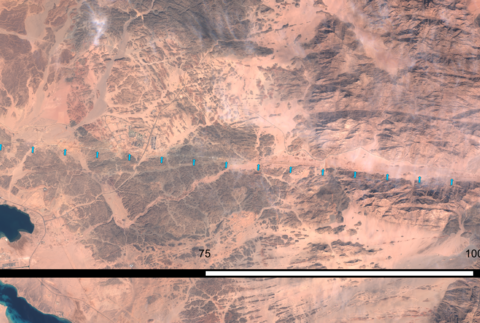
The Line — announced in 2021 as a 170-kilometer mirrored linear city designed to house 9 million people — was formally halted in May 2026 after completing 2.4 kilometers of foundation work, or 1.4% of its designed length. Approximately $50 billion has been spent on NEOM to date, according to European Business Magazine. The 2030 population target now stands at 100,000.
Construction was first suspended in September 2025. The May 2026 halt, reported by Semafor, made the suspension indefinite — pushing any resumption past 2030.
The project’s trajectory had been fixed by an internal PIF audit presented to NEOM’s board in 2024 and subsequently reported by the Wall Street Journal. That audit projected completing The Line to its original specification would cost approximately $8.8 trillion — more than 25 times Saudi Arabia’s annual government budget — with a completion date of 2080. PIF never publicly acknowledged the figure. But the decision-makers who approved the 2026-2030 strategy had already absorbed its implications. The standalone pillar was not a response to external criticism. It was a response to internal arithmetic.
Al-Rumayyan’s April 15 concession — that The Line was desirable but not essential by 2030 — was the first public acknowledgment from PIF leadership that the timeline had collapsed. But the framing positioned the halt as optional rather than forced, preserving the fiction that The Line remains a deferred ambition rather than an abandoned one.
A senior executive familiar with the project told AGBI in January 2026: “If you ask me whether there is work ongoing at Neom, the answer is yes…Are things moving fast? No. Spending on nearly every [Neom] project has been frozen and is now under intense reassessment.” The gap between “work ongoing” and “frozen and under intense reassessment” is the gap the standalone pillar was built to contain.
Oxagon Survived Because the War Proved It Right
Of NEOM’s original sub-projects — The Line, Oxagon, Trojena, Sindalah — only Oxagon received fresh capital in the 2026-2030 strategy. The $3 billion commitment targets the Red Sea port’s infrastructure, utilities, and data connectivity. The reason is not architectural ambition. It is strategic geography.
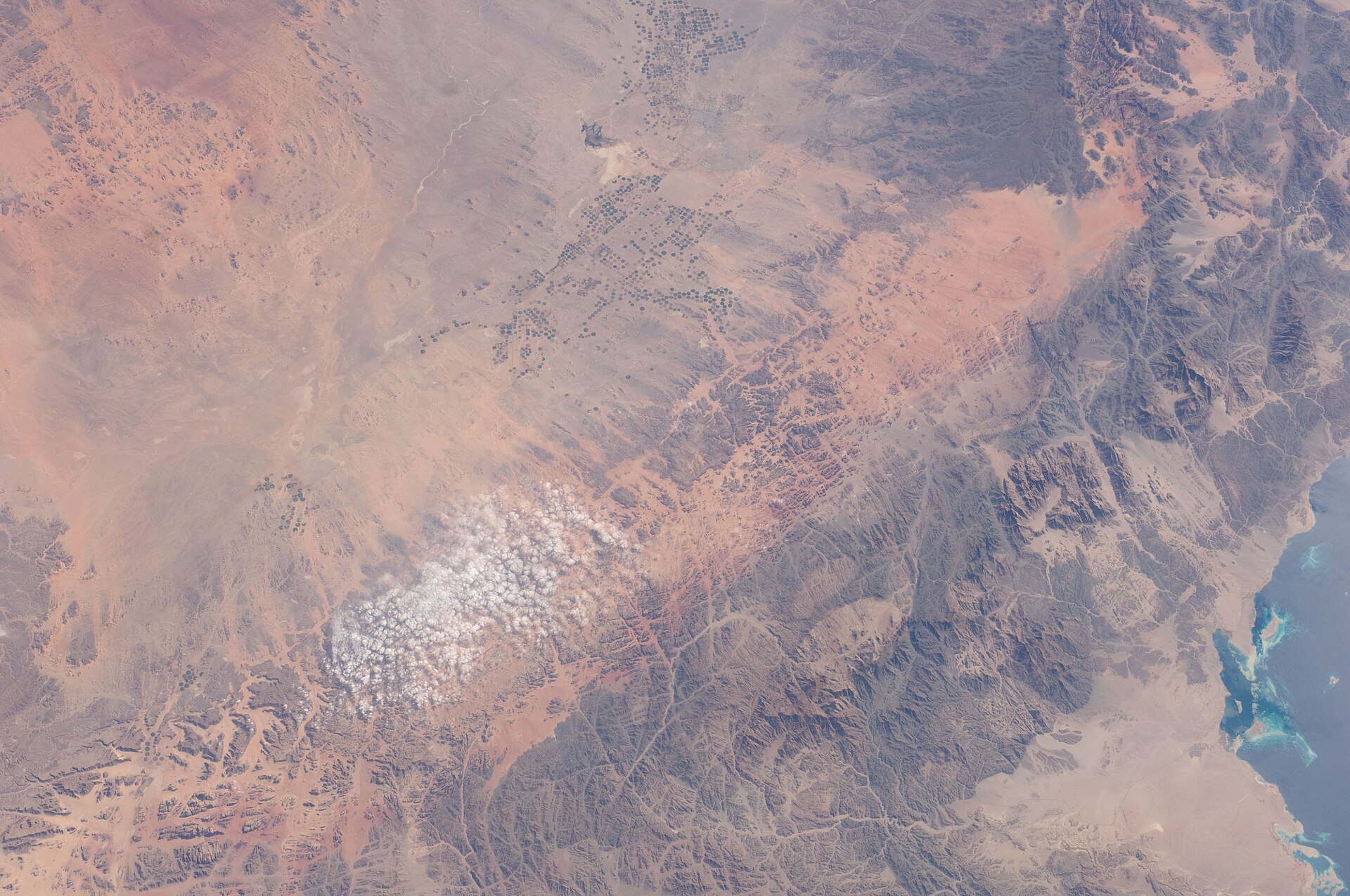
Oxagon’s port sits outside the Strait of Hormuz — the chokepoint that has defined Saudi Arabia’s wartime export vulnerability since February 2026. While Aramco rerouted crude through the East-West Pipeline to Yanbu — covering 3 million of 7.76 million barrels per day but leaving 2.5 million barrels per day Hormuz-dependent — Oxagon’s Red Sea location offered what The Line never could: relevance during a shooting war.
PIF’s Oxagon investment is a bet on industrial logistics and AI data center hosting, not on NEOM’s original residential mega-city vision. Unnamed officials told the Financial Times the redesigned NEOM would become “a far smaller development” supporting “industrial” applications, likely undergirded by a water-cooled data center hub on the northeastern Red Sea coast. Al-Rumayyan’s April statement that “some priorities have been reshuffled…with greater focus on AI infrastructure” was a description of Oxagon, not NEOM.
The NEOM Green Hydrogen Company, valued at $8.4 billion with production targeted for 2027, remains the only other protected sub-project (Middle East Briefing). Green hydrogen and industrial port logistics share a common trait: they generate exportable commodities with paying customers. Neither requires the residential population that NEOM’s original prospectus promised and that the target reduction now concedes will not arrive. The pivot from utopian urbanism to industrial port logistics is the most honest signal in PIF’s 2026-2030 strategy — and the only one not wrapped in euphemism.
Will Saudi Arabia Host the 2029 Asian Winter Games at Trojena?
The 2029 Asian Winter Games at Trojena present a problem NEOM’s quiet restructuring cannot solve: a hard, internationally scheduled deadline backed by venue requirements that no longer have active contractors. The Games are scheduled for February 2029. Core infrastructure contracts — the artificial lake, the ski village, the connecting rail — were all terminated in early-stage construction between March and May 2026, leaving less than three years to rebuild.
NEOM terminated the Webuild dam contract that would have created the Games’ centerpiece freshwater lake. It terminated the Eversendai structural steel contract for the ski village. The Connector Rail — which would have connected the NEOM territory — was also cancelled. The Webuild dam and Eversendai ski village terminations alone represent the primary Games venues. No public statement has addressed the Games’ status. The Olympic Council of Asia has issued no comment.
AGBI reported in January 2026 that Trojena was being considered for transfer to the Ministry of Sport and Qiddiya Investment Co. If that transfer proceeds, the Asian Winter Games would be hosted by a different Saudi entity than the one that won the bid — a jurisdictional handoff with no precedent in the event’s history.
The silence around Trojena functions identically to the silence around The Line. The absence of an announcement is not evidence that plans remain on track. It is evidence that no one wants to be the first to say they are not. But unlike The Line — which had no external deadline — Trojena has a date on a calendar that the International Olympic Committee and the OCA control. The quiet restructuring will eventually collide with a public timeline. When it does, the standalone pillar will not contain the reputational cost.
Sindalah — NEOM’s luxury island resort and the only sub-project still on its original timeline — illustrates the costs even “on-track” NEOM projects generate. Its soft opening is targeted for late 2026, but it is reported to be three years late and three times over initial budget, with total costs approaching $4 billion.
The Balance Sheet Behind the Silence
The reason NEOM’s restructuring proceeds without a single royal statement is fiscal. Saudi Arabia cannot afford a confidence crisis in its sovereign wealth fund while running the largest quarterly deficit on record.
PIF’s cash position stands at $15 billion — 1.6% of total assets. Aramco’s quarterly dividend of $21.9 billion now exceeds its quarterly free cash flow of $18.6 billion, meaning the payment stream that funds PIF and the state budget is being partially financed by Aramco’s own balance sheet rather than its operations.
Saudi Arabia’s Q1 2026 fiscal deficit reached SAR 125.7 billion ($33.5 billion) — 76% of the full-year SAR 165 billion target consumed in 90 days. The National Debt Management Center had reached approximately 90% of its borrowing capacity before Goldman Sachs projected a revised full-year deficit of $80-90 billion. PIF itself issued its largest-ever single bond — $7 billion — in the same period it ordered a 20% spending cut across its portfolio.
Brent crude trades near $93 per barrel — well below the $108-111 breakeven that Saudi Arabia requires when PIF’s domestic spending commitments are factored in. That gap translates to tens of billions in annual revenue shortfall at the exact moment PIF is supposed to be entering a “Value Realization” phase. The phrase is aspirational. The arithmetic is not.
NEOM was announced at the 2017 Future Investment Initiative with a $500 billion headline budget and a promise to build a city of the future. Eight years later, the project has been reclassified into its own ecosystem, its largest contracts terminated under convenience clauses, its population target reduced to a fraction of the original promise, and its construction formally halted — all without a press conference.
The standalone pillar did not save NEOM. It saved PIF’s other portfolios from NEOM. That is the strategy the April 15 document announced. Everything else — “Value Realization,” “ecosystem integration,” “disciplined investment” — is the language wrapped around the firewall so the firewall does not have to be called one.
Frequently Asked Questions
Who replaced Nadhmi Al-Nasr as NEOM CEO?
Aiman al-Mudaifer was appointed NEOM CEO during a leadership change in 2025. Al-Nasr had served as founding CEO since NEOM’s announcement at the Future Investment Initiative in October 2017, overseeing The Line’s design phase and the initial wave of construction contracts. Al-Mudaifer conducted the strategic review that produced the May 2026 decision to halt The Line and designate Oxagon as the priority node. The leadership transition itself received minimal coverage — consistent with the pattern of restructuring through personnel changes rather than policy announcements.
How does PIF’s investment performance compare to other Gulf sovereign wealth funds?
PIF’s annualized return of 7.2% from September 2017 through end-2024, as calculated by AGSI’s Tim Callen, trails the UAE’s Mubadala, which reported a five-year annualized return of approximately 10% in its most recent annual disclosure. The gap reflects a structural difference: PIF carries a domestic development mandate that diverts capital from market-rate investments into below-market-return mega-projects. Abu Dhabi Investment Authority and Qatar Investment Authority hold predominantly international portfolios with no equivalent to NEOM-scale domestic obligations. PIF’s mandate — building the post-oil economy — is inherently more expensive than managing a global portfolio for financial returns alone.
What is the NEOM Green Hydrogen Company and why did it survive the restructuring?
The NEOM Green Hydrogen Company is an $8.4 billion project developed by ACWA Power and Air Products, targeting the production of green ammonia for export beginning in 2027. It survived the restructuring because it generates an exportable industrial commodity with contracted buyers — primarily in Japan, South Korea, and the European Union — rather than depending on a residential population that has not materialized. Green hydrogen production also aligns with PIF’s stated pivot toward AI infrastructure and industrial applications, serving the same logic that preserved Oxagon: revenue-generating assets with existing demand, not speculative real estate at unprecedented scale.
Has Crown Prince Mohammed bin Salman personally addressed NEOM’s restructuring?
No. Every public statement about NEOM’s budget reductions, timeline changes, and strategic reclassification has come from financial officials — PIF Governor Al-Rumayyan, Finance Minister Al-Jadaan — or from unnamed sources speaking to journalists. MBS chaired the PIF Board of Directors meeting that approved the 2026-2030 strategy but issued no personal statement on NEOM. He has not publicly addressed the project’s revisions since announcing NEOM at the Future Investment Initiative in October 2017. The communications architecture is deliberate: financial officials frame adjustments as routine portfolio management while the political leadership maintains distance from what would otherwise register as the abandonment of Vision 2030’s most prominent commitment.