RIYADH — Operation Project Freedom lasted thirty-six hours before a phone call from Riyadh killed it. On May 4, two US Navy guided-missile destroyers pushed through the Strait of Hormuz into the Persian Gulf while two American-flagged merchant vessels sailed out — the first contested transits since Iran’s blockade sealed the waterway in March — and CENTCOM declared these the operation’s “first successful steps,” backed by 15,000 service members and more than 100 aircraft distributed across the Gulf’s basing architecture. Within hours, Saudi Arabia suspended US military use of Prince Sultan Air Base and closed Saudi airspace to American combat operations, Kuwait simultaneously cut off base access and overflight corridors, and Qatar imposed activity restrictions at Al Udeid — the largest US military installation in the Middle East — collapsing the air-cover framework before the second wave could launch.
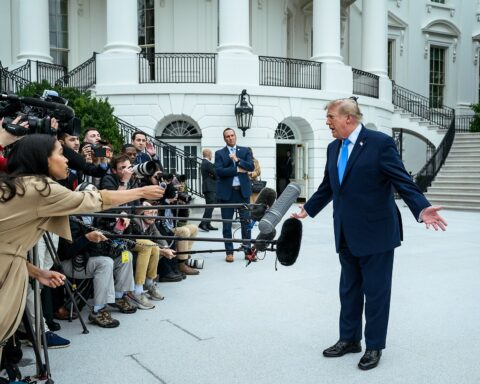
President Trump called Crown Prince Mohammed bin Salman directly. The call failed. The operation paused. Trump told cameras the halt reflected “great progress” in Pakistan-mediated peace talks; two US officials told NBC News the real reason was that Saudi Arabia had pulled the floor out from under American air power in the Gulf. A second presidential phone call was required before Riyadh and Kuwait restored access on May 7 — by which point the operational window had closed, the force posture had degraded, and Iran’s parliament was advancing a twelve-article Hormuz sovereignty law with the confidence of a government that had just watched its primary adversary get grounded by its own ally.
Table of Contents
- What Happened in 36 Hours
- The Geographic Trap Washington Cannot Escape
- Prince Sultan Air Base: Grace-and-Favor, Not Treaty Right
- Why Did Saudi Arabia Veto an Operation Designed to Protect Saudi Exports?
- The Paradox: Saudi Arabia Was Already Bombing Iran
- What Did Iran Conclude About American Operational Freedom?
- Is the Saudi Veto a Rupture or a Pattern?
- Why Didn’t the Market Believe Project Freedom Even Before the Pause?
- What Comes After the Veto
- FAQ
What Happened in 36 Hours
CENTCOM’s force package for Project Freedom was not modest. The operation committed approximately 15,000 service members, more than 100 land- and sea-based aircraft, multi-domain unmanned platforms, and a surface action group led by guided-missile destroyers — a force designed not merely to escort commercial shipping but to establish persistent sea control in confined waters where Iran’s mine-and-swarm naval denial strategy had shut down 96.4 percent of pre-war transit volume since March. The two merchant vessels that exited the Strait on May 4 were proof-of-concept, not proof-of-capacity; the operational plan required sustained air superiority over the Strait’s approaches, which meant continuous combat air patrols launched from regional bases and sustained by tanker aircraft operating in Saudi, Kuwaiti, and Qatari airspace.
The Saudi response came the same day. Prince Sultan Air Base — home to roughly 2,300 US personnel operating under a classified bilateral agreement — was closed to offensive operations. Saudi airspace, which provides the only viable corridor between CENTCOM’s Diego Garcia assets and the Persian Gulf theater for heavy bomber and tanker rotations, went dark for American military aircraft. Kuwait’s parallel closure eliminated the northern overflight route that connects Jordanian and Iraqi staging areas to the Gulf. Qatar’s restrictions at Al Udeid constrained the command-and-control backbone of the entire operation, since Al Udeid houses the Combined Air Operations Center that directs all US air combat activity in the Middle East. The IRGC’s response to that same hosting posture arrived three weeks later: on May 17, Saudi Arabia grounded American air power while Khatam al-Anbiya warned all US Gulf bases would be “deactivated” — and Riyadh chose silence over acknowledgement.
Three countries moved simultaneously. This was not a cascade of independent decisions — it was a coordinated Gulf position, with Riyadh as the organizing force and Kuwait and Qatar falling in behind a Saudi determination that the operation “would just escalate the situation and would not work,” as a Saudi source told NBC News. A separate Middle East official assessed that execution “was risky and could have triggered escalation” with “catastrophic” consequences for Gulf allies — the allies whose oil infrastructure sits within Iranian missile range and whose air defenses had already expended an estimated 86 percent of their PAC-3 interceptor inventory by late April.
The Geographic Trap Washington Cannot Escape
A US official explained the dependency chain to NBC News with unusual candor: “Because of geography, you need cooperation from regional partners to utilize their airspace along their borders — in some cases there is no other way around.” The official identified the specific links: Saudi Arabia and Jordan provide basing, Kuwait provides overflight, Oman provides both overflight and naval logistics. Remove any single link and the operational architecture degrades; remove Saudi Arabia and it collapses entirely, because the Kingdom’s airspace connects every other node in the network.
The Middle East briefing 3,000+ readers start their day with.
One email. Every weekday morning. Free.
This is not a political problem that can be solved by diplomatic pressure or financial incentives. It is a geographic fact that the Arabian Peninsula sits between CENTCOM’s power-projection platforms and their targets, and that Saudi Arabia occupies the largest contiguous block of that geography. There is no overflight route from Diego Garcia, Djibouti, or the eastern Mediterranean to the Persian Gulf that does not cross Saudi, Jordanian, or Omani airspace — and Jordan quietly aligned with Riyadh’s position, leaving only Oman’s cooperation (which provides naval logistics but cannot substitute for the combat air corridors Saudi Arabia controls). The US cannot fly around the Kingdom because there is no “around” — there is only through. The northern access corridor faces an additional complication: Iraq’s Popular Mobilization Forces have now deployed across western Anbar to the Arar border crossing with Saudi Arabia, controlling the same ground corridor that any overland logistics track from Jordan would have to use.
| Dependency | Role in Project Freedom | Status (May 4-7) | Substitutable? |
|---|---|---|---|
| Saudi Arabia (PSAB) | Primary basing, airspace corridor, tanker operations | Suspended | No |
| Kuwait (Ali Al Salem, Arifjan) | Northern overflight, logistics hub | Suspended | No |
| Qatar (Al Udeid) | CAOC, C2 backbone, ISR platforms | Restricted | No |
| Oman (various) | Naval logistics, southern overflight | Active | Partial only |
| Bahrain (NSA) | Fifth Fleet HQ | Degraded since Feb 28 | No |
Analysts at CSIS identified the Saudi denial as “a fundamental exposure of the limitations of the US hub-and-spoke basing architecture in the Middle East,” noting that the Hormuz operation “exposed the limits of what air power can achieve against a mine-and-swarm naval denial strategy in confined waters.” The assessment was clinical but the implication was radical: the entire US force posture in the Gulf — $142 billion in weapons sales to Saudi Arabia alone, decades of base construction, an alliance architecture built for exactly this scenario — could be switched off by one phone call from one palace in Riyadh.
Prince Sultan Air Base: Grace-and-Favor, Not Treaty Right
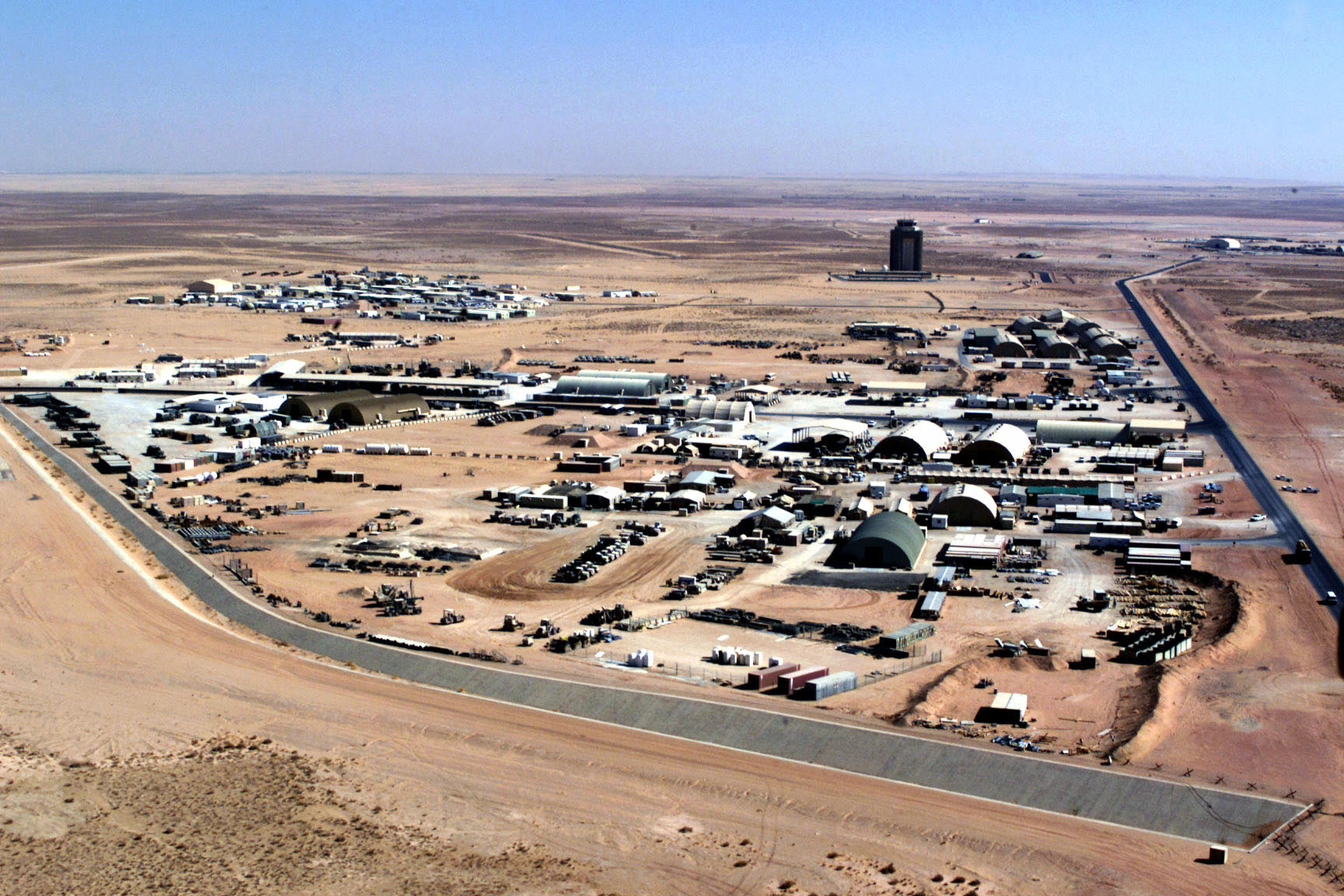
Prince Sultan Air Base sits approximately 60 kilometers south of Riyadh — close enough to the capital that its political sensitivity inside Saudi Arabia has shaped every phase of the US presence there. The base is wholly Saudi-owned and operated by the Royal Saudi Air Force. American personnel are guests, not tenants; they operate under a classified bilateral agreement whose terms have never been made public but whose essential structure is known from Congressional Research Service reporting: the US cannot fly combat missions from PSAB without Saudi authorization for each specific operation. There is no NATO-style Article 5 obligation, no Status of Forces Agreement that guarantees American operational freedom, no treaty mechanism that prevents Saudi Arabia from closing the gates on any given Tuesday for any given reason.
The history confirms this architecture. When the US Air Force first deployed to PSAB in November 1990 for Desert Storm, Saudi Arabia granted access because Saddam Hussein’s forces threatened the Kingdom directly — the access was conditioned on threat proximity, not extended as a permanent entitlement. After the 1996 Khobar Towers bombing killed nineteen American airmen at a different Saudi facility, the US consolidated at PSAB precisely because its distance from urban areas reduced political friction. But on August 26, 2003, after the Iraq invasion that Saudi Arabia had publicly vetoed, Defense Secretary Rumsfeld and the Saudi defense minister agreed to withdraw all US combat forces from the Kingdom — confirming that Saudi Arabia could terminate American access at political will, and would.
The US returned sixteen years later, on December 17, 2019, when the 378th Air Expeditionary Wing reactivated at PSAB with approximately 2,000 additional troops deployed for what the Air Force described as “strategic depth and defensive support.” The language was deliberate: defensive support, on Saudi terms, for Saudi-approved purposes. MBS allowed the Americans back because Iranian-backed Houthi drone attacks on Aramco facilities at Abqaiq and Khurais in September 2019 had demonstrated that Saudi Arabia needed the air defense depth that US Patriot batteries provided. The access was transactional from the first day of the return — and the May 2026 suspension demonstrated that the transaction has terms Riyadh can modify unilaterally and without notice.
Why Did Saudi Arabia Veto an Operation Designed to Protect Saudi Exports?
Saudi Arabia’s oil exports have crashed by 3.15 million barrels per day since the war began — a 30 percent production collapse from 10.4 million bpd in February to 7.25 million bpd in March, according to IEA data. The Yanbu bypass via the East-West Pipeline provides a ceiling of 4-5.9 million bpd, far below pre-war Hormuz throughput. Every day the Strait remains closed costs the Kingdom revenue measured in hundreds of millions of dollars. Reopening Hormuz is, on paper, the single most urgent Saudi economic interest in the world. And yet Riyadh killed the operation designed to reopen it.
The Saudi source who spoke to NBC News provided the logic plainly: the operation “would just escalate the situation and would not work.” This is not diplomatic hedging — it is an operational assessment that Project Freedom’s two-ship transit could not be scaled into sustained sea control against Iran’s layered denial architecture (mines, fast-attack craft, anti-ship cruise missiles, shore-based radar) without triggering the very escalation that would put Saudi oil infrastructure under renewed bombardment. Saudi Arabia’s PAC-3 inventory is depleted. Its critical facilities at Ras Tanura, Khurais, and the remaining Red Sea terminal infrastructure sit within range of Iranian ballistic missiles that have already demonstrated the ability to penetrate Saudi air defenses. The Kingdom was being asked to provide the air corridor for an operation whose failure mode was Iranian retaliation against Saudi targets that could no longer be defended.
A second layer runs beneath the operational calculus. The Saudi official who spoke to Al Arabiya framed the denial explicitly: “The Kingdom did not allow the use of its airspace to support offensive military operations” because Riyadh was pursuing de-escalation and supporting Pakistan-mediated talks. This is the public framing — and it is also true. Saudi Arabia occupies a position no other actor in this crisis holds: it is simultaneously the most damaged party (3.15 million bpd lost), the most active covert belligerent against Iran, the primary diplomatic interlocutor through whom Pakistan’s mediation flows, and now the operational veto-holder over American military escalation. These roles are not contradictory — they are the architecture of Saudi leverage, maintained by keeping all four functions active and refusing to collapse them into a single posture that would reduce Riyadh’s options.
The Paradox: Saudi Arabia Was Already Bombing Iran
Reuters reported on May 12 that Saudi Arabia conducted “numerous, unpublicized strikes on Iranian soil” in late March 2026 — strikes that achieved a 76 percent reduction in Iranian attacks on Saudi territory and oil infrastructure. This is the fact that makes the Project Freedom veto legible as strategy rather than weakness: Saudi Arabia was not refusing military action against Iran. It was refusing American military action conducted under American command for American strategic objectives, while simultaneously prosecuting its own covert campaign against Iranian targets that served Saudi strategic objectives. The distinction is the entire point.
The covert strikes gave MBS something the pre-war Saudi position never had: demonstrated willingness to use force against Iran directly, without American authorization, without American participation, and without American knowledge until Reuters broke the story weeks later. This is not a country hiding behind American power projection — it is a country that has already demonstrated independent escalation capacity and is now choosing, deliberately, which escalation pathways serve its interests and which do not. Project Freedom served American interests (reopening Hormuz for global trade, demonstrating US operational credibility, satisfying domestic political pressure on Trump) and Saudi Arabia determined that those American interests, in this specific operational form, conflicted with Saudi interests in managing escalation on a timeline Riyadh controls.
The Soufan Center captured the divergence on May 14: “Saudi Arabia favors accommodation with Iran; UAE believes military confrontation can produce transformative change.” But “accommodation” understates what Riyadh is doing. Saudi Arabia is not accommodating Iran — it is managing Iran through a combination of covert strikes, diplomatic positioning, and selective denial of American operational access that keeps Tehran uncertain about Saudi intentions while preventing Washington from collapsing the ambiguity through a unilateral military fait accompli that would force Riyadh to choose sides publicly.
What Did Iran Conclude About American Operational Freedom?
The most telling signal from Tehran was not what Iranian officials said — it was what they did not say. There was no celebration. PressTV ran the story straight: “Saudi Arabia denies opening airspace for US aggression against Iran,” and “Trump halted ‘Project Freedom’ after backlash from Saudi Arabia.” Tasnim published one line that captured the Iranian reading: “No one in Iran drafts plans to please Trump.” The IRNA military spokesperson, Brigadier General Mohammad Akraminia, warned of “surprising options” if adversaries made another “miscalculation,” promising any future aggression would take the conflict into areas “the enemy has not anticipated.” But there was no triumphalism, no public mockery of American weakness, no celebration of the Saudi decision.
This restraint reads as baseline confirmation rather than surprise. Iran’s military planners appear to have already incorporated Saudi non-cooperation into their operational assumptions — which means the veto told Tehran nothing it did not already know, but confirmed it with the kind of public evidence that hardens intelligence assessments into planning certainties. The Iranian parliament’s timing is instructive: the twelve-article Hormuz sovereignty law advanced through committee simultaneously with Project Freedom’s pause, treating the American operational humiliation not as a crisis requiring response but as a favorable condition to be exploited legislatively. Iran read the pause as structural, not tactical — and acted accordingly.
Iran’s formal negotiating position after the pause hardened rather than softened. Iran International reported on May 10 that Tehran’s demands now included war compensation and formal recognition of Iranian sovereignty over the Strait of Hormuz — positions that are not opening bids in a negotiation but maximalist claims designed to be tabled from a position of perceived strength. The Foundation for Defense of Democracies responded on May 11 that “Iran’s unacceptable deal means US must open the Strait of Hormuz by force” — but force, as May 4-7 demonstrated, requires permissions that the United States does not control and cannot guarantee.
Is the Saudi Veto a Rupture or a Pattern?
The Hill framed the May 2026 events as unprecedented: “Gulf states vetoed a major American initiative — something that would have been almost unthinkable only a year ago.” But the historical record suggests this is a feature of the US-Saudi relationship, not a rupture of it. The pattern repeats with mechanical regularity: when American military operations serve mutual interests and face mutual threats, Saudi Arabia provides access enthusiastically (Desert Storm, 1990). When American operations serve primarily American strategic interests and expose Saudi Arabia to retaliation risk without proportionate Saudi benefit, Riyadh says no — publicly or privately depending on the domestic political cost of each option.
The 2003 Iraq War is the cleanest precedent. Crown Prince Abdullah declared Saudi Arabia would not participate “under any condition or in any form” in the invasion of Iraq. The public veto was absolute — and it was theater. Privately, US aircraft flew from Saudi bases, US special forces staged from Saudi territory, and the operational cooperation continued beneath the rhetorical rejection. In 2026, the dynamic inverted: the public framing preserved alliance continuity (“pursuing de-escalation,” “supporting Pakistan mediation”) while the private reality was an absolute operational shutdown that grounded American air power for 72 hours. In 2003, Saudi Arabia said no publicly and yes privately. In 2026, Saudi Arabia said yes publicly and no operationally — a more dangerous configuration for American planners because it means Saudi cooperation cannot be assumed even when political signals appear favorable.
The structural difference between 2003 and 2026 is that the 2003 veto was manageable — the US had alternative invasion routes through Kuwait and could prosecute the Iraq campaign without Saudi basing, though at higher cost. The 2026 veto was operationally fatal because Hormuz operations cannot be conducted without Saudi airspace. There is no Kuwait workaround, no Turkish alternative, no carrier-based substitute that provides the persistent air coverage required for mine clearance and convoy escort in the world’s most confined maritime chokepoint. Saudi Arabia’s geographic position relative to the Strait makes its permission structurally non-substitutable in a way that its permission for Iraq operations was not.
| Year | US Operation | Saudi Public Position | Saudi Private Reality | US Workaround Available? |
|---|---|---|---|---|
| 1990-91 | Desert Storm | Full support (mutual threat) | Full access | N/A — access granted |
| 2003 | Iraq Invasion | “Not under any condition” | Quiet operational access | Yes — Kuwait primary route |
| 2026 | Project Freedom | “De-escalation / mediation” | Total operational shutdown | No — geography non-substitutable |
Why Didn’t the Market Believe Project Freedom Even Before the Pause?
Lloyd’s List reported that ship owners and insurers assessed the US operation had not given them “sufficient clarity or credible protection to justify resuming transits” — and this assessment predated the Saudi veto. The maritime industry’s skepticism reflected a professional judgment that two destroyer transits and two merchant vessel exits did not constitute the sustained sea-control environment required for commercial shipping to resume at scale. Mine clearance alone requires an estimated 51 days for the 200-square-mile threat area based on 1991 Kuwait benchmarks, and CENTCOM’s mine countermeasures capability in theater has degraded catastrophically since the four Avenger-class MCM ships were decommissioned from Bahrain in September 2025, leaving only two operational vessels for the entire Gulf.
The insurance market prices risk on demonstrated capability, not announced intention. Project Freedom demonstrated the ability to push a small task force through contested waters with massive overwatch — 15,000 personnel and 100+ aircraft supporting two commercial transits — but this force-to-transit ratio is economically absurd for sustained operations. Commercial Hormuz transit before the war averaged approximately 1,250 vessel movements per day; providing even a fraction of this coverage would require a force posture the US cannot sustain from carrier groups alone, which is precisely why the land-based air architecture (PSAB, Al Udeid, Ali Al Salem) is operationally necessary rather than merely convenient. When Saudi Arabia removed the land-based component, the mathematical impossibility of carrier-only sustained operations became publicly visible to every shipowner with a calculator.
The market’s pre-veto skepticism and post-veto confirmation created a compounding credibility problem for any future attempt. Even if the US restores Saudi access and relaunches Project Freedom, commercial operators now know that Saudi Arabia can withdraw permission at any moment for any reason, that Iran’s parliament is legislating sovereignty claims over the Strait, and that the US force posture depends on access that is politically contingent rather than legally guaranteed. This is not a risk that war-risk insurance can price — it is an uncertainty that paralyzes decision-making entirely, which is why the 45 transits recorded since the April 8 ceasefire represent just 3.6 percent of a single pre-war day’s traffic volume despite nominal de-escalation.
What Comes After the Veto
The question RANE/Stratfor posed — that “Riyadh effectively vetoed the US’ Project Freedom” — is now settled fact, not analytical speculation. What remains unsettled is whether Washington’s acceptance of the veto reflects a tactical choice to preserve the Saudi relationship for a future operation under conditions MBS would accept, or a structural acknowledgment that the US cannot execute Gulf military operations against Saudi political will and must therefore adjust its entire regional strategy to accommodate this constraint. The difference matters for every actor in the region calculating their next move.
If tactical, the US will attempt to rebuild Saudi buy-in through concessions — perhaps offering Riyadh a veto mechanism over operational timing, or tying Hormuz reopening to ceasefire progress benchmarks that Saudi Arabia co-designs, or providing air defense replenishment (PAC-3 interceptors, THAAD rounds) that reduces Saudi vulnerability to Iranian retaliation. The reverse co-belligerent trap that Saudi Arabia has constructed — simultaneously bombing Iran and blocking American bombing of Iran — gives MBS maximum leverage in this negotiation because he can offer or withhold both cooperation vectors independently. Washington needs Saudi permission to fly; MBS needs American interceptors to defend. The trade is obvious but its terms will be Saudi-set.
If structural, the implications cascade outward. A United States that cannot unilaterally reopen the world’s most important maritime chokepoint because a single regional partner holds geographic veto power is a United States whose security guarantees across the Indo-Pacific become subject to similar questions from every allied nation hosting American forces. Japan, South Korea, the Philippines, Australia — every country that provides basing access will register that Saudi Arabia denied permission, the operation stopped, and the American president absorbed the humiliation rather than pursue alternatives. The FDD’s May 11 demand that the US “must open the Strait of Hormuz by force” runs into the geographic reality that force requires Saudi territory, and Saudi territory requires Saudi consent, and Saudi consent has been demonstrated to be conditional on Saudi strategic interests rather than American requests.
MBS now holds a position no Saudi ruler has occupied since the Kingdom’s founding: the demonstrated ability to ground American military power in the Gulf through a single decision, exercised and confirmed, with the world watching. The Custodian of the Two Holy Mosques has acquired a third custodianship — over the airspace corridor that connects American power to its primary theater of operations — and the rental terms have just been publicly repriced.
That leverage has a countdown attached. The diplomatic capital MBS accumulated through the base-denial framework and the May 18 stand-down call must now be converted into a concrete deliverable on the Iranian file — how MBS is deploying that Saudi leverage in the 48-hour window that opened when Trump cancelled the strike.
FAQ
Did the US have any legal right to use Prince Sultan Air Base without Saudi permission?
No. The basing arrangement at PSAB is governed by a classified bilateral agreement, not a treaty ratified by either country’s legislature. Congressional Research Service reporting confirms the US requires Saudi authorization for each specific combat operation launched from the base. Unlike NATO’s Article 5 framework or US-Japan SOFA arrangements, there is no mechanism that compels Saudi cooperation and no international arbitration body with jurisdiction. The US operates at PSAB entirely on terms Riyadh sets — making every deployment there legally revocable without notice, as May 4-7 demonstrated in practice.
Could the US have conducted Project Freedom using only naval assets without land-based air support?
Theoretically possible for short-duration transits but operationally unsustainable for the mine-clearance and convoy-escort mission Project Freedom required. Carrier air wings can provide approximately 120-150 sorties per day — sufficient for combat operations but insufficient for the 24/7 air superiority umbrella needed over a 200-square-mile mine-threat area while simultaneously protecting commercial convoys. Land-based tanker aircraft (KC-135s, KC-46s) extend fighter endurance from roughly 90 minutes to 4-6 hours per sortie; without tankers operating from regional bases, carrier aircraft burn fuel at rates that halve effective coverage. The CSIS assessment that the operation “exposed the limits of what air power can achieve against a mine-and-swarm naval denial strategy” reflects this mathematics.
Has any other US ally denied military access during an active operation?
Turkey denied the US Fourth Infantry Division transit rights for the 2003 Iraq invasion (parliamentary vote, March 1, 2003), forcing a weeks-long rerouting through the Suez Canal to Kuwait. France refused US overflight rights for the 1986 Operation El Dorado Canyon strike on Libya, adding 1,300 nautical miles to the F-111 mission profile and requiring multiple additional aerial refuelings. But neither denial was as operationally fatal as Saudi Arabia’s May 2026 action because both had geographic workarounds — Turkey’s denial delayed but did not prevent the northern front, and France’s denial complicated but did not block the Libya strike. The Saudi veto had no workaround because the geography offers none.
What leverage does the US have to prevent Saudi Arabia from exercising this veto again?
The traditional American leverage over Saudi security policy — arms sales conditionality, extended deterrence guarantees, intelligence sharing — is limited and declining, eroded by Saudi Arabia’s demonstrated willingness to conduct independent military operations against Iran without US coordination or approval. The Reuters-reported covert strikes on Iranian soil removed the dependency that previously gave Washington influence: if Saudi Arabia can achieve a 76 percent reduction in Iranian attacks through its own strikes, the marginal value of American combat operations launched from Saudi territory diminishes relative to the political cost of hosting them. Saudi Arabia’s $142 billion in accumulated US weapons purchases also creates reverse leverage — the sunk-cost architecture makes Washington reluctant to impose consequences that might push Riyadh toward alternative suppliers.
What does Iran’s twelve-article Hormuz sovereignty law actually require?
Iran’s parliament advanced the law through committee simultaneously with Project Freedom’s pause; its reported provisions include: mandatory IRGC authorization for all commercial transits, a per-vessel fee structure to be set by the Supreme National Security Council, a prohibition on passage by vessels linked to states that Iran designates as hostile, formal Iranian sovereignty recognition over the Traffic Separation Scheme lanes currently governed by IMO regulations, and a requirement that any foreign naval transit receive written IRGC Navy clearance at least 72 hours in advance. If enacted, the law would make every Hormuz transit a de facto act of Iranian administrative compliance — converting an international waterway into a nationally licensed corridor and rendering UNCLOS Article 38 transit passage rights legally contested under Iranian domestic law.
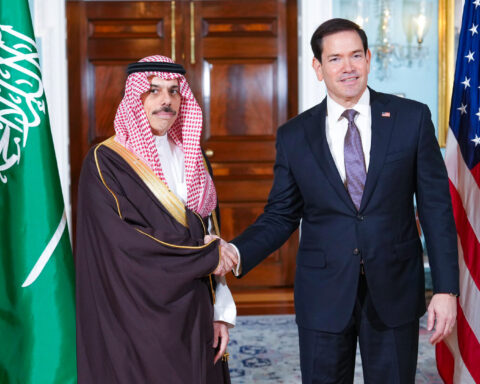
Three days after Project Freedom paused, Iran moved to formalize the Hormuz control that had just outlasted the US operation: First VP Aref declared Hormuz sovereignty “established and closed,” parliament security chief Azizi announced the PGSA toll mechanism would be “unveiled soon,” and European shipowners began negotiating with the IRGC Navy. That convergence is reported in Iran Announces Formal Hormuz Toll Mechanism — 74 Days After the IRGC Already Built One. On the same day Saudi Arabia issued the grounding order, Tom Barrack was in Riyadh briefing Prince Faisal — evidence that the airbase decision and Saudi Syria co-sponsorship are components of one transaction. What the May 5 precedent means for the NSC’s May 19 war cabinet — and the structural gap between authorization in Washington and execution on the ground — is examined in what the May 19 NSC meeting actually decides.
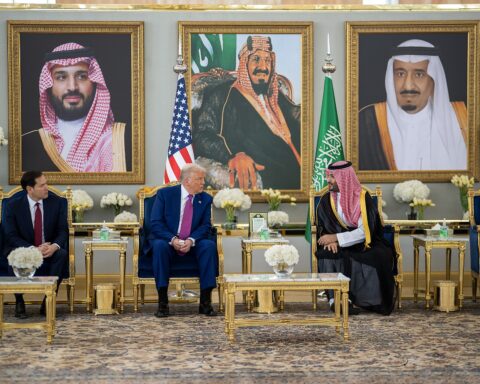
The transaction that enabled the May 5 grounding order — and that gave MBS the standing to place the May 18 stand-down call — was operating within a relationship whose terms Trump had publicly described thirteen days earlier: what Trump told 1,500 Saudi investors about MBS at the FII Miami summit on March 27 is the public record that Tehran and Riyadh both hold. The same base-denial logic that grounded US aircraft from Al Dhafra also blocked the counter-battery operations that might have stopped the Iraqi drones that struck Barakah on May 18 — how the UAE’s consent architecture became Iran’s permissive environment. The base-denial framework that blocked US strikes from Al Dhafra has no equivalent when the pilot wears an IDF patch: why Saudi Arabia cannot stop an Israeli strike on Iran — and the hardware Netanyahu has already acquired to prove it.