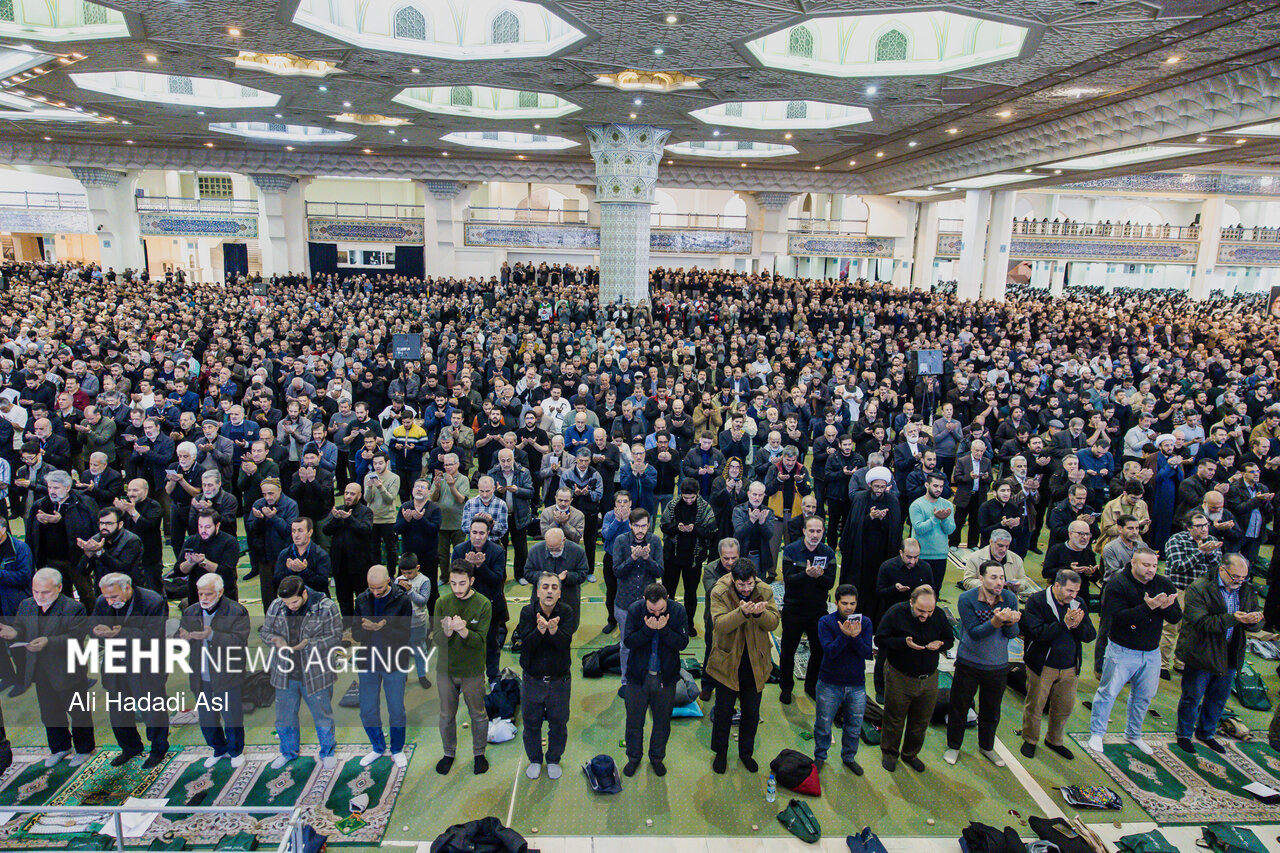
TEHRAN — Mohammad Rasouli stood at the official podium of Imam Khomeini Grand Mosalla on July 5 and told the crowd that killing the president of the United States was a religious duty. “Why is the most bastard man in the world still alive?” he asked. “Trump’s killing is our duty.” The crowd cheered. Rasouli was not a mourner who seized a microphone. He was the ceremony emcee — the figure selected by the IRGC-managed program committee to structure the entire pre-prayer portion of Ali Khamenei’s state funeral.
The threat landed on Day 18 of the Islamabad Memorandum of Understanding, during a five-day diplomatic pause that both parties had agreed to observe for the funeral. Parliament Speaker Mohammad Bagher Ghalibaf, the MOU’s chief Iranian negotiator, must now return to the table after July 9 carrying the weight of an internationally broadcast assassination call that came from the same state apparatus whose compliance the agreement requires. The PGSA fee-free window expires around August 18. The funeral consumed five of the forty days between the pause’s end and that deadline producing a mandate-hardening event that makes the remaining thirty-five harder to use.
Table of Contents
- The Emcee, the Podium, and the IRGC Program Committee
- Who Authorized Rasouli’s Inclusion?
- What Did the Five-Day Sequence Produce?
- The Assembly Has Already Voted
- Can Ghalibaf Negotiate Through the Aftermath?
- Moscow Owns the Succession Information Architecture
- What Happens Between July 9 and August 18?
- 1989 in Reverse
- Frequently Asked Questions
The Emcee, the Podium, and the IRGC Program Committee
Rasouli’s formal role matters. He was not a eulogy speaker delivering prepared remarks from a printed text. He was the emcee who ran the pre-prayer program — the figure who sets pacing, introduces segments, and fills the intervals between formal addresses. His selections reflect the program committee’s intent. Hassan Hassanzadeh, commander of the IRGC’s Tehran division, was identified by ABC News and CBS News as the official “in charge of funeral ceremonies.” Hassanzadeh announced the prayer schedule on state television. The program committee reported to him.
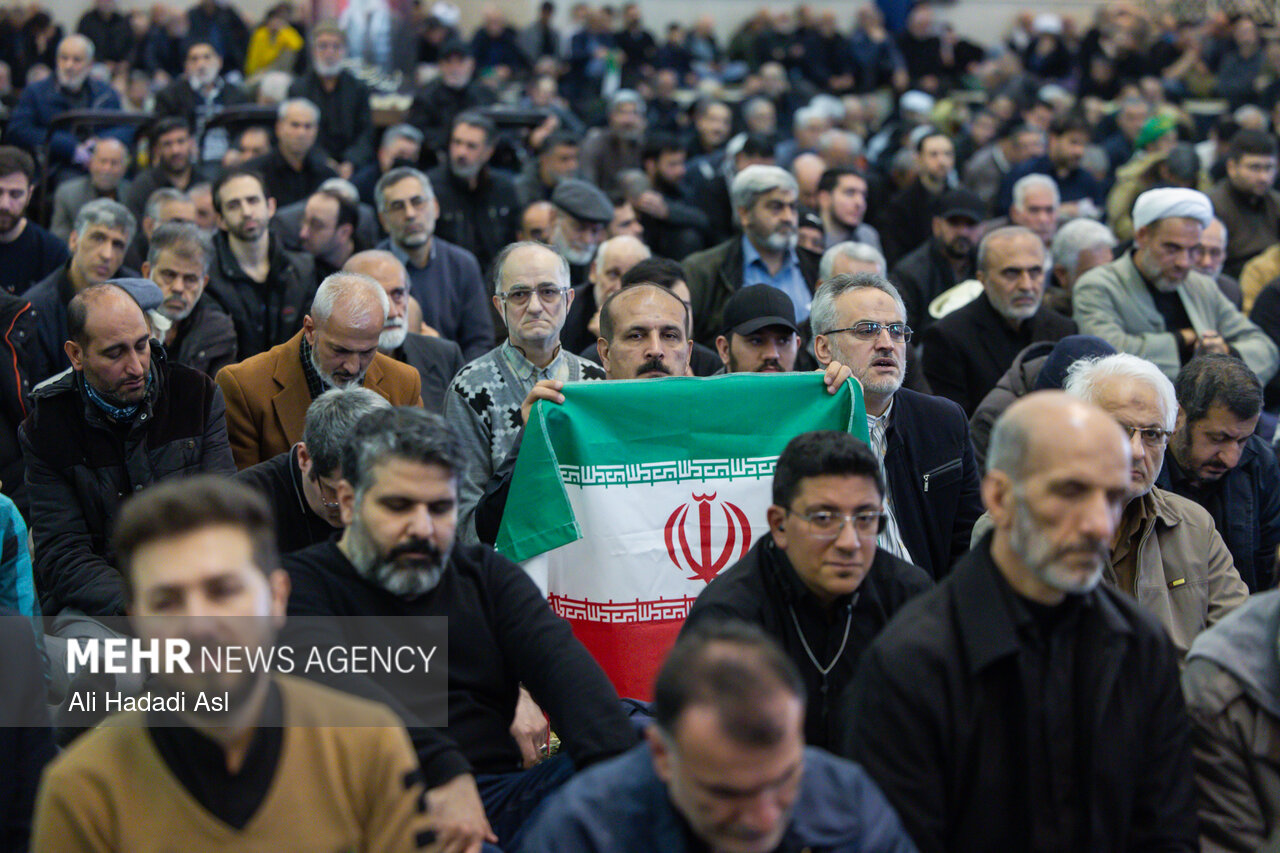
An emcee at a state funeral of this magnitude does not freelance. The IRGC controlled physical access to the Grand Mosalla, managed the crowd, and structured the broadcast feed that state television carried to a domestic audience of tens of millions. Rasouli’s remarks — “Why should we not kill the man who killed my Imam?” and “It would be a disgrace if we did not kill your killer” — ran on that feed without interruption. Kill-Trump posters and banners were visible inside the venue, carried by mourners who had passed through IRGC security checkpoints to enter.
The AP wire described Rasouli’s statements as “the first direct threat to Trump’s life by an official during the funeral.” The word “official” is doing load-bearing work. It distinguishes Rasouli from the crowd chanting “Death to America” — a ritual incantation at Iranian state events since 1979 — and places his words inside the institutional architecture of the ceremony. The Times of Israel and IBTimes UK separately documented the kill-Trump posters and graffiti at the Grand Mosalla.
Who Authorized Rasouli’s Inclusion?
No Iranian government official or spokesperson had publicly rebuked Rasouli’s remarks as of July 5. IRNA, the state news agency, issued no distancing statement. The Foreign Ministry offered no clarification. Ghalibaf, whose negotiating position depends on maintaining the MOU as a legitimate instrument, said nothing about the podium remarks. The silence is the answer to a question that no Iranian institution will pose in public.
The Middle East briefing 3,000+ readers start their day with.
One email. Every weekday morning. Free.
The non-response follows the structural pattern of previous ceremony-driven incitement at Iranian state events — with one difference. Previous “Death to America” chants carried the protection of ritual: they were ambient, collective, and deniable as cultural performance rather than operational intent. Rasouli’s remarks were specific, individual, and attributable. He named Trump. He called for his killing from the podium, not from the crowd. And the program committee that placed him there reported to an IRGC commander.
Ahmad Vahidi, the IRGC commander-in-chief, sat next to Khamenei’s casket throughout the ceremony — a rare open-air appearance for a figure whose assassination risk is among the highest in Iran’s security establishment. Al Jazeera and Outlook India described Vahidi’s presence as “a costly, verifiable signal” of IRGC command continuity and reconstitution capacity. He was advertising survival, not mourning. Hassanzadeh’s program committee, which reported to Vahidi’s command structure, placed Rasouli behind the microphone.
What Did the Five-Day Sequence Produce?
The funeral did not arrive in isolation. It capped a five-day sequence — July 1 through July 5 — in which the state apparatus systematically narrowed Ghalibaf’s diplomatic space while widening the hardline baseline. Each day produced a discrete escalation that Ghalibaf did not control and could not publicly contest.
On July 1, IRIB — Iran’s state broadcaster — cut short Ghalibaf’s television interview when he began discussing Iran’s nuclear commitments under the MOU. Parliament accused IRIB of censorship. The accusation produced no institutional consequence. IRIB continued broadcasting.
On July 3, Ghalibaf told ISNA: “If US and Zionist regime fail to fulfil commitments, Iran will resume proportionate actions.” The statement was hedged — conditional, attributed to the other side’s failure, phrased in the language of compliance rather than aggression. Ghalibaf offered a floor, not a ceiling.
On July 5, the IRGC-managed funeral ceremony gave the podium to a poet who called for Trump’s assassination. The arc — from censorship to conditional threat to explicit kill-call — traced a five-day escalation with a clear structural outcome: the negotiator was muted on Day 1, hedged on Day 3, and rendered subordinate on Day 5.
| Date | Event | Actor | Platform |
|---|---|---|---|
| July 1 | IRIB cuts Ghalibaf interview on nuclear commitments | IRIB (state broadcaster) | Television |
| July 2 | Doha round 2 ends with “positive progress” | Qatar mediators | Diplomatic channel |
| July 3 | “Resume proportionate actions” if commitments unmet | Ghalibaf | ISNA interview |
| July 3 | Mojtaba Khamenei absent from father’s funeral | — | Tehran ceremony |
| July 4 | Doha talks suspended for funeral pause (July 4–9) | Both parties | Diplomatic channel |
| July 4 | “We gave them a week off” | Trump | America 250 celebration |
| July 5 | “Trump’s killing is our duty” | Rasouli (ceremony emcee) | Grand Mosalla podium |
Iran International had warned before the funeral that “past funeral disasters cast a shadow over Khamenei’s burial” — a reference to the 1989 Khomeini funeral chaos and the 2020 Soleimani funeral stampede in Kerman that killed 56. The IRGC’s acute institutional sensitivity about ceremonial control, forged by those two failures, makes Rasouli’s inclusion a committee decision. Hassanzadeh’s designation as ceremony director carried direct institutional accountability for every figure who reached the podium.
The Assembly Has Already Voted
The funeral did not create the institutional opposition to Ghalibaf’s negotiating position. It amplified machinery that was already running. Sixty-two of eighty-eight members of the Assembly of Experts — 70.5 percent — had issued a statement before the funeral calling the Hormuz reopening under the MOU a “strategic mistake” and urging negotiators to hold to the elder Khamenei’s red lines. The Assembly is the constitutional body empowered to supervise the Supreme Leader. Its members were telling the new Supreme Leader, before his father was buried, that the agreement his predecessor’s government signed was illegitimate.
The Paydari Party — the ultra-hardline faction led by Saeed Jalili — had gone further. The party formally accused Ghalibaf and President Pezeshkian of “staging a constitutional coup” through the Doha MOU. The accusation rested on Article 77 of the Iranian constitution, which requires parliamentary ratification for treaties. The MOU was structured to avoid that requirement. The Paydari argument is that the avoidance was itself the violation — that calling a treaty a memorandum does not strip the Majlis of its constitutional prerogative.
Three documented instances buttress the “coup” charge. Iranian lawmakers stated that Ali Khamenei gave Ghalibaf specific instructions not to enter nuclear negotiations — on April 4, on April 18, and in early May 2026. Each instruction was recorded. Each is now cited by Ghalibaf’s opponents as evidence that the MOU was signed against the Supreme Leader’s explicit wishes. A dead leader’s documented objections, in a system where the Supreme Leader’s word is constitutionally supreme, are not subject to reinterpretation by the man who issued them.
Fox News and Responsible Statecraft reported that Jalili is expected to replace Ghalibaf as Iran’s lead negotiator in the US nuclear talks. The appointment, if confirmed, would represent a documented return to maximum-resistance posture. Jalili’s six-year tenure as chief nuclear negotiator from 2007 to 2013 produced three UN Security Council sanctions resolutions — 1803 (2008), 1929 (2010), and 1984 (2011) — and zero enrichment suspension agreements.
Can Ghalibaf Negotiate Through the Aftermath?
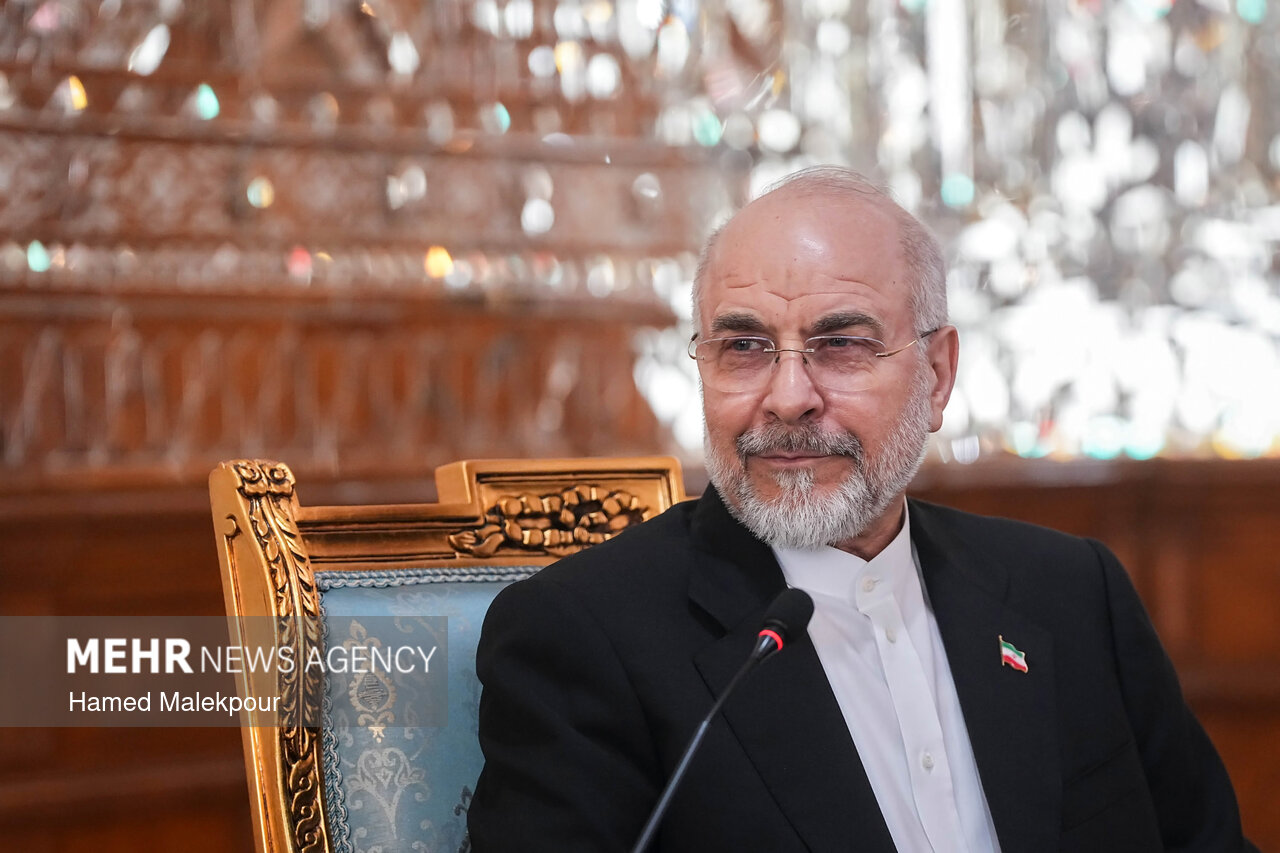
Ghalibaf’s position after the funeral rests on an irreconcilable pair of obligations. To preserve the MOU as a functioning instrument, he must distance himself from an assassination threat that the state funeral’s own program committee authorized. To survive politically in a system where the MOU is already framed as a constitutional coup, he cannot distance himself from the ceremony that buried the Supreme Leader and set the post-funeral domestic baseline.
Mojtaba Khamenei’s June 18 statement on the MOU — “In principle, I held a different opinion” — had already positioned the new Supreme Leader at arm’s length from the agreement his government negotiated. The funeral compressed that distance into something more binding. The ceremony’s broadcast reach, the crowd’s response to Rasouli, the kill-Trump posters inside the IRGC-controlled venue — these constitute a televised mandate that a new, untested Supreme Leader cannot easily walk back. Mojtaba did not attend, but the funeral broadcast what he could not say from a podium he did not occupy.
Ghalibaf’s July 3 ISNA statement now reads differently in the post-funeral context. “If US and Zionist regime fail to fulfil commitments, Iran will resume proportionate actions” was, at the time, a conditional threat designed to preserve negotiating room — the kind of hedged language that keeps both escalation and de-escalation available. After the funeral, the state podium has called for the other side’s president to be killed. Proportionate actions are now the moderate position.
Article 176 of the Iranian constitution requires the Supreme Leader’s confirmation for all Supreme National Security Council decisions. Ghalibaf cannot sign, ratify, or amend the MOU without Mojtaba’s approval. A Supreme Leader who has publicly expressed reservation about the agreement — and whose father’s funeral produced the kill-threat — has no institutional incentive to provide that confirmation. Ghalibaf’s constitutional ceiling is set by a man he cannot reach, whose physical condition is uncertain, and whose political preferences have been expressed in a single ambiguous sentence.
Moscow Owns the Succession Information Architecture
The funeral produced a second structural anomaly that has attracted less attention than Rasouli’s podium remarks but may prove more durable. Mojtaba Khamenei, Iran’s new Supreme Leader, was absent from his father’s burial. Three of his brothers — Mostafa, Meysam, and Masoud — stood at the casket. Mojtaba did not appear.
The most authoritative public statement about Mojtaba’s whereabouts came not from Tehran but from Moscow. Russian Ambassador to Iran Alexey Dedov told RTVI on March 31: “As the Iranian leadership has stated repeatedly, the new leader is in Iran, but for obvious reasons, he is refraining from appearing in public.” Iran’s own ambassador in Moscow denied separately, via TASS and Al Arabiya English on March 17, that Mojtaba was receiving medical treatment in Russia — a denial that addressed a specific claim while confirming nothing about his actual condition or location.
Reuters reported, citing three sources, that Mojtaba sustained facial disfigurement and leg damage in the attack that killed his father. The New York Times, citing four officials, added that he had undergone three leg surgeries with a prosthetic pending and sustained facial burns. These reports, if accurate, reframe the 127-day public absence as physical incapacitation rather than strategic concealment.
The funeral itself registered Mojtaba’s absence in a way that official statements have not. State media pre-assigned funeral prayers across three cities — Sobhani for Tehran, Makarem Shirazi for Qom, Nouri Hamedani for Mashhad — before the ceremony began. The assignments were a logistical accommodation for a Supreme Leader who could not attend his own father’s burial, and a tacit institutional admission of what Tehran’s official position denies: that Mojtaba’s absence is not a choice but a constraint.
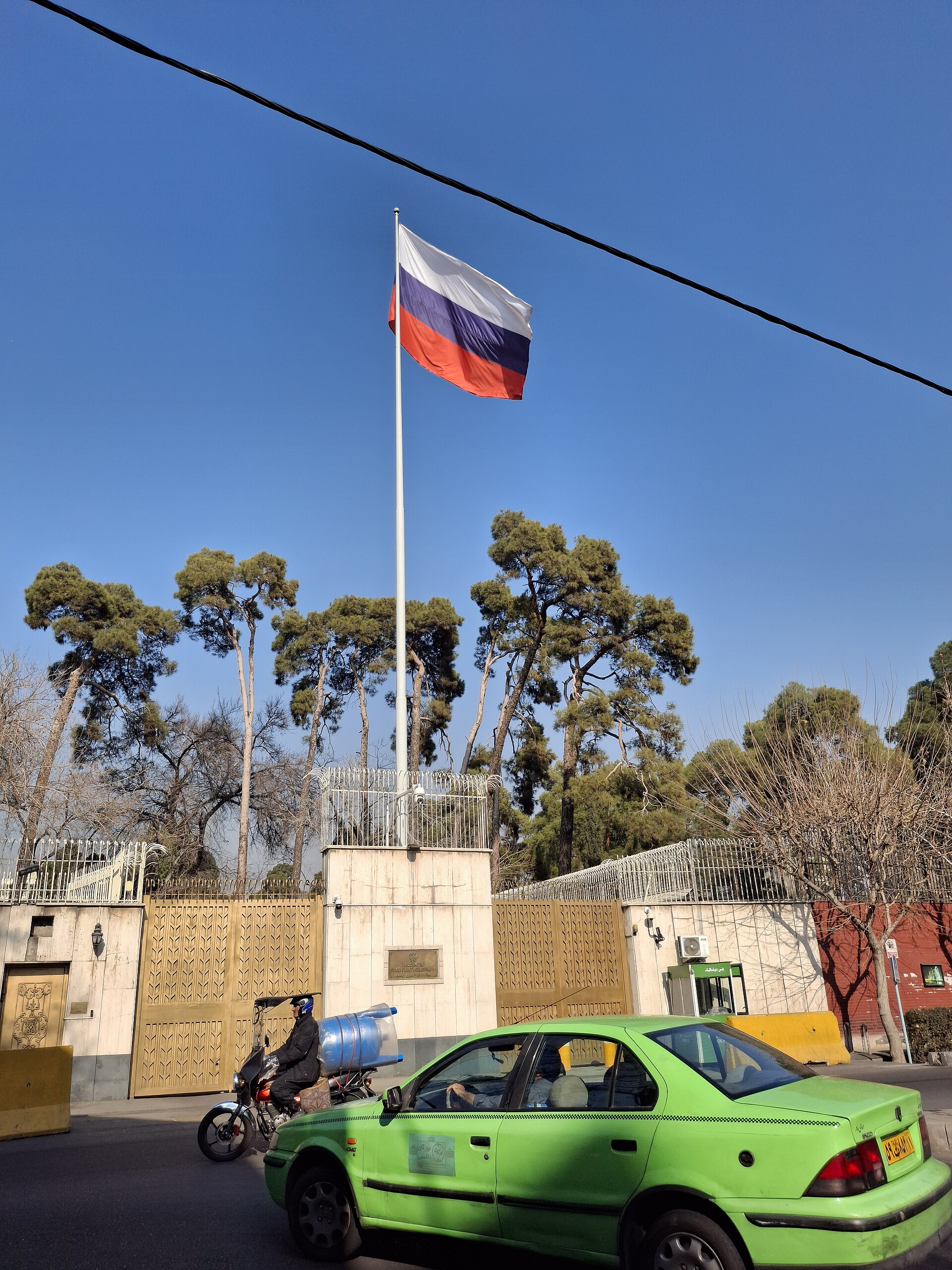
Dedov’s statement placed Russia — not Iran’s own government, not the IRGC, not the Assembly of Experts — in the position of confirming the Supreme Leader’s status to an international audience. When the most reliable public data point about the Iranian head of state’s location comes from a Russian diplomat speaking to a Russian outlet, the succession file has acquired a dependency that no MOU clause contemplated. Ghalibaf negotiates on behalf of a state whose leader’s condition is verified by a third country. The delegations in Doha know this.
What Happens Between July 9 and August 18?
The funeral pause expires after July 9. The PGSA fee-free window closes around August 18, when $5.5 million per day in Hormuz transit fees activate automatically — requiring no Iranian government decision, no Supreme Leader confirmation, no SNSC vote. Saudi Arabia’s total exposure stands at $253 million. The interval between Doha’s expected resumption and the fee deadline is forty days.
Qatar confirmed that the second Doha round produced “positive progress made on issues related to the Islamabad Memorandum of Understanding, building on the outcomes of the Lake Lucerne Summit.” The phrase “positive progress” is diplomatic boilerplate for movement without agreement. The specifics were process wins, not substantive concessions: a goods-purchase mechanism for $6 billion in frozen Qatar-held assets, restricted to humanitarian uses with no cash transfers, and a communication channel for MOU violation complaints that Iran used immediately — flagging what it described as a US violation of Clause 1, the Lebanon ceasefire provision.
The MOU’s public framework and its private reality had already diverged before the funeral. Trump told Defense Secretary Hegseth and General Caine privately, according to the Wall Street Journal, that he is comfortable letting the August 18 deadline slip. The PGSA auto-activates on lapse. The financial pressure falls on transit states — principally Saudi Arabia — not on Washington. Trump’s public framing at his July 4 celebration — “we gave them a week off” — characterized the funeral pause as an American concession. PressTV carried the funeral under the banner of Ali Khamenei as a “martyred leader,” the term shahid invoking the jurisprudential obligation of vengeance. Neither party arrived at the same event.
The Islamabad track adds a further complication. Al Hadath and Al Arabiya confirmed July 11 as the date for direct talks in Pakistan’s capital, with nuclear issues explicitly on the agenda — sanctions, frozen funds, and the enrichment question. Army Chief Munir, who co-signed the MOU and attended Khamenei’s funeral alongside Prime Minister Sharif, carries dual credentials: IRGC ties dating to 2016-17 and his role as a Doha co-signatory. He is, at present, the only figure with standing in both the diplomatic and military dimensions of the process. Saudi Arabia has no seat, no signatory status, and no observer role at the Islamabad table.
Ghalibaf returns to that table — if he remains the negotiator — facing a counterpart whose assassination his own state ceremony called for from an official podium. Trump returns to a process whose deadline he privately considers optional. Between them sits a forty-day window, a $253 million fee mechanism, and Rasouli’s recorded remarks on the AP wire.
1989 in Reverse
Iran’s last Supreme Leader transition followed a different trajectory. When Ruhollah Khomeini died in June 1989, Akbar Hashemi Rafsanjani managed the funeral period to consolidate Ali Khamenei’s authority before hardline factions could organize opposition. Rafsanjani used the mourning window to build consensus inside the Assembly of Experts, secure the succession vote, and present the new Supreme Leader as a fait accompli. The funeral was a tool of succession management. The hardliners were outpaced by the ceremony’s own timeline.
The 2026 funeral inverts that mechanism. The hardliners are the organized faction. They hold 70.5 percent of the Assembly. They control the Paydari Party’s “coup” narrative. They run the IRGC apparatus that managed the ceremony. They placed Rasouli at the podium. They used the mourning window — and the diplomatic pause it created — to set a post-funeral baseline that constrains the incoming Supreme Leader rather than empowering him. The same institutional mechanism that built Ali Khamenei’s authority in 1989 has been used against his son’s in 2026.
Mojtaba Khamenei inherits a system in which his father’s funeral narrowed his options. His June 18 reservation about the MOU — “In principle, I held a different opinion” — may have been a genuine policy preference or a survival statement issued under institutional pressure. The funeral converted it from a private caveat into a public mandate. The ceremony broadcast what the new Supreme Leader cannot unsay, amplified it to an audience of millions through state television, and framed it with the specific, attributed, AP-reported call for the assassination of the treaty partner.
Frequently Asked Questions
What did Trump say about the funeral and Iran at his July 4 celebration?
At the America 250 celebration on July 4, Trump said: “We’ve had tremendous success. You look at Venezuela, you look at Iran. We wiped it out, wiped out their military.” He also characterized the funeral pause as a unilateral American concession — “we gave them a week off.” The framing places the pause inside a narrative of American dominance and generosity, which is structurally irreconcilable with Iran’s “martyrdom” framing of the same event. The Wall Street Journal separately reported that Trump privately told Defense Secretary Hegseth and General Caine he would not resume strikes and was comfortable with the August 18 PGSA deadline slipping — a private posture that contradicts the public bravado.
What is the Paydari Party’s specific constitutional argument against the MOU?
The Paydari (Stability Front) Party, led by Saeed Jalili, argues that the Islamabad MOU is a de facto treaty requiring parliamentary ratification under Article 77 of the Iranian constitution. By structuring the agreement as a memorandum of understanding, Ghalibaf and Pezeshkian bypassed the Majlis — which Paydari characterizes as a constitutional coup. The Eastern Herald reported on July 3 that the faction had formalized this accusation in writing. The legal argument draws additional force from the three documented instances in which Ali Khamenei instructed Ghalibaf not to enter nuclear negotiations — April 4, April 18, and early May 2026 — creating a paper trail of the deceased Supreme Leader’s explicit opposition that the Paydari faction treats as binding precedent.
What happened at Khomeini’s 1989 funeral that shapes IRGC ceremonial sensitivity today?
Khomeini’s June 1989 funeral became one of the most chaotic state ceremonies in modern history. Mourners overwhelmed the burial site at Behesht-e Zahra cemetery, and the body fell from its coffin during the procession — images broadcast live on Iranian state television. The IRGC used helicopters to retrieve the body, and the burial was delayed by hours. Iran International noted in pre-funeral coverage that “past funeral disasters cast a shadow over Khamenei’s burial.” The 2020 Soleimani funeral stampede in Kerman — which killed 56 — reinforced the institutional memory. Hassanzadeh’s formal designation as ceremony director for the 2026 funeral, and the IRGC’s total control over Grand Mosalla access, reflect direct lessons from both failures. The tight program control makes Rasouli’s podium inclusion a product of institutional design, not oversight.
Who is Saeed Jalili and what does his negotiating record suggest?
Jalili served as Secretary of Iran’s Supreme National Security Council and chief nuclear negotiator from 2007 to 2013. His tenure is defined by three UN Security Council sanctions resolutions — 1803 (March 2008), 1929 (June 2010), and 1984 (December 2011) — and zero enrichment suspension agreements. Iran’s centrifuge count expanded from approximately 3,000 to over 19,000 during his watch. He lost the 2013 presidential election to Hassan Rouhani, whose campaign was built on reversing Jalili’s approach. His expected appointment as Ghalibaf’s replacement in the nuclear talks, reported by Fox News and Responsible Statecraft, would return Iran to the negotiating posture that produced maximum diplomatic isolation alongside maximum nuclear expansion — a combination that the MOU was designed to avoid.
What is the PGSA and why does the August 18 deadline matter for Saudi Arabia?
The Persian Gulf Security Agreement is Iran’s framework for imposing transit fees on commercial shipping through the Strait of Hormuz. Under the MOU, Iran agreed to suspend fee collection temporarily. That suspension expires around August 18, 2026. On lapse, fees of approximately $5.5 million per day activate automatically — requiring no Iranian government action, no Supreme Leader signature, and no SNSC authorization. Saudi Arabia faces total exposure of roughly $253 million as the Gulf’s largest oil exporter by tanker volume. OFAC sanctioned the PGSA’s administering entity on May 27, 2026, but the sanctions target the institution, not the fee mechanism — meaning auto-activation occurs regardless of the US sanctions regime. The automatic nature of the trigger is the structural hazard: neither Ghalibaf’s political survival nor Mojtaba’s medical condition affects whether the fees begin.