Introduction: The Kingdom of One
As of early 2026, the Kingdom of Saudi Arabia stands at a historical precipice, shaped less by the collective will of the House of Saud and more by the singular, unyielding vision of one man: Crown Prince Mohammed bin Salman (MBS). What was once a sprawling, multi-polar monarchy defined by cautious consensus among senior princes has been surgically reconstructed into a vertical, hyper-efficient, and occasionally ruthless autocracy.
The year 2026 marks a symbolic and practical turning point. King Salman bin Abdulaziz, now 90 years old and largely withdrawn from the public eye, remains the vital link between the old guard and the new era. Yet, his role is increasingly that of a ceremonial patriarch, providing the “Salmanic” seal of legitimacy to a radical domestic and foreign policy overhaul that his predecessors would have found unrecognizable.
The “New Saudi Arabia” is no longer a kingdom managed by a committee of brothers. It is a nation-state under the total management of the Salman branch. The transition of power—once the greatest source of regional anxiety—has already happened in every way but the formal title.
This deep dive examines the internal mechanics of this dominance, the shadows cast by those who have been sidelined, and the fragile but high-stakes social contract that now binds the Saudi people to their future King.
The Sidelined and the Shadowed: Internal Family Tensions
To understand the Saudi Royal Family in 2026, one must first look at who is not in the room. The traditional power centers of the House of Saud—the branches of King Faisal, King Abdullah, and the once-mighty Sudairi Seven—have been systematically dismantled or neutralized. In their place is a generation of technocrats and “Princes of the New Order” who owe their status entirely to the Crown Prince.
The Twilight of the Senior Princes
The most striking feature of the 2026 royal landscape is the near-total invisibility of the Kingdom’s senior statesmen. Prince Ahmed bin Abdulaziz, the King’s last surviving full brother and a long-time hopeful for the throne, remains in a state of “monitored retirement.” His arrest in 2020 on allegations of treason sent a message that has echoed clearly for six years: biological proximity to the King is no longer a shield.
The Middle East briefing 3,000+ readers start their day with.
One email. Every weekday morning. Free.
Similarly, Mohammed bin Nayef (MBN), the former Crown Prince and counter-terrorism darling of the West, exists as a ghost in the system. While rumors regarding his health and location periodically surface in international intelligence circles, his domestic influence has been ground to zero. The security apparatus he once commanded—the Ministry of Interior—has been hollowed out and replaced by the Presidency of State Security, a body reporting directly to MBS.
The “Erasure” of the Former Branches
Beyond the senior brothers, the descendants of previous monarchs—King Saud, King Faisal, and King Abdullah—have seen their influence eroded through a strategy of “Bureaucratic Displacement.”
- The Faisal Branch: Historically known for their diplomatic savvy and high education (most notably Prince Turki al-Faisal, former intelligence chief), the Faisals have been moved into purely cultural or advisory roles. Their voice in foreign policy, once dominant, has been replaced by the more aggressive stance of the Salman-loyalist core.
- The Abdullah Branch: The sons of the late King Abdullah bin Abdulaziz Al Saud (the former Mutaib bin Abdullah, commander of the National Guard) were hit hardest during the 2017 purge. By 2026, the SANG (Saudi Arabian National Guard), once a “private army” for this branch, has been fully integrated into a unified command structure under Prince Khalid bin Salman at the Ministry of Defense. This effectively ended the era where different royal branches controlled different military arms—a key safeguard against absolute centralized power that used to define the Kingdom.
- The “Venture Princes”: To survive, a new class of “Venture Princes” has emerged. These are members of the wider family who have publicly surrendered all political ambition in exchange for the ability to manage private family offices that act as junior partners to the PIF. They are the “Princes of Neom,” providing real estate, maintenance, and logistics services to the giga-projects, their wealth now entirely contingent on their continued public support for the Crown Prince.
The Legacy of the Ritz-Carlton: A Permanent State
The 2017 Ritz-Carlton “anti-corruption” purge is often discussed as a singular event, but in 2026, it is understood as a permanent method of governance. The financial independence of the various royal branches has been permanently curtailed. The massive “stipend and commission” model that sustained thousands of minor princes for decades has been replaced by a rigorous audit culture. Princes who once acted as quasi-feudal lords over government ministries now find themselves competing for business licenses like ordinary citizens.
Those who have thrived in this new era are those who have pivoted from “power brokers” to “venture capitalists,” aligning their private wealth with the Public Investment Fund (PIF) and Vision 2030 projects.
Case Study: The Pivot of the Commercial Princes
In 2026, the contrast between “Old Royal Wealth” and “New Royal Wealth” is stark.
- The Al-Waleed Model: Prince Al-Waleed bin Talal, once the most visible face of Saudi global investment via Kingdom Holding, has successfully navigated the post-Ritz era. In 2026, he operates as a senior “partner-prince” to the state, with his global stakes in tech and hospitality now serving as conduit for PIF expansion. His survival is the blueprint for the “Loyalist Billionaire.”
- The Sidelined Contractors: Conversely, royal branches that historically survived on massive government construction markups have been largely wiped out. The “Saudi Binladin Group” model—though not purely royal, but deeply connected—has been effectively nationalized. Younger princes who failed to diversify into the “Vision 2030” sectors (renewable energy, e-commerce, and entertainment) find themselves living off diminishing family trusts, their lifestyle increasingly out of sync with the lean, technocratic Riyadh of 2026.
The Allegiance Council: A Formal Rubber Stamp
The Allegiance Council, established by King Abdullah to ensure a smooth and consensual transition of power, is, in 2026, a relic of a bygone era. While its bylaws remain on paper, the mechanics of succession are now determined by the “de facto” reality of MBS’s control over the military, the intelligence services, and the national guard.
Any potential internal challenge to the succession has been pre-empted by the promotion of younger, loyalist royals to key governorships and ministerial posts. These “New Guard” princes—such as Prince Khalid bin Salman (Minister of Defense) and Prince Abdulaziz bin Turki Al Saud (Minister of Sports)—represent a family consolidated around a single objective: the survival and success of the Salman line.
The Silent Tensions
Beneath the surface of total loyalty, however, are the “Silent Tensions.” These are the hundreds of younger princes from excluded branches who find themselves sidelined from the Kingdom’s massive wealth redistribution. While the Kingdom celebrates the construction of NEOM and the success of “The Line,” some family members privatively lament the loss of the “family pact” that historically prevented any one branch from exercising absolute power.
These tensions do not currently pose an existential threat to the Crown Prince’s rule, primarily because of the lack of a unifying figurehead among the dissenters. However, as the formal transition to the MBS era approaches, the temperature of these quiet grievances remains a critical metric for long-term stability.
Domestic Political Situation: The Crucible of Consent
By February 2026, the domestic landscape of Saudi Arabia has undergone a seismic shift in its fundamental “Social Contract.” For decades, the Al Saud ruled through a “Rentier State” model: providing free education, healthcare, and high-paying government jobs in exchange for political loyalty and the acceptance of a strict religious orthodoxy. Today, that model is dead.
The Death of the Rentier State
In 2026, the Saudi citizen lives in a world of VAT (Value Added Tax), utility price hikes, and hyper-competitive private sector benchmarks. The Public Investment Fund (PIF) has displaced the traditional ministries as the Kingdom’s primary economic engine. While the 15% VAT remains a point of private contention among the middle class, it is presented by the state as a necessary “patriotic contribution” to a post-oil future.
Entertainment as Political Currency
The “Circuses” half of the equation has been delivered with unprecedented scale. From the completion of major phases of the Qiddiya entertainment city to the world-class sporting events now hosted monthly in Riyadh and Jeddah, the social landscape has been liberalized to a degree that was unthinkable in 2016.
The Psychological Profile of “Generation MBS”
In 2026, the 20-to-30-year-old demographic in Saudi Arabia—the largest and most critical political bloc—posses a psychological profile that differs radically from their parents. This “Generation MBS” is defined by three primary traits:
- Transactional Patriotism: Their loyalty to the state is not based on the “divine right” of the Al Saud, but on the state’s ability to provide a high-quality, Western-standard lifestyle. As long as the entertainment, jobs, and social freedoms remain, the “Generation MBS” is the Crown Prince’s strongest shield.
- The Secularized Horizon: While still predominantly Muslim, the religious identity of the youth in 2026 is increasingly secondary to their national and consumer identity. They view Islam as a private moral compass rather than a public legal framework.
- Performance Anxiety: The flip side of the Kingdom’s “meritocratic” turn is a new, pervasive sense of career anxiety. The end of guaranteed government employment means that the 2026 Saudi youth is under immense pressure to acquire global skills—leading to a hyper-competitive, occasionally stressed urban population.
The New Saudi Nationalism
In 2026, the state has successfully pivoted from pan-Islamism to “Saudi First” nationalism. Traditional Wahhabi icons have been replaced by archaeological celebrations of the Kingdom’s pre-Islamic past (e.g., AlUla). This new identity is exclusionary of the old clerical influence. The Council of Senior Scholars remains, but its role is restricted to issuing fatwas that support state policy—ranging from the permissibility of interest-based loans to the religious necessity of Vision 2030.
Dismantling the Tribal Subsidy: The End of Bedouin Bureaucracy
For decades, the “Founding Contract” of the Saudi state relied on the loyalty of the desert tribes (the Mutayr, Utaybah, and Shamsmar), secured through massive state subsidies and guaranteed roles in the National Guard. In 2026, this system has been surgically dismantled. MBS has replaced the “Tribal Subsidy” model with a “Local Content” model. Tribal chiefs are now encouraged to register their lands and clans as “Development Entities” that compete for agricultural or logistical contracts from the PIF. This has effectively demoted the tribal leaders from political stakeholders to corporate contractors.
While this has minimized the risk of tribal uprising, it has also alienated a significant segment of the rural population who feel the “Riyadh-centric” Vision 2030 has left them behind.
Women’s Rights: Beyond the Driving Ban
By early 2026, the rhetoric of “Women’s Empowerment” has transitioned into a fundamental economic necessity. The labor force participation rate for Saudi women has surpassed 40%, far exceeding the original 30% target set for 2030. This is not merely about social liberty; it is about “Domestic Localization.” In 2026, Saudi women manage logistics at Oxagon, lead research teams at KAUST, and serve in senior combat roles in the Royal Saudi Land Forces.
However, the “Gender Fault Line” persists. While the urban, educated elite flourish under the new laws—which include the removal of guardianship for travel and residency—women in rural provinces still face significant tribal and societal pressure. The 2026 reality is a Kingdom of “Two Speeds,” where legal rights and cultural acceptance are often years apart.
High-Tech Totalitarianism: The Cybersecurity Fortress
The cost of this rapid transformation is the total suppression of political dissent. The 2026 environment is one of “High-Tech Totalitarianism.” Between the monitoring of social media and the widespread utilization of advanced surveillance technologies, the space for civil society is non-existent. Riyadh has invested billions into its “National Cybersecurity Authority” (NCA), creating a defensive shield that is as much about internal control as it is about external threats.
In 2026, “The Absher System” has evolved into a comprehensive digital identity platform that tracks everything from a citizen’s carbon footprint in The Line to their compliance with the new labor laws.
The Judicial Revolution: Toward a Codified State
For much of its history, Saudi Arabia’s legal system was based on uncodified Sharia, giving judges (Ulama) vast discretion. By 2026, the “Judicial Revolution” initiated by MBS has reached its climax. The Kingdom now operates under a series of codified laws—specifically the Law of Personal Status and the Law of Civil Transactions—that provide the predictability required by international investors.
In 2026, commercial disputes in Riyadh are settled in specialized courts that look and act more like those in Singapore or Dubai than the traditional Sharia courts of the 2000s. While family law still retains religious roots, the “Center of Gravity” in the Saudi legal system has shifted toward a civil, state-managed code that prioritizes economic efficiency over clerical interpretation.
The AI Arms Race: GAIA and the Battle for Silicon Gulf
By 2026, the geopolitical competition between Saudi Arabia and the UAE has moved from territory and oil to the “Compute Frontier.” The GAIA (Global AI Academy) in Riyadh has become the centerpiece of a $100 billion AI investment strategy.
Sovereign Compute
Saudi Arabia in 2026 is no longer a consumer of AI; it is a developer. Utilizing its massive energy surplus, the Kingdom has built some of the world’s largest GPU clusters, aiming for “Sovereign Compute” that does not rely on Western cloud providers. This infrastructure is the backbone of Vision 2030, managing everything from the desalination flows of the Red Sea to the predictive policing of the giga-cities.
The Rivalry with Abu Dhabi
The AI race with the UAE’s “G42” and “TII” has become the primary driver of regional innovation. In 2026, Riyadh and Abu Dhabi compete fiercely for global talent, offering tax-free “Golden Visas” and research budgets that dwarfed those of Ivy League institutions. This rivalry is the most significant “Cold War” in the 2026 Middle East, defining which city will be the “London of the Levant.”
Regional Realignment: The Beijing Pivot and The Iran “Cold Peace”
Three years after the landmark 2023 Beijing-brokered agreement, the Saudi-Iran relationship in 2026 has settled into a pragmatic, if icy, “Cold Peace.” This realignment has fundamentally altered the geopolitical map of the Middle East.
The Iran Rapprochement: Pragmatism over Ideology
In 2026, the “existential threat” logic that dominated Saudi foreign policy from 1979 to 2022 has been shelved. Riyadh and Tehran now maintain robust diplomatic channels and have even initiated joint economic workshops. However, intelligence analysts at HOS note that this is a marriage of convenience, not a change of heart.
Saudi Arabia’s primary goal in 2026 is “De-risking.” To complete Vision 2030 and attract $100 billion in annual Foreign Direct Investment (FDI), MBS cannot afford Houthi drones hitting Saudi refineries or tankers being seized in the Gulf. Iran, crippled by decades of sanctions and internal unrest, needs the economic relief that a stable neighborhood provides.
Yemen: From War to Influence
The war in Yemen, once MBS’s greatest liability, has entered a post-combat phase in 2026. The Saudi-Houthi ceasefire has largely held, with Riyadh transitioning from military intervention to a strategy of “Financial Stabilization.”
The Red Sea Hegemony and the Emirati Rivalry
By February 2026, the primary geopolitical flashpoint in the Middle East has shifted from the Persian Gulf to the Red Sea. Saudi Arabia’s “Red Sea Council”—an intergovernmental body of littoral states—now serves as the de facto governing body for the region’s security. This leadership, however, has brought Riyadh into direct conflict with Abu Dhabi.
The “Battle for the Ports” has seen Saudi Arabia invest billions in Sudanese and Djiboutian infrastructure to bypass UAE-managed terminals in the Gulf of Aden. In 2026, the House of Salman views the Red Sea as a “Saudi Lake,” essential for the safety of NEOM and the delivery of Vision 2030 goods. This rivalry with the UAE’s President Mohammed bin Zayed (MBZ) is the most significant intra-GCC tension, representing two competing visions for the future of Arab leadership.
The American Divorce (and Re-marriage)
The 2026 relationship with the United States is one of “Transactional Multipolarity.” Riyadh no longer views Washington as its sole security guarantor. Following the 2024 U.S. election, Saudi Arabia has doubled down on its relationship with Beijing and Moscow, utilizing its position in the expanded BRICS+ bloc to hedge its bets.
While the “Oil-for-Security” pact remains the bedrock, Riyadh now demands a “Nuclear Equivalent” treatment: the right to domestic uranium enrichment and the purchase of advanced defense systems (like the Chinese Silent Hunter laser systems) without U.S. “usage restrictions.”
The UK and Europe: The Hydrogen Diplomacy
In 2026, the Saudi relationship with London and Brussels is defined by “Energy Interdependence.”
- Global Britain: Following the UK’s post-Brexit economic realignment, Riyadh has become one of London’s most vital financial partners. The 2026 “UK-GCC Free Trade Agreement” has turned the City of London into the primary offshore hub for PIF capital. In exchange, British aerospace and security firms have been granted “Preferred Partner” status in the localization of the SAMI industrial plants.
- The Green Corridor to Europe: With the EU’s “Green Deal” in full swing, Saudi Arabia has positioned itself as the primary provider of Green Hydrogen to European industry. The 2026 completion of the ammonia-export infrastructure at the Port of Yanbu has created a “Green Corridor” to Germany and the Netherlands, giving Riyadh significant diplomatic leverage over European energy policy.
BRICS+ and the Chinese Pivot
By early 2026, Saudi Arabia’s integration into the expanded BRICS+ bloc has transitioned from a diplomatic gesture to an economic powerhouse. The Kingdom’s role as the “Energy Hub of the Global South” has been cemented through several key initiatives:
- Pétro-Yuan Settlement: A significant portion (estimated at 15-20%) of Saudi oil exports to China are now settled in Yuan. While the Dollar remains the dominant reserve currency, the “Pétro-Yuan” has become a reality for bilateral trade, providing a buffer against Western sanctions-risk.
- Tech-Integration: The Kingdom’s digital infrastructure—from its 6G networks to its national AI strategy—is built predominantly on Huawei and Alibaba cloud foundations. In 2026, the “Digital Silk Road” runs directly through Riyadh, creating a massive interoperability challenge for Western security agencies.
- The Moscow Channel: Despite the volatility of the global energy market, the Saudi-Russian alliance within OPEC+ has remained remarkably resilient. In 2026, this partnership is seen as the primary stabilizer of global oil prices, often acting in direct opposition to the IEA (International Energy Agency).
The Red Line: Military Localization and the Nuclear Question
In 2026, the Saudi military apparatus is undergoing its most radical transformation since the Kingdom’s founding. The objective is no longer merely to purchase security, but to build the capacity to project it. At the heart of this strategy is the “50% Localization” target—a goal to spend half of the Kingdom’s massive defense budget on domestically produced equipment by 2030.
SAMI and the Rise of the Saudi Defense Industry
Saudi Arabian Military Industries (SAMI) has, by 2026, moved from a holding company to a genuine industrial giant. Through forced joint ventures with global titans like Lockheed Martin, Raytheon, and Hanwha, SAMI has established massive production facilities in the Eastern Province and near Riyadh.
The HOS Contracts Tracker for 2026 shows a significant shift: deals are no longer “Off-the-shelf.” Every major acquisition now includes a mandatory “Technology Transfer” (ToT) clause. This has led to the production of Saudi-made drones, armored vehicles, and parts for the F-15 and Eurofighter Typhoon fleets—reducing Riyadh’s vulnerability to Western “arms embargoes” used as political leverage.
The Nuclear Red Line
The defining geopolitical tension of 2026 is Saudi Arabia’s pursuit of a civilian nuclear program. For MBS, this is not merely an energy diversification play; it is a matter of strategic parity with Iran. The Kingdom has made it clear: if Tehran maintains the capacity to enrich uranium, Riyadh will do the same.
Riyadh has cleverly played Washington against Beijing in this arena. While the U.S. has insisted on “Gold Standard” restrictions (no domestic enrichment), Saudi Arabia has utilized its “all-weather friendship” with China to source yellowcake processing technology and explore fast-breeder reactor designs. This nuclear brinkmanship has forced a fundamental rethink in the U.S. State Department, where the fear of “Losing Saudi to China” now outweighs traditional non-proliferation concerns.
The Religious Revolution: Breaking the Wahhabi Pact
Perhaps the most visible change in the 2026 Saudi state is the total eclipse of the clerical establishment that once shared power with the House of Saud. The “Founding Pact” between the Al Saud and the descendants of Muhammad ibn Abd al-Wahhab has been unilaterally rewritten.
The Marginalization of the Mutawa
The “Committee for the Promotion of Virtue and the Prevention of Vice” (Mutawa) is, in 2026, a powerless shadow of its former self. Its members no longer patrol the streets; they are confined to administrative roles, their “policing” powers transferred to the regular security forces who operate under a secular legal code.
This is not merely a social change—it is a political decapitation. By removing the clergy’s ability to enforce social norms, MBS has removed the only institution that could historically mobilize the Saudi masses against the monarchy.
Branding “Moderate Islam”
The state-sponsored narrative of “Moderate Islam” has been fully institutionalized by 2026. This version of Islam is defined by tolerance, economic productivity, and absolute obedience to the ruler (Wali al-Amr). The Global Center for Combatting Extremist Ideology (Etidal) in Riyadh now serves as the Kingdom’s primary export to the Muslim world—rebranding Saudi Arabia as a bastion of stability rather than a source of radicalism.
The Silent Pulse of the Heartland
However, intelligence gathered from the Kingdom’s interior provinces (Qassim and Ha’il) suggests that the “Religious Revolution” has not been universally embraced. While the urban elite in Riyadh and Jeddah enjoy the new social freedoms, a “Silent Pulse” of conservatism remains.
Among the older generation and the traditional tribal structures, there is a lingering discomfort with the “Westernization” of the Kingdom. While this sentiment lacks the leadership to form an opposition movement, it represents a cultural fault line. The challenge for the Al Salman branch in the late 2020s will be to ensure that the rapid social liberalization does not create a “cultural blowback” similar to that seen in pre-revolutionary Iran.
Vision 2030 at the Halfway Mark: THE LINE and The PIF Empire
The year 2026 serves as a critical “Halfway Audit” for Vision 2030. For the global community, the success of this vision is defined by the giga-projects—NEOM, THE LINE, and the Red Sea Project. For the Saudi state, it is defined by the absolute dominance of the Public Investment Fund (PIF) over the national economy.
The Reality of THE LINE: From 170km to its Initial Core
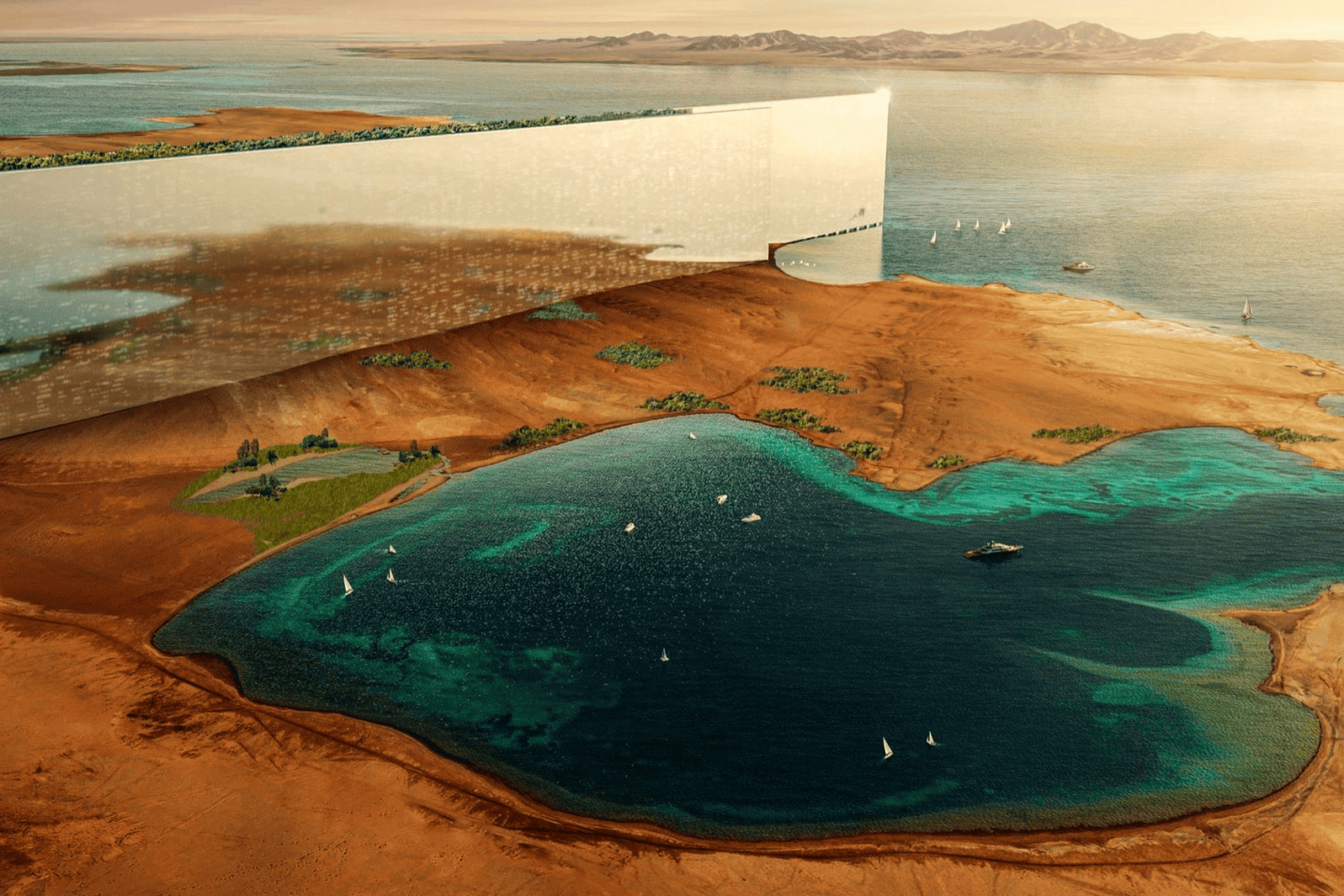
In 2026, the global skepticism regarding THE LINE (NEOM’s signature 170km mirror city) has met with a concrete reality. While the full 170km remains a multi-generational target, the “Initial Core” (the first 2.4km module) is reaching operational maturity. This segment, designed to house approximately 300,000 residents, serves as the proof-of-concept for the Kingdom’s “Vertical Urbanism.”
Neom’s Quadrant Strategy in 2026
The management of Neom in 2026 has pivoted to a “Quadrant Strategy,” focusing on four distinct regions to demonstrate near-term RoI (Return on Investment):
- Sindalah (The Island): By early 2026, Sindalah has become the premier yachting destination in the Red Sea, competing directly with the Mediterranean elite. It acts as the “Gateway to Neom,” providing the luxury proof-point required to attract further private investment.
- Trojena (The Mountains): With the 2029 Asian Winter Games approaching, Trojena in 2026 is a massive mountain construction site. The development of man-made lakes and ski slopes in the Sarawat Mountains has become a symbol of the Kingdom’s defiance of climatic limitations.
- Oxagon (The Industrial Hub): Oxagon has emerged as the most strategically vital of the regions. By 2026, major global logistics firms (including DP World and Maersk) have integrated into its “Floating Industrial” model, utilizing its proximity to the Suez Canal.
- The Line (The Mirror City): While the mirror facades are being installed on the first module, the internal infrastructure—specifically the “The Spine” (the high-speed subterranean transport layer)—is being stress-tested with AI-managed logistics.
The Neom Social Experiment: Who are the Citizens of 2026?
By early 2026, Neom has transitioned from a construction site to a lived reality for approximately 100,000 residents, primarily concentrated in Sindalah and the first module of The Line. This population represents a unique “Social Experiment” in the Middle East:
- The Global Technocrat: A significant portion of residents are international specialists in biotech, AI, and renewable energy, attracted by tax-free salaries and a “Common Law” legal environment that mirrors London or Singapore.
- The Saudi Professional: A new class of young Saudi professionals—many educated at Neom University—forms the backbone of the project’s management. For them, Neom is not a “futuristic dream” but their primary residence, representing a geographic shift of the Kingdom’s intellectual talent away from Riyadh.
- The Digital Nomad: Through the “Neom Resident Visa,” the Kingdom has successfully attracted a class of high-net-worth digital nomads, creating a cosmopolitan atmosphere that is intentionally distinct from the more conservative “Mainland Saudi.”
The PIF as the “Super-Ministry”
In 2026, the PIF is no longer just a sovereign wealth fund; it is the Kingdom’s governing body for economic change. It operates with a speed and agility that traditional ministries (Civil Service, Finance, Industry) cannot match. Under the direct chairmanship of MBS, the PIF has created over 80 new companies in sectors ranging from luxury tourism to sewage management. This “PIF-ification” of the economy has created a new class of technocrat—highly educated, Western-trained, and fiercely loyal to the Crown Prince’s timeline.
The Energy Pivot: OPEC+ and the “Last Man Standing” Strategy
By 2026, the Saudi energy strategy has matured into what analysts call a “Dual Track” approach. While Riyadh leads the global rhetoric on carbon capture and the “Circular Carbon Economy,” its core oil policy remains one of extreme dominance. Through OPEC+, Saudi Arabia has successfully maintained a pricing floor that supports the CAPEX requirements of Vision 2030. However, the Kingdom is also aggressively expanding its production capacity to 13 million barrels per day.
The logic is simple: in a world moving toward energy transition, Saudi Arabia intends to be the “Last Man Standing”—the most efficient, lowest-cost, and least carbon-intensive producer of the world’s final barrels of oil. Furthermore, the Kingdom’s investment in Green Hydrogen (specifically the Helios plant in Neom) has positioned it to be the dominant energy exporter of the 2030s. In 2026, Saudi Arabia is no longer just an “oil player”; it is a comprehensive “energy superpower” that utilizes its massive solar irradiance to hedge against the decline of internal combustion.
Localization and the SME Challenge
The greatest economic challenge of 2026 remains the successful “Localization” of the supply chain. While giga-projects attract headline FDI, the Kingdom’s ability to foster a robust Small and Medium Enterprise (SME) sector remains a work in progress. The “Localization 50%” tracker indicates that while defense and manufacturing are hitting targets, the retail and service sectors still struggle with the high cost of compliant labor and the withdrawal of energy subsidies.
Sports Sovereignty: From Soft Power to Strategic Asset
In 2026, Saudi Arabia’s foray into global sports is no longer seen as a “new” phenomenon or merely a “rebranding exercise.” It has evolved into a pillar of national policy known internally as “Sports Sovereignty.”
The Consolidation of Global Golf and Football
The legacy of the 2023 LIV Golf/PGA merger has, by 2026, resulted in the PIF becoming the primary financier of the global professional golf circuit. This model—where the Kingdom doesn’t just sponsor, but owns the infrastructure—has been replicated in football.
With the 2034 FIFA World Cup bid officially in its operational development phase in 2026, Riyadh has utilized its ownership of clubs like Newcastle United and the star-studded Saudi Pro League (SPL) to create a “Football Diplomacy” corridor. This corridor bypasses traditional diplomatic channels, allowing the Kingdom to project influence directly into the living rooms of billions in Europe, South America, and Africa.
The 2034 World Cup: A 10-Year Infrastructure Sprint
For the House of Salman, the 2034 World Cup is the true deadline for the “New Saudi Arabia.” In 2026, the construction of the Prince Mohammed bin Salman Stadium (perched on a cliff edge in Qiddiya) has become the flagship project of this ambition. These venues are designed not just for sport, but as “Mixed-Use Strategic Assets” that can be converted into logistical or security hubs if required, demonstrating the dual-use nature of Saudi giga-infrastructure.
The “Sports-Washing” Debate in 2026
While Western media occasionally revisits the term “sports-washing,” by 2026, the sheer gravity of Saudi capital has forced a normalization. Major sporting leagues, Olympic committees, and e-sports federations (the 2026 E-Sports World Cup in Riyadh being a prime example) have largely made their peace with the Kingdom’s funding. For the Saudi state, the debate is over: they have successfully pivoted from “pariah” to “patron” of global entertainment.
The Gaming and E-sports Hegemony
Beyond physical sports, the “Savvy Games Group” (wholly owned by the PIF) has, by 2026, turned Riyadh into the undisputed capital of the global gaming industry. This is more than leisure; it is a “Digital Sovereignty” play. By acquiring major publishers and hosting the “Olympic E-sports Games” in 2026, Saudi Arabia has secured a dominant position in the “Metaverse” economy.
For the global youth population, the Kingdom is no longer associated with oil, but with the games they play daily. This “Cultural Integration” is the most effective long-term defense the House of Salman has against international political pressure.
The Global Security Nexus and the PR Machine
Behind the gleaming skyscrapers and the green hydrogen plants of 2026 lies one of the world’s most sophisticated intelligence and public relations apparatuses. In the House of Salman, “Image” and “Security” are two sides of the same coin.
The GIP and the Presidency of State Security
The reorganization of the Saudi security services—completed in the mid-2020s—has created a hyper-centralized intelligence model. The GIP (General Intelligence Presidency) now focuses exclusively on regional power projection and the “Beijing-Moscow-Riyadh” intelligence sharing nexus.
The Presidency of State Security (PSS), however, is the watchdog of the Salmanic Order. In 2026, the PSS utilizes “Predictive Stability” algorithms to monitor potential dissent within the royal family and the broader population. This technological edge has made the traditional “consensus-building” within the tribes obsolete; in the digital age, compliance is more efficient than negotiation.
The Khashoggi Legacy and the 2026 PR Machine
The shadow of the 2018 Khashoggi incident has, from the perspective of Riyadh in 2026, been successfully managed. Through a multi-billion dollar investment in global PR firms and “Digital Influence Hubs,” the Kingdom has successfully shifted the narrative from its human rights record to its economic potential.
The “New Saudi Spokesperson” in 2026 is no longer a bearded cleric, but a female, Western-educated technocrat who speaks fluently in the language of “ESG” (Environmental, Social, and Governance) and “Inclusion.” This linguistic shift has been devastatingly effective in neutralising institutional opposition in the West, particularly among the corporate elite of the Fortune 500.
Private Security and the Sovereignty of Neom
A unique feature of the 2026 landscape is the emergence of “Regional Sovereignty” within Saudi borders. Neom, managed under its own legal system and security code, utilizes a mix of private security firms and elite GIP units.
This “Boutique Sovereignty” allows the Kingdom to provide a Western-friendly legal and social environment for expatriates while maintaining an absolute security perimeter around the project’s high-tech assets.
Conclusion: The Salmanic Era and the Legacy of MBS
As 2026 draws to a close, the Saudi Royal Family is a vastly different institution than the one that dominated the 20th century. The transition from the “Committee of Brothers” to the “House of Salman” is complete.
Stability at What Cost?
The Kingdom is undeniable more efficient, more socially open (at the surface), and more geopolitically autonomous than ever before. MBS has achieved what many analysts thought impossible: he has broken the power of the clergy, neutralized his internal family rivals, and begun the forced transition of the economy away from oil.
However, the “Stability” of 2026 is of a brittle nature. It is heavily dependent on the persona and will of a single man. In the absence of a consensual family pact or a formal civil society, the “Single Point of Failure” is the Crown Prince himself.
The Unfinished Legacy
For the average Saudi citizen in 2026, life is faster, more expensive, and more exciting. The “Prince of Change” has delivered on his promise of entertainment and national pride, but the long-term price—both in fiscal taxes and political silence—is only starting to be tallied.
The Saudi Royal Family in 2026 is no longer a “family” in the political sense. It is a corporate board where only the Chairman’s vote counts. Whether this model can survive the eventual passing of King Salman and the multi-decade lifespan of MBS’s rule remains the defining question of Middle Eastern geopolitics for the remainder of the century.
Final Assessment: The End of the Founding Era
To conclude this deep dive, it is necessary to contextualize the current state of the Saudi Royal Family within the arc of the century. From 1902 to 2015, the House of Saud operated as a desert-born confederation of tribes and princes, balanced by religious legitimacy and oil wealth. In 2026, that era is definitively over.
The “Third Saudi State” has effectively been replaced by a “Fourth Saudi State”—one that is technological, secularized in its commercial logic, and centralized around a single, absolute lineage. The House of Salman has successfully navigated the most dangerous transition in its history. But in doing so, it has traded the security of “family consensus” for the high-stakes gamble of “individual vision.”
In 2026, the gamble appears to be paying off, but the true test will come when the founding patriarch, King Salman, finally departs the stage, leaving his son to rule alone in the mirror-walled cities of the future.
Appendix: Clinical Succession Audit (Scenario 2026+)
For the purposes of strategic planning, HOS provides the following clinical projection for the inevitable passing of King Salman:
- T+0 to T+24 Hours: Immediate activation of the “Royal Protocol.” Total saturation of domestic media with the King’s legacy. Prince Khalid bin Salman (Defense) and Prince Abdulaziz bin Salman (Energy) secure the twin pillars of the state. The Allegiance Council meets to “formally” confirm the transition, which occurs via a pre-recorded broadcast.
- T+48 Hours: Recognition of MBS as King by the GCC, BRICS+, and G20 partners. Domestic security levels remain at “Alpha” to pre-empt any mobilization by sidelined family branches.
- The “Double Crown” Challenge: As King, MBS will likely retain the Prime Ministership and the Chairmanship of the PIF, consolidating the ultimate executive, military, and financial power into a single office—a first in the history of the modern Saudi state.
Strategic Advisory Note for 2026 Investors
For those operating in the 2026 Saudi market, the takeaway is clear: the Kingdom is no longer a place of “indirect influence.” Every major project, legal reform, and regional diplomatic move is now tied to the survival and success of the Salmanic Vision.
Investors must navigate a landscape where “Economic Opportunity” is inextricably linked to “Political Compliance.” The days of the independent royal middle-man are over; in the House of Salman, the state is the family, and the family is the state.
End of Intelligence Report.