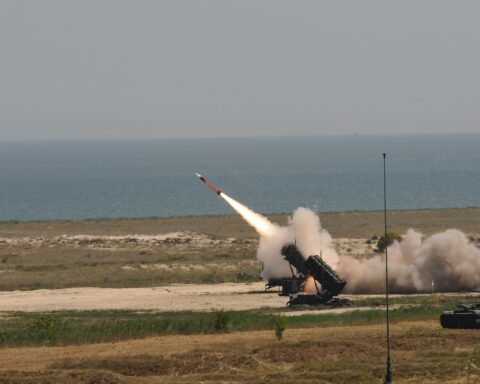
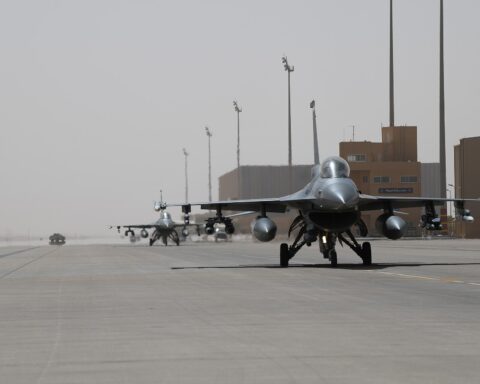
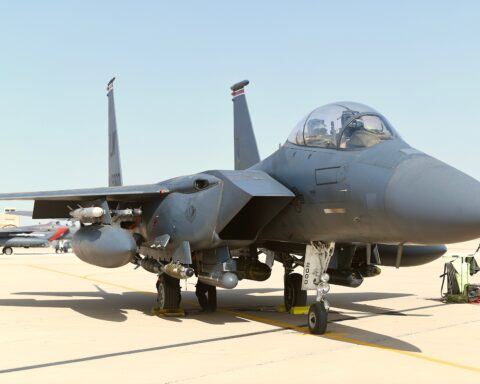
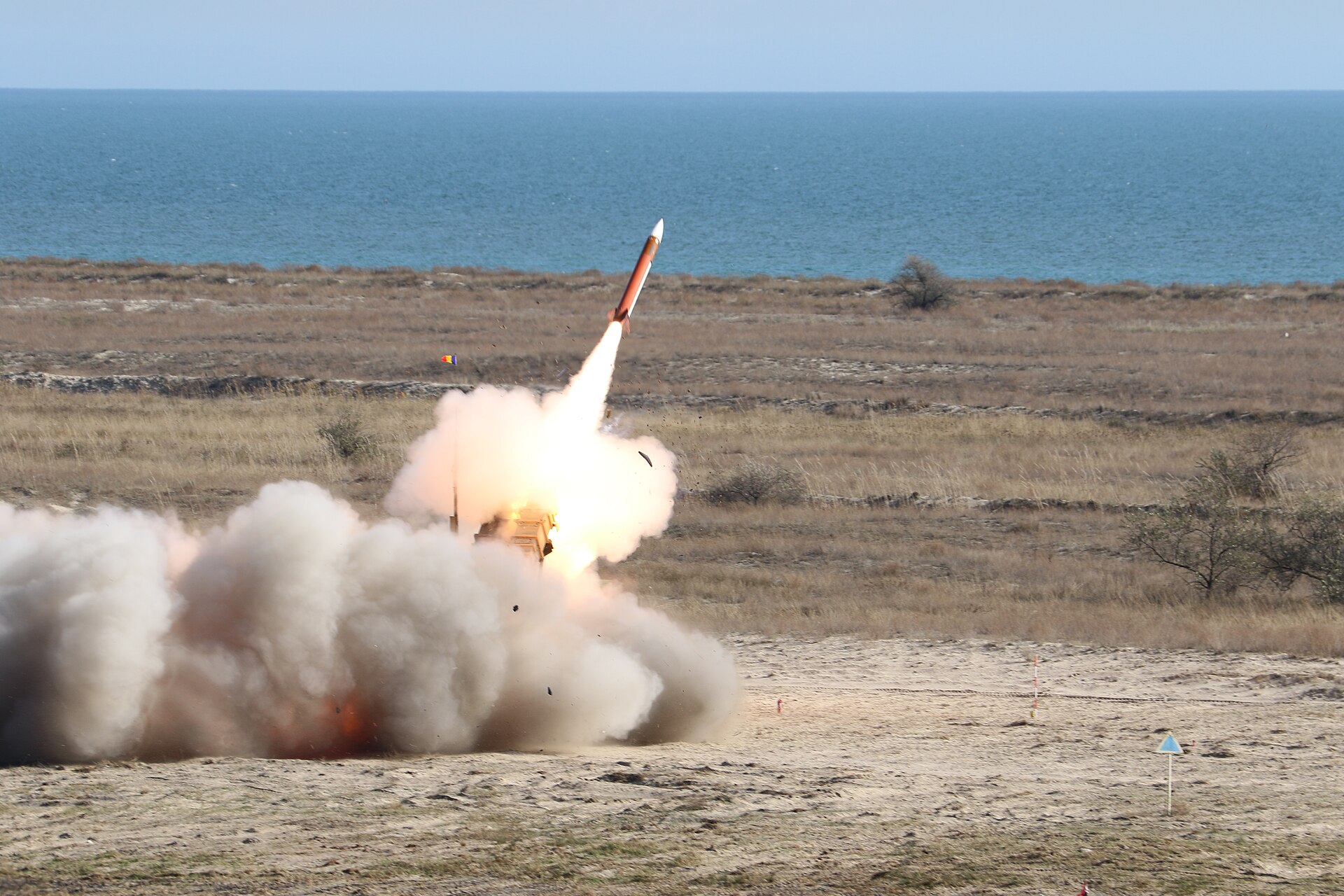
JEDDAH — Saudi Arabia has deployed Patriot PAC-3 missile batteries around Mecca and Medina, releasing official images on April 12-13 showing launchers positioned to defend the two holiest sites in Islam with the first Hajj pilgrims arriving in five days. The Ministry of Defence captioned the images “Air defense forces — an eye that never sleeps, its mission is the safety of Muslim pilgrims” — a message aimed less at reassuring the faithful than at warning Tehran what a strike on the holy cities would cost.
The deployment carries an arithmetic problem the MoD did not advertise. Saudi Arabia has roughly 400 PAC-3 MSE interceptors remaining from a pre-war stockpile of 2,800 — an 86% depletion rate across 38 days of war, according to CSIS Missile Defense Project data. With those 400 rounds, Saudi commanders must now choose between protecting the Eastern Province oil spine, the Yanbu export corridor, and the two holy cities. They cannot do all three. The MoD’s photo release tells you which choice they have made.
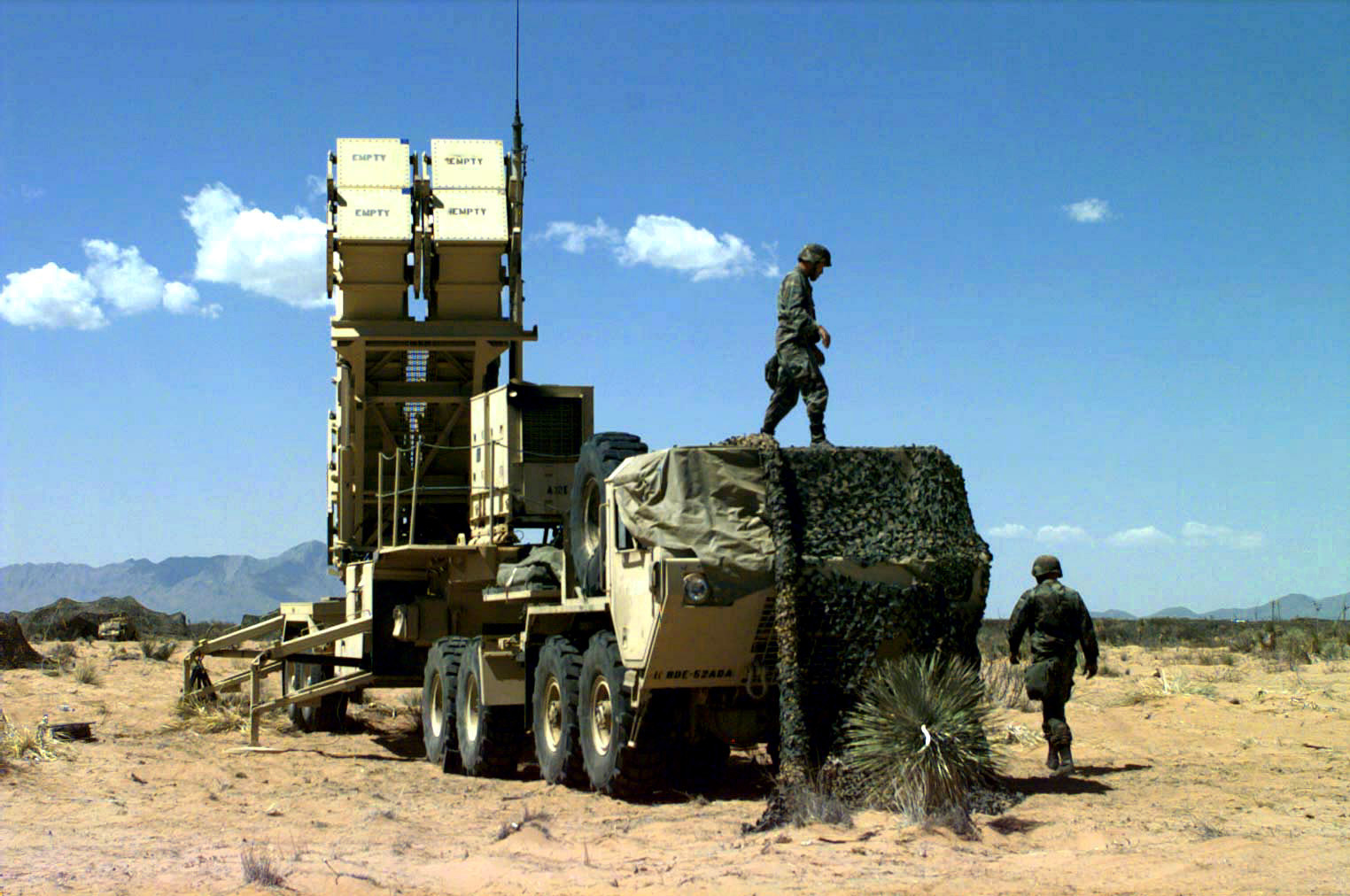
Table of Contents
The Triage Geometry: 400 Rounds, Three Fronts
A single PAC-3 battery covers a roughly 15-20 kilometre radius against ballistic missiles, according to CSIS Missile Threat assessments and Army Recognition technical data. That is wide enough to shield a city. It is nowhere near wide enough to shield a country. Mecca and Medina sit approximately 1,200 kilometres from the Eastern Province oil infrastructure — Ras Tanura, Jubail, the petrochemical spine that funds the Saudi state — and around 300 kilometres from the Yanbu industrial corridor on the Red Sea coast.
Before the war, Saudi Arabia operated one of the densest integrated air defense networks outside NATO, anchored by those 2,800 PAC-3 MSE interceptors. Thirty-eight days of Iranian drone and missile barrages have consumed the overwhelming majority. The kingdom has intercepted 799 drones and 95 missiles — 894 threats in total since March 3, burning through roughly $3.49 billion at $3.9 million per round, per CSIS estimates. What remains is a force that must be rationed.
The rationing creates a triage map that Saudi commanders would rather not discuss publicly. Greece’s ELDYSA PAC-3 battery at Yanbu — which scored its first confirmed combat intercept on March 19, downing two Iranian ballistic missiles according to Army Recognition — provides some coverage on the Red Sea flank. The Greek parliament extended the deployment through November 2026. But Greece brought one battery, not a national shield. Eastern Province coverage requires its own allocation, and now the holy cities demand theirs. Every battery redeployed to Mecca or Medina is a battery no longer covering a refinery or a port.
| Defensive Zone | Distance from Eastern Province | Assets at Risk | Coverage Trade-Off |
|---|---|---|---|
| Mecca / Medina | ~1,200 km | 750,000 Hajj pilgrims, Grand Mosque, Prophet’s Mosque | Batteries moved from oil corridor or Yanbu |
| Eastern Province | 0 km (origin) | Ras Tanura, Jubail, SABIC, Sadara, petrochemical spine | Already struck multiple times; PAC-3 triage ongoing since March |
| Yanbu (Red Sea) | ~950 km | East-West Pipeline terminal, SAMREF refinery, bypass export corridor | Greek ELDYSA battery provides partial cover; 2 intercepts confirmed March 19 |
Who Is Coming — and Who Is Not?
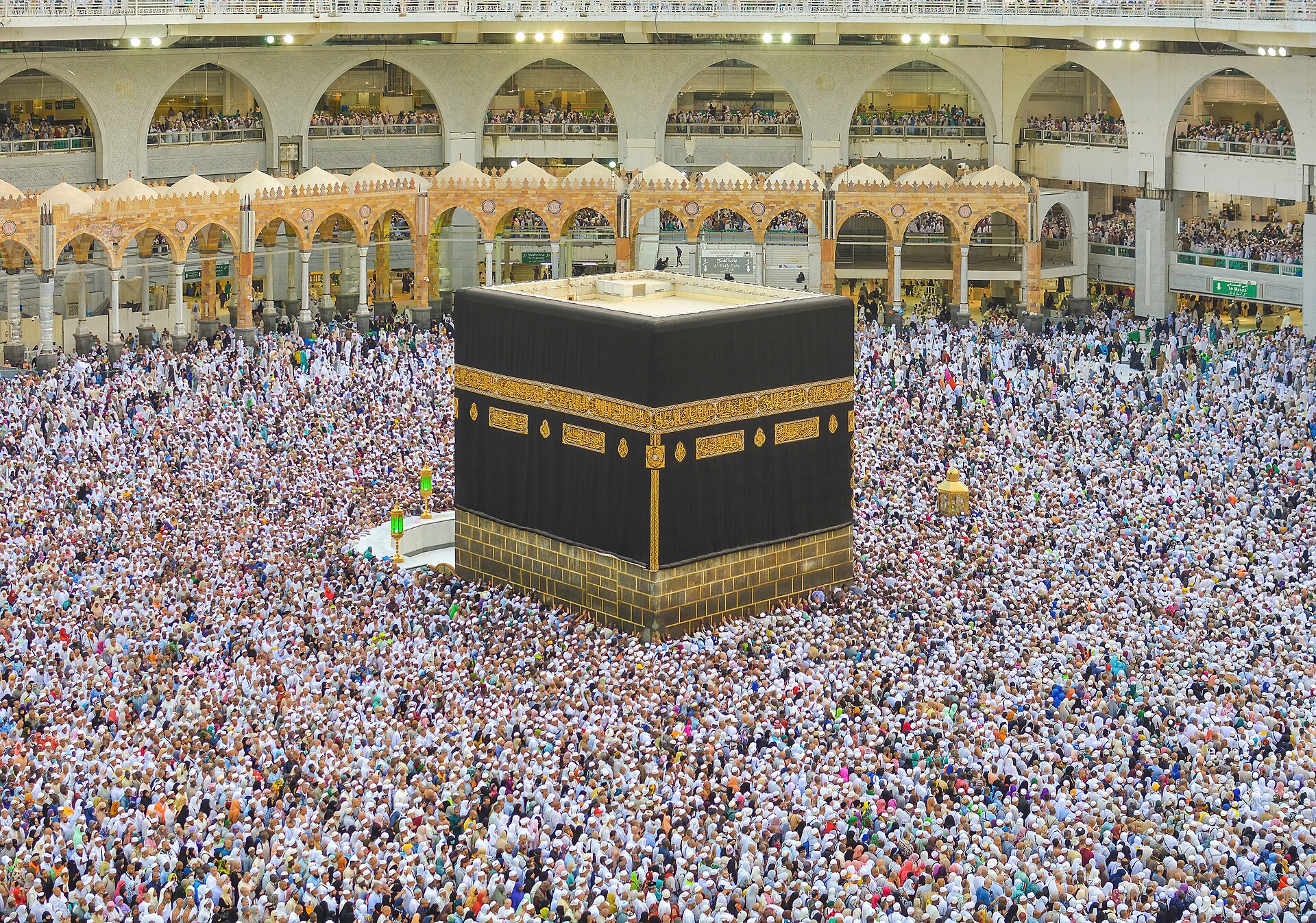
Approximately 750,000 pilgrims have registered for Hajj 2026 as of April 10, according to the Saudi Hajj Authority and Wego travel data. Indonesia leads with 221,000 pilgrims, followed by Pakistan at 179,210 and India at 175,025. Pakistan’s first Hajj flights are Medina-bound and scheduled for April 18 — the same day the Umrah cordon seals and the formal Hajj arrival window opens, per GACA schedules. Indonesia’s first charter departs April 22, the day the ceasefire nominally expires.
The Middle East briefing 3,000+ readers start their day with.
One email. Every weekday morning. Free.
Iran has zero pilgrims registered. Visa processing has been suspended for 2026, and Iran’s 10-point ceasefire plan contains no carve-out for Hajj access, according to Iran International. This is not a minor diplomatic detail. It means Tehran has no hostage stake in Hajj security — no citizens on the ground whose safety would constrain Iranian military action. When Iran boycotted Hajj after the 1987 Mecca incident that killed 402 people (mostly Iranian pilgrims), the country’s Hajj quota was slashed from 150,000 to 45,000 and diplomatic relations with Riyadh collapsed until 1991, per Al Jazeera’s timeline. In 2026, that constraint does not exist. Iran has no pilgrims to protect and no quota to lose.
The IRGC and Iranian government have not issued direct threats against Mecca or Medina — Iran’s publicly stated strike doctrine targets US military installations and energy infrastructure, not religious sites. But the SNSC’s ceasefire statement, reported by Middle East Eye — “negotiations are continuation of battlefield” — and the pattern of post-ceasefire violations undermine any comfort that doctrine provides. After the ceasefire took nominal effect on April 8, Kuwait intercepted 28 drones, Bahrain stopped 31 drones and 6 missiles, the UAE faced 52 threats, and Qatar intercepted 7 missiles, as documented in the ceasefire halt order analysis. The question facing Saudi commanders is not whether Iran would deliberately target Mecca, but whether the IRGC’s fractured command chain can guarantee that nothing else does either.
What Do the MoD Photos Actually Say?
Saudi Arabia does not typically release images of active Patriot deployments. The kingdom operates under a doctrine of strategic ambiguity about the precise disposition of its air defense assets — for the same reason any military prefers an adversary not to know exactly where the interceptors are pointed. The April 12-13 release, reported by Newsweek, broke that pattern deliberately. The MoD’s Arabic-language caption — “an eye that never sleeps, its mission is the safety of Muslim pilgrims” — was distributed across Saudi state media channels in a coordinated information operation timed to the five-day countdown before Hajj arrivals.
The message operates on two frequencies. For the Muslim world, it says: the Custodian of the Two Holy Mosques is fulfilling his founding obligation, the physical protection of Hajj. For Tehran, it says: these sites are defended, and a strike here would not merely be an act of war but an act against Islam’s holiest ground, with consequences no Iranian government could survive politically. The deterrence logic depends on Iran calculating that hitting Mecca or Medina — even accidentally, even with debris from an intercepted missile — would unite the entire Islamic world against the Islamic Republic in a way that striking Ras Tanura never could.
But deterrence signals carry a cost when your magazine is nearly empty. By publicly confirming Patriot batteries at Mecca and Medina, the MoD has told Iranian military planners that those interceptors are not available for the Eastern Province or for Yanbu. For an IRGC that has already struck the East-West Pipeline, hit Ras Tanura on March 2, and caused a debris fire at SABIC’s Jubail complex, that information has operational value. The photograph that protects the holy cities may expose the oil fields.
Can Washington Resupply in Time?
On April 9, the Pentagon awarded Lockheed Martin a $4.76 billion contract to ramp PAC-3 MSE production from 620 rounds per year to 2,000, according to the Washington Times. The contract specifies that 94% of output is earmarked for Foreign Military Sales — meaning allied nations like Saudi Arabia, not US stockpiles. But the production surge will not reach its 2,000-round target until 2030. At current output of 620 rounds per year, it would take nearly four years to replace what Saudi Arabia has consumed in five weeks.
The proliferation and maturation of threat missiles have upped the ante on the number of AMD interceptors required for the United States and other powers to defend their strategic interests.
Wes Rumbaugh, Fellow, CSIS Missile Defense Project
The broader US arsenal offers no quick fix either. THAAD, the higher-altitude system designed for longer-range ballistic missiles, has a total delivered inventory of just 534 interceptors as of end-2025, with no new deliveries since July 2023 and the next batch not expected until April 2027, according to CSIS Missile Defense Project data. Saudi Arabia asked allies for help directly: Poland refused a US request to transfer Patriot batteries to the Middle East on March 31. The $16.5 billion emergency US arms package dispatched during the war went to the UAE, Kuwait, and Jordan — not Saudi Arabia.
While the demand coming from political and military leaders for deployments is strong, the demand signal sent to industry by budgets and appropriations is inconsistent.
Wes Rumbaugh, CSIS Missile Defense Project
The $142 billion US-Saudi defense cooperation agreement signed in May 2025 — the largest in US history, per Breaking Defense — included PAC-3 MSE expansion, but its delivery schedule runs through 2030. Contracts are not interceptors. The rounds arrive on production schedules, not political ones. None of this helps a commander who needs missiles before April 18, and the $4.76 billion contract is Washington’s admission that the air defense industrial base cannot recover before Hajj, before the ceasefire expires, or before any plausible resumption of hostilities.
The Four-Day Window Between Hajj and Ceasefire
The calendar creates its own threat geometry. Hajj arrivals begin April 18. The ceasefire nominally expires April 22 — a gap of four days during which hundreds of thousands of pilgrims will be on the ground in Mecca and Medina while the legal framework restraining Iranian military action dissolves. Indonesia’s 221,000 pilgrims depart on their first charter flights the same day the ceasefire expires, according to Wego scheduling data. They will be airborne or in transit as the ceasefire clock hits zero.
The Hajj-ceasefire overlap is not an accident of scheduling — Hajj dates are fixed by the Islamic calendar and have been known for years. But the ceasefire negotiators in Islamabad made no provision for it. Iran’s 10-point plan contains no Hajj security clause, no extension mechanism, and no mutual restraint commitment around the holy cities. The Soufan Center has noted the absence of any renewal pathway. The ceasefire either holds past April 22 through informal mutual restraint, or it does not hold at all.
The IRGC’s track record suggests informal restraint is not its operating mode. The IRGC Navy declared “full authority to manage the Strait of Hormuz” on April 5 and again on April 10 — both times while Iran’s chief negotiator Araghchi was physically present in Islamabad. If the IRGC operates independently of its own diplomatic track during a ceasefire, the question of what happens when that ceasefire expires — with three-quarters of a million pilgrims in the kingdom — does not require speculation to answer.
The Title on the Line
King Fahd adopted the title “Custodian of the Two Holy Mosques” on October 27, 1986, according to Saudipedia — one year before Iranian pilgrims and Saudi security forces clashed in the 1987 Mecca incident that ended with Iran’s Hajj quota slashed and diplomatic relations severed until 1991. The title was a political act dressed as a religious one, a claim that the Saudi monarchy’s legitimacy rests on its capacity to protect Hajj. Every Saudi king since has carried it, and the title means that a failure to defend Mecca and Medina is not a military setback but an existential crisis for the ruling family.
That is what the Patriot batteries outside the holy cities are really defending — not just 750,000 pilgrims or two ancient cities, but the theological claim that justifies Saudi governance. MBS needs those interceptors in front of Mecca more than he needs them in front of Ras Tanura, not because the oil is less valuable, but because the oil can be rebuilt and the title cannot be recovered once it is lost. The MoD’s photo release, with its language about protecting Muslim pilgrims, is the most expensive sentence the Saudi military has published this war. It commits irreplaceable rounds to a mission defined by faith rather than barrels.
The CENTCOM blockade of Iran’s ports may reduce the volume of inbound Iranian munitions over the coming weeks. But the missiles already manufactured, already deployed, already aimed — those are the ones that matter between now and April 22. Saudi Arabia has made its choice about where to point the interceptors it has left. Whether 400 rounds are enough depends entirely on whether Iran decides to test them.
FAQ
How many Patriot batteries does Saudi Arabia currently operate?
Saudi Arabia has not disclosed its exact current Patriot battery count, but the kingdom has acquired launchers across multiple Foreign Military Sales agreements since the 1990s, with CSIS Missile Defense Project data tracking cumulative Saudi Patriot purchases. Each battery typically comprises a radar, a control station, and multiple launchers carrying four PAC-3 MSE interceptors each. The constraint in April 2026 is not the number of launchers but the number of interceptors available to load them — at approximately 400 remaining rounds, many launchers are likely sitting partially loaded or empty, according to CSIS Missile Defense Project assessments of wartime expenditure rates.
Has Iran ever threatened to strike Mecca or Medina directly?
No. The IRGC’s publicly stated targeting doctrine identifies US military bases and Gulf state energy infrastructure as legitimate targets. Iranian officials have consistently avoided any language suggesting strikes on Islamic holy sites, which would be politically catastrophic across the Muslim world. However, the IRGC has struck targets within 300 kilometres of the holy cities — including the East-West Pipeline pumping station and Yanbu-area infrastructure — and missile debris from intercepted warheads has caused fires at industrial sites like SABIC’s Jubail complex, demonstrating that even successful interceptions can produce ground-level damage.
What role does THAAD play in Saudi Arabia’s air defense posture?
THAAD (Terminal High Altitude Area Defense) provides an upper-tier layer designed to intercept ballistic missiles at higher altitudes and longer ranges than Patriot PAC-3. The global interceptor supply is severely constrained: only 534 total THAAD interceptors have been delivered worldwide as of end-2025, with no new production deliveries since July 2023 and the next batch not expected until April 2027, according to CSIS data. THAAD interceptors cost roughly $12 million each according to GAO procurement data — three times the price of a PAC-3 MSE round — making them even harder to replenish at scale.
What happens to Hajj if the ceasefire collapses on April 22?
The peak Hajj period runs approximately May 25-26 in 2026, meaning pilgrims would be present in Saudi Arabia for over a month after the ceasefire’s nominal expiration. Indonesia’s Hajj Commission has published three contingency scenarios, including full suspension. Saudi Arabia has not publicly addressed contingency planning for Hajj under renewed hostilities. The 1987 precedent resulted in Iran’s Hajj quota being cut from 150,000 to 45,000 and a three-year diplomatic rupture — but in 1987, Iranian pilgrims were present and directly involved. In 2026, Iran has no pilgrims on the ground, removing the most direct lever for bilateral escalation management during the pilgrimage season. The ceasefire expiry kinetic asymmetry sharpened further on April 14, when Iran claimed full missile and drone replenishment while Saudi Arabia’s PAC-3 stockpile remained at approximately 400 rounds — a gap examined in detail in Iran’s claimed full arsenal replenishment against Saudi Arabia’s depleted interceptor inventory.