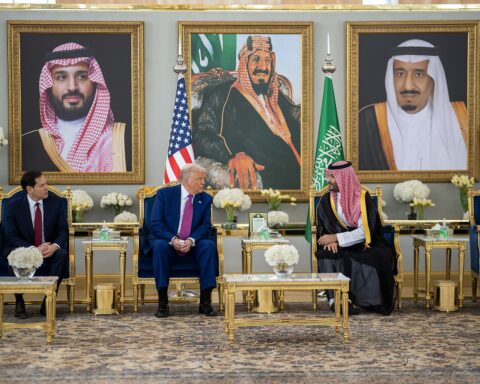
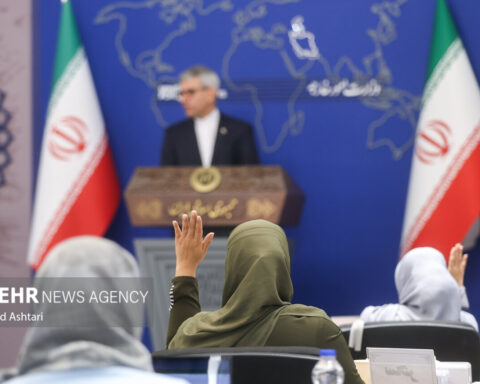
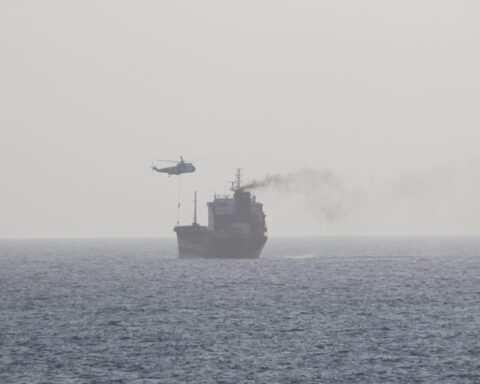
LONDON — Donald Trump and Keir Starmer spoke by phone on April 26 and agreed on what Downing Street called “the urgent need to get shipping moving again in the Strait of Hormuz,” the first time the US and UK have issued a joint public statement naming the waterway as an immediate shared priority. The same day their call ended, Iran’s Foreign Minister Abbas Araghchi landed in Saint Petersburg, continuing a 72-hour diplomatic tour — Islamabad to Oman to Moscow — designed to ensure that when shipping does move again, it moves on Tehran’s terms.
The two tracks are not merely parallel — they are structurally opposed. The Western convergence that Starmer briefed Trump about, anchored by a 51-nation Paris summit and a Northwood military planning conference that drew more than 30 countries, aims to reopen Hormuz unconditionally. Araghchi’s Moscow visit, timed to coincide with a Putin meeting on April 27, aims to build the diplomatic and strategic architecture that makes unconditional reopening impossible. Saudi Arabia, which depends on Hormuz more than any other economy on earth, attended neither the Paris summit nor Araghchi’s coalition-building tour — and has no seat at either table.
Table of Contents
What Trump and Starmer Actually Agreed
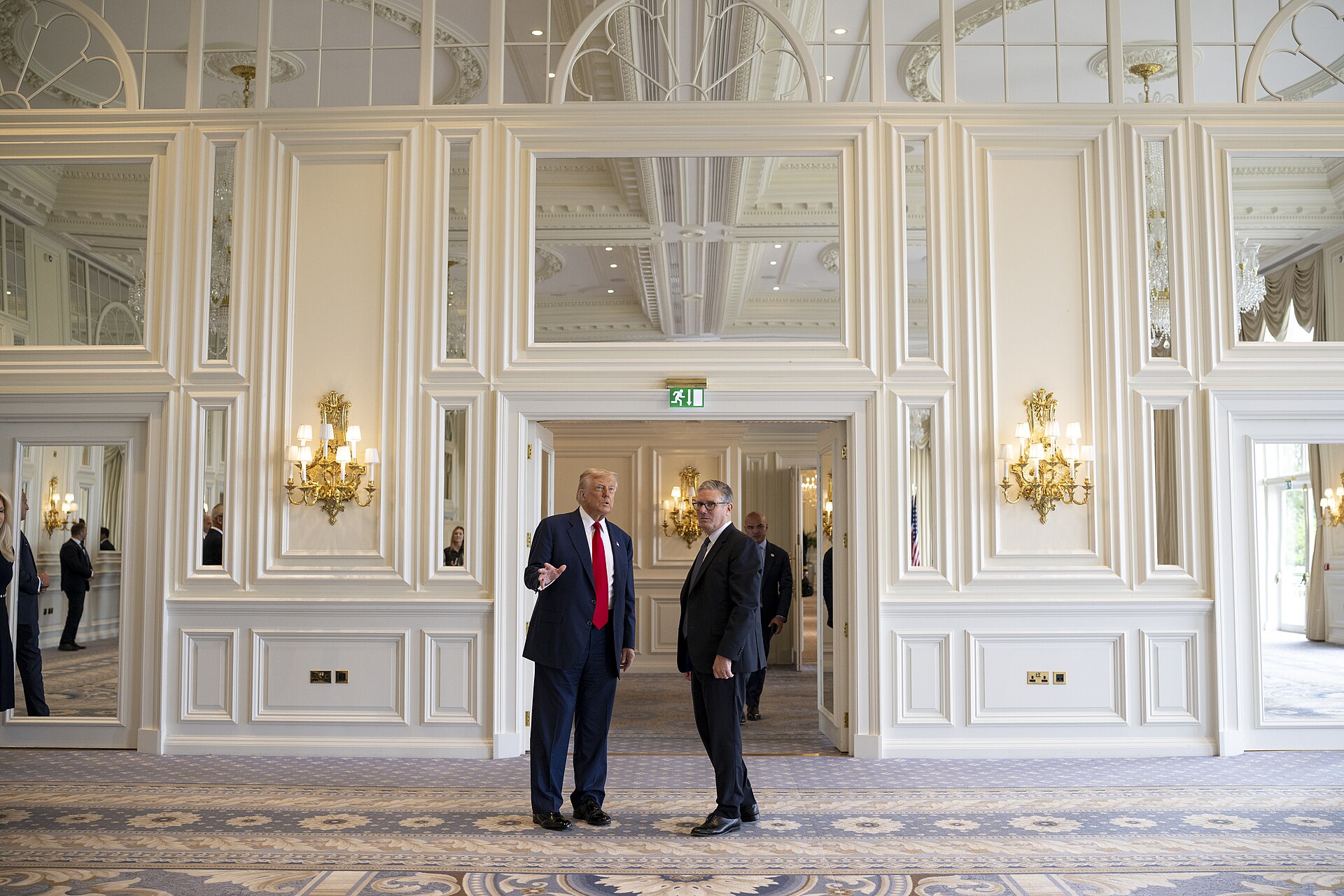
The Downing Street readout released Saturday evening was unusually specific for a transatlantic call that covered multiple topics. The two leaders discussed “the urgent need to get shipping moving again in the Strait of Hormuz, given the severe consequences for the global economy and cost of living for people in the UK and globally,” according to the GOV.UK summary — language that explicitly frames Hormuz as a cost-of-living issue, not merely a security abstraction. Starmer briefed Trump on the joint initiative he has been co-leading with French President Emmanuel Macron, including what Downing Street described as “the military planning conference at Northwood that week.”
Until this call, Washington and London had addressed Hormuz through separate channels — the US through its unilateral naval blockade imposed on April 13, the UK and France through the Paris summit process that began April 17. The April 26 call is the first time both governments publicly acknowledged they are working toward the same objective on the same timeline, even if their methods remain different. The US approach is coercive — a blockade designed to squeeze Iranian ports until Tehran concedes. The UK-France approach is coalitional — a multinational freedom-of-navigation mission designed to make the waterway physically passable again.
Whether those two approaches are compatible is a question neither government has answered. The US blockade applies to Iranian ports and toll-collecting vessels, not to all Hormuz transit, but Iran treats the blockade and the coalition as a single Western front — and has framed any reopening of Hormuz as contingent on the blockade’s removal. Ghalibaf, the Iranian Parliament Speaker, made this explicit on April 22, posting on X that it was impossible for others to transit Hormuz while Iran could not — formally linking the two tracks that Washington and London are trying to keep separate.
The Northwood Coalition and Its Limits
The military planning conference at Northwood, the UK’s Permanent Joint Headquarters in Hertfordshire, ran April 22-23 and assembled representatives from more than 30 nations — the operational follow-up to the 51-country Paris summit that Starmer and Macron co-chaired on April 17. According to the UK Defence Ministry, more than 12 countries volunteered assets for what was described as a “peaceful and defensive” freedom-of-navigation mission. The coalition is operating on a non-NATO command structure for the first time, a deliberate choice designed to allow participation from countries that would not join a NATO-flagged operation in the Persian Gulf.
The Middle East briefing 3,000+ readers start their day with.
One email. Every weekday morning. Free.
The Paris summit’s joint statement called for the “unconditional, unrestricted and immediate reopening of the Strait of Hormuz” — language so absolute that it effectively rules out any of the conditions Iran has attached to reopening. But the gap between summit communiques and operational capability is vast. The Royal Navy has no permanent Gulf presence since withdrawing from Bahrain, and HMS Anson, a Tomahawk-armed Astute-class submarine, is likely the only major UK naval asset currently in the region. The UK is preparing divers and autonomous mine-hunters — RFA Lyme Bay, HMS Dragon, and X-Ray Squadron from the Royal Navy Mine and Threat Exploitation Group based in Bahrain — but mine clearance of the Strait is estimated at six months, according to Congressional testimony reported by the Washington Post on April 22.
Sidharth Kaushal of the Royal United Services Institute told Euronews that mine-clearing and maritime warning systems are more realistic roles for the UK-led coalition than warship escorts, an assessment that quietly concedes the coalition’s limits before it has begun operating. His colleague Ed Arnold, a senior research fellow in European security at RUSI, was blunter: “There’s always the possibility we’ll be drawn into a broader conflict,” he said, warning that without genuine deterrence capability, Europeans risk being ineffective. Barak Seener of the Henry Jackson Society went further, arguing that Starmer and Macron are “playing at being relevant” given the Royal Navy’s diminished capacity.
The absences from Paris are as telling as the attendance. Saudi Arabia, Oman, Qatar, Turkey, and Pakistan — the five countries with the most direct economic or diplomatic exposure to Hormuz — did not attend the April 17 summit. Only the UAE and Bahrain joined from the Middle East. The countries most affected by the closure are the countries least willing to be publicly associated with the Western effort to end it, a pattern that mirrors how the GCC has used European diplomatic cover throughout this crisis while maintaining direct channels with Tehran.
Why Is Araghchi in Moscow?
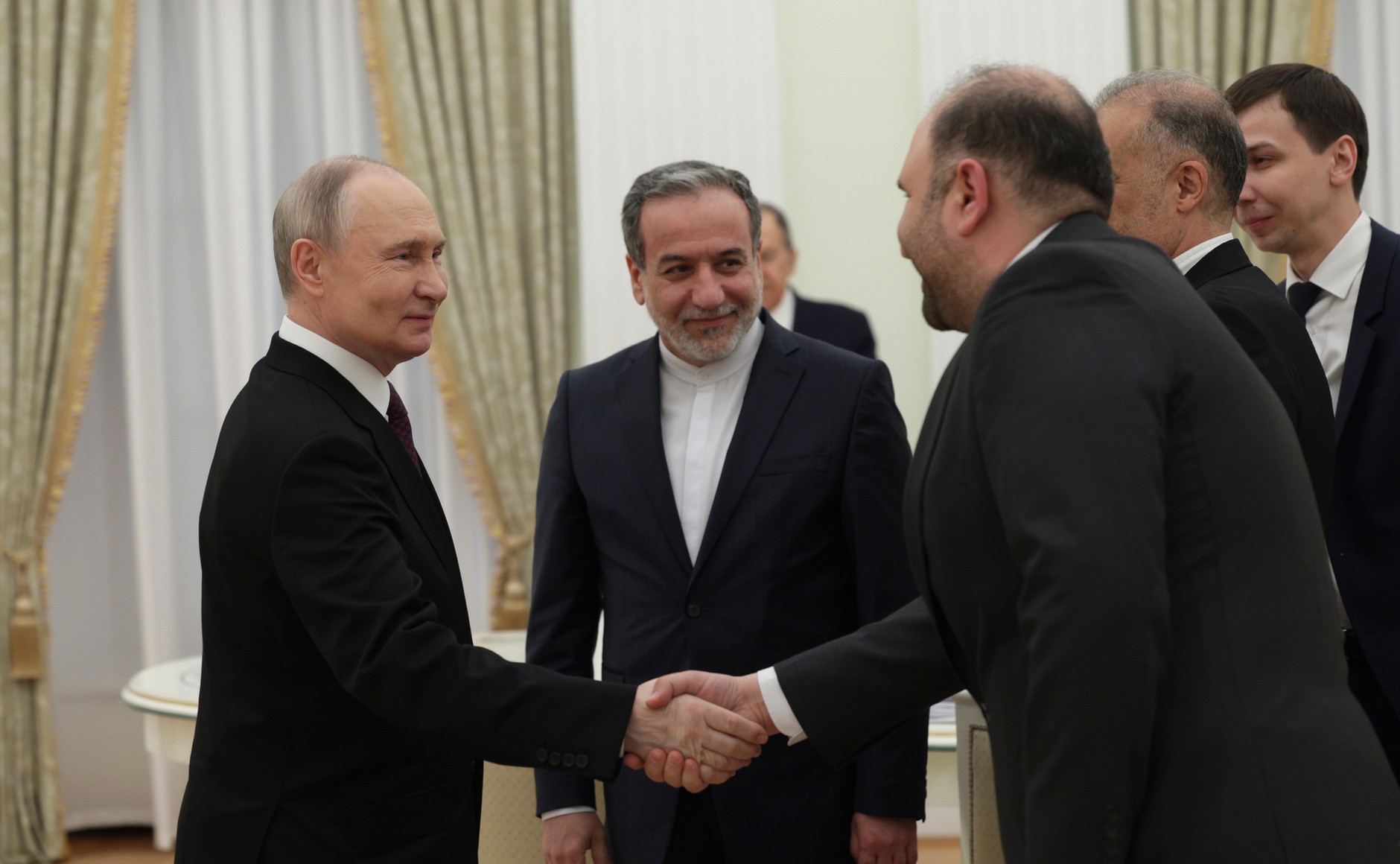
Araghchi’s arrival in Saint Petersburg on April 26 — the same day as the Trump-Starmer call — was, by his own framing, about coordination. Iran’s ambassador to Russia told Sputnik and Gulf News that the visit was explicitly framed around “briefing Russian authorities on the state of negotiations, ceasefire, and surrounding developments.” Araghchi himself said the Putin meeting would be “a good opportunity,” adding he was “confident consultations and coordination between the two countries would be of particular importance.”
The diplomatic language is bland but every stop on Araghchi’s tour corresponds to a pressure point. Islamabad is where the ceasefire framework was negotiated and where Pakistan — the only country with enforcement leverage over both sides — has been attempting to restart talks. Oman is Iran’s traditional back-channel to the Gulf states and the one country that has maintained open transit arrangements through the crisis. Moscow is where the real architecture is being built: Russia has positioned itself as Iran’s senior partner on the nuclear file, repeatedly offering to take custody of Iran’s highly enriched uranium as part of any peace deal, with Rosatom confirming its readiness as recently as April 20 according to the Moscow Times.
Tehran’s ambassador to Moscow described the meeting’s agenda as “coordinating interactions and advancing joint programs at the regional and international levels,” language that tracks precisely with the Iran-Russia Comprehensive Strategic Partnership Treaty signed in January 2026. That treaty established institutional frameworks for military-technical cooperation and, critically, “efforts to reduce the impact of Western sanctions through financial and trade mechanisms outside the dollar system.” When Araghchi sits down with Putin on April 27, he is not freelancing — he is operating within a treaty architecture designed for exactly this moment.
The Russia-Iran Architecture
Russia’s role in the Hormuz crisis extends well beyond hosting Araghchi. On April 7, Russia and China vetoed the UN Security Council draft resolution on Hormuz, with Russian Ambassador Vassily Nebenzia accusing Trump of using the blockade as “a political smokescreen to justify illegal military strikes against Iranian infrastructure.” One week later, Russian Foreign Minister Sergey Lavrov flew to Beijing to coordinate what the Kremlin described as a “joint response to unprecedented maritime lawlessness” — language that reframes the Western freedom-of-navigation effort as the destabilising act, not the Iranian mine-laying and vessel seizures that prompted it.
The veto was not merely diplomatic — it was structural. By blocking the UN route, Russia and China ensured that any Hormuz resolution must be negotiated bilaterally or through ad hoc frameworks, terrain where Moscow has maximum influence and Washington has minimum leverage. The 51-nation Paris coalition is impressive on paper, but it operates outside the UN Security Council precisely because Russia made the Security Council unavailable. The Northwood military planning conference is a consequence of the veto, not an alternative to it — the coalition exists because the multilateral route was destroyed.
Russia-Iran bilateral trade has doubled since the Russia-Ukraine war, and Russia has purchased more than $4 billion in Iranian weapons, primarily Shahed drones, according to Carnegie Endowment and Council on Foreign Relations assessments. In return, Russia has supplied trainer jets, attack helicopters, and armored vehicles. The January 2026 partnership treaty formalised what was already a functioning military-industrial relationship, and the Araghchi-Putin meeting lands at a moment when that relationship has never been more operationally relevant. Iran’s IRGC has mined the Strait, seized commercial vessels — including the 11,660-TEU MSC Francesca and the 6,690-TEU Epaminodas on April 22 — and declared “full authority to manage” the waterway, all while Araghchi tours capitals promising good-faith negotiation.
“It is impossible for others to pass through the Strait of Hormuz while we cannot.”
— Mohammad Baqer Ghalibaf, Iranian Parliament Speaker, April 2026
IRNA, Iran’s state news agency, cited “excessive demands,” “unrealistic expectations,” and the continuation of the US naval blockade as reasons Iran rejected further talks — a position that only hardens with Russian diplomatic backing. Iran’s state media framed the Moscow trip not as a sign of desperation but as coalition-building, and the framing is not wrong: Araghchi is constructing a counter-architecture to the Paris coalition, one that has two permanent UN Security Council members as its foundation.
Where Does This Leave Saudi Arabia?
Saudi Arabia did not attend the Paris summit. It did not attend the Northwood military planning conference. It is not part of Araghchi’s diplomatic tour. It has no seat at the Putin-Araghchi meeting, no representative at the UK-France coalition command, and no formal role in the US blockade that is nominally being conducted to protect Saudi oil exports.
The Kingdom is the single largest economic stakeholder in the outcome of the Hormuz crisis — Saudi March production fell to 7.25 million barrels per day from February’s 10.4 million, a 30 percent drop that the IEA called “the largest disruption on record” — and it is structurally absent from every forum where that outcome is being negotiated. That absence is strategic, not careless.
Saudi Arabia’s absence from the Paris summit is not accidental — it matches a pattern that has defined Riyadh’s crisis management since the war began: using allied governments to advance positions it cannot publicly own. When Starmer visited Jeddah on April 8, the UK attributed statements about Lebanon-inclusion in ceasefire terms that Saudi Arabia wanted said but could not say itself. The UK-Saudi trade relationship — £16.6 billion current with a £30 billion 2030 target, plus a $6.8 billion PIF-UKEF memorandum of understanding — provides the institutional ballast for this arrangement. A Sky Sabre short-range air defense battery deployed to Saudi Arabia in late March gives the UK physical military exposure in the Kingdom, a fact that makes British interest in Hormuz reopening something more than rhetorical.
The arrangement has limits, because Saudi Arabia benefits from Western convergence on Hormuz only so long as it is not identified as the beneficiary — identification means targeting. Iran has already struck Ras Tanura, already placed the King Fahd Causeway on the IRGC’s counter-target list, and already demonstrated that the playbook Saudi Arabia wrote for using proxies and intermediaries can be turned against Riyadh. Publicly endorsing the Western coalition would give Iran a named justification for escalation. When Germany’s Friedrich Merz became the first G7 leader to call Iran’s conduct humiliating to the United States on April 28, Saudi Arabia received something it cannot produce for itself: a European chancellor doing the naming so Riyadh does not have to.
Staying silent means accepting whatever terms others negotiate on Saudi Arabia’s behalf. The structural tension is irreducible: two diplomatic tracks moving at the same speed in opposite directions, and Riyadh sits at the intersection with leverage over neither.
Background
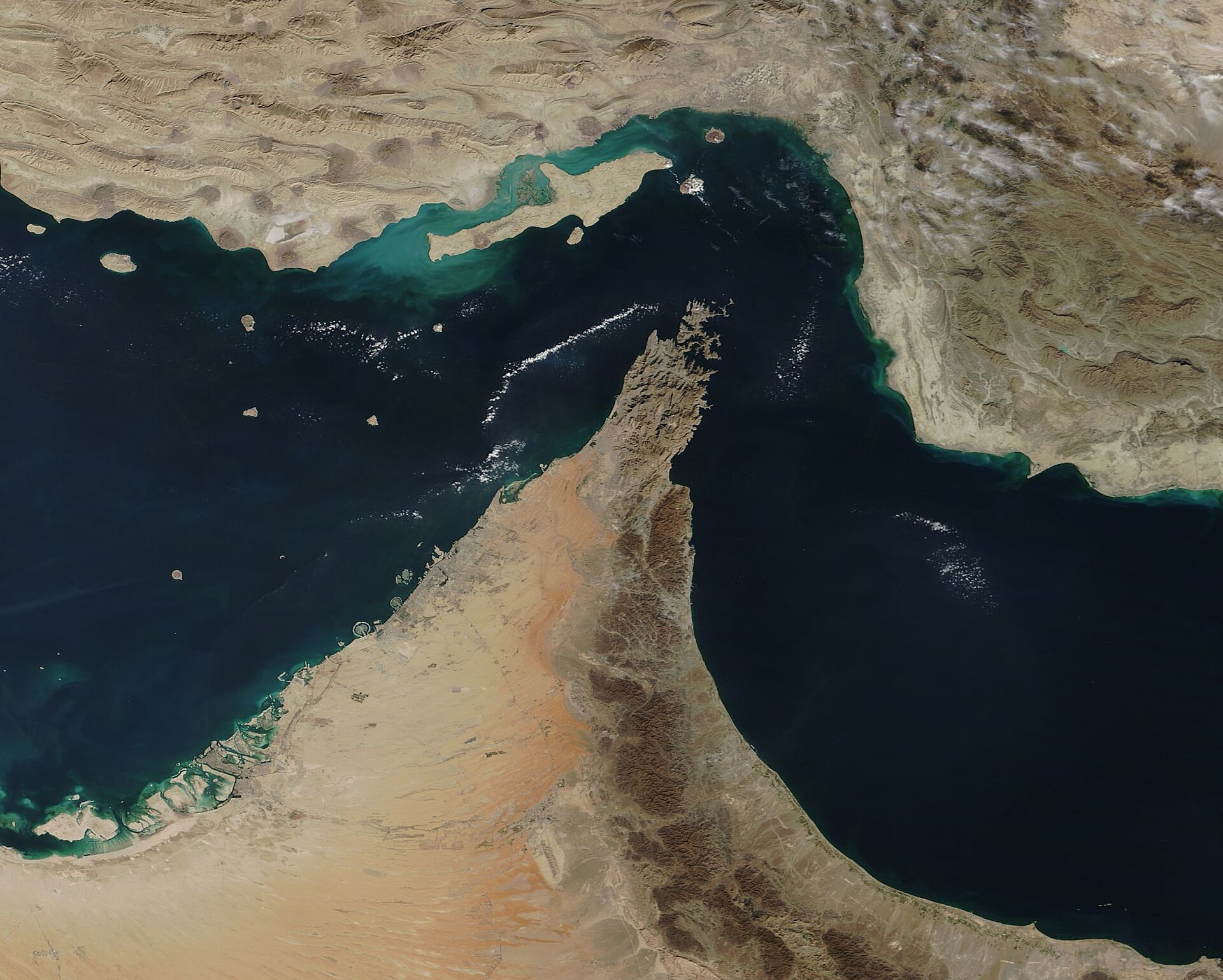
The Strait of Hormuz has been effectively contested since Iran’s IRGC began mining operations and imposing transit controls in early March 2026, as part of the broader Iran-US conflict that began February 28. The ceasefire, brokered in Islamabad, expired on April 22 with no extension mechanism, according to the Soufan Center. Iran’s parliament is advancing a 12-article Hormuz sovereignty law that would codify IRGC control as a legal framework, rather than a military fact. Russia’s offer to take custody of Iran’s highly enriched uranium — 440.9 kilograms at 60 percent enrichment as of the last IAEA measurement — remains on the table but is, according to the Moscow Times, “slipping out of reach” as the military situation hardens.
FAQ
Has the UK-led coalition actually deployed forces to the Gulf?
Not in a formal operational capacity as of April 27. The Northwood conference produced asset pledges from more than 12 countries, but deployment timelines have not been announced. The UK’s known assets in the region include HMS Anson (an Astute-class submarine), RFA Lyme Bay, HMS Dragon, and X-Ray Squadron, the Royal Navy Mine and Threat Exploitation Group based in Bahrain. The coalition is operating on a non-NATO command structure, which adds planning complexity but broadens potential participation beyond NATO members.
What is Russia’s specific role in backing Iran on Hormuz?
Russia’s role operates on three levels. Diplomatically, Moscow and Beijing vetoed the April 7 UN Security Council resolution, eliminating the multilateral path and forcing any Hormuz resolution into bilateral terrain where Moscow holds maximum influence. Strategically, the January 2026 Comprehensive Strategic Partnership Treaty provides institutional frameworks for military cooperation and sanctions-evasion through non-dollar trade mechanisms. On the nuclear file, Russia has offered Rosatom as custodian for Iran’s highly enriched uranium — a structural role that gives Moscow a permanent seat in any eventual deal, regardless of who else is at the table. An analysis of Russia’s Rosatom custody bid and its implications for Saudi Arabia’s nuclear programme traces how each of Moscow’s three custody variants reshapes the US-Saudi 123 Agreement and the UAE gold-standard clause simultaneously.
Why didn’t Saudi Arabia attend the Paris summit?
Saudi Arabia has consistently avoided public association with Western-led initiatives on Hormuz, even when those initiatives serve Saudi interests directly. Attendance would make the Kingdom a named participant in a coalition that Iran frames as hostile, potentially providing justification for further IRGC targeting of Saudi infrastructure. Riyadh has instead relied on bilateral relationships — particularly with the UK and France — to influence outcomes without formal membership, a pattern visible in the Starmer-MBS Jeddah meeting on April 8 and the broader GCC strategy of using European intermediaries throughout the crisis.
How long would it take to physically reopen the Strait of Hormuz?
Mine clearance alone is estimated at six months, according to Congressional testimony cited by the Washington Post on April 22. The US decommissioned its four Avenger-class mine countermeasure ships from Bahrain in September 2025, leaving only two such vessels in the theater. The UK is contributing autonomous mine-hunters and diving teams, but RUSI analysis places mine-clearing and maritime warning systems as more realistic near-term roles than full escort operations. Even under optimistic assumptions, the physical reopening timeline extends well beyond any diplomatic deadline currently on the table.
What happens if neither diplomatic track produces results?
The status quo — 3.6 percent of pre-war transit volume, a US blockade on Iranian ports, IRGC control of the Gulf of Oman exit — becomes the new baseline. Saudi Arabia’s Yanbu bypass via the East-West Pipeline has a ceiling of 5.9 million barrels per day against a pre-war Hormuz throughput of 7-7.5 million, leaving a structural gap of 1.1-1.6 million barrels per day that cannot be closed by any pipeline. IEA Executive Director Fatih Birol has called the current disruption “the biggest energy security threat in history,” with 13 million barrels per day effectively offline. Saudi Arabia, which sits at the center of that disruption, has no guaranteed voice in how it ends — only exposure to whoever wins.