{“content”: “
Table of Contents
n
- n
- A Chancellor in a Classroom
- What Did Merz Actually Say About Iran Humiliating the United States?
- The u20ac13 Billion Wound Behind the Words
- The Fulda Sailed Before Merz Spoke
- Why Did Merz and Rubio Arrive at the Same Word on the Same Day?
- The St. Petersburg Counter-Frame
- European Soldiers Are Already Inside Saudi Arabia
- Why Has Saudi Arabia Said Nothing?
- Is the Diplomatic Space Closing From Every Direction?
- Frequently Asked Questions
- n
n
The Middle East briefing 3,000+ readers start their day with.
One email. Every weekday morning. Free.
n
n
n
n
n
n
n
n
n
n
n
n
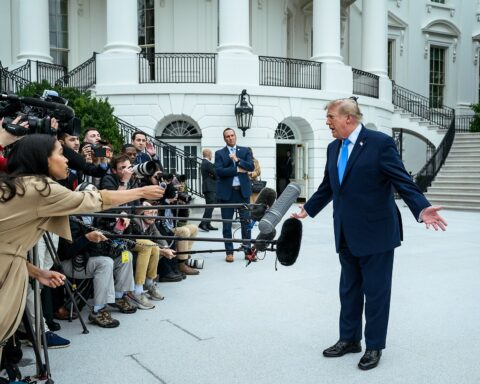
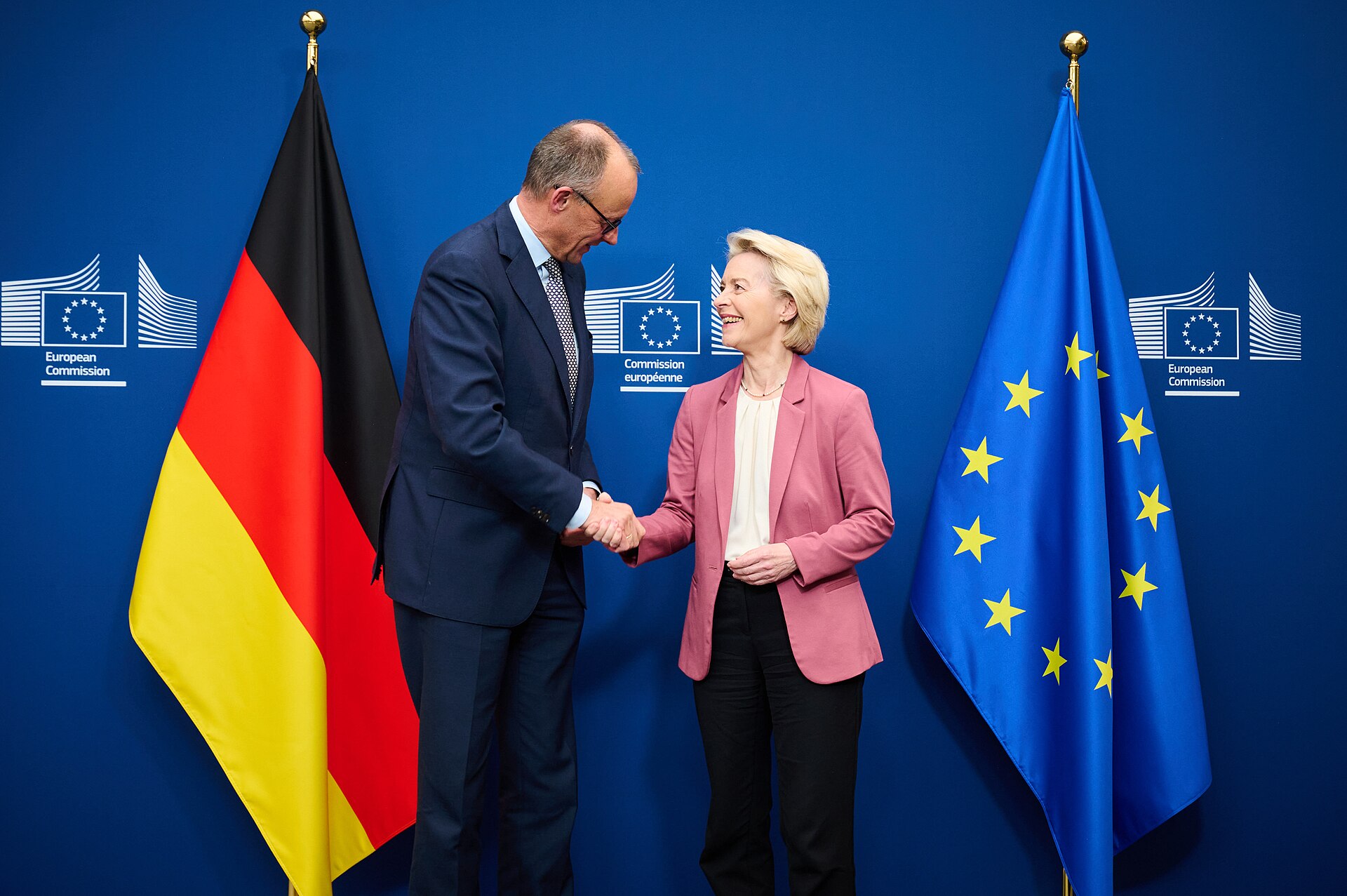
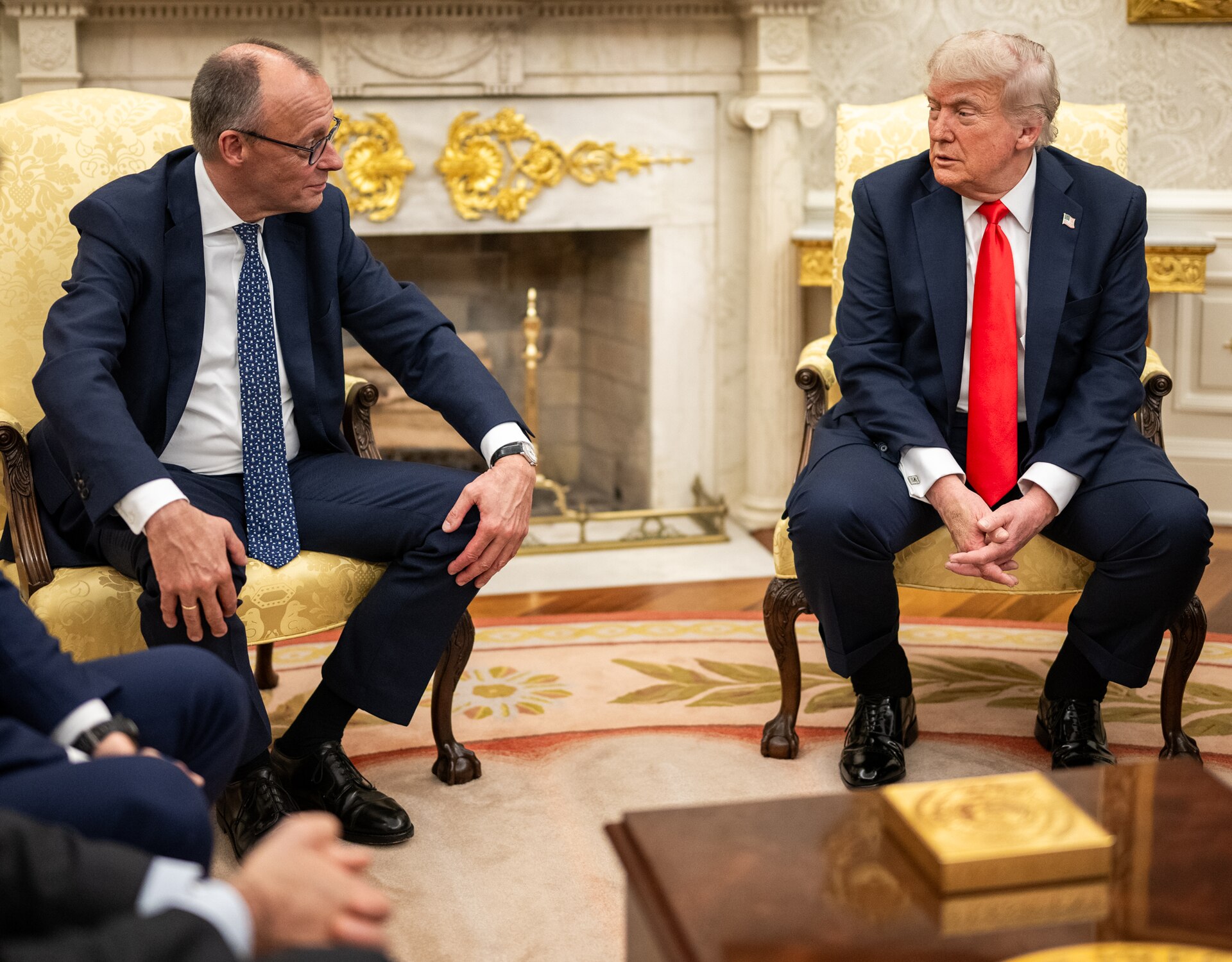
BERLIN — Friedrich Merz chose a school in Marsberg, a town of 19,000 in North Rhine-Westphalia, to deliver the sharpest public rebuke any G7 leader has aimed at Iran’s handling of the war — and, by extension, at America’s inability to end it. “An entire nation is being humiliated by the Iranian leadership,” Merz told students on Monday, “especially by these so-called Revolutionary Guards.” He was not describing Iran’s conduct toward Germany. He was describing what Iran is doing to the United States. That a German chancellor would name American humiliation out loud — in a student Q&A, not a summit communiquu00e9 — is itself the story. Merz has converted a private grievance shared across European capitals into a public pressure instrument aimed directly at the one audience most likely to respond to it: Donald Trump.
n
The timing was precise. Merz spoke on April 27, the same day Iran transmitted a new proposal via Pakistan offering to reopen the Strait of Hormuz in exchange for ending the US naval blockade and deferring nuclear talks. The same day Abbas Araghchi briefed Vladimir Putin in St. Petersburg. The same day Marco Rubio began hardening against the very proposal he had initially called “better than what we thought they were going to submit.” Into that convergence, Merz dropped a word — humiliated — that functions less as diplomatic language than as psychological ordnance.
n
n
A Chancellor in a Classroom
n
The setting matters. Merz did not say this at the Bundestag, at NATO, or at a press conference with prepared remarks and coordinated talking points. He said it in a school gymnasium, answering questions from students, in a format that German chancellors use to project accessibility. The informality was the delivery mechanism. A statement this sharp at a G7 foreign ministers’ meeting would have required weeks of back-channel preparation, allied coordination, and careful diplomatic hedging. At a student Q&A in Marsberg, it lands as candor — something a chancellor says because he believes it, not because his foreign ministry drafted it.
n
This is a man who sat across from Trump in the Oval Office on March 3, fifty-five days earlier, and told him that the strikes on Iran were “damaging our economies” but that he “shared the goal” of ending Iran’s threat. Merz backed the war. He supported the February 28 launch. What he did not support — and what he has complained about consistently since — was the absence of consultation. “We were not consulted before the US and Israel started attacking Iran on February 28,” he has said repeatedly. The Marsberg remarks carry the accumulated weight of that grievance: not an ideological reversal but a creditor calling in a debt.
n
“If I had known that it would continue like this for five or six weeks and get progressively worse,” Merz told the students, “I would have told him even more emphatically.”
n
The “him” is Trump.
n
What Did Merz Actually Say About Iran Humiliating the United States?
n
Merz’s exact language, as reported by the Irish Times, Bloomberg, and PBS on April 27, frames the IRGC — not Iran generically — as the agent of humiliation, and identifies the specific mechanism: the Witkoff-Kushner cancellation in Islamabad. “The Iranians are obviously very skilled at negotiating, or rather, very skilful at not negotiating, letting the Americans travel to Islamabad and then leave again without any result,” Merz said. The distinction between “negotiating” and “not negotiating” is doing real work. Merz is saying Iran is not outmaneuvering the US at the table — it is refusing to sit at the table while making the US show up anyway.
n
“An entire nation is being humiliated by the Iranian leadership, especially by these so-called Revolutionary Guards. And so I hope that this ends as quickly as possible.”
n
Two elements are worth isolating. First, “an entire nation” — Merz did not say “the Trump administration” or “American diplomats.” He said the nation. This raises the stakes from a policy failure to a national credibility crisis, which is precisely the frame most likely to trigger a response from a president who processes geopolitics through personal dignity. Second, “these so-called Revolutionary Guards” — the so-called is contemptuous, a linguistic move that strips the IRGC of institutional legitimacy while identifying them, not Pezeshkian or Araghchi, as the decision-making body. Merz is telling Trump who his actual adversary is.
n
He then added what may be the most revealing line: “The problem with conflicts like this is always you don’t just have to get in — you have to get out again.” That is not a statement about Iran. It is a statement about the United States.
n
The u20ac13 Billion Wound Behind the Words
n
Merz’s frustration is not abstract. Five days before Marsberg, on April 22, Economics Minister Katherina Reiche announced that Germany had halved its 2026 GDP growth forecast from 1.0% to 0.5%. The 2027 outlook dropped from 1.3% to 0.9%. Inflation expectations rose to 2.7%. German investor morale hit its lowest point since late 2022, when the Ukraine energy crisis was at its peak.
n
The structural mechanism is straightforward. Germany’s industrial base — steel, chemicals, automotive — is more exposed to energy price shocks than any other G7 economy. The EU estimates that gas prices have risen 70% and oil prices 50% since the war began on February 28, adding u20ac13 billion to the bloc’s fossil fuel import bill. Germany absorbs a disproportionate share of that cost not because it imports more LNG through Hormuz than Belgium or the UK — it doesn’t — but because its heavy industry converts every dollar of energy price increase into output contraction.
n
| Indicator | Pre-War / Forecast | Current / Revised | Change |
|---|---|---|---|
| 2026 GDP growth forecast | 1.0% | 0.5% | -0.5 pp |
| 2027 GDP growth forecast | 1.3% | 0.9% | -0.4 pp |
| 2026 inflation forecast | ~2.0% | 2.7% | +0.7 pp |
| Hapag-Lloyd weekly war costs | — | $50u201360 million | — |
| Hapag-Lloyd ships trapped (Persian Gulf) | — | 6 ships / 25,000 TEU | — |
| EU fossil fuel import bill increase | — | +u20ac13 billion | — |
| EU gas price increase | — | +70% | — |
| EU oil price increase | — | +50% | — |
n
n
Hapag-Lloyd, Germany’s flagship container carrier headquartered in Hamburg, has six ships — 25,000 TEU of capacity — trapped in the Persian Gulf. For a company already managing Red Sea disruptions from the Houthi campaign, the Hormuz closure is a second front on the same balance sheet.
n
Merz acknowledged this directly in Marsberg: “It is, at the moment, a pretty tangled situation. And it is costing us a great deal of money.” The understatement is characteristically German. The GDP revision is not.
n
The Fulda Sailed Before Merz Spoke
n
Two days before Marsberg, on April 25, Defense Minister Boris Pistorius announced that the minesweeper Fulda had deployed to the Mediterranean with a command and supply ship, staging for a potential Hormuz mine-clearance mission. The crew of approximately 45 would proceed to the Gulf only after cessation of hostilities and with Bundestag approval — two conditions that currently do not exist. Merz himself confirmed at Marsberg that Hormuz was “at least partially mined.”
n
The sequencing is worth reading carefully. Germany positioned a naval asset on April 25. Merz publicly named American humiliation on April 27. Foreign Minister Johann Wadephul departed for the United Nations on the same day, carrying language calibrated one register above Merz’s: “In the Persian Gulf, Iran is attacking the global economy. The blockade of the Strait of Hormuz reminds us how vulnerable our prosperity and global supply chains are.”
n
Wadephul added a nuclear dimension that Merz left implicit: “As long as nuclear threats against us and our partners continue, we will need a credible deterrent.” And then the institutional ask: “If the UN Security Council assumes responsibility now, it will also strengthen the international order.”
n
These are not disconnected events. A ship, a speech, and a UN intervention in seventy-two hours constitute a coordinated German escalation — not military, but rhetorical and positional. Germany is telling Washington that it has skin in the game, that it is prepared to contribute assets, but that the current trajectory — five deadlines set and none enforced, as CNN documented on April 22 — is producing costs Berlin can quantify and will not absorb indefinitely.
n
Why Did Merz and Rubio Arrive at the Same Word on the Same Day?
n
On April 27, while Merz was in Marsberg, Rubio was in Washington processing Iran’s latest proposal — the Hormuz-for-blockade-removal offer transmitted via Pakistan. His initial assessment was surprisingly open: Iran’s proposal was “better than what we thought they were going to submit.” But the hardening followed within hours. “They cannot normalize, nor can we tolerate them trying to normalize, a system in which the Iranians decide who gets to use an international waterway and how much you have to pay them to use it.”
n
Rubio did not use the word “humiliation.” He did not need to. The substance of his rejection — that Iran is attempting to convert a temporary military fait accompli into a permanent toll regime — describes the same condition Merz named in Marsberg, only from the inside. Rubio is saying: we will not accept this. Merz is saying: the fact that you are in a position where you have to say that is itself the problem.
n
The convergence is not coordinated. There is no evidence that Merz and Rubio spoke before April 27, and the G7 foreign ministers’ channel runs through Wadephul, not Merz directly. What produced the convergence is the same underlying reality arriving at two different desks simultaneously: Iran’s proposal, by offering to reopen Hormuz only in exchange for the end of America’s blockade and the war itself, frames any US acceptance as capitulation and any US rejection as indefinite stalemate. Both Merz and Rubio, from entirely different positions, recognized that this is a trap — and both reacted by naming it, one from outside and one from within.
n
Elizabeth Saunders, a political scientist at Columbia University, had already identified this binary in The New Republic: Trump faces only “humiliation or escalation.” Merz’s contribution is to say the first half of that binary out loud, in a European accent, to an audience of students who will repeat it.
n
The St. Petersburg Counter-Frame
n
The same day Merz spoke in Marsberg, Abbas Araghchi was in St. Petersburg briefing Putin on Iran’s proposal and the state of negotiations. Putin’s response operated on the exact opposite frequency: “We see how courageously and heroically the Iranian people are fighting for their independence, for their sovereignty.” Russia stood “ready to do everything possible” to help resolve the situation — language that promises support without specifying any.
n
The three-way information contest that emerged on April 27 is structurally revealing. Merz frames Iran’s behavior as humiliation of America — a credibility problem requiring American action. Putin frames Iran’s behavior as heroic sovereignty — a legitimacy claim requiring international deference. Iran’s actual proposal, transmitted through Pakistan on the same day, tries to split the difference: reopen Hormuz (addressing the credibility problem) in exchange for ending the blockade and the war (claiming the sovereignty victory). The proposal defers nuclear talks — the issue that Russia has positioned itself to mediate on terms favorable to Tehran.
n
What Merz understands, and what his Marsberg remarks implicitly communicate, is that Russia’s role as Iran’s diplomatic patron makes the European rhetorical escalation necessary. If Moscow is telling Iran that its resistance is heroic, someone needs to tell Washington that its patience looks weak. Merz has volunteered for that role — not because Germany has the military capacity to change the trajectory, but because Germany has the economic credibility to make the argument that the status quo is unsustainable.
n
n
European Soldiers Are Already Inside Saudi Arabia
n
The dimension of Merz’s intervention that no competing coverage has adequately explored is the military one — not Germany’s minesweeper in the Mediterranean, but the European soldiers already under fire inside Saudi Arabia.
n
A British Royal Artillery battery operating the Sky Sabre air defense system has been engaged in live combat inside Saudi Arabia since late March 2026, shooting down Iranian drones and missiles. Approximately 1,000 UK military personnel are deployed across the Gulf and Cyprus in support of the operation. A Greek PAC-3 battery has been operational inside Saudi Arabia since March 19. Two NATO member states have sovereign air defense units inside Saudi territory, firing at Iranian projectiles in real time.
n
This changes the geometry of Merz’s remarks. When a German chancellor says the United States is being humiliated by the IRGC, he is speaking as the leader of a NATO alliance in which two members already have soldiers in the blast radius of any IRGC counter-strike on Saudi air defense infrastructure. PAC-3 interceptor stocks are at approximately 400 rounds — 14% of pre-war levels. If Iran escalates in response to American escalation, British and Greek soldiers die on Saudi soil. If Iran escalates in response to American inaction, the same soldiers die anyway, with fewer interceptors.
n
Merz’s offer of minesweepers — conditional on cessation of hostilities and Bundestag approval — looks cautious against this backdrop. Germany is staging assets but not committing forces. The UK and Greece are already committed. The gap between Germany’s rhetorical escalation and its military restraint is itself a pressure point: Berlin is saying what London cannot say publicly, because London has troops under fire and cannot afford to antagonize either Washington or Riyadh.
n
Why Has Saudi Arabia Said Nothing?
n
No public Saudi reaction to Merz’s Marsberg remarks has appeared. The Saudi Press Agency, the Foreign Ministry, and the usual network of authorized commentators have been silent. This silence is not incidental.
n
Saudi Arabia bears the war’s highest cost — production collapsed from 10.4 million barrels per day to 7.25 million in March, the Yanbu bypass pipeline caps effective export capacity at 5.9 million bpd, and the fiscal break-even of $108u2013111 per barrel sits above Brent’s current $107/bbl. Goldman Sachs estimates a war-adjusted deficit of 6.6% of GDP against the official 3.3% forecast. Saudi Arabia needs the United States to act. It cannot say so publicly.
n
The fact that Prince Faisal bin Farhan served as Saudi ambassador to Germany and speaks fluent German — a personal channel to Berlin that does not exist with most G7 peers — makes Saudi silence on Merz’s remarks more legible. Riyadh does not need to respond because it does not need to distance itself. A European leader publicly telling Trump that he is being humiliated performs the exact function that Faisal bin Farhan’s three-call mediation architecture performs through diplomatic channels: pressure toward American resolve without Saudi fingerprints.
n
n
“The Iranians are obviously very skilled at negotiating, or rather, very skilful at not negotiating, letting the Americans travel to Islamabad and then leave again without any result.”
n
Friedrich Merz, German Chancellor, Marsberg, April 27, 2026n
n
The double-edged quality is real, however. Merz’s intervention accelerates a narrative in which European leaders — not Gulf monarchs — define the terms of American credibility in the Middle East. For Saudi Arabia, this transfers the escalation narrative away from Riyadh and toward European capitals. That is useful cover in the short term. In the longer term, it means the post-war settlement framework will carry European conditions — freedom of navigation, nuclear constraints, mine clearance timelines — that may not align perfectly with Saudi priorities around market share, OPEC+ architecture, and the bilateral relationship with Washington.
n
The GCC has already used European pressure to harden negotiating terms that Washington was prepared to soften. Merz’s Marsberg intervention is a more aggressive version of the same mechanism — but this time the pressure is aimed at Trump’s psychology, not at treaty language.
n
Is the Diplomatic Space Closing From Every Direction?
n
The architecture of April 27 reveals how many directions the pressure is now coming from simultaneously.
n
| Actor | Action (April 27) | Direction of Pressure | Target |
|---|---|---|---|
| Merz (Germany) | “Humiliated” framing at Marsberg | Ego/credibility pressure | Trump |
| Rubio (US) | Rejection of Hormuz-for-blockade deal | Hardline closure of interim track | Iran |
| Wadephul (Germany) | UNSC responsibility call at UN | Institutional escalation | Security Council |
| Putin (Russia) | “Full support” to Iran / Araghchi meeting | Sovereignty validation | Western bloc |
| Iran (via Pakistan) | Hormuz-for-blockade-removal proposal | Conditional reopening | US / international community |
| Saudi Arabia | Silence | Permissive cover for all vectors | — |
n
n
None of these vectors opens diplomatic space. Merz’s “humiliation” framing raises the cost of a deal by making any agreement look like capitulation — exactly the dynamic Saunders identified. Rubio’s rejection closes the interim track. Putin’s solidarity pledge gives Iran confidence to hold. Iran’s proposal demands preconditions the US cannot meet. Saudi silence permits all of these dynamics to continue without offering an alternative framework.
n
The April 8 joint statement — signed by Merz, Macron, Starmer, Meloni, and seven other leaders — welcomed the ceasefire and called for “quick progress towards a substantive negotiated settlement” and “freedom of navigation in the Strait of Hormuz.” The April 17 Hormuz Summit, with 51 countries including Merz attending in person, called for “unconditional, unrestricted, and immediate re-opening” of Hormuz. Both documents maintained collective, diplomatic register. Merz’s April 27 remarks in Marsberg are his departure from that register — a solo move that speaks to Trump rather than to the international community, and that names the condition (humiliation) rather than the aspiration (freedom of navigation).
n
The Libya 2011 parallel — Sarkozy pressuring Obama into intervention — is imperfect but instructive. Sarkozy pulled Obama toward military action by framing inaction as European abandonment. Merz is pushing Trump toward resolution by framing inaction as national humiliation. The mechanism is the same: a European leader manipulating the gap between an American president’s self-image and the visible reality of the conflict. The difference is direction. Sarkozy wanted more war. Merz wants less of it — but on terms that restore American credibility, not on terms that reward Iranian brinkmanship.
n
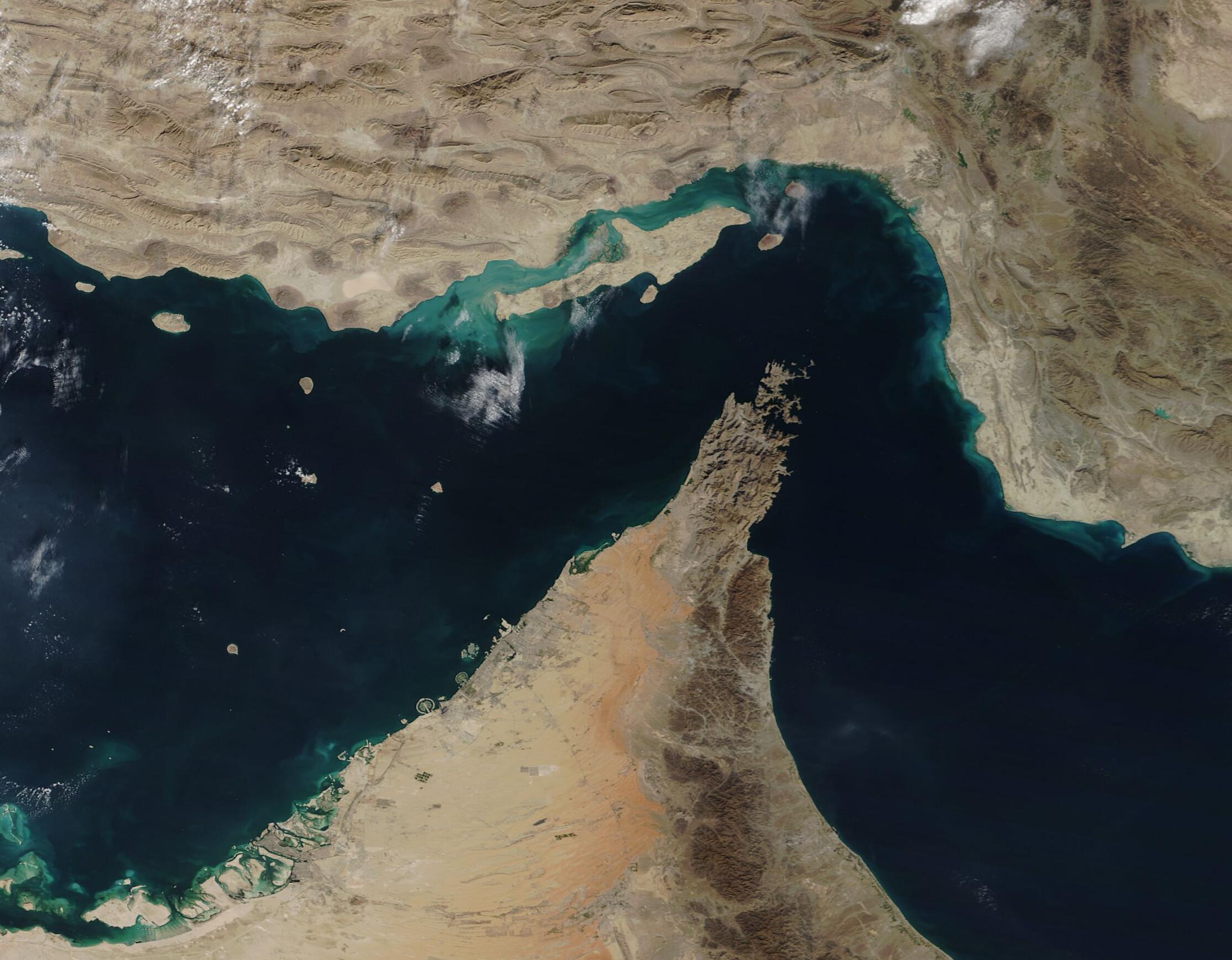
Every pressure vector converging on April 27 makes the exit narrower. The one actor that most needs the exit to open — Saudi Arabia, with its fiscal break-even unreachable at current prices and 3.15 million barrels per day offline — is the one actor that cannot publicly say so.
n
n
Frequently Asked Questions
n
Has any other G7 leader used the word “humiliation” to describe the US position on Iran?
n
No. Merz is the first sitting G7 leader to publicly frame the Iran standoff in terms of American humiliation. The closest prior instance was Elizabeth Saunders at Columbia University, who wrote in The New Republic that Trump faces only “humiliation or escalation” — an academic framing that Merz effectively elevated to head-of-state level. Canadian Prime Minister Mark Carney, French President Macron, and UK Prime Minister Starmer have all criticized the war’s economic effects and called for diplomatic progress, but none has characterized the US position as one of being humiliated by Iran. Italian Prime Minister Meloni, who attended the April 17 Hormuz Summit alongside Merz, has maintained the most restrained public posture among major European leaders.
n
What is Germany’s direct military contribution to the Iran war theater?
n
Germany has deployed the minesweeper Fulda and a command/supply ship to the Mediterranean as of April 25, 2026, staging for a potential Hormuz mine-clearance mission. The deployment requires two conditions before proceeding to the Gulf: cessation of hostilities and Bundestag approval. Neither condition currently exists. Germany is not operating air defense systems inside Saudi Arabia — that role belongs to the UK (Sky Sabre battery, Royal Artillery) and Greece (PAC-3 battery, operational since March 19). Germany’s G7 March 27 joint statement committed to a broader 30+ country readiness declaration for Hormuz passage security, also conditional on hostilities ending. Pistorius described the Fulda deployment as a signal of “operational readiness,” not active engagement.
n
What is the Faisal bin Farhanu2013Germany diplomatic channel?
n
Saudi Foreign Minister Prince Faisal bin Farhan Al Saud served as Saudi ambassador to Germany before his appointment as foreign minister in 2020. He speaks fluent German and maintains personal relationships within the German political establishment that predate the current crisis. This structural channel — a foreign-minister-level personal connection grounded in language fluency and ambassadorial tenure — does not exist between Saudi Arabia and most other G7 peers at comparable depth. The channel’s significance in the current context is inferential: Saudi silence on Merz’s Marsberg remarks may reflect a calculation that the statement is doing useful work that Riyadh need not publicly endorse or repudiate, communicated through a bilateral relationship with enough bandwidth to manage any private concerns.
n
How does Merz’s April 27 language differ from the April 8 and April 17 joint statements he co-signed?
n
The April 8 joint statement, co-signed by Merz with Macron, Starmer, Meloni, and seven other leaders, used institutional language: it “welcomed” the ceasefire, called for “quick progress towards a substantive negotiated settlement,” and affirmed “freedom of navigation.” The April 17 Hormuz Summit declaration, involving 51 countries with Merz attending in person, called for “unconditional, unrestricted, and immediate re-opening” of Hormuz — stronger in substance but still multilateral in register. The Marsberg remarks abandon both the collective voice and the diplomatic register. Merz spoke alone, named the United States as the humiliated party, identified the IRGC specifically as the humiliating agent, and addressed Trump’s decision calculus directly rather than appealing to the international community. The shift from “freedom of navigation” to “humiliation” is a shift from aspiration to diagnosis.
n
What was the MAGA response to Merz’s remarks?
n
Gateway Pundit ran the headline “Failing German Chancellor Merz Says the US is Being ‘Humiliated’ by Iran” on April 27, framing Merz’s domestic political vulnerabilities — his coalition difficulties and Germany’s economic weakness — as delegitimizing his criticism of Trump. This is the White Houseu2013adjacent counter-narrative: that Merz is projecting German failure onto American policy. The framing did not engage with the substance of Merz’s argument about the Witkoff cancellation or the IRGC’s refusal to negotiate. No official White House or State Department response to Merz’s specific “humiliation” language was published as of April 28. Rubio’s same-day comments on Iran’s proposal did not reference Merz. The pattern Merz identified continued into April 28, when Araghchi filed a third draft in Islamabad in under 48 hours — documented in Araghchi Files Third Islamabad Draft in 48 Hours.