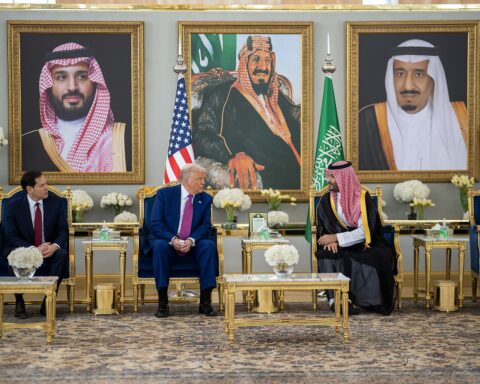
RIYADH — Hours after US Navy destroyers traded fire with Iranian forces in the Strait of Hormuz — strikes Donald Trump dismissed as “just a love tap” — the five-day diplomatic sequence from Riyadh to Beijing that is supposed to deliver an Iran nuclear deal has become a coercive chain in which Saudi Arabia hosts the deadline and Xi Jinping holds the lever. Trump arrives in Riyadh on May 13, the same window in which US officials said Iran’s response to a 14-point MOU framework was expected, then flies to Beijing for a summit Xi has every incentive to slow-walk until tariff and rare-earth concessions are on the table.
Saudi Arabia — which suspended US military access to its airspace barely a week ago over the botched Project Freedom Hormuz escort and restored it only under direct pressure — now hosts the ceremony for a deal it cannot enforce, while running a Yanbu bypass ceiling that sits roughly 1.1 to 1.6 million barrels per day below Saudi Arabia’s pre-war Hormuz export capacity — volume the Red Sea route cannot recover regardless of how hard Aramco presses it. For Riyadh, the cost of Xi playing the clock is not abstract; it compounds in lost revenue whether or not the cameras are rolling.
Table of Contents
- The Ceasefire as Political Fiction
- What Is the Three-Date Architecture of Trump’s Middle East-Asia Trip?
- Why Is MBS the Involuntary Host of the Iran Deadline?
- What Does Xi Gain by Waiting?
- How Do Today’s Strikes Make the Authorization Ceiling Worse?
- What Does Trump Need from Each City — and Why Can’t the Sequence Deliver It?
- What Saudi Arabia Actually Gets from the Summit
- Frequently Asked Questions
The Ceasefire as Political Fiction
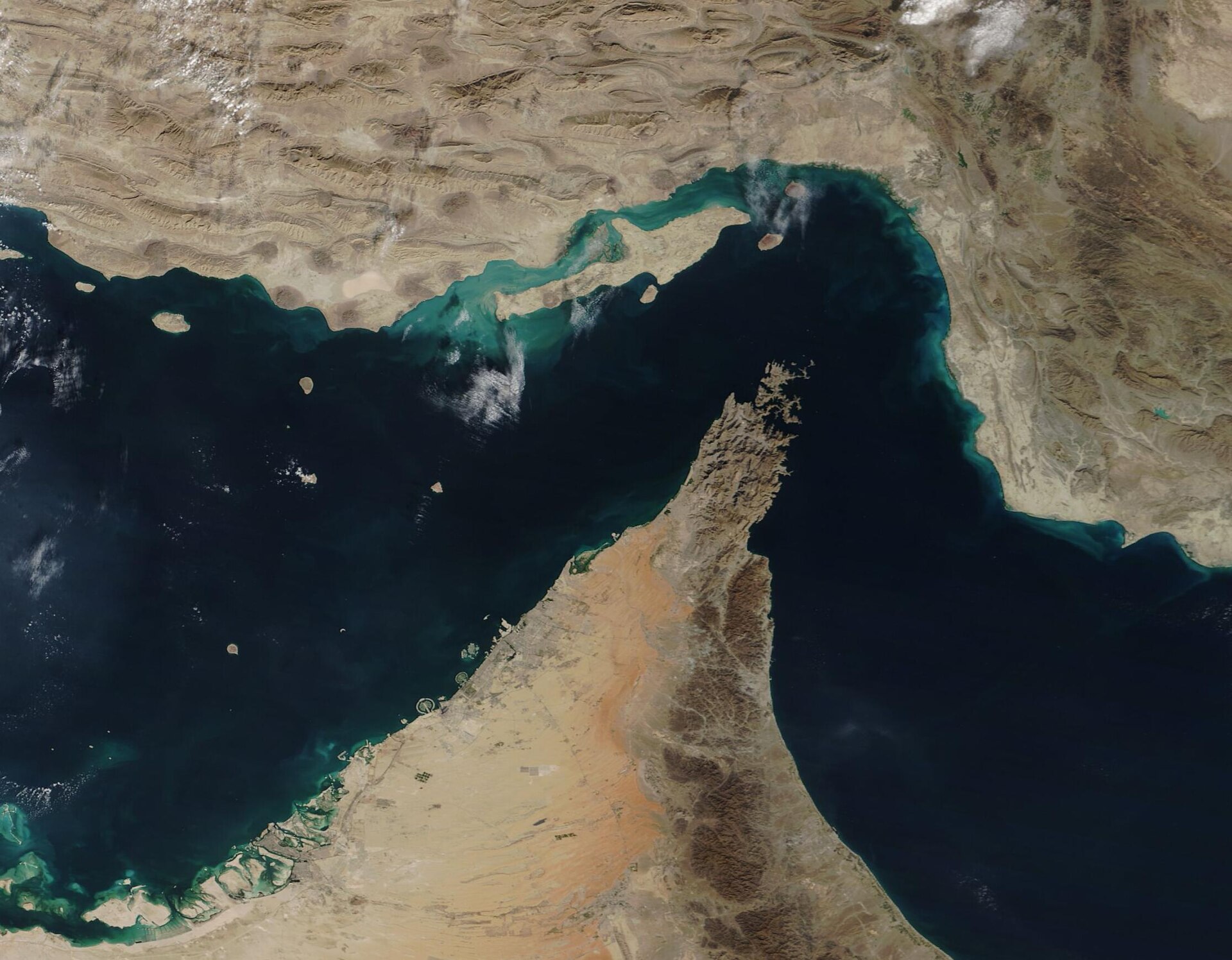
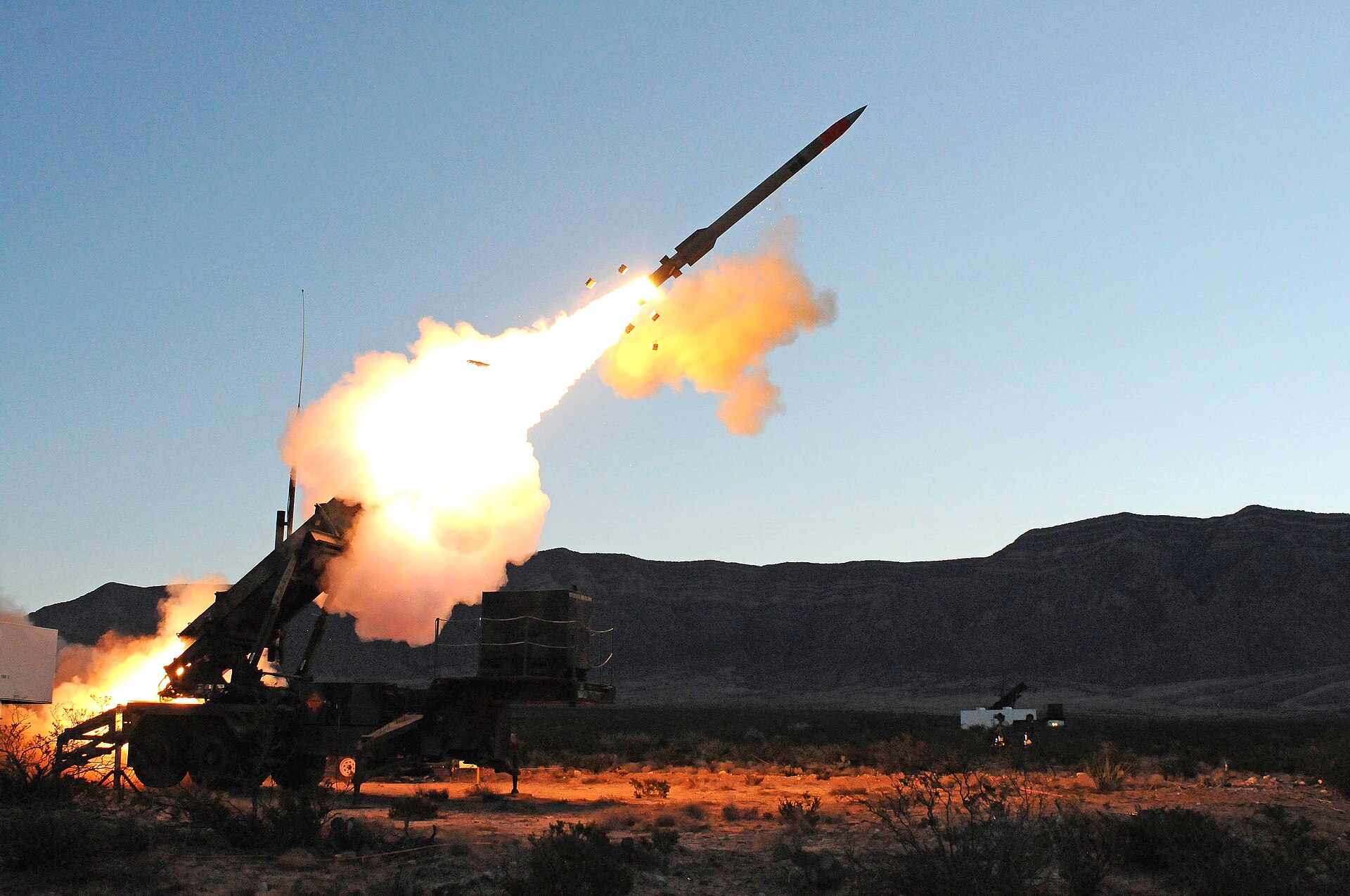
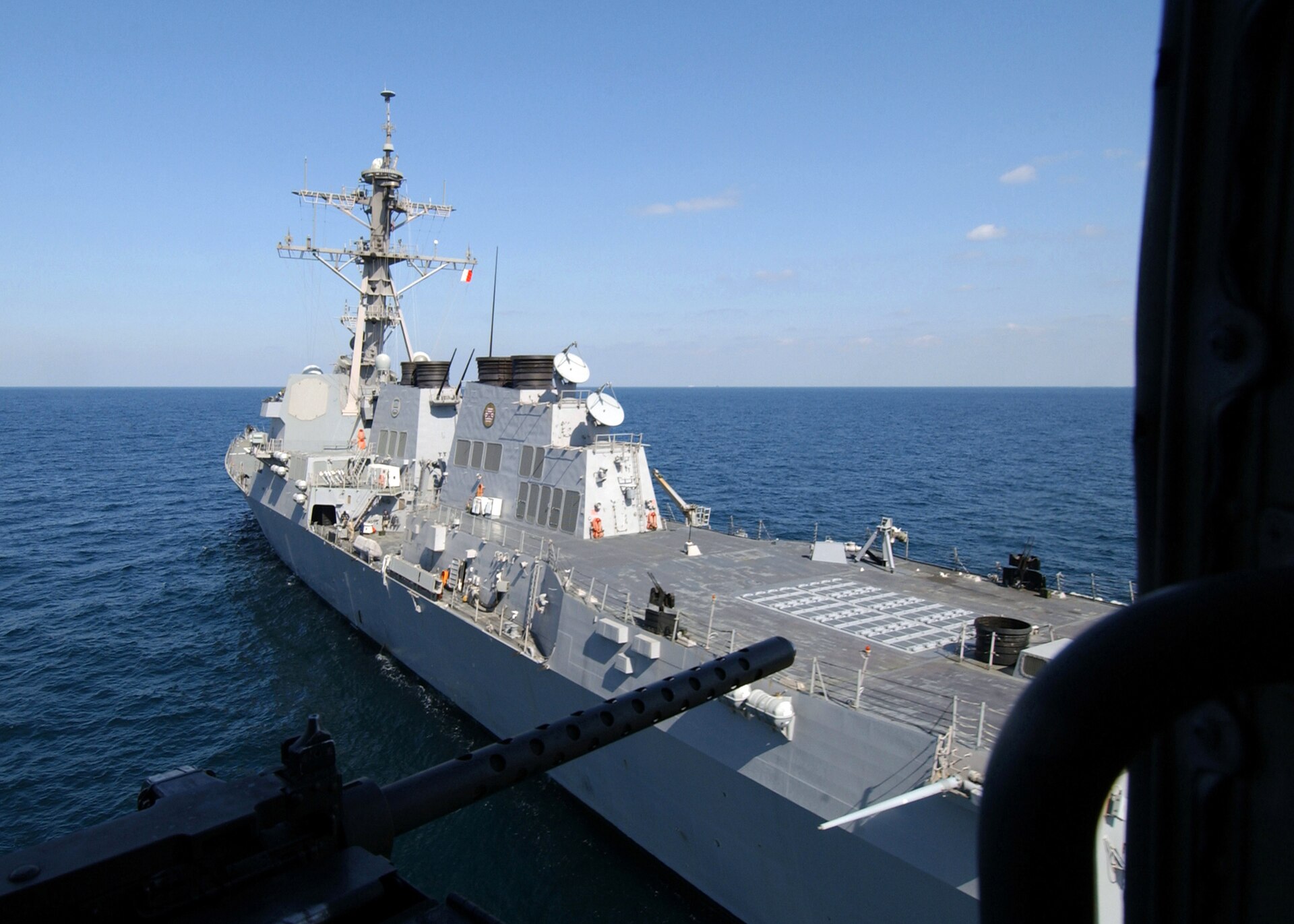
The facts of May 8 are not ambiguous, even if the framing from both capitals works hard to make them so. Three US guided-missile destroyers — the USS Truxtun, the USS Rafael Peralta, and the USS Mason — were transiting the Strait of Hormuz when Iranian forces engaged them with missiles, drones, and fast-boat attacks, according to Pentagon statements and reporting by Axios, Bloomberg, and CNN. US forces responded by striking Iranian command-and-control locations and intelligence, surveillance, and reconnaissance nodes along the coastline, in what appears to be the most direct US-Iran kinetic exchange since the war’s opening weeks. No American assets were damaged; Iran’s military described the strikes as a ceasefire violation and threatened retaliation.
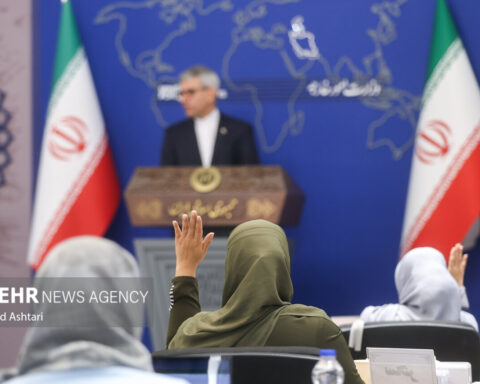
Trump declared the ceasefire “remains in effect” and characterized the US strikes as “just a love tap,” adding a warning that if Iran refuses to sign a deal, “we’ll knock them out a lot harder, and a lot more violently.” The framing is instructive: a president calls naval combat a love tap only when the audience he is managing is not the adversary but his own schedule, where a collapsed ceasefire would wreck a Riyadh arrival that needs to look triumphant and a Beijing summit he needs to enter with momentum rather than escalation spiraling behind him. Iran’s Foreign Ministry spokesperson Esmail Baghaei answered in a register the remark deserved: “If you see a lion’s teeth exposed, do not assume the lion is smiling.”
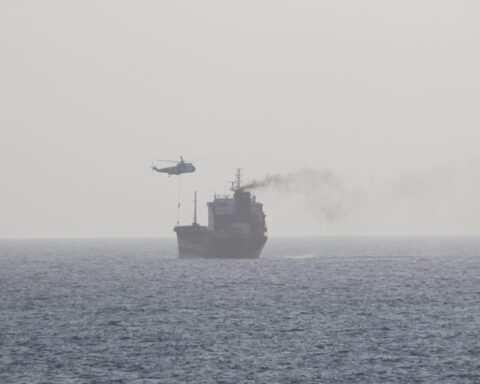
Iran also claimed — without independent corroboration — that the US struck an Iranian oil tanker, a narrative detail designed to reframe a military exchange as an attack on civilian economic infrastructure and to justify the IRGC’s wartime institutions as defensive rather than provocative. The claim buried what remained of the fiction that the Hormuz double blockade represents a stable equilibrium. Iran’s Persian Gulf Strait Authority, launched May 5, now requires all transiting vessels to submit ownership details, crew nationalities, cargo manifests, and voyage plans before entering the waterway — an institution with no basis in international law but considerable enforcement power in the operating reality of the Strait, where IRGC patrol boats enforce what UNCLOS does not authorize.
The PGSA is not a bargaining chip to be exchanged at the negotiating table, and reading it as one misidentifies Tehran’s intent. It is a wartime institution designed to create administrative facts on the water — facts that any future agreement must accommodate rather than reverse, and that the May 8 fire exchange has made more entrenched by demonstrating to IRGC commanders that their waterway-control apparatus is an active combat asset, not a diplomatic provocation they will be talked out of.
The Middle East briefing 3,000+ readers start their day with.
One email. Every weekday morning. Free.
What Is the Three-Date Architecture of Trump’s Middle East-Asia Trip?
Trump’s trip spans three events in five days: his arrival at the Riyadh investment forum on May 13, where he urged Iran to take “a new and a better path”; a GCC heads-of-state summit on May 14; and the Trump-Xi bilateral in Beijing on May 14-15, where Treasury Secretary Scott Bessent confirmed to CNBC that Iran “will be a topic.” The MOU response deadline falls in the May 13 window, making Riyadh the venue where the deal’s fate is decided — or where its failure becomes visible.
| Date | Event | Location | What Trump needs |
|---|---|---|---|
| May 13 | Riyadh Investment Forum | Riyadh | Iran MOU response or Saudi headline figure |
| May 14 | GCC Heads-of-State Summit | Riyadh | Unified Gulf position on Iran |
| May 14-15 | Trump-Xi Bilateral Summit | Beijing | Chinese pressure on Tehran to accept deal |
The 14-point MOU framework — the product of months of back-channel negotiation that survived the first direct US-Iran contact in Islamabad and multiple subsequent collapses — calls for a 12-to-15-year enrichment moratorium, the shipment of Iran’s highly enriched uranium to the United States, the closure of underground nuclear facilities, enhanced IAEA snap inspections, and a mutual lifting of the blockades. US officials told Axios on May 6 that Iran’s formal response was expected “within 24-48 hours,” a window that — whether by design or scheduling accident — places the deadline squarely on Trump’s Riyadh arrival.
The sequencing runs backward. Trump needs Iran’s answer before he arrives in Riyadh, so he can land with a deal in hand or at least credible momentum toward one, but the only external actor with enough influence over Tehran to accelerate that answer is Xi Jinping — and Trump does not reach Beijing until May 14, a full day after the deadline window opens. The influence he needs on May 13 in Riyadh resides in a capital he will not visit until the 14th, which means the trip’s diplomatic logic operates in reverse: the president arrives at the venue before he has secured the instrument, and asks the host to project confidence before the outcome justifies it.
The Beijing summit was itself originally scheduled for late March or early April, and each week of postponement has widened the asymmetry — a dynamic Brookings’ Ryan Hass identified well before the dates were confirmed. For Saudi Arabia, that delay compounds something more concrete than positional advantage: every day Hormuz stays blocked, the Yanbu bypass ceiling burns revenue that no Riyadh photo-op recovers.
Why Is MBS the Involuntary Host of the Iran Deadline?
Because Saudi Arabia’s structural position gives it the most to lose from delay and the least ability to accelerate the outcome. Crown Prince Mohammed bin Salman enters the summit having already burned political capital — suspending US airspace access over Project Freedom — while carrying a $600 billion investment pledge and $142 billion defense package whose delivery depends on a Hormuz reopening only Beijing can broker.
The Project Freedom episode revealed MBS’s bind in miniature. When Trump announced Operation Project Freedom on May 4 — a US naval escort mission through Hormuz that had not been adequately coordinated with Gulf allies — Saudi Arabia shut US military access to Prince Sultan Airbase and Saudi airspace, with Kuwait following suit. A Trump-MBS phone call did not resolve the standoff; Trump had to pause the operation entirely. Pakistani Prime Minister Shehbaz Sharif subsequently named MBS as the leader who “prodded” Trump to suspend the mission, according to Pakistani media reports — a public attribution that established the Crown Prince’s weight in the moment but also marked its boundaries.
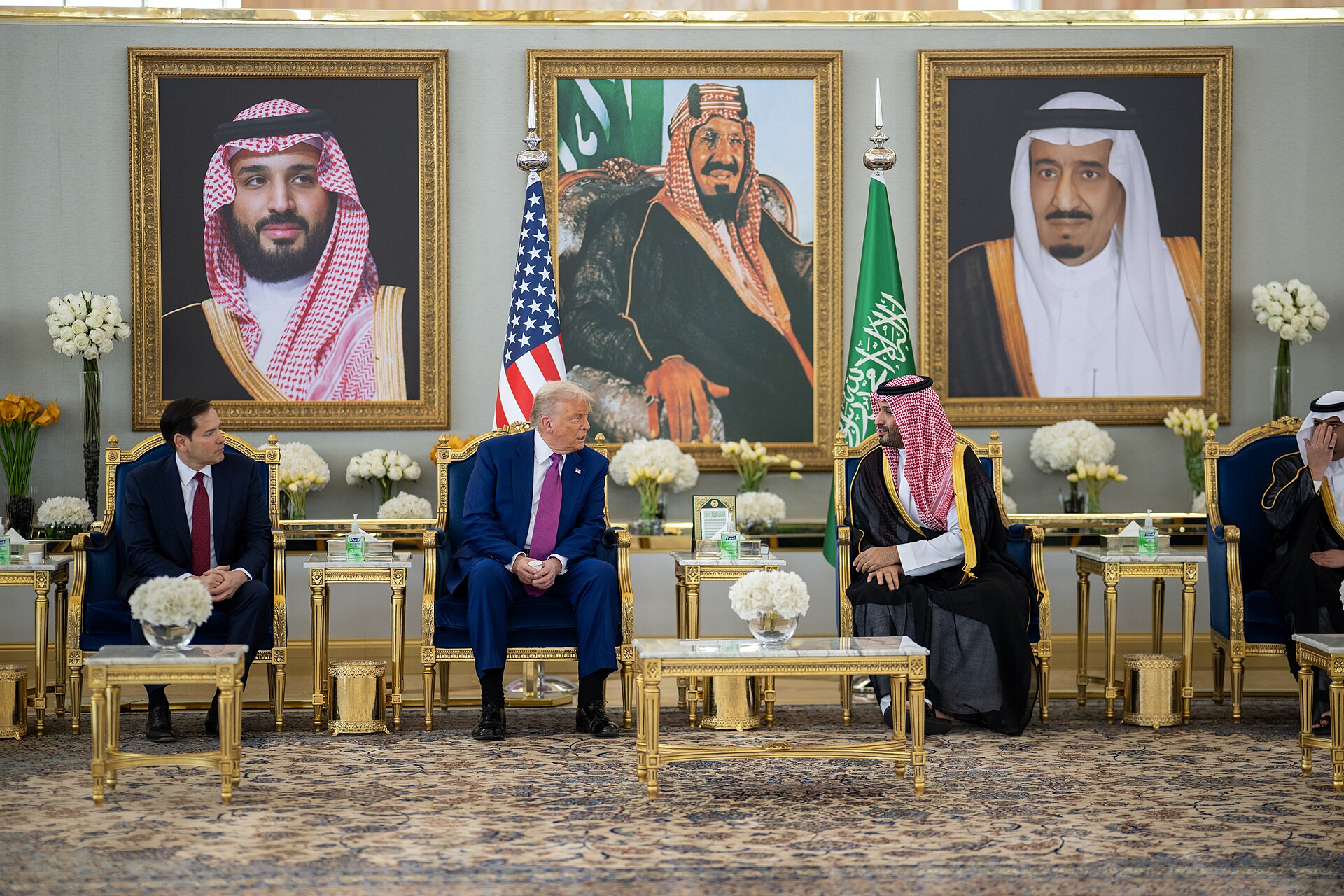
The weight was real but temporary: MBS showed he could impose costs on a unilateral US military action, but the objection was to the execution rather than the strategic objective. Riyadh needs Hormuz reopened — arguably more urgently than any other state in the region — and the airspace suspension was a signal about consultation norms, not a disagreement over ends. The access was subsequently restored, and the underlying dependency remained intact.
That dependency now arrives in presidential form. The November 2025 Trump-MBS White House meeting produced the $600 billion Saudi investment pledge and the $142 billion defense procurement package — numbers that carry a built-in credibility discount for anyone who recalls the precedent. Trump’s first foreign trip was also to Riyadh, in May 2017, where he announced $110 billion in immediate defense sales and $350 billion in commitments over ten years. By October 2018, actual purchases totaled approximately $14.5 billion — roughly 13 cents on each headline dollar.
The pattern is durable: Riyadh summits produce figures designed for a news cycle rather than a procurement pipeline, and the gap between announcement and delivery widens under stress. MBS is hosting a president who arrives needing a deliverable — either Iran signing the MOU, or a Saudi investment headline large enough to cover its absence — while presiding over $600 billion in pledges whose implementation requires stable Hormuz throughput and an oil price that justifies the spending. If the deal collapses because Xi withholds pressure on Tehran, the Riyadh forum becomes a ceremony for announced intentions backed by shrinking revenue — 2017 at higher stakes, with the same structural gap between the handshake and the contract.
What Does Xi Gain by Waiting?
China purchases 80-90% of Iran’s oil exports — roughly 1.4 million barrels per day, or about 13% of Chinese crude imports — at a guaranteed 12% discount plus 6-8% risk compensation under the 25-year cooperation agreement signed in 2021. Beijing holds the only external influence capable of pressing Tehran toward the MOU framework, but exercising it before Trump offers tariff relief and rare-earth concessions would mean surrendering its strongest card for nothing in return.
Wang Yi met Iranian Foreign Minister Abbas Araghchi in Beijing on May 7 — exactly one week before Trump’s scheduled arrival — in what Al-Monitor described as a meeting that “gives China the upper hand to control the agenda” in the Hormuz stalemate and the nuclear file. The timing was deliberate. Araghchi went to Beijing to set terms before Trump could, and Wang Yi used the meeting to stake a position that appears cooperative while structurally undercutting the MOU’s core provision: China “welcomes Iran’s commitment not to develop nuclear weapons,” Wang Yi told his counterpart, “while considering that Iran has the legitimate right to the peaceful use of nuclear energy.”
That phrase — “legitimate right to the peaceful use of nuclear energy” — does not support the MOU’s enrichment moratorium; it contradicts it, by framing any moratorium demand as an infringement on a right Beijing has publicly endorsed. Wang Yi was not being imprecise. He was constructing a negotiating position that allows China to present itself as a responsible mediator while preserving Iran’s nuclear ambiguity as a problem the United States must pay Beijing to help resolve.
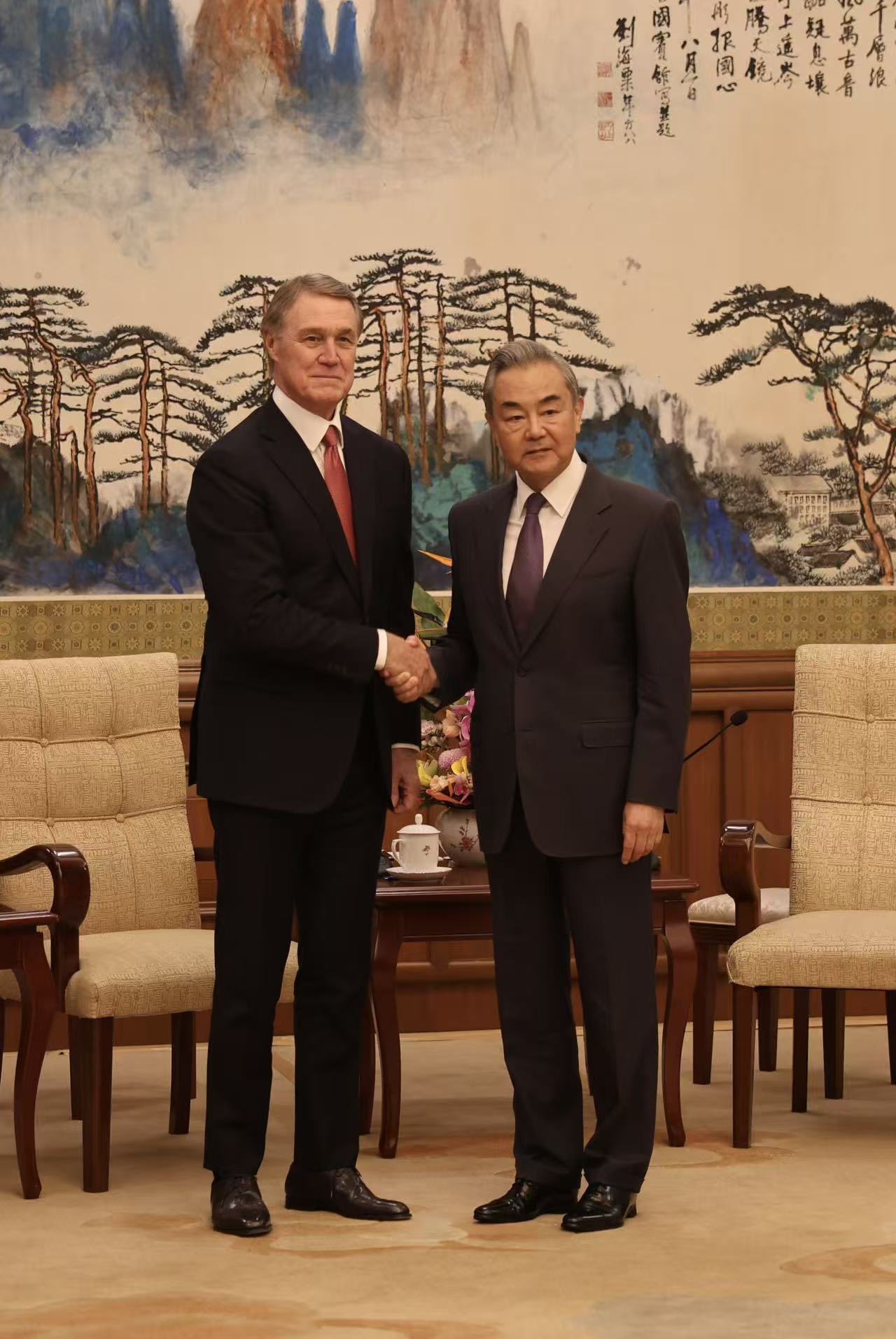
“China already thinks that it has a lot of leverage over Washington after last year and what they did with the rare earths, and they think that that leverage is actually going to increase as we approach the midterm elections. If the theory is that Beijing wants more time and they think they’re going to have more leverage over time, they could get real benefit from the fact that this is delayed.”
Ryan Hass, Brookings Institution
The structural incentives are legible from outside the room. China’s oil relationship with Iran — the discounted crude, the 25-year framework, the guaranteed below-market pricing — is not a dependency Beijing wants to dissolve but an asset it can deploy in several directions simultaneously. Beijing vetoed the UN Security Council’s Hormuz resolution alongside Russia and ordered domestic firms to ignore US sanctions on five Chinese oil refiners — signaling to Tehran that the oil channel is protected while summit preparations proceed. Xi’s dominant strategy is visible to anyone willing to read it plainly: maintain the appearance of cooperation on Iran, withhold actual pressure on Tehran until Trump is seated across the table in Beijing, then extract tariff relief, rare-earth export terms, and whatever else the traffic will bear as the price of a phone call to Araghchi that may or may not produce results.
The summit’s postponement from late March tells its own story. Each week of delay has strengthened Beijing’s position: US midterm pressure mounts, the blockade’s economic damage accumulates on the Gulf states rather than China, and the IRGC’s wartime institutions — the PGSA, the Hormuz control apparatus — become more entrenched and harder to reverse in any agreement. Xi is not stalling because he lacks the ability to act; he is stalling because inaction is the action, and time is running against everyone in the room except him.
How Do Today’s Strikes Make the Authorization Ceiling Worse?
The May 8 strikes on IRGC command-and-control and ISR nodes have made it politically impossible for the military commanders whose countersignature any agreement requires to accept terms from the country that just bombed their infrastructure. The authorization ceiling — the gap between what Iran’s civilian government can negotiate and what its military apparatus will ratify — has widened at precisely the moment the MOU needed it to close.
The ceiling has been the structural barrier to any Iran deal since the war’s early weeks, and President Pezeshkian’s public accusation against IRGC commanders in April made its dimensions impossible to ignore. Pezeshkian named Supreme National Security Council and Khatam al-Anbiya figures as the actors who wrecked the Islamabad ceasefire by deviating from the delegation’s mandate — a confession, effectively, that the elected president cannot control the military apparatus whose cooperation any agreement demands. Under Iran’s Article 110, IRGC authority resides with the Supreme Leader, not the president, and Khamenei’s extended physical absence has left Pezeshkian appealing to his son Mojtaba, who is reported to be physically incapacitated himself.
The May 8 strikes have compounded this structural defect with an operational one. A confidential CIA assessment obtained by the Washington Post found that approximately 75% of Iran’s pre-war mobile launcher inventories and roughly 70% of its missile stockpiles remain intact — meaning the IRGC retains the capacity to escalate and therefore the credibility to veto any deal that constrains its freedom of action. The same assessment concluded Iran can survive the US blockade for at least three to four months before severe economic hardship sets in, a timeline that exceeds the diplomatic window Washington has imposed on itself and removes the coercive pressure that was supposed to force IRGC compliance.
“The leadership has gotten more radical, determined and increasingly confident they can outlast U.S. political will and sustain domestic repression to check any resistance.”
US official, speaking to the Washington Post
That assessment was delivered before the May 8 strikes, and it is almost certainly more accurate now than when it was written. IRGC commanders who watched their C2 nodes hit by American ordnance are not going to countersign a document committing Iran to a 12-to-15-year enrichment moratorium, the surrender of its HEU stockpile, the closure of underground facilities, and enhanced IAEA snap inspections — not hours after the strike, not days after, and quite possibly not at all without a change in the command structure no external actor can engineer on this timeline. Pezeshkian was reported to have called the IRGC’s escalation pattern “madness” and sought an emergency meeting with Mojtaba Khamenei after the May 4 strikes on the UAE — that his only recourse was a reportedly incapacitated intermediary rather than an institutional channel tells you where authority actually sits in the Islamic Republic.
The MOU framework assumes a unitary Iranian decision-maker who can agree to terms and deliver compliance across both civilian and military domains. The authorization ceiling means that decision-maker does not exist — and today’s strikes have given the commanders who fill the vacuum their strongest reason yet to refuse.
What Does Trump Need from Each City — and Why Can’t the Sequence Deliver It?
Trump needs three deliverables from three cities in the wrong order: an Iran deal response before Riyadh on May 13, a unified Gulf front at the GCC summit on May 14, and Chinese pressure on Tehran at the Beijing bilateral on May 14-15. The prerequisite for the first two — Beijing’s influence over Tehran — comes last in the sequence, giving Xi effective control over outcomes Trump needs to have in hand before he lands.
From Riyadh, Trump needs either a signed MOU or a Saudi investment headline large enough to dominate the cycle without one — a tacit admission that the trip’s value is measured in spectacle rather than diplomacy. At the investment forum, he urged Iran to take “a new and a better path,” language that gestures at hope without specifying a mechanism for getting there, directed at an audience of Gulf investors and sovereign wealth officials who need Hormuz reopened before the numbers in their PowerPoint decks become real commitments. The $600 billion pledge and $142 billion defense package from November provide the raw material for a headline, but their implementation depends on conditions — stable shipping lanes, sustained oil revenue, a defense procurement timeline not derailed by regional escalation — that the MOU’s failure would directly undermine.
From the GCC summit on May 14, Trump needs the appearance of unified Gulf support for US-led Iran diplomacy, and the Project Freedom episode suggests he will not get it without friction. Saudi Arabia’s airspace suspension, with Kuwait mirroring it, demonstrated that Gulf states will impose costs on unilateral American military operations in their region, and Sharif’s public attribution of MBS as the leader who halted the mission established that the pushback came from the senior Gulf partner rather than a peripheral objection. The summit falls after the MOU deadline has either been met or missed — meaning it will either ratify a deal already secured (an outcome the authorization ceiling makes vanishingly unlikely) or become a forum for coordinating a response to its absence.
From Beijing, Trump needs Xi to make the call — to tell Araghchi, or more precisely to tell the intermediaries who manage the oil relationship funding the IRGC’s operational independence, that Iran should accept the framework before the window closes. But Xi’s incentive structure, as Hass at Brookings has documented, runs in the opposite direction: delay strengthens China’s position, the midterm election calendar applies pressure to Washington rather than Beijing, and Iran’s CIA-assessed capacity to endure the blockade for three to four months means the coercive timeline favors patience over action. The gap between May 13 and May 14-15 — one day on the calendar, but a chasm in diplomatic sequencing — is the space in which Xi decides whether to help before extracting his price, and everything about Beijing’s positioning over the past month suggests he will not.
What Saudi Arabia Actually Gets from the Summit
The arithmetic is unforgiving. Saudi Arabia’s Yanbu bypass — the East-West Pipeline that was supposed to insulate the Kingdom from Hormuz risk — delivers roughly 7 million barrels per day to the Red Sea coast, but Yanbu’s terminal ceiling runs to approximately 5.9 million bpd, against the 7 to 7.5 million bpd that transited Hormuz before the war — a structural gap of 1.1 to 1.6 million bpd that no amount of Aramco logistics effort can close. Actual Yanbu crude exports run at approximately 5 million bpd, with an additional 700,000 to 900,000 bpd in refined products, and the revenue equivalence is punishing: Saudi Arabia earning $102 Brent on 5 million bpd takes home roughly the same as it would earning $75 Brent on full pre-war Hormuz capacity — meaning Riyadh is paying a daily premium, measured in stranded volume rather than price, for the privilege of routing its oil the long way around.
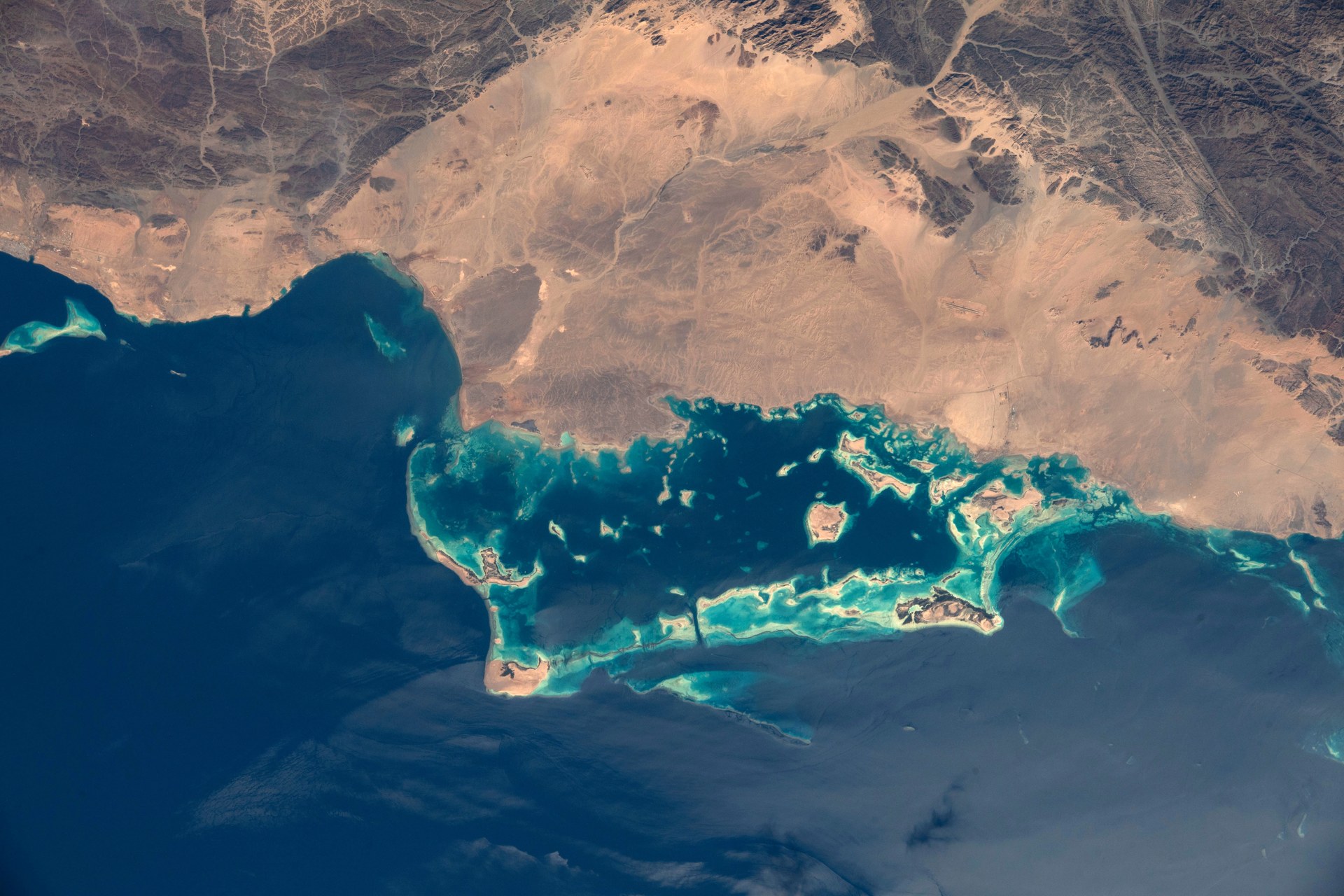
This is why the summit’s outcome matters more to MBS than to any other leader at the table, and why Xi’s incentive to delay is — from Riyadh’s vantage — the single most dangerous variable in the sequence. If Beijing withholds pressure on Tehran through the May 14-15 summit, extracting tariff concessions and rare-earth terms before committing to any action on Iran, the MOU framework collapses and the Hormuz closure that costs Saudi Arabia billions per month in unrealized exports continues without a diplomatic endpoint. The revenue base underpinning the $600 billion investment pledge erodes with each week of blockade, and the precedent from 2017 — where the gap between ceremony and contract proved far wider than either side acknowledged at the time — threatens to repeat itself not because of procurement bureaucracy but because the oil that was supposed to pay for it cannot get to market.
MBS will host Trump on May 13, announce investment commitments calibrated for a news cycle, and project alignment with a president whose Iran strategy depends on a Chinese leader MBS cannot influence, a timeline MBS cannot accelerate, and a military command in Tehran that has just had its communications infrastructure hit by the country asking it to sign a nuclear agreement. The last time a US president arrived in Riyadh with headline defense numbers and a Middle East strategy requiring cooperation from actors who had no incentive to provide it, the Gulf states — emboldened by the visit — launched the Qatar blockade within weeks, overcorrecting faster than any American strategy could manage. The Yanbu terminals will be straining against their loading ceiling the morning after Air Force One departs, the Hormuz blockade will still be compressing Saudi revenue into a fraction of its pre-war capacity, and Xi will still be deciding — at his own price, on his own clock — whether the call to Tehran is worth making. The full account of what that exclusion means for Riyadh across all three days of the May 13–15 window is in Seventy-Two Hours in Riyadh: Indispensable, Powerless, and Not in the Room.
Frequently Asked Questions
What is the 14-point MOU framework between the US and Iran?
The MOU is a one-page framework reported by Axios and CNN on May 6, requiring a 12-to-15-year enrichment moratorium, HEU transfer to the US, closure of underground nuclear facilities, enhanced IAEA snap inspections, and a mutual lifting of the blockades. The critical incompatibility is sequencing: Iran’s position, articulated through Al Jazeera on May 6, is that Hormuz reopening must come before any nuclear commitments, while the MOU treats both sets of concessions as concurrent — a structural gap no amount of summit pressure has yet bridged.
What is Iran’s Persian Gulf Strait Authority?
The PGSA, launched May 5, 2026, requires all vessels transiting the Strait of Hormuz to submit ownership, crew nationality, cargo manifests, and full voyage plans to Iranian authorities before entering the waterway. No other state in history has claimed unilateral administrative control over an international strait during active hostilities, and the PGSA has no basis under UNCLOS or any existing maritime treaty. Its practical effect is to give the IRGC a bureaucratic instrument for selective enforcement — permitting some transits and blocking others based on criteria Iran defines and adjusts without external oversight, which makes it function less as a navigation authority than as a wartime checkpoint regime with administrative trappings.
How does the 25-year China-Iran cooperation agreement affect these negotiations?
The agreement, signed in March 2021, commits China to approximately $400 billion in Iranian infrastructure and energy investment over 25 years in exchange for guaranteed oil access at below-market rates. The discount structure — 12% off market price plus an additional 6-8% for risk compensation — means China’s economic incentive is to maintain the relationship in its current form rather than facilitate an agreement that would reintegrate Iranian crude into global markets where the discount would evaporate. Beijing’s decision to order domestic firms not to comply with US sanctions on five Chinese oil refiners, reported during the summit preparation period, signals that this commercial relationship is being actively shielded regardless of the diplomatic framing being presented at the summit level.
What happened after Trump’s 2017 Riyadh summit and why does it matter now?
Trump’s first foreign trip in May 2017 produced a $110 billion immediate defense package and $350 billion in commitments over ten years, of which approximately $14.5 billion was actually purchased by October 2018. The aftermath extended well beyond procurement shortfalls: within weeks of the visit, Saudi Arabia and its allies launched the Qatar blockade, Bahrain accelerated domestic crackdowns, and the Gulf region entered a period of overcorrection by states that interpreted the Riyadh summit as a license for regional assertiveness — actions that ran ahead of any coherent US strategy and generated consequences Washington had to spend years managing.
Can Iran survive the US naval blockade long enough to outlast the diplomatic timeline?
According to a CIA assessment obtained by the Washington Post, Iran can sustain itself under the current blockade for at least three to four months before experiencing severe economic hardship, partly because Tehran has adapted by storing crude on tankers and pre-positioning essential supplies through overland routes. The same assessment found that approximately 75% of pre-war mobile launcher inventories and 70% of missile stockpiles remain intact, which gives the IRGC both the economic resilience to wait and the military capacity to escalate — a combination that removes the time pressure Washington needs to force acceptance of the MOU before Trump arrives in Riyadh on May 13.