
WASHINGTON — The central problem in the Iran nuclear negotiations is no longer enrichment thresholds, moratorium durations, or third-country custodianship. It is a public factual dispute about what Iran verbally agreed to — a dispute that has destroyed the constructive ambiguity every comparable arms agreement in the modern era has required to survive its own negotiation.
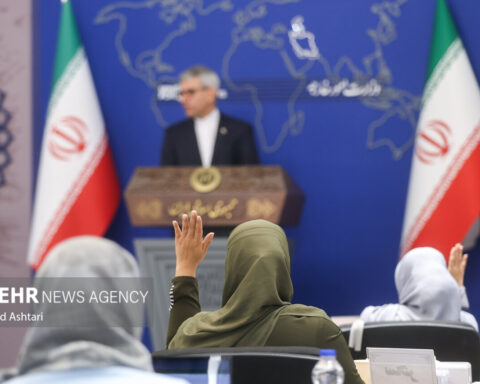
On April 16, President Trump told reporters Iran would “hand us the nuclear dust” and wrote on Truth Social that “the U.S.A. will get all Nuclear ‘Dust.’” The next morning, Iranian Foreign Ministry spokesman Esmail Baghaei went on state television and said the opposite: “Iran’s enriched uranium is not going to be transferred anywhere under any circumstances.” Twenty-four hours. Two irreconcilable public positions. No treaty text can validate both. The Trump-Xi summit beginning in Beijing today is the last diplomatic venue where a third party — one that is Iran’s largest oil customer and the architect of the 2023 Saudi-Iran normalization — possesses the standing to provide both Washington and Tehran a reframe that neither can offer the other directly.
Table of Contents
- What Did Trump Claim Iran Agreed To?
- What Did Iran Actually Propose?
- Thirty-Two Days from Dilution to ‘Nuclear Dust’
- Why Do Public Disputes Over Verbal Commitments Kill Arms Deals?
- The Lausanne Precedent and the Singapore Warning
- The Courier Cannot Ratify
- What Can Xi Offer in Beijing That Neither Side Can Offer Itself?
- Saudi Arabia’s Calculated Absence
- Frequently Asked Questions
What Did Trump Claim Iran Agreed To?
Trump claimed Iran verbally agreed to surrender all of its highly enriched uranium to the United States. On April 16, he told Reuters the US would “go down and start excavating with big machinery” to retrieve Iran’s stockpile and “bring it back to the United States.” On Truth Social the same day, he posted that “the U.S.A. will get all Nuclear ‘Dust.’” To reporters, he summarized the arrangement: “It’s an offer that basically said they will not have nuclear weapons, they are going to hand us the nuclear dust and many other things that we want.”
The language is unqualified. “Hand us” implies physical transfer. “All Nuclear ‘Dust’” implies totality. “Bring it back to the United States” specifies the destination. No conditional clauses, no reference to third-country arrangements, no mention of return clauses or enrichment timelines.
Dr. Matthew Bunn, a former White House nuclear adviser now at Harvard’s Belfer Center for Science and International Affairs, told CBS News’s 60 Minutes that Trump’s broader characterization — including his claim that Iran’s nuclear program had been “completely obliterated” — was “just not true.” Iran still holds approximately 440 kilograms of uranium enriched to 60 percent purity, material sufficient for ten to eleven nuclear devices by the assessments of UN inspectors and the Carnegie Endowment for International Peace.
No Iranian official — at any level of government or military command — has used language equivalent to “handing” the United States Iran’s enriched uranium. The gap between Trump’s public description and the documented negotiating record is not interpretive. It is factual.
The Middle East briefing 3,000+ readers start their day with.
One email. Every weekday morning. Free.
What Did Iran Actually Propose?
Iran’s May 10 counter-proposal, submitted through Pakistan’s mediation channel, offered partial HEU transfer to a third country with an explicit return clause, dilution of remaining stockpile to lower enrichment levels, a 10-to-15-year enrichment suspension, 30-day formal negotiations, and gradual Hormuz reopening in exchange for lifting the US blockade. Every element is conditional and reversible — the opposite of the unconditional surrender Trump described.
Iran initially proposed Russia as the third-country recipient. Washington rejected it. The US counter-suggested “an unspecified third country” without identifying one. Kremlin spokesman Dmitry Peskov confirmed that Russia’s offer to accept the material “still stands, but has not been acted upon.”
Trump rejected the full package. “Totally unacceptable,” he told reporters. “I don’t like it.” Iran’s government called its own offer “reasonable and generous.”
The return clause is the element that makes Iran’s proposal categorically incompatible with Trump’s public description. A commitment to return fissile material if the US exits is not surrender. It is a conditional arrangement predicated on American compliance — designed by a government that watched Trump unilaterally withdraw from the JCPOA in 2018, forfeiting every Iranian concession the deal had secured without mechanism for recovery.
The IRGC’s position is harder than the Foreign Ministry’s. On May 7, the Defa Press — the publication of Iran’s Armed Forces General Staff, closer to IRGC command than any civilian agency — rejected both dilution and third-country transfer, stating that diluting uranium is equivalent to handing it to “the enemy.” This is a more restrictive position than the May 10 counter-proposal itself, which includes dilution among its five elements. The gap between Iran’s diplomatic track and its military establishment’s published stance is the authorization ceiling expressed in newsprint: the Foreign Ministry can propose what the IRGC has already publicly rejected.
On the same day Iran submitted its peace response, IRGC-affiliated media issued Hormuz threats — the two-track pattern that has defined Tehran’s negotiating posture throughout the war.
| Element | Trump’s Statement (April 16) | Iran’s Counter-Proposal (May 10) |
|---|---|---|
| HEU disposition | “Hand us the nuclear dust” — full transfer to US | Partial third-country transfer with return clause |
| Enrichment halt | Not publicly specified | 10-15 year suspension (US demands 20) |
| Verification method | “Excavating with big machinery” | Not detailed in published proposal |
| Hormuz linkage | Not connected to nuclear file | Gradual reopening tied to blockade end |
| Third-country custodian | Not addressed | Russia proposed (US rejected); alternative unresolved |
| Return mechanism | None — “bring it back to the United States” | Explicit return clause if US exits the deal |
Thirty-Two Days from Dilution to ‘Nuclear Dust’
The timeline between what Iranian negotiators offered and what Trump publicly claimed reveals how the negotiating space was compressed — not by events, but by characterization.
On March 15, Iranian Foreign Minister Abbas Araghchi appeared on CBS’s Face the Nation and made a specific, on-the-record offer in English:
“I offered actually that we are ready to dilute those enriched material, or down-blend them, as they say, into lower percentage.”
— Abbas Araghchi, Iranian Foreign Minister, CBS Face the Nation, March 15, 2026
This is dilution inside Iran. The material stays within Iranian borders. The enrichment level drops from 60 percent toward civilian-use thresholds. No physical transfer occurs. The process is technically reversible — Iran retains both custody and the centrifuge infrastructure to re-enrich.
Thirty-two days later, on April 16, Trump characterized Iran’s position as “handing us the nuclear dust.”
Dilution inside Iran and physical transfer to the United States are different operations, performed in different countries, under different legal frameworks, with opposite sovereignty implications. Araghchi’s offer — made on American television, in English, viewed by both governments’ domestic audiences — is the documented baseline. No Iranian official between March 15 and April 16 made a public or privately reported statement moving from the dilution offer toward the unconditional transfer Trump described.
The Arms Control Association documented a pattern that may explain how the gap widened. US negotiators Steve Witkoff and Jared Kushner displayed limited technical command of the nuclear file. Witkoff expressed surprise that Iran produces centrifuges. He described Iran’s IR-6 centrifuge as “probably the most advanced centrifuge in the world” — it is not; several experimental European designs and Pakistan’s more recent models are more advanced. He referred to Natanz, Fordow, and Esfahan as “industrial reactors.” Natanz and Fordow are enrichment facilities. Esfahan houses a uranium conversion plant. None are reactors. A negotiating team that does not distinguish between enrichment facilities and reactors may not have distinguished between dilution-in-place and physical transfer when reporting back to the president.
Why Do Public Disputes Over Verbal Commitments Kill Arms Deals?
Public factual disputes over verbal commitments eliminate the constructive ambiguity that arms negotiations require. Once one leader publicly claims the other agreed to something the other publicly denies, both sides’ domestic audiences demand the other capitulate before talks resume — and no subsequent treaty text can validate both leaders’ incompatible statements simultaneously.
Arms agreements have always required each side to tell its domestic audience that it won. The 1987 INF Treaty survived because Reagan told Americans it eliminated Soviet missiles threatening Western Europe while Soviet media framed the same agreement as American capitulation on the Strategic Defense Initiative. Both framings were defensible readings of the same text. Neither leader stated that the other had verbally agreed to something the other then denied.
The distinction matters because disputes over written text or undefined terms can be resolved through longer, more precise drafting. A disagreement over enrichment moratorium duration — 5 years versus 20 years — can be split at 12 or 15. A disagreement over which third country holds uranium can be resolved by identifying an acceptable custodian. These are quantitative or procedural gaps. They narrow through negotiation.
A dispute over whether one side verbally agreed to surrender sovereign fissile material does not narrow. It is binary. Either Iran agreed or it did not. The moment both versions became public record — Trump’s on April 16, Baghaei’s on April 17 — the negotiation acquired a factual precondition that cannot be met. Any text implying Iran agreed validates Trump and humiliates Tehran. Any text implying Iran did not agree validates Tehran and humiliates Trump. The two incompatible voices that have defined Iran’s negotiating posture are now mirrored by two irreconcilable American positions: the deal Trump described to his domestic audience and the deal Iran’s authorization structure would permit.
The Lausanne Precedent and the Singapore Warning
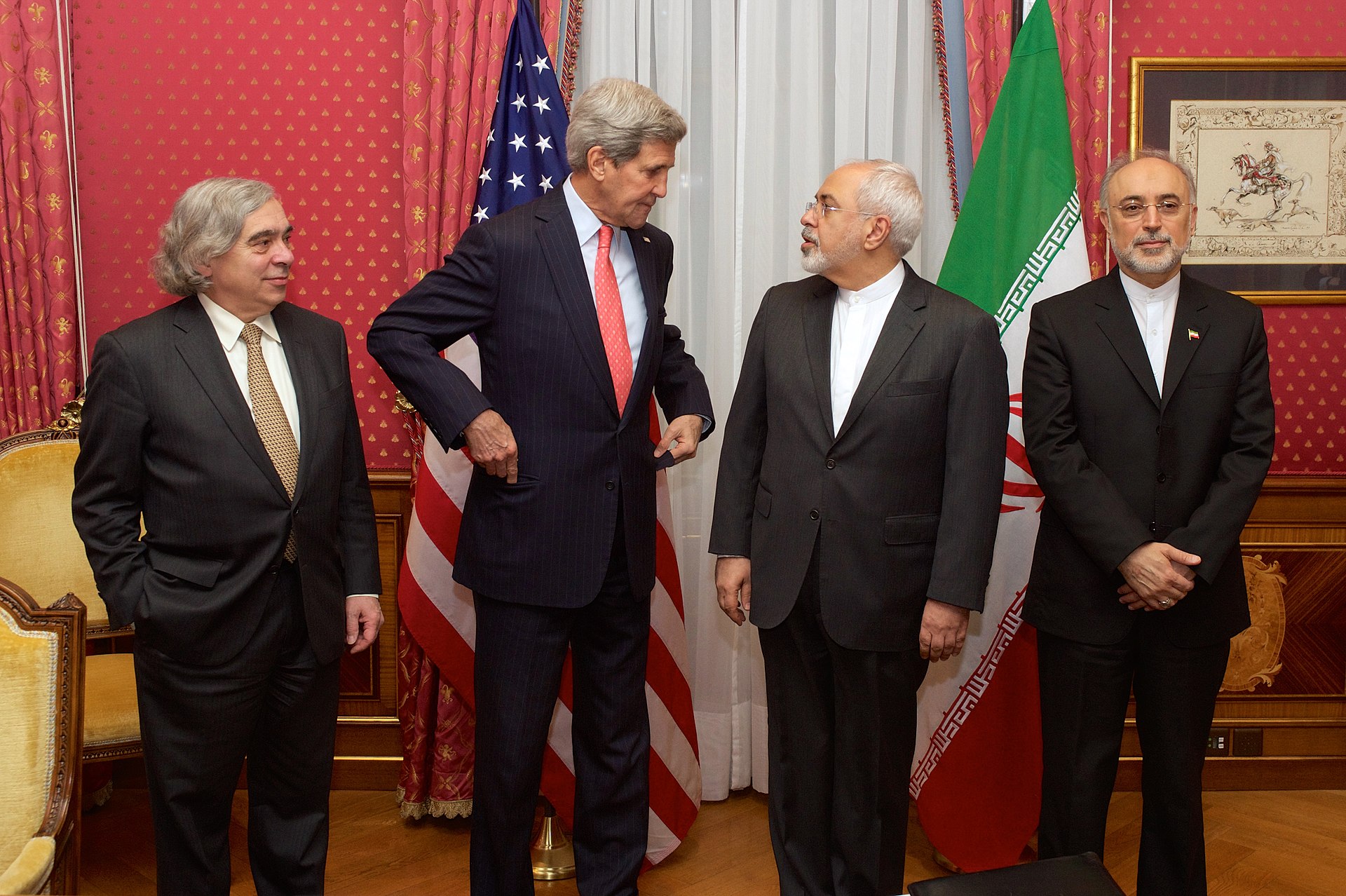
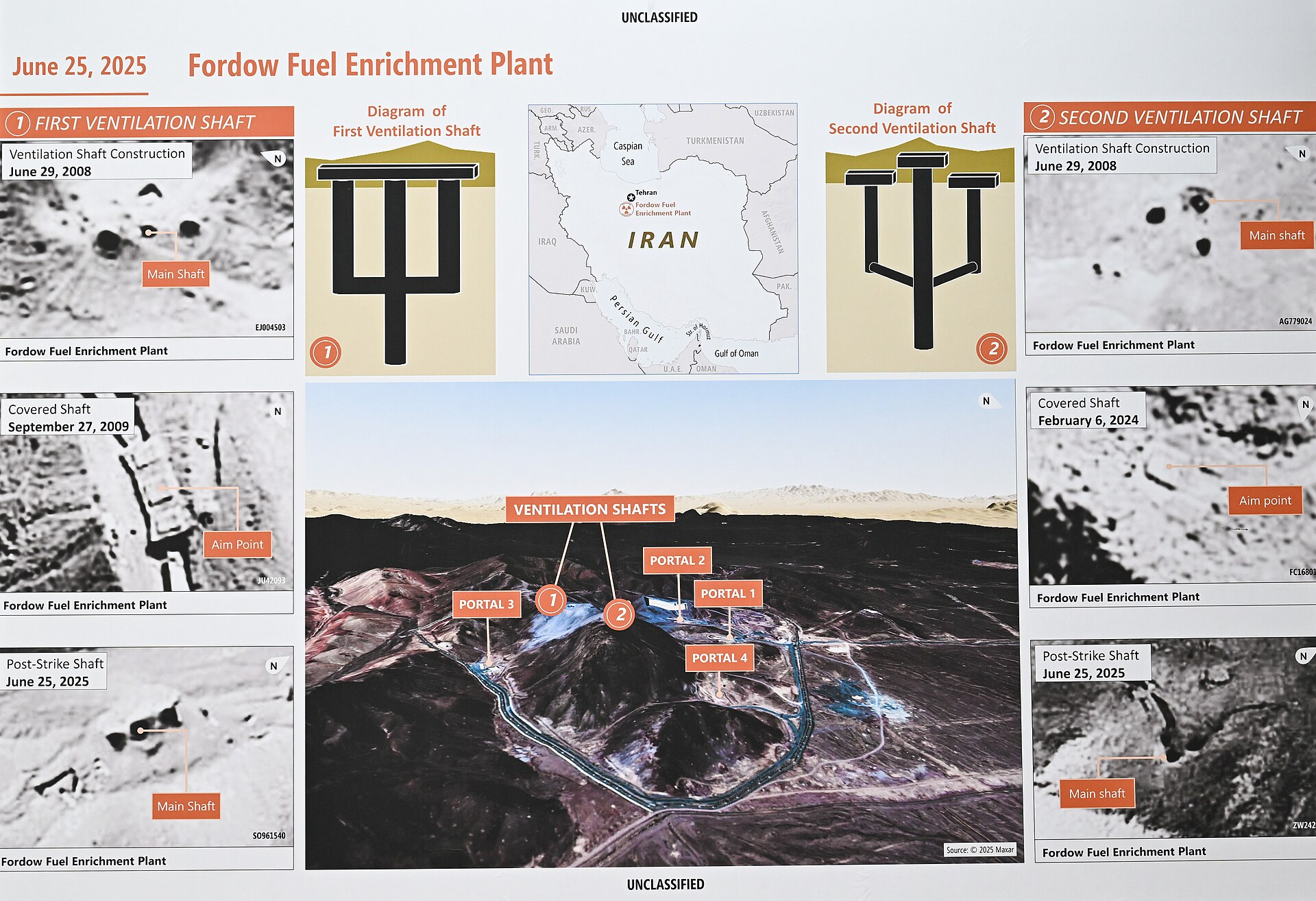
On April 2, 2015, the Lausanne framework talks ended with two fundamentally incompatible documents. The United States issued a four-page factsheet titled “Parameters for a Joint Comprehensive Plan of Action,” listing specific numbers and deadlines — 6,104 centrifuges, 300 kilograms of low-enriched uranium, 15 years of enhanced monitoring. Iran’s team read a joint statement that participants described as “a thin, page and a half” containing none of the American numbers. Zarif went to Twitter immediately: “There is no need to spin using ‘fact sheets’ so early on.”
The Lausanne dispute was severe. But it was recoverable because the disagreement was about what a written framework committed each side to — not about what one side had verbally agreed to in the other’s characterization. Neither Kerry nor Zarif accused the other of having spoken specific words in a room and then denied them publicly. The resolution came through three additional months of technical negotiation in Vienna, producing a legal text whose 159 pages and annexes were dense enough that both the US factsheet and the Iranian joint statement could be read as compatible with different provisions. The JCPOA’s extraordinary length was not bureaucratic excess. It was the engineering solution to Lausanne’s ambiguity problem.
The Singapore summit of June 12, 2018 produced a different kind of failure — one closer to the current impasse. Trump and Kim Jong Un signed a one-page joint statement committing to “complete denuclearization of the Korean Peninsula” without defining the term. Secretary of State Pompeo then told reporters that Kim had verbally committed to destroying a missile testing site, and specified this commitment was “not in the written agreement itself.” North Korea’s KCNA did not mention verification in its readout of the same meeting. The verbal commitment Pompeo publicly claimed could not be confirmed or operationalized in subsequent sessions. By February 2019, the Hanoi summit collapsed.
The pattern holds across decades. Written ambiguity — Lausanne’s factsheet dispute — can be resolved through more precise text. Verbal commitments publicly claimed by one side and denied by the other cannot, because the resolution text would have to adjudicate a factual dispute between two heads of state. No treaty drafter on either side has the authority or the domestic mandate to declare their own president wrong.
The Courier Cannot Ratify
The impossibility of Iran ratifying any verbal commitment made in a negotiating room is not only political. It is physical.
CNN reported on May 8 that Mojtaba Khamenei — Iran’s supreme leader since his father’s incapacitation — has burns on his face, arm, torso, and leg from the strikes. He avoids all electronic devices for security reasons. He communicates exclusively through human couriers and in-person messengers. US intelligence assesses he is still shaping war strategy and directing nuclear negotiations, but through a chain of physical communication that introduces days of latency into every authorization decision.
Any verbal commitment made by Araghchi or any other Iranian negotiator in a room with American counterparts requires physical courier travel to reach the supreme leader, deliberation by a leader who cannot confer electronically with advisers, and physical courier return with authorization or rejection. The IRGC’s own media infrastructure — Defa Press, Tasnim, Fars — publishes binding public positions faster than Mojtaba Khamenei can receive, process, and respond to a diplomatic proposal from Islamabad or Geneva. The IRGC’s declaration of Hormuz as Iran’s deterrent traveled at the speed of internet publication. Any countermanding authorization from the supreme leader arrives by foot.
The Defa Press rejection of both dilution and transfer on May 7 reached the world in minutes. If Araghchi had offered something in a room that could be interpreted as acceptance — and no reporting confirms he did — the supreme leader’s authorization would arrive days later, into a public environment already shaped by the IRGC’s harder-line position. The sequence of communications guarantees that the military establishment’s stance reaches both domestic and international audiences before the supreme leader’s private authorization can modify it.
Iran’s constitution codifies the constraint. Under Article 110, the president has no authority over the Islamic Revolutionary Guard Corps. President Pezeshkian publicly accused IRGC commanders Vahidi and Abdollahi of sabotaging ceasefire negotiations on April 4 — an extraordinary admission that the elected government cannot control the military establishment’s positions on the nuclear file. Even if Araghchi verbally offered HEU transfer in a negotiating room, the IRGC command that controls the facilities housing the material has no constitutional obligation to comply.
What Can Xi Offer in Beijing That Neither Side Can Offer Itself?
Beijing can provide a sovereign reframe — a Chinese-supervised custodial arrangement or verification mechanism — that allows Trump to claim the uranium is being secured and Iran to claim it remains under sovereign protection with a return clause. No other capital on earth has the standing to issue that formula.
Chinese Foreign Minister Wang Yi hosted Araghchi in Beijing on May 12 — the day before Trump arrived — and publicly defended Iran’s right to develop civilian nuclear energy. This is not neutrality. It is an opening position, communicated within earshot of both delegations, establishing Beijing’s substantive stance before any trilateral reframing can begin.
Ahmed Aboudouh, a China-Middle East specialist at Chatham House, assessed Beijing’s approach as sending “a subtle message of discontent to Iran” for closing Hormuz and to the United States for its shipping blockade, while remaining “very cautious, risk-averse” — a power that does not “want to be involved in anything that would drag them into something that they don’t consider their problem.”
“The US is fighting without winning, China is winning without fighting.”
— Former president, EU Chamber of Commerce in China, cited in Council on Foreign Relations analysis, May 2026
What Xi can provide is not mediation in the shuttle-diplomacy sense but a specific formula: a Chinese-supervised custodial arrangement for Iran’s HEU under IAEA auspices — housed in China or in a neutral state with Chinese guarantees. Trump could tell his domestic audience the uranium was being secured under an arrangement he negotiated with Xi. Iran could tell its domestic audience the material remained under sovereign protection with Chinese guarantees and a return clause. The text would need to be precise enough to be enforceable and elastic enough for both narratives to coexist.
The Carnegie Endowment for International Peace offered a framing that defines Beijing’s opportunity: “The decision to deploy force in the middle of negotiations has vitiated the credibility of diplomatic tools that could provide traction on these challenges.” Iran “still has an ability and perhaps greater desire to reconstitute these capabilities, including in smaller, clandestine facilities.” American military action degraded Iran’s declared nuclear infrastructure but increased its motivation to rebuild covertly — a dynamic only a non-military reframe from a non-belligerent capital can address.
China declined a US request to delay the summit. That refusal carries its own message. Beijing believes it enters the room with more options than Washington — a confidence supported by the arithmetic of the war, in which the US has degraded declared facilities without producing any framework to prevent their clandestine reconstitution.
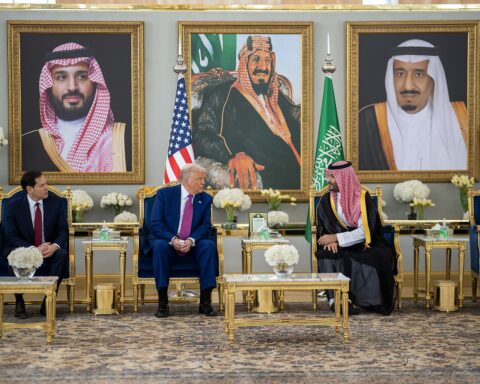
Iran’s proposed enrichment consortium — tabled four days before Trump landed in Riyadh — could serve as the raw material for a Chinese reframe. A multilateral consortium with Chinese participation would internationalize Iran’s enrichment activities while maintaining Iranian soil as the physical location, splitting the difference between surrender and sovereignty in terms that neither Washington nor Tehran invented. Whether Beijing picks up that thread may depend on whether Xi sees the consortium as a vehicle for Chinese influence or a liability that ties Beijing to Iran’s compliance record.
Saudi Arabia’s Calculated Absence
Saudi Foreign Minister Prince Faisal bin Farhan traveled to London while Trump flew to Beijing. The scheduling was not coincidental.
Riyadh’s interest in the nuclear negotiations is bounded. The kingdom needs the ceasefire to hold and the Strait of Hormuz to reopen — Saudi export capacity through the Yanbu bypass is capped below pre-war Hormuz throughput, and the fiscal arithmetic at current production levels is unsustainable. Goldman Sachs estimated a 6.6 percent GDP deficit adjusted for war conditions, against the official forecast of 3.3 percent. But the nuclear file carries risks for Saudi Arabia that the ceasefire file does not.
The US-Saudi 123 agreement for civilian nuclear cooperation, still under negotiation, does not explicitly prohibit Saudi enrichment — a deliberate asymmetry dissected in Washington’s two-tier nuclear framework. That deliberate ambiguity serves Riyadh’s long-term nuclear positioning. Any deal in which Trump publicly secures Iran’s HEU surrender or a permanent enrichment moratorium would intensify pressure on Saudi Arabia to accept equivalent constraints. The kingdom’s interest is not in the nuclear file being resolved on Washington’s terms. It is in the nuclear file not becoming the template against which Saudi nuclear development is measured.
Saudi Arabia’s pattern throughout the war has been to participate in the kinetic campaign while preserving diplomatic optionality on the terms of its conclusion. MBS’s red lines have been consistent: the kingdom will not serve as the venue, the guarantor, or the co-signer of an American nuclear deal with Iran. Prince Faisal’s London schedule on the day the Beijing summit opened made the position explicit. Saudi Arabia will participate in ending the war. It will not participate in writing the nuclear terms.
The deeper problem with Washington’s 14-point nuclear proposal is not that Iran refuses to accept it — it is that no Iranian figure with the institutional standing to accept or meaningfully reject it is alive. Ali Shamkhani, killed on February 28, was the only figure who sat above the authorization ceiling that has blocked every Iranian negotiator since. How Shamkhani’s death turned the 14-point proposal into a letter addressed to an empty building is examined in full.
Frequently Asked Questions
How close is Iran to producing a nuclear weapon?
At the time of the last verified IAEA inspection, Iran held approximately 440 kilograms of uranium at 60 percent enrichment — enough fissile material for ten to eleven devices. Breakout from 60 percent to weapons-grade 90 percent via an IR-6 centrifuge cascade requires roughly 25 days per device. IAEA inspectors have not had access to Iranian nuclear facilities since February 28, 2026, when Iran terminated cooperation following the US-led strikes. Current stockpile estimates are based on the last verified data, meaning the actual quantity may be higher. The 14-point MOU framework under negotiation does not contain a verification mechanism for the existing stockpile, because no inspectors are on the ground to implement one.
What is the difference between diluting uranium inside Iran and transferring it out?
Dilution — or down-blending — reduces the enrichment level by mixing highly enriched uranium with natural or depleted uranium. When performed inside Iran, the process preserves Iranian custody of the material, maintains the centrifuge infrastructure that produced it, and is technically reversible: Iran could re-enrich the diluted material, though this would take months and be detectable by monitoring equipment. Physical transfer moves the material across a border, stripping Iranian custody and control entirely. The distinction echoes a 2009 precedent: Iran nearly agreed to ship 1,200 kilograms of low-enriched uranium to Russia for further processing as part of a Tehran Research Reactor fuel swap. Domestic hardliners killed the arrangement by recharacterizing it as “surrendering the national patrimony” — language nearly identical to what the Defa Press published in May 2026.
Has China brokered nuclear agreements before?
No. China participated in the P5+1 format that negotiated the 2015 JCPOA, but the United States and the European Union led those talks. Beijing’s brokering of the March 2023 Saudi-Iran diplomatic normalization is the only precedent for Chinese-hosted security architecture in the Gulf, and it contained no nuclear component. A Chinese-led custodial framework for Iran’s HEU would represent a first — formalizing Beijing’s role as a principal in Middle Eastern security rather than a participant in Western-led formats. It would also tie China’s credibility to Iran’s compliance, a commitment Beijing’s risk-averse diplomatic establishment has so far declined to make.
Why did the US reject Russia as the third-country recipient?
Russia remains under extensive US and EU sanctions over the Ukraine war. Moscow maintains independent nuclear cooperation agreements with Tehran, including the Bushehr reactor contract, creating a dual-interest relationship Washington views as disqualifying. The deeper objection is structural: placing Iranian HEU under Russian custody would give Moscow effective veto power over the deal’s implementation — the ability to return or withhold the material based on its own geopolitical calculations, effectively making Putin an unsanctioned signatory to a US-Iran arrangement. The US proposed “an unspecified third country” without naming one, leaving the custodian question — one of five unresolved gaps in the framework — open.
What happens if the Beijing summit fails to produce a nuclear reframe?
Without a Chinese formula, the next negotiating venue is the Islamabad track through Pakistan — a channel that lacks the economic leverage China’s oil purchases give it over Tehran and the strategic weight Xi’s position commands in Washington. The IRGC’s declared posture of treating Hormuz as its nuclear bargaining chip means the strait remains functionally restricted as long as the nuclear file is unresolved, keeping approximately 13 million barrels per day of global oil supply offline — what IEA Director Fatih Birol called “the biggest energy security threat in history.” Iran’s proposed enrichment moratorium of 10 to 15 years and the US demand of 20 years remain unresolved alongside the HEU custody question, and neither number has been tested in a room since the Islamabad walkout.
An ISW assessment published May 13, 2026 confirmed that the ambiguity deficit described above has hardened into a strategic posture: Iranian leaders are “trying to dictate the terms for ending the war,” perceiving they hold the upper hand — a conclusion that follows directly from Iran’s judgment that US restrike threats lack credibility and that no regime-safety guarantee is on offer. The full ISW analysis and CIA blockade-endurance data are examined in ISW Says Iran Believes It Holds the Upper Hand. The CIA Data Supports It.