KUWAIT CITY — Kuwait declared two members of Iran’s diplomatic mission persona non grata and summoned Iranian Chargé d’Affaires Hamed Hamid Yaqoubi Far on Tuesday, hours after an IRGC barrage of 30 ballistic missiles and drones struck Kuwait International Airport’s Terminal 1, killing one Indian national and injuring 63. Deputy Foreign Minister Hamad Sulaiman Al-Mashaan handed Yaqoubi Far an official protest note and ordered the two diplomats to leave the country within 24 hours, citing “continued and blatant” attacks violating Kuwait’s sovereignty.
The move makes Kuwait the second GCC capital to formally reduce Iran’s diplomatic presence since the war began, 94 days after the UAE closed its Tehran embassy on March 1. Kuwait also shuttered Iran’s cultural mission, according to the Times of Israel — a broader diplomatic reduction than the persona non grata declarations alone. Saudi Arabia, which chairs the GCC and expelled five Iranian diplomatic staff 74 days ago, condemned the Terminal 1 strike and voiced “full support for any measures Kuwait takes” but announced no parallel action of its own.
Kuwait’s Foreign Minister traveled to Washington the following day and met Secretary of State Rubio less than 24 hours after the strike, making the bilateral meeting the fastest diplomatic escalation any Gulf state has taken to Washington since the war began.
Table of Contents
The Summons and the 24-Hour Deadline
Al-Mashaan delivered the protest note at Kuwait’s Foreign Ministry, rejecting Iranian allegations that the United States had conducted strikes from Kuwaiti soil. The Deputy Foreign Minister called those claims “baseless,” according to Xinhua. Kuwait chose to enumerate the legal violations publicly and in detail — sovereignty, territorial integrity, international law, UN resolutions — language that mirrors the formal record a state would compile before pursuing a matter at the Security Council.
Under Article 9 of the Vienna Convention on Diplomatic Relations, a host state may declare any diplomat persona non grata without providing a reason. Kuwait volunteered one anyway — a deliberate choice to create a public legal record.
The 24-hour departure deadline matched the speed Qatar imposed when it expelled Iranian military and security attachés on March 19, within a day of IRGC strikes that damaged the Ras Laffan industrial complex. Kuwait’s action on June 3, however, targeted civilian diplomatic staff rather than military attachés, and paired the expulsions with closure of Iran’s cultural mission — a step Qatar did not take. Kuwait’s own embassy in Tehran has been operating with minimal staff since February.
The Middle East briefing 3,000+ readers start their day with.
One email. Every weekday morning. Free.
Thirty Missiles, One Dead, Sixty-Three Injured
Kuwait’s defense ministry detected 30 ballistic missiles and drones in the June 3 barrage, according to Al Jazeera. Terminal 1, which had reopened on June 1 after closing in February due to the war, was struck 48 hours after resuming passenger operations. The 48-hour window between reopening and the strike pointed to updated Iranian targeting intelligence.
The attack killed one Indian national — the first civilian fatality recorded at a GCC airport in the conflict — and injured at least 63 people, including airport workers and passengers, according to the Kuwait Health Ministry. Documented injuries included fractures, head injuries, cerebral hemorrhages, amputations, and smoke inhalation. The strike also damaged unnamed diplomatic missions on Kuwaiti territory, according to Kuwait’s Foreign Ministry.
The Terminal 1 attack was part of a broader IRGC operational package on Day 96 of the conflict. On the same day, Iranian forces struck NSA Bahrain for the third time since the war began, with Bahrain down to roughly 8 PAC-3 interceptors from its original stock of 60. A separate barrage hit Camp Arifjan, the logistics hub sustaining Saudi Arabia’s air defense supply chain. The June 3 strikes marked the first time IRGC forces hit command, civilian, and logistics targets in a single operational package.
The June 3 barrage continued a pattern of escalating strikes on Kuwait. An IRGC attack on May 28 struck Ali Al Salem Air Base, wounding five Americans and destroying two MQ-9 Reaper drones worth an estimated $60 million. CENTCOM called that strike an “egregious ceasefire violation.” Neither Washington nor Kuwait City treated the May 28 incident as a trigger for diplomatic measures; the Terminal 1 strike, with its civilian casualties and damage to diplomatic premises, crossed a threshold the military base attack did not.
What Did Iran Claim?
The IRGC claimed responsibility for targeting “Ali Al Salem Air Base in Kuwait… as well as the headquarters of the US Fifth Fleet in Bahrain,” according to the group’s Telegram channel. Terminal 1 was not mentioned. The gap between the stated military target and the actual civilian impact — one dead, 63 injured at a passenger terminal — went unaddressed in Iranian statements.
Iran’s Foreign Ministry said Kuwait and Bahrain bore “direct and clear responsibility” for attacks on their territory because their soil was used to support US military operations, according to the Deccan Herald and Times Live. The ministry characterized Iran’s strikes as legitimate self-defense, citing US attacks on an Iranian oil tanker and a telecommunications tower on Qeshm Island. Iran reserved “the right to self-defence” and threatened to use “all available means to respond, including by targeting the source of any future attacks.”
No Iranian Foreign Ministry statement specifically addressing the diplomat expulsion had been issued as of publication. Tehran typically responds to persona non grata declarations with reciprocal measures but had announced none for Kuwait. Iran’s framing of the conflict as a bilateral confrontation with the United States — rather than with the Gulf states hosting US forces — has been consistent since the IRGC opened Hormuz for Iraqi shipping while simultaneously bombing Kuwait on June 1, a dual-track posture that treats Gulf Arab states as bystanders to a US-Iran fight even as their airports and military bases absorb the strikes.
Why Has Saudi Arabia Not Acted?
Saudi Arabia’s Foreign Ministry condemned “the brutal Iranian aggression” on June 3 and stressed “full support for any measures Kuwait takes,” according to the Saudi Press Agency. The kingdom announced no parallel diplomatic reduction — no further expulsions, no embassy closure, no formal downgrade. Saudi Arabia’s last punitive action against Iran’s diplomatic presence was the March 21 expulsion of Iran’s military attaché and four embassy staff, 74 days before Kuwait’s move.
On the same day Kuwait expelled the diplomats, Saudi FM Prince Faisal bin Farhan held a phone call with Qatari PM and FM Sheikh Mohammed bin Abdul Rahman Al Thani to coordinate on Pakistani mediation between the United States and Iran, according to Asharq Al-Awsat. Faisal bin Farhan has spoken with Iranian FM Abbas Araghchi at least four times since the war began — on April 9, April 13, April 27, and May 6 — according to Al Arabiya and the Times of Israel. Saudi officials have confirmed daily-level contact with Tehran.
Kuwait reserved “its full and inherent right to take appropriate measures in response to these sinful and repeated Iranian attacks, in a manner consistent with international law.”
Kuwait Ministry of Foreign Affairs, June 3, 2026
The GCC’s April 28 summit in Jeddah, chaired by Crown Prince Mohammed bin Salman, declared that “the security of each member state is indivisible and any attack against one constitutes a direct attack on all.” Saudi Arabia has not matched that collective-defense language with bilateral punitive action in the 36 days since. Gulf analysts described it as the most explicit collective-security commitment the council had issued in its 45-year history; Kuwait appears to have taken it more literally than the state that hosted it. On June 4, MBS telephoned King Hamad to condemn the attacks as “brutal” — Saudi Arabia’s sharpest public language yet, with no diplomatic action to match it.
Riyadh has instead maintained what it describes as a private de-escalation track with Tehran, built on years of back-channel engagement that preceded the conflict. Qatar’s example complicates the premise that mediation and punishment are mutually exclusive — Doha expelled Iranian military attachés on March 19 and subsequently positioned itself as a mediator, performing both functions without interruption.
Abdulaziz Sager, chairman of the Gulf Research Center, told the Christian Science Monitor in April that “Saudi Arabia is unlikely to abandon diplomacy with Iran, but the balance has clearly shifted.” He added: “Dialogue on its own is not enough if it is not backed by credible deterrence.” Mohammed Alhamed, a Saudi geopolitical analyst, framed the constraint differently in the same publication: “Saudi Arabia right now is taking on the responsibility of the entire global economy. Iran fighting Saudi Arabia does disrupt global energy. Everyone should pray that Saudi Arabia does not join the war.”
The structural constraints on Saudi action extend beyond diplomacy. Saudi Arabia has an estimated 80 to 150 PAC-3 interceptors remaining — enough for 1.3 to 2.4 days of sustained fire — and has not received an emergency resupply waiver from Washington, unlike Qatar. Riyadh’s foreign minister has not spoken publicly on the war in over 10 days, and Saudi Arabia remains excluded from all three active Hormuz negotiation tracks between the US and Iran.
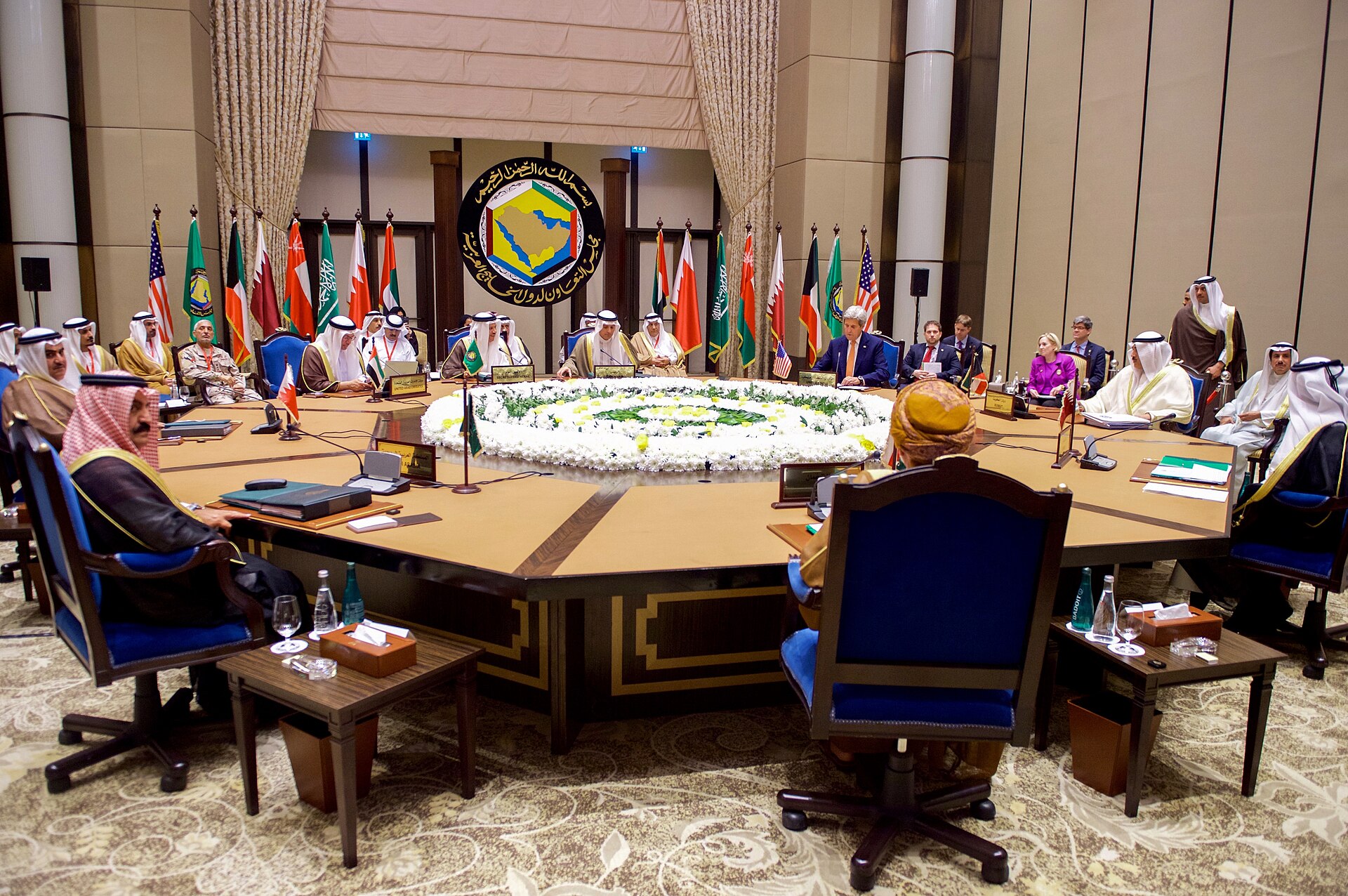
The GCC’s Shrinking Diplomatic Map
Iran’s formal diplomatic presence across the Gulf has contracted to a fraction of its pre-war footprint. The UAE closed its entire Tehran embassy on March 1. Bahrain’s embassy in Tehran is closed. Saudi Arabia maintains a reduced civilian presence after the March 21 expulsions. Qatar expelled military and security attachés on March 19. Kuwait’s June 3 expulsions and cultural mission closure now further narrow the channel.
Oman is the only GCC state with a fully functional Iranian embassy and unrestricted diplomatic staff as of June 3. Muscat has served as a mediating channel between Iran and outside powers for decades and is one of several intermediaries in the current conflict. No other Gulf capital retains anything close to normal diplomatic relations with Tehran.
Anwar Gargash, the UAE’s presidential diplomatic adviser, called on June 3 for a “firm, unified, cohesive Gulf position” against Iran, according to NPR. GCC Secretary-General Jasem Mohamed Albudaiwi had condemned the strikes on Kuwait two days earlier, on June 1, as “a dangerous and irresponsible escalation, a blatant violation of the sovereignty of the State of Kuwait and all international laws and norms.” Albudaiwi said GCC states “stand in a united and steadfast position alongside the State of Kuwait” and called on the UN Security Council to take “a firm, deterrent stance.”
Whether a unified stance translates into coordinated diplomatic action remains open. Bader Al Saif, a Kuwaiti political scientist at the Carnegie Endowment, argued in a March 2026 paper that “only collective action among the GCC states is likely to get them out of this dilemma,” because individual states are easier for Iran to coerce one at a time. Andrew Leber, also at Carnegie, described Gulf monarchies as caught in an “impossible position between Iranian desperation and U.S. recklessness,” with economic models built on investment and tourism now under direct threat from active conflict.
Background
Kuwait has a longer record of expelling Iranian diplomats than any other GCC state. In 2017, Kuwait expelled 15 Iranian diplomats after the discovery of an IRGC-linked weapons cache and a Hezbollah spy cell in what became known as the “Abdali affair” — the largest single expulsion of Iranian diplomats by a Gulf state before the current war. In 2011, Kuwait expelled three Iranian diplomats after uncovering a separate IRGC-linked espionage network. In both cases, Kuwait restored ambassador-level ties within months.
Kuwait’s historical pattern has been punitive action followed by relatively swift restoration — a hedging posture that distinguished it from its neighbors. In 2016, when Saudi Arabia and Bahrain severed ties with Iran after protesters stormed the Saudi embassy in Tehran following the execution of Shia cleric Nimr al-Nimr, Kuwait was among the few Gulf states that declined to cut relations. That long-standing restraint makes the June 3 expulsion a departure from Kuwait’s own diplomatic tradition, driven this time by a direct military strike on civilian infrastructure rather than covert activity.
The broader Iran-US negotiation over a memorandum of understanding has stalled. Iran formally suspended MOU talks on June 1 and the same day struck Kuwait, threatened to extend operations to the Bab al-Mandab strait, and opened Hormuz for Iraqi shipping under a bilateral exemption — a sequence that compressed diplomatic, military, and economic signals into a single 24-hour period. Kuwait’s expulsion of Iranian diplomats adds a GCC-level diplomatic rupture to that sequence.
Frequently Asked Questions
Has Kuwait expelled Iranian diplomats before?
Yes, twice in the last 15 years. In 2017, Kuwait expelled 15 Iranian diplomats and shut the Iranian military attaché’s office and two Iranian-linked cultural organizations after the Abdali affair — a case involving an IRGC-linked weapons cache containing explosives, rocket-propelled grenades, and ammunition stored inside a Kuwaiti farmhouse. In 2011, Kuwait expelled three diplomats over a separate espionage case. Both times, ambassador-level relations resumed within two to three months. The June 3, 2026, expulsion differs in that it was triggered by a direct military strike on civilian infrastructure rather than covert intelligence activity — a qualitatively different threshold that may affect the restoration timeline.
Did any other GCC state take diplomatic action against Iran on June 3?
No. Saudi Arabia, the UAE, Bahrain, and Qatar all issued statements of condemnation or solidarity, but none announced parallel diplomatic reductions. The UAE and Bahrain had already closed their Tehran embassies earlier in the conflict. Qatar, which expelled military attachés in March, has since repositioned itself as a mediation partner rather than pursuing further diplomatic penalties. Saudi Arabia’s statement specifically endorsing “any measures Kuwait takes” was received in Gulf diplomatic circles as acknowledgement that Riyadh was not prepared to take equivalent steps itself.
Is Oman the only GCC state with full Iranian diplomatic relations?
Yes. As of June 3, 2026, Oman maintains a fully staffed Iranian embassy in Muscat and a fully staffed Omani embassy in Tehran — the only complete diplomatic bridge between any GCC capital and Iran. Oman’s position reflects decades of deliberate neutrality; Muscat facilitated the secret 2012-2013 US-Iran talks that led to the JCPOA and has hosted intermediary channels throughout the current conflict. Sultan Haitham bin Tariq has maintained this posture despite IRGC strikes on other Gulf states, calculating that Oman’s value as a channel protects it from being targeted.
What does the Vienna Convention say about expelling diplomats?
Article 9 of the Vienna Convention on Diplomatic Relations (1961) allows a receiving state to declare any member of a diplomatic mission persona non grata at any time, without obligation to explain. The sending state must either recall the individual or terminate their function at the mission. If it fails to do so within a “reasonable period,” the receiving state may refuse to recognize the person as a member of the mission. Kuwait was not legally required to provide grounds for the expulsion — the decision to do so publicly, citing specific violations of sovereignty and international law, was a deliberate political act intended to build a formal record.
Could Iran retaliate diplomatically against Kuwait?
Iran typically responds to persona non grata declarations with reciprocal expulsions, but as of publication had not announced any for Kuwait. Iran’s options are constrained: Kuwait’s embassy in Tehran has operated with minimal staff since February 2026, and further reductions would leave Tehran with one fewer channel into a GCC capital at a time when its regional diplomatic access is at a historic low. Iran’s retaliatory capacity is more military than diplomatic — the Foreign Ministry statement threatening to target “the source of any future attacks” with “all available means” signals that any response is more likely to come from the IRGC than from Iran’s foreign service.