Table of Contents
- What Did Iraq Actually Threaten?
- The UAE Precedent and OPEC’s Shrinking Core
- Why Can’t Saudi Arabia Flood the Market Like It Did in 1986?
- The Mizuho Sub-$50 Scenario
- The Ceyhan Pipeline as Exit Infrastructure
- Aramco’s Dividend Already Exceeds Its Cash Flow
- How Long Would SAMA Reserves Last at $50 Brent?
- The Swing Producer Trap
- FAQ

RIYADH — Iraq’s threat to leave OPEC, issued June 25 and retracted within hours, arrived two months after the UAE ended 59 years of membership. If Baghdad follows Abu Dhabi, Saudi Arabia loses the second-largest producer in the cartel and faces a combined capacity defection of roughly 29 percent of OPEC’s core output. The deterrent Riyadh has wielded against past defectors — opening the taps and crashing the price — is now the instrument of its own fiscal destruction. At Brent $70.57 versus a composite breakeven of $108–111 per barrel, Saudi Arabia cannot survive the weapon it would need to deploy.
Mizuho’s Robert Yawger has put a sub-$50 floor on the table if producers begin racing for market share without coordination, a price level not seen since the COVID collapse of 2020. The enforcer has become the most vulnerable party in any confrontation it initiates. In every quarter from 1993 to 2005, total OPEC production exceeded member quotas by an average of 6.7 percent. The cartel has always leaked. What has changed is that the entity absorbing the cost of those leaks — Saudi Arabia — can no longer afford to plug them.
What Did Iraq Actually Threaten?
On June 25, an Iraqi Oil Ministry official told Bloomberg that “a decision will have to be made regarding whether to remain in or withdraw” from OPEC if Baghdad’s production quota was not increased. Iraq’s current OPEC quota sits at 4.378 million barrels per day. The government has stated a production target of 5 to 7 million bpd, a range that reflects both Rumaila’s 1.47 million bpd plateau and West Qurna’s expansion toward 750,000 bpd — output constrained not by geology but by OPEC ceiling.
The walkback came within hours. A second ministry statement said the earlier remarks “did not reflect the Iraqi government’s official position,” while adding that Iraq “continues to stress the importance of reviewing oil production quotas.” The retraction was procedural. The signal was structural. Iraq’s oil revenue collapsed from $6.8 billion in February 2026 to $1.087 billion in April — an 84 percent drop driven by the near-closure of the Strait of Hormuz. April exports through Hormuz fell to 10 million barrels, down from 93 million barrels per month before the Iran conflict. Oil supplies roughly 90 percent of Iraqi government income. The country posted a $5 billion fiscal deficit in the first four months of 2026, and parliament has submitted an emergency mini-budget of $15–23 billion to keep government offices functioning.
Iraq’s IMF-projected fiscal deficit will average 8.8 percent of GDP in 2026–27, based on a $65-per-barrel Brent assumption that is already generous relative to the structural risks facing Gulf crude. The exit threat was real enough to require official denial — and denial, in OPEC’s institutional grammar, is how members telegraph demands they intend to escalate.
The UAE Precedent and OPEC’s Shrinking Core
The UAE announced on April 28, 2026, that it would leave OPEC effective May 1, ending 59 years of membership. ADNOC’s production capacity of 4.85 million bpd had been constrained below 3.5 million bpd by OPEC quotas — an annual opportunity cost that the Middle East Institute estimated at $50–70 billion. Within weeks of exit, ADNOC accelerated a $55 billion investment program and began scaling toward a 5-million-bpd target by 2027.
The Middle East briefing 3,000+ readers start their day with.
One email. Every weekday morning. Free.
Chatham House described the Saudi-UAE split as “the institutional manifestation of deeper geopolitical repositioning,” observing that the UAE’s presence inside OPEC had given Saudi compliance demands “additional force when Abu Dhabi’s ADNOC was visibly backing” them. That force is gone. The first OPEC meeting without the UAE, on May 3, added 188,000 bpd — a modest escalation that understated the scale of the institutional loss.
If Iraq follows the UAE, OPEC loses approximately 29 percent of its pre-exit core production capacity. The cartel would retain Saudi Arabia’s roughly 12 million bpd of capacity, Kuwait’s 2.8 million, Algeria’s 1 million, and a collection of smaller African and South American producers whose compliance has never been the binding constraint. Russia, the largest OPEC+ ally, has been overproducing for years; its compliance is estimated at 65–75 percent, though verification of Russian data remains unreliable. Iran is quota-exempt under U.S. sanctions. The organization’s production discipline depends on one country.
The sequence matters as much as the arithmetic. OPEC+ production fell from 42.77 million bpd in February 2026 to 33.19 million bpd in April — a 22 percent decline driven by the Hormuz crisis, not voluntary cuts. The cartel cannot enforce discipline when war has already destroyed the production base it was managing.
Members that were cheating at the margin before the conflict — Iraq at 62 percent compliance, Kazakhstan at 55 percent — have even less incentive to comply with quotas now that the market disruption has scrambled the production baselines those quotas were calibrated against. The UAE’s departure removed the institutional weight of 4.85 million bpd of capacity that had visibly backed Saudi enforcement demands. Iraq’s departure would remove the pretense that OPEC’s second-largest Arab producer still accepts the quota framework as legitimate.
Why Can’t Saudi Arabia Flood the Market Like It Did in 1986?
In September 1985, Oil Minister Ahmed Zaki Yamani announced the end of Saudi Arabia’s role as swing producer after Riyadh had cut output from 10 million bpd in 1980–81 to 2.3 million bpd by August 1985 while other OPEC members cheated their quotas. Yamani introduced netback pricing, tying crude sales to refinery margins rather than posted prices, and Saudi production surged. Total OPEC output climbed from 14.1 million bpd in June 1985 to 21.8 million bpd by August 1986. Brent crashed from $28 to $8.55 per barrel. Recovery required an emergency Geneva meeting in August 1986, and Yamani was fired before the year was out.
The 1986 weapon worked because Saudi Arabia’s fiscal breakeven was roughly $15–20 per barrel. At $8.55, Riyadh bled — but it survived. In 2026, the composite breakeven incorporating government spending, PIF obligations, and giga-project commitments stands at $108–111 per barrel, according to Bloomberg Economics. The IMF’s narrower central-government estimate is $96. Brent closed July 2 at $70.57. The gap between market price and fiscal need is $37–40 per barrel before any price war begins.
At $50 Brent — the floor Mizuho identifies as plausible in an uncoordinated race for market share — the annual Saudi deficit run rate reaches approximately $180–220 billion. SAMA’s foreign reserves of $475 billion, a six-year high reached in February, would provide roughly 24 to 32 months of coverage at that burn rate. The 2014–16 precedent, when SAMA burned $150 billion in 20 months defending the riyal peg, unfolded at government expenditure levels 60 percent below today’s. A price war in 2026 would compress that timeline sharply.
The deterrent and the catastrophe are the same action. Riyadh cannot trigger the 1986 playbook without accelerating a sovereign budget crisis that is already consuming the kingdom’s borrowing capacity at the current price.
The Mizuho Sub-$50 Scenario
Robert Yawger, energy futures director at Mizuho Securities, warned on June 26 that a sub-$50 barrel is plausible if producers begin racing for market share without OPEC coordination — “a level not seen since the COVID collapse.” The analysis rests on straightforward arithmetic. The UAE is already unconstrained. Iraq, at 62 percent compliance — the weakest among major OPEC members — is functionally unconstrained even inside the cartel. Kazakhstan, at 55 percent compliance, has similarly treated its quota as advisory. Russia’s overproduction has normalized the expectation that discipline is aspirational rather than binding.
Brent has already declined from a March 2026 peak above $115 to $70.57 on July 2 — a 39 percent drop driven by the partial reopening of Hormuz shipping and the evaporation of war-risk premia. Ras Tanura restarted, but the revenue did not follow. Aramco cut its July Arab Light Official Selling Price by $6 per barrel, to a $9.50 premium over Oman/Dubai, down from a $19.50 all-time high in May — a $10-per-barrel collapse in two months that reflects Hormuz credibility priced into every barrel.
The Mizuho scenario does not require a formal price war. It requires the absence of coordination — which is what OPEC fragmentation produces by default. The market is already receiving barrels the quota system nominally excludes. A formal Iraqi exit would remove the pretense.
Iran adds a dimension that OPEC’s quota architecture was never designed to manage. Tehran is OPEC quota-exempt under U.S. sanctions, and Ghalibaf told CNBC in late June that Iran has exported 40 million-plus barrels since the blockade began, at a 20 percent premium — an inversion of the price signal facing every other Gulf exporter. For Iran, a fragmented OPEC removes the institutional architecture that gave Riyadh multilateral price-management capacity during the Doha negotiations. Every barrel of OPEC discipline that erodes strengthens Iran’s relative position in a post-war energy order where coordination has been replaced by a race for bilateral market share.
The Ceyhan Pipeline as Exit Infrastructure
Iraq’s cabinet approved plans in June 2026 to expand exports through the Kirkuk-Ceyhan pipeline from approximately 220,000 bpd to as much as 770,000 bpd — a Mediterranean route that bypasses the Strait of Hormuz entirely. The expansion involves two segments: 200,000–250,000 bpd from Kirkuk’s northern fields, and an additional 400,000 bpd from the Kurdistan Region. A parallel segment from Baiji to Fishkhabour, running independently of the Kurdish-managed route, is designed for 1.6 million bpd with an initial target of 600,000.
The pipeline is not merely a Hormuz workaround. It is exit infrastructure. An Iraq that can route 770,000 bpd through Ceyhan and eventually scale to 1.6 million bpd has reduced its dependence on the strait that gives Saudi Arabia its strategic chokepoint proximity. The Crude Oil Pipeline Agreement between Iraq and Turkey expires in July 2026, creating urgency for a new bilateral framework that would operate outside OPEC’s institutional architecture entirely.
The Foundation for Defense of Democracies assessed in May that Iraq’s pipeline ambitions “are likely a pipe dream” given the security environment and the political complexity of Kurdish-federal revenue sharing. That assessment may be correct in the near term. But the approval itself — at the cabinet level, during the worst fiscal crisis in post-2003 Iraqi history — signals that Baghdad is building the logistical basis for an energy policy independent of both Hormuz and OPEC. The Doha rounds have produced process wins but no resolution on Hormuz fees, which means the toll regime that Iran claims under UNCLOS Article 26(2) remains structurally unresolved — giving Iraq further incentive to route around the strait.
For Saudi Arabia, the Ceyhan pipeline carries a second-order threat. Riyadh’s own Hormuz bypass — the East-West Pipeline from Abqaiq to Yanbu on the Red Sea — handles roughly 4 million bpd of the kingdom’s effective export capacity, but the 3–3.5 million bpd gap between Yanbu’s throughput and pre-war Hormuz volumes remains a permanent structural loss. Iraq building its own bypass does not solve Saudi Arabia’s chokepoint problem. It solves Iraq’s — and in doing so, removes one of the dependencies that kept Baghdad inside OPEC’s institutional orbit. A producer that can export via the Mediterranean has a route to European buyers that Saudi crude, priced off Oman/Dubai benchmarks and shipped through either the strait or the Red Sea, cannot easily match on freight economics.
Aramco’s Dividend Already Exceeds Its Cash Flow
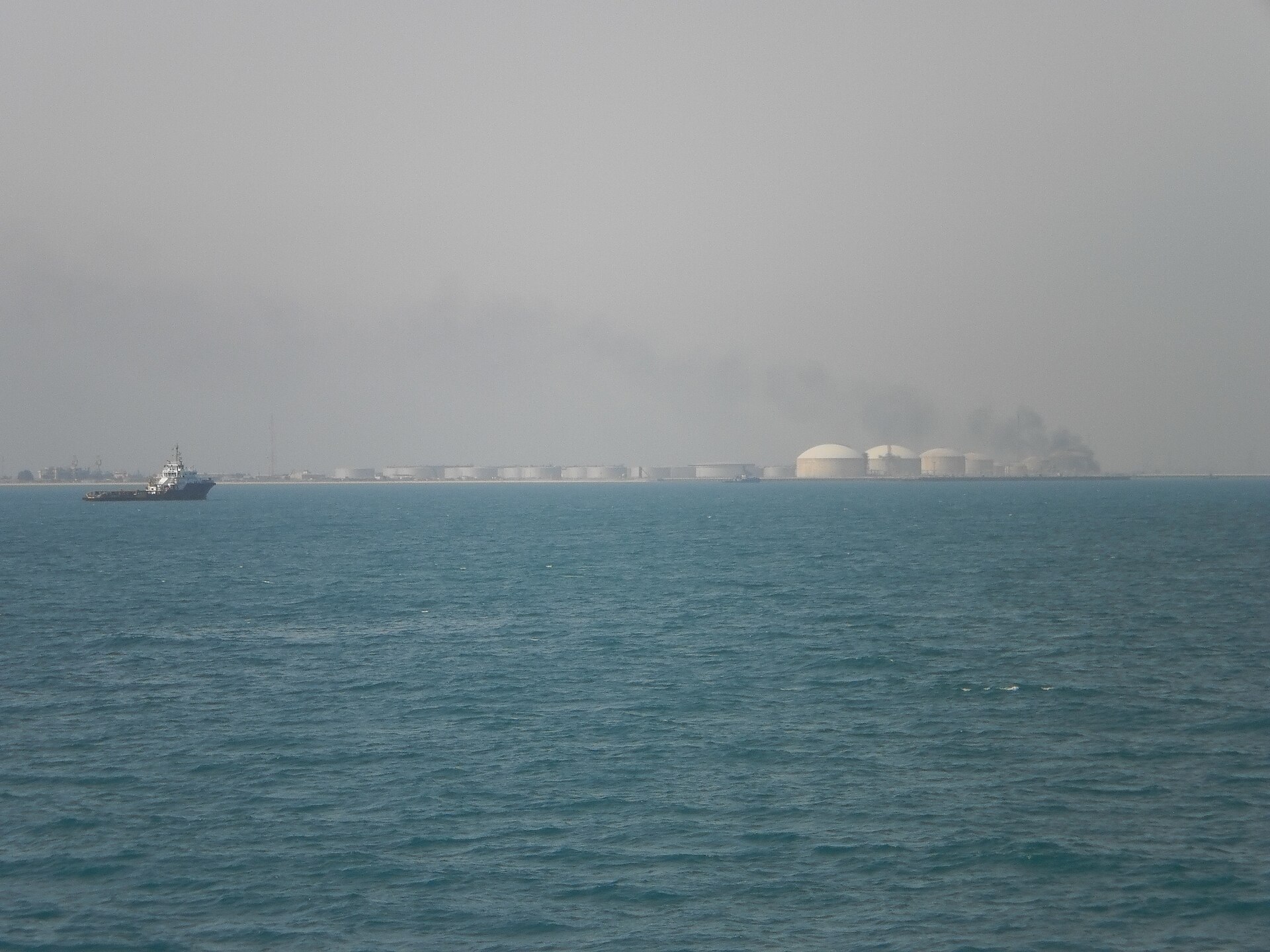
Saudi Aramco generated $18.6 billion in free cash flow in Q1 2026 against a $21.89 billion quarterly dividend obligation — a $3.3 billion gap and a coverage ratio of 0.85x. Aramco produced eighty-five cents of cash for every dollar it was contractually required to distribute. A $15.8 billion working-capital build, driven by the Hormuz closure disrupting tanker scheduling and leaving excess inventory on Aramco’s books, compressed reported free cash flow below the dividend threshold.
The dividend was set at SAR 0.3393 per share under a post-2024 framework committing $87.6 billion annually with a 3.5 percent growth escalator — a structure designed when Brent traded above $100. At the current price, the dividend is a fiscal transfer mechanism from Aramco’s balance sheet to the Saudi state, with PIF’s 16 percent stake alone channeling billions into a sovereign wealth fund whose cash reserves have fallen to approximately $15 billion, the lowest since 2020. PIF’s governor has acknowledged a 15 percent capital-spending cut.
Goldman Sachs estimated in April that the war-adjusted Saudi deficit will reach 6.6 percent of GDP for the full year — roughly double the official 3.3 percent figure and equivalent to approximately $80–90 billion. The divergence reflects Goldman’s inclusion of PIF obligations and off-balance-sheet sovereign commitments that the Finance Ministry’s headline number does not capture. The Q1 deficit alone was SAR 125.7 billion ($33.5 billion), driven by a 20 percent surge in government expenditure to SAR 387 billion. That single quarter consumed 76 percent of the full-year official deficit target in 90 days.
The dividend structure creates a ratchet effect in any price-war scenario. Aramco’s $87.6 billion annual commitment with a 3.5 percent escalator means the payout grows regardless of oil price, while the free cash flow it draws from contracts with every dollar Brent falls. At $70 Brent, Aramco’s coverage ratio is already below 1.0x. At $50, it would fall to roughly 0.4–0.5x, requiring Aramco to borrow at scale simply to maintain distributions to the Saudi state. The kingdom issued $17.5 billion in international bonds in 2025. At $50 Brent, annual sovereign and Aramco borrowing combined could approach $50–60 billion — a pace that would test even Saudi Arabia’s deep capital-market access against rising spreads and downgrade risk.
How Long Would SAMA Reserves Last at $50 Brent?
SAMA held $475 billion in foreign reserves as of February 2026, a six-year high. Foreign currency reserves constitute roughly 95 percent of total holdings, providing approximately 40 months of import cover at pre-war levels. The reserve position appears strong in isolation. It is less reassuring in the context of what Saudi Arabia has already spent defending the riyal peg under stress.
Between mid-2014 and early 2016, when Brent fell from $115 to $27 per barrel, SAMA burned $150 billion over 20 months — roughly $7.5 billion per month — to defend the SAR 3.75 peg and cover fiscal gaps before spending reforms took effect. At $50 Brent, the monthly fiscal gap would be substantially larger than during the 2014–16 episode because government expenditure has expanded by more than 60 percent since then. Military spending alone rose 26 percent in Q1 2026.
| Brent Price ($/bbl) | Est. Annual Deficit ($B) | SAMA Reserve Coverage (Months) | Historical Precedent |
|---|---|---|---|
| $70 (current) | $80–90 | ~63–71 | Current trajectory |
| $60 | $120–140 | ~41–47 | — |
| $50 (Mizuho floor) | $180–220 | ~26–32 | COVID 2020 ($21.65 low) |
| $40 | $240–280 | ~20–24 | — |
The Sadara Chemical Company — Saudi Aramco’s joint venture with Dow — has recorded 78-plus days of zero revenue due to war disruption, while carrying $3.7 billion in debt. NEOM faces $16 billion in termination exposure on rephased contracts. These are not marginal line items. They represent structural fiscal commitments that continue to drain reserves regardless of oil price, and that would accelerate drawdowns in any price-war scenario.
The Arab Center DC assessed that Saudi Arabia “cannot afford to cut unilaterally because the fiscal math is catastrophic, cannot afford to flood the market because the weapon would destroy its own remaining buffers before disciplining any cheater, and cannot afford to wait because every month deepens a deficit consuming the kingdom’s borrowing capacity.” At current prices, the kingdom is already running deficits that will consume its fiscal cushion over a multi-year horizon. At $50, the timeline compresses to months rather than years — and the mechanism for returning to $70 or above, which historically required coordinated OPEC production restraint, would depend on the very institutional framework whose collapse caused the price decline.
The Swing Producer Trap
Saudi Arabia was built as the swing producer that could outlast every other member of the cartel. That structural advantage rested on a low fiscal breakeven relative to other producers — the ability to absorb the damage of a price war longer than whoever started it. The 1986 episode proved the model. Yamani crashed the market to $8.55 and, though Riyadh bled, the kingdom’s low domestic costs meant it survived while higher-cost OPEC cheaters were forced back to the table.
The advantage has inverted. Saudi Arabia’s fiscal breakeven has risen from roughly $15–20 per barrel in 1986 to $108–111 in 2026 — a function of Vision 2030 capital commitments, expanded social spending, military expenditure driven by the Iran conflict, and a dividend structure that treats Aramco as a fiscal utility rather than a commercial enterprise. The kingdom punished the cheaters and got the bill. Iraq’s breakeven is lower. The UAE’s breakeven is lower. Russia’s tolerance for fiscal pain, conditioned by a decade of sanctions, is structurally higher.
The 1986 price war required nine months and an emergency Geneva conference to produce a recovery. In 2026, nine months at $50 Brent would consume roughly $135–165 billion of SAMA reserves, reduce Aramco’s dividend coverage ratio well below 0.5x, and compress PIF’s already depleted cash position to a level that would force the suspension or cancellation of giga-project commitments. The U.S. military drawdown has already degraded Saudi air defense capacity, meaning the kingdom cannot even guarantee the physical security of the production facilities it would need to flood the market.
Dermot Gately’s 1986 Brookings analysis of the Yamani price war documented how the recovery mechanism — the August 1986 Geneva emergency meeting — depended on OPEC members facing uniform pain from low prices. In 2026, the pain is asymmetric. The UAE, freed from OPEC quotas, benefits from every barrel of market share it gains during a price collapse. Iraq, with 90 percent oil dependence but lower per-capita fiscal commitments, reaches its own floor sooner. Iran, under sanctions and running a parallel economy, is functionally indifferent to OPEC price signals. The producer most damaged by the enforcer’s weapon is the enforcer.
OPEC’s quota system never had a formal enforcement mechanism beyond the threat of Saudi spare capacity. In every quarter from 1993 to 2005, total OPEC production exceeded member quotas, averaging 6.7 percent overproduction. Members exceeded their quotas by more than 10 percent nearly 30 percent of the time. Saudi Arabia tolerated this because it could afford to. It carried the cost of being the cartel’s floor. That floor has cracked — not because of Iraqi rhetoric or Emirati defection, but because the fiscal structure of the Saudi state has made the swing-producer role a liability rather than an asset.
FAQ
Has Iraq formally announced its withdrawal from OPEC?
No. An Iraqi Oil Ministry official told Bloomberg on June 25 that Baghdad was weighing exit, but the statement was walked back within hours as not reflecting “the Iraqi government’s official position.” Iraq remains an OPEC member with a quota of 4.378 million bpd. The walkback followed the pattern of the UAE’s own escalation sequence — Abu Dhabi signaled dissatisfaction for months before its April 28 formal announcement, and the UAE’s exit took effect just three days later on May 1. Between stated membership and functional defection, the gap is already narrow.
What would sub-$50 oil mean for Iraq’s budget?
The IMF’s current Iraq deficit forecast of 8.8 percent of GDP is based on $65 Brent. At $50, Iraq’s annual oil revenue — which constitutes roughly 90 percent of government income — would contract by an additional $8–12 billion below already catastrophic 2026 levels, pushing the deficit above 15 percent of GDP and likely triggering an IMF emergency financing program. Iraq’s $70 billion in foreign reserves (as of late 2025) provide a thinner buffer than Saudi Arabia’s $475 billion, but Iraq’s per-capita fiscal commitments and giga-project exposure are a fraction of Riyadh’s. Baghdad reaches its own fiscal floor sooner, but the fall is shorter.
Could OPEC survive the loss of both the UAE and Iraq?
OPEC would retain 11 members if Iraq departed (down from 13 at the start of 2026), but the organization’s credibility as a price-management cartel would depend almost entirely on Saudi willingness to cut production unilaterally. Kuwait, the only other Gulf producer with material spare capacity, has shown no appetite for solo market intervention. Algeria, Libya, and Nigeria collectively produce under 4 million bpd with limited ability to swing output. The organization survived Qatar’s 2019 departure because Qatar produced only 600,000 bpd of crude. Losing a combined 8.5–9 million bpd of potential capacity between the UAE and Iraq is a structural event, not a membership adjustment.
Why did the UAE leave OPEC before Iraq?
Abu Dhabi had both the economic incentive and the strategic infrastructure to exit first. ADNOC’s 4.85 million bpd capacity against a sub-3.5 million bpd quota represented an opportunity cost of $50–70 billion annually. The UAE also possesses 1.5 million bpd of Hormuz bypass capacity via the Habshan-Fujairah pipeline to the Indian Ocean — infrastructure Iraq lacked until the June 2026 Ceyhan expansion approval. The UAE’s exit was a calculated act with pre-positioned logistics. Iraq’s threatened exit is a fiscal distress signal from a country whose 96–97 percent of crude exports still pass through the Strait of Hormuz.
What is Saudi Arabia’s realistic policy option if both the UAE and Iraq leave OPEC?
Saudi Arabia’s remaining options narrow to bilateral production agreements with individual producers — a return to the ad hoc diplomacy that preceded OPEC’s founding in 1960. Riyadh could attempt a bilateral compact with Russia (the core of the pre-existing OPEC+ arrangement), but Moscow’s compliance record provides limited basis for confidence. More plausibly, Saudi Arabia would be forced to accept a structurally lower oil price, accelerate non-oil revenue programs under Vision 2030, and increase sovereign borrowing at a pace that tests even its deep capital-market access — a trajectory Goldman Sachs has already priced into its 6.6 percent GDP deficit forecast. The cartel’s answer came on July 5, when the seven-member subgroup ratified OPEC+’s fifth consecutive output increase for August — adding another 188,000 barrels per day even as Saudi Arabia simultaneously slashed its Asian crude prices to their lowest premium in two years. The full fiscal consequences of that fifth hike — including Aramco’s 0.85x dividend coverage ratio and the Q1 SAR 125.7 billion budget deficit — are examined in The Hike Saudi Arabia Cannot Afford.