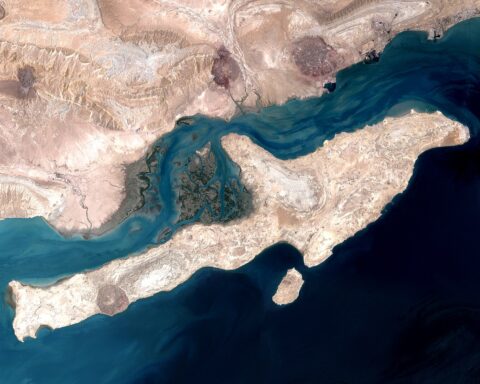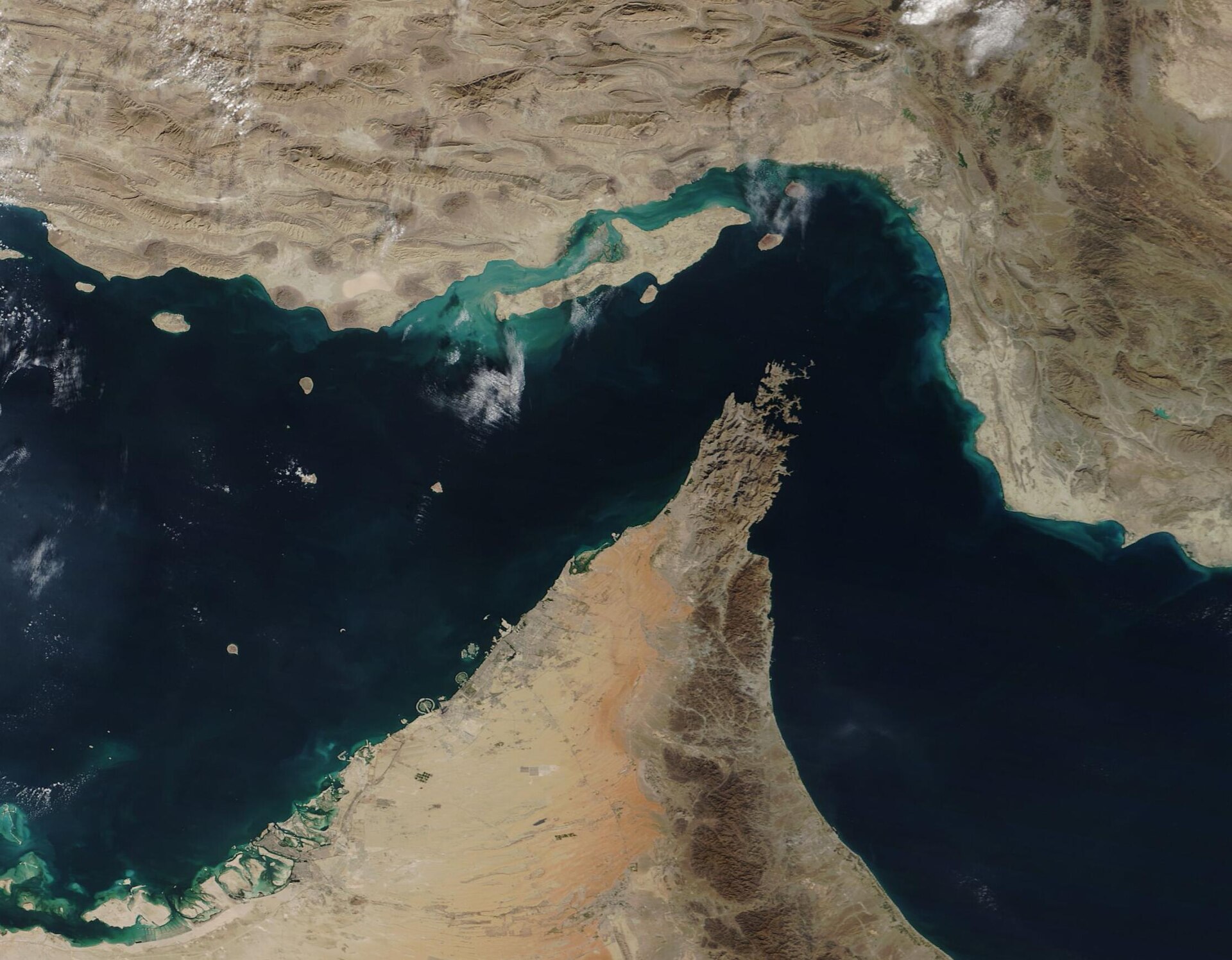

RIYADH — Donald Trump rejected Iran’s seven-day plan to reopen the Strait of Hormuz on Thursday and, according to the Wall Street Journal, told aides he expects to resume bombing after the November midterm elections. For Saudi Arabia, the rejection was secondary — the date was the story.
For seven months, Riyadh has managed the Hormuz closure as an open-ended emergency — spending deferred, alliances left vague, public statements kept deliberately empty. Trump’s Truth Social post, a map of the strait circled and labeled “Trump Strait,” combined with the WSJ’s sourcing on a post-midterms bombing timeline, converted fog into calendar. The crisis now has a floor: at minimum, two more months of closure, with no confirmed ceiling.
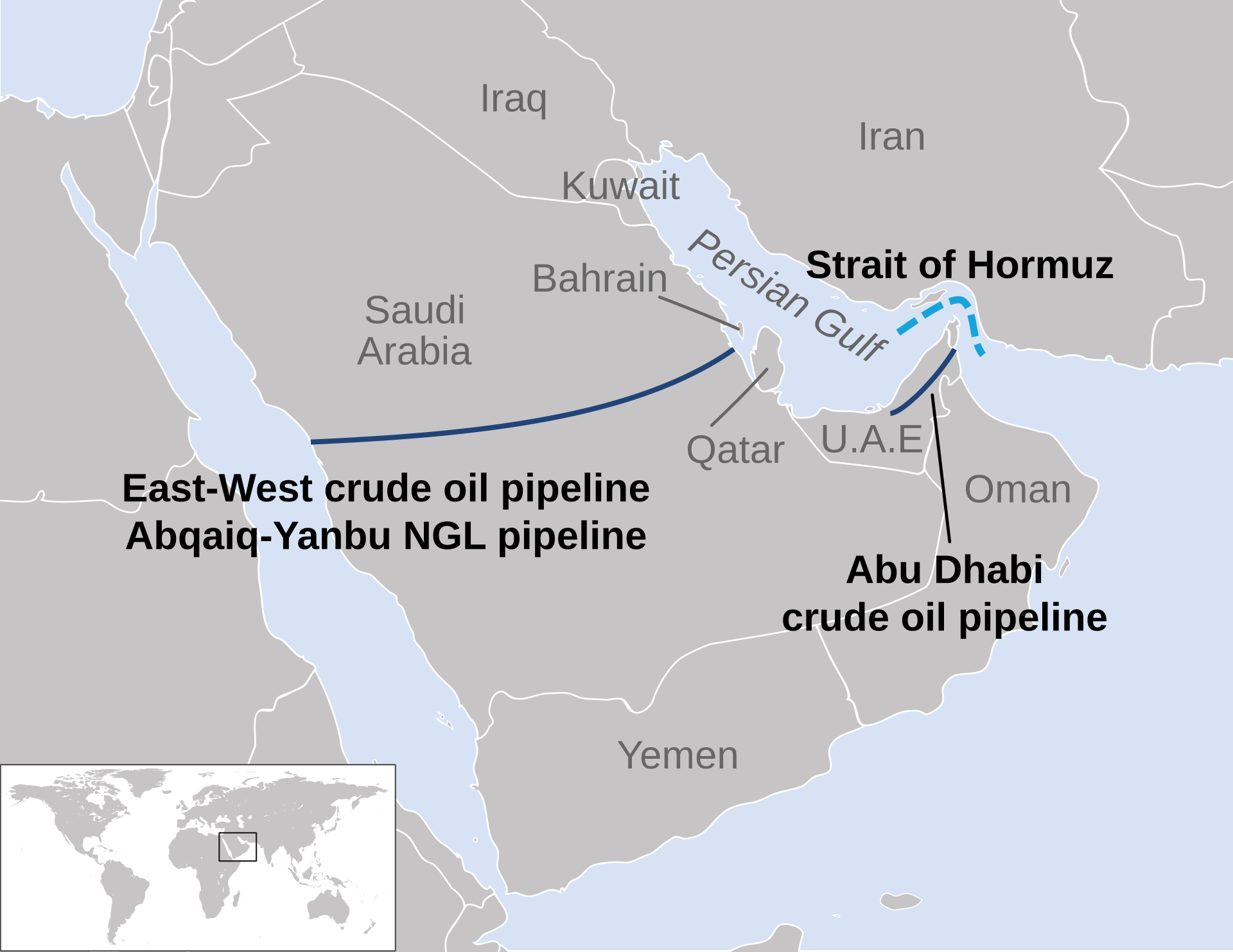
Saudi crude exports recovered to 6 million barrels per day in September, the highest since the war began, but Aramco has cancelled every European cargo through November. The East-West pipeline restarted on September 22 after a twelve-day drone shutdown, at a throughput Riyadh has not disclosed. Prince Faisal bin Farhan addressed the General Assembly and mentioned “freedom of navigation in international waterways” without naming Hormuz, Iran, or Trump.
Table of Contents
- The Seven-Day Plan That Lasted One News Cycle
- What Did Trump Actually Reject?
- How Does Saudi Arabia Plan Around a Dated Crisis?
- Six Million Barrels and Nowhere to Send Them
- Can Four Hundred Interceptors Last Until November?
- The Pipeline Saudi Arabia Cannot Afford to Lose Twice
- What Did Faisal’s Silence at the UN Tell Us?
- The Financial Floor
- Saudi Arabia’s Hormuz Crisis by the Numbers
- Frequently Asked Questions
The Seven-Day Plan That Lasted One News Cycle
Iran’s Foreign Minister Abbas Araghchi met Trump envoy Steve Witkoff on Tuesday at the United Nations in New York and presented what he called “a concrete seven-day plan” conveyed through Qatari mediators. The sequencing was specific and deliberately front-loaded: Day 1, all fighting stops across every front including Lebanon, the US naval blockade lifts, and sanctions are repealed. Day 7, the Strait of Hormuz reopens. After Day 7, nuclear talks resume.
Tehran also demanded the release of frozen assets “estimated to be worth at least $12 billion,” according to AP. The plan was built to be rejected, and everyone involved knew it. Nuclear concessions — Washington’s stated precondition for any deal — were pushed past the Hormuz reopening, not placed before it. A senior Iranian official told Reuters that “Iran will show no flexibility over its nuclear program even if the United States accepts its peace deal.” The enrichment programme, the stockpile, the centrifuges: all off-limits on Day 1 and still off-limits on Day 8.
Araghchi framed the conditions as consistent with the Islamabad Framework agreed in June, insisting Iran was restating previously accepted terms rather than introducing new ones. Those terms included halting military operations across fronts, easing the naval blockade, permitting commercial passage through Hormuz, issuing waivers for Iranian crude exports, and unfreezing blocked assets. Iranian President Masoud Pezeshkian reinforced the framing in an interview with CBS News, saying the ceasefire “process will begin from the very day they accept it” — a line that placed the entire burden of initiation on Washington while preserving Tehran’s posture as the party waiting at the table.
The Middle East briefing 3,000+ readers start their day with.
One email. Every weekday morning. Free.
The proposal’s diplomatic utility was never about acceptance. It was about authorship: Iran wanted to be the country that offered peace, on the record, at the General Assembly podium, so that whoever resumed bombing would do so having publicly declined it.
What Did Trump Actually Reject?
Trump rejected the sequencing, not the principle. The WSJ’s reporting, citing US officials, made clear that the president told aides he expects a renewed bombing campaign after the November midterm elections — the first public indication of a specific resumption timeline since Operation Project Freedom was paused on May 6. The word “expects” is doing real work in that sentence. It is not a commitment, not a plan, not an order — it is a disposition, leaked at a moment when the White House needed to signal resolve without spending a single munition.
The munitions dimension matters more than the diplomatic one. Bloomberg, drawing on the same WSJ reporting, noted that Trump is “leery of resuming major combat operations partly because the U.S. wants to reserve dwindling munitions for other contingencies.” The United States is not choosing between bombing Iran and not bombing Iran. It is choosing between bombing Iran and maintaining the capacity to bomb something else — a distinction that transforms the Hormuz closure from a Middle East crisis into a global force-allocation question that Riyadh has no influence over and no seat in.
“Leery of resuming major combat operations partly because the U.S. wants to reserve dwindling munitions for other contingencies” — Wall Street Journal, September 25, 2026
The “Trump Strait” post deserves its own scrutiny. Trump did not pick up the phone. He did not send Witkoff back with a counter-proposal. He circled a body of water on a map, wrote his name on it, and published it on Truth Social.
As a diplomatic response to a formal proposal conveyed through a mediating state, it is without precedent at the presidential level. As a signal, it is unambiguous in sentiment and entirely useless as planning input — it tells Riyadh, Abu Dhabi, and Manama what Trump feels about Hormuz without communicating what he will do, when he will do it, or with what resources. For allied capitals managing fuel reserves, interceptor inventories, and export schedules, feelings are not actionable.
By Friday morning, Iran’s official posture was that it “awaited an official US response,” a deliberate choice to keep the proposal formally alive even after the informal rejection. Tehran is preserving optionality and placing the burden of formal closure on Washington — the diplomatic equivalent of leaving the door open so that whoever slams it does so loudly and on camera.
How Does Saudi Arabia Plan Around a Dated Crisis?
This is the question the WSJ report inadvertently answered — not for Washington, but for Riyadh. For seven months, Saudi Arabia managed the Hormuz closure the way states manage open-ended emergencies: hedging, deferring, keeping options alive, because an open-ended crisis demands resilience not strategy. Riyadh could tell partners the situation was fluid, that American strikes might resume any day, that Hormuz could reopen at any time. The ambiguity was itself a form of protection, because ambiguity excuses inaction.
Trump ended that. Not through a policy decision communicated through diplomatic channels, but through a leak to the Wall Street Journal and a social media post — a combination no Saudi strategist planned for and no Saudi diplomat can now ignore. The planning horizon is published, and European lifters, Asian buyers, shipping insurers, credit agencies, and defence contractors can all read the same sentence: after November. Saudi Arabia cannot claim uncertainty about the timeline when the president of the United States has attached his name to the strait and his aides have told reporters when bombing might resume.
What certainty changes is not the material situation — the strait was closed yesterday and it is closed today. What it changes is the set of questions that partners, creditors, and the Saudi public are entitled to ask.
If Hormuz will not reopen before November at the earliest — and potentially not before 2027 if a post-midterm bombing campaign produces an Iranian escalatory response — then what is the actual throughput of the East-West pipeline, what is the interceptor resupply timeline, and what is the strategy for the European crude market? These questions were deferrable when the crisis had no timeline. They became unavoidable the moment it acquired one.
Prince Faisal bin Farhan’s General Assembly address on September 20-21 reaffirmed Saudi Arabia’s commitment to “the safety and freedom of navigation in international waterways,” per Arab News and Gulf News. He did not name Hormuz, Iran’s proposal, Trump’s rejection, or the WSJ report. The omissions were not oversights — they were the diplomatic vocabulary of a state that has not decided what to say, or has decided that silence is the only safe option when your security guarantor has posted your crisis on social media with his name written across it.
Six Million Barrels and Nowhere to Send Them
The headline number from CNBC on September 25 looked like a recovery story: Saudi crude exports reached 6 million barrels per day in September, the highest since the war began in February, up roughly 76 percent from August’s 3.4 million bpd. Production had fallen from 10.9 million bpd at the war’s start to 6.2 million bpd by August, according to Khalid Azim at the Atlantic Council’s MENA Futures Lab. The September rebound was real in aggregate and misleading in almost every other sense.
Aramco cancelled all September European crude allocations and scrapped every cargo slated for late-September loading onward. A European lifter told OilPrice.com’s Hormuz Letter that there would be “no Saudi oil cargoes at all until November.” The East-West pipeline’s partial restart on September 22 — after the twelve-day drone shutdown — enabled at least one loading at Yanbu on the Red Sea, but the throughput was described only as a “low rate” with no barrel-per-day figure confirmed.
The pipeline’s nameplate capacity is 7 million bpd; before the September 10 drone attack it was carrying 4-5 million bpd of rerouted export crude. What it is carrying now is a number Saudi Arabia has chosen not to share with the market.
The result is dissonant arithmetic: production recovering, the monthly export average climbing, yet Europe receiving nothing and Hormuz transits running at roughly 5 percent of pre-war levels — about 1.4 tankers per day against a baseline of 55. The September figure includes crude that moved before the September 10 shutdown, meaning the monthly average flatters a reality that deteriorated sharply in the second half of the month. For trading desks in London and Singapore, the question is not what September averaged but what October will deliver, and that depends entirely on a pipeline whose vulnerability was demonstrated two weeks before Trump gave the crisis a calendar — and whose protection depends on air defences that are also depleting.
Can Four Hundred Interceptors Last Until November?
Saudi Arabia has 400 PAC-3 interceptors remaining from an original stock of 2,800 — fourteen percent, according to Defence Security Asia. The burn rate during the first 38 days of intensified conflict ran at approximately 63 interceptors per day. No Lockheed Martin resupply is projected before 2028, a gap that Saudi Arabia has been unable to close through either American or alternative procurement channels. Those depletion numbers predated the September drone attacks on the East-West pipeline and the continued Houthi strikes that CNN reported Trump has decided to “stay out” of.
The November timeline turns a general concern into a specific mathematical problem. If the current, lower-intensity threat environment produces an average consumption of 10 interceptors per day — covering occasional Iranian missile salvos and Houthi drone strikes — the remaining 400 last 40 days, reaching early November; if the rate drops to 5 per day, the stockpile stretches to late November. If Iran or the Houthis escalate during the US bombing pause, knowing that American strikes will not resume until after the midterms, the mathematics compresses. Every adversary who can read the Wall Street Journal now knows the same number Riyadh does: at least sixty-one days of reduced American kinetic activity, starting now.
The Mecca Joint Defence Agreement signed August 7 with Pakistan and Turkey was designed to address exactly this category of gap. It does not. The Arab Center Washington DC’s analysis found that the pact’s language “carries political weight without operational content.” Turkish Foreign Minister Hakan Fidan said it “identifies no common adversary and is not directed at Iran.” The agreement does not cover drone strikes — the weapon that shut the East-West pipeline on September 10 and the most frequent threat Saudi Arabia has faced since the war began. A defence pact that excludes drones in a drone war is a communiqué dressed as a treaty, and the 400 remaining PAC-3s are the only honest number in the equation.
The Pipeline Saudi Arabia Cannot Afford to Lose Twice
The East-West pipeline’s September 22 restart deserved more attention than it received. The pipeline is not a backup system — it became Saudi Arabia’s primary export route the day Hormuz dropped to near-zero capacity. After Prince Sultan Air Base lost its deterrent value and the American aerial posture contracted, it became the single piece of infrastructure keeping Saudi crude flowing to global markets — and the September 10 drone attack proved that Tehran, or its proxies, can reach it.
The restart at “low rate” — the only characterisation Riyadh has offered — leaves the market guessing. One cargo was scheduled for loading at Yanbu, per Hydrocarbon Processing. But the pipeline feeds more than export tankers: it supplies the Yanbu refinery complex and the petrochemical facilities on the Red Sea coast.
At reduced throughput, there is a prioritisation question that Saudi Arabia has not addressed publicly — does the crude go to export cargoes or to domestic refining? At the pipeline’s full 7-million-bpd capacity, there is room for both. At an undisclosed “low rate,” there may not be, and the choice between export revenue and domestic fuel supply is not one any government makes in public.
The pipeline’s demonstrated vulnerability changes the risk profile of the next two months. Iran and the Houthis now know that a single drone strike can take Saudi Arabia’s only functioning export corridor offline for nearly two weeks, that the US bombing campaign is paused until at least November, and that the Mecca pact does not obligate Pakistan or Turkey to provide air defence over pipeline infrastructure. The pipeline is operational today, but it operates in a threat environment that the WSJ’s published timeline has made more permissive for Saudi Arabia’s adversaries, not less.
What Did Faisal’s Silence at the UN Tell Us?
The Oman-facilitated talks between Gulf states and Iran on Hormuz were postponed indefinitely around September 13, according to CNN. Iran had rejected an earlier Omani-drafted proposal before tabling its own plan at the General Assembly. The diplomatic track — Muscat, Doha, New York — has produced proposals, counter-proposals, and postponements, but no mechanism that includes Saudi Arabia as a negotiating party rather than an affected bystander watching its economic lifeline discussed in rooms it does not sit in.
Faisal’s UNGA statement operated within those constraints. By affirming “freedom of navigation” without naming Hormuz, he avoided two traps simultaneously: endorsing Iran’s seven-day plan, which would have put Riyadh ahead of Washington and exposed the Kingdom to a White House rebuke, and endorsing Trump’s rejection, which would have publicly aligned Saudi Arabia with a bombing campaign it has no control over and whose resumption is now pegged to American domestic politics. The absence of specificity was the strategy. In a week when Araghchi named his plan, Trump named the strait, and the WSJ named the timeline, Faisal named nothing.
That is not weakness — it is the calculated posture of a foreign minister who understands that the first Gulf state to take a public position on the US-Iran standoff inherits responsibility for the outcome. Washington’s own contradictions — Rubio’s deal versus Rubio’s legislation, Trump’s resolve versus Trump’s munitions constraint — give Faisal cover for now. But the November timeline compresses that cover.
If bombing resumes and Hormuz still does not reopen, because bombing a strait open is not the same as negotiating it open, Saudi Arabia will eventually need a public position. The silence that worked at the General Assembly in September may not survive the G20 in November.
The Financial Floor
Khalid Azim, director of the Atlantic Council’s MENA Futures Lab, published a financial stress test of Saudi Arabia’s wartime economy that reads differently now that the crisis has a minimum timeline attached. Saudi central bank net foreign assets are projected at $463.9 billion for 2026. Under a zero-export stress scenario through year-end, the fiscal deficit widens from 3.7 percent of GDP to approximately 5.5 percent, and government debt rises to roughly 36 percent of GDP. The estimated total export loss if Saudi shipments remained at zero for the remaining 100 days of 2026 would be approximately $75 billion.
Saudi Arabia is not at zero exports — the September recovery confirms that. But the European market is functionally cut off through November, and the pipeline’s undisclosed throughput makes the actual export rate a matter of inference rather than confirmed data. The stress test’s value is not as a prediction of collapse — Saudi reserves can absorb the shock — but as a measurement of the cost of time.
Time is what the WSJ report has now quantified. Every week of continued closure costs Riyadh in revenue, in reserves, and in the credibility of economic plans built on assumptions the war has destroyed. Vision 2030 projects have already been scaled back, NEOM has absorbed $16 billion in cancellations, and the Public Investment Fund’s strategy depends on revenue trajectories that pre-date the Hormuz shutdown.
“The goal should not simply be to reopen Hormuz, but rather to construct an energy system in which closing it matters far less.” — Landon Derentz, former White House Director for Energy, Atlantic Council, September 2026
Derentz, who served as White House energy director during Trump’s first term, is describing a generation of investment: pipeline diversification, refining expansion, storage infrastructure, and strategic partnerships that do not depend on a single chokepoint or a single ally’s election calendar. Saudi Arabia started that work forty years ago when it built the East-West pipeline. The drone that shut it on September 10 showed how much remains to be done, and Trump’s calendar, published on September 25, showed how little time there is to do it.
Saudi Arabia’s Hormuz Crisis by the Numbers
The following table compiles the data points that now define Saudi Arabia’s two-month planning floor, drawn from reporting by CNBC, the Atlantic Council, Defence Security Asia, and AP through September 26, 2026. Read together, they map the gap between September’s recovery headlines and the operational reality underneath them.
| Metric | Value | Source |
|---|---|---|
| Hormuz transits (current) | ~1.4 tankers/day (5% of pre-war baseline) | Atlantic Council |
| Hormuz transits (pre-war baseline) | ~55 tankers/day | Atlantic Council |
| Iran’s proposed reopening timeline | 7 days from US acceptance | Al Jazeera, Sep 25 |
| Iran’s frozen assets demanded | $12 billion | AP/France 24, Sep 26 |
| Saudi crude exports (Sep 2026) | 6 million bpd (highest since war began) | CNBC, Sep 25 |
| Saudi crude exports (Aug 2026) | 3.4 million bpd | CNBC |
| Saudi production (Feb 2026, pre-war) | 10.9 million bpd | Atlantic Council |
| Saudi production (Aug 2026) | 6.2 million bpd | Atlantic Council |
| East-West pipeline nameplate capacity | 7 million bpd | Fortune, Mar 2026 |
| East-West pipeline throughput (pre-Sep 10 attack) | 4-5 million bpd | CNBC, Sep 13 |
| East-West pipeline throughput (post-Sep 22 restart) | “Low rate” (undisclosed) | US News, Sep 22 |
| European Saudi cargoes through November | Zero (all cancelled) | OilPrice.com/Hormuz Letter |
| PAC-3 interceptors remaining | 400 of 2,800 (14%) | Defence Security Asia |
| PAC-3 resupply projection | Not before 2028 | Defence Security Asia |
| Saudi central bank net foreign assets (2026) | $463.9 billion (projected) | Atlantic Council |
| Fiscal deficit under zero-export stress | ~5.5% of GDP (from 3.7% baseline) | Atlantic Council |
| Estimated export loss (100-day zero scenario) | $75 billion | Atlantic Council |
| Operation Project Freedom paused | May 6, 2026 | WSJ |
| Expected bombing resumption | After November 2026 midterms | WSJ, Sep 25 |
Frequently Asked Questions
Has Iran formally withdrawn its seven-day Hormuz proposal?
No. As of September 26, Iran’s official position was that it “awaited an official US response,” according to reporting by the Times of Israel. IRNA and Tasnim, Iran’s state news agencies, deliberately chose not to harden the rejection in their coverage, maintaining a posture of diplomatic availability rather than confrontation.
This is a calculated choice: by keeping the proposal formally on the table, Tehran preserves its ability to present itself as the reasonable party in any future UN Security Council debate or General Assembly vote on the conflict. Iran has used this tactic before — leaving proposals alive long after informal rejection — because the diplomatic cost of formally withdrawing an offer is always higher than the cost of letting it sit unanswered. The burden of closure remains on Washington, which would need to issue a formal, on-the-record rejection to kill the proposal, a step the White House has so far avoided by relying on the WSJ leak and Trump’s social media post to communicate its position indirectly.
What are the “other contingencies” the US is reserving munitions for?
The phrase “other contingencies” was left deliberately unspecified by the WSJ and Bloomberg. The phrasing strongly implies concerns about Indo-Pacific readiness — US precision-guided munition stocks were already at historically low levels before the Iran campaign began in February, and Pentagon replenishment orders placed with Raytheon and Lockheed Martin have production timelines extending into 2028 and 2029.
The munitions constraint connects directly to Saudi Arabia’s own defence shortfall: the PAC-3 interceptors Riyadh needs are manufactured on the same Lockheed Martin production lines that supply the US military, meaning Saudi Arabia’s resupply request is competing against the same industrial bottleneck that is making Washington hesitate about its own operations. The munitions question is not about willingness to fight — it is about production capacity that neither the US nor Saudi Arabia can accelerate in the next two months.
Could Saudi Arabia negotiate directly with Iran to reopen Hormuz?
Not under the current diplomatic architecture, and not without considerable risk. The negotiating channels on Hormuz have run through two intermediaries: Qatar on the US-Iran track, and Oman on the Gulf-Iran track. Saudi Arabia has not been present as a direct negotiating party in either. The Oman-facilitated Gulf-Iran talks were postponed indefinitely around September 13 before the UNGA session, according to CNN.
Iran rejected an earlier Omani-drafted reopening proposal before tabling its own at the General Assembly. For Riyadh to open a direct bilateral channel with Tehran on Hormuz would risk being seen by Washington as negotiating behind its ally’s back — a move that could jeopardise the American security umbrella Saudi Arabia depends on, particularly the PAC-3 resupply pipeline. The paradox is that Riyadh bears the heaviest economic cost of the closure but has the least diplomatic room to pursue its own resolution.
What happens to global oil markets if Hormuz stays closed through 2027?
The Strait of Hormuz carried approximately 20 percent of global oil supply before the war — roughly 20 million barrels per day — and global markets have absorbed the disruption through a combination of strategic reserve releases, increased non-OPEC production, and demand destruction in importing economies. If the closure extends into 2027, the Atlantic Council’s modelling suggests Saudi Arabia’s fiscal deficit could widen further as reserves deplete and borrowing costs rise.
For global markets, the longer-term risk is not a supply shock — markets have already repriced — but a structural disadvantage for producers whose exports depend on a single chokepoint. Landon Derentz’s prescription — building “an energy system in which closing it matters far less” — is the strategic answer, but it requires infrastructure investment on a decade-long timeline that the current crisis does not provide.