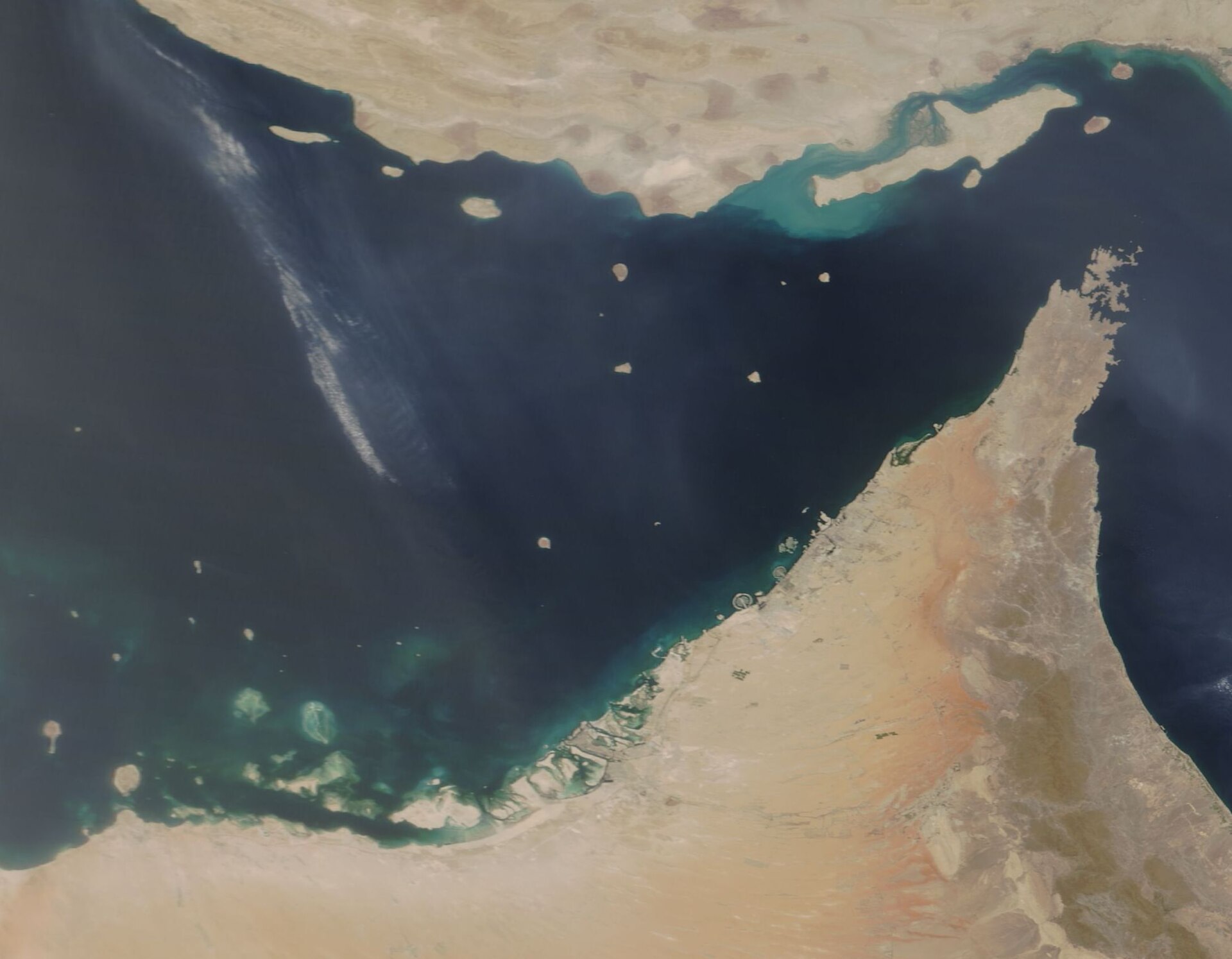

NASA MODIS satellite image of the Strait of Hormuz and UAE coastline, June 2018, showing the narrow passage between Iran and the Musandam Peninsula through which 21 million barrels of oil transited daily before the war

Iran’s Foreign Minister Declared Hormuz Open. His Own Deputy Said No Temporary Ceasefire Is Acceptable. Both Spoke on the Same Day.

Araghchi declared Hormuz 'completely open' while Khatibzadeh rejected any temporary ceasefire — on the same day. The IRGC has confirmed neither statement.

TEHRAN — At some point on April 17, 2026, Iran’s foreign minister posted a statement to X declaring the Strait of Hormuz “completely open for the remaining period of ceasefire.” At roughly the same time, on the sidelines of the Antalya Diplomacy Forum in Turkey, his own deputy foreign minister told reporters that Iran was “not accepting any temporary ceasefire” and demanded that every active battleground from Lebanon to the Red Sea be resolved simultaneously. Markets moved: the S&P 500 gained, Brent crude fell toward $94–95. Two vessels had transited Hormuz the day before.

Conflict Pulse IRAN–US WAR
Live conflict timeline
Day
49
since Feb 28
Casualties
13,260+
5 nations
Brent Crude ● LIVE
$113
▲ 57% from $72
Hormuz Strait
RESTRICTED
94% traffic drop
Ships Hit
16
since Day 1

These are not competing interpretations of a single policy. They are competing policies, issued by officials within the same ministry, on the same day, about the same waterway — and neither official controls the military force that actually governs passage through the strait. The contradiction between Foreign Minister Seyed Abbas Araghchi and Deputy Foreign Minister Saeed Khatibzadeh is not a messaging failure or a breakdown in coordination. It is a surface-level expression of the institutional fracture that has defined Iran’s war posture since late February: the foreign ministry can declare, but the Islamic Revolutionary Guard Corps commands.

Markets moved on Araghchi’s words as though words were policy. The question is whether anyone in Tehran has the authority to turn his declaration into a navigable reality before the ceasefire expires in five days — and whether Khatibzadeh’s simultaneous rejection means the hardliner faction has already decided the answer is no.

NASA MODIS satellite image of the Persian Gulf and Strait of Hormuz, March 2021, showing the Qeshm-Larak corridor designated by the IRGC as the mandatory transit route for commercial vessels
The Persian Gulf and the Strait of Hormuz in March 2021 — the strait narrows to 21 nautical miles at its tightest point between Iran (top) and Oman’s Musandam Peninsula (right). Iran’s IRGC has designated a 5nm Qeshm-Larak corridor inside Iranian territorial waters as the mandatory commercial transit route, replacing the international Traffic Separation Scheme. Araghchi’s April 17 declaration of “complete openness” applies only to this IRGC-controlled lane. Photo: NASA / Public Domain

What Did Araghchi Actually Declare — and What Did He Leave Out?

Araghchi’s exact language deserves close reading, because it contains its own expiration date. “In line with the ceasefire in Lebanon,” he wrote, “the passage for all commercial vessels through Strait of Hormuz is declared completely open for the remaining period of ceasefire, on the coordinated route as already announced by Ports and Maritime Organisation of the Islamic Rep. of Iran.” The statement is conditional three times over: it is linked to a Lebanon ceasefire that began at 5 p.m. on April 17 and lasts ten days; it applies only on the “coordinated route,” which is the 5-nautical-mile IRGC-controlled corridor between Qeshm and Larak islands inside Iranian territorial waters; and it defers to the Ports and Maritime Organisation, which has no authority over IRGC Navy operations in the strait.

The Lebanon ceasefire is itself a fragile instrument — a 10-day Israeli-Hezbollah truce brokered under separate diplomatic architecture from the Iran-US ceasefire that expires on April 22. By tethering Hormuz to Lebanon, Araghchi created a nested conditionality: the strait stays open only as long as a ceasefire in a different theater holds, on a timeline that does not align with the Iran-US framework, through a corridor that the IRGC — not the foreign ministry — physically controls. If the Lebanon truce collapses on day three, Araghchi’s Hormuz declaration collapses with it. If the Iran-US ceasefire expires on April 22 without extension, the declaration becomes moot regardless of Lebanon.

What Araghchi conspicuously did not say is that the IRGC Navy had endorsed, confirmed, or operationalized his statement. He did not cite any military order. He did not name the IRGC Navy commander — because there is no named successor to Alireza Tangsiri, killed on March 30 — and he did not address the $2 million transit fee that the IRGC extracted from the first non-Iranian vessel to transit the strait on April 9. The Ports and Maritime Organisation, which Araghchi invoked as the implementing authority, is a civilian body. The guns in the strait belong to the Revolutionary Guards.

The HOS Daily Brief

The Middle East briefing 3,000+ readers start their day with.

One email. Every weekday morning. Free.
Iranian Foreign Minister Abbas Araghchi at a diplomatic meeting, the Iranian diplomat who declared the Strait of Hormuz completely open on April 17 2026 while his deputy simultaneously rejected any temporary ceasefire framework
Iranian Foreign Minister Seyed Abbas Araghchi (centre, in white collar), pictured at a diplomatic meeting. On April 17, 2026, Araghchi declared the Strait of Hormuz “completely open for the remaining period of ceasefire” — while his deputy Khatibzadeh simultaneously told reporters at the Antalya Diplomacy Forum that Iran “is not accepting any temporary ceasefire.” The contradiction maps directly onto the institutional fracture between Iran’s civilian foreign ministry and the IRGC. Photo: Presidential Executive Office / CC BY 4.0

Why Did Khatibzadeh Reject the Framework His Own Minister Just Endorsed?

Khatibzadeh’s statement at the Antalya Diplomacy Forum was unambiguous and structurally incompatible with Araghchi’s declaration. “We are not accepting any temporary ceasefire,” he told reporters, demanding that every active battleground “from Lebanon to the Red Sea” be included in a comprehensive resolution that would end the conflict “once and for all.” This is not a nuance or a different emphasis. It is a direct contradiction: Araghchi offered a time-limited tactical opening keyed to a temporary Lebanon truce; Khatibzadeh rejected any temporary framework as a category.

The venue matters. The Antalya Diplomacy Forum is a Turkish-hosted multilateral event — 150 countries, approximately 500 officials — and Khatibzadeh’s statement was delivered to press on the sidelines, not inside a formal negotiating session. This suggests the statement was directed at a domestic audience: the hardliner constituency centered on Ahmad Vahidi, the IRGC’s de facto commander-in-chief who has systematically blocked Araghchi’s diplomatic efforts since the Islamabad talks. Vahidi explicitly sought to curb Araghchi’s authority before those talks, pushed for Mohammad Bagher Zolghadr’s inclusion on the delegation, and insisted the team refuse to negotiate on Iran’s missile program. When President Pezeshkian publicly accused Vahidi and Ali Abdollahi of steering Iran toward “a huge catastrophe” on April 4, he was naming the same institutional fault line that Khatibzadeh’s statement traces.

Khatibzadeh’s position echoes what Tasnim News Agency — the IRGC’s media arm — published on the same day: that Tehran had “forced the criminal America to accept its 10-point plan, in which the United States is committed in principle to guaranteeing non-aggression, continuing Iranian control over the Strait of Hormuz.” The phrase “continuing Iranian control” is the operative signal. It does not describe an open strait. It describes an IRGC-managed waterway in which passage is a privilege granted by the Revolutionary Guards, not a right guaranteed by the foreign minister. The Foundation for Defense of Democracies identified this power structure in its April 6 analysis naming “5 men running Iran” — Vahidi, Zolghadr, Rezaei, Ghalibaf, and Mojtaba Khamenei — a list from which both Araghchi and Pezeshkian are explicitly absent.

The question is not whether Khatibzadeh freelanced. A deputy foreign minister does not contradict his own minister’s same-day public declaration without authorization from someone more powerful than the minister. The question is who authorized the contradiction — and the answer maps directly onto the authorization ceiling that has governed every Iranian negotiating position since the war began.

The IRGC Has Not Confirmed Araghchi’s Declaration. What Does That Silence Mean?

As of April 17, the IRGC Navy has issued no statement confirming, endorsing, or operationalizing Araghchi’s declaration that Hormuz is “completely open.” The last public IRGC Navy statement on Hormuz governance came on April 10, when it declared “full authority to manage the Strait” — while Araghchi was in Islamabad negotiating. On April 5, PressTV published an IRGC Navy declaration that “the Strait of Hormuz will never return to previous status, especially for US and Israel.” Neither statement has been updated, walked back, or superseded.

This silence is not ambiguity. It is operational language. When the IRGC published a navigation chart on April 9 declaring standard shipping lanes a “danger zone” and redirecting vessels into the Qeshm-Larak corridor, that was an act of enforcement. When the IRGC Navy boarded the MSG — a Gabon-flagged tanker carrying 7,000 tonnes of Emirati fuel oil — on April 9, extracted approximately $2 million, and then declared at 21:26 UTC that “the management of the Strait of Hormuz has entered a new phase,” that was an act of institutional assertion. The IRGC does not need to contradict Araghchi verbally. Its operational posture contradicts him structurally.

The enforcement architecture tells the story more precisely than any statement. Iran International reported on April 16 that Zolghadr’s Hormuz revenue committee had issued approximately 60 permits, sent payment requests for only 8 shipments, and collected zero funds. The IRGC’s toll infrastructure — the mechanism through which it asserts sovereign management of the strait — is administratively non-functional. It cannot process payments. It cannot coordinate transit at scale. And it answers to the SNSC and the Supreme Leader’s office, not to the foreign ministry. Under Article 176 of Iran’s constitution, all SNSC decisions require Supreme Leader ratification to become effective. Mojtaba Khamenei — who has exercised his father’s functions since the elder Khamenei’s incapacitation — has been absent from public view for more than 44 days. The ratification mechanism is inoperative.

Former Iranian parliamentarian Ali Akbar Mousavi Khoeini, now at George Mason University, put it without diplomatic hedging in an NBC News interview in April: “Vahidi is in charge of the country… the power is in the hands of the Revolutionary Guard and the most radical faction.” Gustavo de Arístegui, the former Spanish diplomat and analyst, assessed the probability of the ceasefire holding through late April at 42% in an April 6 analysis for Atalayar, and offered the structural diagnosis: “There is no one on the Iranian side with both the will to strike a deal and the power to authorise it.” Araghchi has the will. The IRGC has the power. April 17 proved they are not coordinating.

IRGC Navy missile boats and fast attack craft lined up at commissioning ceremony, March 2023 — the force that physically controls the Strait of Hormuz and has not endorsed Foreign Minister Araghchi's declaration of the strait as completely open
IRGC Navy fast-attack missile boats at their March 2023 commissioning ceremony — including the flagship Shahid Nader Mahdavi and 95 light missile craft. It is these vessels, not the foreign ministry, that physically govern passage through Hormuz. As of April 17, 2026, the IRGC Navy has issued no statement confirming, endorsing, or operationalizing Araghchi’s “completely open” declaration. Its last public statement, issued April 10, claimed “full authority to manage the Strait.” Photo: IRGC / CC BY 4.0

Markets Priced In an Opening Before a Single Vessel Moved. Where Is the Gap?

The market reaction to Araghchi’s declaration was immediate and significant. The S&P 500 climbed 1% to close at 6,886; the Dow gained 302 points; the Nasdaq rose 1.2%. Brent crude, which had traded near $98–99 per barrel on April 16, fell toward the $94–95 range — a drop of roughly $4–5 on a single diplomatic statement. Traders treated Araghchi’s words as a supply signal, pricing in a reopening of the world’s most critical oil chokepoint on the strength of a tweet from an official who does not command the military force that controls the chokepoint.

The operational baseline tells a different story. On April 16, the day before Araghchi’s declaration, exactly two vessels transited Hormuz. That is not a congested chokepoint gradually easing; it is a waterway under de facto military blockade with occasional supervised exceptions. The first non-Iranian vessel to transit since the war’s escalation — the MSG, on April 9 — did so only after paying the IRGC’s toll and submitting to a physical boarding. That transaction was not a market opening. It was a toll booth operated by a military organization, and the IRGC marked it as such: “The management of the Strait of Hormuz has entered a new phase.”

Trump’s reaction demonstrated the contradictions on the American side as well. He posted to Truth Social on April 17 — “IRAN HAS JUST ANNOUNCED THAT THE STRAIT OF IRAN IS FULLY OPEN AND READY FOR FULL PASSAGE. THANK YOU!” — and simultaneously maintained that the US blockade “will remain in full force” on Iranian ports “until such time as our transaction with Iran is 100% complete.” CENTCOM had turned back 13 ships as of April 16, according to CNBC. The blockade and the “opening” now coexist as parallel assertions, neither of which has been tested against the other.

The pattern has a precedent. On April 9, the ceasefire was declared and the IRGC simultaneously issued a new navigation chart designating standard shipping lanes as a danger zone. Windward Maritime documented the post-ceasefire situation as “a supervised pause,” not an opening. The April 17 pattern is a repetition: a civilian declaration of openness layered over an unchanged military posture, with markets responding to the declaration rather than the posture. The gap between the $94–95 Brent price and the two-vessel daily transit reality is not a lag. It is a mispricing of institutional authority.

ADNOC CEO Sultan Al Jaber, speaking on April 9, had already identified the structural problem: the strait was “still not open, despite the Iran war ceasefire, because Iran is restricting and conditioning traffic.” Nothing in Araghchi’s April 17 declaration addresses the restrictions Al Jaber identified. The “coordinated route” Araghchi referenced is the same IRGC-controlled corridor. The transit fee structure is unchanged. The IRGC boarding protocol is unchanged. The only thing that changed on April 17 was the adjective: “completely open” replaced “managed.” The nouns — the corridor, the fee, the IRGC authority — remained identical.

Can Saudi Export Recovery Happen Even If Araghchi’s Declaration Is Real?

Even granting the most charitable interpretation of Araghchi’s statement — that the IRGC will quietly comply, that vessels will begin transiting without boarding or tolls, that the Qeshm-Larak corridor will function as a normal shipping lane — Saudi Arabia’s export crisis does not resolve. The IEA confirmed that Saudi production in March fell to 7.25 million barrels per day, down from 10.4 million in February — a decline of 3.15 million bpd, the largest single-month disruption on record. The East-West Pipeline to Yanbu, Saudi Arabia’s bypass around Hormuz, has a structural ceiling of 4–5.9 million bpd against pre-war Hormuz throughput of 7–7.5 million bpd. That leaves a gap of 1.1–1.6 million bpd that no pipeline can fill.

The Yanbu ceiling is not an engineering problem awaiting a fix. It reflects the physical capacity of the Petroline system and the refining and loading infrastructure at the Red Sea terminal. Khurais, which produced 300,000 bpd before being taken offline, has no announced restoration timeline. The structural gap between what Saudi Arabia can export via bypass routes and what it exported through Hormuz before the war is a permanent feature of the current crisis — permanent, that is, until Hormuz actually functions as an open waterway with predictable, fee-free, unsupervised transit at pre-war volumes.

The June OSP decision looms. Around May 5 — 18 days from Araghchi’s declaration — Aramco must set pricing for June-loading crude. The May OSP for Arab Light to Asia was set at a war-premium of +$19.50 per barrel; the June OSP has already been reset to +$3.50, a $16 correction that reflects the market’s assumption of eventual normalization. But normalization requires volume, and volume requires Hormuz. If the strait remains a supervised corridor with two transits per day, the June OSP will be set against a supply picture that Araghchi’s words cannot change. Asian demand destruction from six-plus weeks of constrained supply adds a second variable: buyers who secured alternatives may not return to Saudi term contracts at pre-war volumes even when Hormuz reopens.

The OPEC+ quota framework adds a third distortion. Saudi Arabia’s April quota stands at 10.2 million bpd — approximately 3 million above its actual March output. The cartel’s production framework assumes a supply infrastructure that currently does not exist. No quota adjustment can compensate for a chokepoint that a foreign minister declares open but a military organization continues to control.

What Happens on April 22?

The ceasefire expires on April 22 — five days after Araghchi’s declaration. No extension mechanism exists. The Soufan Center has documented the procedural gap: there is no clause in any agreed framework that provides for automatic renewal, no signatory designated to authorize extension, and no process for converting the current pause into a durable arrangement. Araghchi’s Hormuz declaration is explicitly time-limited to “the remaining period of ceasefire,” which means it is self-terminating on April 22 unless the ceasefire is extended by a mechanism that does not yet exist.

Khatibzadeh’s Antalya statement forecloses extension as currently structured. His demand that the conflict end “from Lebanon to the Red Sea… once and for all” is not a negotiating position from which to build an extension; it is a precondition that makes extension impossible without a comprehensive regional deal that no party is close to achieving. Iran’s demand for simultaneous regional resolution has been the hardliner faction’s consistent position — and it has consistently functioned as a mechanism for preventing any incremental agreement.

The April 22 expiry creates a five-day window in which Araghchi’s declaration can be tested against reality. If vessels begin transiting in significant numbers — not two per day, but dozens — then the IRGC has silently acquiesced to the foreign minister’s authority, and the institutional fracture is narrower than it appears. If transit volumes remain at two per day, or if the IRGC continues to demand boarding, escort, and fees, then Araghchi’s declaration is what every previous civilian FM declaration about Hormuz has been: a statement of aspiration unmatched by enforcement capability. The market will have five days to discover which reality it has priced.

ISS Expedition 53 view of Dammam and the Ras Tanura peninsula on the Persian Gulf coast of Saudi Arabia, showing the concentration of oil loading infrastructure whose export capacity fell from 10.4 million to 7.25 million barrels per day between February and March 2026
Dammam and the Ras Tanura peninsula on Saudi Arabia’s Eastern Province coast, photographed from the International Space Station during Expedition 53. The loading infrastructure visible here represents the eastern end of Saudi Arabia’s pre-war oil export system — a system whose throughput collapsed from 10.4 million bpd (February 2026) to 7.25 million bpd (March 2026) as the war disrupted Hormuz transits. Even if Araghchi’s April 17 declaration holds through the April 22 ceasefire expiry, Saudi exports cannot recover to pre-war volumes without restoration of Khurais (300,000 bpd offline) and sustained unimpeded Hormuz transit. Photo: NASA / Public Domain

The deeper structural question extends beyond April 22. Iran’s 10-point plan, specifically Point 7, demands IRGC “coordination” over Hormuz as a treaty requirement — meaning that even a genuine, IRGC-endorsed reopening would legally require continued IRGC supervision as a matter of international agreement. Alex Vatanka of the Middle East Institute has noted that “Mojtaba [Khamenei] owes his position to the Revolutionary Guards and as such he is not going to be as supreme as his father was” — a structural assessment that applies whether the elder Khamenei recovers or not. The IRGC’s grip on Hormuz is not a wartime emergency measure. It is an institutional claim to permanent sovereign management, and Araghchi’s April 17 declaration does not challenge that claim. It operates within it, on the IRGC’s “coordinated route,” for the IRGC’s “remaining period,” using the IRGC’s corridor.

The Hajj pilgrimage begins arriving on April 18 — the day after Araghchi’s declaration — and the ceasefire’s expiry on April 22 falls four days into the arrival window for 1.2 million pilgrims. The kinetic threshold rises dramatically once Hajj is underway, which may explain the timing of Araghchi’s declaration: it is easier to declare Hormuz open when the political cost of military escalation is about to spike. But Khatibzadeh’s simultaneous rejection suggests the hardliner faction is not bound by the same Hajj calculus — or has decided that its comprehensive demands matter more than the pilgrimage calendar.

Two Iranian officials spoke on April 17 about the same waterway and said opposite things. One offered a conditional, time-limited, corridor-specific opening without military endorsement. The other rejected any temporary framework and demanded total resolution. The S&P 500 heard the first official. The IRGC has not heard from either. And in five days, the ceasefire that makes Araghchi’s declaration nominally operative will expire, leaving the strait’s status to be determined not by diplomatic statements but by the institutional balance of power between a foreign minister who cannot command and a military organization that does not negotiate.


Frequently Asked Questions

Has any major oil tanker transited Hormuz since Araghchi’s April 17 declaration?

As of the declaration date, no VLCC or Suezmax-class tanker has transited the strait under the terms Araghchi described. The only confirmed non-Iranian commercial transit since the war’s escalation was the MSG, a Gabon-flagged vessel carrying just 7,000 tonnes of Emirati fuel oil — roughly 2% of a VLCC’s capacity — which transited on April 9 after paying the IRGC approximately $2 million and submitting to a boarding party. Lloyd’s of London war-risk premiums for Hormuz transit have not moved since the declaration, meaning insurers have not repriced the strait as “completely open” regardless of Araghchi’s language.

Who is Saeed Khatibzadeh and what is his relationship to the IRGC?

Khatibzadeh served as Iran’s foreign ministry spokesman from 2020 to 2023 before being elevated to deputy foreign minister. His career has been entirely within the civilian diplomatic apparatus, not the IRGC. However, his April 17 statement at Antalya aligned precisely with the hardliner position articulated by Vahidi and the SNSC faction, suggesting he was delivering a message authorized by figures above Araghchi in the actual power hierarchy. His previous role as spokesman makes him a practiced conduit for institutional messaging — and the choice to have a civilian diplomat deliver the hardliner position at an international forum, rather than an IRGC figure, provides deniability: Tehran can claim its diplomatic corps is unified while its deputy FM publicly contradicts its FM.

What is the “coordinated route” Araghchi referenced?

The “coordinated route” refers to the approximately 5-nautical-mile corridor between Qeshm and Larak islands, inside Iranian territorial waters, which the IRGC Navy designated as the mandatory transit lane after declaring standard shipping lanes a “danger zone” in early April. Pre-war, commercial vessels used the internationally recognized Traffic Separation Scheme (TSS), which runs through Omani as well as Iranian waters and is approximately 10 nautical miles wide. The IRGC’s corridor is half the width, entirely within Iranian jurisdiction, and has historically required IRGC clearance codes and escort boats — infrastructure that Araghchi’s foreign ministry does not control and cannot order deployed or withdrawn.

Could the Lebanon ceasefire outlast the Iran-US ceasefire, creating a paradox for Hormuz?

Yes, and this is an underexamined structural risk. The Lebanon ceasefire is a 10-day truce starting April 17, extending to approximately April 27. The Iran-US ceasefire expires April 22. This creates a five-day window (April 22–27) during which the Lebanon ceasefire would still be active but the Iran-US ceasefire would have expired. Under Araghchi’s literal language — “for the remaining period of ceasefire” — it is ambiguous which ceasefire he means. If he meant the Lebanon ceasefire, Hormuz could theoretically remain “declared open” for five days after the Iran-US framework collapses, creating a legal and operational paradox in which the strait is nominally open while the broader conflict has resumed.

What would a genuine Hormuz reopening look like operationally?

A genuine reopening would require several observable indicators currently absent: IRGC Navy issuance of a formal order reinstating the standard Traffic Separation Scheme (not the restricted Qeshm-Larak corridor); withdrawal of IRGC naval assets from boarding and escort positions; cancellation of the transit fee structure; resumption of AIS transponder signals from commercial vessels (many went dark in the corridor for fear of IRGC tracking); and Lloyd’s of London reducing war-risk premiums from the current 2.5–3% of hull value to pre-war levels of approximately 0.1%. None of these indicators were present on April 17. Shipping industry analysts at Windward Maritime and Kpler have established that meaningful reopening would be visible in vessel count data within 48–72 hours — providing a clear empirical test of Araghchi’s declaration by April 19–20.

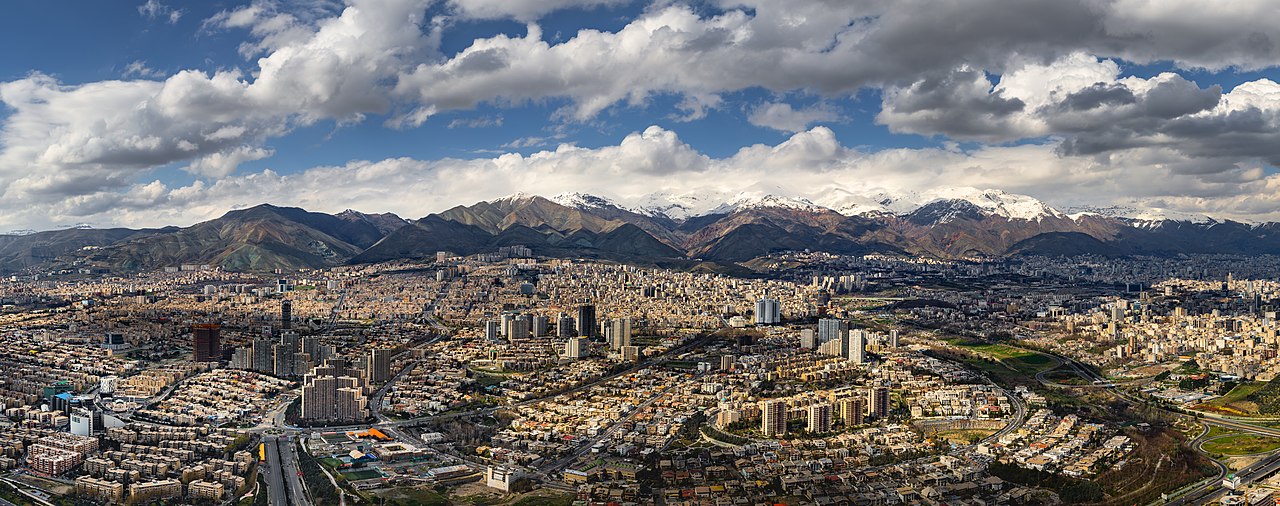
Tehran northern panorama viewed from Milad Tower, with the snow-capped Alborz mountains behind the city skyline
Previous Story

Iran Demands Simultaneous Regional Ceasefire, Blocking US Sequenced Approach

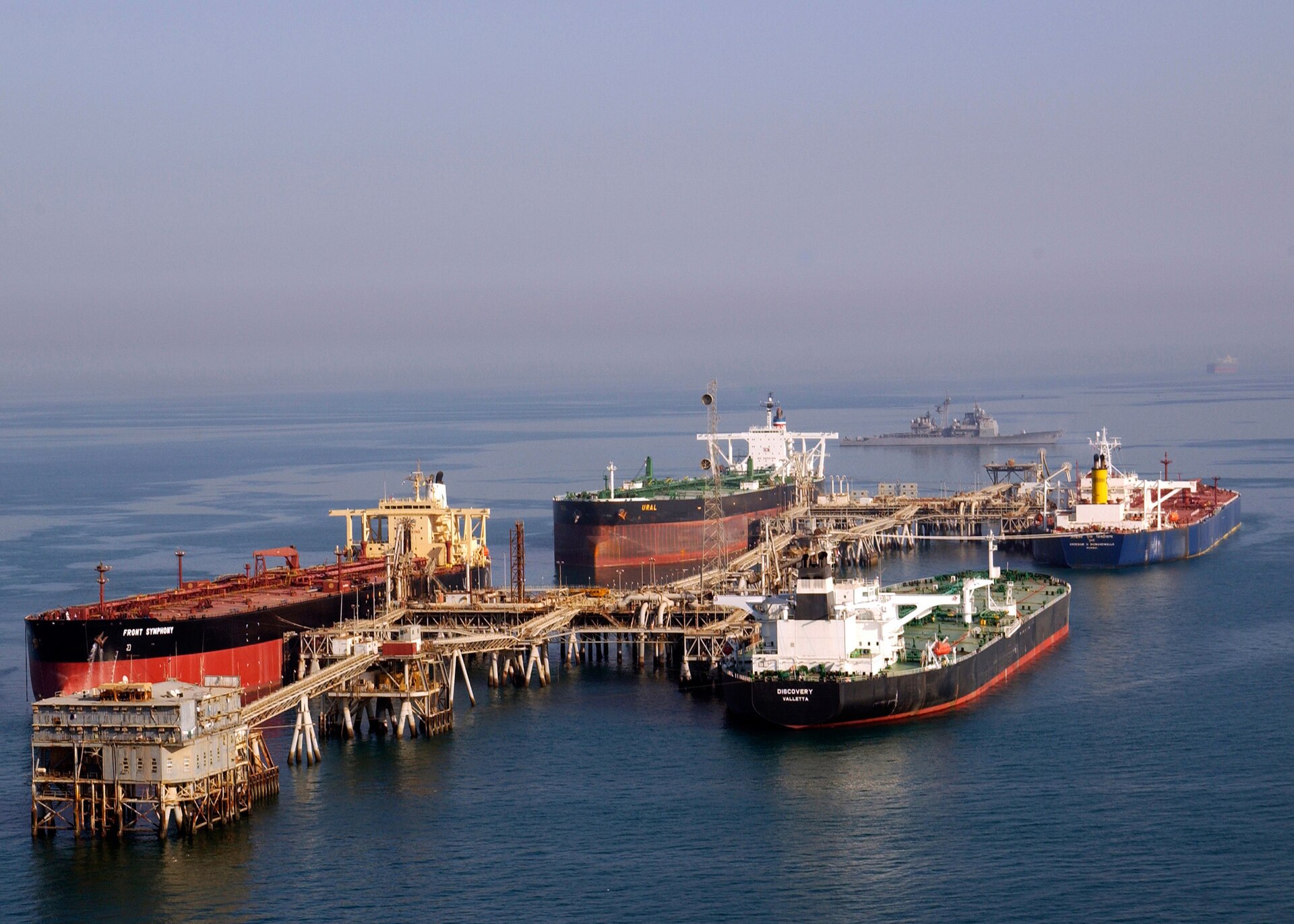
Multiple VLCC supertankers loading crude oil at an offshore terminal in the Northern Persian Gulf
Next Story

Saudi Oil Revenue Math Collapses as Brent Crashes 11% on Hormuz Opening

Latest from Diplomacy & Geopolitics

The HOS Daily Brief

The Middle East briefing 3,000+ readers start their day with.

One email. Every weekday morning. Free.
Something went wrong. Please try again.